Alpha-Gal Syndrome: History and Discovery
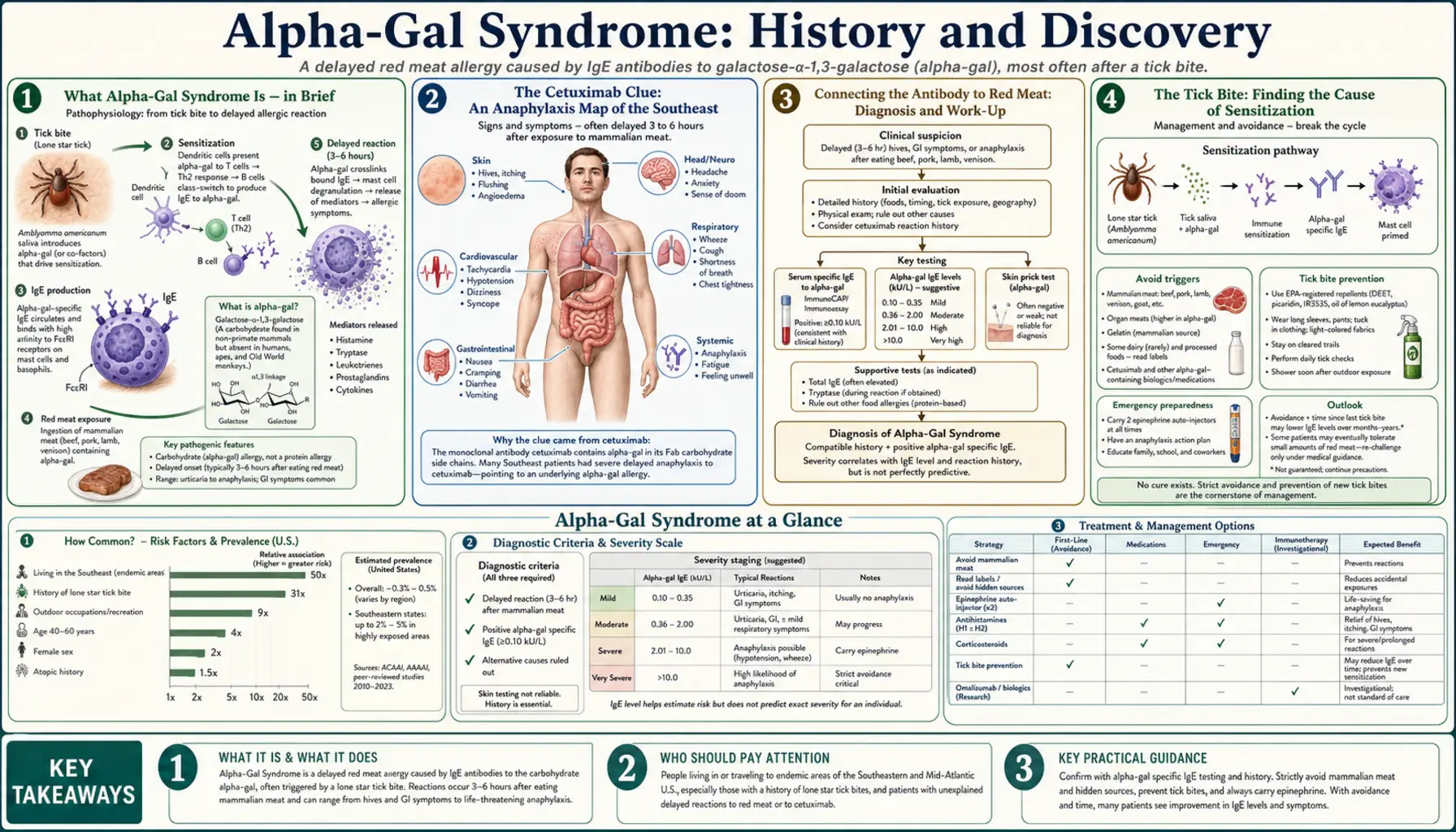
Alpha-gal syndrome (AGS) is one of the most surprising discoveries in modern allergy: a delayed allergic reaction to red (mammalian) meat that is set off not by anything in the food itself but by the bite of a tick. The culprit is a sugar — galactose-alpha-1,3-galactose, nicknamed "alpha-gal" found in beef, pork, lamb, and other mammal products but absent from humans, fish, and poultry. The story began in the mid-2000s when an anti-cancer antibody drug, cetuximab, caused unexplained anaphylaxis clustered in the southeastern United States. Following that clue, Thomas Platts-Mills, Scott Commins, and colleagues at the University of Virginia traced the reactions to pre-existing IgE antibodies against alpha-gal, then connected the same antibodies to a delayed (typically three-to-six-hour) reaction to mammalian meat, and finally linked the underlying sensitization to bites from the Lone Star tick. Reported around 2009, AGS became the first recognized food allergy to a carbohydrate rather than a protein, and the first food allergy known to be triggered by a tick bite — a genuinely new disease, discovered in living memory.
Table of Contents
- What Alpha-Gal Syndrome Is — in Brief
- The Cetuximab Clue: An Anaphylaxis Map of the Southeast
- Connecting the Antibody to Red Meat
- The Tick Bite: Finding the Cause of Sensitization
- Why the Delay? A Reaction Unlike Any Other Food Allergy
- Parallel Discovery in Australia
- Two Genuine "Firsts" in the History of Allergy
- A Disease That Can Fade — and Spread
- From Curiosity to Recognized Public-Health Concern
- Key Research Papers
- Connections
- Featured Videos
What Alpha-Gal Syndrome Is — in Brief
Alpha-gal syndrome is an allergy to a sugar molecule called galactose-alpha-1,3-galactose ("alpha-gal"). This carbohydrate is present in the tissues of most non-primate mammals — cattle, pigs, sheep, deer, rabbit, goat — and therefore in the meat, organs, gelatin, and dairy derived from them. Humans, apes, and Old World monkeys lost the ability to make alpha-gal millions of years ago, which is precisely why the human immune system can learn to treat it as foreign. Fish and poultry do not contain it, so people with AGS typically tolerate chicken, turkey, and seafood.
What makes AGS so unusual, and what delayed its discovery for so long, is the timing of the reaction. Classic food allergies — to peanut, shellfish, or egg — strike within minutes because they target proteins that the immune system recognizes almost instantly. In alpha-gal syndrome the reaction is delayed, usually appearing three to six hours after a meal of mammalian meat, with hives, swelling, gastrointestinal distress, or full anaphylaxis arriving in the middle of the night long after dinner. For decades this delay hid the connection: neither patients nor doctors readily linked a 2 a.m. emergency to a hamburger eaten at 7 p.m.
The other defining feature is the cause. A person is not born with this allergy and does not develop it from eating meat. Instead, the immune system is "taught" to react to alpha-gal by the bite of a tick whose saliva contains the same sugar. This page tells the story of how that improbable chain — tick to sugar to red meat — was pieced together, and why the result counts as the discovery of a brand-new human disease.
The Cetuximab Clue: An Anaphylaxis Map of the Southeast
The trail did not begin with meat at all. It began with a cancer drug. Cetuximab (brand name Erbitux) is a monoclonal-antibody therapy used for colorectal and head-and-neck cancers. When it entered wide use in the mid-2000s, oncologists noticed something strange: a small but significant fraction of patients suffered severe, sometimes life-threatening anaphylaxis on their very first infusion — before the drug had ever been given a chance to "sensitize" them in the usual way. Stranger still, these reactions were not scattered evenly across the country. They were geographically clustered in the southeastern United States, with much higher rates in states such as Tennessee, North Carolina, and Arkansas than in the Northeast or West.
In 2008, a team that included Christine Chung, Beloo Mirakhur, and Thomas Platts-Mills published the explanation in the New England Journal of Medicine. They found that patients who reacted to cetuximab already carried, before treatment, IgE antibodies directed against galactose-alpha-1,3-galactose — and that cetuximab itself carries alpha-gal sugars on part of its antibody structure, because it is produced in a mouse-derived cell line. In other words, the immune systems of these patients had been primed to attack alpha-gal long before they ever received the drug. The reaction to cetuximab was simply the first time that pre-existing army of antibodies met its target in the bloodstream.
This finding raised an obvious and urgent question. If people in the rural Southeast were walking around with high levels of anti-alpha-gal IgE before any cetuximab exposure, where had that sensitization come from — and what else might it cause? The geographic pattern was the first real clue, and it pointed researchers toward something in the environment of the American South.
Connecting the Antibody to Red Meat
At the same time, allergists at the University of Virginia — chiefly Scott Commins and Thomas Platts-Mills — were puzzling over a separate group of patients. These people described a baffling pattern of severe allergic reactions, including anaphylaxis, that seemed to follow meals but defied the rules of ordinary food allergy. The reactions came hours later, not minutes; they followed beef, pork, or lamb but never chicken, turkey, or fish; and standard allergy testing often came back unremarkable for the usual meat-protein allergens.
The breakthrough was recognizing that these meat-reactive patients carried the very same antibody — IgE specific for alpha-gal — that the cetuximab work had just put on the map. Mammalian meat is rich in alpha-gal; poultry and fish are not. The pattern of "reacts to mammals, tolerates birds and fish" fit the sugar perfectly. In 2009, Commins, Platts-Mills, and colleagues reported this novel form of delayed anaphylaxis to red meat driven by anti-alpha-gal IgE in the Journal of Allergy and Clinical Immunology, describing both the clinical syndrome and the antibody that explained it. For the first time, a food allergy had been pinned not to a protein but to a carbohydrate.
That single insight unified two seemingly unrelated phenomena — an anaphylactic reaction to a cancer drug and a delayed reaction to a steak — under one molecular cause. But it deepened the central mystery rather than solving it. Why did so many people in the rural Southeast carry antibodies to a sugar found in red meat? Eating meat does not normally provoke such antibodies; if it did, half the planet would be allergic to beef. Something else had to be doing the sensitizing.
The Tick Bite: Finding the Cause of Sensitization
The final piece arrived partly through detective work and partly through the senior investigator's own misfortune. The geographic footprint of high anti-alpha-gal IgE overlapped strikingly with the range of the Lone Star tick (Amblyomma americanum), an aggressive biter abundant across the southeastern and south-central United States, named for the single white dot on the back of the adult female. Researchers also noticed that affected patients frequently reported lots of tick bites, and that anti-alpha-gal antibody levels seemed to rise after bites.
Platts-Mills himself became, in effect, a case study. After hiking, he developed intensely itchy bites — later identified as the bites of larval Lone Star ticks — and subsequently watched his own anti-alpha-gal IgE climb, eventually reacting to mammalian meat himself. When the team systematically asked their meat-allergic patients about tick exposure, the great majority — by the published account, more than ninety percent — reported a history of tick bites, often describing bites that itched for weeks. In 2011, Commins, Platts-Mills, and colleagues reported in the Journal of Allergy and Clinical Immunology that tick bites were central to the production of anti-alpha-gal IgE, identifying the Lone Star tick as the key driver of sensitization in the United States.
The mechanism is elegant and slightly unsettling: when a tick that has previously fed on a mammal bites a human, its saliva introduces alpha-gal sugar directly into the skin, where the immune system — primed by the inflammatory, immune-activating properties of tick saliva — learns to mount an IgE (allergic) response against it. From then on, the same person can react to alpha-gal whenever it next appears, whether in a slice of roast beef or in a dose of cetuximab. The chain was complete: tick bite → anti-alpha-gal IgE → delayed allergy to mammalian meat.
Why the Delay? A Reaction Unlike Any Other Food Allergy
The hallmark three-to-six-hour delay is not just a clinical curiosity; it was the single biggest reason the disease went unrecognized for so long, and explaining it is part of what made the discovery so compelling. Most food allergens are proteins that are absorbed and presented to the immune system quickly, producing symptoms within minutes. Alpha-gal is a sugar carried mainly on fats and fat-associated molecules in meat. These have to be digested and processed, and the alpha-gal-bearing particles only enter the bloodstream hours after the meal — which is when the waiting IgE antibodies finally encounter their target and trigger the reaction.
This delay had real human consequences before the syndrome was understood. People would wake in the night with hives, swelling, vomiting, or collapse and have no idea why; emergency physicians, finding no recent "exposure," would record idiopathic (cause-unknown) anaphylaxis. Many patients carried the diagnosis for years. Part of the lasting value of the UVA discovery was simply giving these episodes a name and an explanation — allowing a clinician to ask the previously unthinkable question: Did you eat red meat several hours before this happened, and do you live where ticks are common?
Recognizing the delay also reshaped how AGS is diagnosed. Because skin-prick tests with commercial meat extracts are often weak or negative, diagnosis relies on a specific blood test for IgE to alpha-gal, combined with a compatible history. The companion Testing and Diagnosis article covers that workup in detail; here the point is historical — the unusual timing was both the obstacle that hid the disease and, once understood, the key that revealed it.
Parallel Discovery in Australia
The American story was not the only thread. On the other side of the world, the Australian clinical immunologist Sheryl van Nunen was independently working out a strikingly similar puzzle. Practicing on the tick-prone northern beaches of Sydney, she observed a cluster of patients who had developed allergic reactions to red meat after being bitten by the local paralysis tick (Ixodes holocyclus). Van Nunen presented and published her observations of mammalian-meat allergy following tick bites around 2007–2009, arriving at the central tick-and-meat connection from a different continent, a different tick species, and a different patient population.
This independent, near-simultaneous discovery is one of the most scientifically persuasive features of the alpha-gal story. When two research groups, oceans apart and working without knowledge of each other's cases, converge on the same unlikely conclusion — that a tick bite can make a person allergic to mammal meat — the conclusion becomes very hard to dismiss as coincidence or local quirk. It showed that AGS was not a peculiarity of one American region but a genuine, reproducible biological phenomenon wherever the right ticks and the right exposures coincide.
Since then, tick-associated alpha-gal sensitization has been recognized on multiple continents, linked to a range of tick species beyond the Lone Star tick and the Australian paralysis tick — in Europe, Asia, Central America, southern Africa, and elsewhere. The names of the ticks differ, but the underlying mechanism that Commins, Platts-Mills, and van Nunen uncovered is the same.
Two Genuine "Firsts" in the History of Allergy
Alpha-gal syndrome earned its place in textbooks because it broke two long-standing assumptions at once. The first concerns the chemistry of allergens. Before AGS, the working rule was that IgE-mediated food allergies are reactions to proteins — peanut proteins, shellfish tropomyosin, milk casein, egg ovalbumin. Carbohydrates were generally regarded as, at most, minor cross-reacting nuisances incapable of causing serious clinical allergy on their own. Alpha-gal overturned that: it is a sugar that, by itself, can drive full-blown anaphylaxis. AGS is widely described as the first food allergy in which the responsible allergen is a carbohydrate rather than a protein.
The second assumption concerns cause. Food allergies were understood to be established through the gut or, in some cases, the skin — through exposure to the food (or a related substance) itself. The idea that an insect or arachnid bite could be the sensitizing event for a food allergy — that something biting your leg in the woods could change what you can safely eat for dinner — had no real precedent. AGS is the first recognized food allergy known to be caused by a tick bite, forging an entirely new link between vector-borne exposure and food allergy.
Together these two firsts are why the discovery is fairly called the identification of a new disease rather than merely a new variant of an old one. It expanded the very definition of how a food allergy can arise — what can act as an allergen, and what can act as the trigger — and it did so on the strength of careful clinical observation, antibody science, and a willingness to follow an improbable geographic clue to its source.
A Disease That Can Fade — and Spread
Another feature that sets alpha-gal syndrome apart from most food allergies is that it is not necessarily permanent. Because the allergy is sustained by ongoing tick exposure, many people find that their anti-alpha-gal IgE levels fall — and their tolerance for mammalian meat gradually returns — if they manage to avoid further tick bites over time. Reported recoveries span a wide range, on the order of roughly eight months to several years of bite-free living. Each new tick bite, by contrast, can re-boost the antibody level and set tolerance back, which is why scrupulous tick-bite prevention is central to long-term management. The practical strategies for that are covered in the companion Tick-Bite Prevention and Mammalian Foods to Avoid articles.
At the same time, the footprint of the disease appears to be widening rather than shrinking. As tick populations expand their geographic range and grow denser — shifts that researchers link partly to changing climate, land use, and deer populations — the territory in which people can acquire alpha-gal sensitization is enlarging. Public-health surveillance in the United States has documented a substantial and rising number of suspected cases and anti-alpha-gal antibody tests in recent years, along with the recognition that the condition is widely underdiagnosed because so many clinicians remain unfamiliar with it.
This combination — individually reversible yet collectively spreading — gives AGS an unusual public-health profile. Avoiding bites can return a single patient to a normal diet, while the population of people at risk keeps growing as the ticks advance. It is a disease whose history is still being written.
From Curiosity to Recognized Public-Health Concern
In the span of a single decade, alpha-gal syndrome went from an unexplained scattering of cetuximab reactions to a named, mechanistically understood, internationally recognized condition. The arc is a textbook example of how modern medical discovery actually works: an anomaly noticed in a clinical trial; a geographic pattern that demanded explanation; an antibody that tied disparate cases together; a parallel discovery abroad that confirmed the idea; and, finally, public-health systems catching up to track a condition that had been hiding in plain sight as "idiopathic" anaphylaxis.
The discovery also carries a broader scientific lesson. The team did not set out to find a meat allergy; they followed a drug reaction wherever the evidence led, and were willing to entertain a hypothesis — that a tick bite could rewire what a person can eat — that would have sounded implausible only a few years earlier. The fact that the senior investigator was himself bitten and sensitized, turning a researcher into a patient, is a memorable reminder that the natural experiment was unfolding in the same woods where the science was being done.
Today alpha-gal syndrome is taught as a model of carbohydrate-driven allergy and of vector-induced food allergy, and it has reframed how allergists think about "unexplained" anaphylaxis, especially in tick-endemic regions. For the patient, the practical meaning of all this history is concrete and hopeful: a once-mysterious, frightening, recurrent illness now has a name, a blood test, a clear set of avoidance strategies, and the real possibility of improvement over time. The remaining clinical detail — testing, cross-reactive medications, emergency planning, and diet — is taken up across the linked companion articles on this site.
Key Research Papers
The references below combine the landmark peer-reviewed papers that established alpha-gal syndrome with curated PubMed topic-search links into the broader literature. The foundational discovery papers are cited with their journal details and identifiers where confirmed; topic-search links open at PubMed (National Library of Medicine). Each external link opens in a new tab.
- Chung CH, Mirakhur B, Chan E, Le QT, Berlin J, Morse M, Murphy BA, Satinover SM, Hosen J, Mauro D, Slebos RJ, Zhou Q, Gold D, Hatley T, Hicklin DJ, Platts-Mills TAE. Cetuximab-induced anaphylaxis and IgE specific for galactose-alpha-1,3-galactose. New England Journal of Medicine. 2008;358(11):1109-1117. — doi:10.1056/NEJMoa074943
- Commins SP, Satinover SM, Hosen J, Mozena J, Borish L, Lewis BD, Woodfolk JA, Platts-Mills TAE. Delayed anaphylaxis, angioedema, or urticaria after consumption of red meat in patients with IgE antibodies specific for galactose-alpha-1,3-galactose. Journal of Allergy and Clinical Immunology. 2009;123(2):426-433. — doi:10.1016/j.jaci.2008.10.052
- Commins SP, Platts-Mills TAE. Anaphylaxis syndromes related to a new mammalian cross-reactive carbohydrate determinant. Journal of Allergy and Clinical Immunology. 2009;124(4):652-657. — doi:10.1016/j.jaci.2009.08.026
- Commins SP, James HR, Kelly LA, Pochan SL, Workman LJ, Perzanowski MS, Kocan KM, Fahy JV, Nganga LW, Ronmark E, Cooper PJ, Platts-Mills TAE. The relevance of tick bites to the production of IgE antibodies to the mammalian oligosaccharide galactose-alpha-1,3-galactose. Journal of Allergy and Clinical Immunology. 2011;127(5):1286-1293. — doi:10.1016/j.jaci.2011.02.019
- Van Nunen SA, O'Connor KS, Clarke LR, Boyle RX, Fernando SL. An association between tick bite reactions and red meat allergy in humans. Medical Journal of Australia. 2009;190(9):510-511. — doi:10.5694/j.1326-5377.2009.tb02533.x
- Platts-Mills TAE, Schuyler AJ, Tripathi A, Commins SP. Anaphylaxis to the carbohydrate side chain alpha-gal. Immunology and Allergy Clinics of North America. 2015;35(2):247-260. — doi:10.1016/j.iac.2015.01.009
- Commins SP, Platts-Mills TAE. Tick bites and red meat allergy. Current Opinion in Allergy and Clinical Immunology. 2013;13(4):354-359. — doi:10.1097/ACI.0b013e3283624560
- Steinke JW, Platts-Mills TAE, Commins SP. The alpha-gal story: lessons learned from connecting the dots. Journal of Allergy and Clinical Immunology. 2015;135(3):589-596. — doi:10.1016/j.jaci.2014.12.1947
- Alpha-gal syndrome — discovery and history (Platts-Mills, Commins, University of Virginia) — PubMed: alpha-gal syndrome history
- Galactose-alpha-1,3-galactose and delayed mammalian-meat anaphylaxis — PubMed: alpha-gal delayed red-meat anaphylaxis
- Lone Star tick (Amblyomma americanum) and alpha-gal sensitization — PubMed: Lone Star tick alpha-gal sensitization
- Tick bites and the production of IgE to alpha-gal across tick species — PubMed: tick bites and anti-alpha-gal IgE
- Waning of alpha-gal allergy with avoidance of tick bites — PubMed: alpha-gal allergy resolution over time
- Epidemiology and rising recognition of alpha-gal syndrome — PubMed: alpha-gal syndrome epidemiology
External Authoritative Resources
Connections
- Pain & Allergy
- Alpha-Gal Syndrome (Main Page)
- How a Tick Bite Causes the Allergy
- Alpha-Gal Testing and Diagnosis
- Tick-Bite Prevention
- Lyme Disease (Tick-Borne)
- Allergies
- Food Intolerance
- All Conditions