⚠ Evidence warning: Clinical trials or other evidence do not support the claims that a stable baseline drops flare frequency by 50 to 80 percent, that one bad night raises mast cell activation, that treating sleep apnea lowers it, and that most vaccines trigger flares. This page keeps it as a report of what people, websites or other media say.
Mast Cell Activation Syndrome (MCAS) Triggers and Flare Management
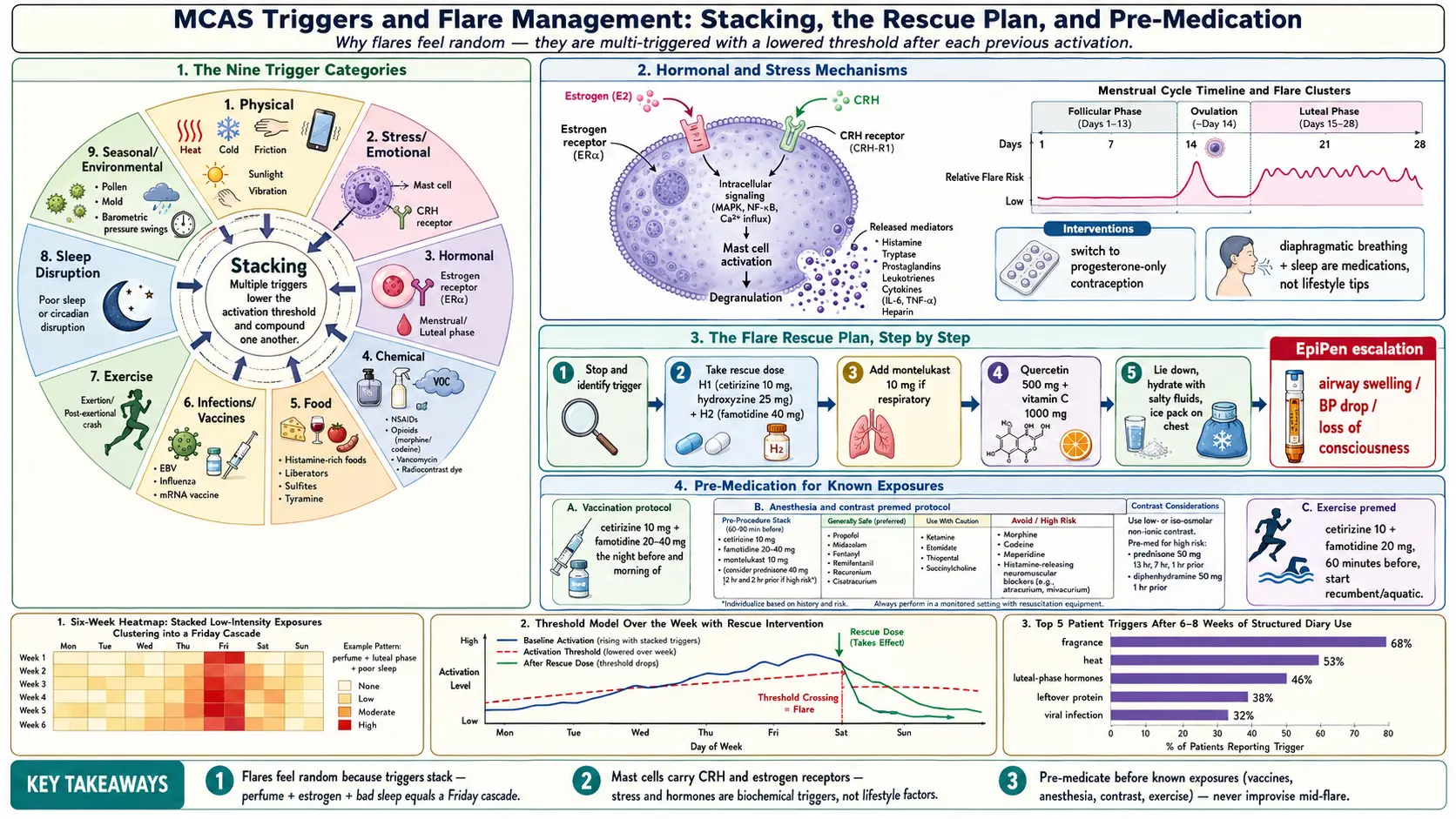
Table of Contents
- Why Triggers Look Random
- Categories of Mast Cell Activation Syndrome Triggers
- Physical Triggers
- Stress & Emotional Triggers
- Hormonal Triggers
- Chemical Triggers
- Food & Drink Triggers
- Infections & Vaccines
- Exercise Triggers
- Sleep Disruption as a Trigger
- How a Trigger Diary Is Built
- The Flare Rescue Plan People Describe
- When an Epinephrine Auto-Injector Is Used
- Pre-Medication Strategies for Known Trigger Events
- Chronic Baseline Management and Flare Frequency
- Warning Signs for Returning to a Specialist
- Mast Cell Activation Syndrome Diagnosis Is Disputed
- Key Research Papers
- Connections
- Featured Videos
1. Why Triggers Look Random
People with this condition often describe flares that seem to come out of nowhere. Mast cell activation syndrome (MCAS) flares are described as following patterns. One explanation offered for why they feel random is that the condition is multi-triggered, and that mast cells that have already released mediators from one trigger have a lowered threshold for the next one. A perfume on Monday that would normally cause a minor flush is said to produce a full-body cascade on Friday when layered on top of pre-menstrual estrogen and a poor night’s sleep.
This stacking is the core idea: a single exposure might look harmless, and it is the combination that is said to set off a flare. People report that repeat offenders start to emerge after a few weeks of careful diary-keeping, and often name their top three to five triggers within six to eight weeks.
The largest published description of this group covered 298 patients reviewed from records and 115 followed prospectively. Median age at first symptoms was 9 and at diagnosis 49, a median of 30 years from first symptoms to diagnosis. Acid reflux, fatigue and dermographism (skin that welts when stroked) were the most common comorbidity, symptom and examination finding.
This article collects how people catalog their triggers, how a diary is built to reveal a pattern, and the flare plans people describe using before and during an episode.
2. Categories of Mast Cell Activation Syndrome Triggers
Reported triggers are usually grouped into nine buckets.
- Physical — heat, cold, friction, pressure, sunlight, vibration
- Emotional / stress — acute arguments, performance anxiety, chronic stress load
- Hormonal — menstrual cycle, ovulation, pregnancy, peri-menopause, hormone replacement therapy (HRT)
- Chemical — perfumes, cleaning products, medications, preservatives, fragrances, volatile organic compounds (VOCs)
- Food and drink — histamine-rich, histamine liberators, sulfites, tyramine
- Infections and vaccines — viral illnesses, mRNA and live vaccines, gut dysbiosis
- Exercise and exertion — including food-dependent exercise-induced anaphylaxis
- Sleep disruption — people report that one bad night raises next-day symptoms
- Seasonal / environmental — pollen, mold, humidity, barometric pressure swings
3. Physical Triggers
Heat
Hot showers, saunas, summer heat, hot tubs, and even the fevers of minor infections are reported to activate mast cells directly through thermal signaling. Many people with this condition report that a flushing episode starts the minute a hot shower starts.
What people report using: tepid showers, staying out of saunas, staying indoors during peak summer heat, keeping the home thermostat below 72°F, and cooling vests and neck-wrap ice packs on bad-weather days.
Cold
Conversely, ice-water contact, winter wind, and abrupt temperature changes are reported to trigger cold-activated mast cells (cold urticaria is a well-recognized subtype). Dunking the face in ice water for vagus-nerve stimulation — a technique used by people with postural orthostatic tachycardia syndrome (POTS) — is reported to backfire in mast cell activation syndrome.
What people report using: layered clothing, a warm-up period before cold exposure, gloves in freezer aisles, and gradual acclimation rather than sudden shocks.
Friction and Pressure (Dermographism)
Tight waistbands, bra straps, backpacks, and even a firm massage are reported to trigger skin mast cells in people with dermographism. Sexual activity is a commonly reported and under-discussed trigger.
What people report using: loose clothing, elastic-free waistbands, soft seamless bras, and leaving deep-tissue massage until baseline symptoms are stable.
Sunlight (Solar Urticaria)
Ultraviolet (UV) light is reported to activate a subset of skin mast cells directly. Some people tolerate shade but flare within minutes of direct sun.
What people report using: broad-spectrum zinc oxide sunscreen, ultraviolet-blocking clothing (ultraviolet protection factor 50+), wide-brimmed hats, and staying in the shade.
Vibration
Power tools, motorcycles, lawn mowers, and certain vibrating exercise platforms are reported to trigger vibratory angioedema in susceptible people. Symptoms that track with yard work or a particular commute are a reason people give vibration a line in the diary.
4. Stress & Emotional Triggers
Stress is not a character flaw in this condition; it is described as a biochemical trigger. Acute stress releases corticotropin-releasing hormone (CRH), and mast cells carry CRH receptors on their surface. That receptor is well-documented. In a 2005 laboratory study of human mast cells, the hormone made the cells release a blood-vessel growth factor (vascular endothelial growth factor) selectively, without releasing histamine or tryptase. How stress worsens flares in people remains unproven. Arguments, job interviews, public speaking, and even anticipation of a medical appointment are all reported precipitants.
Chronic stress is described as worse in a different way: people and practitioners report that it keeps baseline activation elevated, so that every other trigger packs a bigger punch.
What people report using: slow diaphragmatic breathing (see Vagus Nerve and Autonomic Retraining), meditation, trauma-informed therapy, and strict attention to sleep. People with this condition describe these as part of treatment rather than optional extras.
5. Hormonal Triggers
Mast cells carry estrogen receptors, and estrogen is reported to amplify mediator release. This is the proposed reason why most people diagnosed with this condition are women, and why flares are said to cluster at predictable points in the cycle.
People report worse symptoms in the luteal phase (the week before menstruation), at ovulation, in pregnancy (especially first trimester), during peri-menopause when estrogen swings widely, and on estrogen-containing hormone replacement therapy or birth control.
What people report using: progesterone-only contraceptives such as a levonorgestrel intrauterine device or norethindrone, staying off systemic estrogen where possible, and timing supplement and medication changes so that a new agent is on board before the luteal phase begins.
6. Chemical Triggers
Fragrances are described as the most universal trigger of all. Perfumes, scented candles, dryer sheets, plug-in air fresheners, and scented personal care products are reported to set off mast cells in sensitive people. Cleaning chemicals (bleach, ammonia), off-gassing from new carpet and furniture, airborne mold spores, and volatile organic compounds round out the list.
High-Risk Medications
Several drug classes are described as direct histamine liberators or known mast cell degranulators. Any one of them is reported to be able to precipitate a severe flare.
- Nonsteroidal anti-inflammatory drugs (NSAIDs) (ibuprofen, naproxen) — aspirin is paradoxically reported as tolerated by some people and helpful, and is described as introduced only under supervision
- Opioids, especially morphine and codeine — classic histamine liberators
- Succinylcholine — used in anesthesia
- Vancomycin — causes “red man syndrome” through direct mast cell activation
- Radiocontrast dye — computed tomography (CT) with contrast, angiograms
- General anesthesia agents — pre-medication with antihistamines is the reported practice
What people report using: a fragrance-free household, high-efficiency particulate air purifiers in the bedroom and living areas, and a pre-anesthesia protocol letter from a physician, carried to every procedure. Such a letter typically lists the diagnosis, safe and unsafe medications, and the premedication regimen used before any anesthesia or contrast.
7. Food & Drink Triggers
Food triggers have their own article — see Low-Histamine Diet. Low-histamine diet lists describe four overlapping food categories that people with this condition report trouble with. These lists are reported for this group of people:
- Histamine-rich foods — aged cheese, cured meats, fermented foods (sauerkraut, kombucha, vinegar), and anything left over. Histamine is reported to accumulate in protein foods from the moment they are cooked.
- Histamine liberators — tomato, strawberry, pineapple, citrus, chocolate, alcohol. These are described as not containing histamine themselves but causing mast cells to release it.
- Preservatives — sulfites in wine, dried fruit, and restaurant salads; benzoates; nitrates; monosodium glutamate
- Tyramine-rich foods — aged cheese, cured meats, fava beans. Tyramine is reported to trigger a similar cascade and often overlaps with histamine sources.
A rule often repeated among people with this condition is to skip protein leftovers: food is cooked, eaten, and frozen immediately.
8. Infections & Vaccines
Viral infections — Epstein-Barr virus (EBV), influenza, even the common cold — are reported to trigger a mast cell surge that can last for days to weeks after the acute illness resolves. Many people with this condition trace their first symptoms to a specific viral illness that “never quite went away.”
People with this condition commonly report flares after vaccines, especially mRNA and live vaccines. This is not presented as an argument against vaccination; people describe it as a reason for planned pre-medication. Protocols described by allergists typically use cetirizine 10 mg + famotidine 20–40 mg the night before and morning of, sometimes with hydroxyzine 25 mg for higher-risk patients, and where possible staggered single-component vaccinations rather than combination shots. The over-the-counter cetirizine label sets a limit of 10 mg in 24 hours, and the over-the-counter famotidine label a limit of 2 tablets in 24 hours.
In a small 2023 study of people with mastocytosis, a related mast cell disease, most had no symptoms after COVID-19 mRNA vaccine doses (60% after the first dose, 53% after the second), 1 had an allergic reaction at each dose, and none met the criteria for anaphylaxis. Data specific to mast cell activation syndrome are scarce.
Chronic gut dysbiosis is described as a persistent, often-invisible trigger. Practitioners report that lipopolysaccharide (LPS) from gram-negative bacteria and other bacterial metabolites continuously prime mast cells through the gut-immune axis. Unexplained, unrelenting baseline symptoms are a reason practitioners look for small intestinal bacterial overgrowth (SIBO) and broader dysbiosis.
9. Exercise Triggers
People describe exercise as paradoxical territory: gentle movement calms symptoms in the long run, but acute exertion can trigger them in the short run. Two distinct patterns are described.
Exercise-Induced Anaphylaxis
Rare but serious. Often food-dependent (food-dependent exercise-induced anaphylaxis): anaphylaxis occurs only when the person exercises within 2–4 hours of eating a specific food, most commonly wheat or shellfish. Neither the food alone nor the exercise alone triggers the reaction — only the combination does. Testing for it exists for people who have had unexplained anaphylaxis after a run or a bike ride.
Post-Exertional Mast Cell Activation
A delayed flare appearing 12–48 hours after a workout, often mimicking a postural orthostatic tachycardia syndrome crash: fatigue, brain fog, flushing, headache, gastrointestinal (GI) upset. People describe this in a combination of mast cell activation syndrome, postural orthostatic tachycardia syndrome and hypermobile Ehlers-Danlos syndrome.
Studies have not shown that these three conditions travel together. A 2025 systematic review found no study meeting its criteria and did not find evidence to confirm a relationship, though one study came close, and the authors ask for research with strict diagnostic criteria. A 2026 report is titled “Lack of evidence for increased mast cell activation syndrome prevalence” in these conditions.
What people report using: pre-medication 60 minutes before exercise with cetirizine 10 mg + famotidine 20 mg (the cetirizine label limit is 10 mg in 24 hours), starting with recumbent or aquatic exercise (swimming, recumbent bike), staying off known food-exercise combinations, and keeping sessions short at first.
10. Sleep Disruption as a Trigger
People report that a single bad night raises next-day symptoms substantially. Those who log their sleep often find that their “mystery flares” cluster on days following poor sleep.
Sleep habits people report using: a cool bedroom below 68°F, blackout curtains, white noise, a consistent schedule (same bedtime and wake time, weekends included), no screens in bed, and testing for sleep apnea when they snore or wake unrefreshed. Practitioners report that treating apnea with continuous positive airway pressure reduces symptoms in patients who needed it.
11. How a Trigger Diary Is Built
People describe a structured trigger diary as the most useful single activity in managing this condition. A common problem they report is giving up within a week because of how the diary was set up.
People report tracking for at least six weeks before expecting patterns. Triggers stack across days, and a pattern that takes four weeks to reveal itself does not show up in a seven-day log.
Variables People Log Every Day
- Date and time
- Symptoms and severity on a 0–10 scale
- Location (home, office, outdoors)
- Weather (temperature, humidity, barometric pressure)
- Menstrual cycle day
- Every food and drink in the last 4 hours
- Medications and supplements taken, with doses
- Stress level (0–10)
- Sleep quality and duration the night before
- Physical activity
- Chemical or fragrance exposures
Tools
People use a symptom-tracking phone app or a structured paper diary. Some pair a nutrition-tracking app with a published histamine food list to estimate the histamine load of each meal.
Weekly Review
People describe setting a fixed day each week to look for repeated correlations, discounting single incidents and counting patterns that appear three or more times. Over six to eight weeks, they report that three to five top triggers usually emerge.
12. The Flare Rescue Plan People Describe
People describe writing this plan when they are well, printing it and taping it inside a kitchen cupboard, because reasoning through it during a flare is hard. The doses below are what people and practitioners report; the over-the-counter cetirizine label sets a limit of 10 mg in 24 hours, so an extra dose on top of a daily dose goes beyond the label, and the over-the-counter famotidine label sets a limit of 2 tablets in 24 hours.
Pre-Flare (a known exposure is coming)
A perfume in the elevator, a hot kitchen, a stressful meeting in an hour. Reported pre-medication, 60 minutes before exposure: an extra dose of cetirizine 10 mg + famotidine 20–40 mg, hydroxyzine 25 mg for people who run hot, and diphenhydramine 25–50 mg if the exposure is acute and unavoidable.
Early Flare (symptoms starting)
- Moving away from the exposure comes first — leaving the scented room, stopping the food
- Extra H1 antihistamine: cetirizine 10 mg or diphenhydramine 25–50 mg
- Extra H2 antihistamine: famotidine 20–40 mg
- A low-histamine electrolyte drink — people report that flushing costs fluid
- Lying flat when dizzy on standing; many flares are reported to drop blood pressure
- A cool (not cold) shower if heat-triggered; a warm blanket if cold-triggered
Moderate Flare (full symptom cascade)
- Everything above, layered
- Ketotifen or cromolyn rescue dose where prescribed
- Aspirin 325 mg is reported for people who tolerate aspirin and whose main symptom is flushing
- Short course oral prednisone 20–40 mg is reported for severe flares when a physician has already supplied it
Severe Flare / Anaphylaxis
Throat swelling, severe wheeze, loss of consciousness, or blood pressure crash are emergency signs. The standard response is an epinephrine auto-injector and 911 immediately, without waiting. Epinephrine is safer than a delayed decision.
13. When an Epinephrine Auto-Injector Is Used
Any one of the following is treated as an indication to inject:
- Any airway swelling — tongue, lips, throat tightness, stridor
- Severe wheeze with hypotension
- Loss of consciousness
- Severe abdominal pain with vomiting and hypotension
- Rapidly progressing symptoms across two or more body systems
People with this condition describe erring on the side of using it, because a missed dose in anaphylaxis can mean death. An injection is not free of harm: the epinephrine label lists headache, anxiety, tremor and palpitations, and also arrhythmias including fatal ventricular fibrillation, rapid rises in blood pressure producing brain hemorrhage, and angina, along with rare serious infections at the injection site. It notes the arrhythmias particularly in people with underlying heart disease.
The 2023 anaphylaxis practice parameter says that measuring blood tryptase is important for diagnosing anaphylaxis and identifying an underlying mast cell disorder. It also says that if epinephrine is used promptly, immediate activation of emergency medical services may not be required when the response is prompt, complete and lasting. It describes training for patients and caregivers on when and how to inject, and on whether and when to call 911.
14. Pre-Medication Strategies for Known Trigger Events
Medical procedures, flights, weddings, big social gatherings, and new restaurants are events people describe planning for with a written premedication schedule.
- 24 hours prior: extra H1 antihistamine dose in the evening
- 1 hour prior: cetirizine 10 mg + famotidine 40 mg + hydroxyzine 10–25 mg (the over-the-counter cetirizine label limit is 10 mg in 24 hours)
- Emergency supplies people carry: epinephrine auto-injector (two, if possible), diphenhydramine 50 mg, hydrocortisone tablets if prescribed, a small bottle of water
People also describe carrying a card or phone note listing the diagnosis, safe and unsafe medications, and emergency contacts, and telling one person at the event about the condition before it starts.
15. Chronic Baseline Management and Flare Frequency
People describe fewer flares as the main goal: rescue protocols for safety, and baseline control for daily life.
The baseline is usually described as built step by step: see H1 and H2 Blocker Stacks, Cromolyn and Ketotifen Protocols, Low-Histamine Diet, and Natural Mast Cell Stabilizers. Practitioners report that layered together, a stable baseline can drop flare frequency by 50–80% within six months.
16. Warning Signs for Returning to a Specialist
People with this condition and the clinicians who treat them describe these as reasons to return to care:
- Flares increasing in frequency, severity, or duration
- Any anaphylaxis episode, even a mild one that resolved on its own
- Poor response to a fully optimized baseline medication stack
- New symptoms suggesting autoimmune overlap (joint swelling, rash, new low blood counts)
- Unexplained weight loss, new gastrointestinal bleeding, persistent fever
Immunologists and allergists with experience of this condition are few, though their number is growing, and people report that finding one changed the course of their care.
17. Mast Cell Activation Syndrome Diagnosis Is Disputed
Experts disagree on how to diagnose this condition. A 2025 analysis, using large language models to compare symptom criteria, found that wider alternative criteria were less specific than the consortium criteria and raised concern about overdiagnosis. The authors of the broader consensus-2 criteria answered in 2026 that those fears “have not been realized” and that more restrictive criteria underdiagnose the disease. A reader who meets either view is reading a live dispute.
Key Research Papers
- Afrin LB, et al. Diagnosis of mast cell activation syndrome: a global “consensus-2.” Diagnosis. 2020. — doi:10.1515/dx-2020-0005
- Valent P, et al. Proposed diagnostic algorithm for patients with suspected mast cell activation syndrome. J Allergy Clin Immunol Pract. 2019;7(4):1125–1133. — doi:10.1016/j.jaip.2019.01.006
- Afrin LB, Self S, Menk J, Lazarchick J. Characterization of mast cell activation syndrome. Am J Med Sci. 2017;353(3):207–215. — PubMed PMID: 28262205
- Cardet JC, Castells MC, Hamilton MJ. Immunology and clinical manifestations of non-clonal mast cell activation syndrome. Curr Allergy Asthma Rep. 2013;13(1):10–18. — PubMed PMID: 23212667
- Cao J, Papadopoulou N, Kempuraj D, et al. Human mast cells express corticotropin-releasing hormone (CRH) receptors and CRH leads to selective secretion of vascular endothelial growth factor. J Immunol. 2005;174(12):7665–7675. — PubMed PMID: 15944267
- Farley M, Estrada-Mendizabal RJ, Gansert EA, et al. Prevalence of mast cell activation disorders and hereditary alpha tryptasemia among patients with postural orthostatic tachycardia syndrome and Ehlers-Danlos syndrome: a systematic review. Ann Allergy Asthma Immunol. 2025;135(1):97–102. — PubMed PMID: 40185471
- Valdez JA, Gansert E, Bhuiyan FJ, et al. Lack of evidence for increased mast cell activation syndrome prevalence in postural orthostatic tachycardia syndrome and/or hypermobile Ehlers-Danlos syndrome. J Allergy Clin Immunol Pract. 2026;14(11):2728–2730.e1. — PubMed PMID: 42595300
- Golden DBK, Wang J, Waserman S, et al. Anaphylaxis: a 2023 practice parameter update. Ann Allergy Asthma Immunol. 2024;132(2):124–176. — PubMed PMID: 38108678
- Zhu CK, Nguyen A, Prosty C, et al. Safety of COVID-19 mRNA vaccination and effects of SARS-CoV-2 infection in children and adults with mast cell disorders. Clin Exp Med. 2023;23(8):4937–4942. — PubMed PMID: 37837561
- Solomon BD, Khatri P. Clustering of clinical symptoms using large language models reveals low diagnostic specificity of proposed alternatives to consensus mast cell activation syndrome criteria. J Allergy Clin Immunol. 2025;155(1):213–218.e4. — PubMed PMID: 39278360
- Afrin LB, Blitshteyn S, Bluestein LS, et al. Progress in mast cell activation syndrome: the global consensus-2 diagnostic criteria at six years. Diagnosis (Berl). 2026. — PubMed PMID: 42240520
PubMed Topic Searches
Curated PubMed topic searches for mast cell activation syndrome triggers and flare management. Each link opens a live PubMed query.
Connections
- Neurology
- Mast Cell Activation Syndrome Overview
- Cromolyn & Ketotifen Protocols
- Natural Mast Cell Stabilizers
- H1 and H2 Blocker Stacks
- Low-Histamine Diet
- Small Intestinal Bacterial Overgrowth
- Postural Orthostatic Tachycardia Syndrome
- Testing Guide
- Mediators & Symptom Map
- Hereditary Alpha-Tryptasemia
- Alpha-Gal Syndrome
- Allergies
- Vagus Nerve & Autonomic Retraining
- Sulfites
- Hormone Sensitivity: Estrogen & Menstrual Flares