Creatinine: Reference Ranges, Interpretation, and Pitfalls
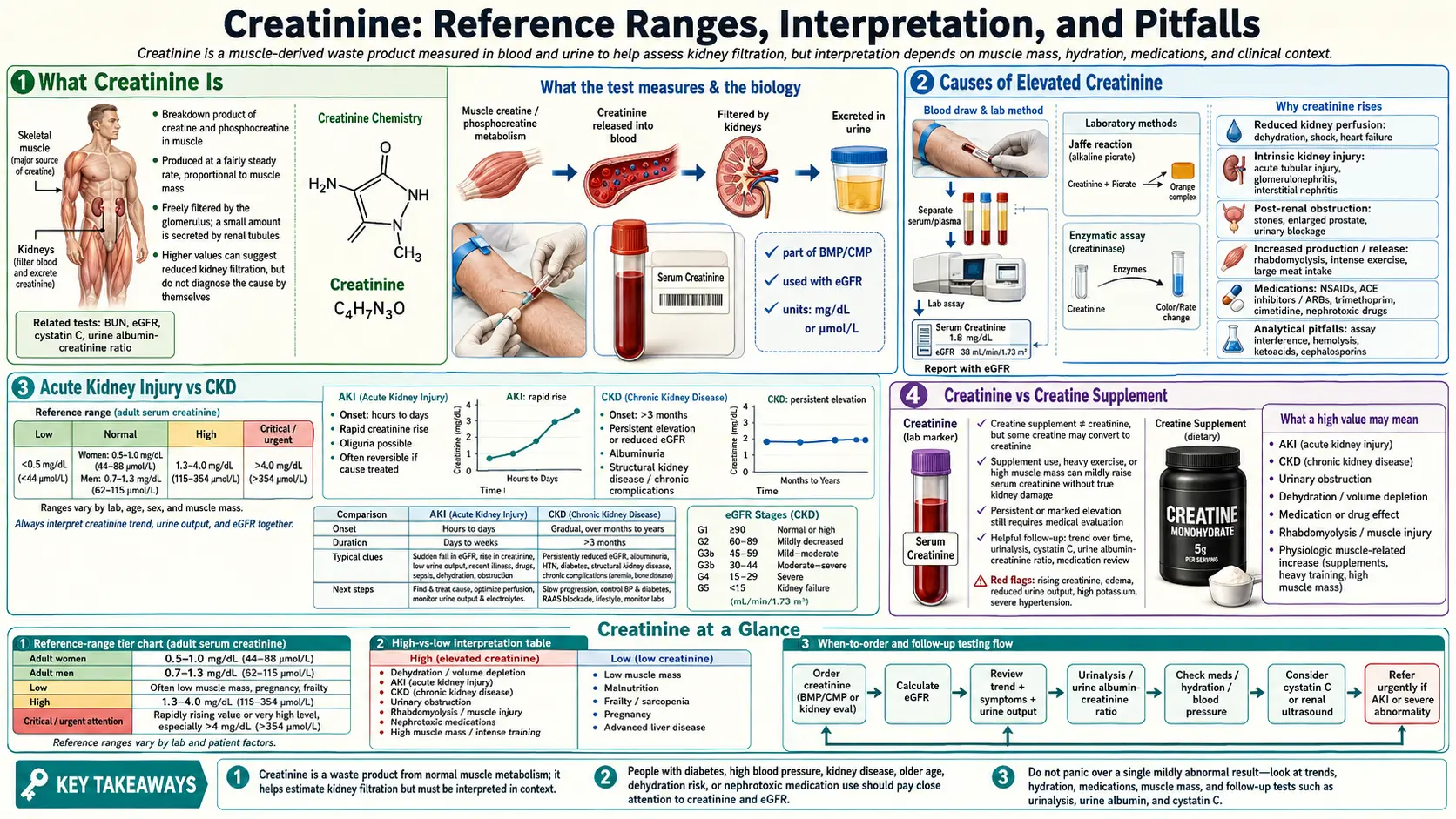
Serum creatinine is one of the most widely ordered kidney markers. It is inexpensive, automated and offered by routine clinical laboratories. On its own, it is also an imperfect proxy for kidney function — it is influenced by muscle mass, age, sex, diet (including cooked meat and creatine supplements) and several common medications that raise the number without changing filtration. This page describes what is being measured, what the number reflects, and the main ways it can mislead.
Interactive Visualization Kidney Nephron — watch blood become urine Follow blood into the glomerulus and see filtration and reabsorption turn 180 litres of filtrate into urine — then toggle dehydration or diabetes. Launch →Table of Contents
What Creatinine Is
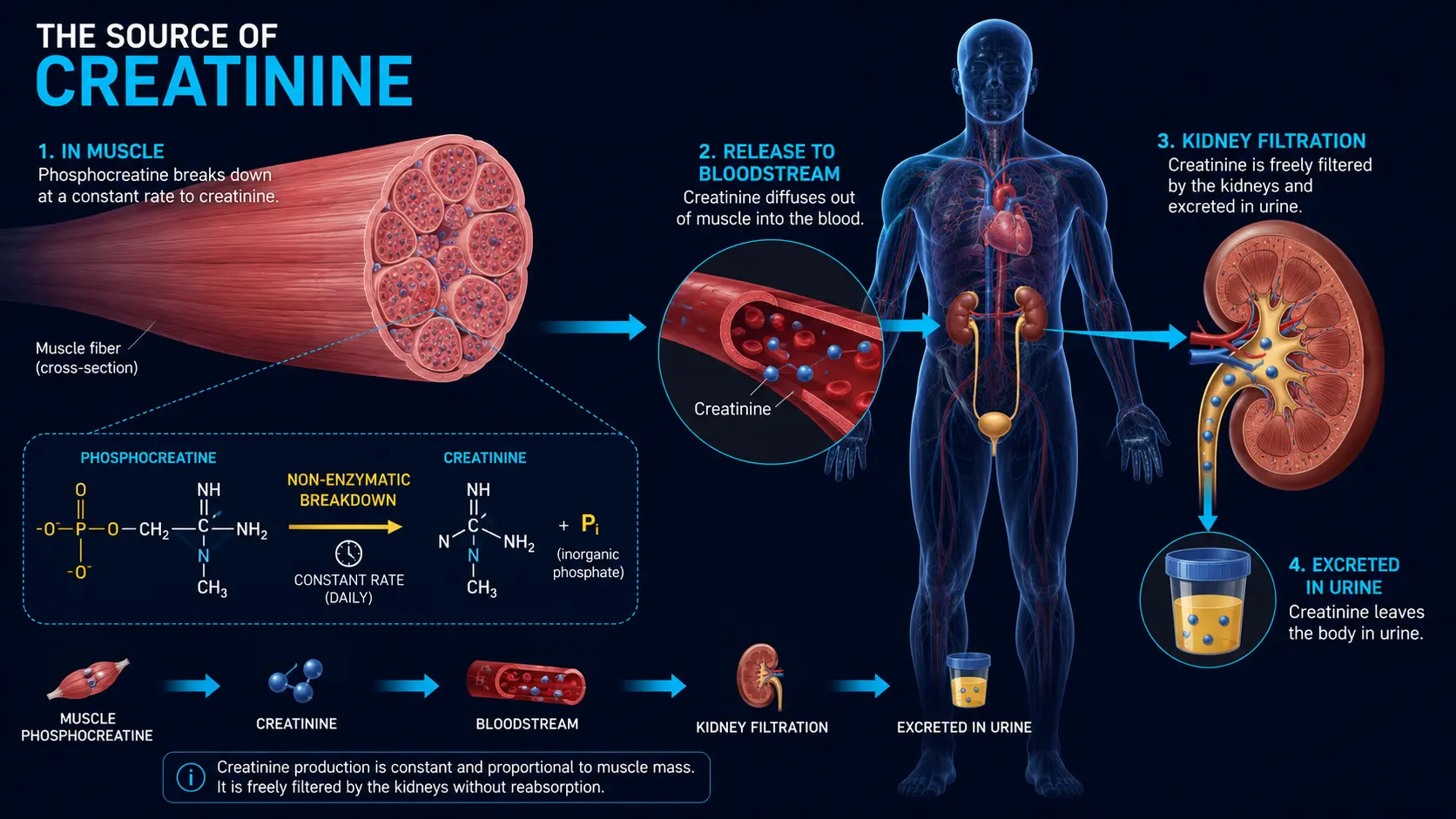
Creatine is stored in muscle tissue largely as phosphocreatine, a high-energy phosphate buffer used during short bursts of effort. A small, steady fraction of the body's creatine and phosphocreatine converts non-enzymatically each day to creatinine, a small (113 Da) waste molecule (reviewed by Wyss and Kaddurah-Daouk, 2000). Creatinine enters plasma at a roughly constant rate that tracks total muscle mass.
Creatinine is freely filtered at the glomerulus and little is reabsorbed, but part of what reaches the urine is added by tubular secretion — and that share grows as filtration falls. In 171 patients with glomerular disease, creatinine clearance averaged 1.64 times inulin clearance, and blocking secretion with cimetidine brought it back toward inulin clearance (Shemesh 1985). Because production is steady when muscle mass and diet are stable, and filtration is the main route of clearance, serum creatinine is still a useful index of glomerular filtration (Perrone 1992).
The corollary — and the source of most clinical confusion — is that anything affecting muscle mass, dietary protein, or tubular secretion will move creatinine independently of actual kidney function.
Reference Ranges
Serum Creatinine — Adult Male (mg/dL)
Serum Creatinine — Adult Female (mg/dL)
The ranges above are the example normal values given by MedlinePlus (U.S. National Library of Medicine): 0.7 to 1.3 mg/dL (62 to 115 µmol/L) for men and 0.5 to 0.95 mg/dL (44 to 84 µmol/L) for women. MedlinePlus notes that normal ranges vary among laboratories; each lab prints its own range on the report, and it can also differ by method (Jaffe vs. enzymatic). The sex difference reflects average muscle mass, not a difference in kidney physiology. The standard conversion factor is 88.4 (mg/dL × 88.4 = µmol/L).
Children, pregnant people and bodybuilders all have their own patterns. The same creatinine value can correspond to very different filtration rates: a value slightly above the range in a heavily muscled athlete may reflect muscle mass, while the same value in a frail older person with little muscle can reflect a substantial loss of filtration. The KDIGO 2024 guideline lists extreme exercise or bodybuilding, eating disorders and amputation among the situations in which creatinine-based estimates are less accurate (Levin 2024).
The "Creatinine Blind Range"
Serum creatinine does not rise in a straight line as kidney function declines. Its relationship with GFR is inverse and curved (hyperbolic): in the higher GFR range a large fall in filtration produces only a small rise in creatinine, which can stay inside the reference range, while in the lower range small further losses produce steep rises (Perrone 1992). Rising tubular secretion as filtration falls blunts the change further (Shemesh 1985).
This is often called the "creatinine blind range": early loss of filtration that creatinine alone may not reveal. Two approaches are used to narrow the gap:
- eGFR equations — the 2021 CKD-EPI creatinine equation estimates GFR from serum creatinine, age and sex, without the race term used in earlier versions (Inker 2021). The NKF-ASN Task Force recommended its immediate use by all U.S. laboratories (Delgado 2021).
- Cystatin C — a second filtration marker that depends far less on muscle mass and diet. Equations combining creatinine and cystatin C were more accurate than either marker alone (Inker 2021). In a meta-analysis of 11 general-population cohorts (90,750 participants), cystatin C-based eGFR classified more people below 60 mL/min/1.73 m² (13.7% vs 9.7%) and strengthened the association of eGFR with death and kidney failure (Shlipak 2013). The NKF-ASN Task Force and KDIGO 2024 call for wider use of cystatin C to confirm eGFR (Delgado 2021; Levin 2024).
Causes of Elevated Creatinine
Reduced filtration (the kidneys are not clearing it)
- Acute kidney injury — any cause; KDIGO defines it by a creatinine rise of ≥ 0.3 mg/dL within 48 hours or to ≥ 1.5 times baseline within 7 days, or by low urine output (details below)
- Chronic kidney disease — diabetic, hypertensive, glomerulonephritis, polycystic, obstructive, drug-induced
- Dehydration — transient, reverses with rehydration
- Heart failure, shock, sepsis — reduced renal perfusion
- Bilateral renal artery stenosis
- Postrenal obstruction — bladder outlet obstruction, ureteral stones, retroperitoneal disease
Increased production (more muscle than the formulas assume)
- Bodybuilders, athletes with very high lean mass
- Recent strenuous exercise (transient)
- Rhabdomyolysis — extensive muscle injury that releases muscle contents, including creatine kinase (CK), into the blood and can itself injure the kidneys; typically described with dark (tea- or cola-coloured) urine, very high CK, and raised potassium
Drug-induced creatinine elevations without true kidney injury
These drugs raise serum creatinine by reducing its tubular secretion, so the printout can resemble a fall in kidney function although the studies below found filtration unchanged:
- Trimethoprim (also in trimethoprim-sulfamethoxazole) — in 21 patients the combination raised serum creatinine by an average of 2 mg per litre, reversibly, while iothalamate clearance (a true GFR measure) was unchanged in the two subjects tested (Berglund 1975). In volunteers, trimethoprim raised creatinine by an average 14.8% in healthy subjects (not statistically significant) and 34.6% in people with chronic kidney failure (Myre 1987). Cimetidine blocks creatinine secretion in the same way and is used experimentally for that purpose (Shemesh 1985; Ducharme 1993).
- Cobicistat, dolutegravir (HIV antiretrovirals) — cobicistat lowered creatinine-based eGFR by about 10 mL/min with no change in GFR measured by iohexol (German 2012); dolutegravir lowered creatinine clearance by 10–14% without affecting measured GFR, consistent with inhibition of the creatinine transporter OCT2 (Koteff 2013)
- Fenofibrate — creatinine rises are well documented and usually reversible, but the mechanism is unsettled; a 2013 review found the proposed mechanisms untested and the true incidence of kidney harm unknown (Attridge 2013)
In these studies the rise appeared soon after the drug was started, stayed modest and stable, and reversed when it was stopped — the pattern that distinguishes a secretion effect from true kidney injury.
Causes of Low Creatinine
- Reduced muscle mass — frailty, sarcopenia, advanced age, prolonged hospitalization, cachexia, neuromuscular disease, amputation
- Pregnancy — physiologic; increased plasma volume and GFR
- Vegetarian or vegan diet — less dietary creatine; KDIGO 2024 lists vegetarian diets among non-GFR influences on creatinine (Levin 2024)
- Severe liver disease — impaired creatine synthesis
- Chronic illness, malnutrition — muscle wasting
A "normal" creatinine in a person with low muscle mass can hide significant kidney impairment. Reduced muscle mass is one of the situations for which the KDIGO 2024 guideline lists cystatin C-based eGFR as an option (Levin 2024).
Non-Kidney Things That Move Creatinine
These are commonly described reasons creatinine moves without a lasting change in kidney function (contrast is the exception noted):
- Heavy exercise shortly before the draw — can cause a transient rise
- A cooked-meat meal — creatine in meat converts to creatinine during cooking and is absorbed. In 32 people, median creatinine rose from 80.5 to 101.0 µmol/L 1–2 hours after a cooked-meat meal and median eGFR fell from 84.0 to 59.5 mL/min/1.73 m²; a meat-free meal had little effect and cystatin C was largely unaffected (Preiss 2007). In 80 people, including patients with diabetic kidney disease, a cooked-meat meal raised creatinine at every CKD stage studied and moved 6 of 16 stage-3a patients into stage 3b; the effect was gone after a 12-hour fast (Nair 2014).
- Creatine supplementation — a meta-analysis of randomized trials found a mean rise of 0.13 mg/dL (Tsiaras 2026); see the section below
- Starting cimetidine, trimethoprim, fenofibrate, cobicistat, dolutegravir — described above
- Recent contrast study — unlike the items above, iodinated contrast is associated with real acute kidney injury in some people; KDIGO addresses contrast-induced AKI separately (Lameire and Kellum 2013, KDIGO summary Part 2)
- Lab method change — routine methods differ; in a 2006 comparison of nine routine creatinine methods against an isotope-dilution mass spectrometry reference, three showed sample bias exceeding 5% in the range that matters most for eGFR (Peake 2006)
Acute Kidney Injury vs CKD
The same creatinine value can mean very different things depending on the trajectory:
- Acute kidney injury (AKI) — KDIGO 2012 criteria: creatinine rise ≥ 0.3 mg/dL (≥ 26.5 µmol/L) within 48 hours, OR a rise to ≥ 1.5 times baseline known or presumed to have occurred within the prior 7 days, OR urine output < 0.5 mL/kg/hour for 6 hours. AKI is staged 1–3 by the size of the creatinine rise (stage 3: 3 times baseline, a creatinine of ≥ 4.0 mg/dL, or the start of dialysis) or the depth and duration of low urine output (Kellum and Lameire 2013). The guideline's evaluation focuses on finding the cause — volume loss, drugs, obstruction, sepsis.
- Chronic kidney disease (CKD) — abnormal kidney structure or function, such as reduced GFR or albuminuria, present for a minimum of 3 months. KDIGO 2024 classifies CKD by Cause, GFR category (G1–G5) and albuminuria category (A1–A3) — the "CGA" system — and lists review of past GFR and albuminuria results as a way to establish chronicity (Levin 2024). The trend carries information that a single value does not: a value that has been stable for years means something different from the same value reached by a steady climb.
For this reason, previous results are central to interpreting an elevated creatinine: a baseline value turns a single number into a trajectory, and KDIGO uses past measurements both to define AKI (a rise from baseline) and to prove chronicity in CKD.
Preparation and Specimen
- Fasting: not routinely required for kidney function tests; because cooked meat raises creatinine for several hours, the authors of the cooked-meat studies proposed fasting samples or no cooked meat on the day of sampling (Preiss 2007; Nair 2014)
- Other pre-test influences: heavy exercise, a cooked-meat meal, and drugs that block creatinine secretion (cimetidine, trimethoprim) can each shift the result, which matters most when results are compared over time
- Tube: serum separator (gold-top SST) or lithium heparin (green-top)
- Methods: the Jaffe (alkaline picrate) reaction, which is subject to analytical interferences such as bilirubin and ketones, and enzymatic methods, which are more specific. A 2006 review described the Jaffe reaction as the cornerstone of most routine methods and expert bodies as recommending that all methods be traceable to an isotope-dilution mass spectrometry reference (Peake 2006).
Creatinine vs Creatine Supplement
A common question is whether creatine supplementation harms the kidneys. Two meta-analyses of randomized trials address it. Tsiaras 2026 (19 RCTs and one crossover study) found serum creatinine higher with creatine (mean difference 0.13 mg/dL, 95% CI 0.07 to 0.18) but no difference in urea or eGFR; its authors noted that trials longer than 1 year are still needed. De Souza Almeida 2026 (26 studies, 1,036 participants, including people with CKD) found creatinine higher (mean difference 0.14 mg/dL) and creatinine-based GFR lower, but no significant change in GFR measured with Cr-EDTA, urea, albuminuria or proteinuria; its authors interpreted the creatinine changes as altered creatinine metabolism rather than kidney injury. Creatine use is therefore relevant information for anyone interpreting a creatinine result.
In people with existing CKD, the creatinine rise lowers creatinine-based eGFR and can complicate staging; KDIGO 2024 lists creatine supplements and high-protein diets among the influences on creatinine for which cystatin C is an indication (Levin 2024). Long-term safety data in CKD are limited, and decisions about supplements belong with a clinician.
For more on the supplement, see Creatine.
Key Research Papers
- Perrone RD, Madias NE, Levey AS (1992). Serum creatinine as an index of renal function: new insights into old concepts. Clinical Chemistry 38(10):1933-53 — PubMed PMID: 1394976
- Wyss M, Kaddurah-Daouk R (2000). Creatine and creatinine metabolism. Physiological Reviews 80(3):1107-213 — PubMed PMID: 10893433
- Shemesh O, Golbetz H, Kriss JP, et al. (1985). Limitations of creatinine as a filtration marker in glomerulopathic patients. Kidney International 28(5):830-8 — PubMed PMID: 2418254
- Inker LA, Eneanya ND, Coresh J, et al. (2021). New creatinine- and cystatin C-based equations to estimate GFR without race. New England Journal of Medicine 385(19):1737-1749 — PubMed PMID: 34554658
- Delgado C, Baweja M, Crews DC, et al. (2021). A unifying approach for GFR estimation: recommendations of the NKF-ASN Task Force on Reassessing the Inclusion of Race in Diagnosing Kidney Disease. Journal of the American Society of Nephrology 32(12):2994-3015 — PubMed PMID: 34556489
- Shlipak MG, Matsushita K, Ärnlöv J, et al. (2013). Cystatin C versus creatinine in determining risk based on kidney function. New England Journal of Medicine 369(10):932-43 — PubMed PMID: 24004120
- Kellum JA, Lameire N; KDIGO AKI Guideline Work Group (2013). Diagnosis, evaluation, and management of acute kidney injury: a KDIGO summary (Part 1). Critical Care 17(1):204 — PubMed PMID: 23394211
- Lameire N, Kellum JA; KDIGO AKI Guideline Work Group (2013). Contrast-induced acute kidney injury and renal support for acute kidney injury: a KDIGO summary (Part 2). Critical Care 17(1):205 — PubMed PMID: 23394215
- Levin A, Ahmed SB, Carrero JJ, et al. (2024). Executive summary of the KDIGO 2024 Clinical Practice Guideline for the Evaluation and Management of Chronic Kidney Disease: known knowns and known unknowns. Kidney International 105(4):684-701 — PubMed PMID: 38519239
- Preiss DJ, Godber IM, Lamb EJ, et al. (2007). The influence of a cooked-meat meal on estimated glomerular filtration rate. Annals of Clinical Biochemistry 44(Pt 1):35-42 — PubMed PMID: 17270090
- Nair S, O'Brien SV, Hayden K, et al. (2014). Effect of a cooked meat meal on serum creatinine and estimated glomerular filtration rate in diabetes-related kidney disease. Diabetes Care 37(2):483-7 — PubMed PMID: 24062331
- Tsiaras A, Loufopoulos G, Theodoridis X, et al. (2026). The effect of creatine supplementation on kidney function: a systematic review and meta-analysis of randomized controlled trials. Journal of Renal Nutrition (online ahead of print) — PubMed PMID: 42035842
- de Souza Almeida A, da Silva LOD, Takahasi BNA, et al. (2026). Impact of creatine supplementation on kidney health: a systematic review and meta-analysis. International Urology and Nephrology (online ahead of print) — PubMed PMID: 42507286
- Berglund F, Killander J, Pompeius R (1975). Effect of trimethoprim-sulfamethoxazole on the renal excretion of creatinine in man. Journal of Urology 114(6):802-8 — PubMed PMID: 1195454
- Myre SA, McCann J, First MR, et al. (1987). Effect of trimethoprim on serum creatinine in healthy and chronic renal failure volunteers. Therapeutic Drug Monitoring 9(2):161-5 — PubMed PMID: 3617154
- Ducharme MP, Smythe M, Strohs G (1993). Drug-induced alterations in serum creatinine concentrations. Annals of Pharmacotherapy 27(5):622-33 — PubMed PMID: 8347916
- German P, Liu HC, Szwarcberg J, et al. (2012). Effect of cobicistat on glomerular filtration rate in subjects with normal and impaired renal function. Journal of Acquired Immune Deficiency Syndromes 61(1):32-40 — PubMed PMID: 22732469
- Koteff J, Borland J, Chen S, et al. (2013). A phase 1 study to evaluate the effect of dolutegravir on renal function via measurement of iohexol and para-aminohippurate clearance in healthy subjects. British Journal of Clinical Pharmacology 75(4):990-6 — PubMed PMID: 22905856
- Attridge RL, Frei CR, Ryan L, et al. (2013). Fenofibrate-associated nephrotoxicity: a review of current evidence. American Journal of Health-System Pharmacy 70(14):1219-25 — PubMed PMID: 23820458
- Peake M, Whiting M (2006). Measurement of serum creatinine — current status and future goals. Clinical Biochemist Reviews 27(4):173-84 — PubMed PMID: 17581641
PubMed Topic Searches
- PubMed: Serum creatinine as a kidney marker
- PubMed: KDIGO AKI definition
- PubMed: Creatine supplementation and kidney function
- PubMed: Drugs blocking creatinine secretion
- PubMed: Rhabdomyolysis and kidney injury
- PubMed: Jaffe vs enzymatic creatinine assay
- PubMed: Sarcopenia and creatinine in elderly CKD
External Authoritative Resources
Connections
- All Lab Tests
- Kidney Nephron — interactive animation
- eGFR
- Cystatin C
- BUN
- Kidney Function Tests
- Comprehensive Metabolic Panel
- Urinalysis
- Creatine
- Kidney Disease
- Acute Kidney Injury
- Glomerulonephritis
- Nephrotic Syndrome
- Heart Failure
- Sepsis
- Potassium
- Preeclampsia
- Hyperparathyroidism
- Cadmium
- Diabetes Complications