IBD Biologics: TNF, IL-23, and Integrin Inhibitors
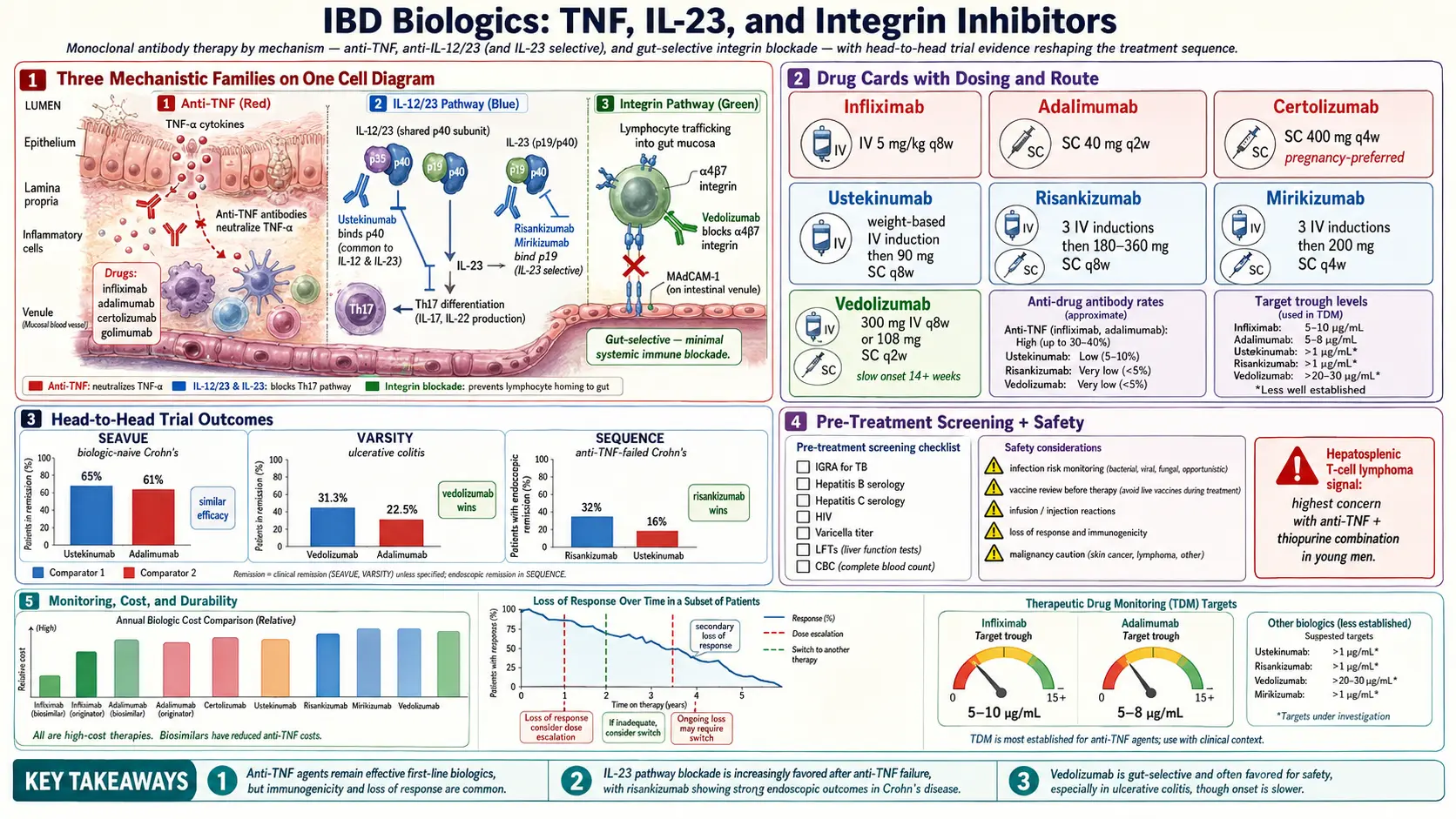
Table of Contents
- What Biologics Are and What They Target
- Anti-TNF Agents: Infliximab, Adalimumab, Certolizumab, Golimumab
- Loss of Response, Antibody Formation, and Therapeutic Drug Monitoring
- IL-12/23 Blockade: Ustekinumab
- Selective IL-23 Inhibitors: Risankizumab, Mirikizumab, Guselkumab
- Gut-Selective Integrin Blockade: Vedolizumab
- Head-to-Head Trials: SEAVUE, VARSITY, SEQUENCE
- Positioning: What the 2025 ACG Guidelines Say
- Infusion vs Self-Injection: What the Labels Describe
- Screening Before Treatment: TB, Hepatitis B, Vaccines
- Infection Risk, Surgery, and Pregnancy
- The Malignancy Signal
- Biosimilars and Cost
- Key Research Papers
- Connections
- Featured Videos
What Biologics Are and What They Target
Biologics are protein drugs — in inflammatory bowel disease (IBD), monoclonal antibodies or antibody fragments — each built to block one immune-system target. The first controlled trial of an antibody to tumor necrosis factor alpha (TNF-α) in Crohn's disease, published in 1997, gave 108 people with moderate-to-severe, treatment-resistant disease a single two-hour infusion of a chimeric monoclonal antibody coded cA2, or placebo. At four weeks, 81% of those given 5 mg/kg had a clinical response, compared with 17% on placebo, and 33% of all antibody-treated patients were in remission, compared with 4% (Targan 1997).
The 2025 American College of Gastroenterology (ACG) ulcerative colitis guideline describes a treat-to-target approach with a goal of endoscopic improvement (a Mayo endoscopic score of 0 to 1) (Rubin 2025).
The IBD biologics on this page fall into three families by target:
- Anti-TNF agents (infliximab, adalimumab, certolizumab pegol, golimumab) — bind TNF-α.
- Interleukin-23 pathway antibodies — ustekinumab binds the p40 subunit shared by interleukin-12 and interleukin-23 (Feagan 2016); risankizumab, mirikizumab and guselkumab bind the p19 subunit of interleukin-23 (D'Haens 2022; D'Haens 2023; Rubin 2025, QUASAR).
- Gut-selective integrin blockade — vedolizumab, an antibody to the α4β7 integrin, blocks the trafficking of lymphocytes into the gut (Feagan 2013; Colombel 2017).
The drugs differ in route, schedule, trial evidence and safety warnings. The sections below report what the trials, the U.S. prescribing information and the guidelines state; decisions about these medicines belong with a gastroenterologist.
Anti-TNF Agents: Infliximab, Adalimumab, Certolizumab, Golimumab
The U.S. prescribing information for each of the four anti-TNF drugs carries a boxed warning for serious infections and malignancy (infliximab-product prescribing information, DailyMed; adalimumab-product prescribing information, DailyMed; certolizumab pegol prescribing information, DailyMed; subcutaneous golimumab prescribing information, DailyMed).
Infliximab. A chimeric monoclonal IgG1 antibody against TNF (Baert 2003), given by intravenous infusion over at least 2 hours. The label dose for adult Crohn's disease and ulcerative colitis is 5 mg/kg at weeks 0, 2 and 6, then every 8 weeks; for adults with Crohn's disease who respond and later lose their response, it states that 10 mg/kg every 8 weeks may be considered, and that patients who have not responded by week 14 are unlikely to respond with continued dosing. The label language covers “infliximab products”; the label cited here is for a biosimilar infliximab. The ACG Crohn's guideline lists subcutaneous infliximab for maintenance only (Lichtenstein 2025).
- ACCENT I (Crohn's disease): 335 of 573 patients (58%) responded to a first 5 mg/kg infusion. At week 30, 21% of responders switched to placebo were in remission, compared with 39% given 5 mg/kg and 45% given 10 mg/kg every 8 weeks; serious infections were similar across groups (Hanauer 2002).
- ACT 1 and ACT 2 (ulcerative colitis): clinical response at week 8 was 69% (5 mg/kg) and 61% (10 mg/kg) versus 37% on placebo in ACT 1, and 64% and 69% versus 29% in ACT 2; at week 54 in ACT 1, 45% and 44% versus 20% (Rutgeerts 2005).
- SONIC (Crohn's disease, combination therapy): in 508 adults new to both drugs, corticosteroid-free remission at week 26 was 56.8% on infliximab plus azathioprine, 44.4% on infliximab alone and 30.0% on azathioprine alone. Serious infections occurred in 3.9%, 4.9% and 5.6% (Colombel 2010).
- UC SUCCESS (ulcerative colitis, combination therapy): corticosteroid-free remission at week 16 was 39.7% on infliximab plus azathioprine, 22.1% on infliximab alone and 23.7% on azathioprine alone; the trial stopped before reaching its enrolment target (Panaccione 2014).
Adalimumab. A subcutaneous anti-TNF; several adalimumab products are labelled for Crohn's disease and ulcerative colitis. The label dose for adult Crohn's disease and ulcerative colitis is 160 mg on day 1 (in one day or split over two days), 80 mg on day 15, then 40 mg every other week from day 29; for ulcerative colitis it states that adalimumab is discontinued in adults without evidence of clinical remission by week 8 (day 57).
Certolizumab pegol. A pegylated humanized Fab′ fragment that binds TNF-α (Schreiber 2007). Its label lists Crohn's disease but not ulcerative colitis, at 400 mg subcutaneously at weeks 0, 2 and 4, then 400 mg every 4 weeks in patients who respond.
- PRECISE 1: response at week 6 was 35% versus 27% on placebo; remission rates did not differ significantly, and the authors described a modest improvement in response with no significant improvement in remission (Sandborn 2007).
- PRECISE 2: among the 64% who responded to induction, 48% of those continued on certolizumab and 29% of those switched to placebo were in remission at week 26 (Schreiber 2007).
- Pregnancy: in a study of 31 pregnant women, median cord-blood levels were 160% of the mother's for infliximab, 153% for adalimumab and 3.9% for certolizumab, which had the lowest placental transfer of the drugs tested (Mahadevan 2013). The European Crohn's and Colitis Organisation (ECCO) pregnancy guidelines describe certolizumab as an exception to placental transfer because of its polyethylene glycol moiety (Torres 2023). Neither the ECCO guidelines nor the 2025 Global Consensus on pregnancy in IBD names certolizumab as a preferred anti-TNF: ECCO recommends continuing anti-TNF therapy through pregnancy for women with active or hard-to-control disease, and the Global Consensus recommends continuing maintenance anti-TNF therapy throughout pregnancy without naming an agent (Torres 2023; Mahadevan 2025). The pregnancy and IBD article covers this in detail.
Golimumab. A fully human monoclonal antibody to TNF-α (Sandborn 2014). Its subcutaneous label lists ulcerative colitis but not Crohn's disease; for adults (and children of 40 kg or more) the dose is 200 mg at week 0, 100 mg at week 2, then 100 mg every 4 weeks. In the PURSUIT induction trial, clinical response at week 6 was 51.0% (200/100 mg) and 54.9% (400/200 mg) versus 30.3% on placebo (Sandborn 2014, induction). In the maintenance trial, response was maintained through week 54 in 47.0% (50 mg) and 49.7% (100 mg) versus 31.2% on placebo; among all patients given golimumab, three died (sepsis, tuberculosis, cardiac failure) and four developed active tuberculosis (Sandborn 2014, maintenance).
For hospitalised acute severe ulcerative colitis, the 2025 ACG guideline recommends infliximab or cyclosporine as rescue therapy when there is no response to intravenous corticosteroids by day 3 (Rubin 2025).
Loss of Response, Antibody Formation, and Therapeutic Drug Monitoring
The largest prospective data on anti-TNF failure come from PANTS, a UK cohort of 1,610 anti-TNF-naive people with active luminal Crohn's disease starting infliximab (955) or adalimumab (655) (Kennedy 2019):
- Primary non-response at week 14 occurred in 23.8%, and 63.1% were not in remission at week 54. Adverse events ended treatment in 7.8%.
- The only factor independently associated with primary non-response was a low drug concentration at week 14; the week-14 concentrations associated with remission at weeks 14 and 54 were 7 mg/L for infliximab and 12 mg/L for adalimumab.
- Of 113 people who stayed on standard dosing after primary non-response, 14 (12.4%) entered remission by week 54.
- Anti-drug antibodies developed in 62.8% on infliximab and 28.5% on adalimumab. Low drug levels predicted antibodies, and antibodies predicted later low drug levels.
- Taking an immunomodulator (thiopurine or methotrexate) alongside lowered the risk of antibodies (hazard ratio 0.39 for infliximab, 0.44 for adalimumab).
The three-year PANTS extension reported the following (Chanchlani 2024):
- Loss of response by year 1 among initial responders was 34.4% on infliximab and 32.1% on adalimumab, rising to 60.0% and 68.4% by year 3.
- About a third of patients were in remission at the end of 3 years.
- Low week-14 drug concentrations predicted loss of response, and immunomodulator use was associated with fewer antibodies linked to undetectable drug levels.
In an earlier cohort of 125 people given infliximab, 61% formed antibodies to the drug. Antibody concentrations of 8.0 µg/mL or more before an infusion were linked to a shorter response (35 vs 71 days) and to more infusion reactions (relative risk 2.40). Concomitant immunosuppressive therapy was linked to lower antibody titers (Baert 2003). Antibodies against certolizumab developed in 8% in PRECISE 1 and 9% in PRECISE 2 (Sandborn 2007; Schreiber 2007). Antibodies against vedolizumab developed in 4.0% in GEMINI 2 (Sandborn 2013).
Therapeutic drug monitoring (TDM) measures the drug level just before a dose, usually with an anti-drug antibody test. For loss of response to an anti-TNF, the 2025 ACG ulcerative colitis guideline describes measuring serum drug levels and anti-drug antibodies (Rubin 2025). The TAXIT trial studied 263 adults on stable maintenance infliximab (Vande Casteele 2015):
- Doses were adjusted to a trough of 3–7 µg/mL.
- Raising the dose in patients below 3 µg/mL increased the share of people with Crohn's disease in remission (88% vs 65%). This was not seen in ulcerative colitis.
- Lowering the dose in patients above 7 µg/mL cut drug cost by 28%.
- After this optimisation, continued level-based dosing was not superior to clinically based dosing for remission at one year (69% vs 66%), but fewer patients relapsed (7% vs 17%).
IL-12/23 Blockade: Ustekinumab
Ustekinumab is a monoclonal antibody to the p40 subunit of interleukin-12 and interleukin-23 (Feagan 2016). The label dose for Crohn's disease and ulcerative colitis is a single weight-based intravenous infusion (260 mg up to 55 kg, 390 mg above 55 to 85 kg, 520 mg above 85 kg), then 90 mg subcutaneously 8 weeks later and every 8 weeks thereafter (ustekinumab prescribing information, DailyMed).
- UNITI-1 and UNITI-2 / IM-UNITI (Crohn's disease): week-6 response was 34.3% (130 mg) and 33.7% (about 6 mg/kg) versus 21.5% on placebo in people who had failed or not tolerated TNF antagonists, and 51.7% and 55.5% versus 28.7% in people who had failed conventional therapy. Among responders, 53.1% (every 8 weeks) and 48.8% (every 12 weeks) were in remission at week 44, versus 35.9% on placebo; adverse-event rates were similar across groups (Feagan 2016).
- UNIFI (ulcerative colitis): clinical remission at week 8 was 15.6% (130 mg) and 15.5% (6 mg/kg) versus 5.3% on placebo; at week 44, 38.4% (every 12 weeks) and 43.8% (every 8 weeks) versus 24.0%. Through 52 weeks there were two deaths and seven cancers among 825 ustekinumab-treated patients, and no deaths and one cancer among 319 given placebo (Sands 2019, UNIFI).
The label states that ustekinumab may increase the risk of malignancy, that live vaccines are to be avoided during treatment, and that BCG vaccine is not given during treatment or for one year before starting or after stopping it.
Selective IL-23 Inhibitors: Risankizumab, Mirikizumab, Guselkumab
These three antibodies bind the p19 subunit unique to interleukin-23. Their labels state that live vaccines are to be avoided during treatment, and each carries a hepatotoxicity warning with liver tests at baseline and during induction (risankizumab, mirikizumab and guselkumab prescribing information, DailyMed).
Risankizumab. The label gives intravenous induction at weeks 0, 4 and 8 — 600 mg for Crohn's disease, 1,200 mg for ulcerative colitis — then 180 mg or 360 mg subcutaneously at week 12 and every 8 weeks. It reports drug-induced liver injury during induction treatment of IBD and lists liver-test monitoring for at least the first 12 weeks.
- ADVANCE and MOTIVATE (Crohn's disease): all co-primary endpoints at week 12 were met with both doses. In ADVANCE, clinical remission by the Crohn's Disease Activity Index (CDAI) was 45% (600 mg) and 42% (1,200 mg) versus 25% on placebo; in MOTIVATE, which enrolled people with prior biologic failure, it was 42% and 40% versus 20% (D'Haens 2022).
- FORTIFY (Crohn's disease maintenance): CDAI clinical remission at week 52 was 52% on 360 mg versus 41% in those withdrawn to placebo, and endoscopic response 47% versus 22% (Ferrante 2022).
- INSPIRE and COMMAND (ulcerative colitis): clinical remission at week 12 was 20.3% on 1,200 mg versus 6.2% on placebo; at week 52 it was 40.2% (180 mg) and 37.6% (360 mg) versus 25.1% (Louis 2024).
Mirikizumab. The label gives, for ulcerative colitis, 300 mg intravenously at weeks 0, 4 and 8, then 200 mg subcutaneously every 4 weeks; for Crohn's disease, 900 mg intravenously at weeks 0, 4 and 8, then 300 mg subcutaneously every 4 weeks. It describes a case of drug-induced liver injury after a longer-than-recommended induction regimen and lists liver tests for at least 24 weeks.
- LUCENT-1 and LUCENT-2 (ulcerative colitis): clinical remission was 24.2% versus 13.3% on placebo at week 12, and 49.9% versus 25.1% at week 40 of maintenance (week 52 overall). Bowel-movement urgency was among the major secondary endpoints, all of which were met. Among 1,217 mirikizumab-treated patients, 15 had an opportunistic infection (6 herpes zoster) and 8 had cancer (3 colorectal) (D'Haens 2023).
- VIVID-1 (Crohn's disease): the composite of clinical response at week 12 plus endoscopic response at week 52 was reached by 38.0% on mirikizumab versus 9.0% on placebo; clinical response plus CDAI remission by 45.4% versus 19.6%. Serious adverse events were reported in 10.3% on mirikizumab, 10.7% on the ustekinumab comparator and 17.1% on placebo (Ferrante 2024).
Guselkumab. Described by its trialists as a dual-acting human IgG1 interleukin-23 p19 inhibitor that can also bind CD64 (Rubin 2025, QUASAR). The label gives induction of 200 mg intravenously or 400 mg subcutaneously at weeks 0, 4 and 8, then 100 mg subcutaneously every 8 weeks from week 16 or 200 mg every 4 weeks from week 12, for both ulcerative colitis and Crohn's disease.
- QUASAR (ulcerative colitis): clinical remission at week 12 was 23% versus 8% on placebo; at maintenance week 44 it was 50% (200 mg every 4 weeks) and 45% (100 mg every 8 weeks) versus 19% (Rubin 2025, QUASAR).
- GALAXI-2 and GALAXI-3 (Crohn's disease): both regimens beat placebo on the week-12 response plus week-48 remission composite (for example 55% and 49% versus 12% in GALAXI-2). The authors report superiority to the ustekinumab comparator at week 48 across multiple endpoints (Panaccione 2025).
- GRAVITI (Crohn's disease, subcutaneous induction): clinical remission at week 12 was 56.1% versus 21.4% on placebo, and at week 48, 60.0% and 66.1% versus 17.1% (Hart 2025).
Gut-Selective Integrin Blockade: Vedolizumab
Vedolizumab is an antibody to the gut-selective α4β7 integrin, which blocks lymphocyte trafficking into the gut (Feagan 2013; Colombel 2017). The label dose is 300 mg intravenously at weeks 0, 2 and 6, then every 8 weeks, or, after the two intravenous doses at weeks 0 and 2, 108 mg subcutaneously every 2 weeks. It states that therapy is discontinued in patients who show no evidence of therapeutic benefit by week 14 (vedolizumab prescribing information, DailyMed).
- GEMINI 1 (ulcerative colitis): response at week 6 was 47.1% versus 25.5% on placebo. At week 52, 41.8% (every 8 weeks) and 44.8% (every 4 weeks) of responders were in clinical remission versus 15.9% switched to placebo. Adverse-event frequency was similar to placebo (Feagan 2013).
- GEMINI 2 (Crohn's disease): clinical remission at week 6 was 14.5% versus 6.8% on placebo, but CDAI-100 response did not differ significantly (31.4% vs 25.7%). At week 52, 39.0% and 36.4% of responders were in remission versus 21.6% on placebo. Serious adverse events (24.4% vs 15.3%) and serious infections (5.5% vs 3.0%) were more common with vedolizumab in this trial (Sandborn 2013).
- VISIBLE 1 (subcutaneous maintenance, ulcerative colitis): clinical remission at week 52 was 46.2% on subcutaneous, 42.6% on intravenous vedolizumab and 14.3% on placebo. Injection-site reactions occurred in 10.4% on the subcutaneous form, versus 1.9% (intravenous) and 0% (placebo) (Sandborn 2020).
Safety data. An integrated analysis of six trials covered 2,830 patients and 4,811 patient-years of exposure (Colombel 2017):
- No increased risk of any infection or of serious infection was linked to vedolizumab.
- No cases of progressive multifocal leukoencephalopathy (PML) were observed.
- Eighteen exposed patients (under 1%) were diagnosed with a malignancy.
The label reports one postmarketing PML case in a patient with multiple contributing factors (HIV infection and prior and concomitant immunosuppression). It states that a PML risk, although unlikely, cannot be ruled out.
Head-to-Head Trials: SEAVUE, VARSITY, SEQUENCE
Most IBD trials compare a drug with placebo; these three compared two biologics directly.
SEAVUE (Lancet 2022): ustekinumab vs adalimumab, biologic-naïve Crohn's disease. Both drugs were given without an immunomodulator and without dose changes. At week 52, 65% on ustekinumab and 61% on adalimumab were in clinical remission, with no significant difference (p=0.42). Serious infections occurred in 2% and 3%, and more patients stopped adalimumab before week 52 (24% vs 15%) (Sands 2022).
VARSITY (NEJM 2019): vedolizumab vs adalimumab, ulcerative colitis. Up to 25% of patients could have had a TNF inhibitor other than adalimumab. At week 52, vedolizumab gave higher clinical remission (31.3% vs 22.5%) and higher endoscopic improvement (39.7% vs 27.7%). It was not superior for corticosteroid-free remission (12.6% vs 21.8%). Serious infections were 1.6 and 2.2 events per 100 patient-years (Sands 2019, VARSITY).
SEQUENCE (NEJM 2024): risankizumab vs ustekinumab, Crohn's disease after anti-TNF failure. This open-label trial assessed its endpoints blinded:
- Risankizumab was noninferior for clinical remission at week 24 (58.6% vs 39.5%).
- It was superior for endoscopic remission at week 48 (31.8% vs 16.2%).
- More patients completed all assigned treatment on risankizumab (90.2% vs 72.8%).
- Adverse-event incidence appeared similar (Peyrin-Biroulet 2024).
The guidelines reflect these trials. The 2025 ACG ulcerative colitis guideline recommends vedolizumab over adalimumab for induction and maintenance (Rubin 2025). The 2025 ACG Crohn's guideline favours risankizumab over ustekinumab in anti-TNF-experienced patients (Lichtenstein 2025).
Positioning: What the 2025 ACG Guidelines Say
Crohn's disease. The ACG's summary of its 2025 Crohn's guideline makes these points (Lichtenstein 2025):
- Early initiation of advanced therapy is key to optimal outcomes.
- Moderate-to-severe disease: anti-TNF agents (intravenous infliximab, subcutaneous adalimumab, subcutaneous certolizumab pegol), vedolizumab, ustekinumab, the IL-23 inhibitors guselkumab, mirikizumab and risankizumab, and upadacitinib are listed for induction and maintenance.
- For patients naive to both agents, intravenous infliximab plus a thiopurine is favoured over either alone.
- Upadacitinib is limited to anti-TNF-experienced patients in the U.S.
- For fistulizing Crohn's disease, it lists infliximab, adalimumab, antibiotics, upadacitinib, vedolizumab and ustekinumab.
- For people at high risk of recurrence after surgery, it lists anti-TNF therapy or vedolizumab.
Ulcerative colitis. The ACG's summary of its 2025 guideline makes these points (Rubin 2025):
- Moderate-to-severe disease: S1P receptor modulators, ustekinumab, the IL-23 p19 inhibitors (guselkumab, mirikizumab, risankizumab), vedolizumab, anti-TNF agents (infliximab, adalimumab, golimumab) and JAK inhibitors are listed.
- Infliximab is described as the preferred anti-TNF therapy.
- Combination with a thiopurine is recommended when infliximab is used for induction.
- Vedolizumab is favoured over adalimumab.
The small-molecule options are covered in JAK inhibitors and S1P modulators.
Labelled indications beyond the gut. The U.S. labels for infliximab products, adalimumab products, certolizumab pegol and golimumab also list ankylosing spondylitis (see ankylosing spondylitis), and the adalimumab label lists uveitis. The vedolizumab label lists only ulcerative colitis and Crohn's disease. The overlap between IBD and joint, skin and eye disease is covered in extraintestinal manifestations.
Infusion vs Self-Injection: What the Labels Describe
Intravenous infusions. Infusion times stated in the U.S. labels:
- Infliximab: at least 2 hours.
- Vedolizumab: about 30 minutes.
- Risankizumab induction: at least 1 hour for Crohn's disease, at least 2 hours for ulcerative colitis.
- Mirikizumab induction: at least 30 minutes for ulcerative colitis, at least 90 minutes for Crohn's disease.
- Guselkumab intravenous induction: at least 1 hour.
- Ustekinumab: a single intravenous induction dose.
Subcutaneous injections. Adalimumab, certolizumab pegol and golimumab are subcutaneous throughout. Ustekinumab, risankizumab, mirikizumab, guselkumab and vedolizumab have subcutaneous maintenance forms. Guselkumab also has a subcutaneous induction option, tested in GRAVITI (Hart 2025), and the ACG lists subcutaneous infliximab for maintenance (Lichtenstein 2025). The adalimumab-product label states that the pen or syringe can be taken out of the refrigerator for 15 to 30 minutes before injecting so the liquid comes to room temperature. In VISIBLE 1, injection-site reactions occurred in 10.4% on subcutaneous vedolizumab; most were mild and none led to discontinuation (Sandborn 2020).
Screening Before Treatment: TB, Hepatitis B, Vaccines
The U.S. labels and the ACG guideline describe these checks before and during biologic therapy:
- Tuberculosis. The anti-TNF, ustekinumab, IL-23 inhibitor and vedolizumab labels all describe evaluating for TB before treatment. The anti-TNF, ustekinumab and vedolizumab labels describe treating latent TB before the biologic starts, and the adalimumab and certolizumab labels report that patients with TB frequently presented with disseminated or extrapulmonary disease. The ACG Crohn's guideline lists TB and hepatitis B testing before anti-TNF therapy (Lichtenstein 2025).
- Hepatitis B. The infliximab and certolizumab labels describe testing for hepatitis B virus before starting. All four anti-TNF labels describe monitoring carriers during and for several months after therapy, and stopping the drug and starting antiviral therapy if reactivation occurs.
- Liver tests. The risankizumab, mirikizumab and guselkumab labels list liver enzymes and bilirubin at baseline for IBD.
- Vaccines. The labels describe bringing vaccinations up to date before treatment:
- Live vaccines are not given with infliximab, adalimumab or golimumab.
- The ustekinumab, risankizumab, mirikizumab and guselkumab labels state that live vaccines are to be avoided; the ustekinumab label adds that BCG is not given for one year before or after treatment.
- The vedolizumab label states that patients may receive non-live vaccines, and live vaccines if the benefits outweigh the risks.
- For infants exposed in the womb, the infliximab label recommends at least six months after birth before live vaccines. The adalimumab label states that the safety of live vaccines in exposed infants is unknown.
- Skin. The infliximab label reports melanoma and Merkel cell carcinoma in patients on TNF blockers. It recommends periodic skin examination for all patients, particularly those with skin-cancer risk factors.
Infection Risk, Surgery, and Pregnancy
Infection. All four anti-TNF labels carry boxed warnings for serious infections that may lead to hospitalisation or death. A French nationwide cohort of 190,694 people with IBD reported these comparisons (Kirchgesner 2018):
- Combination therapy (anti-TNF plus thiopurine) carried a higher risk than anti-TNF alone of serious infection (HR 1.23) and opportunistic infection (HR 1.96).
- Anti-TNF monotherapy carried a higher risk than thiopurine monotherapy of serious infection (HR 1.71), mycobacterial infection (HR 1.98) and bacterial infection (HR 2.38).
- Anti-TNF monotherapy carried a lower risk of opportunistic viral infection than thiopurine monotherapy (HR 0.57).
Trial-reported serious-infection rates appear in the drug sections above.
Surgery. In the prospective PUCCINI cohort, 947 people with IBD had intra-abdominal surgery. Anti-TNF use within 12 weeks before surgery was not associated with any postoperative infection (18.1% vs 20.2%) or with surgical-site infection (12.0% vs 12.6%), and a detectable drug level was not associated with either (Cohen 2022).
Pregnancy. The PIANO cohort followed 1,490 completed pregnancies. Biologic, thiopurine or combination exposure did not increase congenital malformations, spontaneous abortions, preterm birth, low birth weight or infant infections in the first year, while higher disease activity was associated with spontaneous abortion (Mahadevan 2021). The guidelines on continuing therapy:
- The 2025 Global Consensus recommends continuing maintenance anti-TNF therapy throughout pregnancy (strong recommendation, low-certainty evidence) (Mahadevan 2025).
- The ECCO guidelines recommend timing the last third-trimester anti-TNF dose to the presumed due date to reduce fetal exposure. They state that stopping anti-TNF before the third trimester is not recommended for women in remission (Torres 2023).
The pregnancy and IBD article covers each drug class and infant vaccination.
The Malignancy Signal
Hepatosplenic T-cell lymphoma (HSTCL). The anti-TNF labels report postmarketing cases of this rare, aggressive and usually fatal lymphoma:
- Most cases occurred in patients with Crohn's disease or ulcerative colitis, most of them adolescent or young adult males.
- Almost all had received azathioprine or 6-mercaptopurine with or before the TNF blocker.
A systematic review of 36 HSTCL cases in IBD found the following (Kotlyar 2011):
- 20 cases had received infliximab plus a thiopurine, and 16 a thiopurine alone.
- 27 of the 30 patients of known age were younger than 35, and only 2 of 31 of known sex were female.
- No cases were reported with anti-TNF therapy alone.
Lymphoma overall. A French nationwide cohort of 189,289 adults with IBD reported lymphoma incidence rates per 1,000 person-years and adjusted hazard ratios compared with unexposed patients (Lemaitre 2017):
- Unexposed: 0.26.
- Thiopurine monotherapy: 0.54 (aHR 2.60).
- Anti-TNF monotherapy: 0.41 (aHR 2.41).
- Combination therapy: 0.95 (aHR 6.11).
The authors described the monotherapy increases as small but statistically significant.
Skin cancer. The infliximab label reports melanoma and Merkel cell carcinoma with TNF blockers, and the golimumab label reports some skin cancers.
Non-TNF biologics. Cancer data from the trials:
- UNIFI: seven cancers among 825 ustekinumab-treated patients and one among 319 given placebo through 52 weeks (Sands 2019, UNIFI). The ustekinumab label states that it may increase the risk of malignancy.
- LUCENT: eight cancers, three of them colorectal, among 1,217 mirikizumab-treated patients (D'Haens 2023).
- Vedolizumab integrated trial data: 18 malignancies (under 1%) among 2,830 exposed patients (Colombel 2017).
Follow-up for the newer drugs is shorter than for anti-TNF agents.
Biosimilars and Cost
The U.S. Food and Drug Administration defines a biosimilar as a biologic that is highly similar to an already-approved reference product, with no clinically meaningful differences from it. An interchangeable biosimilar meets additional requirements, so it may be substituted at the pharmacy without consulting the prescriber, subject to state law (FDA: Biosimilar Basics for Patients).
The NOR-SWITCH trial randomised 482 adults on stable reference infliximab to stay on it or switch to a less expensive biosimilar infliximab; 32% had Crohn's disease and 19% ulcerative colitis. Switching was noninferior for disease worsening over 52 weeks (26% vs 30%; adjusted difference −4.4%), and adverse events were similar. The authors note that the trial was not powered to show noninferiority within individual diseases (Jørgensen 2017).
On cost, in the TAXIT trial, lowering infliximab doses in patients with trough levels above 7 µg/mL reduced drug cost by 28% (Vande Casteele 2015). The trials and guidelines cited on this page do not report drug prices, which vary by country, insurer and site of care.
Key Research Papers
- Targan SR, Hanauer SB, van Deventer SJ, et al. A short-term study of chimeric monoclonal antibody cA2 to tumor necrosis factor alpha for Crohn's disease. Crohn's Disease cA2 Study Group. N Engl J Med. 1997;337(15):1029-35. Original infliximab trial. — doi:10.1056/nejm199710093371502 (PubMed PMID: 9321530)
- Feagan BG, Rutgeerts P, Sands BE, et al. Vedolizumab as induction and maintenance therapy for ulcerative colitis. N Engl J Med. 2013;369(8):699-710. GEMINI 1. — doi:10.1056/NEJMoa1215734 (PubMed PMID: 23964932)
- Feagan BG, Sandborn WJ, Gasink C, et al. Ustekinumab as Induction and Maintenance Therapy for Crohn's Disease. N Engl J Med. 2016;375(20):1946-1960. UNITI. — doi:10.1056/NEJMoa1602773 (PubMed PMID: 27959607)
- Sands BE, Peyrin-Biroulet L, Loftus EV Jr, et al. Vedolizumab versus Adalimumab for Moderate-to-Severe Ulcerative Colitis. N Engl J Med. 2019;381(13):1215-1226. VARSITY. — doi:10.1056/NEJMoa1905725 (PubMed PMID: 31553834)
- Sands BE, Irving PM, Hoops T, et al. Ustekinumab versus adalimumab for induction and maintenance therapy in biologic-naive patients with moderately to severely active Crohn's disease: a multicentre, randomised, double-blind, parallel-group, phase 3b trial. Lancet. 2022;399(10342):2200-2211. SEAVUE. — doi:10.1016/S0140-6736(22)00688-2 (PubMed PMID: 35691323)
- D'Haens G, Panaccione R, Baert F, et al. Risankizumab as induction therapy for Crohn's disease: results from the phase 3 ADVANCE and MOTIVATE induction trials. Lancet. 2022;399(10340):2015-2030. ADVANCE / MOTIVATE. — doi:10.1016/S0140-6736(22)00467-6 (PubMed PMID: 35644154)
- D'Haens G, Dubinsky M, Kobayashi T, et al. Mirikizumab as Induction and Maintenance Therapy for Ulcerative Colitis. N Engl J Med. 2023;388(26):2444-2455. LUCENT. — doi:10.1056/NEJMoa2207940 (PubMed PMID: 37379135)
- Peyrin-Biroulet L, Chapman JC, Colombel JF, et al. Risankizumab versus Ustekinumab for Moderate-to-Severe Crohn's Disease. N Engl J Med. 2024;391(3):213-223. SEQUENCE. — doi:10.1056/NEJMoa2314585 (PubMed PMID: 39018531)
- Baert F, Noman M, Vermeire S, et al. Influence of immunogenicity on the long-term efficacy of infliximab in Crohn's disease. N Engl J Med. 2003;348(7):601-8. Antibody formation and loss of response. — doi:10.1056/nejmoa020888 (PubMed PMID: 12584368)
- Hanauer SB, Feagan BG, Lichtenstein GR, et al. Maintenance infliximab for Crohn's disease: the ACCENT I randomised trial. Lancet. 2002;359(9317):1541-9. ACCENT I. — doi:10.1016/S0140-6736(02)08512-4 (PubMed PMID: 12047962)
- Rutgeerts P, Sandborn WJ, Feagan BG, et al. Infliximab for induction and maintenance therapy for ulcerative colitis. N Engl J Med. 2005;353(23):2462-76. ACT 1 and ACT 2. — doi:10.1056/NEJMoa050516 (PubMed PMID: 16339095)
- Colombel JF, Sandborn WJ, Reinisch W, et al. Infliximab, azathioprine, or combination therapy for Crohn's disease. N Engl J Med. 2010;362(15):1383-95. SONIC. — doi:10.1056/NEJMoa0904492 (PubMed PMID: 20393175)
- Panaccione R, Ghosh S, Middleton S, et al. Combination therapy with infliximab and azathioprine is superior to monotherapy with either agent in ulcerative colitis. Gastroenterology. 2014;146(2):392-400.e3. UC SUCCESS. — doi:10.1053/j.gastro.2013.10.052 (PubMed PMID: 24512909)
- Sandborn WJ, Feagan BG, Stoinov S, et al. Certolizumab pegol for the treatment of Crohn's disease. N Engl J Med. 2007;357(3):228-38. PRECISE 1. — doi:10.1056/NEJMoa067594 (PubMed PMID: 17634458)
- Schreiber S, Khaliq-Kareemi M, Lawrance IC, et al. Maintenance therapy with certolizumab pegol for Crohn's disease. N Engl J Med. 2007;357(3):239-50. PRECISE 2. — doi:10.1056/NEJMoa062897 (PubMed PMID: 17634459)
- Sandborn WJ, Feagan BG, Marano C, et al. Subcutaneous golimumab induces clinical response and remission in patients with moderate-to-severe ulcerative colitis. Gastroenterology. 2014;146(1):85-95; quiz e14-5. PURSUIT induction. — doi:10.1053/j.gastro.2013.05.048 (PubMed PMID: 23735746)
- Sandborn WJ, Feagan BG, Marano C, et al. Subcutaneous golimumab maintains clinical response in patients with moderate-to-severe ulcerative colitis. Gastroenterology. 2014;146(1):96-109.e1. PURSUIT maintenance. — doi:10.1053/j.gastro.2013.06.010 (PubMed PMID: 23770005)
- Sandborn WJ, Feagan BG, Rutgeerts P, et al. Vedolizumab as induction and maintenance therapy for Crohn's disease. N Engl J Med. 2013;369(8):711-21. GEMINI 2. — doi:10.1056/NEJMoa1215739 (PubMed PMID: 23964933)
- Sandborn WJ, Baert F, Danese S, et al. Efficacy and Safety of Vedolizumab Subcutaneous Formulation in a Randomized Trial of Patients With Ulcerative Colitis. Gastroenterology. 2020;158(3):562-572.e12. VISIBLE 1. — doi:10.1053/j.gastro.2019.08.027 (PubMed PMID: 31470005)
- Colombel JF, Sands BE, Rutgeerts P, et al. The safety of vedolizumab for ulcerative colitis and Crohn's disease. Gut. 2017;66(5):839-851. Integrated vedolizumab safety analysis. — doi:10.1136/gutjnl-2015-311079 (PubMed PMID: 26893500)
- Sands BE, Sandborn WJ, Panaccione R, et al. Ustekinumab as Induction and Maintenance Therapy for Ulcerative Colitis. N Engl J Med. 2019;381(13):1201-1214. UNIFI. — doi:10.1056/NEJMoa1900750 (PubMed PMID: 31553833)
- Ferrante M, Panaccione R, Baert F, et al. Risankizumab as maintenance therapy for moderately to severely active Crohn's disease: results from the multicentre, randomised, double-blind, placebo-controlled, withdrawal phase 3 FORTIFY maintenance trial. Lancet. 2022;399(10340):2031-2046. FORTIFY. — doi:10.1016/S0140-6736(22)00466-4 (PubMed PMID: 35644155)
- Louis E, Schreiber S, Panaccione R, et al. Risankizumab for Ulcerative Colitis: Two Randomized Clinical Trials. JAMA. 2024;332(11):881-897. INSPIRE and COMMAND. — doi:10.1001/jama.2024.12414 (PubMed PMID: 39037800)
- Ferrante M, D'Haens G, Jairath V, et al. Efficacy and safety of mirikizumab in patients with moderately-to-severely active Crohn's disease: a phase 3, multicentre, randomised, double-blind, placebo-controlled and active-controlled, treat-through study. Lancet. 2024;404(10470):2423-2436. VIVID-1. — doi:10.1016/S0140-6736(24)01762-8 (PubMed PMID: 39581202)
- Rubin DT, Allegretti JR, Panés J, et al. Guselkumab in patients with moderately to severely active ulcerative colitis (QUASAR): phase 3 double-blind, randomised, placebo-controlled induction and maintenance studies. Lancet. 2025;405(10472):33-49. QUASAR. — doi:10.1016/S0140-6736(24)01927-5 (PubMed PMID: 39706209)
- Panaccione R, Feagan BG, Afzali A, et al. Efficacy and safety of intravenous induction and subcutaneous maintenance therapy with guselkumab for patients with Crohn's disease (GALAXI-2 and GALAXI-3): 48-week results from two phase 3, randomised, placebo and active comparator-controlled, double-blind, triple-dummy trials. Lancet. 2025;406(10501):358-375. GALAXI-2 and GALAXI-3. — doi:10.1016/S0140-6736(25)00681-6 (PubMed PMID: 40684778)
- Hart A, Panaccione R, Steinwurz F, et al. Efficacy and Safety of Guselkumab Subcutaneous Induction and Maintenance in Participants With Moderately to Severely Active Crohn's Disease: Results From the Phase 3 GRAVITI Study. Gastroenterology. 2025;169(2):308-325. GRAVITI. — doi:10.1053/j.gastro.2025.02.033 (PubMed PMID: 40113101)
- Kennedy NA, Heap GA, Green HD, et al. Predictors of anti-TNF treatment failure in anti-TNF-naive patients with active luminal Crohn's disease: a prospective, multicentre, cohort study. Lancet Gastroenterol Hepatol. 2019;4(5):341-353. PANTS. — doi:10.1016/S2468-1253(19)30012-3 (PubMed PMID: 30824404)
- Chanchlani N, Lin S, Bewshea C, et al. Mechanisms and management of loss of response to anti-TNF therapy for patients with Crohn's disease: 3-year data from the prospective, multicentre PANTS cohort study. Lancet Gastroenterol Hepatol. 2024;9(6):521-538. PANTS 3-year extension. — doi:10.1016/S2468-1253(24)00044-X (PubMed PMID: 38640937)
- Vande Casteele N, Ferrante M, Van Assche G, et al. Trough concentrations of infliximab guide dosing for patients with inflammatory bowel disease. Gastroenterology. 2015;148(7):1320-9.e3. TAXIT. — doi:10.1053/j.gastro.2015.02.031 (PubMed PMID: 25724455)
- Kotlyar DS, Osterman MT, Diamond RH, et al. A systematic review of factors that contribute to hepatosplenic T-cell lymphoma in patients with inflammatory bowel disease. Clin Gastroenterol Hepatol. 2011;9(1):36-41.e1. — doi:10.1016/j.cgh.2010.09.016 (PubMed PMID: 20888436)
- Lemaitre M, Kirchgesner J, Rudnichi A, et al. Association Between Use of Thiopurines or Tumor Necrosis Factor Antagonists Alone or in Combination and Risk of Lymphoma in Patients With Inflammatory Bowel Disease. JAMA. 2017;318(17):1679-1686. — doi:10.1001/jama.2017.16071 (PubMed PMID: 29114832)
- Kirchgesner J, Lemaitre M, Carrat F, et al. Risk of Serious and Opportunistic Infections Associated With Treatment of Inflammatory Bowel Diseases. Gastroenterology. 2018;155(2):337-346.e10. — doi:10.1053/j.gastro.2018.04.012 (PubMed PMID: 29655835)
- Cohen BL, Fleshner P, Kane SV, et al. Prospective Cohort Study to Investigate the Safety of Preoperative Tumor Necrosis Factor Inhibitor Exposure in Patients With Inflammatory Bowel Disease Undergoing Intra-abdominal Surgery. Gastroenterology. 2022;163(1):204-221. PUCCINI. — doi:10.1053/j.gastro.2022.03.057 (PubMed PMID: 35413359)
- Jørgensen KK, Olsen IC, Goll GL, et al. Switching from originator infliximab to biosimilar CT-P13 compared with maintained treatment with originator infliximab (NOR-SWITCH): a 52-week, randomised, double-blind, non-inferiority trial. Lancet. 2017;389(10086):2304-2316. NOR-SWITCH. — doi:10.1016/S0140-6736(17)30068-5 (PubMed PMID: 28502609)
- Mahadevan U, Wolf DC, Dubinsky M, et al. Placental transfer of anti-tumor necrosis factor agents in pregnant patients with inflammatory bowel disease. Clin Gastroenterol Hepatol. 2013;11(3):286-92; quiz e24. — doi:10.1016/j.cgh.2012.11.011 (PubMed PMID: 23200982)
- Mahadevan U, Long MD, Kane SV, et al. Pregnancy and Neonatal Outcomes After Fetal Exposure to Biologics and Thiopurines Among Women With Inflammatory Bowel Disease. Gastroenterology. 2021;160(4):1131-1139. PIANO. — doi:10.1053/j.gastro.2020.11.038 (PubMed PMID: 33227283)
- Torres J, Chaparro M, Julsgaard M, et al. European Crohn's and Colitis Guidelines on Sexuality, Fertility, Pregnancy, and Lactation. J Crohns Colitis. 2023;17(1):1-27. Published online 2022; corrigendum 2025 (PMID 39801315). — doi:10.1093/ecco-jcc/jjac115 (PubMed PMID: 36005814)
- Mahadevan U, Seow CH, Barnes EL, et al. Global Consensus Statement on the Management of Pregnancy in Inflammatory Bowel Disease. J Crohns Colitis. 2025;19(8). Published simultaneously in several journals, including Am J Gastroenterol (PMID 40862489) and Gut (PMID 40876906). — doi:10.1093/ecco-jcc/jjaf129 (PubMed PMID: 40914850)
- Lichtenstein GR, Loftus EV, Afzali A, et al. ACG Clinical Guideline: Management of Crohn's Disease in Adults. Am J Gastroenterol. 2025;120(6):1225-1264. Statements on this page are taken from the ACG’s one-page summary of the guideline (ACG Guideline Highlights: Crohn’s Disease). — doi:10.14309/ajg.0000000000003465 (PubMed PMID: 40701562)
- Rubin DT, Ananthakrishnan AN, Siegel CA, et al. ACG Clinical Guideline Update: Ulcerative Colitis in Adults. Am J Gastroenterol. 2025;120(6):1187-1224. Correction published 2026 (PMID 41384833). Statements on this page are taken from the ACG’s one-page summary of the guideline (ACG Guideline Highlights: Ulcerative Colitis). — doi:10.14309/ajg.0000000000003463 (PubMed PMID: 40701556)
PubMed Topic Searches
For further reading, the following PubMed topic searches return current peer-reviewed work on IBD biologics, positioning, and safety:
- PubMed: Infliximab in Crohn's and ulcerative colitis maintenance
- PubMed: Adalimumab and therapeutic drug monitoring in IBD
- PubMed: Vedolizumab long-term safety
- PubMed: Ustekinumab real-world outcomes in Crohn's disease
- PubMed: Risankizumab in Crohn's and the SEQUENCE trial
- PubMed: Mirikizumab in ulcerative colitis
- PubMed: Anti-TNF and hepatitis B reactivation
- PubMed: IBD biologic biosimilar switching studies
- PubMed: Hepatosplenic T-cell lymphoma risk with thiopurines and anti-TNF
- PubMed: Vedolizumab subcutaneous maintenance
Connections
- Gastroenterology
- Inflammatory Bowel Disease Overview
- Crohn's vs Ulcerative Colitis: Key Differences
- Diagnostic Workup: Calprotectin, Colonoscopy, MRE
- JAK Inhibitors and S1P Modulators
- Diet for IBD: SCD and Mediterranean
- IBD Surgery Decisions
- Extraintestinal Manifestations: Joints, Skin, Eyes
- IBD Fatigue, Anemia, and Nutrient Deficiencies
- Pregnancy and IBD
- Crohn's Disease
- Ulcerative Colitis
- Arthritis
- Ankylosing Spondylitis
- AS and IBD Overlap
- Cancer
- Tuberculosis