IBD Fatigue, Anemia, and Nutrient Deficiencies
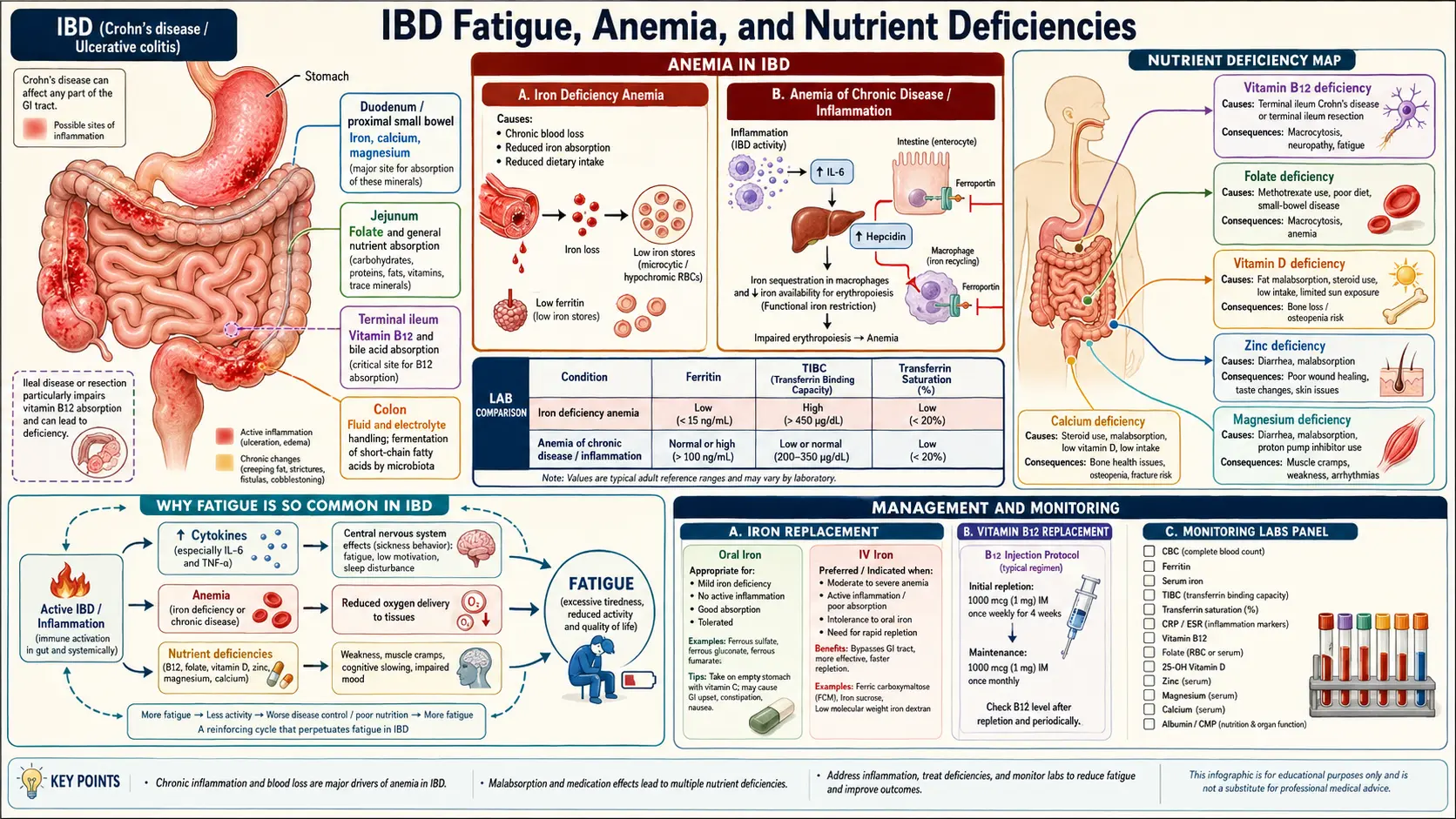
Table of Contents
- Why Fatigue Persists Even in Remission
- Iron Deficiency Anemia — the Most Common IBD Deficiency
- Ferritin in Inflammation — Why <100 Matters in IBD
- Oral Iron vs IV Iron — What the Trials and Guideline Report
- Vitamin B12 and Folate
- Vitamin D Deficiency
- Calcium and Bone Density
- Zinc
- Magnesium
- Protein-Calorie Undernutrition
- Sleep Disruption
- Anxiety, Depression, and the Fatigue Overlap
- Celiac Disease and Other Overlaps
- What Trials Report on Supplements
- Monitoring Intervals the Guidelines Describe
- Key Research Papers
- Connections
- Featured Videos
Why Fatigue Persists Even in Remission
Fatigue is one of the most common symptoms of inflammatory bowel disease, and it does not always go away when the gut inflammation settles. A 2022 systematic review and meta-analysis of 20 studies found a pooled fatigue prevalence of 47% in adults with IBD; prevalence was 72% in active disease and 47% in remission, and it varied with how fatigue was defined (28% for chronic fatigue, 48% for high fatigue) (D'Silva 2022). An earlier 2010 systematic review put the prevalence in patients in remission at 41–48% and found the data sparse and conflicting on whether fatigue severity tracks disease activity (van Langenberg 2010).
The 2022 meta-analysis found that sleep disturbance, anxiety, depression and anemia were the most commonly reported fatigue-related risk factors (D'Silva 2022). The sections below cover these, along with the nutrient deficiencies that reviews describe as common in IBD:
- Iron deficiency and anemia — anemia is described as the most common systemic complication of IBD (Gisbert 2008).
- Other micronutrient deficiencies — a 2015 review reports that micronutrient deficiencies occur in more than half of patients with IBD, more often in Crohn's disease than in ulcerative colitis and more often in active disease than in remission (Weisshof 2015).
- Disrupted sleep — poorer subjective sleep quality than in people without IBD (Ballesio 2021).
- Anxiety and depression — symptoms of both are common in IBD and more common in active disease (Barberio 2021).
Not every proposed cause holds up: a Norwegian study of 405 patients found no association between vitamin D deficiency and fatigue (Frigstad 2018). Questions about the cause of fatigue in a particular person are for the clinician who knows their disease.
Iron Deficiency Anemia — the Most Common IBD Deficiency
The 2015 European Crohn's and Colitis Organisation (ECCO) consensus on iron deficiency and anaemia reports that anaemia is more common in children with IBD (about 70%) than in adults (about 30–40%) (Dignass 2015). A 2015 review describes iron deficiency as the most common cause of anemia in IBD (Weisshof 2015), and a 2008 review lists "anemia is uncommon in IBD" and "iron deficiency is also uncommon" among the common misconceptions that lead to anemia going uninvestigated and untreated (Gisbert 2008).
Iron deficiency anemia and anemia of chronic disease are the two most frequent types of anemia in IBD (Karaskova 2021). Reviews describe the mechanisms this way:
- Inflammation blocks iron use — during inflammation the liver makes more hepcidin, which binds the iron-export protein ferroportin and blocks it, so iron is not absorbed from the bowel and stays locked inside macrophages (Karaskova 2021).
- More than one cause at once — the 2008 review lists as misconceptions the beliefs that iron deficiency is the only cause of anemia in IBD and that treating the intestinal disease will by itself correct the anemia (Gisbert 2008).
Does iron deficiency explain the fatigue? A 2025 systematic review of seven studies (1,425 people) found the evidence heterogeneous: two of three studies comparing iron deficiency without anemia with normal iron status found more fatigue with iron deficiency, while four studies of iron deficiency regardless of hemoglobin gave mixed results. The authors concluded that iron deficiency does not explain all fatigue in IBD (Sartain 2025).
See also the dedicated mineral page on iron.
Ferritin in Inflammation — Why <100 Matters in IBD
Ferritin is the usual blood marker of iron stores, but it is read differently when the bowel is inflamed. A 2008 review lists "ferritin is an accurate parameter for the diagnosis of iron deficiency in IBD" among the common misconceptions (Gisbert 2008). The ECCO consensus states different cutoffs depending on inflammation (Dignass 2015):
- No clinical, endoscopic or biochemical evidence of active disease: a serum ferritin below 30 µg/L is described as an appropriate criterion for iron deficiency.
- Inflammation present: a serum ferritin up to 100 µg/L may still be consistent with iron deficiency.
- Anemia of chronic disease: with biochemical or clinical evidence of inflammation, the criteria given are a serum ferritin above 100 µg/L and a transferrin saturation below 20%.
For laboratory screening, the consensus names a complete blood count, serum ferritin and C-reactive protein (CRP) (Dignass 2015).
Oral Iron vs IV Iron — What the Trials and Guideline Report
The ECCO consensus states that oral iron is effective in IBD and may be used in patients with mild anaemia whose disease is clinically inactive and who have not previously been intolerant of oral iron, and that no more than 100 mg of elemental iron a day is recommended in IBD. It states that intravenous iron should be considered as first-line treatment in patients with clinically active IBD, previous intolerance of oral iron, hemoglobin below 10 g/dL, and in those who need erythropoiesis-stimulating agents (Dignass 2015).
The consensus also notes that studies in animal models of IBD indicate that luminal iron may worsen disease activity and alter the gut microbiota (Dignass 2015). A 2021 review states that oral iron is less effective in IBD and may worsen the underlying disease (Karaskova 2021).
What the trials comparing the two routes found:
- 2012 meta-analysis — three industry-funded randomised trials (333 patients): intravenous iron gave a 6.8 g/L greater rise in hemoglobin and a 110 µg/L greater rise in ferritin, and oral iron had more adverse events (odds of discontinuation 6.2). Disease activity and quality-of-life scores were comparable. The authors described the hemoglobin difference as small and of uncertain clinical significance (Lee 2012).
- 2021 Cochrane review — 11 randomised trials (1,670 participants). Across all comparisons of intravenous with oral iron, intravenous iron may lead to more responders (risk ratio 1.17; low-certainty evidence), and withdrawals due to adverse events may be more common with oral iron. The authors could draw no conclusion about which of most of the individual treatments is most effective, because studies were few and certainty was low or very low (Gordon 2021).
- Ferric carboxymaltose vs iron sucrose (FERGIcor, 2011) — in 485 patients with IBD and iron deficiency anemia, more patients reached a hemoglobin rise of at least 2 g/dL with fixed-dose ferric carboxymaltose (up to 3 infusions) than with individually calculated iron sucrose (up to 11 infusions of 200 mg): 65.8% vs 53.6% (Evstatiev 2011).
- Ferric derisomaltose vs ferric carboxymaltose (PHOSPHARE-IBD, 2023) — in a double-blind trial of 97 adults with IBD, both drugs corrected iron deficiency anemia, but low blood phosphate (below 2.0 mg/dL) occurred in 8.3% after ferric derisomaltose and 51.0% after ferric carboxymaltose. Fatigue scores improved in both groups, more slowly and to a lesser extent with ferric carboxymaltose, and slower improvement was associated with a larger fall in phosphate (Zoller 2023).
The ECCO consensus states that patients should be monitored for recurrent iron deficiency every 3 months for at least a year after correction, and every 6 to 12 months thereafter (Dignass 2015).
Alternate-day oral iron. In two small randomised trials in iron-depleted women aged 18–40, 60 mg of iron given on alternate days for 28 days was absorbed better than the same dose on consecutive days for 14 days (cumulative fractional absorption 21.8% vs 16.3%), and serum hepcidin was higher with daily dosing; splitting a dose into two daily doses raised hepcidin without increasing absorption. The authors wrote that the findings should be confirmed in iron-deficient anemic patients (Stoffel 2017). The trials studied iron-depleted women, not people with IBD.
Vitamin B12 and Folate
A 2014 systematic review of 42 articles (3,732 patients) examined whether IBD — including Crohn's disease of the ileum (the last part of the small intestine) and its surgical removal — predisposes to vitamin B12 deficiency. It found (Battat 2014):
- Crohn's disease without ileal resection — regardless of disease location in the ileum, it did not increase the risk of B12 deficiency.
- Ileal resections longer than 30 cm — associated with B12 deficiency.
- Resections shorter than 20 cm — not associated with deficiency.
- Resections of 20–30 cm — inconsistent results.
- Ulcerative colitis — did not predispose to deficiency.
The review's authors concluded that only ileal resections longer than 20 cm in Crohn's disease predispose to deficiency, that none of the studies used the confirmatory biomarker tests that diagnostic guidelines call for, and that serum B12 alone is likely insufficient to diagnose deficiency in people without symptoms (Battat 2014). A 2015 review likewise states that B12 deficiency cannot be diagnosed definitively from serum levels alone (Weisshof 2015).
The ECCO consensus states that serum vitamin B12 and folic acid should be measured at least once a year, or if red cells are enlarged (macrocytosis), and that B12 and folate deficiencies should be treated to avoid anaemia (Dignass 2015). Folic acid is among the deficiencies a 2015 review lists as most common in IBD (Weisshof 2015).
See the full page on vitamin B12.
Vitamin D Deficiency
In a 2015 meta-analysis of 14 observational studies (938 people with IBD and 953 controls), people with IBD had 64% higher odds of vitamin D deficiency (25-hydroxyvitamin D of 20 ng/mL or less) than controls (odds ratio 1.64), and people with ulcerative colitis more than double the odds (odds ratio 2.28); latitude did not change the association (Del Pinto 2015). In the Norwegian study of 405 patients, half had vitamin D below 50 nmol/L (Frigstad 2018).
The 2024 American Gastroenterological Association (AGA) clinical practice update states that all patients with IBD should be monitored for vitamin D and iron deficiency (Hashash 2024).
What supplementation trials found: a 2020 meta-analysis of 12 randomised trials (611 patients) and 4 observational studies found that vitamin D supplementation raised blood 25-hydroxyvitamin D by 15.5 ng/mL on average in the trials, and was associated with a 1.47-point improvement in the Harvey-Bradshaw disease-activity index and a 1.58 mg/L fall in high-sensitivity CRP (Guzman-Prado 2020). Vitamin D levels were not associated with fatigue in the Norwegian study (Frigstad 2018).
See the full page on vitamin D.
Calcium and Bone Density
A 2020 systematic review of 12 population-based studies (3,661 people with IBD and 12,789 controls) found osteoporosis prevalence of 4–9% in studies of mixed Crohn's and ulcerative colitis patients, 2–9% in ulcerative colitis and 7–15% in Crohn's disease, against 3% and 10% in the two studies that reported controls. Crohn's disease, lower body mass index and lower body weight were risk factors for osteoporosis or low bone density; people with Crohn's disease had an increasing risk over time, while those with ulcerative colitis did not. Results varied considerably between studies (Kärnsund 2020).
A 2015 review describes the relationship between vitamin D and vitamin K deficiency and bone disease in IBD as controversial (Weisshof 2015).
Zinc
Zinc is among the deficiencies a 2015 review lists as most common in IBD (Weisshof 2015). In a registry study of 773 people with Crohn's disease and 223 with ulcerative colitis, zinc deficiency (serum zinc below 0.66 µg/mL) was associated with more subsequent IBD-related hospitalisations (odds ratio 1.44), surgeries (2.05) and complications (1.50) in Crohn's disease; in ulcerative colitis the association with hospitalisation was significant (odds ratio 2.14), while those for surgery and complications were not. Normalisation of zinc levels was associated with better outcomes. This was an observational study, so it shows an association, not that zinc caused the difference (Siva 2017).
Magnesium
A 2024 systematic review of eight small studies (453 people with Crohn's disease and 292 controls) found slightly lower serum magnesium in Crohn's disease than in controls (0.79 vs 0.82 mmol/L), with up to 50% prevalence of low magnesium in one study, and associations between low magnesium and longer time to fall asleep, shorter sleep and higher CRP. Its authors wrote that more rigorous research is needed (Costescu 2024).
See the full page on magnesium.
Protein-Calorie Undernutrition
The 2024 AGA update describes malnutrition as an under-recognised condition in IBD that dietary restrictions and the complications of IBD can cause. It states that all patients with IBD warrant regular screening for malnutrition by assessing signs such as unintended weight loss, fluid retention and loss of fat and muscle, with fuller evaluation by a registered dietitian when malnutrition is found, and that serum proteins are no longer recommended for diagnosing malnutrition because they are not specific and are highly sensitive to inflammation. It describes exclusive enteral nutrition (a liquid formula as the only food) as effective for inducing remission in Crohn's disease, with stronger evidence in children than adults, and as possibly effective before elective Crohn's surgery in malnourished patients (Hashash 2024).
A 2023 systematic review of 35 studies estimated that 42% of adults with IBD have low muscle mass (myopenia), 34% pre-sarcopenia and 17% sarcopenia; low muscle mass was associated with therapy failure, postoperative complications and low bone density, and two studies found that a personalised high-protein nutrition plan improved muscle mass (Fatani 2023).
Sleep Disruption
A 2021 meta-analysis of 42 studies found poorer subjective sleep quality in people with IBD than in controls (moderate effect size), no difference between Crohn's disease and ulcerative colitis, and poorer sleep in active disease than in remission (large effect size). Results on objectively recorded sleep were mixed, with no clear evidence of objective sleep impairment (Ballesio 2021). Sleep disturbance was one of the most commonly reported fatigue risk factors in the 2022 fatigue meta-analysis (D'Silva 2022) and was associated with fatigue in the Norwegian cohort (Frigstad 2018).
Anxiety, Depression, and the Fatigue Overlap
A 2021 meta-analysis of 77 studies (30,118 patients) found a pooled prevalence of anxiety symptoms of 32.1% and of depression symptoms of 25.2% in IBD. Prevalence was higher in active disease (anxiety 57.6%, depression 38.9%) than in inactive disease, higher in Crohn's disease than in ulcerative colitis, and higher in women than in men (Barberio 2021). The authors note that these symptoms may arise both through two-way gut-brain communication and from the chronic course of the disease and its effect on quality of life (Barberio 2021).
Anxiety and depression were among the most commonly reported fatigue risk factors in the 2022 meta-analysis (D'Silva 2022). On treatment, a 2021 systematic review found four randomised trials of psychological interventions for IBD fatigue; cognitive behavioural therapy showed the largest effect, but the results were not statistically significant because the studies were small and underpowered, and the reviewers described the evidence as scant and low quality (Emerson 2021).
Celiac Disease and Other Overlaps
A 2020 meta-analysis of 65 studies found moderate-certainty evidence of an increased risk of celiac disease in people with IBD compared with controls (risk ratio 3.96), and of IBD in people with celiac disease (risk ratio 9.88) (Pinto-Sanchez 2020). See the dedicated page on celiac disease.
Because fatigue in IBD has several overlapping causes (D'Silva 2022), questions about which other conditions to look for belong with a clinician.
What Trials Report on Supplements
Repletion of a documented deficiency is covered in the sections above. Beyond that, a few supplements have been tested in IBD trials:
- Curcumin — a 2025 meta-analysis of eight randomised trials (482 patients with ulcerative colitis) found that curcumin added to standard therapy improved clinical remission compared with placebo (risk ratio 2.33), while the trend for endoscopic remission was not statistically significant. Heterogeneity was high, and the authors called for larger trials (Peng 2025).
- The probiotic E. coli Nissle 1917 — in a 12-month double-blind trial of 327 people with ulcerative colitis in remission, relapse rates were 36.4% with the probiotic and 33.9% with mesalazine, and the authors judged the two equivalent (Kruis 2004).
- Vitamin D — see the vitamin D section for the 2020 meta-analysis (Guzman-Prado 2020).
Decisions about medicines and supplements belong with a clinician.
Monitoring Intervals the Guidelines Describe
The intervals below are reported as the guidelines publish them:
- Blood count, ferritin and CRP — every 6 to 12 months in remission or mild disease, and at least every 3 months in outpatients with active disease (ECCO; Dignass 2015).
- After iron deficiency has been corrected — every 3 months for at least a year, then every 6 to 12 months (ECCO; Dignass 2015).
- Vitamin B12 and folic acid — at least once a year, or if red cells are enlarged (ECCO; Dignass 2015).
- Vitamin D and iron — monitoring in all patients with IBD (AGA; Hashash 2024).
- Malnutrition — regular screening in all patients (AGA; Hashash 2024).
Key Research Papers
- Dignass AU, Gasche C, Bettenworth D, et al. European consensus on the diagnosis and management of iron deficiency and anaemia in inflammatory bowel diseases. J Crohns Colitis. 2015;9(3):211-22. — doi:10.1093/ecco-jcc/jju009 (PubMed PMID: 25518052)
- Bischoff SC, Bager P, Escher J, et al. ESPEN guideline on Clinical Nutrition in inflammatory bowel disease. Clin Nutr. 2023;42(3):352-379. — doi:10.1016/j.clnu.2022.12.004 (PubMed PMID: 36739756)
- Stoffel NU, Cercamondi CI, Brittenham G, et al. Iron absorption from oral iron supplements given on consecutive versus alternate days and as single morning doses versus twice-daily split dosing in iron-depleted women: two open-label, randomised controlled trials. Lancet Haematol. 2017;4(11):e524-e533. — doi:10.1016/S2352-3026(17)30182-5 (PubMed PMID: 29032957)
- Gisbert JP, Gomollón F. Common misconceptions in the diagnosis and management of anemia in inflammatory bowel disease. Am J Gastroenterol. 2008;103(5):1299-307. — doi:10.1111/j.1572-0241.2008.01846.x (PubMed PMID: 18477354)
- Weisshof R, Chermesh I. Micronutrient deficiencies in inflammatory bowel disease. Curr Opin Clin Nutr Metab Care. 2015;18(6):576-81. — doi:10.1097/MCO.0000000000000226 (PubMed PMID: 26418823)
- D'Silva A, Fox DE, Nasser Y, et al. Prevalence and Risk Factors for Fatigue in Adults With Inflammatory Bowel Disease: A Systematic Review With Meta-Analysis. Clin Gastroenterol Hepatol. 2022;20(5):995-1009.e7. — doi:10.1016/j.cgh.2021.06.034 (PubMed PMID: 34216824)
- van Langenberg DR, Gibson PR. Systematic review: fatigue in inflammatory bowel disease. Aliment Pharmacol Ther. 2010;32(2):131-43. — doi:10.1111/j.1365-2036.2010.04347.x (PubMed PMID: 20456309)
- Guzman-Prado Y, Samson O, Segal JP, et al. Vitamin D Therapy in Adults With Inflammatory Bowel Disease: A Systematic Review and Meta-Analysis. Inflamm Bowel Dis. 2020;26(12):1819-1830. — doi:10.1093/ibd/izaa087 (PubMed PMID: 32385487)
- Battat R, Kopylov U, Szilagyi A, et al. Vitamin B12 deficiency in inflammatory bowel disease: prevalence, risk factors, evaluation, and management. Inflamm Bowel Dis. 2014;20(6):1120-8. — doi:10.1097/MIB.0000000000000024 (PubMed PMID: 24739632)
- Gordon M, Sinopoulou V, Iheozor-Ejiofor Z, et al. Interventions for treating iron deficiency anaemia in inflammatory bowel disease. Cochrane Database Syst Rev. 2021;1:CD013529. — doi:10.1002/14651858.CD013529.pub2 (PubMed PMID: 33471939)
- Lee TW, Kolber MR, Fedorak RN, et al. Iron replacement therapy in inflammatory bowel disease patients with iron deficiency anemia: a systematic review and meta-analysis. J Crohns Colitis. 2012;6(3):267-75. — doi:10.1016/j.crohns.2011.09.010 (PubMed PMID: 22405161)
- Evstatiev R, Marteau P, Iqbal T, et al. FERGIcor, a randomized controlled trial on ferric carboxymaltose for iron deficiency anemia in inflammatory bowel disease. Gastroenterology. 2011;141(3):846-853.e1-2. — doi:10.1053/j.gastro.2011.06.005 (PubMed PMID: 21699794)
- Zoller H, Wolf M, Blumenstein I, et al. Hypophosphataemia following ferric derisomaltose and ferric carboxymaltose in patients with iron deficiency anaemia due to inflammatory bowel disease (PHOSPHARE-IBD): a randomised clinical trial. Gut. 2023;72(4):644-653. — doi:10.1136/gutjnl-2022-327897 (PubMed PMID: 36343979)
- Sartain S, Al-Ezairej M, McDonnell M, et al. Iron deficiency and fatigue in inflammatory bowel disease: A systematic review. PLoS One. 2025;20(1):e0304293. — doi:10.1371/journal.pone.0304293 (PubMed PMID: 39804874)
- Frigstad SO, Høivik ML, Jahnsen J, et al. Fatigue is not associated with vitamin D deficiency in inflammatory bowel disease patients. World J Gastroenterol. 2018;24(29):3293-3301. — doi:10.3748/wjg.v24.i29.3293 (PubMed PMID: 30090009)
- Barberio B, Zamani M, Black CJ, et al. Prevalence of symptoms of anxiety and depression in patients with inflammatory bowel disease: a systematic review and meta-analysis. Lancet Gastroenterol Hepatol. 2021;6(5):359-370. — doi:10.1016/S2468-1253(21)00014-5 (PubMed PMID: 33721557)
- Del Pinto R, Pietropaoli D, Chandar AK, et al. Association Between Inflammatory Bowel Disease and Vitamin D Deficiency: A Systematic Review and Meta-analysis. Inflamm Bowel Dis. 2015;21(11):2708-17. — doi:10.1097/MIB.0000000000000546 (PubMed PMID: 26348447)
- Siva S, Rubin DT, Gulotta G, et al. Zinc Deficiency is Associated with Poor Clinical Outcomes in Patients with Inflammatory Bowel Disease. Inflamm Bowel Dis. 2017;23(1):152-157. — doi:10.1097/MIB.0000000000000989 (PubMed PMID: 27930412)
- Kärnsund S, Lo B, Bendtsen F, et al. Systematic review of the prevalence and development of osteoporosis or low bone mineral density and its risk factors in patients with inflammatory bowel disease. World J Gastroenterol. 2020;26(35):5362-5374. — doi:10.3748/wjg.v26.i35.5362 (PubMed PMID: 32994694)
- Fatani H, Olaru A, Stevenson R, et al. Systematic review of sarcopenia in inflammatory bowel disease. Clin Nutr. 2023;42(8):1276-1291. — doi:10.1016/j.clnu.2023.05.002 (PubMed PMID: 37352818)
- Emerson C, Barhoun P, Olive L, et al. A systematic review of psychological treatments to manage fatigue in patients with inflammatory bowel disease. J Psychosom Res. 2021;147:110524. — doi:10.1016/j.jpsychores.2021.110524 (PubMed PMID: 34034138)
- Pinto-Sanchez MI, Seiler CL, Santesso N, et al. Association Between Inflammatory Bowel Diseases and Celiac Disease: A Systematic Review and Meta-Analysis. Gastroenterology. 2020;159(3):884-903.e31. — doi:10.1053/j.gastro.2020.05.016 (PubMed PMID: 32416141)
- Kruis W, Fric P, Pokrotnieks J, et al. Maintaining remission of ulcerative colitis with the probiotic Escherichia coli Nissle 1917 is as effective as with standard mesalazine. Gut. 2004;53(11):1617-23. — doi:10.1136/gut.2003.037747 (PubMed PMID: 15479682)
- Peng Z, Li D, Wu N, et al. Safety and efficacy of curcumin in the treatment of ulcerative colitis: An updated systematic review and meta-analysis of randomized controlled trials. Explore (NY). 2025;21(1):103083. — doi:10.1016/j.explore.2024.103083 (PubMed PMID: 39612780)
- Hashash JG, Elkins J, Lewis JD, et al. AGA Clinical Practice Update on Diet and Nutritional Therapies in Patients With Inflammatory Bowel Disease: Expert Review. Gastroenterology. 2024;166(3):521-532. — doi:10.1053/j.gastro.2023.11.303 (PubMed PMID: 38276922)
- Karaskova E, Pospisilova D, Velganova-Veghova M, et al. Importance of Hepcidin in the Etiopathogenesis of Anemia in Inflammatory Bowel Disease. Dig Dis Sci. 2021;66(10):3263-3269. — doi:10.1007/s10620-020-06652-1 (PubMed PMID: 33063192)
- Costescu S, Bratosin F, Popa ZL, et al. Does Magnesium Provide a Protective Effect in Crohn's Disease Remission? A Systematic Review of the Literature. Nutrients. 2024;16(11):1662. — doi:10.3390/nu16111662 (PubMed PMID: 38892595)
- Ballesio A, Zagaria A, Baccini F, et al. A meta-analysis on sleep quality in inflammatory bowel disease. Sleep Med Rev. 2021;60:101518. — doi:10.1016/j.smrv.2021.101518 (PubMed PMID: 34214847)
PubMed Topic Searches
For further reading, the following PubMed topic searches return current peer-reviewed work on fatigue, anemia, and nutrient deficiencies in IBD:
- PubMed: IBD and fatigue
- PubMed: Iron deficiency anemia in IBD
- PubMed: Ferric carboxymaltose in IBD
- PubMed: Ferric derisomaltose and iron deficiency
- PubMed: Vitamin B12 and ileal resection in Crohn's disease
- PubMed: Vitamin D in IBD
- PubMed: Bone density and osteoporosis in IBD
- PubMed: Zinc deficiency in Crohn's disease
- PubMed: Magnesium deficiency in IBD
- PubMed: Sarcopenia in IBD
- PubMed: Depression and anxiety in IBD
- PubMed: Celiac disease and IBD overlap
Connections
- Gastroenterology
- Inflammatory Bowel Disease Overview
- Crohn's vs Ulcerative Colitis: Key Differences
- Diagnostic Workup: Calprotectin, Colonoscopy, MRE
- Biologics: TNF, IL-23, and Integrin Inhibitors
- Diet for IBD: SCD and Mediterranean
- IBD Surgery Decisions
- Extraintestinal Manifestations: Joints, Skin, Eyes
- Pregnancy and IBD
- JAK Inhibitors and S1P Modulators
- Crohn's Disease
- Celiac Disease
- Iron
- Vitamin B12
- Vitamin D3
- Magnesium
- Zinc
- Anemia
- Vitamin B12 Lab Test