Pregnancy and IBD: Fertility, Medications, and Outcomes
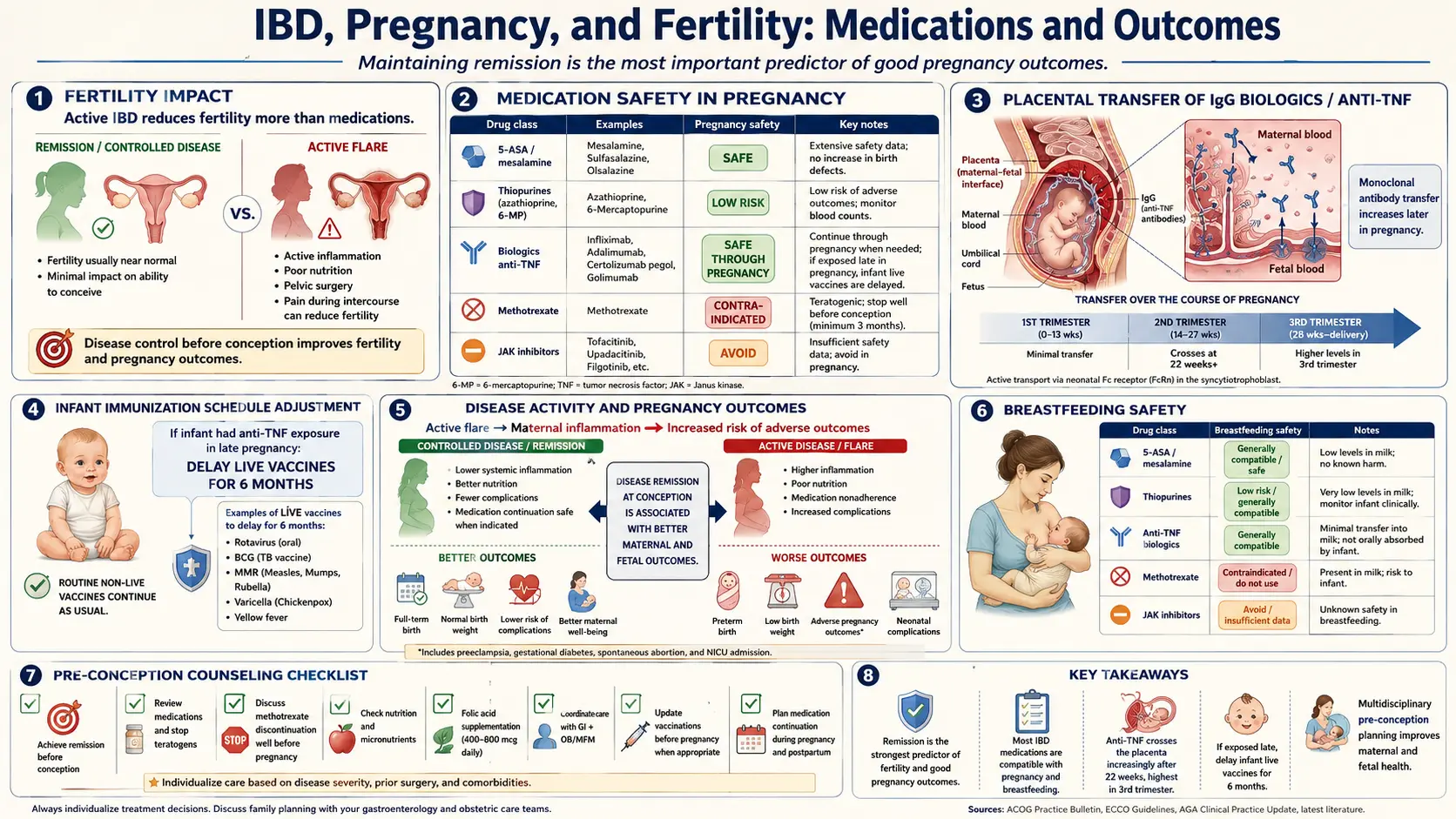
Table of Contents
- The Big Picture: What the Research Links to Pregnancy Outcomes
- Preconception Counseling — What the Guidelines Describe
- Fertility and IBD
- Medications the Guidelines Describe Continuing
- Medications the Guidelines and Labels Single Out Before Conception
- Newer Drugs: JAK Inhibitors and S1P Modulators
- Monitoring Disease Activity During Pregnancy
- Delivery Mode: Vaginal vs. C-Section
- Postpartum Flare Risk
- Breastfeeding on IBD Medications
- The Baby: Live Vaccines After In-Utero Biologic Exposure
- The PIANO Registry — What It Actually Found
- Planning Topics the Guidelines Cover
- Key Research Papers
- Connections
- Featured Videos
The Big Picture: What the Research Links to Pregnancy Outcomes
The 2025 Global Consensus Statement on the Management of Pregnancy in Inflammatory Bowel Disease was written by 39 IBD and content experts and 7 patient advocates from 6 continents, and contains 34 GRADE recommendations and 35 consensus statements. Its authors state that the recommendations were informed by the guiding principle that maternal health best supports infant health, and one of its statements is that controlling disease activity during pregnancy is critical to reduce adverse outcomes (Mahadevan 2025).
The European Crohn's and Colitis Organisation (ECCO) guidelines on sexuality, fertility, pregnancy and lactation, published online in 2022, report that active disease at conception increases the risk of adverse birth outcomes such as preterm birth, low birthweight and small for gestational age, while quiescent IBD at conception is associated with pregnancy outcomes similar to the non-IBD population (Torres 2023). The Global Consensus suggests counselling that women with IBD have an increased risk of adverse pregnancy outcomes including low birth weight and preterm delivery, that moderate to severe disease activity raises the risk of spontaneous abortion, and that children born to women with active IBD have higher rates of small for gestational age and low birth weight (Mahadevan 2025).
On the medicines themselves, the U.S. PIANO cohort found that exposure in the womb to biologics, thiopurines or both did not increase congenital malformations, spontaneous abortions, preterm birth, low birth weight or infections in the first year of life, while higher disease activity was associated with spontaneous abortion (Mahadevan 2021). The PIANO authors describe the 2019 American Gastroenterological Association (AGA) IBD Parenthood Project care pathway as recommending that biologic therapy continue through pregnancy (Mahadevan 2021). The 2016 Toronto Consensus states that, in general, women on 5-ASA, thiopurine or anti-TNF monotherapy for maintenance should continue therapy throughout pregnancy (Nguyen 2016). The sections below report what these guidelines, the PIANO data and the U.S. prescribing information say, drug by drug. Decisions about medicines before and during pregnancy belong with a clinician.
Preconception Counseling — What the Guidelines Describe
The Global Consensus recommends that women with IBD undergo preconception counselling (strong recommendation, low certainty of evidence) and states that women with IBD should be in documented remission and medically optimized prior to elective conception (Mahadevan 2025). The ECCO guidelines state that IBD remission before conception is recommended (Torres 2023), and the Toronto Consensus describes preconception counselling and access to specialist care as paramount (Nguyen 2016).
- Fecal calprotectin. The guideline statements reviewed for this page give no pregnancy-specific calprotectin target. The Global Consensus states that fecal calprotectin is useful for monitoring disease activity in pregnant women with IBD (Mahadevan 2025). Outside pregnancy, the 2023 AGA biomarker guidelines state that for people in symptomatic remission, a calprotectin below 150 µg/g with a normal CRP (Crohn's disease), or below 150 µg/g with a normal fecal lactoferrin and/or a normal CRP (ulcerative colitis), rules out active inflammation (Ananthakrishnan 2023; Singh 2023). The cutoffs used for a first diagnosis are different and are covered on the diagnostic workup page.
- Nutrition. The Global Consensus states that women with IBD should be assessed early in pregnancy or preconception for nutritional status, weight gain and micronutrient deficiency (Mahadevan 2025). Iron deficiency and other deficiencies in IBD are covered in the fatigue and anemia article.
- Folic acid. The ECCO guidelines state that patients planning pregnancy should be advised to take supplemental folic acid, with a higher dose (2 mg/day) for women taking sulfasalazine (Torres 2023).
- Low-dose aspirin. The Global Consensus suggests that pregnant women with IBD take low-dose aspirin by 12 to 16 weeks' gestation (conditional recommendation, low certainty) (Mahadevan 2025).
Fertility and IBD
The Global Consensus suggests counselling that women with IBD may have decreased fertility (conditional, very low certainty), recommends counselling that active disease increases the risk of infertility (strong, very low certainty), and states that women with IBD may have reduced fertility due to reduced ovarian reserve (Mahadevan 2025). The ECCO guidelines state that IBD-related pelvic surgeries lead to decreased fertility and fecundity rates in women (Torres 2023).
Ileal pouch-anal anastomosis (IPAA / J-pouch) in women
In a 2006 meta-analysis of eight studies, after one study with very high preoperative infertility (38%) was omitted, the relative risk of infertility after IPAA compared with medical management of ulcerative colitis was 3.17 (95% CI 2.41–4.18). The weighted average infertility rate, defined by whether pregnancy was achieved within 12 months of trying, was 15% in medically treated ulcerative colitis and 48% after IPAA; the authors could not identify any procedural factor that consistently affected the risk (Waljee 2006). The Global Consensus suggests counselling that prior IPAA is associated with decreased fertility (Mahadevan 2025).
- Laparoscopic surgery. The ECCO guidelines state that laparoscopic surgical approaches may lower the risk of infertility, and describe laparoscopic IPAA as seeming to be associated with lower infertility rates than open surgery because of reduced pelvic adhesions (Torres 2023).
- Assisted reproduction. The Global Consensus suggests counselling that women with IBD may have comparable effectiveness of assisted reproductive technology, that women who have had pelvic surgery have similar effectiveness of in vitro fertilization, and states that women with IBD may undergo oocyte retrieval without an increased risk of flare (Mahadevan 2025).
Sulfasalazine and male fertility
The ECCO guidelines state that sulfasalazine is associated with reversible oligospermia (low sperm count) and asthenozoospermia (reduced sperm motility). They cite a meta-analysis of four studies comparing 2–4 g/day of sulfasalazine with mesalamine as the strongest evidence, and note that men taking sulfasalazine may be switched to mesalamine (Torres 2023).
On methotrexate in men, the ECCO guidelines report that it can induce sperm DNA damage in animal studies, but that a systematic review did not find a direct influence on sperm integrity, fertility or the risks associated with conception (Torres 2023). The U.S. prescribing information for methotrexate tablets advises men with female partners of reproductive potential to use effective contraception during treatment and for 3 months after the final dose (methotrexate prescribing information, DailyMed).
Medications the Guidelines Describe Continuing
The Global Consensus statements below apply to women with IBD who are pregnant or attempting conception (Mahadevan 2025). The strength and certainty ratings are the consensus group's own.
Mesalamine (5-ASA) and sulfasalazine
The Global Consensus recommends continuing maintenance 5-aminosalicylate therapy (strong recommendation, low certainty) and suggests continuing maintenance sulfasalazine therapy (conditional, very low certainty) (Mahadevan 2025).
Azathioprine and 6-mercaptopurine
The Global Consensus suggests continuing maintenance thiopurine therapy (conditional, very low certainty). Its consensus statements add that women with active disease in pregnancy should start or optimize the same therapies as non-pregnant patients except thiopurines, methotrexate, JAK inhibitors and S1P receptor modulators, and that in women who continue thiopurines, precautions for intrahepatic cholestasis of pregnancy include measuring liver enzymes and metabolite levels and considering split dosing (Mahadevan 2025). The ECCO guidelines state that patients on thiopurine monotherapy can continue treatment throughout pregnancy, that stopping the thiopurine may be considered individually when it is combined with a biologic in a patient in long-term remission, and that starting thiopurine monotherapy during pregnancy is generally not recommended because of its slow onset of action (Torres 2023). In PIANO, 242 pregnancies were exposed to thiopurines alone and 227 to a thiopurine plus a biologic (Mahadevan 2021).
Anti-TNF biologics
Maternal antibodies cross the placenta through the neonatal Fc receptor (FcRn). IgG levels in fetal blood rise from early in the second trimester until delivery, with most antibody transferred in the third trimester, and IgG1 is the most efficiently transported subclass; infliximab and adalimumab are IgG1 antibodies (Mahadevan 2013). In a study of 31 pregnant women, the median cord-blood level was 160% of the mother's for infliximab and 153% for adalimumab, and both drugs could be detected in infants for as long as 6 months; no congenital anomalies or serious complications were reported (Mahadevan 2013).
What the guidelines say about continuing anti-TNF therapy:
- The Global Consensus recommends continuing maintenance anti-TNF therapy throughout pregnancy (strong, low certainty) and suggests continuing combination therapy with an anti-TNF and a thiopurine (conditional, very low certainty) (Mahadevan 2025).
- The ECCO guidelines recommend continuing anti-TNF therapy throughout pregnancy for women with active disease just before or during pregnancy, or with disease that is difficult to control, with the last third-trimester dose timed to the presumed due date to reduce fetal exposure. For women in remission, they state that stopping anti-TNF therapy before the third trimester is not recommended, as it may increase the risk of relapse; if a patient in long-term remission chooses to stop, they recommend resuming shortly after delivery (Torres 2023).
- The 2016 Toronto Consensus states that stopping anti-TNF therapy, or switching from combination therapy to monotherapy, may be considered in very select low-risk patients (Nguyen 2016).
- In PIANO, stopping a biologic in the third trimester was not associated with a higher risk of flare after delivery (Mahadevan 2021).
Certolizumab pegol is a PEGylated (polyethylene glycol-linked) Fab′ fragment with no Fc portion, so in theory it should not be actively transported across the placenta. The median cord-blood level was 3.9% of the mother's (Mahadevan 2013), and in PIANO it was the only biologic for which infants did not have detectable concentrations at delivery (Mahadevan 2021). Drug-by-drug detail is in the biologics article.
Ustekinumab and vedolizumab
The Global Consensus suggests continuing maintenance ustekinumab and vedolizumab therapy throughout pregnancy (each a conditional recommendation, low certainty) (Mahadevan 2025). The ECCO guidelines call for an individualised decision on stopping these non-TNF biologics in women in remission, weighing the risk of relapse against the limited data on the consequences of fetal exposure (Torres 2023). PIANO included 41 vedolizumab-exposed and 18 ustekinumab-exposed pregnancies (Mahadevan 2021). In a study of 57 infants, vedolizumab was undetectable at a median of 10.7 weeks of age (Ernest-Suarez 2025).
Anti-IL-23 biologics (risankizumab, mirikizumab, guselkumab)
A Global Consensus statement says that women with IBD who are pregnant or attempting conception should continue anti-interleukin-23 therapy throughout pregnancy (Mahadevan 2025).
Corticosteroids
The Global Consensus suggests corticosteroid use during pregnancy when clinically necessary (conditional, low certainty) (Mahadevan 2025). The ECCO guidelines list infections, hypertension, diabetes and preeclampsia as potential adverse events of corticosteroids and state that anti-TNF agents are preferred over prolonged corticosteroid use (Torres 2023). See the gestational diabetes article.
Medications the Guidelines and Labels Single Out Before Conception
Methotrexate — contraindicated in pregnancy
The U.S. prescribing information for methotrexate tablets carries a boxed warning that methotrexate can cause embryo-fetal toxicity, including fetal death, and that it is contraindicated in pregnancy for non-cancer diseases. It reports that first-trimester exposure is associated with more spontaneous abortions and with skull anomalies, facial dysmorphism, central nervous system and limb abnormalities, and sometimes cardiac anomalies and intellectual impairment. The label advises women of reproductive potential to use effective contraception during treatment and for 6 months after the final dose, and men with female partners of reproductive potential for 3 months after the final dose (methotrexate prescribing information, DailyMed). The ECCO guidelines state that methotrexate is contraindicated during pregnancy (Torres 2023), and the Global Consensus recommends discontinuing maintenance methotrexate therapy before conception (strong, very low certainty) (Mahadevan 2025).
Thalidomide
The U.S. prescribing information for thalidomide carries a boxed warning that it can cause severe birth defects or embryo-fetal death if taken during pregnancy, that even a single dose taken by a pregnant woman can cause severe birth defects, that pregnancy must be excluded before treatment and prevented with two reliable methods of contraception, and that the drug is available only through a restricted distribution program (thalidomide prescribing information, DailyMed).
JAK inhibitors and S1P receptor modulators
The ECCO guidelines state that JAK inhibitors and S1P receptor modulators should currently be avoided during pregnancy (Torres 2023). The stated washout intervals are in the next section.
Antibiotics
Antibiotics are sometimes used for perianal Crohn's disease or pouchitis. A Global Consensus statement says that pregnant women with IBD who have infections, a fistula or pouchitis requiring antibiotics may take an appropriate course of a low-risk antibiotic (Mahadevan 2025).
Newer Drugs: JAK Inhibitors and S1P Modulators
Two oral drug classes, Janus kinase (JAK) inhibitors and sphingosine-1-phosphate (S1P) receptor modulators, are now used in IBD. The U.S. prescribing information for these drugs reports harm in animal studies and describes the human pregnancy data as insufficient. A Global Consensus statement lists JAK inhibitors and S1P receptor modulators among the drugs that are not started or optimized for active disease in pregnancy (Mahadevan 2025).
JAK inhibitors: tofacitinib, upadacitinib and filgotinib
- Tofacitinib. The U.S. prescribing information reports fetocidal and teratogenic effects in pregnant rats and rabbits at exposures 73 and 6.3 times the maximum recommended dose, and states that the available human data are insufficient to draw conclusions about a drug-associated risk (tofacitinib prescribing information, DailyMed).
- Upadacitinib. The U.S. prescribing information reports skeletal malformations in rats, cardiovascular malformations and increased post-implantation loss in rabbits, and decreased fetal body weight in both, states that human data are not sufficient to evaluate the risk, and advises effective contraception during treatment and for 4 weeks after the final dose (upadacitinib prescribing information, DailyMed).
- Global Consensus. Its statements say that women with IBD should discontinue tofacitinib, upadacitinib and filgotinib at least 4 weeks before conception unless there is no effective alternative therapy to maintain maternal health (Mahadevan 2025).
S1P modulators: ozanimod and etrasimod
- Ozanimod. The U.S. prescribing information reports embryolethality, an increase in fetal malformations and neurobehavioral changes in animal studies, states that it takes approximately 3 months to eliminate the drug from the body, and advises effective contraception during treatment and for 3 months after stopping (ozanimod prescribing information, DailyMed).
- Etrasimod. The U.S. prescribing information reports embryolethality and fetal malformations in rats and rabbits and advises effective contraception during treatment and for one week after stopping (etrasimod prescribing information, DailyMed).
- Global Consensus. Its statements say that women with IBD should discontinue ozanimod at least 3 months, and etrasimod at least 1 to 2 weeks, before conception unless there is no effective alternative therapy to maintain maternal health (Mahadevan 2025).
How these drugs work is covered in the JAK and S1P article.
Monitoring Disease Activity During Pregnancy
The Global Consensus states that pregnancies in women with IBD should be considered at high risk of complications (Mahadevan 2025), and the ECCO guidelines state that a multidisciplinary team including an experienced gastroenterologist, obstetrician and surgeon may help optimise outcomes in pregnant women with a flare (Torres 2023). On tests during pregnancy:
- Fecal calprotectin. Described by the Global Consensus as useful for monitoring disease activity in pregnant women with IBD (Mahadevan 2025).
- Endoscopy. The Global Consensus describes endoscopy in pregnancy as low risk but states that it should only be performed if it may change management (Mahadevan 2025). The ECCO guidelines state that endoscopy can be performed when needed to guide clinical decisions and that capsule endoscopy during pregnancy is considered a contraindication (Torres 2023). The Toronto Consensus states that endoscopy or urgent surgery should not be delayed during pregnancy if indicated (Nguyen 2016).
- Imaging. The Global Consensus states that if cross-sectional imaging is needed, intestinal ultrasound and MRI without gadolinium are preferred to CT (Mahadevan 2025); the ECCO guidelines describe ultrasonography and MRI without gadolinium as radiation-free alternatives recommended instead of a CT scan (Torres 2023).
- Surgery. The Global Consensus suggests that urgent and emergent IBD surgery during pregnancy be completed when required (conditional, very low certainty) (Mahadevan 2025).
- Blood clots. The Global Consensus suggests counselling that pregnant women with IBD have an increased risk of venous thromboembolism during pregnancy and after delivery (Mahadevan 2025).
Delivery Mode: Vaginal vs. C-Section
The 2016 Toronto Consensus states that decisions about cesarean delivery should be based on obstetric considerations and not on the diagnosis of IBD alone, with the exception of women with active perianal Crohn's disease (Nguyen 2016). The 2025 Global Consensus covers three situations:
- Active perianal Crohn's disease. It suggests cesarean delivery (conditional, very low certainty) (Mahadevan 2025). The ECCO guidelines state that patients with perianal fistulising disease need timely consultation on the mode of delivery, discussing the patient's preferences and the risk of sphincter injury against the risk of a C-section (Torres 2023).
- Rectovaginal fistula. A consensus statement says that women with a current or past rectovaginal fistula should deliver by cesarean (Mahadevan 2025).
- Ileal pouch (IPAA / J-pouch). It suggests that women with a prior IPAA consider cesarean delivery (conditional, very low certainty) (Mahadevan 2025). The ECCO guidelines state that having an IPAA does not affect pregnancy outcomes (Torres 2023).
In PIANO, 44% of births were by cesarean section, and women on biologics or combination therapy had higher cesarean rates than unexposed women (Mahadevan 2021).
Postpartum Flare Risk
In a retrospective study of 206 women with IBD at two referral institutions, 65 (31.6%) had a flare within the year after delivery. Flare after delivery was predicted by disease activity in the third trimester (odds ratio 6.27), by reducing or stopping therapy during pregnancy (odds ratio 3.00) and by reducing or stopping therapy after pregnancy (odds ratio 4.43); it was not related to disease type, disease duration or mode of childbirth (Yu 2020).
In a prospective European study of 209 pregnant women with IBD compared with non-pregnant women with IBD, the course of Crohn's disease during pregnancy and in the 6 months after delivery was similar to that of non-pregnant women, while women with ulcerative colitis were more likely to relapse both during pregnancy (relative risk 2.19) and after delivery (Pedersen 2013). In PIANO, rates of postpartum flare did not differ between Crohn's disease and ulcerative colitis, and a higher share of the women who flared in the first and third trimesters and after delivery were not on biologics or immunomodulators (Mahadevan 2021).
The ECCO guidelines recommend resuming anti-TNF therapy shortly after delivery when a patient in long-term remission has chosen to stop it before the third trimester (Torres 2023).
Breastfeeding on IBD Medications
The Global Consensus recommends breastfeeding, stating that it is not associated with an increased risk of disease flare (strong, very low certainty), and suggests counselling that infants of mothers on anti-TNF therapy who breastfeed have no increased risk of infection (Mahadevan 2025). The 2016 Toronto Consensus states that, with the exception of methotrexate, the use of IBD medications should not influence the decision to breastfeed, and vice versa (Nguyen 2016).
The Global Consensus statements by drug class (Mahadevan 2025):
- 5-aminosalicylates and sulfasalazine: mothers may breastfeed.
- Thiopurines (azathioprine, 6-mercaptopurine): mothers may breastfeed.
- Corticosteroids: mothers may breastfeed.
- Anti-TNF agents (infliximab, adalimumab, golimumab, certolizumab): mothers may breastfeed.
- Anti-integrins (vedolizumab, natalizumab): mothers may breastfeed.
- Anti-IL-12/23 and anti-IL-23 agents (ustekinumab, risankizumab, mirikizumab, guselkumab): mothers may breastfeed.
- S1P receptor modulators (ozanimod, etrasimod): the statement is that mothers should not breastfeed.
- JAK inhibitors (tofacitinib, upadacitinib, filgotinib): the statement is that mothers should not breastfeed.
Methotrexate: the U.S. prescribing information reports that there are no data on its effects on the breastfed child and instructs women not to breastfeed during treatment and for 1 week after the final dose (methotrexate prescribing information, DailyMed).
The Baby: Live Vaccines After In-Utero Biologic Exposure
Infliximab and adalimumab could be detected in infants for as long as 6 months after birth; infliximab levels on the day of birth ranged from 2.9 to 39.5 µg/mL and took 2 to 7 months to become undetectable (Mahadevan 2013). In PIANO, by a median of 129.5 days after delivery, 86.8% of tested infants had a biologic concentration below 2.0 µg/mL (Mahadevan 2021). In a study of 57 infants exposed to infliximab, adalimumab, vedolizumab or ustekinumab in the third trimester, age-validated immune function tests were normal in all of them (Ernest-Suarez 2025).
What the guidelines and studies say, vaccine by vaccine:
- Rotavirus (live oral vaccine). Earlier gastroenterology society guidelines either recommended against the live rotavirus vaccine in biologic-exposed infants until 6–12 months of age or until serum biologic levels were undetectable (Schell 2025); the 2016 Toronto Consensus states that live vaccinations are not recommended within the first 6 months of life in the offspring of women who were on anti-TNF therapy during pregnancy (Nguyen 2016). The 2025 Global Consensus now suggests that the live rotavirus vaccine may be provided to children with in-utero exposure to biologics (conditional, very low certainty) (Mahadevan 2025). A 2025 systematic review of 10 studies found more than 300 rotavirus vaccinations in biologic-exposed infants (162 exposed to anti-TNFs, 142 to non-TNF biologics), with no increased risk of severe adverse events or of adverse events of any severity (Schell 2025); in a study of 57 biologic-exposed infants, 50 received the vaccine series, the first dose at a median of 13 weeks, with no adverse effects reported (Ernest-Suarez 2025). In the PIANO vaccine survey, mild reactions were reported in 7 of 40 rotavirus-vaccinated infants of biologic-exposed mothers (Beaulieu 2018).
- BCG (tuberculosis vaccine). The Global Consensus recommends that the live BCG vaccine be avoided in the first 6 months of life in children with in-utero exposure to anti-TNF therapy (strong, very low certainty) (Mahadevan 2025). Mahadevan and colleagues cite a case report of an infant exposed to infliximab in the womb who received BCG at 3 months and died of disseminated BCG infection at 4.5 months (Mahadevan 2013).
- After JAK inhibitor or S1P modulator exposure. A Global Consensus statement says that these children may receive live vaccines after 1 month of age (Mahadevan 2025).
- Breastfed infants. A Global Consensus statement says that live vaccines can be given to infants of mothers breastfeeding while on biologics (Mahadevan 2025).
- Inactivated vaccines. The Global Consensus recommends inactive vaccines for children born to mothers with IBD on anti-TNF agents (strong, very low certainty) and states that inactive vaccines should be given on schedule regardless of in-utero medication exposure (Mahadevan 2025). In PIANO, protective antibody titers in infants at least 7 months old did not differ significantly between biologic-exposed and unexposed infants for Haemophilus influenzae type b (71% vs 50%) or tetanus (80% vs 75%) (Beaulieu 2018).
Certolizumab had the lowest placental transfer of the anti-TNF drugs tested, with a median cord-blood level of 3.9% of the mother's (Mahadevan 2013). The statements above differ by drug class.
The PIANO Registry — What It Actually Found
PIANO (Pregnancy in Inflammatory Bowel Disease and Neonatal Outcomes) is a prospective observational study that enrolled pregnant women with IBD at 30 U.S. centers between January 2007 and March 2019. Of 1,712 women enrolled, 1,490 completed pregnancies, with 1,431 live births; one-year infant outcomes were available for 1,010. Exposures were to thiopurines (242), biologics (642) or both (227), compared with 379 unexposed pregnancies (Mahadevan 2021). Its main findings:
- No increase in congenital malformations, spontaneous abortions, preterm birth, low birth weight or infections during the first year of life with biologic, thiopurine or combination exposure.
- Disease activity: higher disease activity was associated with spontaneous abortion (hazard ratio 3.41, 95% CI 1.51–7.69), and preterm birth, the only independent risk factor for infant infection, was associated with more infections (odds ratio 1.73, 95% CI 1.19–2.51).
- Combination therapy: after adjusting for preterm birth, maternal age and disease activity, biologic-plus-thiopurine therapy was not associated with a higher risk of any infection in the first year (odds ratio 0.93, 95% CI 0.66–1.32).
- Development: there were no differences in developmental milestones in the first year by exposure, within the cohort or against population norms; in a subset followed up to 48 months, drug exposure was not associated with differences in milestones.
- Cesarean section: women on biologics and combination therapy had higher cesarean rates than unexposed women.
The authors concluded that biologic, thiopurine or combination therapy during pregnancy was not associated with increased adverse maternal or fetal outcomes at birth or in the first year of life, and that these agents can be continued throughout pregnancy. They list limitations: the data were self-reported, there were no objective markers of disease activity, and the cohort had high income and education levels (Mahadevan 2021).
Planning Topics the Guidelines Cover
The guidelines reviewed on this page cover these topics for the time before, during and after an IBD pregnancy:
- Preconception counselling and documented remission before an elective conception (Mahadevan 2025; Torres 2023).
- Medicines with stated washout intervals — methotrexate (contraception for 6 months after the last dose for women and 3 months for men with female partners, per the U.S. label), ozanimod (at least 3 months), etrasimod (at least 1 to 2 weeks), and tofacitinib, upadacitinib and filgotinib (at least 4 weeks) (Mahadevan 2025).
- Sulfasalazine in men — reversible changes in sperm count and motility, with switching to mesalamine noted as an option (Torres 2023).
- Folic acid — supplemental folic acid, 2 mg/day with sulfasalazine (Torres 2023).
- Nutrition — assessment of nutritional status, weight gain and micronutrient deficiency (Mahadevan 2025).
- High-risk pregnancy care — a multidisciplinary team (Mahadevan 2025; Torres 2023).
- Delivery planning — active perianal disease, rectovaginal fistula and a prior ileal pouch (Mahadevan 2025; Nguyen 2016).
- After delivery — postpartum flare predictors (Yu 2020) and the risk of blood clots (Mahadevan 2025).
- The infant's vaccines — statements that depend on which drug the infant was exposed to (Mahadevan 2025).
Pregnancy in another autoimmune condition is covered in the pregnancy and Hashimoto's article.
Key Research Papers
- Mahadevan U, Robinson C, Bernasko N, et al. Inflammatory Bowel Disease in Pregnancy Clinical Care Pathway: A Report From the American Gastroenterological Association IBD Parenthood Project Working Group. Gastroenterology. 2019;156(5):1508-1524. Full text not openly available; this page reports its position only as described in Mahadevan 2021. — doi:10.1053/j.gastro.2018.12.022 (PubMed PMID: 30658060)
- Mahadevan U, Long MD, Kane SV, et al.; Crohn's Colitis Foundation Clinical Research Alliance. Pregnancy and Neonatal Outcomes After Fetal Exposure to Biologics and Thiopurines Among Women With Inflammatory Bowel Disease. Gastroenterology. 2021;160(4):1131-1139. The PIANO study. — doi:10.1053/j.gastro.2020.11.038 (PubMed PMID: 33227283)
- Torres J, Chaparro M, Julsgaard M, et al. European Crohn's and Colitis Guidelines on Sexuality, Fertility, Pregnancy, and Lactation. J Crohns Colitis. 2023;17(1):1-27. Published online 2022; corrigendum 2025 (PMID 39801315). — doi:10.1093/ecco-jcc/jjac115 (PubMed PMID: 36005814)
- Nguyen GC, Seow CH, Maxwell C, et al. The Toronto Consensus Statements for the Management of Inflammatory Bowel Disease in Pregnancy. Gastroenterology. 2016;150(3):734-757.e1. — doi:10.1053/j.gastro.2015.12.003 (PubMed PMID: 26688268)
- Mahadevan U, Wolf DC, Dubinsky M, et al. Placental transfer of anti-tumor necrosis factor agents in pregnant patients with inflammatory bowel disease. Clin Gastroenterol Hepatol. 2013;11(3):286-292. — doi:10.1016/j.cgh.2012.11.011 (PubMed PMID: 23200982)
- Waljee A, Waljee J, Morris AM, Higgins PD. Threefold increased risk of infertility: a meta-analysis of infertility after ileal pouch anal anastomosis in ulcerative colitis. Gut. 2006;55(11):1575-1580. — doi:10.1136/gut.2005.090316 (PubMed PMID: 16772310)
- Mahadevan U, Seow CH, Barnes EL, et al.; Global Consensus Group for Pregnancy and IBD. Global Consensus Statement on the Management of Pregnancy in Inflammatory Bowel Disease. J Crohns Colitis. 2025;19(8):jjaf129. Published simultaneously in several journals, including Am J Gastroenterol (PMID 40862489) and Gut (PMID 40876906). — doi:10.1093/ecco-jcc/jjaf129 (PubMed PMID: 40914850)
- Schell TL, Fass L, Hitchcock ME, et al. Safety of Rotavirus Vaccination in Infants That Were Exposed to Biologics In Utero: A Systematic Review. Inflamm Bowel Dis. 2025;31(7):1789-1796. — doi:10.1093/ibd/izae220 (PubMed PMID: 39303214)
- Ernest-Suarez K, Murguía-Favela LE, Constantinescu C, et al. Live Rotavirus Vaccination Appears Low-risk in Infants Born to Mothers With Inflammatory Bowel Disease on Biologics. Clin Gastroenterol Hepatol. 2025;23(5):835-845. — doi:10.1016/j.cgh.2024.07.007 (PubMed PMID: 39089515)
- Beaulieu DB, Ananthakrishnan AN, Martin C, et al. Use of Biologic Therapy by Pregnant Women With Inflammatory Bowel Disease Does Not Affect Infant Response to Vaccines. Clin Gastroenterol Hepatol. 2018;16(1):99-105. — doi:10.1016/j.cgh.2017.08.041 (PubMed PMID: 28870657)
- Yu A, Friedman S, Ananthakrishnan AN. Incidence and Predictors of Flares in the Postpartum Year Among Women With Inflammatory Bowel Disease. Inflamm Bowel Dis. 2020;26(12):1926-1932. — doi:10.1093/ibd/izz313 (PubMed PMID: 31895410)
- Pedersen N, Bortoli A, Duricova D, et al. The course of inflammatory bowel disease during pregnancy and postpartum: a prospective European ECCO-EpiCom Study of 209 pregnant women. Aliment Pharmacol Ther. 2013;38(5):501-512. — doi:10.1111/apt.12412 (PubMed PMID: 23855425)
- Ananthakrishnan AN, Adler J, Chachu KA, et al. AGA Clinical Practice Guideline on the Role of Biomarkers for the Management of Crohn's Disease. Gastroenterology. 2023;165(6):1367-1399. — doi:10.1053/j.gastro.2023.09.029 (PubMed PMID: 37981354)
- Singh S, Ananthakrishnan AN, Nguyen NH, et al. AGA Clinical Practice Guideline on the Role of Biomarkers for the Management of Ulcerative Colitis. Gastroenterology. 2023;164(3):344-372. — doi:10.1053/j.gastro.2022.12.007 (PubMed PMID: 36822736)
PubMed Topic Searches
For further reading, the following PubMed topic searches return current peer-reviewed work on pregnancy, fertility, and medication safety in IBD:
- PubMed: IBD pregnancy outcomes
- PubMed: PIANO registry data
- PubMed: Anti-TNF placental transfer
- PubMed: Certolizumab and the placenta
- PubMed: Ustekinumab and vedolizumab in pregnancy
- PubMed: JAK inhibitors in pregnancy
- PubMed: S1P modulators in pregnancy
- PubMed: Ileal pouch and female fertility
- PubMed: Sulfasalazine and male fertility
- PubMed: Rotavirus vaccine after in-utero biologic exposure
- PubMed: Perianal Crohn's and mode of delivery
- PubMed: Postpartum flare in IBD
Connections
- Gastroenterology
- Inflammatory Bowel Disease Overview
- Crohn's vs Ulcerative Colitis: Key Differences
- Diagnostic Workup: Calprotectin, Colonoscopy, MRE
- Biologics: TNF, IL-23, and Integrin Inhibitors
- JAK Inhibitors and S1P Modulators
- Diet for IBD: SCD and Mediterranean
- IBD Surgery Decisions
- Extraintestinal Manifestations: Joints, Skin, Eyes
- IBD Fatigue, Anemia, and Nutrient Deficiencies
- Crohn's Disease
- Ulcerative Colitis
- Gestational Diabetes
- Pregnancy and Hashimoto's Thyroiditis
- Infertility
- Iron
- Anemia
- Lupus and Pregnancy