Bordetella pertussis: Whooping Cough — Symptoms, Stages, and the Vaccine Gap
Symptoms & Whooping Cough
The 100-day cough — how pertussis progresses through three distinct stages.
Read the deep dive →Three-Stage Illness
Catarrhal, paroxysmal, and convalescent stages — what to expect at each phase.
Read the deep dive →Pertussis in Infants
Why babies under 6 months are most at risk — apnea instead of the whoop, hospitalization.
Read the deep dive →Diagnosis Tests
Nasopharyngeal PCR, culture, and serology — timing matters for each test.
Read the deep dive →Treatment & Prevention
Azithromycin reduces contagiousness but not cough duration — prevention is paramount.
Read the deep dive →Antibiotic Treatment
Azithromycin as first-line, post-exposure prophylaxis for household contacts.
Read the deep dive →DTaP & Tdap Vaccines
The 5-dose childhood series, Tdap booster in pregnancy, and adult boosters.
Read the deep dive →Waning Immunity
Why pertussis resurges despite vaccination — shorter protection from acellular vaccines.
Read the deep dive →Whooping cough (pertussis) is caused by Bordetella pertussis and produces a devastating cough that lasts weeks to months — the "100-day cough." It is one of the most contagious human infections and has resurged because vaccine-induced immunity wanes in adolescents and adults, who then spread it to unvaccinated infants who can die from it. Before vaccines, pertussis killed hundreds of thousands of children every year worldwide. Today it kills far fewer — but it has not gone away, and in many countries case counts have climbed steadily back up as the limits of current vaccines have become clear.
Table of Contents
What B. pertussis Is
Bordetella pertussis is a small, gram-negative bacterium that colonizes the lining of the human respiratory tract — the nose, throat, trachea, and bronchi. Unlike many respiratory pathogens, it does not invade the blood or travel to other organs; its damage is done entirely in the airway, which is one reason it can persist there for so long. It is exclusively a human pathogen: there is no animal reservoir, and it can only spread from person to person.
The bacterium produces an impressive arsenal of virulence factors. Pertussis toxin (PT) is considered its most important weapon — a complex protein that disrupts immune signaling, causes the characteristic lymphocytosis (a spike in white blood cell counts) seen in severe cases, and helps the bacteria establish infection in the first place. The toxin is secreted through a specialized secretion system once the bacteria have attached to airway cells. Adenylate cyclase toxin (ACT) is a second major toxin that enters immune cells (particularly macrophages), floods them with a signaling molecule called cyclic AMP, and paralyzes them — allowing the bacterium to persist despite the immune response. Filamentous hemagglutinin (FHA) and other adhesins help the bacteria stick tightly to the hairlike cilia on airway cells, preventing them from being swept out by normal mucus clearance.
The combination of paralyzed cilia and a suppressed immune response allows B. pertussis to sit in the airway for weeks, all while the toxins it releases trigger a cough reflex so violent and so persistent that it has become the infection's defining feature.
Why Immunity Wanes
Pertussis vaccines have saved enormous numbers of lives since they were introduced in the 1940s. But over the past three decades, many countries have shifted from the original whole-cell pertussis vaccine (wP) — which contained killed whole bacteria — to acellular pertussis vaccines (aP) that contain only a handful of purified bacterial proteins (pertussis toxin, FHA, pertactin, and fimbriae in various combinations). The acellular vaccines cause far fewer side effects, which is why they were welcomed. But they have a critical limitation: the immunity they confer fades significantly faster than the immunity from whole-cell vaccines or from natural infection.
Studies have shown that protection from acellular pertussis vaccines begins declining measurably within 2–3 years of the last dose. By the time a child vaccinated with the DTaP schedule reaches adolescence, their protection against pertussis may be substantially diminished. Adolescents and adults with waned immunity who encounter B. pertussis often develop only a prolonged cough — not the dramatic "whoop" — and may not even suspect pertussis. They become unwitting reservoirs who can transmit the bacterium to infants too young to be fully vaccinated, and that transmission chain is now understood to be the primary driver of infant deaths from pertussis in the modern era.
A second factor is antigenic evolution: B. pertussis strains that have stopped producing pertactin (one of the proteins in the acellular vaccine) have become increasingly common in many countries, which may further erode vaccine effectiveness over time.
The Three Stages of Whooping Cough
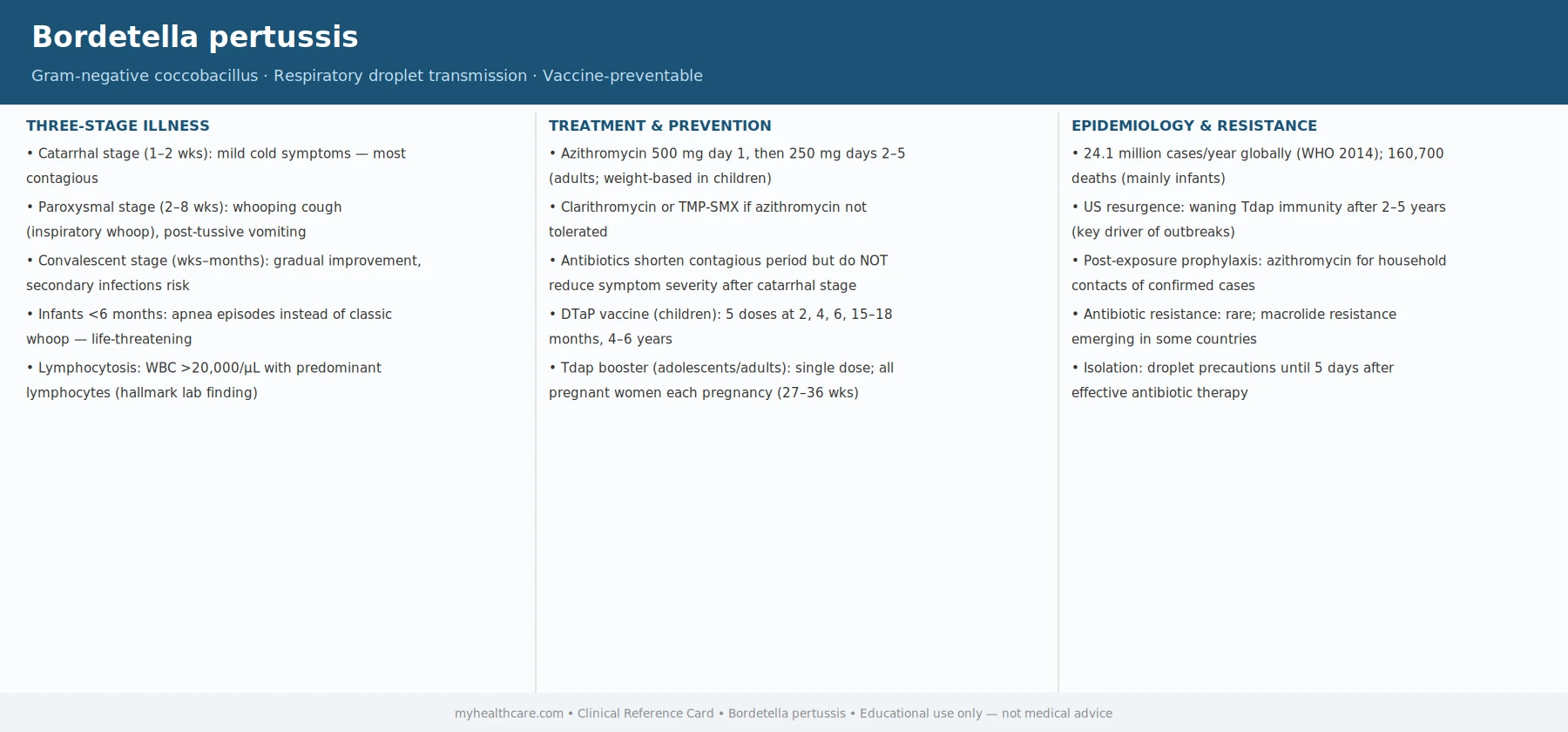
Classic whooping cough unfolds in three recognizable stages, though the full progression is most typical in children who have not been vaccinated. Vaccinated individuals and adults often have a milder, abbreviated course.
Stage 1: Catarrhal phase (1–2 weeks)
The illness begins deceptively mildly, indistinguishable from a common cold: a runny nose, mild cough, low-grade fever, and general malaise. This is actually the most infectious stage — the bacteria are multiplying in the airway and the person is shedding them heavily, but no one yet suspects pertussis. Most transmissions happen here, before anyone has a diagnosis.
Stage 2: Paroxysmal phase (2–8 weeks)
This is the stage that gives whooping cough its name. The cough intensifies dramatically into paroxysms — rapid, uncontrollable bursts of many coughs in a single breath, followed by a sudden forceful inhalation of air that produces the characteristic high-pitched "whoop" as air rushes through a partly closed airway. Coughing fits may end with vomiting, and they are often so severe that the person turns red or even blue from lack of air. Paroxysms are exhausting and can happen dozens of times per day, often worse at night. Between fits, the person may look and feel entirely normal — another reason the diagnosis is often missed in vaccinated individuals who have an atypical presentation.
Stage 3: Convalescent phase (weeks to months)
The cough gradually lessens in frequency and severity, but can persist for months. The "100-day cough" name is not an exaggeration: many patients, especially adults, cough for 10–12 weeks or longer. During this phase, any respiratory irritation — a new cold, a draft of cold air, even laughing — can trigger a fresh paroxysm as the airway remains hypersensitive.
How Deadly It Is for Infants
Whooping cough is not a particularly dangerous disease for healthy adolescents or adults, who usually recover fully after weeks of exhausting coughing. For infants under six months old, especially those under two months (before the first vaccine doses can be given), the picture is entirely different. Young infants often do not produce the classic "whoop" at all — instead they may experience apnea (stopping breathing), turn cyanotic (blue), and require immediate emergency care.
Complications in infants include pneumonia (the leading cause of pertussis-related death), encephalopathy (brain damage from lack of oxygen during prolonged apnea), seizures, and pulmonary hypertension. Infants with severe pertussis may need intensive care, mechanical ventilation, and ECMO (a form of heart-lung bypass) in the most critical cases. Mortality for hospitalized infants under two months old in high-income countries has been estimated at around 1–2%, but is substantially higher in low-income settings. In the pre-vaccine era, pertussis was one of the leading causes of infant death worldwide.
The epidemiology of modern pertussis deaths consistently shows that the victims are young infants who caught the bacterium from a family member — most often a parent or older sibling — with waned vaccine immunity. This is the core public health problem that maternal vaccination and "cocooning" strategies are designed to address.
Diagnosis
Pertussis is frequently missed, especially in vaccinated individuals where the presentation is atypical. Several diagnostic methods are available, each with different strengths depending on when in the illness course testing occurs.
- Nasopharyngeal PCR. A swab of the back of the nose (nasopharynx) is tested by polymerase chain reaction for B. pertussis DNA. This is the most sensitive and specific test, and is now the standard of care in most high-income countries. It is most accurate in the catarrhal and early paroxysmal stages (within the first 3 weeks of cough) when bacterial load is highest. After 4 weeks, sensitivity falls off sharply and a negative PCR does not exclude the diagnosis.
- Culture. Growing the bacterium from a nasopharyngeal swab on specialized media is the historical gold standard and the only method that yields a live isolate for antibiotic susceptibility testing and strain characterization. However, it is slow (5–7 days), technically demanding, and less sensitive than PCR, particularly if the patient has already been started on antibiotics. Culture is most valuable when there is a public health need to characterize the strain.
- Serology (pertussis toxin IgG antibody). A blood test measuring antibodies to pertussis toxin. This is useful in the later stages of illness (after 3–4 weeks of cough), when PCR is no longer sensitive but a serologic response has had time to develop. It is the best test for diagnosing pertussis in adults who present late with a prolonged cough. A single high titer in someone who has not been recently vaccinated is strongly suggestive of recent infection.
In practice, a clinical diagnosis is often made in classic cases (a child with paroxysmal coughing and post-tussive vomiting in a household where pertussis has been confirmed), and treatment is started before the laboratory confirms it.
Treatment
Treatment of pertussis has two goals: eradicating the bacterium to stop transmission, and providing supportive care for the cough itself.
Antibiotics
Macrolide antibiotics are the mainstay of treatment. Azithromycin is now preferred in most settings — a short 5-day course is effective, well-tolerated, and convenient. Clarithromycin (7 days) is an alternative, and erythromycin (14 days) was the traditional standard but is now used less because of more side effects and a longer course. An important caveat: erythromycin given to infants under one month old has been associated with a condition called infantile hypertrophic pyloric stenosis (IHPS), a narrowing of the stomach outlet, so azithromycin is specifically preferred for the youngest infants. For patients who cannot tolerate macrolides, trimethoprim-sulfamethoxazole (TMP-SMX) is an alternative.
The critical point about antibiotics and pertussis: they work best early. When given in the catarrhal phase, they can shorten or prevent the illness. But once paroxysms are fully established, antibiotics do not significantly shorten the cough — the damage to the airway cilia has already been done. Antibiotics are still given even late in the illness because they eliminate the bacterium from the airway and stop the person from being contagious, which is critical for preventing spread to vulnerable contacts.
Supportive care
There is no drug that reliably suppresses the paroxysmal cough. Patients and families are counseled to minimize triggers, rest as much as possible, and ensure adequate hydration (paroxysms with vomiting can cause dehydration). Small, frequent feeds are recommended for infants, as large feeds can precipitate coughing fits. Hospitalized infants are monitored closely for apnea and may need supplemental oxygen or, in severe cases, respiratory support. Household contacts and close contacts of confirmed cases should receive antibiotic prophylaxis regardless of vaccination status, and any unvaccinated or incompletely vaccinated contacts should be vaccinated promptly.
Vaccination — DTaP, Tdap, and the Immunity Gap
The current vaccination schedule in the United States and many other countries uses acellular pertussis vaccines combined with diphtheria and tetanus toxoids:
- DTaP (for infants and young children): given at 2 months, 4 months, 6 months, 15–18 months, and 4–6 years. The capitalization reflects dosing (D and T are full-strength toxoids for younger children).
- Tdap (for adolescents and adults): a booster with reduced doses of diphtheria and pertussis antigens. Recommended at 11–12 years of age and as a one-time booster for adults who have not previously received it. Crucially, it is now recommended for pregnant women during each pregnancy, ideally between 27 and 36 weeks gestation — antibodies from the mother cross the placenta and provide passive protection to the newborn during the first weeks of life before the infant's own vaccination can begin.
The "cocooning" strategy — vaccinating all close household contacts of a newborn so they cannot spread pertussis to the infant — is also recommended, though the evidence for maternal vaccination during pregnancy is stronger and more consistent.
The central challenge remains the waning immunity problem. Even with full vaccination, a person who received their last pertussis-containing vaccine several years ago may have substantially reduced protection. This is not a reason to avoid vaccination — it significantly reduces the risk of severe disease and death, even when it does not fully prevent infection. But it does mean that pertussis cannot be eradicated the way smallpox was, because the bacterium can silently circulate in populations with waned immunity. Research into next-generation pertussis vaccines, including those that might produce more durable mucosal immunity in the respiratory tract (more closely mimicking natural infection), is ongoing.
Key Research Papers
- Burns DL. Secretion of Pertussis Toxin from Bordetella pertussis. Toxins. 2021;13(8):574. — Reviews the molecular mechanism by which B. pertussis secretes its key virulence factor, pertussis toxin, through the Ptl transport system — essential to understanding how the bacterium causes disease. — doi:10.3390/toxins13080574
- Masure HR. The adenylate cyclase toxin contributes to the survival of Bordetella pertussis within human macrophages. Microbial Pathogenesis. 1993;14(4):253–260. — Demonstrated that the adenylate cyclase toxin enables the bacterium to evade destruction by human immune cells, illuminating a key mechanism of immune evasion. — doi:10.1006/mpat.1993.1025
- Ishibashi Y, Nishikawa A. Bordetella pertussis infection of human respiratory epithelial cells up-regulates intercellular adhesion molecule-1 expression: role of filamentous hemagglutinin and pertussis toxin. Microbial Pathogenesis. 2002;33(3):115–125. — Showed how the bacterium's adhesins and toxins alter respiratory cell surfaces to facilitate colonization and propagate inflammation. — doi:10.1006/mpat.2002.0517
- Parental Tdap Boosters and Infant Pertussis: A Case-Control Study. Pediatrics. 2014;134(Suppl 3). — Examined the "cocooning" strategy of vaccinating parents and household contacts to protect newborns from pertussis in the critical pre-vaccination window. — doi:10.1542/peds.2014-1105d
- Auger KA, Patrick SW, Davis MM. Infant Hospitalizations for Pertussis Before and After Tdap Recommendations for Adolescents. Pediatrics. 2013;132(6):e1149–e1155. — Found that infant pertussis hospitalizations remained high even after the adolescent Tdap booster was introduced, underscoring the persistence of the immunity gap and the need for maternal vaccination strategies. — doi:10.1542/peds.2013-1747