Whooping Cough Treatment and Prevention: Antibiotics, Vaccines, and Isolation
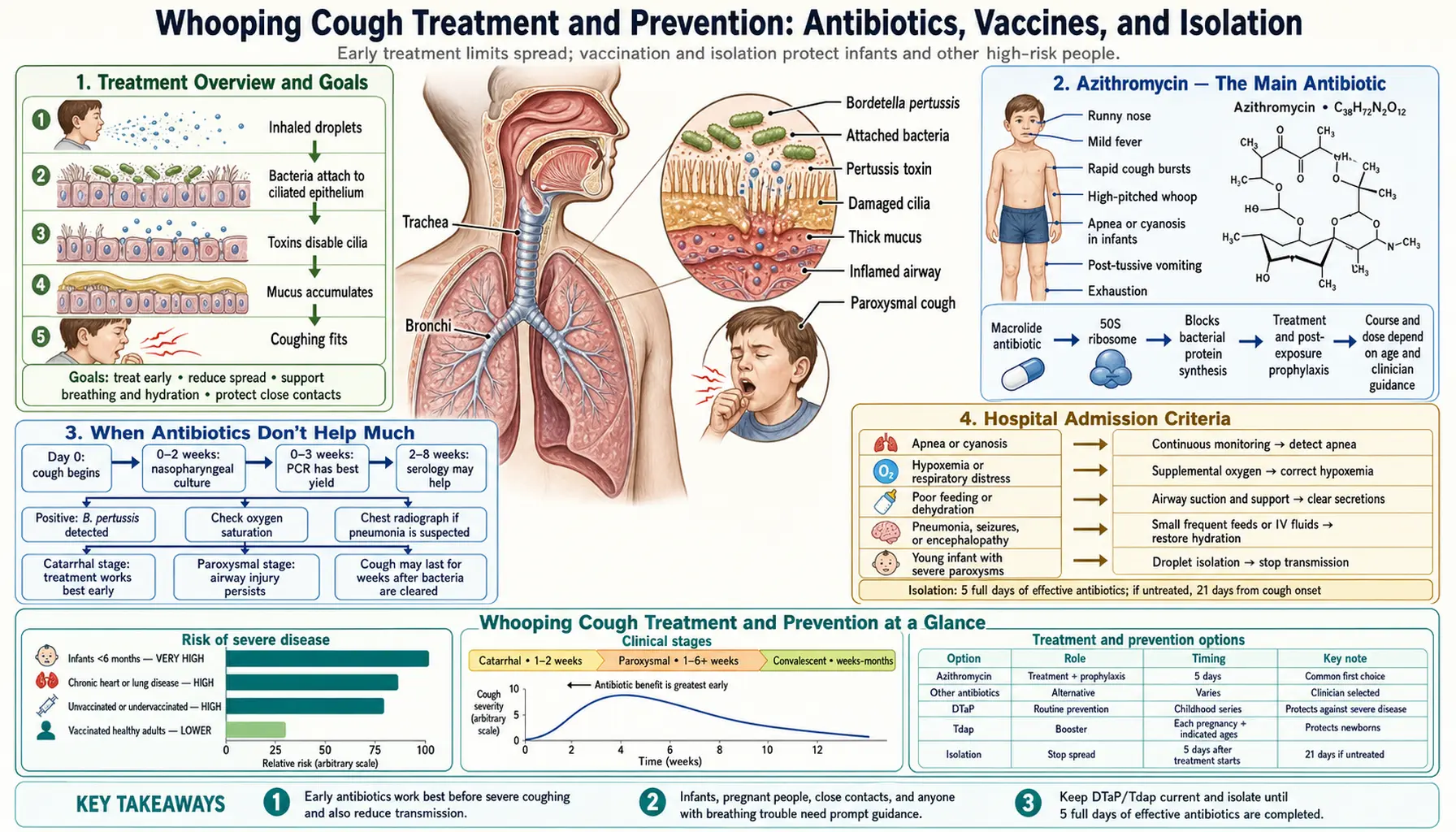
Whooping cough is a two-part problem. The bacterium Bordetella pertussis starts the infection, but most of the suffering comes from the damage it leaves behind in the airway lining. This means treatment has two separate goals that don't always line up: killing the bacteria to protect the people around you, and supporting your body through weeks of exhausting coughing while it heals on its own. Understanding this split is key to setting realistic expectations — and avoiding a lot of frustration.
- Treatment Overview and Goals
- Azithromycin — The Main Antibiotic
- When Antibiotics Don't Help Much
- Hospital Admission Criteria
- Supportive Care at Home
- Vaccination — The Cornerstone of Prevention
- Post-Exposure Prophylaxis
- Isolation Period
- What Doesn't Work
- Key Research Papers
- Connections
Treatment Overview and Goals
Managing whooping cough requires keeping two goals firmly in mind, because they operate on different timelines and serve different people.
Goal 1: Eradicate the bacterium with antibiotics. Starting antibiotics early — ideally within the first one to two weeks, while symptoms still look like an ordinary cold — clears Bordetella pertussis from the respiratory tract within three to five days. This is enormously important for protecting your household, your workplace, and especially any unvaccinated infants in your orbit. A person with untreated pertussis can spread it to 12 to 17 other people; prompt antibiotic treatment slashes that risk to near zero.
Goal 2: Supportive care. Once the paroxysmal stage is underway — the weeks of violent, whooping coughing fits — antibiotics can no longer change the course of the illness for the person who is already sick. The cough is no longer driven by active bacteria; it is driven by airway inflammation and nerve irritation from toxins the bacteria already released. At this stage, rest, fluids, careful feeding, and avoiding triggers become the primary tools.
The CDC and the American Academy of Pediatrics both recommend macrolide antibiotics as first-line treatment, with azithromycin preferred for its tolerability and short course. The full clinical guidance — including dosing tables for every age group — is covered in Antibiotic Treatment.
Azithromycin — The Main Antibiotic
Azithromycin is the antibiotic of choice for whooping cough in people of all ages, including infants. It is preferred over older alternatives like erythromycin because it works just as well, causes far fewer stomach side effects, and requires only a five-day course rather than fourteen.
For infants under one month old, azithromycin is the only recommended antibiotic. Erythromycin and clarithromycin are avoided in this age group because they can cause hypertrophic pyloric stenosis — a dangerous narrowing of the stomach outlet.
A randomized controlled trial published in Pediatrics confirmed that azithromycin achieves bacteriological eradication rates equivalent to erythromycin estolate while producing significantly less nausea, vomiting, and abdominal cramping — a meaningful difference for a sick child who is already vomiting after coughing fits ( Search PubMed).
Trimethoprim-sulfamethoxazole (TMP-SMX) is an option for patients who cannot tolerate macrolides, though it is not used in infants under two months. Full dosing tables and alternative regimens are detailed on the Antibiotic Treatment page.
When Antibiotics Don't Help Much
This is the part of whooping cough that catches most people off guard — and causes significant frustration when a doctor says "there's nothing more we can do for the cough."
Here is what is happening: Bordetella pertussis produces several toxins, most notably pertussis toxin and adenylate cyclase toxin, which damage the hair-like cilia that line the airway and drive an intense inflammatory response. By the time the paroxysmal stage starts — usually around week two — the bacteria have often already been cleared or are present in very small numbers. The cough is being driven by that ongoing airway damage, not by active bacterial replication.
Antibiotics given at this stage will still stop you from spreading the disease to others, which is reason enough to take them. But they will not shorten the coughing, make individual fits less severe, or help you sleep better. A Cochrane systematic review of antibiotic trials found that antibiotics cleared the bacterium from the nasopharynx in virtually all patients but had no significant effect on clinical outcomes — cough duration, number of whoop episodes, or complications — when started after the first two weeks (PMID 17636756).
This is why early diagnosis matters so much. The narrow window for antibiotics to benefit the sick person — not just those around them — closes quickly.
Hospital Admission Criteria
Most older children and adults with whooping cough are managed at home. Hospital admission is necessary when the illness threatens breathing or nutrition directly, or when the patient's age puts them at high risk for rapid deterioration.
Admit to hospital if:
- Any infant — especially under three months — who has apnea (breathing pauses) during coughing fits, turns blue (cyanosis), or cannot feed adequately
- Infants whose lymphocyte count exceeds 30,000 cells per microliter — a marker of severe disease and a predictor of pulmonary hypertension and death in the youngest patients
- Anyone developing secondary bacterial pneumonia, which is the most common serious complication of pertussis
- Anyone showing signs of pulmonary hypertension — a rare but often fatal complication in young infants that may require ECMO (extracorporeal membrane oxygenation)
- Patients who are unable to maintain adequate hydration due to vomiting after coughing fits
Research on fatal infant cases found that extreme lymphocytosis was a consistent finding and that pulmonary hypertension — not pneumonia — was the leading direct cause of death (PMID 18558873). Lymphocyte counts above 100,000/μL in young infants have been associated with leukostasis and a very high mortality rate, sometimes prompting exchange transfusion or leukapheresis to rapidly reduce the count ( Search PubMed).
Supportive Care at Home
For the majority of patients, home care is appropriate and recovery — while slow — is complete. The goal is to reduce triggers, maintain nutrition and hydration, and wait out the weeks of the paroxysmal stage.
Rest. Coughing fits are exhausting. Reduce activity, especially aerobic exertion, which can trigger episodes. Keep the bedroom calm and free of strong smells.
Small, frequent meals. A full stomach presses against the diaphragm and can trigger coughing fits. Eating smaller amounts more often — five or six small meals rather than three large ones — reduces this risk. If vomiting follows a coughing fit, try to offer food or a drink again within 20 to 30 minutes while the gut has settled.
Extra fluids. Vomiting after coughing fits can lead to dehydration, particularly in young children. Offer water, diluted juice, or oral rehydration solutions frequently. Watch for signs of dehydration: dry mouth, no tears when crying, decreased urination.
Avoid smoke and strong odors. Cigarette smoke, perfume, cleaning products, and even spicy cooking smells can trigger paroxysms. Keep the home well-ventilated and smoke-free during the recovery period.
Cool mist humidifier. Adding moisture to the air may soothe irritated airways and reduce the frequency of fits in some patients. Clean the humidifier daily to prevent mold growth.
For infants: suction mucus before feeds. Use a bulb syringe or nasal aspirator to gently clear secretions before each feeding. An infant who is already struggling with mucus will exhaust themselves faster during a feed and be more likely to have a post-feed coughing fit.
Sleep positioning for infants. Always place infants on their back to sleep (back-to-sleep rule applies). Do not prop the mattress — an angled surface increases SIDS risk without proven benefit for pertussis.
Vaccination — The Cornerstone of Prevention
Vaccination does not provide perfect lifelong protection against whooping cough — a critical point discussed in depth on the Waning Immunity page — but it is by far the most effective tool available for preventing severe disease, hospitalization, and death.
DTaP for children (diphtheria, tetanus, and acellular pertussis): given at 2, 4, 6, and 15–18 months, with a booster at 4–6 years. This five-dose series provides strong initial immunity and reduces the risk of severe disease substantially through childhood.
Tdap for adolescents and adults: a single booster dose recommended at age 11–12, with catch-up vaccination for older adolescents and adults who have never received it.
Maternal Tdap vaccination is the single most important intervention for protecting newborns — the age group at highest risk of dying from pertussis. When a pregnant person receives Tdap between 27 and 36 weeks of pregnancy, they pass high levels of pertussis antibodies across the placenta to the fetus. The infant is born with temporary but meaningful protection during the first weeks of life, before they are old enough to receive their own vaccinations.
A landmark UK study found that maternal Tdap vaccination provided 91% protection to infants in the first weeks of life (PMID 25037990). This single intervention has dramatically reduced infant pertussis deaths in countries that have implemented it systematically. The CDC recommends maternal Tdap in every pregnancy, not just the first — antibody levels wane, so each pregnancy warrants a fresh dose.
Detailed vaccine schedules, catch-up guidance, and the evidence on waning immunity are covered in the DTaP & Tdap Vaccines page.
Post-Exposure Prophylaxis
If someone in your household is diagnosed with pertussis, everyone else in the household should receive antibiotics — even if they feel fine and even if they are vaccinated. This is called post-exposure prophylaxis (PEP).
Why vaccinated people still need PEP: Acellular pertussis vaccines lose effectiveness more rapidly than previously understood. A vaccinated person can contract pertussis and spread it, sometimes without recognizing it as whooping cough because their own symptoms may be milder. Prophylactic antibiotics break the chain of transmission before illness develops.
The same antibiotic regimens used for treatment are used for PEP: azithromycin is the preferred agent. The CDC recommends PEP for all household members when there is at least one high-risk contact present — specifically, any infant under 12 months, any pregnant person, or any person with a medical condition that makes pertussis especially dangerous ( Search PubMed).
Timing matters: PEP is most effective when given within 21 days of the household exposure. After 21 days, the window for preventing illness in the exposed person has largely closed, though it may still reduce transmission to others.
If there is an unvaccinated infant in the home, PEP is urgent and should start as soon as the index case is confirmed. Do not wait for symptoms in other household members before beginning prophylaxis.
Isolation Period
Whooping cough spreads through respiratory droplets — the same route as many other respiratory infections, but with an unusually high attack rate among unvaccinated contacts. Isolation is an important public health measure, not just a precaution.
The standard isolation guidance: Stay away from school, work, childcare, and other public settings until either five full days after starting antibiotics OR 21 days from the onset of your first cough — whichever milestone comes first.
In practice, most people who start antibiotics promptly are cleared to return after five days. Those who do not receive antibiotics — or who are diagnosed late — must wait out the full 21-day infectious period, which is a long time to stay home.
Who to protect most urgently:
- Infants under 12 months, especially those too young to be vaccinated
- Pregnant people in their third trimester who have not yet received Tdap
- Immunocompromised individuals
- Anyone with severe asthma or other chronic lung conditions
If you have an infant at home, consider having the sick person stay in a separate area of the house or temporarily stay elsewhere during the infectious period. Infants can deteriorate rapidly after pertussis exposure, and the stakes of household transmission are very high.
What Doesn't Work
Because the paroxysmal cough of pertussis is so distressing — for patients, parents, and caregivers alike — there is a strong impulse to try something, anything, to make it stop. Unfortunately, the cough mechanism in pertussis does not respond to the usual remedies, and some of them carry real risks.
Cough suppressants (dextromethorphan, codeine): Not effective for pertussis cough. The cough is not triggered by the usual mechanisms that these medications target; it is driven by deep airway inflammation and nerve sensitization. Codeine and other opioid-based cough suppressants are contraindicated in children under 12 and should not be used in adolescents. Dextromethorphan is ineffective and adds nothing.
Honey: A well-known home remedy for ordinary coughs that has some evidence behind it — but not for pertussis. The mechanism by which honey soothes a cough (coating irritated throat membranes) has no bearing on the deep airway damage of pertussis. Never give honey to infants under 12 months because of the risk of infant botulism.
Corticosteroids: Not routinely recommended. There is theoretical rationale for reducing airway inflammation, but clinical trials have not demonstrated consistent benefit, and the risks of steroid use are not trivial. Some clinicians use them in severe infant cases as a last resort, but this is not standard care.
Intravenous immunoglobulin (IVIG): Sometimes tried in critically ill infants with severe pertussis, based on the idea that pooled antibodies might neutralize pertussis toxin. The evidence is limited. A small number of case series suggest possible benefit, but there are no large controlled trials, and IVIG is not a standard recommendation outside of specialized intensive care settings.
Salbutamol (albuterol) bronchodilators: Cochrane review found no consistent evidence of benefit for pertussis cough, and they carry cardiovascular risks. Not recommended.
The honest summary: for the cough itself, time is the main treatment. Most otherwise-healthy older children and adults recover fully, although it may take six to ten weeks for coughing fits to resolve completely. In some patients, the "hundred-day cough" name reflects reality.
Key Research Papers
- Tiwari T, et al. Recommended antimicrobial agents for the treatment and postexposure prophylaxis of pertussis. MMWR Recomm Rep. 2005;54(RR-14):1-16. — PubMed PMID: 16340941
- Altunaiji S, et al. Antibiotics for whooping cough (pertussis). Cochrane Database Syst Rev. 2007;(3):CD004404. — PubMed PMID: 17636756
- Langley JM, et al. Azithromycin is as effective as and better tolerated than erythromycin estolate. Pediatrics. 2004;114(1):e96-101. — Search PubMed
- Warfel JM, Zimmerman LI, Merkel TJ. Acellular pertussis vaccines protect against disease but fail to prevent infection and transmission. Proc Natl Acad Sci USA. 2014;111(2):787-92. — PubMed PMID: 24277828
- Amirthalingam G, et al. Effectiveness of maternal pertussis vaccination in England. Lancet. 2014;384(9953):1521-8. — PubMed PMID: 25037990
- Carbonetti NH. Pertussis leukocytosis: mechanisms, clinical implications and treatment considerations. Curr Opin Infect Dis. 2016;29(3):257-64. — Search PubMed
- Paddock CD, et al. Pathology and pathogenesis of fatal Bordetella pertussis infection in infants. Clin Infect Dis. 2008;47(3):328-38. — PubMed PMID: 18558873
- Kilgore PE, et al. Pertussis: Microbiology, Disease, Treatment, and Prevention. Clin Microbiol Rev. 2016;29(3):449-86. — PubMed PMID: 27029594
- Cherry JD. Epidemic pertussis in 2012. N Engl J Med. 2012;367(9):785-7. — Search PubMed
- Witt MA, et al. Unexpectedly limited durability of immunity following acellular pertussis vaccination. Clin Infect Dis. 2012;54(12):1730-5. — PubMed PMID: 22423127
- Mattoo S, Cherry JD. Molecular pathogenesis, epidemiology, and clinical manifestations. Clin Microbiol Rev. 2005;18(2):326-82. — PubMed PMID: 15831828