N-acetyl-cysteine (NAC) & Mental Health
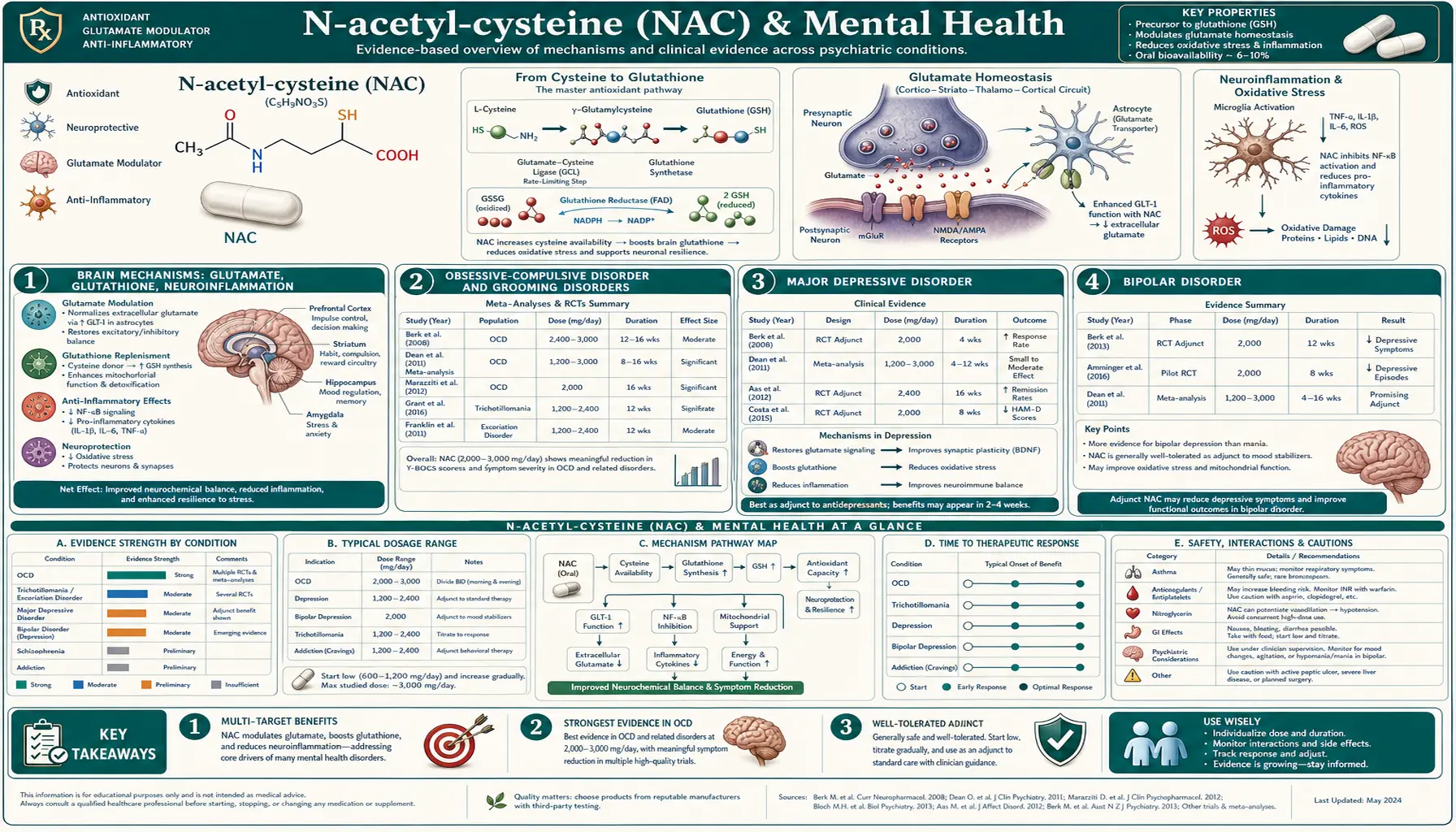
N-acetylcysteine (NAC) has been tested in randomized, placebo-controlled trials across many psychiatric conditions, much of the work coming from research groups led by Berk, Grant, Hardan, Gray and Back. The results are mixed and most trials are small. Some met their primary outcome: adult trichotillomania, excoriation (skin-picking) disorder, adolescent cannabis use, irritability in children with autism, and add-on treatment of chronic schizophrenia. Others did not: pediatric trichotillomania, adult cannabis use, cocaine use in people still using, major depression at the 12-week endpoint, bipolar depression in a 16-week three-arm trial and in a 2021 meta-analysis, negative symptoms in early psychosis, three of the five OCD trials described below, and core social symptoms of autism. A 2015 systematic review found favourable evidence in several disorders, judged the evidence in anxiety and ADHD preliminary, and found that the evidence did not support NAC in gambling, methamphetamine or nicotine addiction (Deepmala 2015).
The hypothesis behind these trials is that several psychiatric disorders involve disturbed glutamate signalling and oxidative stress, and that NAC acts on both: it supplies cysteine for glutathione and alters glutamate exchange through the cystine-glutamate antiporter. Reviews also describe actions on inflammatory pathways, neurotrophins, apoptosis and mitochondrial function (Berk 2013). This article reports the trials condition by condition, including the null results.
Interactive Visualization Free Radicals & Your Antioxidant Network Follow one superoxide radical down the whole relay — SOD, catalase, glutathione, vitamin E, vitamin C, NADPH — then release free iron and watch a membrane tear itself apart. Launch →Table of Contents
- Brain Mechanisms: Glutamate, Glutathione, Neuroinflammation
- Obsessive-Compulsive Disorder and Grooming Disorders
- Major Depressive Disorder
- Bipolar Disorder
- Schizophrenia
- Addiction and Substance Use Disorder
- Autism Spectrum Disorder
- PTSD and Trauma
- Alzheimer's and Cognitive Decline
- Doses Used in Psychiatric Trials
- Safety
- Key Research Papers
- Connections
- Featured Videos
Brain Mechanisms: Glutamate, Glutathione, Neuroinflammation
The Cystine-Glutamate Antiporter (System xc-)
NAC supplies cysteine, which in its oxidized form, cystine, is taken up by glial cells through system xc- in exchange for glutamate. The glutamate released this way is proposed to act on presynaptic mGluR2/3 receptors that dampen synaptic glutamate release. The glutamate homeostasis hypothesis of addiction (Kalivas 2009, a review) links chronic drug use to a lasting imbalance between synaptic and non-synaptic glutamate that impairs communication between the prefrontal cortex and the nucleus accumbens. Restoring that balance is the rationale for the addiction trials, and the same reasoning was extended to compulsive behaviours such as hair pulling (Grant 2009).
Glutathione and Oxidative Stress
In drug-free people with schizophrenia, total glutathione was 27% lower in cerebrospinal fluid than in controls, and glutathione measured by magnetic resonance spectroscopy was 52% lower in the medial prefrontal cortex (Do 2000). A post-mortem study of prefrontal cortex found reduced, oxidized and total glutathione all significantly decreased in bipolar disorder, major depression and schizophrenia compared with controls (Gawryluk 2011). Reviews describe redox dysregulation as one proposed contributor to schizophrenia (Do 2009; Yao and Keshavan 2011). In an early-psychosis trial, six months of NAC raised medial prefrontal glutathione by 23% (Conus 2018).
Neuroinflammation
A meta-analysis of 24 studies found significantly higher concentrations of the inflammatory cytokines TNF-alpha and IL-6 in people with major depression than in controls; the other cytokines studied did not differ (Dowlati 2010). NAC's proposed effects on inflammatory pathways come mainly from laboratory work summarised in reviews (Berk 2013).
Obsessive-Compulsive Disorder and Grooming Disorders
In 11 drug-naive children with OCD, glutamatergic concentrations in the caudate measured by magnetic resonance spectroscopy were higher than in healthy children and fell after 12 weeks of paroxetine (Rosenberg 2000). This finding is part of the rationale for testing glutamate modulators such as NAC as add-ons to serotonin reuptake inhibitors. Of the five placebo-controlled OCD trials below, two met their Y-BOCS primary outcome and three did not, including the largest, a 20-week phase III trial.
Key OCD Trials
- Afshar 2012 (J Clin Psychopharmacol): 48 adults whose OCD had not responded to a serotonin reuptake inhibitor, 12 weeks, NAC up to 2,400 mg/day or placebo added. Y-BOCS scores improved significantly more with NAC; 52.6% of the NAC group were full responders (35% or greater Y-BOCS reduction) versus 15% with placebo.
- Paydary 2016 (J Clin Pharm Ther): 44 adults with moderate-to-severe OCD, 10 weeks, fluvoxamine 200 mg/day plus NAC 2,000 mg/day or placebo. A significant time-by-treatment interaction favoured NAC on the Y-BOCS total score and the obsession subscale.
- Sarris 2015 (CNS Drugs): 44 adults, 16 weeks, NAC 3 g/day or placebo. The primary outcome, Y-BOCS total score, did not differ (p = 0.39). The compulsions subscale favoured NAC, with a significant reduction at week 12 that dissipated by week 16. At 16 weeks, 20% of the NAC group and 27% of the placebo group were responders. Heartburn was more common with NAC.
- Costa 2017 (J Clin Psychiatry): 40 adults with treatment-resistant OCD, 16 weeks, NAC 3,000 mg/day or placebo added to a serotonin reuptake inhibitor. Y-BOCS scores fell in both groups with no significant difference between them (P = .92); anxiety symptoms, a secondary outcome, improved more with NAC. Abdominal pain was more frequent with NAC.
- Sarris 2022 (Prog Neuropsychopharmacol Biol Psychiatry): phase III, 20 weeks, 98 adults, NAC 2–4 g/day titrated to response, added to usual treatment. No evidence that NAC reduced Y-BOCS scores relative to placebo (p = 0.70), and no benefit on anxiety, depression, quality of life or functioning; adverse events were mild and gastrointestinal.
Trichotillomania (Hair-Pulling)
- Grant 2009 (Arch Gen Psychiatry): 12-week placebo-controlled trial in 50 adults, NAC 1,200–2,400 mg/day. Hair-pulling scores fell significantly more with NAC; 56% of NAC patients were much or very much improved versus 16% with placebo (P = .003). Improvement was first noted after 9 weeks.
- Bloch 2013 (J Am Acad Child Adolesc Psychiatry): 12-week add-on trial in 39 children and adolescents aged 8–17. No significant difference between NAC and placebo on any primary or secondary outcome; 25% of the NAC group and 21% of the placebo group were responders.
Excoriation (Skin-Picking) Disorder
- Grant 2016 (JAMA Psychiatry): 12-week trial in 66 adults, NAC 1,200–3,000 mg/day. Skin-picking severity (NE-YBOCS) improved significantly more with NAC (12-week scores 11.5 versus 14.1, P = .048). Among the 53 who completed the study, 47% on NAC versus 19% on placebo were much or very much improved. Psychosocial functioning did not differ.
Nail Biting
Ghanizadeh 2013 randomized 42 children and adolescents with chronic nail biting to NAC 800 mg/day or placebo. Nail length increased significantly more with NAC after one month, with no difference after two months. Two children on NAC stopped because of adverse events (one with headache, agitation and social withdrawal; one with severe aggression), and the dropout rate was high.
Major Depressive Disorder
- Berk 2014 (J Clin Psychiatry): 252 adults with major depression, NAC or placebo added to usual treatment for 12 weeks and followed to week 16. The primary outcome, MADRS, did not separate at week 12 (P = .265). A functioning measure (LIFE-RIFT) differed from placebo at week 12, and at week 16 NAC was superior on secondary measures of function and clinical impression. Gastrointestinal and musculoskeletal adverse events were more common with NAC. The authors concluded that the trial, negative at its endpoint, gave only limited support for NAC in major depression.
- Fernandes 2016 (J Clin Psychiatry, meta-analysis): five placebo-controlled trials with 574 participants — two in bipolar disorder, one in major depression, and two in other conditions with depressive symptoms (trichotillomania and heavy smoking). NAC improved depressive symptoms compared with placebo (SMD 0.37, 95% CI 0.19 to 0.55) and global functioning; minor adverse events were more common with NAC (OR 1.61).
Bipolar Disorder
- Berk 2008 (Biol Psychiatry): 75 people with bipolar disorder in the maintenance phase, NAC 1 g twice daily or placebo added to usual medication for 24 weeks, then a 4-week washout. Depressive symptoms (MADRS) improved significantly more with NAC, but there was no effect on time to a mood episode, the second primary outcome. Improvements were lost after washout.
- Berk 2012 (BMC Medicine): 149 participants received eight weeks of open-label NAC and were then randomized to NAC 2 g/day or placebo. Symptoms fell during the open-label phase, and there were no significant between-group differences in recurrence or symptoms during the maintenance phase.
- Berk 2019 (BMC Medicine): 16-week three-arm trial in 181 people with bipolar depression — NAC 2,000 mg/day, NAC plus a combination of nutraceuticals, or placebo. No between-group differences on the primary outcome (MADRS) or any other clinical or functioning measure at week 16; the combination arm did better than placebo on several measures at a week-20 visit after treatment stopped. Gastrointestinal symptoms were more common with NAC.
- Pittas 2021 (Psychopharmacology, meta-analysis of five trials): adding NAC did not significantly improve MADRS scores (mean difference −3.32, 95% CI −12.79 to 6.16), mania ratings, functioning or quality of life. The authors found no evidence of benefit from NAC as an add-on treatment for bipolar depression.
All of these trials tested NAC added to usual treatment, not as a replacement for it.
Schizophrenia
- Berk 2008 (Biol Psychiatry): 24-week trial in 140 people with chronic schizophrenia on maintenance antipsychotics, NAC 1 g twice daily or placebo; 84 completed treatment. NAC improved PANSS total, negative and general scores and clinical global impression more than placebo; the positive-symptom subscale did not change. Akathisia also improved.
- Farokhnia 2013 (Clin Neuropharmacol): 8-week trial in 42 people with chronic schizophrenia in an active phase, NAC up to 2 g/day or placebo added to risperidone. PANSS negative (the primary outcome) and total scores improved significantly more with NAC; positive and general psychopathology subscales did not differ.
- Conus 2018 (Schizophr Bull): 63 people with early psychosis, NAC 2,700 mg/day or placebo for 6 months. No changes in negative or positive symptoms or functional outcome with NAC; processing speed improved, and brain glutathione rose by 23%. In exploratory subgroup analyses, people with high baseline blood glutathione peroxidase activity showed a link between redox changes and positive-symptom changes.
- Yolland 2020 (Aust N Z J Psychiatry, meta-analysis): seven trials (220 participants on NAC, 220 on placebo). PANSS negative and total scores improved with NAC after 24 weeks of treatment, as did working memory; effects appeared at the later time point (24 weeks or more).
Addiction and Substance Use Disorder
Under the glutamate homeostasis hypothesis (Kalivas 2009), chronic drug use leaves a lasting imbalance between synaptic and non-synaptic glutamate in prefrontal-accumbens circuitry. The trials below asked whether NAC reduces drug use or craving.
Cocaine
- Mardikian 2007 (open-label pilot): 23 cocaine-dependent outpatients, 4 weeks, NAC 1,200, 2,400 or 3,600 mg/day. All three doses were well tolerated, and most of the 16 who completed either stopped or significantly reduced cocaine use. There was no placebo group.
- LaRowe 2007 (Am J Psychiatry): double-blind crossover in 15 participants during two 3-day hospital stays. On NAC, participants reported less desire to use and less interest in response to cocaine slides.
- LaRowe 2013 (Am J Addict): 8-week trial in 111 cocaine-dependent adults, NAC 1,200 or 2,400 mg/day or placebo. The primary results were negative. Among those who were already abstinent when they entered, the 2,400 mg group had longer times to relapse and lower craving than placebo.
Cannabis
- Gray 2012 (Am J Psychiatry): 8-week trial in 116 cannabis-dependent people aged 15–21, NAC 1,200 mg or placebo twice daily, with contingency management and brief weekly counselling. The NAC group had more than twice the odds of negative urine cannabinoid tests during treatment (OR 2.4, 95% CI 1.1–5.2). Exploratory secondary abstinence outcomes favoured NAC but were not statistically significant.
- Gray 2017 (Drug Alcohol Depend): 12-week multisite trial in 302 adults aged 18–50, NAC 1,200 mg or placebo twice daily, with contingency management. No difference from placebo in abstinence (OR 1.00, 95% CI 0.63–1.59); 22.3% of urine tests were negative with NAC and 22.4% with placebo.
Nicotine
- Schmaal 2011 (Eur Addict Res): pilot in heavy smokers asked to stop smoking for 3.5 days, NAC 3,600 mg/day (n = 10) or placebo (n = 12). No significant effect on craving (p = 0.23) and a statistical trend toward fewer withdrawal symptoms (p = 0.07); the first cigarette after abstinence was rated less rewarding on NAC (p = 0.04).
- Prado 2015 (Redox Rep): 12-week trial in 34 outpatients with therapy-resistant tobacco use disorder receiving group behavioural therapy, NAC 3 g/day or placebo. Daily cigarettes fell more with NAC (mean change −10.9 versus −3.2), and 47.1% versus 21.4% quit by an exhaled carbon monoxide measure.
Other Substances
- Methamphetamine: Mousavi 2015 — crossover trial in 32 methamphetamine-dependent volunteers (23 completed), NAC 1,200 mg/day or placebo for four weeks each, alongside a structured outpatient treatment programme. Craving scores were lower on NAC.
- Gambling: Grant 2007 — in an 8-week open-label phase, 16 of 27 people with pathological gambling (59.3%) had a 30% or greater fall in gambling symptom scores. Of the 13 responders who entered a 6-week double-blind phase, 83.3% on NAC and 28.6% on placebo still met responder criteria.
- Alcohol: Squeglia 2018 — a secondary analysis of the adult cannabis trial (277 participants with alcohol data; alcohol use was not an entry requirement). The NAC group had higher odds of alcohol abstinence between visits (OR 1.37), fewer drinks per week and fewer drinking days.
Autism Spectrum Disorder
- Hardan 2012 (Biol Psychiatry): 12-week pilot trial in 33 children aged 3.2–10.7 with autistic disorder. NAC started at 900 mg daily for 4 weeks, then 900 mg twice daily for 4 weeks, then 900 mg three times daily. Irritability (Aberrant Behavior Checklist subscale) improved significantly more with NAC (d = 0.96). Follow-up data were available for 14 children on NAC and 15 on placebo.
- Ghanizadeh 2013 (BMC Psychiatry): 8-week trial in 40 children and adolescents on risperidone, NAC 1,200 mg/day or placebo added. Irritability fell significantly more with NAC; core autism symptoms did not change.
- Nikoo 2015 (Clin Neuropharmacol): 10-week trial in children aged 4–12 on risperidone, NAC 600–900 mg/day or placebo added; 40 completed. Irritability and hyperactivity/noncompliance scores fell more with NAC.
- Wink 2016 (Mol Autism): 12-week pilot in 31 youth aged 4–12, target dose 60 mg/kg/day, with core social impairment as the primary outcome. No difference from placebo (p > 0.69); blood glutathione was higher with NAC.
- Dean 2017 (Aust N Z J Psychiatry): 102 children randomized to NAC 500 mg/day or placebo for 6 months, added to usual treatment. No differences on any primary outcome (social responsiveness, communication, repetitive behaviour) or secondary outcome. The authors note the lower dose as a possible reason.
PTSD and Trauma
- Back 2016 (J Clin Psychiatry): 8-week pilot trial in 35 veterans with PTSD and substance use disorders, NAC 2,400 mg/day or placebo plus cognitive-behavioural therapy for substance use. PTSD symptoms, craving and depression improved significantly more with NAC; substance use was low in both groups and did not differ. The authors describe it as the first randomized trial of NAC for PTSD with substance use disorder and the findings as preliminary.
- Back 2020 (Contemp Clin Trials) described the design of a randomized trial of NAC in people with both alcohol use disorder and PTSD; that paper reports no results.
Alzheimer's and Cognitive Decline
- Adair 2001 (Neurology): double-blind placebo-controlled trial in probable Alzheimer's disease, tested after 3 and 6 months. Changes favoured NAC on nearly every outcome measure, but differences were significant only for a subset of cognitive tasks.
- Remington 2015 (J Alzheimers Dis): phase II trial in 106 people with Alzheimer's disease of a nutritional formulation (folate, alpha-tocopherol, vitamin B12, S-adenosylmethionine, NAC and acetyl-L-carnitine) or placebo. The formulation group improved on two cognitive tests (Clox-1 and the Dementia Rating Scale) within 3 months; daily activities did not change. This tested a combination, not NAC alone.
Trials of NAC alone in Alzheimer's disease are few and small. The 2015 systematic review listed Alzheimer's disease among the conditions with favourable evidence and called for larger controlled trials (Deepmala 2015).
Doses Used in Psychiatric Trials
- Adults: most trials used 2,000–2,400 mg/day (1 g twice daily in the Berk trials, 1,200 mg twice daily in the cannabis trials, 2,400 mg/day in the PTSD trial). OCD and skin-picking trials used up to 3,000 mg/day, one OCD trial up to 4 g/day, the early-psychosis trial 2,700 mg/day, and the nicotine pilot 3,600 mg/day.
- Children: the Hardan autism trial stepped from 900 mg/day to 900 mg three times daily; other autism trials used 1,200 mg/day, 600–900 mg/day, a target of 60 mg/kg/day, and 500 mg/day (the last, Dean 2017, found no benefit). The adolescent cannabis trial used 1,200 mg twice daily.
- Trial duration: 8 to 24 weeks for most trials. In trichotillomania, improvement was first noted after 9 weeks (Grant 2009); in the 2008 bipolar trial, the MADRS benefit was evident at 20 weeks; the schizophrenia meta-analysis found effects at 24 weeks or later (Yolland 2020).
- Absorption: oral bioavailability of NAC was 6–10% across formulations in healthy volunteers (Borgström 1986), and 4.0% for reduced NAC and 9.1% for total NAC in a second study (Olsson 1988).
Safety
- Gastrointestinal effects were the adverse events most often reported more frequently with NAC than placebo: gastrointestinal and musculoskeletal events in the major depression trial (Berk 2014), gastrointestinal symptoms in the bipolar depression trial (Berk 2019), heartburn (Sarris 2015), and abdominal pain (Costa 2017).
- Across five depression-symptom trials, minor adverse events were more common with NAC (OR 1.61; Fernandes 2016).
- Several trials reported no significant difference in adverse events between NAC and placebo (Berk 2008 bipolar trial; Farokhnia 2013; Dean 2017), and the 2015 systematic review described NAC as generally safe and tolerable (Deepmala 2015).
- In the pediatric nail-biting trial, two children stopped NAC because of adverse events, one with severe aggression (Ghanizadeh 2013).
- Proposed actions of NAC include supplying sulfhydryl groups that potentiate the effect of nitroglycerin (covered on the NAC overview page).
In these trials NAC was added to usual care (serotonin reuptake inhibitors in OCD, antipsychotics in schizophrenia, usual medication in bipolar disorder, cognitive-behavioural therapy in PTSD with substance use); none tested it as a replacement for standard treatment. Decisions about medicines and supplements belong with a clinician.
Key Research Papers
- Berk M, Copolov D, Dean O, Lu K, Jeavons S, Schapkaitz I, et al. N-acetyl cysteine as a glutathione precursor for schizophrenia--a double-blind, randomized, placebo-controlled trial. Biol Psychiatry 2008;64(5):361–8. PubMed PMID: 18436195
- Berk M, Copolov DL, Dean O, Lu K, Jeavons S, Schapkaitz I, et al. N-acetyl cysteine for depressive symptoms in bipolar disorder--a double-blind randomized placebo-controlled trial. Biol Psychiatry 2008;64(6):468–75. PubMed PMID: 18534556
- Berk M, Dean OM, Cotton SM, Gama CS, Kapczinski F, Fernandes B, et al. Maintenance N-acetyl cysteine treatment for bipolar disorder: a double-blind randomized placebo controlled trial. BMC Med 2012;10:91. PubMed PMID: 22891797
- Berk M, Turner A, Malhi GS, Ng CH, Cotton SM, Dodd S, et al. A randomised controlled trial of a mitochondrial therapeutic target for bipolar depression: mitochondrial agents, N-acetylcysteine, and placebo. BMC Med 2019;17(1):18. PubMed PMID: 30678686
- Berk M, Dean OM, Cotton SM, Jeavons S, Tanious M, Kohlmann K, et al. The efficacy of adjunctive N-acetylcysteine in major depressive disorder: a double-blind, randomized, placebo-controlled trial. J Clin Psychiatry 2014;75(6):628–36. PubMed PMID: 25004186
- Fernandes BS, Dean OM, Dodd S, Malhi GS, Berk M. N-Acetylcysteine in depressive symptoms and functionality: a systematic review and meta-analysis. J Clin Psychiatry 2016;77(4):e457–66. PubMed PMID: 27137430
- Afshar H, Roohafza H, Mohammad-Beigi H, Haghighi M, Jahangard L, Shokouh P, et al. N-acetylcysteine add-on treatment in refractory obsessive-compulsive disorder: a randomized, double-blind, placebo-controlled trial. J Clin Psychopharmacol 2012;32(6):797–803. PubMed PMID: 23131885
- Sarris J, Oliver G, Camfield DA, Dean OM, Dowling N, Smith DJ, et al. N-Acetyl Cysteine (NAC) in the Treatment of Obsessive-Compulsive Disorder: A 16-Week, Double-Blind, Randomised, Placebo-Controlled Study. CNS Drugs 2015;29(9):801–9. PubMed PMID: 26374743
- Paydary K, Akamaloo A, Ahmadipour A, Pishgar F, Emamzadehfard S, Akhondzadeh S. N-acetylcysteine augmentation therapy for moderate-to-severe obsessive-compulsive disorder: randomized, double-blind, placebo-controlled trial. J Clin Pharm Ther 2016;41(2):214–9. PubMed PMID: 26931055
- Grant JE, Odlaug BL, Kim SW. N-acetylcysteine, a glutamate modulator, in the treatment of trichotillomania: a double-blind, placebo-controlled study. Arch Gen Psychiatry 2009;66(7):756–63. PubMed PMID: 19581567
- Grant JE, Chamberlain SR, Redden SA, Leppink EW, Odlaug BL, Kim SW. N-Acetylcysteine in the Treatment of Excoriation Disorder: A Randomized Clinical Trial. JAMA Psychiatry 2016;73(5):490–6. PubMed PMID: 27007062
- Bloch MH, Panza KE, Grant JE, Pittenger C, Leckman JF. N-Acetylcysteine in the treatment of pediatric trichotillomania: a randomized, double-blind, placebo-controlled add-on trial. J Am Acad Child Adolesc Psychiatry 2013;52(3):231–40. PubMed PMID: 23452680
- Gray KM, Carpenter MJ, Baker NL, DeSantis SM, Kryway E, Hartwell KJ, et al. A double-blind randomized controlled trial of N-acetylcysteine in cannabis-dependent adolescents. Am J Psychiatry 2012;169(8):805–12. PubMed PMID: 22706327
- Gray KM, Sonne SC, McClure EA, Ghitza UE, Matthews AG, McRae-Clark AL, et al. A randomized placebo-controlled trial of N-acetylcysteine for cannabis use disorder in adults. Drug Alcohol Depend 2017;177:249–257. PubMed PMID: 28623823
- LaRowe SD, Kalivas PW, Nicholas JS, Randall PK, Mardikian PN, Malcolm RJ. A double-blind placebo-controlled trial of N-acetylcysteine in the treatment of cocaine dependence. Am J Addict 2013;22(5):443–52. PubMed PMID: 23952889
- Schmaal L, Berk L, Hulstijn KP, Cousijn J, Wiers RW, van den Brink W. Efficacy of N-acetylcysteine in the treatment of nicotine dependence: a double-blind placebo-controlled pilot study. Eur Addict Res 2011;17(4):211–6. PubMed PMID: 21606648
- Back SE, McCauley JL, Korte KJ, Gros DF, Leavitt V, Gray KM, et al. A Double-Blind, Randomized, Controlled Pilot Trial of N-Acetylcysteine in Veterans With Posttraumatic Stress Disorder and Substance Use Disorders. J Clin Psychiatry 2016;77(11):e1439–e1446. PubMed PMID: 27736051
- Hardan AY, Fung LK, Libove RA, Obukhanych TV, Nair S, Herzenberg LA, et al. A randomized controlled pilot trial of oral N-acetylcysteine in children with autism. Biol Psychiatry 2012;71(11):956–61. PubMed PMID: 22342106
- Ghanizadeh A, Moghimi-Sarani E. A randomized double blind placebo controlled clinical trial of N-Acetylcysteine added to risperidone for treating autistic disorders. BMC Psychiatry 2013;13:196. PubMed PMID: 23886027
- Yolland CO, Hanratty D, Neill E, Rossell SL, Berk M, Dean OM, et al. Meta-analysis of randomised controlled trials with N-acetylcysteine in the treatment of schizophrenia. Aust N Z J Psychiatry 2020;54(5):453–466. PubMed PMID: 31826654
- Deepmala, Slattery J, Kumar N, Delhey L, Berk M, Dean O, et al. Clinical trials of N-acetylcysteine in psychiatry and neurology: A systematic review. Neurosci Biobehav Rev 2015;55:294–321. PubMed PMID: 25957927
- Berk M, Malhi GS, Gray LJ, Dean OM. The promise of N-acetylcysteine in neuropsychiatry. Trends Pharmacol Sci 2013;34(3):167–77. PubMed PMID: 23369637
- Kalivas PW. The glutamate homeostasis hypothesis of addiction. Nat Rev Neurosci 2009;10(8):561–72. PubMed PMID: 19571793
- Do KQ, Trabesinger AH, Kirsten-Krüger M, Lauer CJ, Dydak U, Hell D, et al. Schizophrenia: glutathione deficit in cerebrospinal fluid and prefrontal cortex in vivo. Eur J Neurosci 2000;12(10):3721–8. PubMed PMID: 11029642
- Gawryluk JW, Wang JF, Andreazza AC, Shao L, Young LT. Decreased levels of glutathione, the major brain antioxidant, in post-mortem prefrontal cortex from patients with psychiatric disorders. Int J Neuropsychopharmacol 2011;14(1):123–30. PubMed PMID: 20633320
- Do KQ, Cabungcal JH, Frank A, Steullet P, Cuenod M. Redox dysregulation, neurodevelopment, and schizophrenia. Curr Opin Neurobiol 2009;19(2):220–30. PubMed PMID: 19481443
- Yao JK, Keshavan MS. Antioxidants, redox signaling, and pathophysiology in schizophrenia: an integrative view. Antioxid Redox Signal 2011;15(7):2011–35. PubMed PMID: 21126177
- Dowlati Y, Herrmann N, Swardfager W, Liu H, Sham L, Reim EK, et al. A meta-analysis of cytokines in major depression. Biol Psychiatry 2010;67(5):446–57. PubMed PMID: 20015486
- Rosenberg DR, MacMaster FP, Keshavan MS, Fitzgerald KD, Stewart CM, Moore GJ. Decrease in caudate glutamatergic concentrations in pediatric obsessive-compulsive disorder patients taking paroxetine. J Am Acad Child Adolesc Psychiatry 2000;39(9):1096–103. PubMed PMID: 10986805
- Costa DLC, Diniz JB, Requena G, Joaquim MA, Pittenger C, Bloch MH, et al. Randomized, Double-Blind, Placebo-Controlled Trial of N-Acetylcysteine Augmentation for Treatment-Resistant Obsessive-Compulsive Disorder. J Clin Psychiatry 2017;78(7):e766–e773. PubMed PMID: 28617566
- Sarris J, Byrne G, Castle D, Bousman C, Oliver G, Cribb L, et al. N-acetyl cysteine (NAC) augmentation in the treatment of obsessive-compulsive disorder: A phase III, 20-week, double-blind, randomized, placebo-controlled trial. Prog Neuropsychopharmacol Biol Psychiatry 2022;117:110550. PubMed PMID: 35304155
- Ghanizadeh A, Derakhshan N, Berk M. N-acetylcysteine versus placebo for treating nail biting, a double blind randomized placebo controlled clinical trial. Antiinflamm Antiallergy Agents Med Chem 2013;12(3):223–8. PubMed PMID: 23651231
- Pittas S, Theodoridis X, Haidich AB, Bozikas PV, Papazisis G. The effect of N-acetylcysteine on bipolar depression: a systematic review and meta-analysis of randomized controlled trials. Psychopharmacology (Berl) 2021;238(7):1729–1736. PubMed PMID: 33641060
- Farokhnia M, Azarkolah A, Adinehfar F, Khodaie-Ardakani MR, Hosseini SM, Yekehtaz H, et al. N-acetylcysteine as an adjunct to risperidone for treatment of negative symptoms in patients with chronic schizophrenia: a randomized, double-blind, placebo-controlled study. Clin Neuropharmacol 2013;36(6):185–92. PubMed PMID: 24201233
- Conus P, Seidman LJ, Fournier M, Xin L, Cleusix M, Baumann PS, et al. N-acetylcysteine in a Double-Blind Randomized Placebo-Controlled Trial: Toward Biomarker-Guided Treatment in Early Psychosis. Schizophr Bull 2018;44(2):317–327. PubMed PMID: 29462456
- Mardikian PN, LaRowe SD, Hedden S, Kalivas PW, Malcolm RJ. An open-label trial of N-acetylcysteine for the treatment of cocaine dependence: a pilot study. Prog Neuropsychopharmacol Biol Psychiatry 2007;31(2):389–94. PubMed PMID: 17113207
- LaRowe SD, Myrick H, Hedden S, Mardikian P, Saladin M, McRae A, et al. Is cocaine desire reduced by N-acetylcysteine? Am J Psychiatry 2007;164(7):1115–7. PubMed PMID: 17606664
- Prado E, Maes M, Piccoli LG, Baracat M, Barbosa DS, Franco O, et al. N-acetylcysteine for therapy-resistant tobacco use disorder: a pilot study. Redox Rep 2015;20(5):215–22. PubMed PMID: 25729878
- Mousavi SG, Sharbafchi MR, Salehi M, Peykanpour M, Karimian Sichani N, Maracy M. The efficacy of N-acetylcysteine in the treatment of methamphetamine dependence: a double-blind controlled, crossover study. Arch Iran Med 2015;18(1):28–33. PubMed PMID: 25556383
- Grant JE, Kim SW, Odlaug BL. N-acetyl cysteine, a glutamate-modulating agent, in the treatment of pathological gambling: a pilot study. Biol Psychiatry 2007;62(6):652–7. PubMed PMID: 17445781
- Squeglia LM, Tomko RL, Baker NL, McClure EA, Book GA, Gray KM. The effect of N-acetylcysteine on alcohol use during a cannabis cessation trial. Drug Alcohol Depend 2018;185:17–22. PubMed PMID: 29413434
- Nikoo M, Radnia H, Farokhnia M, Mohammadi MR, Akhondzadeh S. N-acetylcysteine as an adjunctive therapy to risperidone for treatment of irritability in autism: a randomized, double-blind, placebo-controlled clinical trial of efficacy and safety. Clin Neuropharmacol 2015;38(1):11–7. PubMed PMID: 25580916
- Wink LK, Adams R, Wang Z, Klaunig JE, Plawecki MH, Posey DJ, et al. A randomized placebo-controlled pilot study of N-acetylcysteine in youth with autism spectrum disorder. Mol Autism 2016;7:26. PubMed PMID: 27103982
- Dean OM, Gray KM, Villagonzalo KA, Dodd S, Mohebbi M, Vick T, et al. A randomised, double blind, placebo-controlled trial of a fixed dose of N-acetyl cysteine in children with autistic disorder. Aust N Z J Psychiatry 2017;51(3):241–249. PubMed PMID: 27316706
- Back SE, Gray K, Santa Ana E, Jones JL, Jarnecke AM, Joseph JE, et al. N-acetylcysteine for the treatment of comorbid alcohol use disorder and posttraumatic stress disorder: Design and methodology of a randomized clinical trial. Contemp Clin Trials 2020;91:105961. PubMed PMID: 32087337
- Adair JC, Knoefel JE, Morgan N. Controlled trial of N-acetylcysteine for patients with probable Alzheimer's disease. Neurology 2001;57(8):1515–7. PubMed PMID: 11673605
- Remington R, Bechtel C, Larsen D, Samar A, Doshanjh L, Fishman P, et al. A Phase II Randomized Clinical Trial of a Nutritional Formulation for Cognition and Mood in Alzheimer's Disease. J Alzheimers Dis 2015;45(2):395–405. PubMed PMID: 25589719
- Borgström L, Kågedal B, Paulsen O. Pharmacokinetics of N-acetylcysteine in man. Eur J Clin Pharmacol 1986;31(2):217–22. PubMed PMID: 3803419
- Olsson B, Johansson M, Gabrielsson J, Bolme P. Pharmacokinetics and bioavailability of reduced and oxidized N-acetylcysteine. Eur J Clin Pharmacol 1988;34(1):77–82. PubMed PMID: 3360052
PubMed Topic Searches
Selected PubMed topic searches relevant to N-acetylcysteine in psychiatry, including OCD, bipolar depression, schizophrenia, and addiction.
- PubMed: NAC in OCD
- PubMed: NAC in trichotillomania
- PubMed: NAC in bipolar depression
- PubMed: NAC in schizophrenia
- PubMed: NAC and cocaine addiction
- PubMed: NAC and cannabis use disorder
- PubMed: NAC in autism-associated irritability
- PubMed: Glutathione and depression
- PubMed: Glutamate-cysteine antiporter and NMDA
- PubMed: NAC in body-focused repetitive behaviors
- PubMed: NAC and pathological gambling
- PubMed: NAC in PTSD
Connections
- Free Radicals & Your Antioxidant Network — interactive animation
- NAC Overview
- NAC & Glutathione
- OCD
- Schizophrenia
- Depression
- Bipolar Disorder
- Autism
- Anxiety
- PTSD
- Cysteine
- Glycine
- Gut-Brain Axis
- Natural Anxiety Relief
- Sleep Hygiene
- Oxidative Stress
- Dementia
- NAC & Liver Health
- NAC & Respiratory Health