Autism
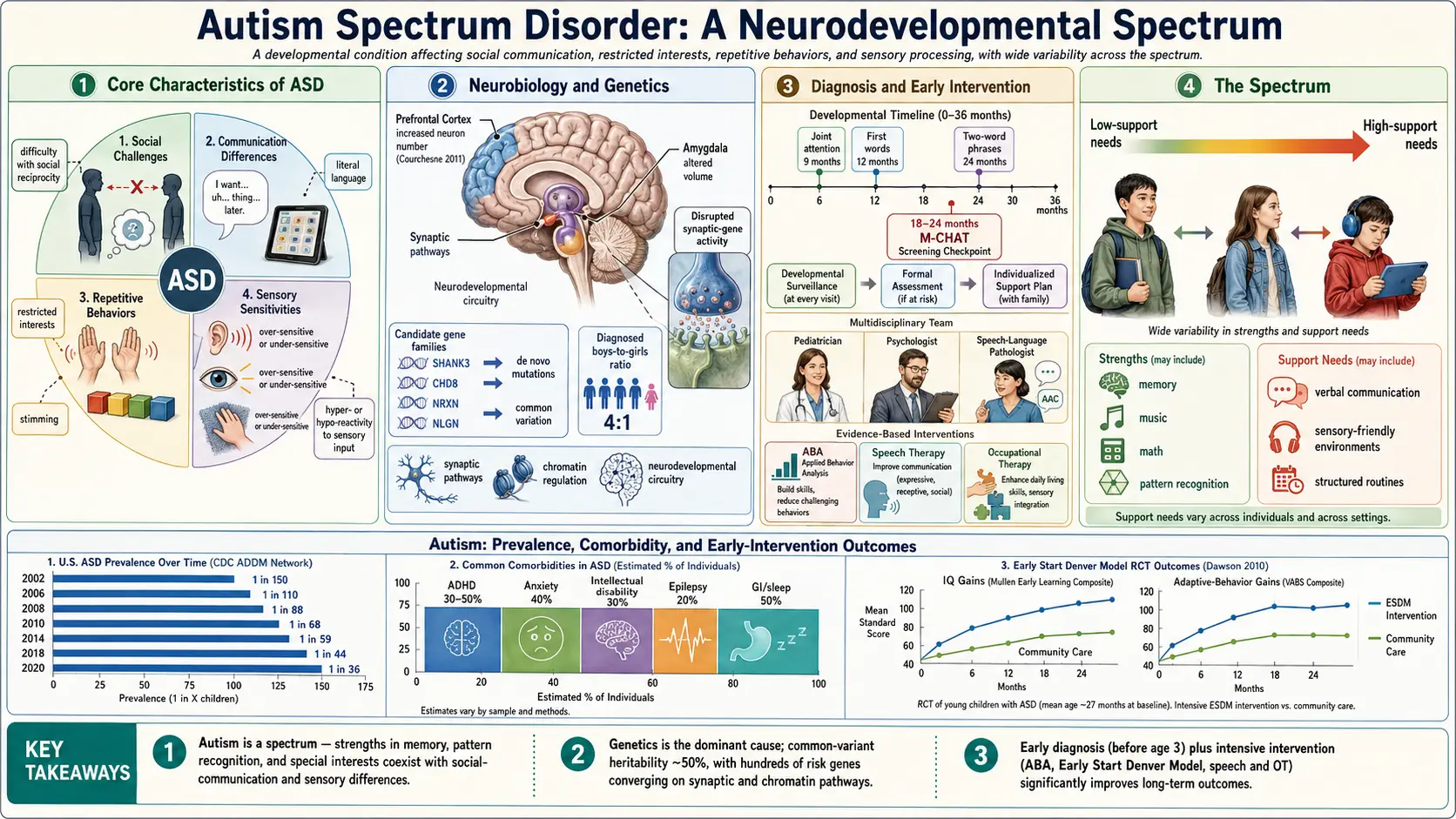
Table of Contents
Autism Explained
Autism, or Autism Spectrum Disorder (ASD), is a developmental disorder that affects communication, behavior, and social interaction. It is called a "spectrum" disorder because there is a wide range of symptoms and severity among individuals.
The latest US count, from the Centers for Disease Control and Prevention (CDC) Autism and Developmental Disabilities Monitoring Network, found autism in 32.2 per 1,000 children aged 8 in 2022 — about 1 in 31 — across 16 sites. The rate varied widely by area, from 9.7 per 1,000 in Laredo, Texas, to 53.1 per 1,000 in California. The median age at the earliest known diagnosis was 47 months.
Characteristics of Autism
- Social challenges: Difficulty with social interactions, understanding social cues, and forming relationships.
- Communication difficulties: Delayed speech and language skills, limited verbal interaction, or nonverbal communication.
- Repetitive behaviors: Engaging in repetitive motions or routines, such as hand-flapping or lining up objects.
- Restricted interests: Intense focus on particular topics or objects.
- Sensory sensitivities: Over- or under-sensitivity to sounds, lights, textures, or smells.
Signs and Symptoms of Autism
Signs and symptoms can vary widely among individuals, but common indicators include:
- Delays in speech and language development
- Limited eye contact or avoidance of social interaction
- Repetitive behaviors: Such as rocking, spinning, or repeating certain words or phrases
- Difficulty understanding others' emotions or expressing their own feelings
- Adherence to routines and distress at changes in the environment
- Exceptional abilities: Some individuals may display strengths in memory, music, art, or academic skills
Causes and Risk Factors
- Genetics: Family history and genetic mutations are linked to autism. A study of about 2 million children born in Denmark, Finland, Sweden, Israel and Western Australia estimated the heritability of autism at about 80%: most of the variation in who develops autism comes from inherited genes, and the study found no support for a mother-related (maternal) effect, which it estimated at 0.4% to 1.6%.
- Brain development: Differences in brain structure or function may contribute.
- Environmental factors: Advanced parental age, low birth weight, and certain complications during pregnancy may increase risk.
- Gender: Boys are more likely to be diagnosed with autism than girls — 3.4 times as often in the 2022 US count (49.2 vs 14.3 per 1,000 children aged 8).
Diagnosis
- Developmental screening: Early assessments during well-child visits to identify developmental delays.
- Comprehensive diagnostic evaluation: A multidisciplinary team may include a pediatrician, psychologist, or speech-language pathologist to conduct further assessments.
- Observation: Analyzing behavior patterns and social interactions.
- Parental reports: Information from parents or caregivers about the child's behavior and development.
Treatment Options
- Behavioral therapies:
- Applied Behavior Analysis (ABA): Uses positive reinforcement to encourage desired behaviors.
- Social skills training: Helps individuals develop appropriate social interactions.
- Speech and language therapy: Aims to improve communication skills and address language delays.
- Occupational therapy: Assists with daily activities and helps improve fine motor skills.
- Educational interventions: Tailored programs in schools to support learning and development.
- Medication: While there is no medication to treat autism directly, medications can help manage related symptoms like anxiety or hyperactivity.
What the research on behavioral therapies shows. A 2014 US government-funded review of 65 studies (48 of them randomized trials) found that early, high-intensity applied behavior analysis delivered over long periods was linked to better thinking (cognitive) and language skills than community care in some young children (moderate strength of evidence), though the size of the effect varied between studies. Early intensive parent-training programs changed how parents interact with their child, with more limited evidence on the child's skills beyond some language gains. Social-skills programs showed some positive effects on social behavior for older children in small studies, joint-attention programs improved shared-attention skills in preschool children (moderate evidence), and cognitive behavioral therapy improved anxiety in older children with an IQ of 70 or above (high strength of evidence). The review rated the evidence as low for many treatment-outcome pairs, and which therapy works best for which child is still not known.
Prevention and Early Intervention
- Early screening and diagnosis: Identifying and addressing developmental delays as early as possible can significantly improve outcomes.
- Early intervention programs: Specialized services that support children and their families can help improve social, communication, and cognitive skills. In a randomized trial of 48 toddlers diagnosed between 18 and 30 months of age, children given the Early Start Denver Model (a program built on developmental and applied behavior analysis principles, delivered by trained therapists and parents for 2 years) gained on average 17.6 IQ-scale standard score points, compared with 7.0 points in children referred to usual community services. The program group kept pace with typically developing children in daily-living (adaptive) skills, while the comparison group fell further behind.
Challenges and Support for Individuals with Autism
- Social integration: Difficulties forming relationships can lead to feelings of isolation.
- Educational support: Tailored education plans (Individualized Education Programs, IEPs) can help meet the needs of children with autism in school settings.
- Workplace support: Adults with autism may benefit from structured environments and support in job settings.
- Family support: Providing resources and guidance for caregivers can help manage the challenges of raising a child with autism.
Complications Associated with Autism
- Co-occurring conditions: Such as attention-deficit/hyperactivity disorder (ADHD), anxiety disorders, or epilepsy.
- Social challenges: Difficulty navigating social interactions and relationships.
- Learning difficulties: Some individuals may face challenges in specific areas of learning.
- Emotional and behavioral issues: Tantrums, aggression, or self-injurious behavior in response to stress or sensory overload.
Key Research Papers
Historical Background
Autism was first described independently by Leo Kanner in 1943 and Hans Asperger in 1944. Kanner identified "early infantile autism" in children who displayed social withdrawal and insistence on sameness, while Asperger described similar traits in higher-functioning children. The term "autism spectrum disorder" was adopted in the DSM-5 (2013), unifying previously separate diagnoses under one umbrella.
Key Research Papers
- Christensen DL, et al. Prevalence and characteristics of autism spectrum disorder among children aged 8 years — Autism and Developmental Disabilities Monitoring Network. MMWR Surveillance Summaries. 2016;65(3):1-23. — doi:10.15585/mmwr.ss6503a1
- Lai MC, Lombardo MV, Baron-Cohen S. Autism. The Lancet. 2014;383(9920):896-910. — doi:10.1016/S0140-6736(13)61539-1
- De Rubeis S, et al. Synaptic, transcriptional and chromatin genes disrupted in autism. Nature. 2014;515(7526):209-215. — doi:10.1038/nature13772
- Geschwind DH, State MW. Gene hunting in autism spectrum disorder: on the path to precision medicine. The Lancet Neurology. 2015;14(11):1109-1120. — doi:10.1016/S1474-4422(15)00044-7
- Lord C, et al. Autism spectrum disorder. Nature Reviews Disease Primers. 2020;6(1):5. — doi:10.1038/s41572-019-0138-4
- Hyman SL, et al. Identification, evaluation, and management of children with autism spectrum disorder (AAP Clinical Report). Pediatrics. 2020;145(1):e20193447. — doi:10.1542/peds.2019-3447
- Dawson G, et al. Randomized, controlled trial of an intervention for toddlers with autism: the Early Start Denver Model. Pediatrics. 2010;125(1):e17-e23. — doi:10.1542/peds.2009-0958
- Gaugler T, et al. Most genetic risk for autism resides with common variation. Nature Genetics. 2014;46(8):881-885. — doi:10.1038/ng.3039
- Courchesne E, et al. Neuron number and size in prefrontal cortex of children with autism. JAMA. 2011;306(18):2001-2010. — doi:10.1001/jama.2011.1638
- Sanders SJ, et al. De novo mutations revealed by whole-exome sequencing are strongly associated with autism. Nature. 2012;485(7397):237-241. — doi:10.1038/nature10945
- Weitlauf AS, et al. Therapies for children with autism spectrum disorder: behavioral interventions update. Comparative Effectiveness Reviews. 2014;137. — PubMed PMID: 25210724
- Shaw KA, Williams S, Patrick ME, et al. Prevalence and early identification of autism spectrum disorder among children aged 4 and 8 years — Autism and Developmental Disabilities Monitoring Network, 16 sites, United States, 2022. MMWR Surveillance Summaries. 2025;74(2):1-22. — doi:10.15585/mmwr.ss7402a1
- Bai D, Yip BHK, Windham GC, et al. Association of genetic and environmental factors with autism in a 5-country cohort. JAMA Psychiatry. 2019;76(10):1035-1043. — doi:10.1001/jamapsychiatry.2019.1411
- Satterstrom FK, et al. Large-scale exome sequencing study implicates both developmental and functional changes in the neurobiology of autism. Cell. 2020;180(3):568-584. — doi:10.1016/j.cell.2019.12.036
PubMed Topic Searches
- PubMed: autism spectrum disorder prevalence
- PubMed: autism early intervention
- PubMed: autism ABA therapy
- PubMed: autism genetics GWAS
- PubMed: autism neurobiology
- PubMed: autism gut microbiome
- PubMed: autism vitamin D
- PubMed: autism omega-3
- PubMed: autism sleep
- PubMed: autism comorbidity anxiety
- PubMed: autism sensory processing
- PubMed: autism adult outcomes
Connections
- Psychiatry
- Anxiety
- Attention-Deficit/Hyperactivity Disorder
- Insomnia
- Vitamin B6
- Vitamin D3
- Magnesium
- Zinc
- Omega-3 Fatty Acids
- Sleep Hygiene
- Lead Poisoning
- Epilepsy
- Schizophrenia
- Depression
- Bipolar Disorder
- Gut Microbiome
- Gut Brain Axis
- Pesticides
- Mental Health
- Measles
- Dr. Bryan Ardis: Nicotine and Autism