N-acetyl-cysteine (NAC) & Liver Health
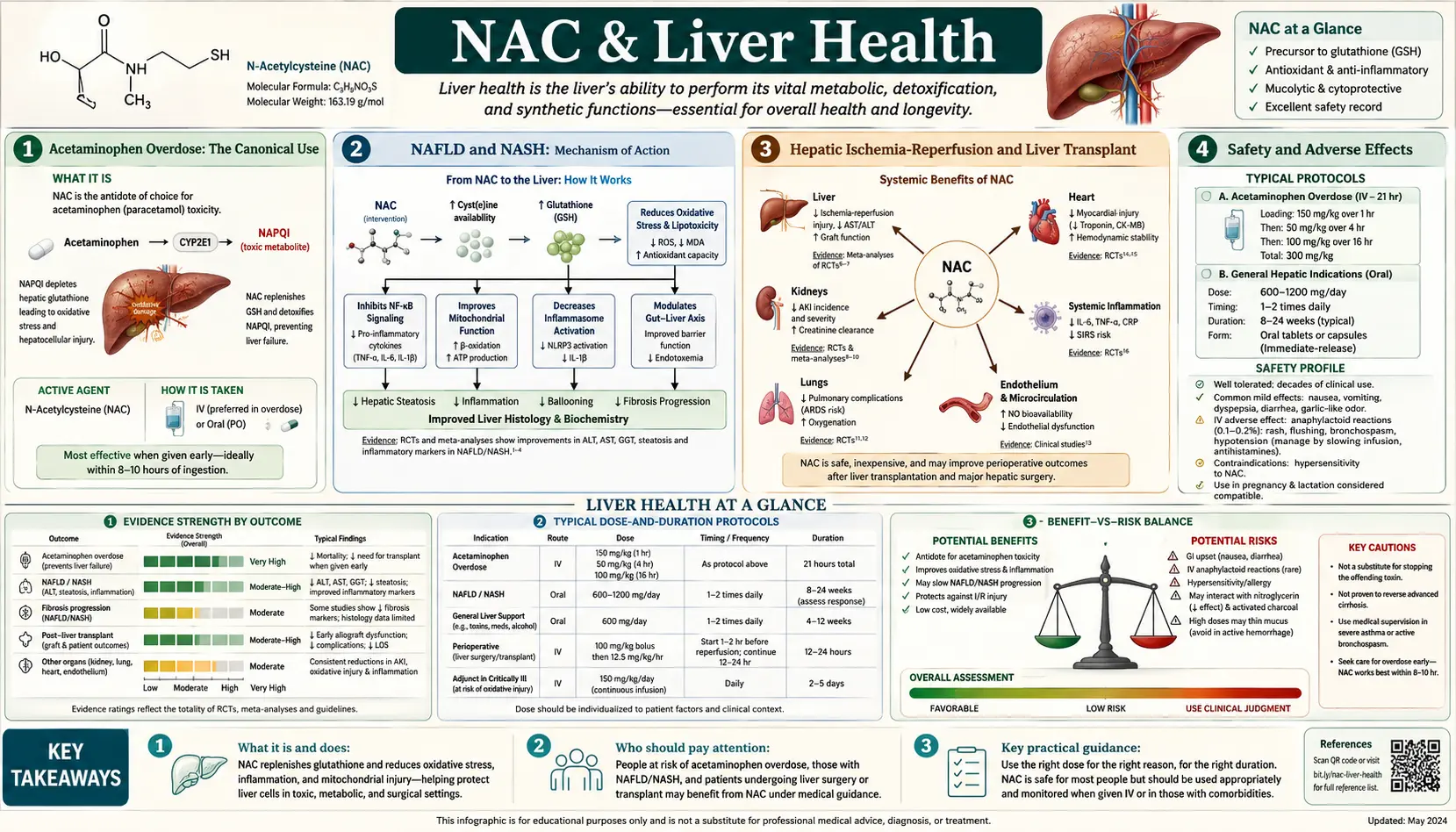
NAC is the antidote used for acetaminophen (paracetamol) overdose. In a US study of 308 consecutive patients at 17 tertiary centres, acetaminophen overdose was the most common apparent cause of acute liver failure, accounting for 39% of cases (Ostapowicz 2002). In a 1979 series of 100 severe poisonings, intravenous NAC given within eight hours of ingestion gave virtually complete protection against liver damage, and efficacy fell progressively after that (Prescott 1979). Beyond this indication, trials have tested NAC in non-acetaminophen acute liver failure, severe alcoholic hepatitis, fatty liver disease, drug-induced liver injury and liver transplantation, with mixed results. In the main adult trial in non-acetaminophen acute liver failure, overall survival, the primary outcome, did not differ (70% versus 66%), while transplant-free survival was better with NAC in patients in early coma grades (Lee 2009). In severe alcoholic hepatitis, adding NAC to prednisolone lowered 1-month mortality (8% versus 24%) but not 6-month mortality, the primary outcome (27% versus 38%, P=0.07) (Nguyen-Khac 2011). This article covers that liver-health literature.
Interactive Visualization Free Radicals & Your Antioxidant Network Follow one superoxide radical down the whole relay — SOD, catalase, glutathione, vitamin E, vitamin C, NADPH — then release free iron and watch a membrane tear itself apart. Launch →Table of Contents
- Acetaminophen Overdose: The Canonical Use
- Non-Acetaminophen Acute Liver Failure (ALF)
- Severe Alcoholic Hepatitis
- NAFLD and NASH
- Drug-Induced Liver Injury (DILI)
- Viral Hepatitis
- Hepatic Ischemia-Reperfusion and Liver Transplant
- Cholestasis and PBC
- Doses Used in Studies
- Safety and Adverse Effects
- Key Research Papers
- Connections
- Featured Videos
Acetaminophen Overdose: The Canonical Use
NAPQI and Glutathione Depletion
At therapeutic doses most acetaminophen is conjugated (by glucuronidation and sulfation) and excreted. A small fraction is oxidized by cytochrome P450 enzymes to a reactive metabolite, N-acetyl-p-benzoquinone imine (NAPQI), which is normally neutralized by conjugation with hepatic glutathione. In overdose, glutathione is used up, NAPQI binds to liver-cell proteins, and centrilobular liver necrosis follows; animal experiments in the early 1970s established glutathione's protective role (Mitchell 1973).
When given early after an overdose, intravenous NAC prevents liver necrosis by replenishing glutathione (Harrison 1991). NAC supplies cysteine, the building block glutathione synthesis depends on, so NAPQI conjugation can resume.
The Rumack-Matthew Nomogram
Rumack and Matthew published a nomogram in Pediatrics in 1975 that relates the plasma acetaminophen concentration to the time since a single acute ingestion, as a way of judging the risk of liver injury (Rumack 1975). Later analyses, such as the US national multicenter study of oral NAC, grouped patients by their initial plasma acetaminophen concentration and by the interval between ingestion and treatment (Smilkstein 1988).
Mortality and Efficacy
In Prescott's 1979 series of 100 severe paracetamol poisonings treated with intravenous NAC, there was virtually complete protection against liver damage in the 40 patients treated within eight hours. Only 1 of 62 patients treated within 10 hours developed severe liver damage, compared with 33 of 57 patients (58%), studied retrospectively, who had received supportive treatment alone. Efficacy fell progressively after eight hours, and treatment after 15 hours was completely ineffective in that series (Prescott 1979).
In the US national multicenter study of 2,540 patients treated with oral NAC, hepatotoxicity developed in 6.1% of patients at probable risk when NAC was started within 10 hours of ingestion and in 26.4% when it was started 10–24 hours after. There were 11 deaths (0.43%), and no deaths were clearly caused by acetaminophen among patients whose treatment began within 16 hours. The authors concluded that treatment was still indicated at least as late as 24 hours after ingestion (Smilkstein 1988).
NAC has also been tested once liver failure is established. In a randomized trial of 50 patients with paracetamol-induced fulminant hepatic failure, survival was 48% with intravenous NAC versus 20% with control (p=0.037); cerebral oedema occurred in 40% versus 68%, and hypotension requiring inotropic support in 48% versus 80% (Keays 1991).
The Intravenous Regimen (Prescott)
The standard intravenous regimen, which originated with Prescott's group, is given in three stages:
- 150 mg/kg as a loading infusion (given over 15 minutes in Harrison 1991)
- 50 mg/kg over 4 hours
- 100 mg/kg over 16 hours
Bateman 2014 describes this standard regimen as lasting 20.25 hours. The SNAP trial (Bateman 2014, Lancet; 222 patients at three UK hospitals) compared it with a shorter, 12-hour modified regimen. Vomiting, retching or the need for rescue antiemetic treatment at 2 hours occurred in 39 of 108 patients on the shorter regimen versus 71 of 109 on the standard regimen, and severe anaphylactoid reactions in 5 versus 31. The trial was not powered to show that the shorter regimen is as effective, and the authors wrote that further research is needed to confirm its efficacy.
The 72-Hour Oral Regimen (Smilkstein)
In the US national multicenter study, patients received a loading dose of 140 mg/kg of oral NAC, followed four hours later by 70 mg/kg every four hours for an additional 17 doses (Smilkstein 1988).
Intravenous Versus Oral
Smilkstein and colleagues concluded, on the basis of the data available to them, that the 72-hour oral regimen is as effective as the 20-hour intravenous regimen, and that it may be superior when treatment is delayed (Smilkstein 1988).
Non-Acetaminophen Acute Liver Failure (ALF)
Lee 2009 — The ALFSG Trial
William Lee and the Acute Liver Failure Study Group published in Gastroenterology in 2009 a double-blind, placebo-controlled trial of 173 adults with acute liver failure and no clinical or historical evidence of acetaminophen overdose. Patients were stratified by site and coma grade and given a 72-hour infusion of NAC (81 patients) or placebo (dextrose, 92 patients). A 2013 erratum corrected a dosage error in the article text.
Key results:
- Overall survival at 3 weeks, the primary outcome: 70% with NAC versus 66% with placebo — not different (1-sided P=0.283)
- Transplant-free survival, a secondary outcome: 40% versus 27% (1-sided P=0.043)
- The transplant-free survival benefit was confined to the 114 patients with coma grade I–II: 52% versus 30% (1-sided P=0.010)
- Coma grade III–IV (59 patients): transplant-free survival 9% with NAC versus 22% with placebo (1-sided P=0.912) — no benefit
- Transplantation rate: 32% versus 45%, not significantly different (P=0.093)
The authors concluded that intravenous NAC improves transplant-free survival in early-stage non-acetaminophen acute liver failure, and that patients with advanced coma grades do not benefit (Lee 2009). A 2015 meta-analysis of four prospective trials (331 patients given NAC, 285 controls) likewise found no difference in overall survival (71% versus 67%), with higher survival with the native liver (41% versus 30%) and higher survival after transplantation (85.7% versus 71.4%) (Hu 2015). A study from a centre without liver transplantation compared 47 adults given oral NAC with 44 historical controls not given NAC and reported survival of 47% versus 27% (P=0.05) — a non-randomized comparison (Mumtaz 2009).
Pediatric ALF — A Negative Trial
Squires 2013 (Hepatology) randomized 184 children, from birth through age 17, with non-acetaminophen acute liver failure to a continuous intravenous NAC infusion or placebo for up to 7 days. One-year survival, the primary outcome, did not differ significantly (73% with NAC versus 82% with placebo, P=0.19). One-year transplant-free survival was significantly lower with NAC (35% versus 53%, P=0.03), particularly among children under 2 years old. The authors wrote that the results do not support broad use of NAC in non-acetaminophen pediatric acute liver failure.
Proposed Mechanisms Beyond Acetaminophen
Harrison 1991 (NEJM) measured circulation and oxygen transport in 12 patients with acetaminophen-induced fulminant hepatic failure and 8 with acute liver failure from other causes. In the acetaminophen group, the NAC infusion raised mean oxygen delivery from 856 to 975 and oxygen consumption from 127 to 184 ml per minute per square meter, and the effects in the other group were similar. Antioxidant and anti-inflammatory effects are other proposed mechanisms.
Severe Alcoholic Hepatitis
Alcoholic hepatitis is a clinical syndrome of jaundice and liver impairment in people with a history of heavy and prolonged alcohol use; short-term mortality in severe disease exceeds 30% (Thursz 2015). Oxidative stress and glutathione depletion are proposed contributors to the injury, which is the rationale for testing NAC alongside corticosteroids.
Nguyen-Khac 2011 — NEJM
This French multicenter trial randomized 174 patients with severe acute alcoholic hepatitis to prednisolone plus NAC (85 patients) or prednisolone alone (89 patients). All patients received 4 weeks of prednisolone. The NAC group received intravenous NAC on day 1 (150, 50 and 100 mg/kg over 30 minutes, 4 hours and 16 hours) and 100 mg/kg per day on days 2–5.
Results:
- 6-month mortality, the primary outcome: 27% versus 38%, P=0.07 — not significantly lower
- 1-month mortality: 8% (prednisolone + NAC) versus 24% (prednisolone alone), P=0.006
- 3-month mortality: 22% versus 34%, P=0.06
- Death due to hepatorenal syndrome at 6 months: 9% versus 22% (P=0.02)
- Infections were less frequent with NAC (P=0.001)
The authors concluded that the combination increased 1-month survival but did not improve 6-month survival, the primary outcome (Nguyen-Khac 2011). In the separate STOPAH trial of 1,103 patients (Thursz 2015, NEJM), prednisolone was associated with a reduction in 28-day mortality that did not reach significance (odds ratio 0.72, 95% CI 0.52–1.01, P=0.06) and with no improvement at 90 days or 1 year; pentoxifylline did not improve survival.
NAFLD and NASH
Non-alcoholic fatty liver disease (NAFLD) can progress to non-alcoholic steatohepatitis (NASH) and cirrhosis. Oxidative stress from fatty acids accumulating in liver cells is believed to drive the progression from steatosis to steatohepatitis, which is why antioxidants such as NAC have been tested (Khoshbaten 2010).
Khoshbaten 2010
Thirty patients with NAFLD were randomly assigned to NAC (600 mg every 12 hours) or vitamin C (1,000 mg every 12 hours) for 3 months (Hepat Mon). NAC significantly lowered serum ALT compared with vitamin C — in the full text, mean ALT in the NAC group went from 77.0 to 51.7 U/L — and decreased spleen size; AST and alkaline phosphatase did not change in either group.
de Oliveira 2008
In a single-group pilot study, 20 consecutive patients with biopsy-proven NASH took NAC 1.2 g/day plus metformin 850–1,000 mg/day for 12 months, with a low-calorie diet. ALT, insulin, glucose and the HOMA-IR index fell, and steatosis and fibrosis decreased on biopsy; lobular inflammation and hepatocellular ballooning did not improve. The authors called for further studies of the combination.
Pamuk 2003
A 2003 letter in the Journal of Gastroenterology and Hepatology reported a small randomized trial of NAC in NASH (Pamuk 2003).
NAC and Vitamin E
The PIVENS trial (Sanyal 2010, NEJM) randomized 247 adults with NASH and without diabetes to pioglitazone, vitamin E 800 IU/day, or placebo for 96 weeks. Vitamin E improved NASH histology compared with placebo (43% versus 19%, P=0.001); pioglitazone did not meet the trial's significance threshold for the primary outcome (34% versus 19%, P=0.04); neither improved fibrosis scores. PIVENS did not test NAC. Vitamin E and glutathione are both part of the cell's antioxidant network, which is the rationale proposed for combining them; no trial of the combination is cited on this page.
Current Status
The trials of NAC in NAFLD and NASH cited here are small, short, or uncontrolled; none is a large randomized trial of NAC alone with liver-biopsy outcomes.
Drug-Induced Liver Injury (DILI)
Many drugs that injure the liver form reactive intermediates that glutathione helps detoxify, which is the rationale for testing NAC. The first-line anti-tuberculosis drugs isoniazid, rifampicin and pyrazinamide are associated with hepatotoxicity (Baniasadi 2010).
Baniasadi 2010 — Anti-Tuberculosis Drug Hepatotoxicity
Sixty newly diagnosed tuberculosis patients aged 60 or older were randomized to the standard four-drug regimen alone (32 patients) or with NAC (28 patients) and followed for 2 weeks. Hepatotoxicity occurred in 12 patients (37.5%) without NAC and in none of those given NAC. The authors concluded that NAC protects against anti-tuberculosis drug-induced hepatotoxicity.
Lee 2009 DILI Subgroup
A 2016 systematic review found only one randomized trial of NAC in non-paracetamol drug-induced liver injury: the Lee 2009 acute liver failure trial. In its DILI subgroup, transplant-free survival was 58% with NAC (19 patients) versus 27% with placebo (26 patients); overall survival was similar (79% versus 65%; odds ratio 0.50, 95% CI 0.13–1.98). The review concluded that the available evidence is limited and does not allow firm conclusions about NAC in non-paracetamol DILI (Chughlay 2016).
Viral Hepatitis
Trials from before the direct-acting antiviral era tested NAC in viral hepatitis:
- Grant 2000 (J Med Virol): in a placebo-controlled, double-blind study at 8 centres in Spain and Italy, 147 patients with chronic hepatitis C received interferon-alpha plus NAC 1,800 mg/day (73 patients) or interferon alone (74 patients) for 6 months. Sustained virological response was 5.5% versus 4.1%. The authors concluded that patients with chronic hepatitis C are very unlikely to benefit from adding NAC to interferon-alpha.
- Gunduz 2003 (World J Gastroenterol): in 41 hospitalized patients with acute viral hepatitis, oral NAC 600 mg/day versus placebo changed neither the time for ALT and bilirubin to normalize nor the length of hospital stay.
Hepatic Ischemia-Reperfusion and Liver Transplant
Cold preservation and warm reperfusion during liver transplantation can injure the graft (ischemia/reperfusion damage), and antioxidants such as NAC have been tested to reduce it.
- D'Amico 2013 (Liver Transpl): 140 grafts transplanted into adults were randomized to an NAC protocol during liver procurement (a systemic infusion of 30 mg/kg 1 hour before procurement plus 300 mg through the portal vein before cross-clamping) or to the standard protocol. Graft survival at 3 and 12 months was 93% and 90% with NAC versus 82% and 70% without (P=0.02), and postoperative complications were 23% versus 51%.
- Hilmi 2010 (Nephrol Dial Transplant): in a randomized, double-blind trial of 100 liver-transplant recipients, intravenous NAC did not affect survival, graft function or the risk of acute kidney injury.
Cholestasis and Primary Biliary Cholangitis (PBC)
Clinical trial evidence for NAC in primary biliary cholangitis and other cholestatic liver diseases is lacking; no such trial is cited on this page.
Doses Used in Studies
The doses below are those reported by the studies cited on this page, not dosing guidance.
| Setting (study) | Route | Regimen reported |
|---|---|---|
| Acetaminophen overdose — standard intravenous regimen (Prescott 1979; Bateman 2014) | IV | 150 mg/kg loading infusion → 50 mg/kg over 4 h → 100 mg/kg over 16 h (20.25 h in Bateman 2014) |
| Acetaminophen overdose — oral regimen (Smilkstein 1988) | PO | 140 mg/kg loading dose → 70 mg/kg every 4 h for 17 further doses (72 h) |
| Non-acetaminophen ALF in adults (Lee 2009) | IV | 72-hour infusion |
| Non-acetaminophen ALF in children (Squires 2013) | IV | Continuous infusion, 150 mg/kg/day for up to 7 days |
| Severe alcoholic hepatitis, with prednisolone (Nguyen-Khac 2011) | IV | Day 1: 150, 50 and 100 mg/kg over 30 min, 4 h and 16 h; days 2–5: 100 mg/kg/day |
| NAFLD (Khoshbaten 2010) | PO | 600 mg every 12 h for 3 months |
| NASH, with metformin (de Oliveira 2008) | PO | 1.2 g/day for 12 months |
| Chronic hepatitis C, with interferon-alpha (Grant 2000) | PO | 1,800 mg/day for 6 months |
| Liver procurement for transplantation (D'Amico 2013) | IV | 30 mg/kg systemic infusion 1 h before procurement, plus 300 mg through the portal vein |
In a study of six healthy volunteers, the oral bioavailability of NAC was 4.0% for reduced NAC and 9.1% for total NAC (Olsson 1988). Much of an oral dose is deacetylated on first pass to cysteine, the substrate for glutathione synthesis, so a low plasma level of intact NAC does not by itself show how much cysteine reaches tissues.
Safety and Adverse Effects
IV Anaphylactoid Reactions
Intravenous NAC can cause anaphylactoid (non-IgE-mediated) reactions such as rash, flushing and bronchospasm during the loading infusion, which can interrupt treatment. In the SNAP trial, severe anaphylactoid reactions were recorded in 31 patients given the standard 20.25-hour regimen versus 5 given a modified 12-hour regimen (Bateman 2014).
Nausea and Vomiting
In the Lee 2009 trial, nausea and vomiting were the only adverse effects significantly more frequent with intravenous NAC than with placebo (14% versus 4%). In the SNAP trial, vomiting, retching or the need for rescue antiemetic treatment at 2 hours was reported in 71 of 109 patients on the standard intravenous regimen (Bateman 2014).
Pregnancy
FDA Pregnancy Category B under the former letter system. NAC is given in pregnancy as the antidote for acetaminophen overdose; in a US poison-centre series of 60 pregnant women with acetaminophen overdose, later NAC treatment was associated with more spontaneous abortion and fetal death (Riggs 1989).
Drug Interactions
- Nitroglycerin: NAC potentiates nitroglycerin-induced vasodilation; in an unstable-angina trial, symptomatic hypotension occurred in 7 of 24 patients given NAC with intravenous nitroglycerin versus none of 22 given nitroglycerin alone (Horowitz 1988).
- The same authors note that NAC and nitroglycerin may form S-nitroso-NAC, which strongly inhibits platelet aggregation (Horowitz 1988).
Key Research Papers
- Rumack BH, Matthew H. Acetaminophen poisoning and toxicity. Pediatrics 1975;55(6):871–6. PubMed PMID: 1134886
- Prescott LF, Illingworth RN, Critchley JA, Stewart MJ, Adam RD, Proudfoot AT. Intravenous N-acetylcystine: the treatment of choice for paracetamol poisoning. Br Med J 1979;2(6198):1097–100. PubMed PMID: 519312
- Smilkstein MJ, Knapp GL, Kulig KW, Rumack BH. Efficacy of oral N-acetylcysteine in the treatment of acetaminophen overdose. Analysis of the national multicenter study (1976 to 1985). N Engl J Med 1988;319(24):1557–62. PubMed PMID: 3059186
- Keays R, Harrison PM, Wendon JA, Forbes A, Gove C, Alexander GJ, et al. Intravenous acetylcysteine in paracetamol induced fulminant hepatic failure: a prospective controlled trial. BMJ 1991;303(6809):1026–9. PubMed PMID: 1954453
- Harrison PM, Wendon JA, Gimson AE, Alexander GJ, Williams R. Improvement by acetylcysteine of hemodynamics and oxygen transport in fulminant hepatic failure. N Engl J Med 1991;324(26):1852–7. PubMed PMID: 1904133
- Lee WM, Hynan LS, Rossaro L, Fontana RJ, Stravitz RT, Larson AM, et al. Intravenous N-acetylcysteine improves transplant-free survival in early stage non-acetaminophen acute liver failure. Gastroenterology 2009;137(3):856–64, 864.e1 (erratum, dosage error in article text: Gastroenterology 2013;145(3):695). PubMed PMID: 19524577
- Squires RH, Dhawan A, Alonso E, Narkewicz MR, Shneider BL, Rodriguez-Baez N, et al. Intravenous N-acetylcysteine in pediatric patients with nonacetaminophen acute liver failure: a placebo-controlled clinical trial. Hepatology 2013;57(4):1542–9. PubMed PMID: 22886633
- Nguyen-Khac E, Thevenot T, Piquet MA, Benferhat S, Goria O, Chatelain D, et al. Glucocorticoids plus N-acetylcysteine in severe alcoholic hepatitis. N Engl J Med 2011;365(19):1781–9. PubMed PMID: 22070475
- Bateman DN, Dear JW, Thanacoody HK, Thomas SH, Eddleston M, Sandilands EA, et al. Reduction of adverse effects from intravenous acetylcysteine treatment for paracetamol poisoning: a randomised controlled trial. Lancet 2014;383(9918):697–704. PubMed PMID: 24290406
- Khoshbaten M, Aliasgarzadeh A, Masnadi K, Tarzamani MK, Farhang S, Babaei H, et al. N-acetylcysteine improves liver function in patients with non-alcoholic fatty liver disease. Hepat Mon 2010;10(1):12–6. PubMed PMID: 22308119
- de Oliveira CP, Stefano JT, de Siqueira ER, Silva LS, de Campos Mazo DF, Lima VM, et al. Combination of N-acetylcysteine and metformin improves histological steatosis and fibrosis in patients with non-alcoholic steatohepatitis. Hepatol Res 2008;38(2):159–65. PubMed PMID: 18197877
- Baniasadi S, Eftekhari P, Tabarsi P, Fahimi F, Raoufy MR, Masjedi MR, et al. Protective effect of N-acetylcysteine on antituberculosis drug-induced hepatotoxicity. Eur J Gastroenterol Hepatol 2010;22(10):1235–8. PubMed PMID: 20461008
- Sanyal AJ, Chalasani N, Kowdley KV, McCullough A, Diehl AM, Bass NM, et al. Pioglitazone, vitamin E, or placebo for nonalcoholic steatohepatitis. N Engl J Med 2010;362(18):1675–85. PubMed PMID: 20427778
- Thursz MR, Richardson P, Allison M, Austin A, Bowers M, Day CP, et al. Prednisolone or pentoxifylline for alcoholic hepatitis. N Engl J Med 2015;372(17):1619–28. PubMed PMID: 25901427
- Grant PR, Black A, Garcia N, Prieto J, Garson JA. Combination therapy with interferon-alpha plus N-acetyl cysteine for chronic hepatitis C: a placebo controlled double-blind multicentre study. J Med Virol 2000;61(4):439–42. PubMed PMID: 10897061
- D'Amico F, Vitale A, Piovan D, Bertacco A, Ramirez Morales R, Chiara Frigo A, et al. Use of N-acetylcysteine during liver procurement: a prospective randomized controlled study. Liver Transpl 2013;19(2):135–44. PubMed PMID: 22859317
- Hu J, Zhang Q, Ren X, Sun Z, Quan Q. Efficacy and safety of acetylcysteine in "non-acetaminophen" acute liver failure: a meta-analysis of prospective clinical trials. Clin Res Hepatol Gastroenterol 2015;39(5):594–9. PubMed PMID: 25732608
- Chughlay MF, Kramer N, Spearman CW, Werfalli M, Cohen K. N-acetylcysteine for non-paracetamol drug-induced liver injury: a systematic review. Br J Clin Pharmacol 2016;81(6):1021–9. PubMed PMID: 26757427
- Mumtaz K, Azam Z, Hamid S, Abid S, Memon S, Ali Shah H, et al. Role of N-acetylcysteine in adults with non-acetaminophen-induced acute liver failure in a center without the facility of liver transplantation. Hepatol Int 2009;3(4):563–70. PubMed PMID: 19727985
- Pamuk GE, Sonsuz A. N-acetylcysteine in the treatment of non-alcoholic steatohepatitis. J Gastroenterol Hepatol 2003;18(10):1220–1. PubMed PMID: 12974918
- Hilmi IA, Peng Z, Planinsic RM, Damian D, Dai F, Tyurina YY, et al. N-acetylcysteine does not prevent hepatorenal ischaemia-reperfusion injury in patients undergoing orthotopic liver transplantation. Nephrol Dial Transplant 2010;25(7):2328–33. PubMed PMID: 20179007
- Gunduz H, Karabay O, Tamer A, Ozaras R, Mert A, Tabak OF. N-acetyl cysteine therapy in acute viral hepatitis. World J Gastroenterol 2003;9(12):2698–700. PubMed PMID: 14669316
- Ostapowicz G, Fontana RJ, Schiødt FV, Larson A, Davern TJ, Han SH, et al. Results of a prospective study of acute liver failure at 17 tertiary care centers in the United States. Ann Intern Med 2002;137(12):947–54. PubMed PMID: 12484709
- Mitchell JR, Jollow DJ, Potter WZ, Gillette JR, Brodie BB. Acetaminophen-induced hepatic necrosis. IV. Protective role of glutathione. J Pharmacol Exp Ther 1973;187(1):211–7. PubMed PMID: 4746329
- Olsson B, Johansson M, Gabrielsson J, Bolme P. Pharmacokinetics and bioavailability of reduced and oxidized N-acetylcysteine. Eur J Clin Pharmacol 1988;34(1):77–82. PubMed PMID: 3360052
- Horowitz JD, Henry CA, Syrjanen ML, Louis WJ, Fish RD, Smith TW, et al. Combined use of nitroglycerin and N-acetylcysteine in the management of unstable angina pectoris. Circulation 1988;77(4):787–94. PubMed PMID: 3127076
- Riggs BS, Bronstein AC, Kulig K, Archer PG, Rumack BH. Acute acetaminophen overdose during pregnancy. Obstet Gynecol 1989;74(2):247–53. PubMed PMID: 2748061
PubMed Topic Searches
Selected PubMed topic searches relevant to N-acetylcysteine in hepatology, including acetaminophen toxicity, NAFLD, and alcoholic hepatitis.
- PubMed: NAC and acetaminophen overdose
- PubMed: NAC and non-acetaminophen acute liver failure
- PubMed: NAC and NAFLD
- PubMed: NAC and alcoholic hepatitis
- PubMed: Glutathione and hepatocyte necrosis
- PubMed: NAPQI and acetaminophen toxicity
- PubMed: NAC in hepatitis C
- PubMed: NAC and drug-induced liver injury
- PubMed: Silymarin and the liver
- PubMed: NAC and liver transplant outcomes
- PubMed: Oxidative stress and liver fibrosis
- PubMed: Cirrhosis and glutathione depletion
Connections
- Free Radicals & Your Antioxidant Network — interactive animation
- NAC Overview
- NAC & Glutathione
- NAC & Kidney Health
- Non-Alcoholic Fatty Liver Disease
- Liver Disease
- Cirrhosis
- Hepatitis
- Hepatitis B
- Hepatitis C
- Liver Cleansing
- Detox Protocols
- Chanca Piedra: Liver Protection and Hepatitis B — HBV-specific antiviral mechanism, niranthin vs nucleoside analogs, trial evidence on HBsAg/HBV-DNA, and adjunctive use with entecavir/tenofovir.
- Milk Thistle
- Vitamin E
- Cysteine
- Oxidative Stress
- GGT
- Coffee & Liver Disease
- NAC & Cardiovascular Health