PQQ (Pyrroloquinoline Quinone)
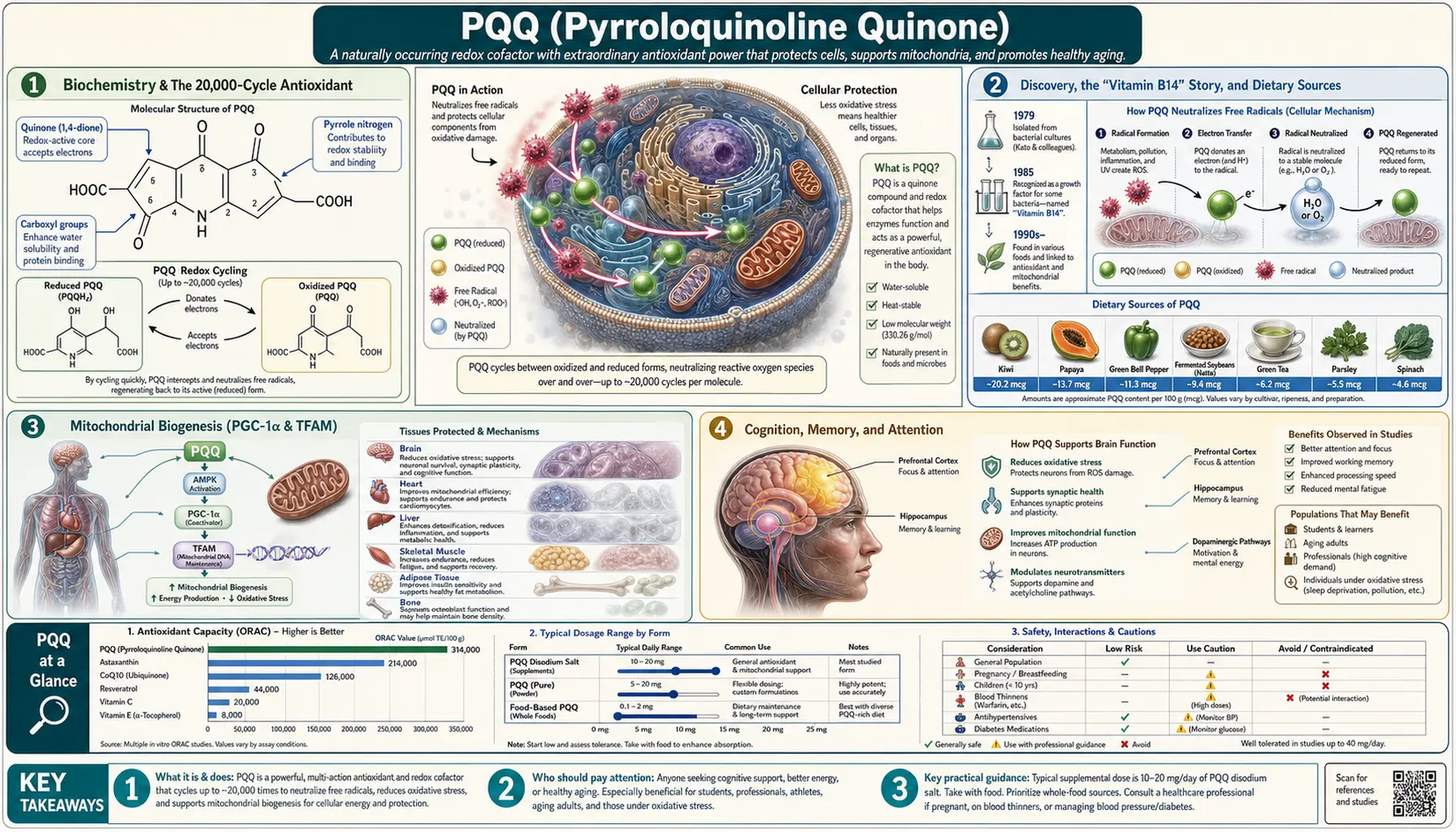
Pyrroloquinoline quinone (PQQ) is a tricyclic ortho-quinone redox cofactor, first identified in bacteria, that occurs in trace amounts in foods and in human milk. Cell and rodent studies show that it can stimulate mitochondrial biogenesis through CREB and PGC-1α; a 2003 proposal that it is a vitamin for mammals was disputed in 2005, and it is not regarded as a vitamin today. Human trials, mostly small, short and run or funded by manufacturers, have used about 20 mg/day and report modest changes in some cognitive test scores and inflammation markers. The European Food Safety Authority judged 20 mg/day safe for healthy adults in 2017.
Interactive Visualization Mitochondria & ATP — watch your cells make energy Follow electrons through the transport chain and watch the ATP-synthase motor spin — then block Complex IV and see the chain stall. Launch →
Table of Contents
- Biochemistry and Redox Cycling
- Discovery, the "Vitamin B14" Story, and Dietary Sources
- Mitochondrial Biogenesis (PGC-1α & TFAM)
- Cognition, Memory, and Attention
- Sleep, Mood, and Quality of Life
- Neuroprotection (Amyloid, Glutamate, NMDA)
- Anti-Inflammatory & Cardiovascular Effects
- Reproductive & Developmental Role
- Skin, Collagen, and Hair
- PQQ Alongside CoQ10 and Other Compounds
- Forms: Fermented and Synthetic Disodium Salt
- Doses Used in Studies
- Safety Findings and Regulatory Status
- Key Research Papers
- Connections
- Featured Videos
Biochemistry and Redox Cycling
PQQ (chemical name 4,5-dihydro-4,5-dioxo-1H-pyrrolo[2,3-f]quinoline-2,7,9-tricarboxylic acid) is a tricyclic ortho-quinone with three fused rings — a pyrrole, a pyridine, and a benzene ring — carrying three carboxylic acid groups. The quinone moiety is the redox-active center, capable of accepting two electrons and two protons to become the fully reduced PQQH&sub2; (pyrroloquinoline quinol), and then donating them again when oxidized. It was first identified as the coenzyme of bacterial alcohol dehydrogenases (Salisbury et al. 1979).
PQQ is chemically stable, which lets it act as a catalyst through repeated oxidation-reduction cycles. A 2009 review (Rucker, Chowanadisai and Nakano; one author was from a PQQ manufacturer's research laboratory) tabulated the "potential number of catalytic cycles" measured in chemical redox-cycling assays: about 20,000 for PQQ, 800 for quercetin and 4 for ascorbic acid (vitamin C). These are test-tube measurements of chemical stability; they do not show how long PQQ acts in the body or that small doses have lasting effects in people.
In laboratory systems PQQ quenches reactive oxygen species, and under some conditions it can also generate them; a 2003 study described both antioxidant and pro-oxidant properties (He et al. 2003). Whether PQQ crosses the blood-brain barrier well is unsettled: one group described PQQ's blood-brain-barrier permeability as insufficient in an in-vitro model and made an ester derivative to improve it (Tsukakoshi et al. 2018), while a 2024 computational and mouse study predicted notable permeability (Li et al. 2024).
Discovery, the "Vitamin B14" Story, and Dietary Sources
PQQ was described as a novel bacterial coenzyme in 1979. In 1989, a University of California, Davis group reported that mice fed a chemically defined diet with no PQQ grew poorly, failed to reproduce, had fragile skin and lower lysyl oxidase, and suggested that PQQ might act as a growth factor or vitamin (Killgore et al. 1989).
In 2003, a short Nature report by Kasahara and Kato proposed PQQ as "a new redox-cofactor vitamin for mammals", on the basis that a mouse enzyme involved in lysine breakdown appeared to be PQQ-dependent; the popular label "vitamin B14" followed. The claim was disputed in Nature in 2005. Felton and Anthony showed that the sequence analysis relied on databases that wrongly labelled beta-propeller sequences as PQQ-binding motifs, so there was nothing to indicate the enzyme was a PQQ-dependent dehydrogenase. Rucker and colleagues tried to reproduce the findings and found that the enzyme's activity in liver and blood levels of its marker were not affected by dietary PQQ, which "call[s] into question the identification of PQQ as a new vitamin." A 2009 review states that PQQ "is not currently viewed as a vitamin" (Rucker et al. 2009). No recommended intake has been set for it. The fuller story is told in the dedicated History & Discovery article.
Dietary sources
A 1995 survey using gas chromatography-mass spectrometry (Kumazawa et al. 1995) detected free PQQ in every food and drink sample tested, at 3.7-61 ng per gram or per millilitre, and reported that levels in human tissues and body fluids are 5-10 times lower than in foods. Popular lists rank natto (fermented soybeans), parsley, green peppers, kiwifruit and papaya near the top; the per-food figures attributed to that survey could not be checked against the paper's tables for this page, so they are not repeated here.
PQQ and its amino-acid condensation products, such as imidazolopyrroloquinoline (IPQ), have been detected in human milk at nanomolar to micromolar concentrations (Mitchell et al. 1999). The 2009 review reports that PQQ in human milk amounts to 1-2 µg per gram of milk solids, similar to the concentrations reported for cow's milk.
Estimates of intake vary. The 2009 review estimates free PQQ intake at 100-400 µg a day, and suggests total exposure including PQQ derivatives may be as much as 1-2 mg a day. The European Food Safety Authority (EFSA) stated in 2017 that a supplement intake of 20 mg/day is at least 250 times the estimated background intake of PQQ from foods. These gaps are part of why PQQ is studied as a supplement rather than as a recognised micronutrient.
Mitochondrial Biogenesis (PGC-1α & TFAM)
PQQ's best-known proposed effect is the stimulation of mitochondrial biogenesis — the making of new mitochondria within existing cells. The evidence for it comes mainly from cell and rodent studies.
The key mechanistic study was published by Chowanadisai, Rucker and colleagues at UC Davis in 2010 (Journal of Biological Chemistry). It was a cell-culture study: mouse liver-derived Hepa1-6 cells exposed to 10-30 µM PQQ for 24-48 hours showed higher citrate synthase and cytochrome c oxidase activity, more mitochondrial DNA and more oxygen use. The effect ran through phosphorylation of the CREB transcription factor and increased expression of PGC-1α, a regulator of mitochondrial biogenesis, with increases in NRF-1 and NRF-2 activation and in TFAM, TFB1M and TFB2M mRNA. When PGC-1α or CREB was knocked down, PQQ no longer stimulated biogenesis.
Earlier rodent work came at the question from the other side, by removing PQQ from the diet. In Stites et al. 2006, PQQ-deficient weanling mice had a 20-30% lower relative amount of mitochondria in the liver than mice given PQQ (2 mg per kg of diet), along with lower respiratory control ratios; the difference in mitochondrial DNA content was a non-significant trend at 4 weeks and was gone at 8 weeks. Bauerly et al. 2006 reported that PQQ status altered lysine metabolism and mitochondrial DNA content in mice and rats.
The human evidence is limited to marker studies. In a randomized trial at Baylor University (Hwang et al. 2020), 23 untrained men took 20 mg/day PQQ or placebo for 6 weeks while following the same supervised endurance-training program. Aerobic performance and body composition did not differ between the groups; PGC-1α protein rose more in the PQQ group. The trial abstract does not state its funding.
This mechanism differs from those of CoQ10 (an electron carrier inside the existing electron transport chain), alpha lipoic acid (a cofactor of mitochondrial dehydrogenase enzymes), and methylene blue (an alternative electron carrier). Whether PQQ supplements increase mitochondrial numbers in human tissues has not been shown; the 2009 review describes the mitochondrial findings as coming from "experimental animal models".
Where the evidence for each claim on this page comes from: cell and animal work (violet) and human trials (cyan), with trial size and length as reported by the authors.
Cognition, Memory, and Attention
Several small randomized trials, most of them in Japan and most run or funded by companies that make or sell PQQ disodium salt, have tested about 20 mg/day for 12 weeks in healthy adults. Results are mixed across tests: some cognitive scores improved, often only in subgroups.
- Itoh et al. (2016, Advances in Experimental Medicine and Biology) — randomized, double-blind, placebo-controlled; 41 healthy older adults; PQQ disodium salt 20 mg/day or placebo for 12 weeks. On the Stroop test, the change in the interference ratio was significantly smaller in the PQQ group. On a tablet visual-spatial test, scores rose significantly only in the PQQ participants with lower starting scores (a stratified analysis). No abnormal blood or urine findings were reported. One author was from the research laboratory of the manufacturer of the salt tested.
- Nakano et al. (2016, Advances in Experimental Medicine and Biology) — 20 healthy adults aged 50-70, 20 mg/day or placebo for 12 weeks; near-infrared spectroscopy showed higher hemoglobin concentration in the right prefrontal cortex after PQQ, which the authors read as increased blood flow. Authors included researchers from the manufacturer.
- Shiojima et al. (2022, Journal of the American Nutrition Association) — randomized, double-blind, placebo-controlled; 64 healthy adults aged 40 to under 80 who felt more forgetful; 21.5 mg/day PQQ disodium salt or placebo for 12 weeks; 58 completed. The PQQ group improved more than placebo on several domains of a computerized test battery (including composite memory, verbal memory and reaction time) and on a forgetfulness questionnaire and the Japanese MMSE; no adverse events were observed. Several authors were from a supplement company, and the salt tested was that company's branded product.
- Tamakoshi et al. (2023, Food & Function) — double-blind, placebo-controlled; adults aged 20-65; 20 mg/day for 12 weeks. Composite and verbal memory improved at 12 weeks; in an age-stratified analysis, younger adults (20-40) improved in cognitive flexibility and processing speed at 8 weeks, and older adults (41-65) in memory at 12 weeks. The abstract does not give the number of participants. Most authors were from the manufacturer.
A 2009 Japanese trade-journal report often cited for a 24-week trial in 71 adults, a 2018 "Korean trial" in 67 older adults, and a 2021 PQQ + CoQ10 cognition trial (Kim et al.) could not be found in PubMed or Crossref, so their figures are not repeated here.
The Itoh 2016 authors cite earlier work in which rats fed a PQQ-supplemented diet showed better learning than controls. The proposed mechanism is the mitochondrial-biogenesis pathway seen in cell and animal studies, together with the cerebral blood flow change reported by Nakano 2016. No trial has tested PQQ in people diagnosed with mild cognitive impairment or dementia, and no trial has compared PQQ directly with CoQ10 or exercise.
Sleep, Mood, and Quality of Life
The sleep and mood data come mainly from one small study without a placebo group. In Nakano et al. 2012 (Functional Foods in Health and Disease), 17 adults took 20 mg/day PQQ for 8 weeks in an open-label trial. Afterwards, all six mood-scale measures (vigor, fatigue, tension-anxiety, depression, anger-hostility and confusion) were significantly improved, as were quality of life, appetite, sleep and pain scores; sleep questionnaires showed improvements in sleepiness on waking, sleep onset and maintenance, and sleep duration, and the sleep changes correlated with the cortisol awakening response. Without a placebo group, improvements of this kind cannot be separated from expectation effects.
The research on chronic fatigue and brain fog is mostly indirect. PQQ appears in narrative reviews of mitochondrial nutrients for chronic fatigue syndrome and fibromyalgia, but no randomized trial of PQQ alone in chronic fatigue syndrome, fibromyalgia, long COVID or post-viral syndromes was found in PubMed for this page.
Neuroprotection (Amyloid, Glutamate, NMDA)
PQQ's neuroprotective activity has been shown in laboratory and animal models, not in people:
- Amyloid fibrils — in test-tube experiments, PQQ reduced fibril formation by amyloid beta (1-42) and mouse prion protein (Kim et al. 2010), and by alpha-synuclein (Kobayashi et al. 2006). In APP/PS1 Alzheimer model mice, a synthetic tri-lithium salt of PQQ reduced amyloid deposition and improved learning and memory (Zhao et al. 2014); that compound combines lithium with PQQ, so the result is not a test of PQQ alone.
- NMDA receptor — in rat cortical neurons in culture, 50 µM PQQ acted at the NMDA receptor's redox modulatory site (not the glutamate-binding site), depressing NMDA-induced currents, and 50-200 µM PQQ protected cultures against NMDA-mediated toxicity (Aizenman et al. 1992). These are concentrations applied directly to cells.
- Nerve growth factor (NGF) — in cultured mouse astroglial cells, PQQ stimulated NGF synthesis, the strongest of the coenzymes tested in those cells (Murase et al. 1993).
No human trial in neurodegenerative disease is cited here. The trials in healthy adults (Itoh, Nakano, Shiojima, Tamakoshi) measured cognitive test scores, not amyloid, NMDA activity or NGF.
Anti-Inflammatory & Cardiovascular Effects
The human inflammation data come from one small study. In Harris et al. 2013 (Journal of Nutritional Biochemistry), 10 healthy adults (5 women, 5 men) took PQQ in a fruit-flavoured drink in a crossover design. After a single dose of 0.2 mg/kg, a malondialdehyde-based (TBAR) assay suggested a change in antioxidant potential. With a daily dose of 0.3 mg/kg, measurements after 76 hours showed significant decreases in plasma C-reactive protein and IL-6 and in urinary methylated amines such as trimethylamine N-oxide, and urinary metabolite changes the authors described as consistent with enhanced mitochondria-related function. Standard clinical measures (cholesterol, glucose, triglycerides) were not altered. The abstract does not state the funding.
A separate randomized trial (Nakano et al. 2015; authors from the manufacturer) gave 20 mg/day or placebo for 12 weeks to 29 healthy Japanese adults aged 40-57 with normal to moderately high triglycerides. Triglycerides did not change; mean LDL cholesterol showed a marginally significant fall in the PQQ group, and a significant fall in the subgroup that started with high LDL.
In rat models of heart attack, PQQ given by injection (15-20 mg/kg, into the abdominal cavity before coronary occlusion or into a vein at reperfusion) reduced infarct size and improved heart function (Zhu et al. 2004). No human cardiovascular outcome trial of PQQ is cited here. PQQ is discussed alongside CoQ10, alpha lipoic acid and omega-3 fatty acids in writing on mitochondrial nutrition, but no trial in heart failure or after a heart attack has tested it.
Reproductive & Developmental Role
Some of the earliest observations behind PQQ research came from mice fed chemically defined diets. Mice given no PQQ grew poorly and failed to reproduce (Killgore et al. 1989); in Steinberg et al. 2003, PQQ-deprived mice mated normally but had lower conception, fertility and pup viability, and their offspring grew more slowly than those of PQQ-supplemented mice. These reproduction findings came before, and are separate from, the 2003 lysine-metabolism "vitamin" claim described above.
The first human study of ovarian measures was small and uncontrolled. In Tsuji et al. 2026, 50 healthy women aged 25-42 took 20 mg/day PQQ for about 90 days in a single-arm, open-label study; in the 35 analysed per protocol, anti-Müllerian hormone (AMH, a marker of ovarian reserve) did not change overall. Subgroup results were inconsistent, and the authors state that the results do not permit conclusions about clinical efficacy. The study was funded by a pharmaceutical company that developed the product tested.
The CoQ10 fertility trials are covered on the CoQ10 page; no trial has tested PQQ with CoQ10 for fertility outcomes.
Skin, Collagen, and Hair
PQQ-deficient mice had fragile skin, more easily extracted skin collagen and lower lysyl oxidase, the copper-dependent enzyme that cross-links collagen and elastin (Killgore et al. 1989). PQQ is not lysyl oxidase's cofactor, however: in 1996 the enzyme's own cofactor was identified as lysine tyrosylquinone, a quinone formed from two of the enzyme's own amino-acid side chains (Wang et al. 1996).
In people, one study (Nakano et al. 2015; manufacturer authors) gave 20 mg/day PQQ for 8 weeks to healthy women with dry skin; PQQ significantly limited the rise in transepidermal water loss on the forearm, and participants reported positive impressions on a questionnaire. The same paper reported fewer mast cells and T cells in the skin of dry-skin model mice.
PQQ appears in some hair supplement formulas, but no trial of PQQ for hair outcomes is cited here.
PQQ Alongside CoQ10 and Other Compounds
PQQ is often sold together with CoQ10. The two have different proposed roles:
- PQQ — in cell and rodent studies, signals for more mitochondria via CREB and PGC-1α
- CoQ10 — carries electrons from Complexes I and II to Complex III inside the mitochondrial electron transport chain
No trial cited here has tested whether the combination does more than either compound alone.
Other compounds discussed alongside PQQ in writing on mitochondria, each with its own evidence:
- Alpha lipoic acid — a cofactor of mitochondrial dehydrogenase enzymes
- NAD+ / NMN — NAD+ and its precursors, studied for energy metabolism and sirtuin activity
- Methylene blue — an alternative electron carrier
- Creatine — an energy buffer through phosphocreatine
- Nicotinamide riboside (B3 form) — an NAD+ precursor
Forms: Fermented and Synthetic Disodium Salt
- Fermentation-derived PQQ disodium salt — produced by bacterial fermentation (EFSA's 2017 opinion describes one such product, made with Hyphomicrobium denitrificans, at a minimum purity of 99.0%). Most of the published Japanese trials above used one fermentation-derived product made by their sponsor, so their results may not transfer to other products.
- Chemically synthesised PQQ disodium salt — also sold; FDA's GRAS inventory lists notices for PQQ disodium salt from several notifiers. Published head-to-head data comparing the forms in people were not found for this page.
- PQQ free acid — less common in supplements.
- Combination products — PQQ is often sold in fixed-dose capsules with CoQ10, in amounts that vary by product.
- Topical products — PQQ and PQQ derivatives appear in skincare; clinical data are limited.
The human trials used 20 mg/day, or 21.5 mg/day in one trial; product labels vary in how much PQQ they contain.
Doses Used in Studies
- Cognition trials — 20 mg/day for 12 weeks (Itoh 2016, Nakano 2016, Tamakoshi 2023); 21.5 mg/day for 12 weeks (Shiojima 2022)
- Sleep and mood (open-label) — 20 mg/day for 8 weeks (Nakano 2012)
- Exercise and PGC-1α — 20 mg/day for 6 weeks (Hwang 2020)
- Inflammation markers — 0.2 mg/kg once, then 0.3 mg/kg daily (Harris 2013)
- Lipids and skin — 20 mg/day for 12 weeks and 8 weeks (Nakano 2015 papers)
- Ovarian reserve (open-label) — 20 mg/day for about 90 days (Tsuji 2026)
EFSA's 2017 safety assessment covered a maximum of 20 mg/day in food supplements for healthy adults, excluding pregnant and breastfeeding women. No trial cited here compared different doses or dosing times.
Absorption. The best-known absorption data are from mice: in Smidt et al. 1991, about 62% (range 19-89%) of an oral dose of radiolabelled PQQ was absorbed, about 81% of the absorbed dose was excreted by the kidneys within 24 hours, and skin and kidney were the only tissues retaining significant amounts at 24 hours. EFSA noted in 2017 that information on absorption, distribution, metabolism and excretion of PQQ in animals and humans is limited.
Safety Findings and Regulatory Status
The main safety data come from rat toxicology studies and short human trials, much of it from the manufacturer:
- Rat toxicology — in Nakano et al. 2014 (manufacturer and consultancy authors), the median lethal dose was 1000-2000 mg/kg in male and 500-1000 mg/kg in female rats. In a 14-day study, high doses raised relative kidney weights with tissue changes in female rats, and a 28-day follow-up in females found more protein and crystals in the urine; these findings reversed during recovery. The no-observed-adverse-effect level in the 13-week study was 100 mg/kg/day, the highest dose tested. Genotoxicity tests are reported separately (Nakano et al. 2013).
- EFSA (2017) — the European Food Safety Authority's panel concluded that a fermentation-derived PQQ disodium salt is safe as a novel food at up to 20 mg/day in food supplements for healthy adults, excluding pregnant and breastfeeding women, based on that 100 mg/kg/day NOAEL and a margin of exposure of 344. The panel noted that data on absorption and metabolism are limited.
- FDA — FDA's GRAS notice inventory lists several notices for PQQ disodium salt (GRN 625 and later notices) to which FDA responded that it had no questions about the notifier's conclusion that the intended uses are safe. A "no questions" letter is not an FDA approval or a finding that PQQ has health effects.
- Human trials — the 12-week trials reported no adverse events (Shiojima 2022) or no abnormal blood, urine or physical findings (Itoh 2016). A 2009 review states there is no evidence of acute side effects or overt toxicity in humans at up to 60 mg per day. These trials were small and short.
- Pregnancy, breastfeeding and children — PQQ occurs naturally in human milk, but supplemental doses have not been studied in pregnancy, breastfeeding or childhood; EFSA's assessment excluded pregnant and breastfeeding women and covered healthy adults only.
- Medicines — the trials described here did not study interactions with medicines, including anticoagulants; no interaction data were found for this page.
Decisions about supplements belong with a clinician.
Key Research Papers
- Salisbury SA, Forrest HS, Cruse WB, Kennard O (1979). A novel coenzyme from bacterial primary alcohol dehydrogenases. Nature 280:843-4 — PubMed PMID: 471057
- Killgore J, Smidt C, Duich L, et al. (1989). Nutritional importance of pyrroloquinoline quinone. Science 245:850-2 — PubMed PMID: 2549636
- Smidt CR, Unkefer CJ, Houck DR, Rucker RB (1991). Intestinal absorption and tissue distribution of [14C]pyrroloquinoline quinone in mice. Proceedings of the Society for Experimental Biology and Medicine 197:27-31 — PubMed PMID: 1850522
- Aizenman E, Hartnett KA, Zhong C, Gallop PM, Rosenberg PA (1992). Interaction of the putative essential nutrient pyrroloquinoline quinone with the N-methyl-D-aspartate receptor redox modulatory site. Journal of Neuroscience 12:2362-9 — PubMed PMID: 1318959
- Murase K, Hattori A, Kohno M, Hayashi K (1993). Stimulation of nerve growth factor synthesis/secretion in mouse astroglial cells by coenzymes. Biochemistry and Molecular Biology International 30:615-21 — PubMed PMID: 8401318
- Kumazawa T, Sato K, Seno H, Ishii A, Suzuki O (1995). Levels of pyrroloquinoline quinone in various foods. Biochemical Journal 307:331-3 — PubMed PMID: 7733865
- Wang SX, Mure M, Medzihradszky KF, et al. (1996). A crosslinked cofactor in lysyl oxidase: redox function for amino acid side chains. Science 273:1078-84 — PubMed PMID: 8688089
- Mitchell AE, Jones AD, Mercer RS, Rucker RB (1999). Characterization of pyrroloquinoline quinone amino acid derivatives by electrospray ionization mass spectrometry and detection in human milk. Analytical Biochemistry 269:317-25 — PubMed PMID: 10222004
- Kasahara T, Kato T (2003). Nutritional biochemistry: A new redox-cofactor vitamin for mammals. Nature 422:832 — PubMed PMID: 12712191 (disputed: see the two 2005 comments below)
- He K, Nukada H, Urakami T, Murphy MP (2003). Antioxidant and pro-oxidant properties of pyrroloquinoline quinone (PQQ): implications for its function in biological systems. Biochemical Pharmacology 65:67-74 — PubMed PMID: 12473380
- Steinberg F, Stites TE, Anderson P, et al. (2003). Pyrroloquinoline quinone improves growth and reproductive performance in mice fed chemically defined diets. Experimental Biology and Medicine 228:160-6 — PubMed PMID: 12563022
- Felton LM, Anthony C (2005). Biochemistry: role of PQQ as a mammalian enzyme cofactor? Nature 433:E10 — PubMed PMID: 15689995
- Rucker R, Storms D, Sheets A, Tchaparian E, Fascetti A (2005). Biochemistry: is pyrroloquinoline quinone a vitamin? Nature 433:E10-1 — PubMed PMID: 15689994
- Stites T, Storms D, Bauerly K, et al. (2006). Pyrroloquinoline quinone modulates mitochondrial quantity and function in mice. Journal of Nutrition 136:390-6 — PubMed PMID: 16424117
- Bauerly KA, Storms DH, Harris CB, et al. (2006). Pyrroloquinoline quinone nutritional status alters lysine metabolism and modulates mitochondrial DNA content in the mouse and rat. Biochimica et Biophysica Acta 1760:1741-8 — PubMed PMID: 17029795
- Kobayashi M, Kim J, Kobayashi N, et al. (2006). Pyrroloquinoline quinone (PQQ) prevents fibril formation of alpha-synuclein. Biochemical and Biophysical Research Communications 349:1139-44 — PubMed PMID: 16962995
- Rucker R, Chowanadisai W, Nakano M (2009). Potential physiological importance of pyrroloquinoline quinone. Alternative Medicine Review 14:268-77 — PubMed PMID: 19803551
- Chowanadisai W, Bauerly KA, Tchaparian E, Wong A, Cortopassi GA, Rucker RB (2010). Pyrroloquinoline quinone stimulates mitochondrial biogenesis through cAMP response element-binding protein phosphorylation and increased PGC-1alpha expression. Journal of Biological Chemistry 285:142-52 — PubMed PMID: 19861415
- Kim J, Kobayashi M, Fukuda M, et al. (2010). Pyrroloquinoline quinone inhibits the fibrillation of amyloid proteins. Prion 4:26-31 — PubMed PMID: 20083898
- Zhu BQ, Zhou HZ, Teerlink JR, Karliner JS (2004). Pyrroloquinoline quinone (PQQ) decreases myocardial infarct size and improves cardiac function in rat models of ischemia and ischemia/reperfusion. Cardiovascular Drugs and Therapy 18:421-31 — PubMed PMID: 15770429
- Nakano M, Yamamoto T, Okamura H, Tsuda A, Kowatari Y (2012). Effects of oral supplementation with pyrroloquinoline quinone on stress, fatigue, and sleep. Functional Foods in Health and Disease 2:307 (not indexed in PubMed) — doi:10.31989/ffhd.v2i8.81
- Harris CB, Chowanadisai W, Mishchuk DO, Satre MA, Slupsky CM, Rucker RB (2013). Dietary pyrroloquinoline quinone (PQQ) alters indicators of inflammation and mitochondrial-related metabolism in human subjects. Journal of Nutritional Biochemistry 24:2076-84 — PubMed PMID: 24231099
- Nakano M, Takahashi H, Koura S, Chung C, Tafazoli S, Roberts A (2014). Acute and subchronic toxicity studies of pyrroloquinoline quinone (PQQ) disodium salt (BioPQQ™) in rats. Regulatory Toxicology and Pharmacology 70:107-21 — PubMed PMID: 24995591
- Nakano M, Suzuki H, Imamura T, Lau A, Lynch B (2013). Genotoxicity of pyrroloquinoline quinone (PQQ) disodium salt (BioPQQ™). Regulatory Toxicology and Pharmacology 67:189-97 — PubMed PMID: 23891671
- Zhao L, Gong N, Liu M, et al. (2014). Beneficial synergistic effects of microdose lithium with pyrroloquinoline quinone in an Alzheimer's disease mouse model. Neurobiology of Aging 35:2736-45 — PubMed PMID: 25018109
- Nakano M, Kawasaki Y, Suzuki N, Takara T (2015). Effects of pyrroloquinoline quinone disodium salt intake on the serum cholesterol levels of healthy Japanese adults. Journal of Nutritional Science and Vitaminology 61:233-40 — PubMed PMID: 26226960
- Nakano M, Kamimura A, Watanabe F, et al. (2015). Effects of orally administered pyrroloquinoline quinone disodium salt on dry skin conditions in mice and healthy female subjects. Journal of Nutritional Science and Vitaminology 61:241-6 — PubMed PMID: 26226961
- Itoh Y, Hine K, Miura H, Uetake T, Nakano M, Takemura N, Sakatani K (2016). Effect of the antioxidant supplement pyrroloquinoline quinone disodium salt (BioPQQ™) on cognitive functions. Advances in Experimental Medicine and Biology 876:319-25 — PubMed PMID: 26782228
- Nakano M, Murayama Y, Hu L, Ikemoto K, Uetake T, Sakatani K (2016). Effects of antioxidant supplements (BioPQQ™) on cerebral blood flow and oxygen metabolism in the prefrontal cortex. Advances in Experimental Medicine and Biology 923:215-22 — PubMed PMID: 27526146
- EFSA Panel on Dietetic Products, Nutrition and Allergies (NDA); Turck D, Bresson JL, Burlingame B, et al. (2017). Safety of pyrroloquinoline quinone disodium salt as a novel food pursuant to Regulation (EC) No 258/97. EFSA Journal 15:e05058 — PubMed PMID: 32625350
- Tsukakoshi K, Yoshida W, Kobayashi M, et al. (2018). Esterification of PQQ enhances blood-brain barrier permeability and inhibitory activity against amyloidogenic protein fibril formation. ACS Chemical Neuroscience 9:2898-903 — PubMed PMID: 30074759
- Hwang PS, Machek SB, Cardaci TD, Wilburn DT, Kim CS, Suezaki ES, Willoughby DS (2020). Effects of pyrroloquinoline quinone (PQQ) supplementation on aerobic exercise performance and indices of mitochondrial biogenesis in untrained men. Journal of the American College of Nutrition 39:547-56 — PubMed PMID: 31860387
- Shiojima Y, Takahashi M, Takahashi R, Moriyama H, Bagchi D, Bagchi M, Akanuma M (2022). Effect of dietary pyrroloquinoline quinone disodium salt on cognitive function in healthy volunteers: a randomized, double-blind, placebo-controlled, parallel-group study. Journal of the American Nutrition Association 41:796-809 (erratum: 41:855) — PubMed PMID: 34415830
- Tamakoshi M, Suzuki T, Nishihara E, Nakamura S, Ikemoto K (2023). Pyrroloquinoline quinone disodium salt improves brain function in both younger and older adults. Food & Function 14:2496-501 — PubMed PMID: 36807425
- Li X, Sun Y, Zhou Z, et al. (2024). Deep learning-driven exploration of pyrroloquinoline quinone neuroprotective activity in Alzheimer's disease. Advanced Science 11:e2308970 — PubMed PMID: 38454653
- Tsuji S, Takiuchi T, Handa M, et al. (2026). Serum anti-Müllerian hormone response to pyrroloquinoline quinone supplementation in healthy women: no overall change and exploratory subgroup findings. Frontiers in Endocrinology 17:1831604 — PubMed PMID: 42500134
PubMed Topic Searches
- PubMed: PQQ mitochondrial biogenesis PGC-1
- PubMed: PQQ cognition memory attention
- PubMed: PQQ sleep mood fatigue
- PubMed: PQQ neuroprotection amyloid NMDA
- PubMed: PQQ CRP IL-6 inflammation
- PubMed: PQQ cardiac ischemia reperfusion
- PubMed: PQQ vitamin B14 reproduction
- PubMed: PQQ CoQ10 combination
- PubMed: PQQ disodium salt pharmacokinetics
- PubMed: PQQ breast milk infant nutrition
- PubMed: PQQ lysyl oxidase collagen
- PubMed: PQQ chronic fatigue mitochondrial
- PubMed: PQQ nerve growth factor NGF
- PubMed: PQQ safety toxicology
- PubMed: PQQ bacterial dehydrogenase Duine
External Authoritative Resources
Connections
- Mitochondria & ATP — interactive animation
- All Antioxidants
- CoQ10 (natural pairing)
- Alpha Lipoic Acid
- Glutathione
- NAC (N-Acetylcysteine)
- NAD+ & NMN
- Methylene Blue
- Oxidative Stress
- Longevity Protocols
- Vitamin B3 (Niacin, NAD+ precursor)
- Vitamin B2 (Riboflavin)
- Vitamin B12
- Magnesium
- Copper (lysyl oxidase cofactor)
- Methionine
- Tyrosine
- Creatine
- Omega-3 Fatty Acids
- Natto (Food Source)
- Kiwi
- Spinach
- Green Tea
- Dark Chocolate
- Fatigue
- Brain Fog
- Chronic Fatigue Syndrome
- Fibromyalgia
- Alzheimer's Disease
- Parkinson's Disease
- Heart Failure
- Reproductive Medicine
- Inflammatory Markers