Taxifolin
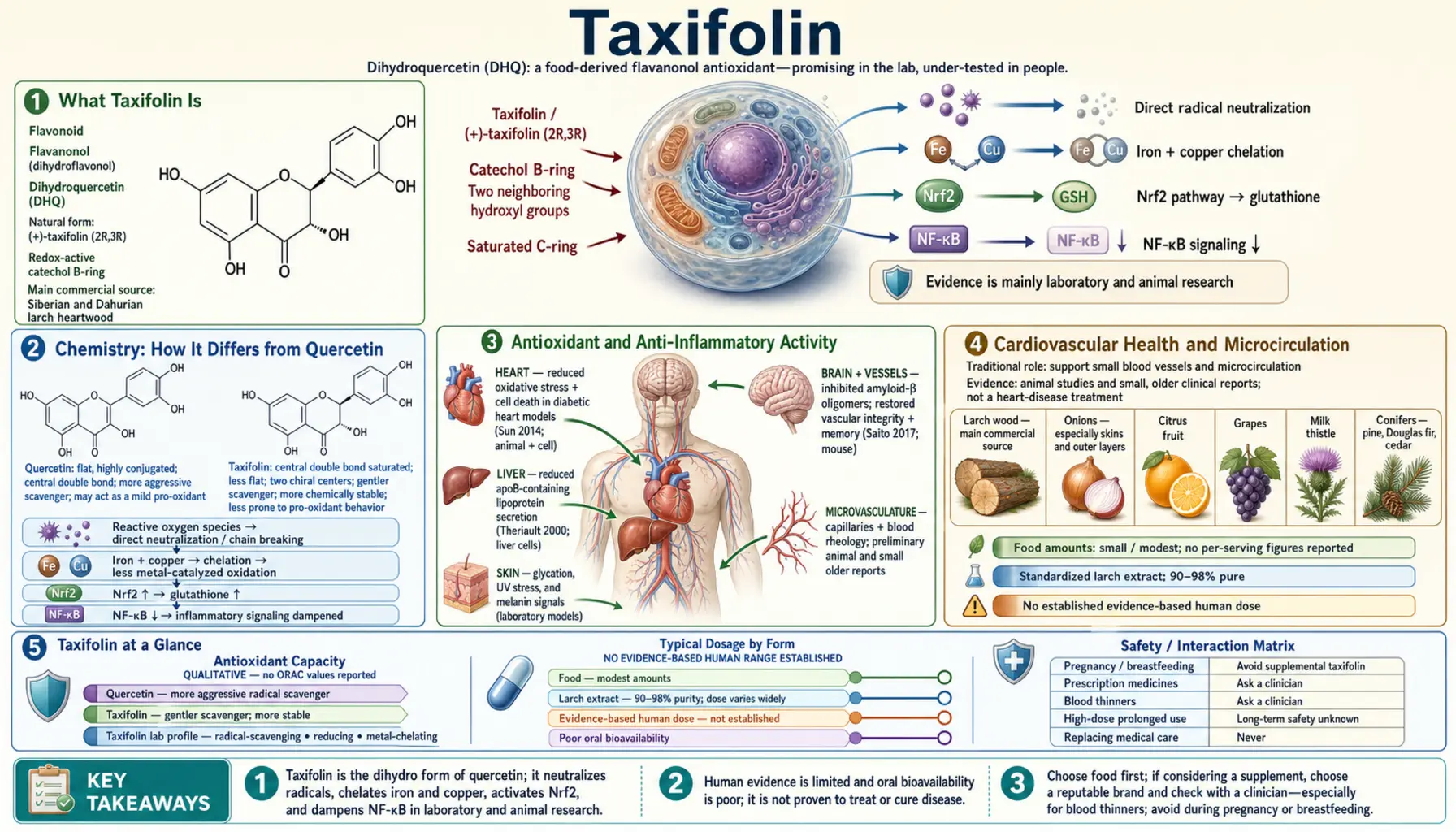
Taxifolin — also widely sold under the name dihydroquercetin (often shortened to DHQ) — is a plant flavonoid closely related to the far more famous quercetin. In fact, its second name is the giveaway: taxifolin is the dihydro (hydrogenated) form of quercetin. Commercially it is extracted from the wood of Siberian and Dahurian larch trees, and it also occurs naturally in onions, citrus fruit, grapes, milk thistle, and many conifers such as pine and Douglas fir. In Russia and parts of Eastern Europe it has a long history as a registered antioxidant supplement (sold as diquertin).
This page explains, in plain language, what taxifolin is, how it differs chemically from quercetin, and what the research actually shows. Most of that research is honest to describe as laboratory and animal work, with only a handful of small human studies. Taxifolin is a genuinely interesting antioxidant with a real scientific literature behind it — but it is not a proven treatment or cure for any disease, and this article says so clearly wherever the human evidence is thin.
Table of Contents
- What Taxifolin Is
- Chemistry: How It Differs from Quercetin
- Antioxidant and Anti-Inflammatory Activity
- Cardiovascular Health and Microcirculation
- Blood Sugar, Metabolism, and Liver
- Neuroprotection Research
- Skin Research
- Bioavailability: An Honest Limitation
- Dietary Sources vs Supplements
- The Honest Evidence Verdict
- Safety and Cautions
- Research Papers
- Connections
- Featured Videos
What Taxifolin Is
Taxifolin is a flavonoid, and more precisely a member of a small subclass called the flavanonols (also written dihydroflavonols). Flavonoids are the large family of colorful, protective plant compounds that also includes quercetin, rutin, hesperidin, the catechins in tea, and the anthocyanins in berries. Within that family, taxifolin sits right next to quercetin — it is the same molecule with one small structural difference described in the next section.
Its most common commercial name is dihydroquercetin. You will see the two names used interchangeably on supplement labels and in the scientific literature; "taxifolin" tends to appear in chemistry and botany, while "dihydroquercetin" (DHQ) dominates the supplement world.
Where it comes from:
- Larch wood — the main commercial source. Extract is produced from the heartwood of Siberian larch (Larix sibirica) and Dahurian larch (Larix gmelinii), where taxifolin is unusually concentrated.
- Onions, especially the skins and outer layers.
- Citrus fruit and grapes.
- Milk thistle — taxifolin is one of the flavonoids in the silymarin complex.
- Conifers — pine, Douglas fir, cedar, and other softwood trees carry it in wood and bark.
Because it can be recovered from larch that is otherwise processed for timber, taxifolin has been an attractive, low-cost antioxidant to produce in Russia, where it was developed and registered decades ago as the supplement diquertin.
Chemistry: How It Differs from Quercetin
Quercetin is a flavonol: it has a flat, highly conjugated structure with a carbon-carbon double bond and a hydroxyl group on its central "C-ring." That flatness is part of why quercetin is such an aggressive free-radical scavenger — and also why, at times, it can behave as a mild pro-oxidant.
Taxifolin is what you get when that central double bond is saturated (has hydrogen added across it) — hence di-hydro-quercetin. This one change has real consequences:
- The saturated C-ring makes the molecule less flat and introduces two chiral centers; the natural, biologically studied form is (+)-taxifolin (the 2R,3R isomer).
- Taxifolin keeps quercetin's catechol B-ring — the two neighboring hydroxyl groups that are the business end of its antioxidant and metal-chelating activity. This is why taxifolin is a strong binder of iron and copper, metals that would otherwise catalyze damaging oxidation reactions.
- In several laboratory comparisons taxifolin is a somewhat gentler radical scavenger than quercetin but is more chemically stable and less prone to pro-oxidant behavior, which is one reason it is marketed as a "milder" antioxidant.
Topal and colleagues (2016) mapped this activity-structure relationship directly, measuring taxifolin's radical-scavenging, reducing, and metal-chelating capacities in a battery of standard chemistry assays. The takeaway is that taxifolin's antioxidant credentials are real in the test tube — the harder question, addressed later on this page, is how much of that survives the trip through the human gut.
Antioxidant and Anti-Inflammatory Activity
This is the core of taxifolin's reputation, so it deserves to be stated both fairly and honestly. In cell-culture and chemical systems, taxifolin:
- Directly neutralizes free radicals and quenches reactive oxygen species (Salah and colleagues catalogued this "chain-breaking" behavior for the flavanol family back in 1995).
- Chelates iron and copper, sopping up the loose metal ions that drive some of the most damaging oxidation in tissues.
- Switches on the cell's own defense machinery through the Nrf2 pathway, nudging cells to make more of their built-in antioxidants such as glutathione.
- Dampens NF-κB signaling, a master switch for inflammation, in cultured cells and animal models.
That is a genuinely respectable antioxidant profile, and it is well summarized in review articles by Weidmann (2012), Sunil and Xu (2019), and Das and colleagues (2021). But here is the honest part: nearly all of this evidence is from test tubes and animals. Being a powerful antioxidant in a dish does not automatically mean a compound treats disease in people — the history of nutrition research is full of antioxidants that looked spectacular in the lab and modest or neutral in human trials. Taxifolin has not yet been tested in the large, controlled human studies that would settle the question, so read the sections below as areas of active research, not as established medical uses.
Cardiovascular Health and Microcirculation
Taxifolin's most established traditional role is in the cardiovascular and circulatory space, and this is where its Eastern-European supplement history is strongest. Like several other flavonoids (rutin and diosmin, for example), it has been used to support small blood vessels and microcirculation — the idea of strengthening capillaries and improving blood flow through the smallest vessels.
The Russian research group led by Plotnikov studied the diquertin form (usually paired with vitamin C) in experimental models of heart attack and disturbed blood flow, reporting improvements in blood rheology — how easily blood flows and how red cells behave (Plotnikov, 2003). Separate laboratory work by Theriault and colleagues (2000) found that taxifolin reduced the secretion of apoB-containing lipoproteins from liver cells, a mechanism relevant to blood cholesterol.
Honest framing: this is a mix of animal studies and small, older clinical reports, mostly from a single research tradition. It is enough to make cardiovascular effects a plausible and interesting research direction — it is not enough to call taxifolin a treatment for heart disease, high blood pressure, or high cholesterol. Modern, large randomized trials simply have not been done.
Blood Sugar, Metabolism, and Liver
Several preclinical studies have looked at taxifolin in the context of metabolic stress. In diabetic animal and cell models, Sun and colleagues (2014) reported that taxifolin reduced oxidative stress and cell death in heart tissue affected by diabetes — a laboratory signal that its antioxidant activity might blunt some of the collateral damage of high blood sugar.
The liver angle is intuitive given taxifolin's presence in milk thistle, whose silymarin complex is traditionally used for liver support. In animal liver-injury models, taxifolin shows the antioxidant and anti-inflammatory behavior you would expect, and the lipoprotein work mentioned above points to a role in how the liver handles fats.
Honest framing: every one of these findings is from cells or animals. There is no good basis to claim that taxifolin lowers blood sugar, reverses fatty liver, or treats diabetes in people. These are hypotheses that the preclinical data make worth investigating — nothing more, for now.
Neuroprotection Research
One of the most striking taxifolin findings came from Saito and colleagues (2017), who reported that taxifolin inhibited the formation of amyloid-β oligomers and restored blood-vessel integrity and memory in a mouse model of cerebral amyloid angiopathy — a condition in which amyloid protein builds up in the walls of brain blood vessels. That is an eye-catching result, and it helped spark interest in taxifolin for vascular-type cognitive impairment. The same Russian tradition that studied circulation also reported "cerebroprotective" effects of diquertin plus vitamin C in animal models (Plotnikov, 2000).
Honest framing: this is mouse and cell data. It is genuinely interesting science, but human trials for cognition or dementia are, at best, only just beginning, and none of this makes taxifolin a treatment for Alzheimer's disease, stroke, or memory loss. Be especially wary of marketing that leans on the amyloid headline — a promising mouse study is a starting point, not a conclusion.
Skin Research
Because taxifolin is a stable antioxidant and metal chelator, it has attracted interest in skin science and cosmetics. In laboratory skin models it shows antioxidant activity, resistance to protein glycation (sugar-driven damage associated with skin aging), and signals of protection against ultraviolet stress and of reduced melanin production. Some cosmetic formulations already include dihydroquercetin for these reasons.
Honest framing: this sits at the cosmetic-science and cell-model level. Controlled human studies of taxifolin for skin aging, pigmentation, or sun protection are thin, so treat any "anti-aging" skin claims as preliminary.
Bioavailability: An Honest Limitation
Here is the caveat that quietly limits every section above. Like many flavonoids, taxifolin is poorly absorbed when swallowed. It has low water solubility, is heavily metabolized in the gut and liver, and clears from the bloodstream quickly. The practical result is that a compound which looks powerful in a laboratory dish may reach only low concentrations in your blood after you take a capsule — and the concentrations used in many cell studies are higher than what oral dosing realistically achieves.
Researchers are aware of this and have tried to improve it. Zu and colleagues (2012), for example, used a micronization process to shrink taxifolin particles and improve their radical-scavenging performance, and various complexed or amorphous forms have been explored to boost absorption. But the honest bottom line is that bioavailability is a real weakness, and it is a central reason to be cautious about extrapolating from impressive test-tube numbers to what happens in a person.
Dietary Sources vs Supplements
From food: taxifolin turns up in onions (especially the papery skins), citrus fruit, grapes, and milk thistle, and it rides along in some conifer-derived ingredients. The amounts in everyday food are small, so ordinary eating delivers only modest doses — useful as part of a flavonoid-rich diet, but not a concentrated source.
From supplements: concentrated taxifolin is sold as dihydroquercetin or DHQ, typically as a standardized larch-wood extract that is often 90–98% pure. The Russian product diquertin is the same idea with a longer regulatory track record in its home market. Doses used in studies and products vary widely, and because there is no established, evidence-based human dose, purity and manufacturing quality differ from brand to brand.
If you are considering a supplement, treat it as you would any antioxidant of uncertain benefit: choose a reputable brand, keep expectations modest, and remember that a varied diet of onions, citrus, grapes, and other flavonoid-rich foods is a reasonable — and food-first — way to get taxifolin alongside its many flavonoid cousins.
The Honest Evidence Verdict
So where does taxifolin actually stand? A fair summary:
- It is a real, well-characterized antioxidant flavonoid — the dihydro form of quercetin — with a substantial chemistry literature and a long supplement history in Russia and Eastern Europe as diquertin.
- Its antioxidant, metal-chelating, and anti-inflammatory activities are solidly demonstrated in the laboratory.
- Its most interesting disease-related findings — in circulation, metabolism, the liver, the brain, and the skin — are almost entirely preclinical (cells and animals), with only a few small, mostly older human studies.
- Its poor oral bioavailability is a genuine limitation that tempers all of the above.
The reasonable way to think about taxifolin is as a food-derived antioxidant of real scientific interest — worth following as the research develops — and not as a proven therapy. It has not been shown to treat or cure any disease, and any product that claims otherwise is getting ahead of the evidence. Shorter and true: promising in the lab, under-tested in people.
Safety and Cautions
Taxifolin appears to be well tolerated in the studies that have been done, and its long use as diquertin in Russia, together with low toxicity in animal testing, is reassuring at the doses typically used. That said, the human safety record is built on limited, mostly short-term data.
- Limited long-term data: there are few controlled, long-term human safety studies, so the safety of high-dose, prolonged use is genuinely unknown.
- Pregnancy and breastfeeding: there is not enough data to consider supplemental taxifolin safe — best avoided.
- Medication interactions: like other flavonoids, taxifolin can in principle affect drug-metabolizing enzymes and has mild effects relevant to blood clotting. If you take prescription medicines — especially blood thinners — or have a medical condition, check with a clinician before supplementing.
- Not a substitute for care: taxifolin is a dietary antioxidant, not a treatment; it should never replace evaluation or therapy for any medical condition.
Research Papers
Verified peer-reviewed references on taxifolin (dihydroquercetin). Journal names are plain text; each linked identifier resolves to the paper. Most of this literature is laboratory and animal research — the live PubMed searches below are provided precisely because human clinical data are still limited.
- Weidmann AE. Dihydroquercetin: More than just an impurity? European Journal of Pharmacology. 2012;684(1-3):19-26. doi:10.1016/j.ejphar.2012.03.035 — the classic review reframing dihydroquercetin as a bioactive flavonoid in its own right.
- Sunil C, Xu B. An insight into the health-promoting effects of taxifolin (dihydroquercetin). Phytochemistry. 2019;166:112066. doi:10.1016/j.phytochem.2019.112066 — comprehensive modern review of taxifolin's chemistry, sources, and reported activities.
- Das A, Baidya R, Chakraborty T, et al. Pharmacological basis and new insights of taxifolin: A comprehensive review. Biomedicine & Pharmacotherapy. 2021;142:112004. doi:10.1016/j.biopha.2021.112004 — wide-ranging survey of preclinical mechanisms and research directions.
- Topal F, Nar M, Gocer H, et al. Antioxidant activity of taxifolin: an activity-structure relationship. Journal of Enzyme Inhibition and Medicinal Chemistry. 2016;31(4):674-683. doi:10.3109/14756366.2015.1057723 — measured radical-scavenging, reducing, and metal-chelating capacities in standard assays.
- Salah N, Miller NJ, Paganga G, et al. Polyphenolic flavanols as scavengers of aqueous phase radicals and as chain-breaking antioxidants. Archives of Biochemistry and Biophysics. 1995;322(2):339-346. doi:10.1006/abbi.1995.1473 — foundational chemistry placing taxifolin among the chain-breaking flavanol antioxidants.
- Zu Y, Wu W, Zhao X, et al. Micronization of taxifolin by supercritical antisolvent process and evaluation of radical scavenging activity. International Journal of Molecular Sciences. 2012;13(7):8869-8881. doi:10.3390/ijms13078869 — illustrates the bioavailability problem and an attempt to improve it by particle micronization.
- Theriault A, Wang Q, Van Iderstine SC, et al. Modulation of hepatic lipoprotein synthesis and secretion by taxifolin, a plant flavonoid. Journal of Lipid Research. 2000;41(12):1969-1979. doi:10.1016/S0022-2275(20)32358-0 — liver-cell study showing reduced apoB lipoprotein secretion (a lipid-metabolism mechanism).
- Sun X, Chen RC, Yang ZH, et al. Taxifolin prevents diabetic cardiomyopathy in vivo and in vitro by inhibition of oxidative stress and cell apoptosis. Food and Chemical Toxicology. 2014;63:221-232. doi:10.1016/j.fct.2013.11.013 — preclinical (animal and cell) evidence in a diabetes-stressed heart model.
- Plotnikov MB, Aliev OI, Maslov MJ, et al. Correction of haemorheological disturbances in myocardial infarction by diquertin and ascorbic acid. Phytotherapy Research. 2003;17(1):86-88. doi:10.1002/ptr.1082 — Russian study of the diquertin form on blood flow properties.
- Plotnikov MB, Chernysheva GA, Smol'yakova VI, et al. Cerebroprotective effects of diquertin and ascorbic acid. Bulletin of Experimental Biology and Medicine. 2000;130(11):1080-1083. doi:10.1007/BF02688184 — animal-model report from the same diquertin research tradition.
- Saito S, Yamamoto Y, Maki T, et al. Taxifolin inhibits amyloid-β oligomer formation and fully restores vascular integrity and memory in cerebral amyloid angiopathy. Acta Neuropathologica Communications. 2017;5(1):26. doi:10.1186/s40478-017-0429-5 — the widely cited mouse study behind taxifolin's neuroprotection interest.
- Manigandan K, Manimaran D, Jayaraj RL, et al. Taxifolin curbs NF-κB-mediated Wnt/β-catenin signaling via up-regulating Nrf2 pathway in experimental colon carcinogenesis. Biochimie. 2015;119:103-112. doi:10.1016/j.biochi.2015.10.014 — mechanistic animal study of anti-inflammatory and Nrf2-activating effects.
Live PubMed Searches
Because human clinical data on taxifolin are still limited, these live searches let you see the latest and judge the evidence for yourself.
- Taxifolin / dihydroquercetin (all)
- Taxifolin and antioxidant activity
- Dihydroquercetin clinical trials
- Taxifolin bioavailability
- Taxifolin and cardiovascular / microcirculation
- Taxifolin and blood sugar / diabetes
- Taxifolin and the liver
- Taxifolin and neuroprotection
- Dihydroquercetin and skin
- Taxifolin from larch (Larix)
Connections
- Quercetin
- Rutin
- Hesperidin
- Luteolin
- EGCG
- Anthocyanins
- Pycnogenol
- Grape Seed Extract
- Fisetin
- Resveratrol
- Milk Thistle
- Onions
- Vitamin C
- Oxidative Stress
- Hypertension
- Diabetes
- All Antioxidants