Fisetin for Brain Health and Cognition
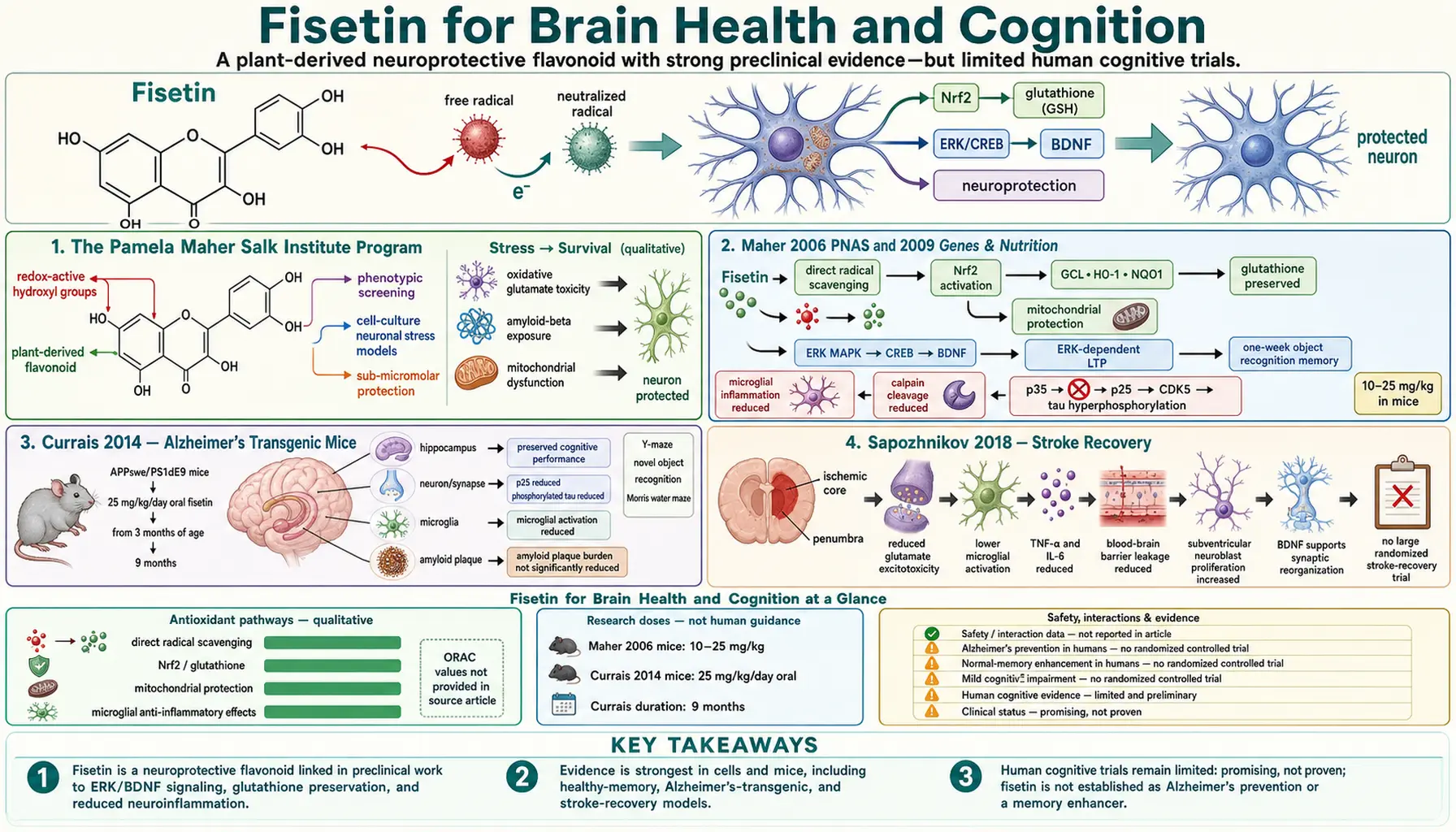
Fisetin's reputation as a senolytic is recent. Its reputation as a neuroprotective flavonoid is older — more than fifteen years of work from Pamela Maher's group at the Salk Institute for Biological Studies has documented an unusual constellation of brain-protective effects. Maher 2006 in PNAS showed fisetin enhances long-term potentiation and memory in healthy mice. Maher 2009 in Genes & Nutrition mapped the multiple pathways involved in age-related neuronal decline that fisetin modulates. Currais et al. 2014 in Aging Cell demonstrated that fisetin prevents cognitive decline in Alzheimer's disease transgenic mice through p25 and inflammatory pathway inhibition. Gelderblom et al. 2012, with Maher as a co-author, added experimental stroke in mice to the dossier. The mechanism appears to involve brain-derived neurotrophic factor (BDNF) upregulation, glutathione preservation in neurons, inhibition of the calpain-mediated cleavage of p35 to neurotoxic p25 (a tau-tangle driver), and reduction of microglial neuroinflammation. The preclinical case is one of the strongest in the natural-product nootropic literature; human cognitive trials remain limited. This deep-dive walks through the mechanism and the major preclinical papers, and frames what the evidence does and does not yet support.
Table of Contents
- The Pamela Maher Salk Institute Program
- Maher 2006 PNAS and 2009 Genes & Nutrition
- Currais 2014 — Alzheimer's Transgenic Mice
- Gelderblom 2012 — Fisetin in Mouse Stroke
- Brain-Derived Neurotrophic Factor Upregulation Mechanism
- Glutathione Preservation in Neurons
- p25 / CDK5 / Tau Hyperphosphorylation Inhibition
- Microglial Neuroinflammation Suppression
- Parkinson's and Huntington's Preclinical Data
- Cognitive Aging and Age-Related Memory Decline
- What Human Cognitive Evidence Exists
- Key Research Papers
- Connections
- Featured Videos
The Pamela Maher Salk Institute Program
Pamela Maher at the Salk Institute's Cellular Neurobiology Laboratory (under David Schubert) has worked on the neurobiology of plant-derived antioxidants for over twenty years. The group's thesis is that age-related neurodegeneration is driven not by a single pathology but by a convergence of oxidative stress, mitochondrial dysfunction, protein aggregation, calcium dysregulation, and chronic neuroinflammation. A drug that targets only one of these — the strategy of most failed Alzheimer's drugs — cannot reverse the integrated dysfunction. A compound that gently modulates several of them in parallel might.
The Maher group's identification of fisetin came out of phenotypic screening rather than mechanism-first drug design. They tested plant flavonoids in cell-culture models of neuronal stress (oxidative glutamate toxicity, amyloid-beta exposure, mitochondrial dysfunction) and identified the compounds that protected neurons across multiple stress paradigms. Fisetin was the standout — it protected neurons against multiple distinct insults and did so at sub-micromolar concentrations, suggesting a real-tissue rather than artifact-of-high-dose effect.
Over the following decade, the group methodically mapped the pathways fisetin modulates and validated them in mouse models — including aged wild-type mice, the APPswe/PS1dE9 Alzheimer's transgenic, the htau Alzheimer's model, and ischemic stroke models. The cumulative body of work is one of the most rigorous preclinical dossiers for any natural product in the neuroprotective space.
Maher 2006 PNAS and 2009 Genes & Nutrition
The opening paper was Maher P, Akaishi T, Abe K. “Flavonoid fisetin promotes ERK-dependent long-term potentiation and enhances memory.” Proceedings of the National Academy of Sciences USA, 2006. The key findings:
- Fisetin enhanced long-term potentiation (LTP) in hippocampal slices — LTP is the cellular correlate of memory formation
- The effect required activation of the ERK (extracellular signal-regulated kinase) MAPK (mitogen-activated protein kinase) pathway and was blocked by ERK inhibitors
- Fisetin treatment in mice produced significantly enhanced object recognition memory at one-week retention
- Effects were observed at low doses (10-25 mg/kg), suggesting plausible translational relevance
The 2009 follow-up was Maher P. “Modulation of multiple pathways involved in the maintenance of neuronal function during aging by fisetin.” Genes & Nutrition, 2009. This was a review and mechanism paper rather than primary experimental work, and it laid out the broad framework: fisetin's neuroprotective effect is the sum of effects on:
- Sustained glutathione preservation through Nrf2 activation
- Direct radical-scavenging antioxidant activity
- Mitochondrial protection
- Anti-inflammatory effects on microglia
- Brain-derived neurotrophic factor upregulation
- Inhibition of calpain-mediated p35 to p25 conversion
- Reduction of tau hyperphosphorylation
The 2009 paper is the most-cited single fisetin paper outside of the Yousefzadeh 2018 senolytic work and is the foundation for most subsequent fisetin neuroprotection research.
Currais 2014 — Alzheimer's Transgenic Mice
The translational test of the Maher framework was Currais A, Prior M, Dargusch R, Armando A, Ehren J, Schubert D, Quehenberger O, Maher P. “Modulation of p25 and inflammatory pathways by fisetin maintains cognitive function in Alzheimer's disease transgenic mice.” Aging Cell, 2014. Design and findings:
- Model — APPswe/PS1dE9 transgenic mice, which over-express mutant human amyloid precursor protein and develop progressive amyloid plaques, neuroinflammation, and cognitive decline
- Intervention — fisetin mixed into the food at 0.05% (about 25 mg/kg/day) starting at 3 months of age (before significant cognitive decline) and continuing for 9 months
- Cognitive endpoints — the Morris water maze at 9 months and a 2-day water-maze memory test at 12 months both showed preserved learning and memory in fisetin-treated transgenic mice compared to untreated transgenic mice, and an elevated plus maze showed less disinhibition. Importantly, performance approached that of non-transgenic wild-type controls.
- Biochemical findings — reduced p25 levels (the truncated calpain cleavage product of p35 that hyperactivates CDK5 and drives tau hyperphosphorylation), reduced phosphorylated tau, reduced microglial activation markers
- Note — amyloid plaque burden was not significantly reduced. The cognitive preservation appeared to operate downstream of plaque deposition, suggesting that fisetin protects against the cellular consequences of plaque pathology rather than preventing plaque formation itself.
The Currais 2014 paper is important because the cognitive endpoint is rigorous (two water-maze memory tests at 9 and 12 months plus a disinhibition test) and because the mechanistic finding — p25 reduction — matched the Maher group's prior predictions from cell-culture work. The convergence of mechanism and behavior is the kind of preclinical evidence that warrants clinical translation. The translational difficulty is that Alzheimer's prevention trials are long, expensive, and difficult to design.
For more on Alzheimer's disease and other plausible disease-modifying interventions, see our Alzheimer's Disease page.
Gelderblom 2012 — Fisetin in Mouse Stroke
The stroke literature for fisetin is smaller but mechanistically interesting. The main animal study is Gelderblom M, Leypoldt F, Lewerenz J, et al., with Maher P and Magnus T. “The flavonoid fisetin attenuates postischemic immune cell infiltration, activation and infarct size after transient cerebral middle artery occlusion in mice.” Journal of Cerebral Blood Flow & Metabolism, 2012. The researchers briefly blocked the middle cerebral artery (middle cerebral artery occlusion, MCAO) in mice and then let blood flow return. Their findings, all in mice or in cells in a dish:
- Smaller area of brain damage — fisetin protected brain tissue when it was given before the stroke and also when it was given 3 hours after it
- Fewer immune cells entering the damaged side — fisetin strongly reduced the number of macrophages and dendritic cells moving into the stroke-affected half of the brain
- Less inflammation — immune cells inside the brain made less tumor necrosis factor-α (TNF-α)
- In a dish — fisetin lowered TNF-α production and the nerve-damaging effect of activated macrophages and microglia by suppressing NF-κB (nuclear factor kappa B) activation and JNK/Jun signalling
Other mechanisms sometimes proposed for fisetin after stroke — less glutamate excitotoxicity in the penumbra (the salvageable tissue around the ischemic core), a tighter blood-brain barrier, more new nerve cells (neurogenesis) and more brain-derived neurotrophic factor in the recovery phase — were not measured in this study, and no study testing them in stroke was found for this page.
Translation to acute stroke care has gone no further than one small trial (Wang 2019, described under What Human Cognitive Evidence Exists) — the timing constraints of acute stroke intervention (the clot-dissolving drug alteplase, a tissue plasminogen activator (tPA), is given up to 4.5 hours after stroke onset: in the ECASS III trial of 821 patients treated 3 to 4.5 hours after onset, 52.4% had a favourable outcome with alteplase versus 45.2% with placebo; endovascular thrombectomy has a 24-hour window) and the requirement for intravenous-administrable drugs make most natural products impractical for the acute setting. The plausible clinical application is in the recovery phase, where oral supplements with hours-to-weeks pharmacokinetics are feasible. No large randomized trial has yet tested fisetin in stroke recovery.
For the broader stroke context, see our Stroke page.
Brain-Derived Neurotrophic Factor Upregulation Mechanism
Brain-derived neurotrophic factor (BDNF) is the dominant trophic factor for hippocampal neuron survival, synaptic plasticity, and adult neurogenesis. Brain-derived neurotrophic factor levels decline with age and are reduced in major depressive disorder, Alzheimer's disease, and many neurodegenerative conditions. Pharmacologic and non-pharmacologic interventions that raise brain-derived neurotrophic factor are a major focus of cognitive-aging research (exercise, ketogenic diet, intermittent fasting, and several flavonoids all upregulate brain-derived neurotrophic factor).
Fisetin upregulates brain-derived neurotrophic factor in hippocampal neurons through ERK MAPK signaling and CREB (cAMP response element-binding protein) phosphorylation — the same canonical pathway used by exercise and antidepressants. The fisetin brain-derived neurotrophic factor effect has been documented in cell culture (primary hippocampal neuron cultures), in mouse hippocampal tissue after dietary fisetin, and indirectly in behavioral measures of memory and learning that are known to be brain-derived neurotrophic factor-dependent.
The clinical implication is that fisetin sits in the same category as exercise, ketogenic intervention, and selective brain-derived neurotrophic factor-raising drugs (some selective serotonin reuptake inhibitors (SSRIs), vortioxetine, ketamine) for the cognitive-aging and depression populations. The evidence for fisetin specifically in human depression is essentially zero (no published trials), but the brain-derived neurotrophic factor mechanism is shared with interventions that do have human depression evidence.
Glutathione Preservation in Neurons
Glutathione (reduced glutathione, GSH) is the brain's primary endogenous antioxidant, present in millimolar concentrations and continuously consumed in defending neurons against the substantial reactive oxygen species generated by mitochondrial respiration. Aged brains have lower glutathione levels; Alzheimer's, Parkinson's, and other neurodegenerative conditions all show depletion of glutathione in affected brain regions.
The Maher group's original model of fisetin neuroprotection in cell culture was the glutamate-induced oxytosis model — high extracellular glutamate inhibits cystine uptake (cystine is the rate-limiting precursor for reduced glutathione synthesis), reduced glutathione depletes, oxidative stress overwhelms remaining antioxidant defenses, and neurons die. Fisetin protected against this paradigm by maintaining intracellular reduced glutathione levels through Nrf2-mediated upregulation of glutamate-cysteine ligase (GCL, the rate-limiting reduced glutathione-synthesis enzyme), HO-1 (heme oxygenase 1), and NAD(P)H quinone oxidoreductase 1 (NQO1).
The same Nrf2 pathway is activated by sulforaphane (from broccoli sprouts), curcumin, and several other dietary polyphenols. What distinguishes fisetin is its potency at low concentrations and its membrane permeability (good blood-brain barrier penetration relative to many other polyphenols, owing to its modest lipophilicity).
p25 / CDK5 / Tau Hyperphosphorylation Inhibition
A specific Alzheimer's-relevant mechanism deserves separate mention. Cyclin-dependent kinase 5 (CDK5) is normally bound to its regulatory partner p35 and produces tightly regulated phosphorylation of synaptic proteins. Under pathologic conditions — calcium dysregulation, oxidative stress, amyloid exposure — calpain proteases cleave p35 to the truncated p25 fragment. The CDK5/p25 complex has dysregulated, sustained kinase activity and produces hyperphosphorylation of:
- Tau protein — hyperphosphorylated tau dissociates from microtubules, oligomerizes, and forms neurofibrillary tangles (the second hallmark of Alzheimer's pathology after amyloid plaques)
- Synaptic proteins — producing synapse dysfunction and loss
- Neurofilaments — disrupting axonal transport
The CDK5/p25 cascade is a plausible drug target. Fisetin inhibits the calpain cleavage of p35 to p25 (the Currais 2014 mechanism), thereby preventing the dysregulated CDK5 activation upstream of tau hyperphosphorylation. The mechanism is upstream of tau pathology rather than directly anti-tau, which means it might be most useful as a prevention or early-disease intervention rather than for established tau-driven neurodegeneration.
The clinical translation of CDK5/p25 inhibition has been pursued by several pharmaceutical companies with limited success — the pathway has been difficult to drug selectively. Fisetin's effect is more modulatory than inhibitory, which may be why it has shown preclinical benefit without the off-target toxicity that has plagued direct CDK5 inhibitors.
Microglial Neuroinflammation Suppression
Microglia are the brain's resident immune cells. In a young brain, they are quietly housekeeping — pruning synapses, clearing debris, surveilling for pathogens. In an aging or diseased brain, microglia shift toward an activated, pro-inflammatory phenotype that secretes the same SASP-like cytokines (IL-6, interleukin-1 beta (IL-1β), tumor necrosis factor-α) that drive systemic inflammaging. Chronic microglial activation is increasingly recognized as a primary driver of Alzheimer's disease progression, Parkinson's disease progression, and post-stroke cognitive decline.
Fisetin suppresses microglial activation through inhibition of NF-κB signaling and reduction of pro-inflammatory cytokine production. This effect has been documented in cell culture (BV2 mouse microglial line, primary microglia) and in vivo in multiple mouse models of neuroinflammation. The microglial effect is mechanistically connected to the broader anti-inflammatory effects described on the Inflammation & Allergy page.
The clinical implication for cognitive aging is that fisetin may slow the chronic-neuroinflammation component of age-related cognitive decline regardless of its effects on amyloid, tau, or senescent cells. This makes it potentially useful in populations with vascular cognitive impairment, post-stroke recovery, and chronic-inflammation-driven cognitive symptoms even outside of classical Alzheimer's disease.
Parkinson's and Huntington's Preclinical Data
Fisetin has been tested in animal models of other neurodegenerative diseases beyond Alzheimer's:
- Parkinson's disease — the Maher 2017 review and several primary papers report that fisetin protects dopaminergic neurons against MPTP (1-methyl-4-phenyl-1,2,3,6-tetrahydropyridine) and 6-OHDA (6-hydroxydopamine) toxicity (the standard chemical models of Parkinson's). Mechanisms include the glutathione preservation and microglial-inflammation suppression discussed above. No human Parkinson's trials have been published.
- Huntington's disease — a 2011 study (Maher 2011) found that fisetin reduced the harm done by the mutant huntingtin protein in three Huntington's disease (HD) models — nerve-like cells in a dish, fruit flies and R6/2 mice — by switching on the ERK signalling pathway. The mechanism may also involve preservation of mitochondrial function, which is particularly compromised in Huntington's disease.
- Amyotrophic lateral sclerosis (ALS) — very preliminary cell-culture data only.
The Parkinson's preclinical case is the strongest of the three secondary indications and would arguably justify a small pilot trial in early-stage Parkinson's. For more on Parkinson's disease, see our Parkinson's Disease page.
Cognitive Aging and Age-Related Memory Decline
The broader question is whether fisetin can slow normal cognitive aging in adults without any specific neurodegenerative disease. The preclinical evidence here is the strongest:
- The Maher 2006 PNAS paper demonstrated memory enhancement in healthy young mice, not just in disease models
- The brain-derived neurotrophic factor upregulation mechanism translates to the “cognitive reserve” concept that drives normal-aging cognitive trajectories
- The senolytic effect itself, if it cleared senescent astrocytes and microglia from aging brain, would be expected to reduce the chronic neuroinflammation that drives age-related cognitive decline
The integrated case for fisetin in cognitive aging would predict effects on processing speed, working memory, and episodic memory in cognitively normal older adults. No large randomized human trial has tested this directly. The Mayo AFFIRM trial measures some cognitive endpoints but is not powered for cognitive outcomes as primary endpoints.
What Human Cognitive Evidence Exists
The honest summary of the human cognitive evidence for fisetin is that it is limited and preliminary:
- No randomized controlled trial has tested fisetin for prevention of Alzheimer's disease or other dementia in humans
- No randomized controlled trial has tested fisetin for memory enhancement in cognitively normal older adults
- No randomized controlled trial has tested fisetin for cognitive enhancement in mild cognitive impairment
- Some small open-label studies of dietary flavonoid intake (including fisetin among other flavonoids) suggest cognitive benefit, but these cannot isolate fisetin specifically
- The Mayo AFFIRM and AFFIRM-LITE trials include some cognitive endpoints as secondary measures, but published results so far are biomarker-focused
- One small double-blind randomized trial in China (Wang 2019) gave stroke patients treated with the clot-dissolving drug alteplase either fisetin or a dummy pill (placebo). Among patients treated later after stroke onset, those given fisetin had lower stroke-severity scores (National Institutes of Health Stroke Scale) and lower blood markers of tissue damage and inflammation (matrix metalloproteinases MMP-2 and MMP-9, and C-reactive protein). It has not been repeated.
- A 2026 review (Sandoval-Caballero 2026) found 34 registered fisetin trials, of which only 4 had finished with results. They were small, often combined fisetin with other treatments, and gave mixed results — some found favourable changes in metabolic or inflammatory markers, others no clear benefit — so the authors write that fisetin's effect in people is still difficult to establish.
In short, the preclinical neuroprotective work is extensive and is the main argument researchers give for human trials, and some people already take fisetin for other reasons (for example as a senolytic). The human evidence does not yet show that fisetin prevents Alzheimer's disease or improves memory in cognitively normal adults.
Other approaches to cognitive health have been tested more directly in people. In the SPRINT MIND trial (9,361 adults with high blood pressure), aiming for a systolic blood pressure below 120 mmHg instead of below 140 mmHg lowered mild cognitive impairment (hazard ratio 0.81) but did not significantly lower probable dementia (hazard ratio 0.83, 95% confidence interval 0.67-1.04); the authors note the trial stopped early and may have been too small for the dementia result. Cardiovascular exercise, the Mediterranean / MIND diet and adequate sleep are also studied for cognitive aging. Fisetin sits in the “promising but not proven” tier alongside curcumin, omega-3 fatty acids, and other dietary polyphenols.
Key Research Papers
- Maher P, Akaishi T, Abe K (2006). Flavonoid fisetin promotes ERK-dependent long-term potentiation and enhances memory. PNAS 103:16568-16573. — PubMed PMID: 17050681
- Maher P (2009). Modulation of multiple pathways involved in the maintenance of neuronal function during aging by fisetin. Genes & Nutrition 4:297-307. — PubMed PMID: 19756810
- Currais A, Prior M, Dargusch R, et al. (2014). Modulation of p25 and inflammatory pathways by fisetin maintains cognitive function in Alzheimer's disease transgenic mice. Aging Cell 13:379-390. — PubMed PMID: 24341874
- Maher P (2017). Protective effects of fisetin and other berry flavonoids in Parkinson's disease. Food & Function 8:3033-3042. — PubMed PMID: 28714503
- Prior M, Chiruta C, Currais A, et al. (2014). Back to the future with phenotypic screening. ACS Chemical Neuroscience 5:503-513. — PubMed PMID: 24902068
- Maher P (2008). The flavonoid fisetin promotes nerve cell survival from trophic factor withdrawal by enhancement of proteasome activity. Archives of Biochemistry and Biophysics 476:139-144. — PubMed PMID: 18396148
- Gelderblom M, Leypoldt F, Lewerenz J, et al. (2012). The flavonoid fisetin attenuates postischemic immune cell infiltration, activation and infarct size after transient cerebral middle artery occlusion in mice. Journal of Cerebral Blood Flow & Metabolism 32:835-843. — PubMed PMID: 22234339
- Patel MY, Panchal HV, Ghribi O, Benzeroual KE (2012). The neuroprotective effect of fisetin in the MPTP model of Parkinson's disease. Journal of Parkinson's Disease 2:287-302. — PubMed PMID: 23938259
- Kim S, Choi KJ, Cho SJ, et al. (2016). Fisetin stimulates autophagic degradation of phosphorylated tau via the activation of TFEB and Nrf2 transcription factors. Scientific Reports 6:24933. — PubMed PMID: 27112200
- Fisetin and BDNF upregulation in hippocampus mechanism — PubMed
- Lapchak PA (2012). A series of novel neuroprotective blood brain barrier penetrating flavonoid drugs to treat acute ischemic stroke. Current Pharmaceutical Design 18:3694-3703. — PubMed PMID: 22574983
- Maher P, Dargusch R, Bodai L, et al. (2011). ERK activation by the polyphenols fisetin and resveratrol provides neuroprotection in multiple models of Huntington's disease. Human Molecular Genetics 20:261-270. — PubMed PMID: 20952447
- Hacke W, Kaste M, Bluhmki E, et al. (2008). Thrombolysis with alteplase 3 to 4.5 hours after acute ischemic stroke. New England Journal of Medicine 359:1317-1329. — PubMed PMID: 18815396
- Wang L, Cao D, Wu H, et al. (2019). Fisetin prolongs therapy window of brain ischemic stroke using tissue plasminogen activator: a double-blind randomized placebo-controlled clinical trial. Clinical and Applied Thrombosis/Hemostasis 25:1076029619871359. — PubMed PMID: 31434498
- SPRINT MIND Investigators for the SPRINT Research Group; Williamson JD, Pajewski NM, Auchus AP, et al. (2019). Effect of intensive vs standard blood pressure control on probable dementia: a randomized clinical trial. JAMA 321:553-561. — PubMed PMID: 30688979
- Sandoval-Caballero C, Roemer Z, Kotz CM, et al. (2026). Clinical translation of fisetin for age-related diseases: current evidence and future opportunities. Nutrients 18:2999. — PubMed PMID: 42796982
PubMed Topic Searches
- PubMed: Fisetin neuroprotection
- PubMed: Fisetin Alzheimer's cognition
- PubMed: Fisetin Parkinson's
- PubMed: Fisetin stroke and ischemia
- PubMed: Flavonoids and cognitive aging
- PubMed: Flavonoids and BDNF
Note: a 2017 mouse study on fisetin and amyloid-beta (Ahmad A, et al., Molecular Neurobiology 54:2269-2285), formerly listed here, was retracted by the journal in 2025 (retraction notice: PubMed PMID: 40751798) and is no longer used as a source.