Pyrroloquinoline Quinone (PQQ) for Mitochondrial Biogenesis
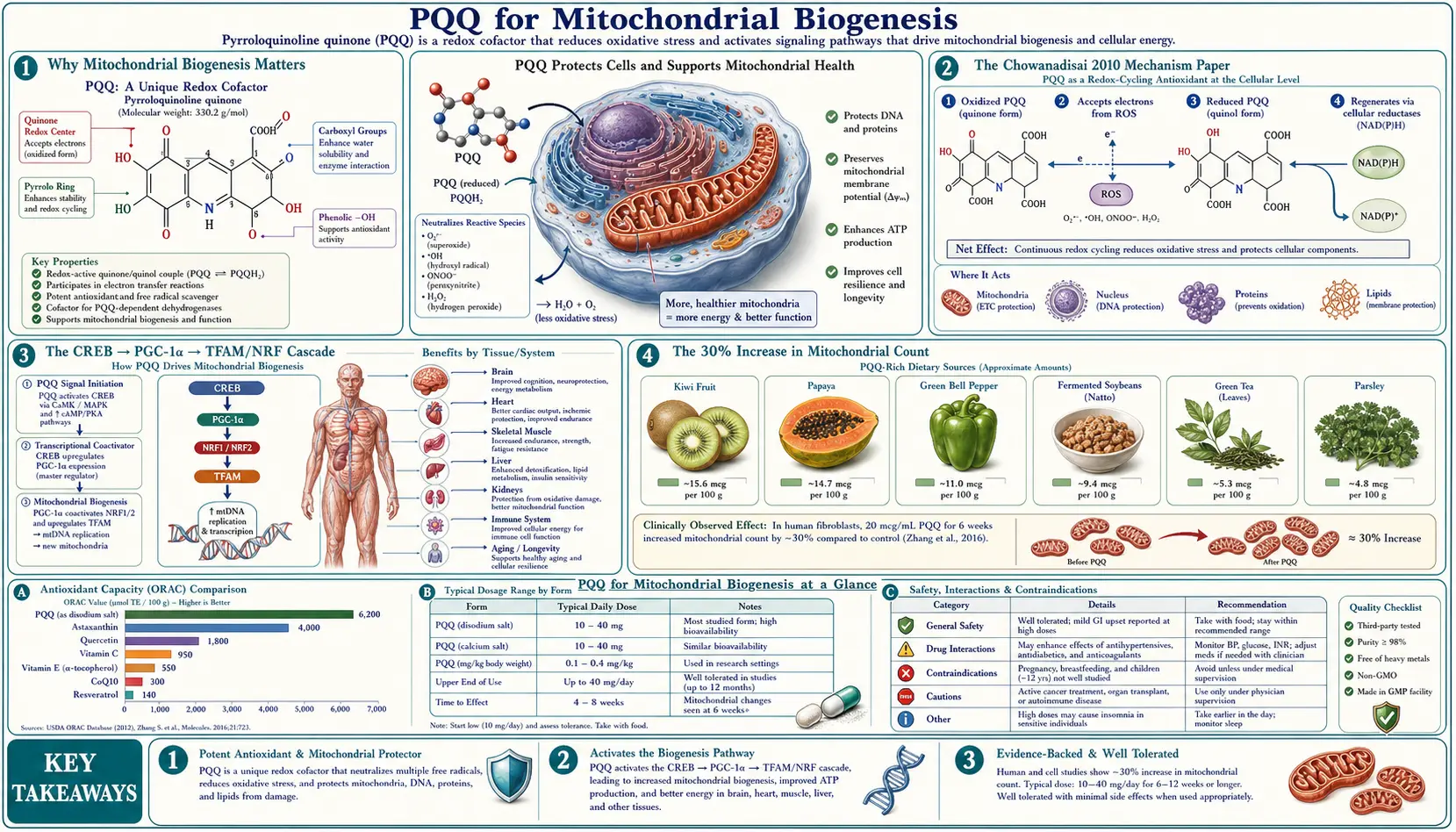
Mitochondrial biogenesis — the making of new mitochondria within existing cells — is pyrroloquinoline quinone (PQQ)'s best-known proposed effect. The key mechanistic paper, Chowanadisai et al. 2010 in the Journal of Biological Chemistry, was a cell-culture study: in mouse liver-derived cells, pyrroloquinoline quinone triggered CREB phosphorylation and raised PGC-1α, and with it markers of mitochondrial content. Earlier mouse work found that animals fed no pyrroloquinoline quinone had 20-30% fewer liver mitochondria than pyrroloquinoline quinone-fed animals (Stites et al. 2006). In people, one small exercise trial found that PGC-1α rose with pyrroloquinoline quinone while aerobic performance did not change (Hwang et al. 2020). Whether pyrroloquinoline quinone increases mitochondria in human tissues has not been shown. This deep-dive walks through the evidence and how pyrroloquinoline quinone's proposed role differs from that of coenzyme Q10 (CoQ10) and alpha lipoic acid.
Table of Contents
- Why Mitochondrial Biogenesis Is Studied
- The Chowanadisai 2010 Mechanism Paper
- The CREB → PGC-1α → TFAM/NRF Cascade
- What the Animal Studies Measured
- Number vs. Function: Pyrroloquinoline Quinone vs. Coenzyme Q10 vs. ALA
- Pyrroloquinoline Quinone and Exercise: The Hwang 2020 Trial
- Contrast With Caloric Restriction
- Mitochondrial Aging: What Has and Has Not Been Tested
- Doses Used in Studies
- Safety Findings and Limits of the Evidence
- Key Research Papers
- Connections
- Featured Videos
Why Mitochondrial Biogenesis Is Studied
Mitochondria make most of a cell's adenosine triphosphate (ATP). Studies of ageing tissues, especially skeletal muscle, report lower mitochondrial content and function in older people, with more reactive oxygen species leaking from the remaining mitochondria. Raising mitochondrial content is one proposed way to offset this, and endurance exercise is the best-studied way of doing it.
Most mitochondrial supplements are proposed to act on the "function" side — helping existing mitochondria work. Coenzyme Q10 is an electron carrier inside the electron transport chain. Alpha lipoic acid is a cofactor of mitochondrial dehydrogenase enzymes. Methylene blue can act as an alternative electron carrier. Riboflavin is the precursor of the FAD and FMN cofactors used by Complexes I and II.
Pyrroloquinoline quinone is studied for a different reason: in cell and rodent studies it acts on the signalling that makes new mitochondria — the same PGC-1α pathway that exercise, caloric restriction and cold exposure engage. Whether oral pyrroloquinoline quinone does this to a meaningful degree in human tissues is not known.
The Chowanadisai 2010 Mechanism Paper
The key mechanistic paper is Chowanadisai W, Bauerly KA, Tchaparian E, Wong A, Cortopassi GA, Rucker RB. "Pyrroloquinoline quinone stimulates mitochondrial biogenesis through cAMP response element-binding protein phosphorylation and increased PGC-1α expression." Journal of Biological Chemistry 285:142-52, 2010, from the University of California, Davis.
The group's earlier work had found that pyrroloquinoline quinone-deficient mice had fewer liver mitochondria than pyrroloquinoline quinone-fed mice (Stites et al. 2006). The 2010 paper asked how pyrroloquinoline quinone might regulate mitochondrial content, and it was a cell-culture study:
- Mouse liver-derived Hepa1-6 cells were exposed to 10-30 µM pyrroloquinoline quinone for 24-48 hours
- The cells showed higher citrate synthase and cytochrome c oxidase activity, more mitochondrial DNA and more oxygen use
- Pyrroloquinoline quinone increased phosphorylation of the CREB transcription factor and expression of PGC-1α
- NRF-1 and NRF-2 activation increased, as did TFAM, TFB1M and TFB2M mRNA
- When PGC-1α or CREB was knocked down, pyrroloquinoline quinone no longer stimulated biogenesis
These are concentrations applied directly to cells in a dish. The paper did not test oral pyrroloquinoline quinone in whole animals or in people.
The CREB → PGC-1α → TFAM/NRF Cascade
The signalling cascade involved is the standard mammalian mitochondrial-biogenesis pathway, which exercise, caloric restriction and cold exposure also engage through different upstream signals. In the 2010 cell study, pyrroloquinoline quinone acted at the CREB step:
- Pyrroloquinoline quinone → CREB phosphorylation. CREB (cAMP response element-binding protein) is a transcription factor activated by phosphorylation. How pyrroloquinoline quinone triggers this — the receptor or target it acts on — has not been identified.
- Phospho-CREB → PGC-1α transcription. The PGC-1α gene promoter contains cAMP response elements, and phosphorylated CREB drives its transcription.
- PGC-1α → nuclear respiratory factors. PGC-1α (peroxisome proliferator-activated receptor gamma coactivator 1-alpha) is a transcriptional coactivator that works with NRF-1 and NRF-2, which switch on nuclear genes for mitochondrial proteins.
- NRF-1/NRF-2 → TFAM. TFAM (mitochondrial transcription factor A) is made in the nucleus but works inside mitochondria, where it packages mitochondrial DNA and drives transcription of its 13 protein-coding genes.
- TFAM → mitochondrial DNA replication. With more TFAM and more nuclear-encoded subunits, cells can build more mitochondria.
In the 2010 study, the changes were measured after 24-48 hours in culture. How long the process would take in human tissues after oral pyrroloquinoline quinone is not known.
What the Animal Studies Measured
The animal evidence comes mainly from removing pyrroloquinoline quinone from the diet rather than adding extra pyrroloquinoline quinone:
- Stites et al. 2006 (Journal of Nutrition) — pyrroloquinoline quinone-deficient weanling mice had a 20-30% lower relative amount of mitochondria in the liver than mice given pyrroloquinoline quinone (2 mg per kg of diet), along with lower respiratory control ratios. The difference in mitochondrial DNA content was a non-significant trend at 4 weeks and was gone at 8 weeks. The authors concluded that dietary pyrroloquinoline quinone can influence mitochondrial amount and function, particularly in perinatal and weanling mice.
- Bauerly et al. 2006 — pyrroloquinoline quinone status altered lysine metabolism and mitochondrial DNA content in mice and rats.
- Bauerly et al. 2011 (PLoS One) — rats fed no pyrroloquinoline quinone had lower energy expenditure than rats fed pyrroloquinoline quinone (2 mg per kg of diet), and energy expenditure correlated with liver mitochondrial content; pyrroloquinoline quinone-deficient rats also had higher plasma di- and triacylglycerides, and more heart damage after experimental ischemia-reperfusion. One author was named on a patent application for a pyrroloquinoline quinone-containing pharmaceutical composition.
These studies compared pyrroloquinoline quinone-deficient with pyrroloquinoline quinone-supplemented animals on purified diets. They do not show that adding pyrroloquinoline quinone to an ordinary diet raises mitochondrial numbers, and no study cited here has counted mitochondria per cell after pyrroloquinoline quinone.
Human studies have not measured mitochondrial content in tissue, which requires a biopsy. What they have reported:
- PGC-1α protein rose more with pyrroloquinoline quinone than with placebo in a 6-week exercise trial in 23 untrained men (Hwang et al. 2020), while aerobic performance did not differ
- In 10 healthy adults, decreases in plasma C-reactive protein and interleukin-6 (IL-6), and urinary metabolite changes the authors described as consistent with enhanced mitochondria-related function (Harris et al. 2013)
- Changes in some cognitive test scores in small trials (see the Cognition deep-dive), which did not measure mitochondria
Number vs. Function: Pyrroloquinoline Quinone vs. Coenzyme Q10 vs. ALA
A common way to describe mitochondrial compounds is by whether they are proposed to affect the number of mitochondria or their function:
| Compound | Primary Mechanism | Number or Function? |
|---|---|---|
| Pyrroloquinoline quinone | CREB → PGC-1α signalling (cell and rodent studies) | Number (proposed) |
| Coenzyme Q10 | Electron carrier between Complexes I/II and III | Function |
| Alpha lipoic acid | Cofactor for PDH, α-KGDH (mitochondrial dehydrogenase enzymes) | Function |
| Methylene blue | Alternative electron carrier | Function |
| Riboflavin (B2) | FAD/FMN precursor for Complex I and II | Function (cofactor) |
| Nicotinamide adenine dinucleotide (NAD+) / nicotinamide mononucleotide (NMN) / nicotinamide riboside (NR) | Nicotinamide adenine dinucleotide precursors; sirtuin activity, indirect PGC-1α effects | Mixed |
| Acetyl-L-carnitine | Fatty acid transport into mitochondria | Function |
| Creatine | Adenosine triphosphate buffering via phosphocreatine | Function (storage) |
Pyrroloquinoline quinone is often sold together with coenzyme Q10 on this reasoning. No trial cited here has tested whether the combination does more than either compound alone, on biomarkers or on any clinical outcome.
Pyrroloquinoline Quinone and Exercise: The Hwang 2020 Trial
Because the PGC-1α pathway is also engaged by endurance exercise, pyrroloquinoline quinone is sometimes described as an "exercise mimic". In contracting muscle, energy-sensing (AMP-activated protein kinase, AMPK) and calcium signalling converge on PGC-1α, and endurance training raises skeletal-muscle mitochondrial content.
The one human test of pyrroloquinoline quinone with exercise is a randomized trial at Baylor University (Hwang et al. 2020): 23 untrained men took 20 mg/day pyrroloquinoline quinone or placebo for 6 weeks while following the same supervised endurance-training programme.
- Peak oxygen consumption and exercise-test duration improved with training in both groups, with no difference between groups
- Body composition did not differ between groups
- PGC-1α protein rose more in the pyrroloquinoline quinone group, and was higher after 6 weeks than with placebo
The authors concluded that pyrroloquinoline quinone does not appear to have ergogenic effects on aerobic performance or body composition but appears to affect mitochondrial biogenesis through higher PGC-1α. The trial abstract does not state its funding. No trial has tested pyrroloquinoline quinone in people who cannot exercise, such as people with severe heart failure or chronic obstructive pulmonary disease (COPD).
Contrast With Caloric Restriction
Caloric restriction (CR) — eating 20-30% fewer calories while keeping nutrition adequate — extends lifespan in many laboratory species, and its effects in primates and people are still being studied. One of its proposed mechanisms is greater PGC-1α activity through SIRT1, which removes acetyl groups from PGC-1α.
In cell studies pyrroloquinoline quinone reaches PGC-1α by a different upstream route (CREB phosphorylation). CR also affects insulin-like growth factor 1 (IGF-1) signalling, autophagy, insulin sensitivity and inflammation, which pyrroloquinoline quinone has not been shown to reproduce. No study cited here has compared pyrroloquinoline quinone with caloric restriction or tested the two together.
Mitochondrial Aging: What Has and Has Not Been Tested
The mitochondrial theory of ageing, developed from Denham Harman's free-radical theory, holds that accumulating mitochondrial damage — mitochondrial DNA mutations, less efficient respiratory chains, more reactive oxygen species and declining biogenesis — contributes to ageing. How much it drives ageing, as opposed to accompanying it, is debated.
Conditions in which mitochondrial decline is studied, and where pyrroloquinoline quinone stands for each:
- Sarcopenia (age-related muscle loss) — no trial of pyrroloquinoline quinone in sarcopenia was found for this page.
- Heart failure and heart attack — in rat models of heart attack, pyrroloquinoline quinone given by injection before coronary occlusion or at reperfusion reduced infarct size (Zhu et al. 2004). No human cardiovascular outcome trial has tested pyrroloquinoline quinone.
- Cognitive ageing — small trials measured cognitive test scores, not brain mitochondria. See the Cognition deep-dive.
- Fertility — pyrroloquinoline quinone-deprived mice had lower conception, fertility and pup viability (Steinberg et al. 2003). In the first human study, a single-arm open-label study of 50 healthy women aged 25-42 taking 20 mg/day for about 90 days, anti-Müllerian hormone did not change overall in the 35 analysed (Tsuji et al. 2026); the study was funded by a pharmaceutical company that developed the product tested. No trial has tested pyrroloquinoline quinone for IVF outcomes.
- Myalgic encephalomyelitis/chronic fatigue syndrome (ME/CFS), fibromyalgia and long COVID — mitochondrial abnormalities have been reported in research on these conditions, but no randomized trial of pyrroloquinoline quinone in them was found for this page.
Doses Used in Studies
- Cell culture: 10-30 µM pyrroloquinoline quinone for 24-48 hours (Chowanadisai 2010)
- Mouse and rat diets: 2 mg pyrroloquinoline quinone per kg of diet compared with none (Stites 2006; Bauerly 2011)
- Exercise and PGC-1α in men: 20 mg/day for 6 weeks (Hwang 2020)
- Inflammation markers: 0.2 mg/kg once, then 0.3 mg/kg daily (Harris 2013)
- Cognition trials: 20-21.5 mg/day for 12 weeks
No trial compared doses, times of day, or pyrroloquinoline quinone with and without other mitochondrial compounds. The European Food Safety Authority's 2017 safety assessment covered up to 20 mg/day in food supplements for healthy adults, excluding pregnant and breastfeeding women.
Safety Findings and Limits of the Evidence
- Short-term safety — the 12-week human trials reported no adverse events (Shiojima 2022) or no abnormal blood, urine or examination findings (Itoh 2016). A 2009 review states there is no evidence of acute side effects or overt toxicity in humans at up to 60 mg per day (Rucker et al. 2009). These trials were small and short.
- Animal toxicology — in rat studies by manufacturer and consultancy authors, high doses raised kidney weights with tissue changes in female rats, which reversed during recovery; the no-observed-adverse-effect level in the 13-week study was 100 mg/kg/day, the highest dose tested (Nakano et al. 2014).
- Pregnancy and breastfeeding — pyrroloquinoline quinone occurs naturally in human milk, but supplemental doses have not been studied in pregnancy or breastfeeding; European Food Safety Authority (EFSA)'s assessment excluded pregnant and breastfeeding women.
- Medicines — the trials did not study interactions with medicines, including anticoagulants; no interaction data were found for this page.
- Products — most published trials used one fermentation-derived pyrroloquinoline quinone disodium salt made by their sponsor, so their results may not transfer to other products. Product labels vary in how much pyrroloquinoline quinone they contain.
- Size of the evidence — the biogenesis findings come from cell and rodent studies; in people, the only direct marker change is PGC-1α in one 23-person trial, without a performance difference.
Decisions about supplements belong with a clinician.
Key Research Papers
- Steinberg F, Stites TE, Anderson P, et al. (2003). Pyrroloquinoline quinone improves growth and reproductive performance in mice fed chemically defined diets. Experimental Biology and Medicine 228:160-6 — PubMed PMID: 12563022
- Zhu BQ, Zhou HZ, Teerlink JR, Karliner JS (2004). Pyrroloquinoline quinone (PQQ) decreases myocardial infarct size and improves cardiac function in rat models of ischemia and ischemia/reperfusion. Cardiovascular Drugs and Therapy 18:421-31 — PubMed PMID: 15770429
- Stites T, Storms D, Bauerly K, et al. (2006). Pyrroloquinoline quinone modulates mitochondrial quantity and function in mice. Journal of Nutrition 136:390-6 — PubMed PMID: 16424117
- Bauerly KA, Storms DH, Harris CB, et al. (2006). Pyrroloquinoline quinone nutritional status alters lysine metabolism and modulates mitochondrial DNA content in the mouse and rat. Biochimica et Biophysica Acta 1760:1741-8 — PubMed PMID: 17029795
- Rucker R, Chowanadisai W, Nakano M (2009). Potential physiological importance of pyrroloquinoline quinone. Alternative Medicine Review 14:268-77 — PubMed PMID: 19803551
- Chowanadisai W, Bauerly KA, Tchaparian E, Wong A, Cortopassi GA, Rucker RB (2010). Pyrroloquinoline quinone stimulates mitochondrial biogenesis through cAMP response element-binding protein phosphorylation and increased PGC-1α expression. Journal of Biological Chemistry 285:142-52 — PubMed PMID: 19861415
- Bauerly K, Harris C, Chowanadisai W, et al. (2011). Altering pyrroloquinoline quinone nutritional status modulates mitochondrial, lipid, and energy metabolism in rats. PLoS One 6:e21779 — PubMed PMID: 21814553
- Harris CB, Chowanadisai W, Mishchuk DO, Satre MA, Slupsky CM, Rucker RB (2013). Dietary pyrroloquinoline quinone (PQQ) alters indicators of inflammation and mitochondrial-related metabolism in human subjects. Journal of Nutritional Biochemistry 24:2076-84 — PubMed PMID: 24231099
- Nakano M, Takahashi H, Koura S, Chung C, Tafazoli S, Roberts A (2014). Acute and subchronic toxicity studies of pyrroloquinoline quinone (PQQ) disodium salt (BioPQQ™) in rats. Regulatory Toxicology and Pharmacology 70:107-21 — PubMed PMID: 24995591
- Itoh Y, Hine K, Miura H, Uetake T, Nakano M, Takemura N, Sakatani K (2016). Effect of the antioxidant supplement pyrroloquinoline quinone disodium salt (BioPQQ™) on cognitive functions. Advances in Experimental Medicine and Biology 876:319-25 — PubMed PMID: 26782228
- EFSA Panel on Dietetic Products, Nutrition and Allergies (NDA); Turck D, Bresson JL, Burlingame B, et al. (2017). Safety of pyrroloquinoline quinone disodium salt as a novel food pursuant to Regulation (EC) No 258/97. EFSA Journal 15:e05058 — PubMed PMID: 32625350
- Hwang PS, Machek SB, Cardaci TD, Wilburn DT, Kim CS, Suezaki ES, Willoughby DS (2020). Effects of pyrroloquinoline quinone (PQQ) supplementation on aerobic exercise performance and indices of mitochondrial biogenesis in untrained men. Journal of the American College of Nutrition 39:547-56 — PubMed PMID: 31860387
- Shiojima Y, Takahashi M, Takahashi R, Moriyama H, Bagchi D, Bagchi M, Akanuma M (2022). Effect of dietary pyrroloquinoline quinone disodium salt on cognitive function in healthy volunteers: a randomized, double-blind, placebo-controlled, parallel-group study. Journal of the American Nutrition Association 41:796-809 (erratum: 41:855) — PubMed PMID: 34415830
- Tsuji S, Takiuchi T, Handa M, et al. (2026). Serum anti-Müllerian hormone response to pyrroloquinoline quinone supplementation in healthy women: no overall change and exploratory subgroup findings. Frontiers in Endocrinology 17:1831604 — PubMed PMID: 42500134
PubMed Topic Searches
- PubMed: PQQ mitochondrial biogenesis
- PubMed: PQQ PGC-1α
- PubMed: PQQ CREB phosphorylation
- PubMed: PQQ TFAM / NRF
- PubMed: PGC-1α aging decline
- PubMed: PGC-1α as a regulator of mitochondrial biogenesis
- PubMed: TFAM mtDNA replication
- PubMed: NRF-1 / NRF-2
- PubMed: exercise PGC-1α skeletal muscle
- PubMed: CR / SIRT1 / PGC-1α
- PubMed: mitochondrial density aging muscle
- PubMed: PQQ cardiac ischemia
- PubMed: PQQ oocyte / IVF
Connections
- Pyrroloquinoline Quinone Overview
- Pyrroloquinoline Quinone Benefits Hub
- Pyrroloquinoline Quinone for Cognition
- Pyrroloquinoline Quinone for Sleep & Mood
- Pyrroloquinoline Quinone for NGF Synthesis
- Coenzyme Q10 (function-side pairing)
- ALA for Mitochondria
- Methylene Blue
- Nicotinamide Adenine Dinucleotide & Nicotinamide Mononucleotide
- All Antioxidants
- Oxidative Stress
- Longevity Protocols
- Creatine
- Vitamin B2 (Riboflavin)
- Vitamin B3 (Niacin / Nicotinamide Adenine Dinucleotide precursor)
- Fatigue
- Brain Fog
- Chronic Fatigue Syndrome
- Heart Failure
- Natto (Food Source)
- History