Methylene Blue: History and Discovery
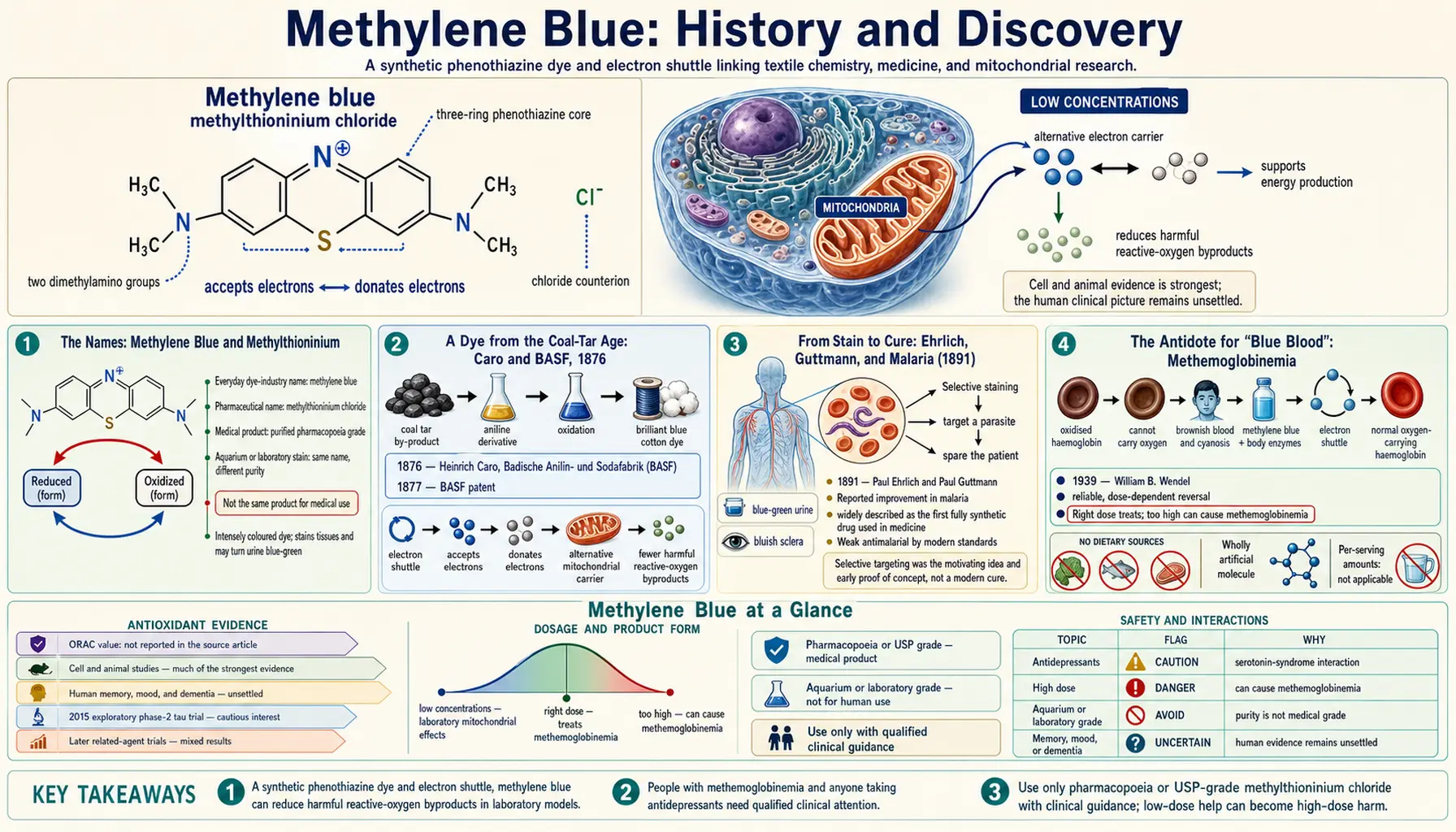
Few medicines have a history as well documented — or as strange — as methylene blue. It began not in a laboratory but in a dye works: a brilliant blue colour for cotton, made from coal tar, first prepared in 1876 by the German chemist Heinrich Caro at the firm that became BASF. Within fifteen years it had crossed from the textile bench to the sickbed, and it is widely described as the first fully synthetic drug used in medicine. From there its story runs through Paul Ehrlich's malaria experiments, the first reliable cure for "blue blood" (methemoglobinemia), and — remarkably — the chemical ancestry of the entire modern class of antipsychotic drugs. This article traces what the historical record actually supports, naming the real chemists and physicians where the documentation is firm, and flagging the places where a famous date or claim is less certain than it sounds.
Table of Contents
- The Names: Methylene Blue and Methylthioninium
- A Dye from the Coal-Tar Age: Caro and BASF, 1876
- From Stain to Cure: Ehrlich, Guttmann, and Malaria (1891)
- The Antidote for "Blue Blood": Methemoglobinemia
- The Molecule That Founded Modern Psychiatry
- Rediscovery: Mitochondria, Memory, and Alzheimer’s
- From Coal-Tar Dye to Modern Antioxidant
- Research Papers and References
- Connections
- Featured Videos
The Names: Methylene Blue and Methylthioninium
The everyday name methylene blue is a dye-industry name — the kind of plain, descriptive label nineteenth-century colour chemists gave their products. The molecule's formal pharmaceutical name is methylthioninium chloride, and this is the term you will see on a hospital ampoule or a pharmacopoeia monograph. Its full chemical name is 3,7-bis(dimethylamino)phenothiazin-5-ium chloride, which simply spells out its structure: a three-ring phenothiazine core carrying two dimethylamino groups. That phenothiazine skeleton is worth remembering, because — as a later section shows — it is the thread connecting a humble textile dye to an entire family of modern medicines.
The colour itself is the reason the compound exists at all. Methylene blue is an intensely coloured dye that stains tissues, fabrics, and (famously) the person taking it, turning urine a vivid blue-green. That same property — the ability to bind selectively to certain cells and structures — is exactly what first drew physicians to it, because a dye that picks out a parasite under the microscope might, the thinking went, be persuaded to attack that parasite inside the body. The history of methylene blue is in large part the history of that one idea being pushed in every possible direction.
One more naming point matters for safety, and the tradition is unusually clear about it. The substance sold cheaply as an aquarium treatment or a laboratory stain shares the name "methylene blue" but is not the same product as the purified, pharmacopoeia-grade methylthioninium chloride used in medicine. The name is identical; the purity is not. This distinction recurs throughout the compound's modern story and is covered in detail on the companion pages.
A Dye from the Coal-Tar Age: Caro and BASF, 1876
Methylene blue is a child of the nineteenth-century synthetic-dye boom — the era when chemists learned to make brilliant colours from the coal tar left over by the gas industry, and when those colours built some of the first great chemical companies. The compound was first prepared in 1876 by Heinrich Caro, a German chemist working at Badische Anilin- und Sodafabrik — the Mannheim firm known today as BASF. Caro made it as a textile dye, a new blue for cotton, by oxidising an aniline derivative; in 1877 BASF was granted a patent on it, often described as one of the earliest German dye patents. These are firm, well-attributed facts: a named chemist, a named company, and dates that the chemical and historical literature agree on.
It is worth being precise about what "discovery" means here, because methylene blue is exactly the kind of compound where naming a single inventor is appropriate. Unlike a plant medicine, which emerges from the anonymous accumulated practice of many cultures, methylene blue is a wholly artificial molecule that did not exist in nature until a chemist built it. Caro's priority is documented. (As with many industrial discoveries, several chemists of the period worked on related thiazine dyes, and the fine details of who optimised what were later argued over in patent disputes — but Caro's 1876 preparation of methylene blue itself is the standard, well-sourced attribution.)
The significance of this origin is easy to miss. Methylene blue entered the world as a commercial product of heavy industry, not as a remedy. Everything medical that followed — and there is a great deal — happened because a textile colour turned out to have biological powers nobody had been looking for. That accident of history is why the same molecule can be found in a fabric-dyeing patent of the 1870s and on the World Health Organization's list of essential medicines today.
From Stain to Cure: Ehrlich, Guttmann, and Malaria (1891)
The leap from dye to drug is the most celebrated part of methylene blue's story, and the central figure is the German physician and scientist Paul Ehrlich — later a Nobel laureate and one of the founders of modern chemotherapy. Ehrlich was fascinated by the way certain dyes stained some cells and tissues but not others. He reasoned that this selectivity might be turned to therapeutic use: a dye that singled out a microbe might be made to poison it while sparing the patient. This is the seed of his famous later idea of the magische Kugel, the "magic bullet" — a drug aimed at a pathogen the way a marksman aims at a target.
In 1891, Ehrlich and the physician Paul Guttmann tested methylene blue in patients with malaria and reported that it could improve the illness. This is the episode behind the often-repeated description of methylene blue as "the first fully synthetic drug used in medicine" — the first purely man-made molecule deliberately given to treat a disease, rather than a substance extracted or refined from a natural source. The 1891 Guttmann–Ehrlich malaria work is well documented and is cited throughout the scientific literature on the compound's history.
Two honest qualifications belong here. First, methylene blue was a weak antimalarial by modern standards, and it was eventually displaced by far more effective drugs; its lasting importance is as a proof of concept, not as a cure that conquered the disease. Patients also disliked two unmistakable side effects — blue-green urine and a bluish tinge to the whites of the eyes. Second, the phrase "first fully synthetic drug" is a widely used characterisation rather than a precise, undisputed title; what is solidly true is that methylene blue's 1891 use was an early and pivotal demonstration that a synthetic chemical could act as a medicine. From that demonstration grew the whole modern enterprise of designing drugs at the bench — including, by a direct chemical line, the antimalarial chloroquine and the antipsychotics discussed below.
The Antidote for "Blue Blood": Methemoglobinemia
While methylene blue faded as a malaria treatment, it found a different medical role that it still holds today — one rooted in chemistry rather than germ-killing. In a condition called methemoglobinemia, the iron in haemoglobin becomes oxidised so that it can no longer carry oxygen; the blood literally turns brownish and the patient turns blue (cyanotic) despite breathing normally. It can be inherited, or triggered by certain drugs, chemicals, and toxins. Methylene blue acts here as an electron shuttle: with the help of the body's own enzymes it accepts and donates electrons, helping convert the useless oxidised haemoglobin back into the normal oxygen-carrying form.
The treatment was placed on a firm clinical footing in the 1930s. The landmark paper is William B. Wendel's 1939 report, "The Control of Methemoglobinemia with Methylene Blue," published in the Journal of Clinical Investigation, which documented methylene blue's reliable, dose-dependent ability to reverse the condition. This work helped establish methylene blue as the standard antidote — a status it retains in emergency medicine to this day, and the reason a nineteenth-century dye still sits in modern hospital pharmacies.
The compound has also been investigated and used as an antidote in other poisonings over the decades, and the wider literature notes early-twentieth-century interest in its use against cyanide and similar toxins. The exact priority for some of those antidotal uses is reported inconsistently across sources, so this page emphasises the securely documented core: methylene blue's role in methemoglobinemia, firmly established by Wendel's 1939 study and confirmed by every subsequent generation of clinical practice. There is a striking irony baked into this chapter, and it carries forward into the modern research: methylene blue both treats methemoglobinemia at the right dose and can cause it at too high a dose — an early sign of the bell-shaped, "low-dose-helps, high-dose-harms" behaviour that defines the molecule.
The Molecule That Founded Modern Psychiatry
The most far-reaching chapter in methylene blue's history has nothing to do with how the compound itself is used — it is about what chemists built from it. Methylene blue is the original member of the phenothiazine family, built on that three-ring core named in the first section. Through the late nineteenth and early twentieth centuries, chemists modified the phenothiazine skeleton in search of new dyes, antiseptics, antimalarials, and antihistamines. That long programme of tinkering is the reason methylene blue is repeatedly called the prototype or lead compound for a whole lineage of later drugs.
The pivotal moment came in December 1950, when the chemist Paul Charpentier, working at the French firm Rhône-Poulenc, synthesised a phenothiazine derivative designated RP-4560 — the compound the world came to know as chlorpromazine. Introduced into psychiatric practice in the early 1950s by the French clinicians Jean Delay and Pierre Deniker (building on the surgeon Henri Laborit's observations of its calming effect), chlorpromazine became the first effective antipsychotic medication and is widely credited with transforming the treatment of severe mental illness. Every phenothiazine-class psychiatric drug that followed traces its chemical descent back to the same skeleton first seen in a textile dye.
This is one of the clearest examples in all of pharmacology of how a single molecule can reshape medicine. It is also a place to be careful with language: chlorpromazine is a descendant of methylene blue's chemical family, not methylene blue itself, and the two are different drugs with different actions. What the historical record supports — and what the standard reviews state — is that methylene blue was the structural starting point from which the phenothiazine antipsychotics, and several other drug classes, were eventually developed. The dye chemists of the 1870s could not possibly have foreseen it, but the road to the modern psychiatric pharmacy began at their dyeing vats.
Rediscovery: Mitochondria, Memory, and Alzheimer’s
For much of the twentieth century methylene blue settled into the background of medicine — a dependable antidote, a surgical and diagnostic stain, a laboratory reagent. The renewed scientific interest that surrounds it today is comparatively recent, and it grows out of the same electron-shuttling chemistry that makes it an antidote for "blue blood." Researchers found that at low concentrations methylene blue can interact with the mitochondria — the cell's energy factories — acting as an alternative carrier of electrons and, in laboratory models, supporting energy production and reducing harmful reactive-oxygen byproducts. This is the basis for the modern framing of methylene blue as a mitochondrial and antioxidant-adjacent compound, which is why it appears in this section of the site.
A second strand of modern research grew from neurology. Methylene blue was found in the laboratory to interfere with the clumping of tau, a protein whose tangles are a hallmark of Alzheimer's disease, and this prompted formal clinical investigation of methylene blue and its chemical relatives as possible dementia treatments. An exploratory phase-2 trial reported by Claude Wischik and colleagues in 2015 generated cautious interest, though subsequent larger trials of the related agents produced mixed and much-debated results. The thoughtful 2011 commentary by R. Heiner Schirmer and colleagues, "Lest we forget you — methylene blue…," captured this mood of rediscovery, surveying the compound's long past and its renewed promise across malaria and neurodegeneration alike.
Honesty requires a clear line here between history and hype. The mitochondrial and neuroprotective findings are real, are published in peer-reviewed journals, and are genuinely interesting — but much of the strongest evidence is from cell and animal studies, and the human clinical picture for memory, mood, and dementia remains unsettled. The detailed evidence, mechanisms, dosing, and the very real safety cautions (above all the serotonin-syndrome interaction with many antidepressants) are covered on the main Methylene Blue page and the Benefits articles. This history is concerned only with how a coal-tar dye came to be studied for the brain at all.
From Coal-Tar Dye to Modern Antioxidant
Stand back from the details and the shape of methylene blue's history is remarkable. In not much more than a century, one molecule travelled from a textile dye works (1876) to the first synthetic drug given for a disease (1891), to the standard antidote for methemoglobinemia (firmly established by 1939), to the chemical ancestor of the antipsychotic revolution (chlorpromazine, 1950), and finally to a modern object of research into mitochondrial energy, ageing, and neurodegeneration. No herb and very few drugs can claim a documented arc like that, and at almost every turn the history is anchored to named people, named institutions, and datable publications — which is exactly why methylene blue is such a satisfying case to tell accurately.
It is also a useful cautionary tale. The same dye-industry origin that gives methylene blue its long pedigree is the source of its single biggest modern hazard: the cheap industrial and aquarium grades of "methylene blue" are not purified to the standard required for human use, and only pharmacopoeia- or USP-grade methylthioninium chloride belongs anywhere near a person. And the molecule's defining quirk — helpful at low doses, harmful at high ones, an antidote that can also cause the very condition it treats — runs unbroken from Wendel's 1939 methemoglobinemia work to today's nootropic enthusiasm.
The honest summary, then, is the one this whole site tries to model: a long and genuinely impressive history is a reason to take a compound seriously and to study it carefully — not a guarantee that every modern use is proven or safe. Methylene blue's past tells us what it can do and where it came from; the present-day evidence, and a conversation with a qualified clinician, must decide what any individual should do with it.
Research Papers and References
The list below gathers peer-reviewed reviews and primary papers that document methylene blue's history and pharmacology, together with curated PubMed topic-search links. Author names, titles, and journals are given as plain text; only the stable PMID or DOI is hyperlinked, and each opens in a new tab.
- Schirmer RH, Adler H, Pickhardt M, Mandelkow E. "Lest we forget you — methylene blue…". Neurobiology of Aging. 2011;32(12):2325.e7-2325.e16. — PMID: 21316815
- Oz M, Lorke DE, Hasan M, Petroianu GA. Cellular and molecular actions of methylene blue in the nervous system. Medicinal Research Reviews. 2011;31(1):93-117. — PMID: 19760660
- Wainwright M, Crossley KB. Methylene blue — a therapeutic dye for all seasons? Journal of Chemotherapy. 2002;14(5):431-443. — PMID: 12462423
- Wendel WB. The control of methemoglobinemia with methylene blue. Journal of Clinical Investigation. 1939;18(2):179-185. — doi:10.1172/JCI101033
- Wischik CM, Staff RT, Wischik DJ, et al. Tau aggregation inhibitor therapy: an exploratory phase 2 study in mild or moderate Alzheimer's disease. Journal of Alzheimer's Disease. 2015;44(2):705-720. — PMID: 25550228
- Ostrovsky A, Afzal M. Methylene blue. In: StatPearls. StatPearls Publishing. — NCBI Bookshelf: NBK557593
- Methylene blue history and medical uses — PubMed: methylene blue history and Ehrlich
- Phenothiazine dyes and the origin of chlorpromazine — PubMed: phenothiazine history and chlorpromazine
External Authoritative Resources
- StatPearls — Methylene Blue
- PubMed — Methylene blue and methemoglobinemia
- PubMed — All research on methylene blue
Connections
- Methylene Blue
- Methylene Blue Benefits
- All Antioxidants
- CoQ10
- NAD+ and NMN
- Glutathione
- Malaria
- Alzheimer's Disease