Methylene Blue — Benefits Deep Dive
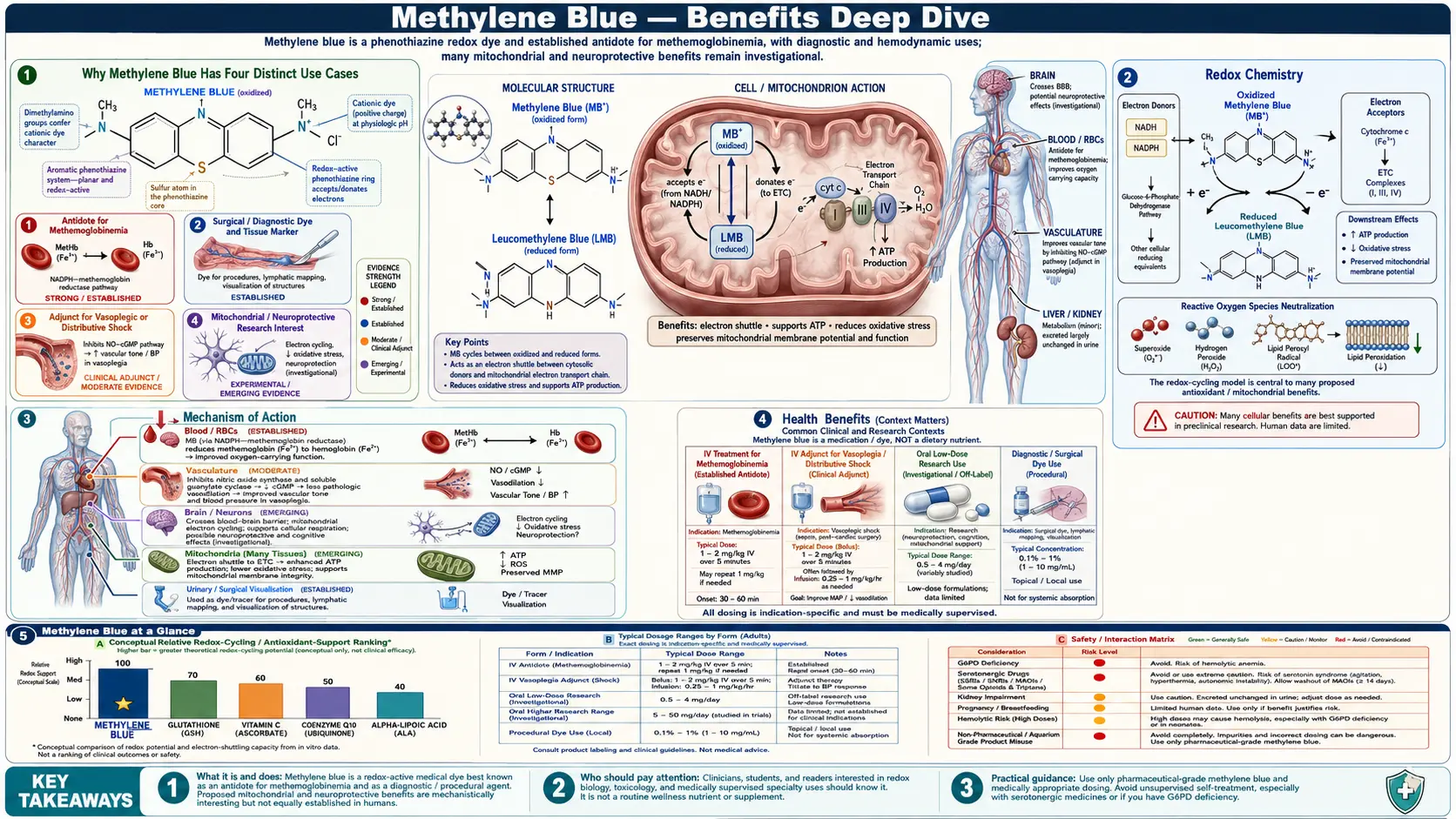
Methylene blue is unusual among small molecules because four entirely distinct therapeutic mechanisms operate from the same phenothiazine core: it acts as an artificial electron acceptor that bypasses damaged Complex I and III in the mitochondrial chain (in contrast to CoQ10, which feeds the chain), it inhibits tau-protein aggregation and supports brain bioenergetics, it kills Plasmodium and certain viruses through methylation and photodynamic effects, and it is the FDA-approved antidote for methemoglobinemia by reducing ferric iron back to ferrous. Each benefit page below explores one specific application in clinical depth — with the caveat that methylene blue carries a tighter drug-interaction profile (serotonin syndrome, G6PD hemolysis) than virtually any other antioxidant on this site.
Deep-Dive Articles
Mitochondrial Bypass & Bioenergetics
How methylene blue accepts electrons from NADH and Complex I, then donates them directly to cytochrome c — routing around damaged Complex III. The U-shaped hormetic dose curve (0.5–4 mg/kg helps, >5 mg/kg harms), the contrast with CoQ10 (which feeds the ETC instead of bypassing it), and the post-viral, traumatic-brain-injury, and stroke models where artificial electron carriers shine.
Cognition & Brain
The Wischik tau-aggregation thesis, the TauRx rember and LMTM (Phase 3 LUCIDITY) Alzheimer's program, the Auchter 2014 photobiomodulation + MB combination trials, low-dose nootropic protocols (1–15 mg/day), and the Bryan Ardis nicotine-receptor controversy. Why the cognitive evidence is real but the effect size in healthy adults is modest.
Antiviral & Antimicrobial
The original Ehrlich antimalarial work that preceded chloroquine by 50 years. RNA methylation and photodynamic inactivation as antiviral mechanisms. The COVID-19 hypothesis discussions (limited evidence), the photodynamic-therapy literature on skin, dental, and superficial infections, and a critical look at Bryan Ardis's snake-venom thesis — included for context, marked as fringe.
Methemoglobinemia — the FDA-Approved Use
The mechanism: methylene blue reduces ferric iron in methemoglobin back to ferrous so the molecule can carry oxygen again. The 1–2 mg/kg IV protocol, the sodium nitrite and dapsone-toxicity reversal indications, the congenital CYB5R deficiency picture, and the two situations where methylene blue is the wrong answer — G6PD deficiency and the serotonergic-drug interaction risk.
Table of Contents
- Deep-Dive Articles
- Why Methylene Blue Has Four Distinct Use Cases
- Research Papers: Mitochondrial Bypass
- Research Papers: Cognition & Brain
- Research Papers: Antiviral & Antimicrobial
- Research Papers: Methemoglobinemia
- Research Papers: Safety (MAO-A, Serotonin Syndrome, G6PD)
- External Authoritative Resources
- Connections
- Featured Videos
Why Methylene Blue Has Four Distinct Use Cases
Most drugs have one primary mechanism of action that produces a narrow range of clinical effects. Methylene blue is unusual because four chemically distinct properties of the phenothiazine core map to four different therapeutic categories:
- Redox-active electron carrier — the leuco (reduced) form donates electrons; the oxidized form accepts them. This is the property that allows methylene blue to act as an artificial electron acceptor in the mitochondrial chain, bypassing damaged Complex I and Complex III and restoring ATP production in cells with mitochondrial dysfunction. The same redox cycling is what lets it reduce methemoglobin (Fe³+) back to functional hemoglobin (Fe²+) — the FDA-approved indication.
- Tau-aggregation inhibitor — methylene blue and its leuco-form derivative LMTM (TRx0237) prevent abnormal tau protein from forming the paired helical filaments seen in Alzheimer's disease. The TauRx program in Aberdeen has been the longest sustained pharmaceutical-development effort around this molecule, with the LUCIDITY Phase 3 trial read out in 2023.
- Photodynamic-active dye — methylene blue strongly absorbs red light around 660 nm and generates singlet oxygen when illuminated. This is the basis of photodynamic antimicrobial and oncology applications, and it is also why methylene blue was Ehrlich's "magic bullet" precursor in the 1890s.
- Monoamine-oxidase A inhibitor — at clinically relevant concentrations, methylene blue inhibits MAO-A. This contributes to its mood effects in small bipolar-depression trials, but it is also the mechanism behind the most dangerous safety signal: serotonin syndrome when combined with SSRIs, SNRIs, tricyclics, tramadol, MDMA, dextromethorphan, or triptans.
The combination of four mechanisms means methylene blue shows up in four nearly unrelated clinical settings: ICU emergency rooms for methemoglobinemia, cognitive-research labs for Alzheimer's and brain bioenergetics, dental and dermatology offices for photodynamic therapy, and integrative-medicine clinics for off-label longevity and post-viral protocols. The same chemistry that makes it useful in all four settings is also what makes it more dangerous than typical antioxidants — the MAO-A inhibition and the G6PD-hemolysis risk are not theoretical.
Research Papers: Mitochondrial Bypass
- Wen Y et al. — alternative electron carrier mechanism — PubMed: MB alternative electron carrier
- Atamna H et al. (FASEB 2008) — cellular senescence and bioenergetics — PubMed: Atamna FASEB 2008
- Poteet E et al. (PLoS ONE 2012) — neuroprotective actions of MB and derivatives — PubMed: Poteet PLoS 2012
- Tucker D et al. (Mol Neurobiol 2018) — mitochondrial function to neuroprotection — PubMed: Tucker 2018
- U-shaped hormetic dose response of methylene blue — PubMed: MB hormesis dose response
- Methylene blue in traumatic brain injury (animal models) — PubMed: MB traumatic brain injury
- MB in stroke and cerebral ischemia — PubMed: MB stroke
- NADH oxidation and shuttle across inner membrane — PubMed: MB NADH shuttle
- Comparison MB vs CoQ10 in mitochondrial dysfunction — PubMed: MB vs CoQ10
Research Papers: Cognition & Brain
- Rodriguez P et al. (Radiology 2016) — functional MRI of MB in human brain — PubMed: Rodriguez fMRI 2016
- Wischik CM et al. — rember (LMTB) Phase 2 Alzheimer's trial — PubMed: Wischik rember Phase 2
- Gauthier S et al. — LMTM (TRx0237) Phase 3 Alzheimer's — PubMed: LMTM TRx0237 Phase 3
- TauRx LUCIDITY Phase 3 readout (hydromethylthionine mesylate) — PubMed: LUCIDITY TauRx
- Auchter A et al. (2014) — photobiomodulation plus methylene blue cognition — PubMed: Auchter MB photobiomodulation
- Riha PD et al. (Eur J Pharm 2005) — memory facilitation and brain oxygen consumption — PubMed: Riha 2005
- Callaway NL et al. (Pharmacol Biochem Behav 2004) — brain oxidative metabolism and memory retention — PubMed: Callaway 2004
- MB in frontotemporal dementia — PubMed: MB frontotemporal dementia
- MB and Parkinson's disease neuroprotection — PubMed: MB Parkinson's
Research Papers: Antiviral & Antimicrobial
- Ehrlich P — methylene blue antimalarial (historical) — PubMed: Ehrlich antimalarial
- Wainwright M, Crossley KB — methylene blue therapeutic dye for all seasons — PubMed: Wainwright MB review
- MB photodynamic inactivation of viruses (HIV, HCV, blood-product decontamination) — PubMed: MB photodynamic virus inactivation
- MB COVID-19 hypothesis discussions — PubMed: MB and SARS-CoV-2
- MB antiparasitic activity (Plasmodium, Trypanosoma) — PubMed: MB antiparasitic
- Photodynamic therapy for periodontal disease — PubMed: MB periodontal PDT
- MB antibacterial activity (MRSA, biofilms) — PubMed: MB MRSA biofilm
- MB for fungal infections (Candida, dermatophytes) — PubMed: MB antifungal
Research Papers: Methemoglobinemia
- Wendel WB (J Clin Invest 1939) — the original methylene blue + methemoglobinemia paper — PubMed: Wendel 1939
- Methylene blue in sodium nitrite poisoning — PubMed: MB sodium nitrite poisoning
- MB for dapsone-induced methemoglobinemia — PubMed: MB dapsone toxicity
- Congenital methemoglobinemia and CYB5R3 deficiency — PubMed: congenital methemoglobinemia CYB5R3
- MB IV dosing (1-2 mg/kg) guidelines for methemoglobinemia — PubMed: MB IV dosing
- Local anesthetic-induced methemoglobinemia (benzocaine, prilocaine) — PubMed: anesthetic-induced methemoglobinemia
- Aniline dye and nitrate-water methemoglobinemia — PubMed: nitrate-water methemoglobinemia
- Methylene blue paradox: antidote at low dose, cause at high dose — PubMed: MB paradox high dose
Research Papers: Safety (MAO-A, Serotonin Syndrome, G6PD)
- Ramsay RR, Dunford C, Gillman PK (Br J Pharmacol 2007) — MAO-A inhibition mechanism — PubMed: Ramsay-Gillman 2007
- Gillman PK (Anaesthesia 2006) — MB implicated in fatal serotonin toxicity — PubMed: Gillman 2006 serotonin toxicity
- FDA Drug Safety Communication 2011 — serious CNS reactions with MB & serotonergic drugs — PubMed: FDA MB serotonin warning
- Beutler E (Blood 1994) — G6PD deficiency comprehensive review — PubMed: Beutler G6PD 1994
- MB-induced hemolysis in G6PD deficiency — PubMed: MB G6PD hemolysis
- MB and tramadol / fentanyl / dextromethorphan interactions — PubMed: MB opioid interactions
- MB in pregnancy — teratogenicity warning — PubMed: MB pregnancy
- Bistas E, Sanghavi DK — StatPearls comprehensive monograph — StatPearls: Methylene Blue
External Authoritative Resources
- StatPearls (NCBI Bookshelf) — Methylene Blue — the most authoritative clinical monograph; covers pharmacology, dosing, contraindications, monitoring
- FDA Drug Safety Communication — serotonin syndrome with methylene blue
- PubMed — all research on methylene blue (~32,000 papers as of 2026)
- ClinicalTrials.gov — active and recent methylene blue trials
Connections
- Methylene Blue (Main Page)
- MB for Mitochondrial Bypass
- MB for Cognition & Brain
- MB Antiviral
- MB for Methemoglobinemia
- Mitochondrial Mechanism & Bioenergetics
- Dosing Guide
- Drug Interactions & Serotonin Syndrome
- Methemoglobinemia & G6PD Deficiency
- Cognitive Enhancement & ADHD
- Methylene Blue & Long COVID
- Photodynamic Therapy
- Pharmaceutical vs Industrial Grade
- History — Ehrlich & Phenothiazines
- All Antioxidants
- CoQ10
- Glutathione
- NAD+ and NMN
- Bryan Ardis (Context)
- Alzheimer's Disease
- Depression
- Malaria