⚠ Evidence warning: Clinical trials or other evidence do not support the claim that early human biomarker data on fisetin is encouraging. This page keeps it as a report of what people, websites or other media say.
Fisetin — Benefits Deep Dive
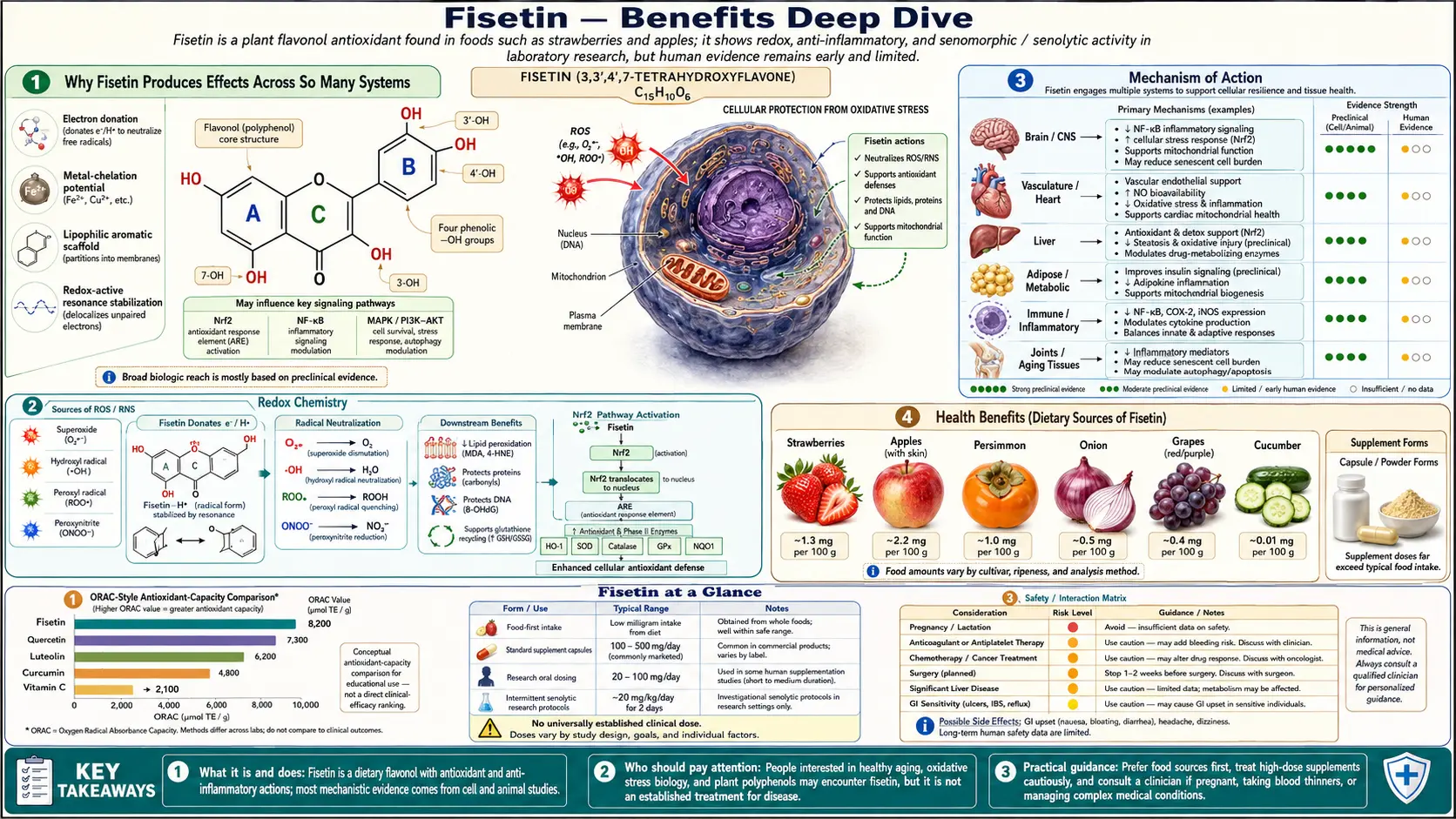
Fisetin is a flavonol found most abundantly in strawberries (~160 µg/g fresh weight), with smaller amounts in apples, persimmons, cucumbers, and onions. In 2018 a Mayo Clinic screen led by James Kirkland and Tamar Tchkonia identified fisetin as the most potent natural senolytic among ten flavonoids tested — a class of molecules that selectively eliminate senescent “zombie” cells that accumulate with age. The Yousefzadeh et al. EBioMedicine paper showed that fisetin in already-aged mice reduced senescent-cell burden across tissues, restored homeostasis, and extended both median and maximum lifespan. An independent test by the US National Institute on Aging's Interventions Testing Program (2024), in genetically mixed mice, found that fisetin did not significantly extend lifespan in either sex at the dose and schedule used. A 2026 review counted 34 registered human trials of fisetin, including the Mayo Clinic AFFIRM-LITE trial in older adults; of the 4 finished trials with published results, some reported better metabolic or inflammation markers and others found no clear benefit. The four benefit pages below explore the senolytic mechanism, brain and cognitive applications, the broader anti-aging context, and the older-established anti-inflammatory and mast-cell-stabilizing literature — with honest framing throughout that the striking animal data still substantially outruns the human clinical evidence.
Deep-Dive Articles
Senolytic Activity
The Yousefzadeh 2018 EBioMedicine paper that identified fisetin as the most-potent natural senolytic among ten flavonoids screened, James Kirkland and Tamar Tchkonia's Mayo Clinic translational program, the AFFIRM-LITE trial, the dasatinib + quercetin (D+Q) cocktail context, the BCL-2/BCL-xL/BCL-W inhibition mechanism, and the honest framing that animal data is striking but human efficacy data remains preliminary.
Read the deep dive →Brain Health and Cognition
Pamela Maher's sustained work at the Salk Institute (2009, 2012, 2017) showing hippocampal protection, memory preservation in Alzheimer's transgenic mice, brain-derived neurotrophic factor (BDNF) and glutathione mechanisms, and rodent studies of stroke recovery. The preclinical neuroprotective dossier is one of the strongest non-senolytic arguments for fisetin.
Read the deep dive →Anti-Aging
The broader “longevity flavonoid” framing — mitochondrial protection, Sestrin/AMP-activated protein kinase (AMPK) signaling, Nrf2 antioxidant response, sirtuin activation, the strawberry/apple/persimmon dietary sources, and the dose discrepancy between dietary intake (~1-5 mg/day from typical diets) and supplemental research doses (100-1000 mg).
Read the deep dive →Inflammation and Allergy
The older-established literature: Park 2007 and 2008 cell studies on NF-κB and cytokine suppression, mast-cell stabilization comparable to quercetin, atopic dermatitis pilot data, and the practical case for fisetin as a quercetin-class anti-allergic and anti-inflammatory flavonoid in everyday use independent of the senolytic story.
Read the deep dive →Table of Contents
- Deep-Dive Articles
- Why Fisetin Produces Effects Across So Many Systems
- Research Papers: Senolytic Activity
- Research Papers: Brain Health & Cognition
- Research Papers: Anti-Aging & Mitochondrial
- Research Papers: Inflammation & Allergy
- Research Papers: Pharmacology, Bioavailability, Safety
- External Authoritative Resources
- Connections
- Featured Videos
Why Fisetin Produces Effects Across So Many Systems
Fisetin is structurally a flavonol — the same chemical sub-family as quercetin and kaempferol — differing from quercetin by a single missing hydroxyl group at position 5 on the A-ring (the B-ring, with its two neighbouring hydroxyl groups, is the same in both). That tiny structural difference disproportionately changes both its biological selectivity and its membrane permeability, and the consequences explain why fisetin produces measurable effects across cellular senescence, neuronal survival, mitochondrial function, and inflammation — rather than fitting neatly into a single “antioxidant” bucket.
- Selective senescent-cell apoptosis via SCAP inhibition — senescent cells survive by over-expressing the anti-apoptotic proteins BCL-2, BCL-xL, BCL-W, and several PI3K/AKT survival nodes (collectively the “senescent-cell anti-apoptotic pathways” or SCAPs). Fisetin inhibits multiple SCAPs simultaneously, tipping already-stressed senescent cells into programmed cell death while sparing healthy cells (Yousefzadeh 2018). This is the mechanism behind the senolytic effect in aged mice and the foundational Mayo Clinic dossier.
- Mitochondrial protection and Sestrin/AMP-activated protein kinase signaling — fisetin preserves mitochondrial membrane potential under oxidative stress and activates the energy-sensing AMP-activated protein kinase (AMPK) pathway, which in turn upregulates Sestrin family proteins, suppresses mechanistic target of rapamycin (mTOR) signaling, and triggers autophagy. The same broad set of metabolic effects underlies the “longevity flavonoid” framing and overlaps mechanistically with the established effects of metformin, rapamycin, and caloric restriction.
- Neurotrophic effects (brain-derived neurotrophic factor, glutathione preservation, p25 inhibition) — fisetin uniquely upregulates brain-derived neurotrophic factor (BDNF) in hippocampal neurons, preserves intracellular glutathione (the brain's primary antioxidant), and inhibits the calpain-mediated cleavage of p35 to neurotoxic p25 (a tau-tangle driver in Alzheimer's disease). Pamela Maher's group at the Salk Institute has documented these effects across more than a decade of work that underlies the cognitive and stroke-recovery dossier.
- NF-κB and cytokine suppression, mast-cell stabilization — fisetin inhibits the master pro-inflammatory transcription factor NF-κB and stabilizes mast cells against immunoglobulin E-triggered degranulation (Park 2007 and 2008, in cultured human and rat mast cells). This is the oldest arm of fisetin research, but it rests mainly on cell-culture results rather than human trials — mechanistically nearly identical to quercetin but with somewhat better cell permeability — and is the basis for the anti-inflammatory and anti-allergic applications.
- Nrf2 activation — fisetin activates the Nrf2 transcription factor that drives expression of phase-II detoxification enzymes (NQO1, HO-1, glutamate-cysteine ligase) and the body's endogenous antioxidant defense. This effect is shared with sulforaphane (from broccoli sprouts) and with other polyphenols but contributes meaningfully to the cross-system effects.
The practical complication is bioavailability. Free fisetin has poor aqueous solubility and is extensively glucuronidated and sulfated on first-pass hepatic metabolism, with a plasma half-life of only ~1-3 hours. The pulsed “hit and run” regimen of high doses for 2-3 consecutive days, rather than continuous low daily dosing, comes from mouse studies, in which short or intermittent fisetin treatment reduced senescence markers in many tissues (Yousefzadeh 2018) — senescent cells take weeks to re-accumulate, so the short serum half-life is acceptable. Commercial formulations attempt to address absorption with liposomes, phytosome encapsulation (used in a commercial fisetin supplement), or co-administration with piperine, with mixed published evidence on actual plasma-level improvement.
The most consequential caveat is that the widely circulated “senolytic protocol” of 20 mg/kg body weight on two consecutive days per month is extrapolated from the mouse data, not validated by published human efficacy trials. The Mayo Clinic AFFIRM and AFFIRM-LITE trials were set up to test whether the mouse-translated dose produces the predicted effects on senescent-cell burden, frailty, and inflammatory cytokines in older humans. As of this writing the early biomarker data is encouraging but the larger trials needed to establish efficacy and dose-response are still in progress.
Where the evidence stands. A 2026 review counted 34 registered human trials of fisetin and looked closely at the 4 finished trials with published results. Some reported favourable changes in metabolic or inflammation markers and others found no clear or significant benefit; the trials were small, often combined fisetin with other treatments, or had no comparison group, so the review concluded that clinical evidence for fisetin remains limited. In mice, the US National Institute on Aging's Interventions Testing Program, which tests candidate anti-aging compounds in genetically mixed mice, found in 2024 that fisetin did not significantly extend lifespan in either males or females at the dose and schedule used — a different result from the 2018 lifespan study.
Research Papers: Senolytic Activity
- Yousefzadeh MJ, Zhu Y, McGowan SJ, et al. (2018). Fisetin is a senotherapeutic that extends health and lifespan. EBioMedicine 36:18-28. — PubMed PMID: 30279143
- Harrison DE, Strong R, Reifsnyder P, et al. (2024). Astaxanthin and meclizine extend lifespan in UM-HET3 male mice; fisetin, SG1002 (hydrogen sulfide donor), dimethyl fumarate, mycophenolic acid, and 4-phenylbutyrate do not significantly affect lifespan in either sex at the doses and schedules used. GeroScience 46(1):795-816. — PubMed PMID: 38041783
- Sandoval-Caballero C, Roemer Z, Kotz CM, et al. (2026). Clinical translation of fisetin for age-related diseases: current evidence and future opportunities. Nutrients 18(18). — PubMed PMID: 42796982
- Zhu Y, Tchkonia T, Pirtskhalava T, et al. (2015). The Achilles' heel of senescent cells: from transcriptome to senolytic drugs. Aging Cell. — PubMed: Zhu & Tchkonia 2015
- Kirkland JL, Tchkonia T (2020). Senolytic drugs: from discovery to translation. Journal of Internal Medicine. — PubMed: Kirkland & Tchkonia 2020
- Hickson LJ, Langhi Prata LGP, Bobart SA, et al. (2019). Senolytics decrease senescent cells in humans: preliminary report from a clinical trial of dasatinib plus quercetin in individuals with diabetic kidney disease. EBioMedicine. — PubMed: Hickson D+Q 2019
- Justice JN, Nambiar AM, Tchkonia T, et al. (2019). Senolytics in idiopathic pulmonary fibrosis: results from a first-in-human, open-label, pilot study. EBioMedicine. — PubMed: Justice IPF 2019
- Kirkland JL, Tchkonia T (2017). Cellular senescence: a translational perspective. EBioMedicine. — PubMed: Translational perspective 2017
- Mayo Clinic AFFIRM-LITE trial (fisetin in older adults) — PubMed: AFFIRM-LITE
- Baker DJ, Wijshake T, Tchkonia T, et al. (2011). Clearance of p16Ink4a-positive senescent cells delays ageing-associated disorders. Nature. — PubMed: Baker p16 clearance
- Xu M, Pirtskhalava T, Farr JN, et al. (2018). Senolytics improve physical function and increase lifespan in old age. Nature Medicine. — PubMed: Xu 2018
- Senescent-cell anti-apoptotic pathways (SCAPs) and BCL-2 family inhibition — PubMed: SCAPs and BCL-2 family
Research Papers: Brain Health & Cognition
- Maher P (2009). Modulation of multiple pathways involved in the maintenance of neuronal function during aging by fisetin. Genes & Nutrition. — PubMed: Maher 2009
- Maher P, Akaishi T, Abe K (2006). Flavonoid fisetin promotes ERK-dependent long-term potentiation and enhances memory. PNAS. — PubMed: Maher 2006 PNAS
- Currais A, Prior M, Dargusch R, et al. (2014). Modulation of p25 and inflammatory pathways by fisetin maintains cognitive function in Alzheimer's disease transgenic mice. Aging Cell. — PubMed: Currais 2014
- Maher P (2017). Protective effects of fisetin and other berry flavonoids in Parkinson's disease. Food & Function. — PubMed: Maher 2017 Parkinson's
- Prior M, Chiruta C, Currais A, et al. (2014). Back to the future with phenotypic screening. ACS Chemical Neuroscience. — PubMed: Prior 2014
- Fisetin and BDNF (brain-derived neurotrophic factor) expression — PubMed: Fisetin and BDNF
- Fisetin and tau hyperphosphorylation in Alzheimer's models — PubMed: Fisetin and tau
- Fisetin and glutathione preservation in neurons — PubMed: Fisetin glutathione neurons
- Fisetin and ischemic stroke rodent models — PubMed: Fisetin ischemic stroke models
Research Papers: Anti-Aging & Mitochondrial
- Khan N, Syed DN, Ahmad N, Mukhtar H (2013). Fisetin: a dietary antioxidant for health promotion. Antioxidants & Redox Signaling. — PubMed: Khan 2013 review
- Fisetin and mitochondrial membrane potential preservation — PubMed: Fisetin and mitochondria
- Fisetin, AMPK activation, and mTOR suppression — PubMed: Fisetin AMPK/mTOR
- Sestrin family proteins in longevity signaling — PubMed: Sestrin in longevity
- Fisetin and Nrf2 antioxidant response element activation — PubMed: Fisetin Nrf2
- Fisetin and SIRT1 activation — PubMed: Fisetin and SIRT1
- Dietary flavonoid intake and all-cause mortality cohort studies — PubMed: Flavonoid intake mortality
- Strawberry consumption and flavonoid intake epidemiology — PubMed: Strawberry flavonoid intake
- Polyphenol intake estimation in Western diets (Phenol-Explorer) — PubMed: Polyphenol intake estimation
- Fisetin in C. elegans lifespan extension — PubMed: Fisetin in C. elegans
Research Papers: Inflammation & Allergy
- Park HH, Lee S, Oh JM, et al. (2007). Anti-inflammatory activity of fisetin in human mast cells (HMC-1). Pharmacological Research 55(1):31-37. — PubMed PMID: 17079162
- Park HH, Lee S, Son HY, et al. (2008). Flavonoids inhibit histamine release and expression of proinflammatory cytokines in mast cells. Archives of Pharmacal Research 31(10):1303-1311. — PubMed PMID: 18958421
- Fisetin and atopic dermatitis pilot data — PubMed: Fisetin and atopic dermatitis
- Quercetin and fisetin comparative mast-cell stabilization — PubMed: Quercetin vs fisetin mast cells
- Fisetin and inhibition of TNF-α-induced inflammation — PubMed: Fisetin and TNF-α
- Fisetin and inhibition of inducible COX-2 expression — PubMed: Fisetin and COX-2
- Fisetin and reduction of IL-6 and IL-8 in inflammatory states — PubMed: Fisetin and IL-6/IL-8
- Fisetin and asthma / airway inflammation models — PubMed: Fisetin and asthma models
- Fisetin and inflammatory bowel disease animal models — PubMed: Fisetin and IBD models
- Senescence-associated secretory phenotype (SASP) cytokine profile — PubMed: SASP cytokine profile
Research Papers: Pharmacology, Bioavailability, Safety
- Fisetin pharmacokinetics in rodents and humans — PubMed: Fisetin pharmacokinetics
- Fisetin glucuronidation and sulfation phase-II metabolism — PubMed: Fisetin metabolism
- Phytosome fisetin formulation studies — PubMed: Phytosome fisetin formulation
- Fisetin liposomal encapsulation absorption studies — PubMed: Fisetin liposomal
- Fisetin safety and toxicology preclinical studies — PubMed: Fisetin safety
- Fisetin antiplatelet activity and bleeding risk — PubMed: Fisetin antiplatelet
- Flavonoid-drug interactions and cytochrome P450 inhibition — PubMed: Flavonoid CYP interactions
- Phenol-Explorer database fisetin content of common foods — PubMed: Phenol-Explorer fisetin
- Senolytic dosing translation from mouse to human — PubMed: Senolytic dose translation
- Pulsed (intermittent) vs continuous senolytic dosing rationale — PubMed: Pulsed senolytic dosing
External Authoritative Resources
- Mayo Clinic — Senolytics research overview (Kirkland Lab)
- ClinicalTrials.gov — All active fisetin trials
- Linus Pauling Institute — Flavonoids Micronutrient Information Center
- Phenol-Explorer — Database of polyphenol content in foods (fisetin food sources)
- PubMed — All research on fisetin (~1,200+ papers)
Connections
- Fisetin (Main Page)
- Fisetin Senolytic Activity
- Fisetin Brain Health & Cognition
- Fisetin Anti-Aging
- Fisetin Inflammation & Allergy
- Quercetin
- Spermidine
- Longevity Protocols
- Rapamycin
- Nicotinamide Adenine Dinucleotide and Nicotinamide Mononucleotide
- Oxidative Stress
- Alzheimer's Disease
- Stroke
- Osteoporosis
- Blueberries
- History