⚠ Evidence warning: Clinical trials or other evidence do not support the claims that fisetin treats allergies, mast cell activation syndrome, urticaria, eczema, inflammatory bowel disease and arthritis. This page keeps it as a report of what people, websites or other media say.
Fisetin for Inflammation and Allergy
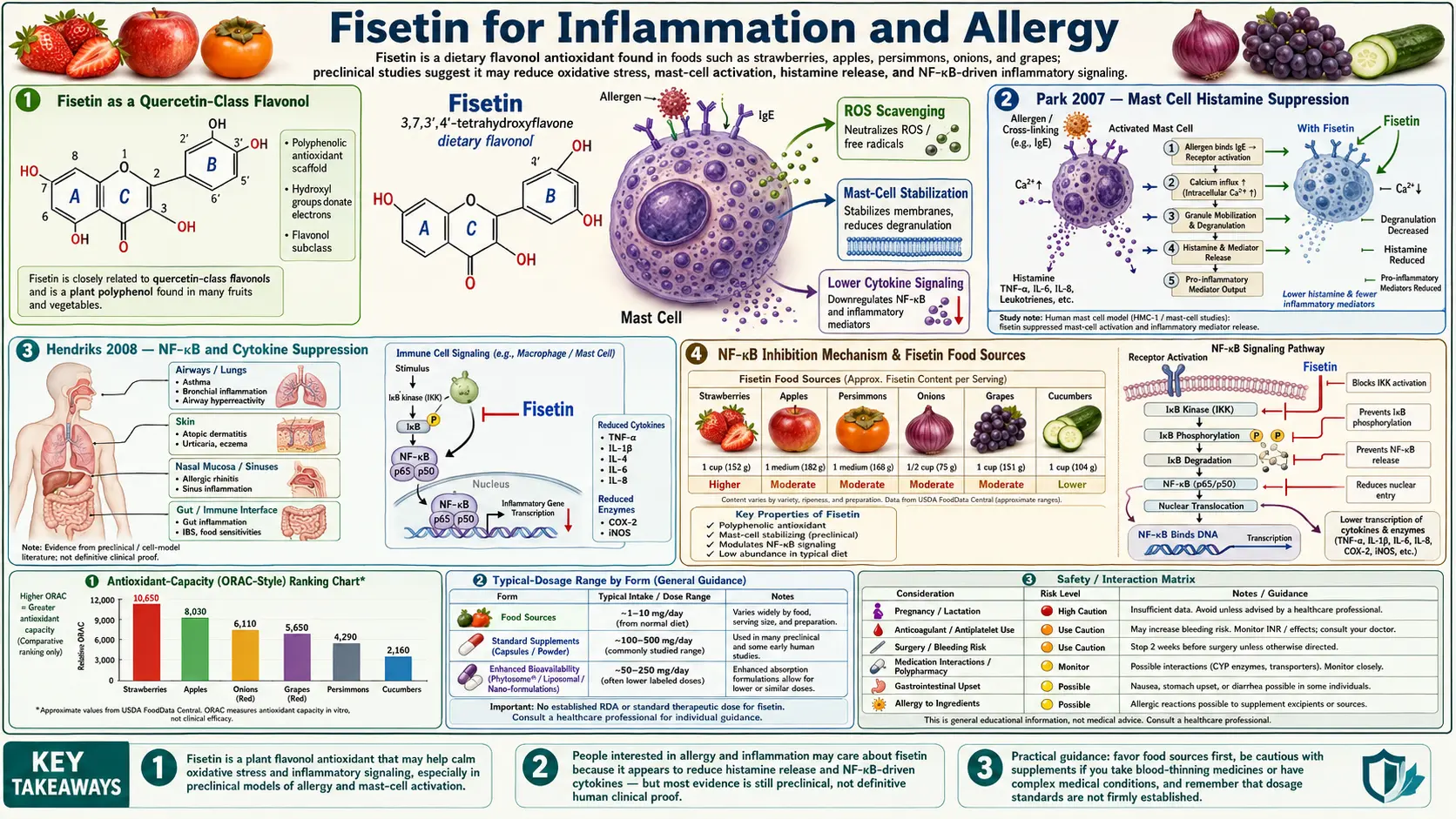
Before fisetin became the senolytic flavonoid in 2018, it was already established in the natural-medicine literature as a quercetin-class anti-inflammatory and mast-cell-stabilizing flavonoid. The foundational work was Park et al. 2008 in Archives of Pharmacal Research, demonstrating that fisetin inhibits histamine release from mast cells and suppresses the expression of proinflammatory cytokines (interleukin-6, IL-8, tumor necrosis factor-α) through NF-κB inhibition. Later cell and mouse studies carried this work beyond mast cells. Subsequent studies have documented effects in allergic asthma models, atopic dermatitis mouse models, inflammatory bowel disease models, and rheumatoid arthritis models. Mechanistically the effects are nearly identical to quercetin — both flavonols inhibit NF-κB, stabilize mast cells against immunoglobulin E-triggered degranulation, suppress cyclooxygenase-2 (COX-2) and pro-inflammatory cytokines, and reduce the inflammatory cytokine production of activated macrophages. Fisetin's practical advantage over quercetin is somewhat better membrane permeability, which translates to better cell-uptake and potentially better tissue penetration at comparable doses. This deep-dive walks through the older but clinically more-established anti-inflammatory and anti-allergic literature, where fisetin has a stronger evidence base than for its widely-marketed but newer senolytic application.
Table of Contents
- Fisetin as a Quercetin-Class Flavonol
- Park 2008 — Mast Cell Histamine Suppression
- NF-κB and Cytokine Suppression Beyond Mast Cells
- NF-κB Inhibition Mechanism
- Mast Cell Stabilization in Detail
- Allergic Asthma and Airway Inflammation
- Atopic Dermatitis and Skin Allergy
- Inflammatory Bowel Disease Models
- Rheumatoid and Osteoarthritis Applications
- Cyclooxygenase-2 and Pro-Inflammatory Cytokine Suppression
- How Fisetin Is Used for Inflammation in Practice
- Key Research Papers
- Connections
- Featured Videos
Fisetin as a Quercetin-Class Flavonol
Quercetin is the most widely-used and best-studied flavonol in human nutritional supplementation, with dozens of clinical trials in asthma, allergic rhinitis, atopic dermatitis, cardiovascular outcomes, and exercise performance. Fisetin is a quercetin-class compound: the two share the same flavonol core and the same B-ring (two hydroxyl groups at positions 3′ and 4′), and fisetin lacks the hydroxyl group at position 5 of the A-ring (PubChem structures). The two have similar pharmacology, with similar but somewhat distinct binding affinity profiles.
The structural similarity translates to mechanistic similarity. Both compounds:
- Inhibit NF-κB activation (the master inflammatory transcription factor)
- Suppress AP-1 transcription
- Inhibit cyclooxygenase-2 expression
- Reduce pro-inflammatory cytokine production (interleukin-6, IL-8, tumor necrosis factor-α, interleukin-1 beta (IL-1β))
- Stabilize mast cells against immunoglobulin E-triggered degranulation
- Inhibit phospholipase A2 (reducing arachidonic acid mobilization upstream of both COX and LOX pathways)
- Have antioxidant activity through direct radical scavenging
- Activate Nrf2 antioxidant gene expression
- Have weak antihistamine activity
The differences are quantitative rather than qualitative. Fisetin appears to have somewhat better membrane permeability owing to slightly higher lipophilicity (PubChem computed XLogP 2.0 for fisetin vs 1.5 for quercetin). This translates to better cell-uptake at comparable extracellular concentrations and potentially better tissue penetration, including across the blood-brain barrier. Fisetin also has somewhat longer plasma half-life in some preparations.
Practitioners treat fisetin and quercetin as largely interchangeable for the basic anti-inflammatory and anti-allergic applications, crediting fisetin with a slight edge for applications requiring tissue penetration (central nervous system (CNS), skin) and quercetin having the larger published evidence base for outcomes like exercise-induced inflammation and allergic rhinitis. Many practitioners use both, either separately or in combination.
Park 2008 — Mast Cell Histamine Suppression
The seminal paper for fisetin in the anti-allergic / anti-inflammatory space is Park HH, Lee S, Son HY, Park SB, Kim MS, Choi EJ, Singh TS, Ha JH, Lee MG, Kim JE, Hyun MC, Kwon TK, Kim YH, Kim SH. “Flavonoids inhibit histamine release and expression of proinflammatory cytokines in mast cells.” Archives of Pharmacal Research, 2008. Key findings (all in cells grown in the laboratory):
- Cell models — histamine release was measured in RBL-2H3 cells (a rat basophilic leukemia cell line) and cytokines in the HMC-1 human mast cell line
- Trigger — immunoglobulin E, or phorbol myristate acetate plus calcium ionophore A23187 (PMACI, a chemical degranulation trigger)
- Compounds tested — six flavonoids: astragalin, fisetin, kaempferol, myricetin, quercetin, and rutin
- Histamine result — fisetin, kaempferol, myricetin, quercetin, and rutin inhibited histamine release and the rise in calcium inside RBL-2H3 cells
- Cytokine effects — fisetin, quercetin, and rutin lowered gene expression and production of tumor necrosis factor-α, interleukin-1β, interleukin-6, and IL-8 in PMACI-stimulated HMC-1 human mast cells (myricetin lowered only tumor necrosis factor-α and interleukin-6)
- Mechanism — fisetin, myricetin, and rutin blocked NF-κB activation (its move into the nucleus, its DNA binding, and NF-κB-driven gene activity)
The authors suggested that these flavonoids may have potential for treating allergic inflammatory diseases by damping mast-cell activation. Practitioners have since applied fisetin to immunoglobulin E-mediated allergic conditions (allergic rhinitis, atopic dermatitis, allergic asthma, urticaria, anaphylaxis) on the same mechanistic basis as quercetin. Most subsequent fisetin anti-allergic work has built on this foundation.
NF-κB and Cytokine Suppression Beyond Mast Cells
Later studies carried the NF-κB findings beyond mast cells. In a mouse model of atopic dermatitis (Kim et al. 2014), fisetin lowered NF-κB p65 activation in the skin lesions and reduced interferon-gamma and interleukin-4 production by activated CD4+ T cells. In a mouse model of allergic asthma (Wu et al. 2011), it suppressed NF-κB activity. These animal and cell results present fisetin as a broad-spectrum anti-inflammatory rather than a narrowly anti-allergic compound.
A 2007 cell study (Sung et al.) found that fisetin blocks NF-κB activation by suppressing the upstream kinases TAK-1 and receptor-interacting protein-regulated I-κBα kinase. This supports the picture that fisetin acts upstream of the NF-κB signalsome — affecting IKK (I-κB kinase) activation or upstream signaling kinases — rather than competing with NF-κB at the DNA-binding level. This places fisetin in the same class as several pharmaceutical anti-inflammatory drugs that target the IKK / NF-κB axis.
On this view, fisetin's effects on neuroinflammation (microglial activation, discussed on the Brain Health page) and on the cytokines released by senescent cells (the senescence-associated secretory phenotype, SASP) (discussed on the Senolytic page) are mechanistically continuous with its better-established anti-inflammatory effects in classical immune cells. The cell-type details vary; the NF-κB suppression is shared.
NF-κB Inhibition Mechanism
Nuclear factor kappa B (NF-κB) is the master transcription factor controlling expression of hundreds of pro-inflammatory genes. NF-κB is held in the cytoplasm in inactive form bound to its inhibitor I-κB. Upon activation (by TLR ligands, cytokine receptors, antigen receptors, oxidative stress, and many other triggers), I-κB is phosphorylated by IKK, ubiquitinated, and degraded by the proteasome. Free NF-κB translocates to the nucleus and drives transcription of:
- Pro-inflammatory cytokines: tumor necrosis factor-α, interleukin-1β, interleukin-6, IL-8, IL-12, IL-18
- Chemokines: CXCL1, CCL2 (MCP-1), CCL3, CCL4
- Adhesion molecules: ICAM-1, VCAM-1, E-selectin
- Enzymes: cyclooxygenase-2, iNOS, MMPs
- Survival proteins: BCL-2, BCL-xL (which is interesting in the senescent-cell context)
NF-κB activation is appropriate for acute infection clearance. Chronic NF-κB activation underlies essentially every chronic inflammatory disease: rheumatoid arthritis, inflammatory bowel disease, atherosclerosis, type-2 diabetes, neurodegenerative diseases, and cancer.
Fisetin inhibits NF-κB activation at multiple points:
- Reduced I-κB phosphorylation (preserving the inhibitor)
- Reduced IKK activity
- Reduced nuclear translocation of the p65 (RelA) NF-κB subunit
- Reduced DNA-binding activity of nuclear NF-κB
The multi-point inhibition makes the net effect robust — even if one intervention point is partial, the cumulative effect on downstream gene expression is substantial. This is the mechanistic basis for fisetin's broad anti-inflammatory profile across disparate cell types and disease models.
Mast Cell Stabilization in Detail
Mast cells are tissue-resident immune cells with primary granules containing histamine, heparin, tryptase, and chymase, and secondary mediators including leukotrienes, prostaglandins, and cytokines. They are positioned at the body's interfaces with the outside world (skin, gut, airway, conjunctiva) where they participate in defense against parasites and venoms and in classical immunoglobulin E-mediated allergic reactions.
Mast-cell stabilizers prevent or attenuate degranulation in response to immunoglobulin E-cross-linking or other triggers. The pharmaceutical mast-cell stabilizers (cromolyn sodium, nedocromil, ketotifen) are used clinically for asthma, allergic rhinitis, and ocular allergy. Several natural flavonoids including quercetin and fisetin also have mast-cell-stabilizing activity through partially overlapping but not identical mechanisms.
Fisetin's mast-cell-stabilizing mechanism includes:
- Reduced calcium influx — calcium signaling is required for degranulation; flavonoids partially block calcium channels
- Inhibition of Syk kinase — the proximal kinase downstream of FcεRI (the high-affinity immunoglobulin E (IgE) receptor on mast cells)
- Stabilization of granule membranes — direct effect on the lipid bilayer reducing granule-membrane fusion
- Reduced cytokine transcription — even when degranulation occurs, subsequent cytokine production is reduced
The proposed clinical relevance is for people with mast-cell activation syndrome (MCAS), chronic urticaria, allergic rhinitis, atopic dermatitis with mast-cell-mediated flares, and food allergy. Quercetin has the larger published clinical evidence base for these applications; practitioners regard fisetin as mechanistically interchangeable and use it in place of or alongside quercetin.
For more on mast cell activation, see our Mast Cell Activation Syndrome page.
Allergic Asthma and Airway Inflammation
Animal models of allergic asthma typically use ovalbumin sensitization and challenge in BALB/c mice to produce a Th2-skewed airway inflammation with eosinophil recruitment, mucus hypersecretion, and airway hyperresponsiveness. Fisetin treatment in these models reduces:
- Bronchoalveolar lavage fluid eosinophils
- Airway hyperresponsiveness measured by methacholine challenge
- IL-4, IL-5, and IL-13 (the Th2 cytokines driving allergic inflammation)
- Serum total immunoglobulin E and ovalbumin-specific immunoglobulin E
- Airway mucus production
- Lung tissue inflammation on histopathology
The mechanism in this context combines mast-cell stabilization, NF-κB inhibition in airway epithelium and immune cells, and direct effects on Th2 cytokine production. Researchers cite the animal data as grounds for human testing; human asthma trials of fisetin specifically have not been published, though quercetin trials in asthma and allergic rhinitis have shown modest benefit.
For more on asthma and respiratory inflammation, see our Asthma page and Pulmonology landing page.
Atopic Dermatitis and Skin Allergy
Atopic dermatitis (eczema) is a chronic inflammatory skin disease with both barrier-function and immune-dysregulation components. Mast-cell activation and Th2-skewed inflammation contribute to flares. Topical and oral flavonoids have been tested as adjuncts to standard topical-corticosteroid management; for fisetin, the published studies are in mice and cells.
The data for fisetin in atopic dermatitis are limited:
- Several small open-label studies of oral quercetin (~500-1000 mg/day) show modest improvement in pruritus and SCORAD (severity scoring index)
- Mouse models of atopic dermatitis (oxazolone-induced or DNFB-induced) show that fisetin reduces ear thickness, mast-cell infiltration, and inflammatory cytokines; in the DNFB model in NC/Nga mice (Kim et al. 2014), fisetin reduced the infiltration of eosinophils, mast cells, and T cells into the skin and lowered total immunoglobulin E
- Topical fisetin preparations have been tested but are not commercially widely available
Practitioners who use fisetin (or quercetin) in atopic dermatitis describe it as an adjunct to standard care — topical corticosteroids or calcineurin inhibitors during flares, with the flavonoid taken orally for ongoing background anti-inflammatory effect. No human trial of fisetin for atopic dermatitis has been published.
For more on dermatologic inflammation, see our Dermatology landing page.
Inflammatory Bowel Disease Models
Animal models of inflammatory bowel disease (dextran sulfate sodium colitis in mice, TNBS colitis, interleukin-10 (IL-10) knockout spontaneous colitis) all show benefit from fisetin treatment. Specific findings:
- Reduced colon shortening (a marker of inflammation in DSS colitis)
- Reduced histopathologic inflammation scores
- Reduced tumor necrosis factor-α, interleukin-6, interleukin-1β in colon tissue
- Preserved tight junction proteins (claudin-1, occludin, ZO-1) maintaining barrier function
- Reduced NF-κB activation in colonic mucosa
- Improved goblet cell density and mucin production
- Modulation of gut microbiome (increased Bacteroidetes, decreased Proteobacteria)
The mechanism combines the broad NF-κB inhibition, the senolytic clearance of senescent cells in inflamed gut tissue, and direct support of epithelial barrier function. The clinical translation to human inflammatory bowel disease (IBD) is plausible but has not been formally tested in large trials. Smaller pilot studies of quercetin in ulcerative colitis show modest benefit.
For more on inflammatory bowel disease, see our Inflammatory Bowel Disease page, Crohn's Disease page, and Ulcerative Colitis page.
Rheumatoid and Osteoarthritis Applications
Fisetin has been tested in animal models of both rheumatoid arthritis (collagen-induced arthritis, CIA) and osteoarthritis (monosodium-iodoacetate-induced cartilage degradation). The findings:
- Rheumatoid arthritis (CIA model) — reduced joint swelling, reduced pannus formation, reduced cartilage damage, reduced synovial NF-κB and pro-inflammatory cytokines
- Osteoarthritis — reduced cartilage matrix degradation, reduced MMP-3 and MMP-13 (matrix metalloproteinases that degrade cartilage), reduced chondrocyte apoptosis, possible senolytic clearance of senescent chondrocytes in OA cartilage
The osteoarthritis application is mechanistically particularly interesting because senescent chondrocytes are increasingly recognized as drivers of OA progression. The senolytic mechanism that drives fisetin's lifespan effects may also clear senescent chondrocytes from OA cartilage, slowing disease progression. In a 2017 study (Zheng et al.), fisetin activated the SIRT1 enzyme and lowered inflammatory and cartilage-degrading markers (including MMP-3 and MMP-13) in IL-1β-stimulated human OA chondrocytes in the laboratory, and mice with surgically induced OA that were given fisetin by mouth had less cartilage destruction. On ClinicalTrials.gov (checked November 2026), one human OA trial of fisetin is completed (NCT04210986), one OA trial of fisetin with quercetin is suspended (NCT05276895), and two related fisetin studies were withdrawn (NCT04770064 on OA pain and NCT05505747 after meniscus repair); none is in progress.
For more on arthritis, see our Arthritis page, Rheumatoid Arthritis page, and Osteoarthritis page.
Cyclooxygenase-2 and Pro-Inflammatory Cytokine Suppression
Cyclooxygenase-2 (COX-2) is the inducible isoform of cyclooxygenase — the enzyme that converts arachidonic acid to prostaglandins. Cyclooxygenase-2 is upregulated in inflammation and is the target of the nonsteroidal anti-inflammatory drug (NSAID) class of drugs (ibuprofen, naproxen, celecoxib, etc.). Selective cyclooxygenase-2 inhibition produces analgesia and anti-inflammatory effects but carries cardiovascular and gastrointestinal risks.
Fisetin inhibits cyclooxygenase-2 expression at the transcriptional level (downstream of NF-κB inhibition) and may also directly inhibit cyclooxygenase-2 enzymatic activity at higher concentrations. The proposed clinical relevance is for conditions where nonsteroidal anti-inflammatory drug use is desired but where chronic nonsteroidal anti-inflammatory drug exposure is problematic — older adults with renal insufficiency, patients with peptic ulcer history, patients on anticoagulants where bleeding risk is elevated.
Fisetin is not a replacement for nonsteroidal anti-inflammatory drugs (NSAIDs) in acute pain management — the onset is slower and the analgesic potency is much lower. Practitioners describe it as one part of a multi-component anti-inflammatory regimen aimed at reducing the nonsteroidal anti-inflammatory drug burden in chronic inflammatory conditions; no trial has tested this.
The cytokine suppression effect on interleukin-6 (IL-6), tumor necrosis factor-α, interleukin-1β, and IL-8 is documented in multiple cell types and tissue models. These are the same cytokines that drive systemic inflammaging in older adults, and they are the cytokines elevated in metabolic syndrome, obesity, and chronic-disease states. Fisetin's suppression of these cytokines is one mechanism by which it may produce broad health effects independent of the senolytic application.
How Fisetin Is Used for Inflammation in Practice
Practitioners and users who take fisetin for its anti-inflammatory or anti-allergic effects (rather than for the senolytic application) describe the following. These doses come from practice, not from human trials of these uses.
- Dose — for ongoing anti-inflammatory effect, commonly 100-200 mg per day with food. This is much lower than the senolytic protocol (1500 mg pulsed) and is more amenable to chronic daily use.
- Form — standard fisetin capsules are what practitioners describe for the anti-inflammatory application; a more-expensive phytosome fisetin supplement is described as unnecessary at these lower daily doses.
- Timing — taken with meals for absorption. Some users split the dose AM and PM.
- Stacking — commonly combined with quercetin (additive mast-cell-stabilizing effect), bromelain (synergistic anti-inflammatory effect through different mechanism), and omega-3 fatty acids (complementary resolution-of-inflammation mechanism through resolvins and protectins).
- Allergic indications — allergic rhinitis (seasonal), chronic urticaria, mast-cell activation syndrome, food-allergy management adjunct. Onset of effect is gradual (days to weeks), not acute.
- Inflammatory indications — mild-to-moderate osteoarthritis (especially with high-dose pulses leveraging the senolytic effect on senescent chondrocytes), background anti-inflammatory effect in inflammatory bowel disease (as adjunct to standard care, not monotherapy), gout (anecdotally; weak evidence base).
- Cautions described — pregnancy, breastfeeding, active anticoagulation (mild antiplatelet effect), and the period around surgery (practitioners stop it two weeks before surgery).
- Drug interactions — mild cytochrome P450 3A4 (CYP3A4) inhibition (theoretical interaction with many medications, which matters most for people taking several medicines). Mild antiplatelet effect may potentiate warfarin, direct oral anticoagulants (DOACs), and antiplatelet drugs.
For the integrated picture across all four fisetin benefit categories, see the Fisetin Benefits Hub.
Key Research Papers
- Park HH, Lee S, Son HY, et al. (2008). Flavonoids inhibit histamine release and expression of proinflammatory cytokines in mast cells. Archives of Pharmacal Research 31(10):1303-1311. — PubMed PMID: 18958421
- Khan N, Syed DN, Ahmad N, Mukhtar H (2013). Fisetin: a dietary antioxidant for health promotion. Antioxidants & Redox Signaling 19:151-162. — PubMed PMID: 23121441
- Pal HC, Pearlman RL, Afaq F (2016). Fisetin and its role in chronic diseases. Advances in Experimental Medicine and Biology 928:213-244. — PubMed PMID: 27671819
- Geraets L, Moonen HJ, Brauers K, Wouters EF, Bast A, Hageman GJ (2007). Dietary flavones and flavonoles are inhibitors of poly(ADP-ribose) polymerase-1 in pulmonary epithelial cells. Journal of Nutrition 137:2190-2195. — PubMed PMID: 17884996
- Wu MY, Hung SK, Fu SL (2011). Immunosuppressive effects of fisetin in ovalbumin-induced asthma through inhibition of NF-κB activity. Journal of Agricultural and Food Chemistry 59:10496-10504. — PubMed PMID: 21899296
- Sahu BD, Kalvala AK, Koneru M, et al. (2014). Ameliorative effect of fisetin on cisplatin-induced nephrotoxicity in rats via modulation of NF-κB activation and antioxidant defence. PLOS ONE 9:e105070. — PubMed PMID: 25184746
- Kim GD, Lee SE, Park YS, Shin DH, Park GG, Park CS (2014). Immunosuppressive effects of fisetin against dinitrofluorobenzene-induced atopic dermatitis-like symptoms in NC/Nga mice. Food and Chemical Toxicology 66:341-349. — PubMed PMID: 24525099
- Zheng W, Feng Z, You S, et al. (2017). Fisetin inhibits IL-1β-induced inflammatory response in human osteoarthritis chondrocytes through activating SIRT1 and attenuates the progression of osteoarthritis in mice. International Immunopharmacology 45:135-147. — PubMed PMID: 28213268
- Sung B, Pandey MK, Aggarwal BB (2007). Fisetin, an inhibitor of cyclin-dependent kinase 6, down-regulates nuclear factor-κB-regulated cell proliferation, antiapoptotic and metastatic gene products through the suppression of TAK-1 and receptor-interacting protein-regulated IκBα kinase activation. Molecular Pharmacology 71:1703-1714. — PubMed PMID: 17387141
- Fisetin osteoarthritis trials on ClinicalTrials.gov: NCT04210986 (completed), NCT05276895 (suspended), NCT04770064 and NCT05505747 (withdrawn) — NCT04210986, NCT05276895, NCT04770064, NCT05505747
- Quercetin and mast cell stabilization in clinical use review — PubMed
PubMed Topic Searches
Connections
- Fisetin Overview
- Fisetin Benefits Hub
- Fisetin Senolytic Activity
- Fisetin Brain Health & Cognition
- Fisetin Anti-Aging
- Quercetin (Sister Flavonol)
- Mast Cell Activation Syndrome
- Allergic Rhinitis
- Asthma
- Dermatology
- Inflammatory Bowel Disease
- Osteoarthritis
- Omega-3 Fatty Acids
- Anti-Inflammatory Diet
- History