Spirulina — Benefits Deep Dive
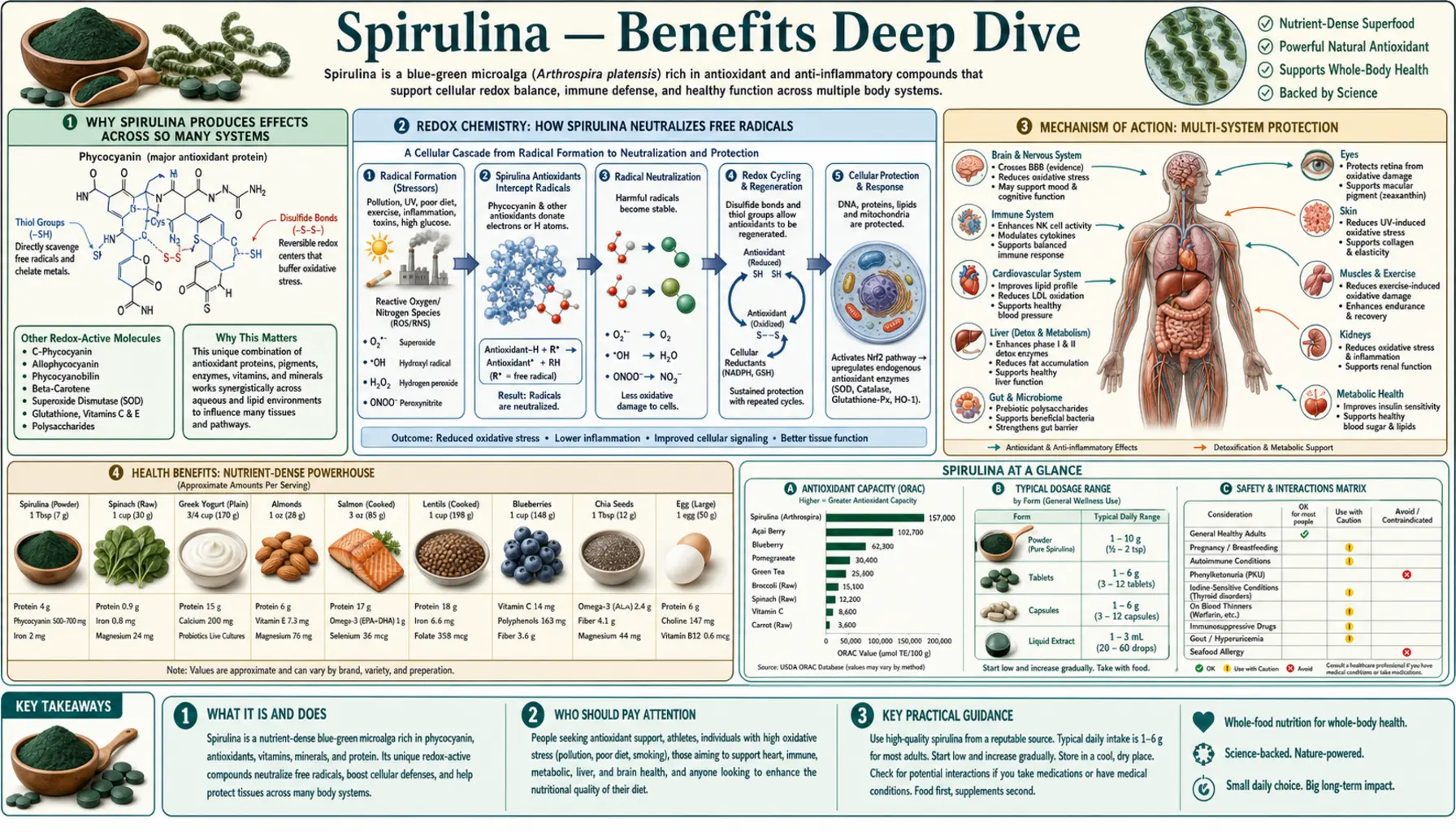
Spirulina (Arthrospira platensis and A. maxima) has drawn unusual institutional attention: the U.S. Food and Drug Administration (FDA) raised no questions about its status as generally recognized as safe (GRAS Notice 127), NASA studied it as a candidate food for long space missions, and the intergovernmental body IIMSAM promotes it as a tool against malnutrition. A blue-green cyanobacterium (technically a prokaryote, not a true alga) harvested for millennia from alkaline lakes in Chad and Mexico, Spirulina yields roughly 60-70% complete protein by dry weight, all essential amino acids, gamma-linolenic acid (GLA), the unique blue pigment-protein phycocyanin, beta-carotene, B-vitamins, iron, and chlorophyll. Four benefit pages below explore the conditions where Spirulina produces the largest, best-validated clinical effects: the powerful antioxidant and anti-inflammatory action of phycocyanin, improvements in cholesterol and cardiovascular markers, modest but measurable enhancement of athletic performance and recovery, and symptom reduction in allergic rhinitis.
Deep-Dive Articles
Phycocyanin & Antioxidant
The blue tetrapyrrole-based pigment-protein C-phycocyanin (C-PC) is structurally similar to bilirubin and shares its potent free-radical-scavenging action. It inhibits reduced nicotinamide adenine dinucleotide phosphate (NADPH) oxidase, scavenges peroxyl and hydroxyl radicals, suppresses NF-kappaB-driven inflammation, induces heme oxygenase-1 (HO-1), and crosses the blood-brain barrier. The pigment alone accounts for most of Spirulina's antioxidant, hepatoprotective, and neuroprotective effects.
Read the deep dive →Cholesterol & Cardiovascular
Spirulina has been studied at 1-10 g/day for blood fats. A 2016 meta-analysis of 7 randomized controlled trials found it reduced total cholesterol by 46.76 mg/dL (95% confidence interval 26.22 to 67.31 mg/dL lower), low-density lipoprotein (LDL) by 41.32 mg/dL, triglycerides by 44.23 mg/dL, and raised high-density lipoprotein (HDL) by 6.06 mg/dL. In that analysis a higher dose did not give a significantly larger effect, while a longer course was linked to larger changes. The mechanism combines bile-acid binding, HMG-CoA reductase inhibition by phycocyanin, and improved endothelial function via increased nitric-oxide bioavailability.
Read the deep dive →Athletic Performance
A small double-blind crossover trial in 9 moderately trained men (Kalafati 2010) found that 6 g/day Spirulina for 4 weeks significantly lengthened time to fatigue in a hard run after a 2-hour run (the abstract reports 2.05 ± 0.68 vs 2.70 ± 0.79 minutes), blunted the exercise-induced rise in lipid peroxidation, raised the fat-burning rate by 10.9% and lowered the carbohydrate-burning rate by 10.3% during the 2-hour run. The mechanism is the antioxidant load buffering the oxidative stress of intense exercise, plus modest contributions from the iron and B-vitamin content.
Read the deep dive →Allergic Rhinitis
In a double-blind, placebo-controlled trial (Cingi 2008), Spirulina significantly improved nasal discharge, sneezing, nasal congestion and itching in allergic rhinitis compared with placebo. The mechanism is inhibition of immunoglobulin E-driven mast-cell histamine release and suppression of IL-4 production by Th2 cells. A small 2020 head-to-head trial (53 patients, no placebo) reported greater improvement in some nasal symptoms with Spirulina than with cetirizine: on Spirulina 2 g/day or cetirizine 10 mg/day for 2 months, runny nose (rhinorrhoea), nasal blockage and loss of smell improved more in the Spirulina group (Nourollahian 2020). What is not known: the evidence rests on these two small trials, and whether the results hold in larger trials is not known.
Read the deep dive →Table of Contents
- Deep-Dive Articles
- Why Spirulina Produces Effects Across So Many Systems
- Research Papers: Phycocyanin & Antioxidant
- Research Papers: Cardiovascular & Lipids
- Research Papers: Athletic Performance
- Research Papers: Allergic Rhinitis & Immune Modulation
- Research Papers: Cross-Cutting (Safety, Quality, Mechanism)
- External Authoritative Resources
- Connections
- Featured Videos
Why Spirulina Produces Effects Across So Many Systems
Most supplements have a single active compound and a narrow clinical effect. Spirulina is unusual because it operates through at least four distinct biochemical pathways simultaneously, each driven by a different constituent of the dried cell. The breadth of clinical effect — cardiovascular, immunologic, hepatic, athletic, anti-allergic, anti-viral — follows from this molecular pluralism.
- Phycocyanin (C-PC, the blue pigment-protein) — comprising up to 20% of dry weight, this open-chain tetrapyrrole chromophore is the dominant antioxidant agent. Structurally analogous to bilirubin, it scavenges peroxyl, hydroxyl, and peroxynitrite radicals, inhibits reduced nicotinamide adenine dinucleotide phosphate oxidase (the primary cellular reactive oxygen species (ROS) generator), induces the cytoprotective transcription factor Nrf2, and suppresses NF-kappaB-driven cytokine production. Read more on the Phycocyanin and Antioxidant page.
- Complete protein and amino-acid profile — at 60-70% protein by dry weight, Spirulina supplies all essential amino acids, including high concentrations of leucine, valine, and isoleucine (the branched-chain amino acids). At a typical 5 g/day dose this contributes a small but meaningful 3-3.5 g of biologically complete protein, which supports the athletic performance and recovery effects observed in trials.
- Gamma-linolenic acid (GLA), an omega-6 derivative — Spirulina is one of the few non-evening-primrose sources of GLA, a precursor (through dihomo-gamma-linolenic acid, DGLA) of anti-inflammatory series-1 prostaglandins (PGE1). GLA contributes to the cardiovascular benefit and to the suppression of allergic-rhinitis symptoms.
- Polysaccharides (calcium-spirulan, immulina) — sulfated polysaccharides in the Spirulina cell wall directly modulate innate immunity, enhancing natural-killer-cell activity and inducing interferon and tumor necrosis factor-alpha production in vitro. Calcium-spirulan has well-documented antiviral activity against enveloped viruses in cell culture. Immulina drives the polysaccharide-based allergy modulation through Th1/Th2 rebalancing.
A practical implication: dose-response curves differ for the different benefits. Anti-allergy effects are seen at 2 g/day; cholesterol benefits typically require 4-10 g/day; athletic-performance benefits cluster around 6 g/day. The doses used in trials therefore vary with the benefit studied; source quality (heavy-metal-free, microcystin-tested) and gastrointestinal tolerance, typically assessed with a slow build-up, are the other recurring factors in the research.
Research Papers: Phycocyanin & Antioxidant
- Romay C et al. C-phycocyanin: a biliprotein with antioxidant, anti-inflammatory and neuroprotective effects — PubMed: Romay phycocyanin review
- Phycocyanin scavenges peroxyl and hydroxyl radicals in vitro — PubMed: Radical scavenging
- C-phycocyanin inhibits NADPH oxidase and superoxide production — PubMed: NADPH oxidase inhibition
- Spirulina hepatoprotection in acetaminophen and CCl4 toxicity models — PubMed: Hepatoprotection
- Phycocyanin and Nrf2 / HO-1 induction — PubMed: Nrf2 induction
- Spirulina supplementation and oxidative-stress markers in humans — PubMed: Human oxidative stress
- Phycocyanin neuroprotection in Parkinson and ischemia models — PubMed: Neuroprotection
- C-phycocyanin selective COX-2 inhibition — PubMed: COX-2 inhibition
- Spirulina and renal protection from cisplatin nephrotoxicity — PubMed: Renal protection
- Phycocyanobilin structural similarity to bilirubin — PubMed: Phycocyanobilin bilirubin
Research Papers: Cardiovascular & Lipids
- Serban MC, Sahebkar A, Dragan S, Stoichescu-Hogea G, Ursoniu S, Andrica F, Banach M. A systematic review and meta-analysis of the impact of Spirulina supplementation on plasma lipid concentrations. Clin Nutr. 2016;35(4):842-51. PubMed PMID: 26433766
- DiNicolantonio JJ et al. Spirulina and cardiovascular risk reduction — PubMed: DiNicolantonio review
- Torres-Duran PV et al. (2007). Spirulina maxima and lipid profile, lipid peroxidation, oxidative status in healthy young Mexicans — PubMed: Torres-Duran 2007
- Mazokopakis EE et al. Spirulina and dyslipidemia in Cretan patients — PubMed: Mazokopakis Crete
- Park HJ et al. Spirulina supplementation reduces blood pressure — PubMed: BP reduction
- Phycocyanin inhibits HMG-CoA reductase — PubMed: HMG-CoA inhibition
- Spirulina and endothelial function / flow-mediated dilation — PubMed: Endothelial function
- Karkos PD et al. Spirulina in clinical practice: evidence-based human applications — PubMed: Karkos clinical review
- Spirulina and platelet aggregation / antithrombotic activity — PubMed: Platelet effects
- Spirulina and type 2 diabetes glycemic control — PubMed: Diabetes glycemic
Research Papers: Athletic Performance
- Kalafati M, Jamurtas AZ, Nikolaidis MG, Paschalis V, Theodorou AA, Sakellariou GK, Koutedakis Y, Kouretas D. Ergogenic and antioxidant effects of spirulina supplementation in humans. Med Sci Sports Exerc. 2010;42(1):142-51. PubMed PMID: 20010119
- Lu HK et al. Spirulina supplementation and trained-athlete exercise-induced oxidative stress — PubMed: Lu trained athletes
- Spirulina and time to exhaustion in endurance exercise — PubMed: Time to exhaustion
- Spirulina increases fat oxidation during exercise — PubMed: Fat oxidation
- Spirulina and muscle damage markers (CK, LDH) after eccentric exercise — PubMed: Muscle damage markers
- Spirulina and iron status / anemia in female athletes — PubMed: Iron and anemia
- Sandhu JS et al. Spirulina platensis and physical performance — PubMed: Sandhu physical performance
- Spirulina branched-chain amino acid content and skeletal muscle recovery — PubMed: BCAA recovery
- Spirulina and post-exercise immune function preservation — PubMed: Post-exercise immune
- Spirulina and chronic fatigue / general energy outcomes — PubMed: Fatigue and vitality
Research Papers: Allergic Rhinitis & Immune Modulation
- Cingi C, Conk-Dalay M, Cakli H, Bal C. The effects of spirulina on allergic rhinitis. Eur Arch Otorhinolaryngol. 2008;265(10):1219-23. PubMed PMID: 18343939
- Nourollahian M, Rasoulian B, Gafari A, Anoushiravani M, Jabari F, Bakhshaee M. Clinical comparison of the efficacy of spirulina platensis and cetirizine for treatment of allergic rhinitis. Acta Otorhinolaryngol Ital. 2020;40(3):224-229. PubMed PMID: 32773785
- Mao TK et al. Effects of dietary Spirulina platensis on human IL-4 production and Th2 cytokines — PubMed: Mao IL-4 / Th2
- Hayashi O et al. Enhancement of antibody production in mice by Spirulina — PubMed: Hayashi antibody production
- Spirulina and mast cell histamine release inhibition — PubMed: Mast cell histamine
- Immulina (Spirulina polysaccharide) and innate immunity in humans — PubMed: Immulina polysaccharide
- Calcium-spirulan and antiviral activity against enveloped viruses — PubMed: Calcium-spirulan antiviral
- Spirulina natural-killer-cell activity in healthy adults — PubMed: NK cell activity
- Spirulina and arsenic poisoning — clinical evidence from Bangladesh — PubMed: Arsenic detoxification
- Spirulina and Th1/Th2 rebalancing in atopic disease — PubMed: Th1/Th2 balance
- Spirulina-induced IFN-gamma production from peripheral blood mononuclear cells — PubMed: IFN-gamma PBMC
Research Papers: Cross-Cutting (Safety, Quality, Mechanism)
- Spirulina nutritional composition: protein, amino acids, lipids, vitamins, minerals — PubMed: Nutritional composition
- Microcystin contamination of commercial Spirulina supplements — PubMed: Microcystin contamination
- Heavy metal content of Spirulina — lead, mercury, cadmium, arsenic — PubMed: Heavy metal content
- Spirulina and pseudovitamin B12 vs methylcobalamin bioavailability — PubMed: Pseudovitamin B12
- Spirulina iron bioavailability and absorption — PubMed: Iron bioavailability
- Spirulina gamma-linolenic acid (GLA) content and prostaglandin metabolism — PubMed: GLA content
- Phenylketonuria (PKU) contraindication: phenylalanine in Spirulina — PubMed: PKU contraindication
- Autoimmune disease caution: theoretical Th1 immune stimulation — PubMed: Autoimmune caution
- Spirulina safety in pregnancy — clinical evidence and theoretical risks — PubMed: Pregnancy safety
- Wu Q et al. The antioxidant, immunomodulatory, and anti-inflammatory activities of Spirulina — PubMed: Wu comprehensive review
External Authoritative Resources
- LiverTox (U.S. National Institutes of Health, NIH) — Spirulina — liver-safety chapter in LiverTox, published by the National Institute of Diabetes and Digestive and Kidney Diseases (NIDDK)
- MedlinePlus — Spirulina — evidence-graded clinical summary with drug interactions
- WHO / IIMSAM — Spirulina as a Tool for the Fight Against Malnutrition
- U.S. Food and Drug Administration generally recognized as safe Notice GRN 127 — Spirulina
- PubMed — All research on Spirulina / Arthrospira (about 4,000 papers)