Spirulina for Phycocyanin and Antioxidant Defense
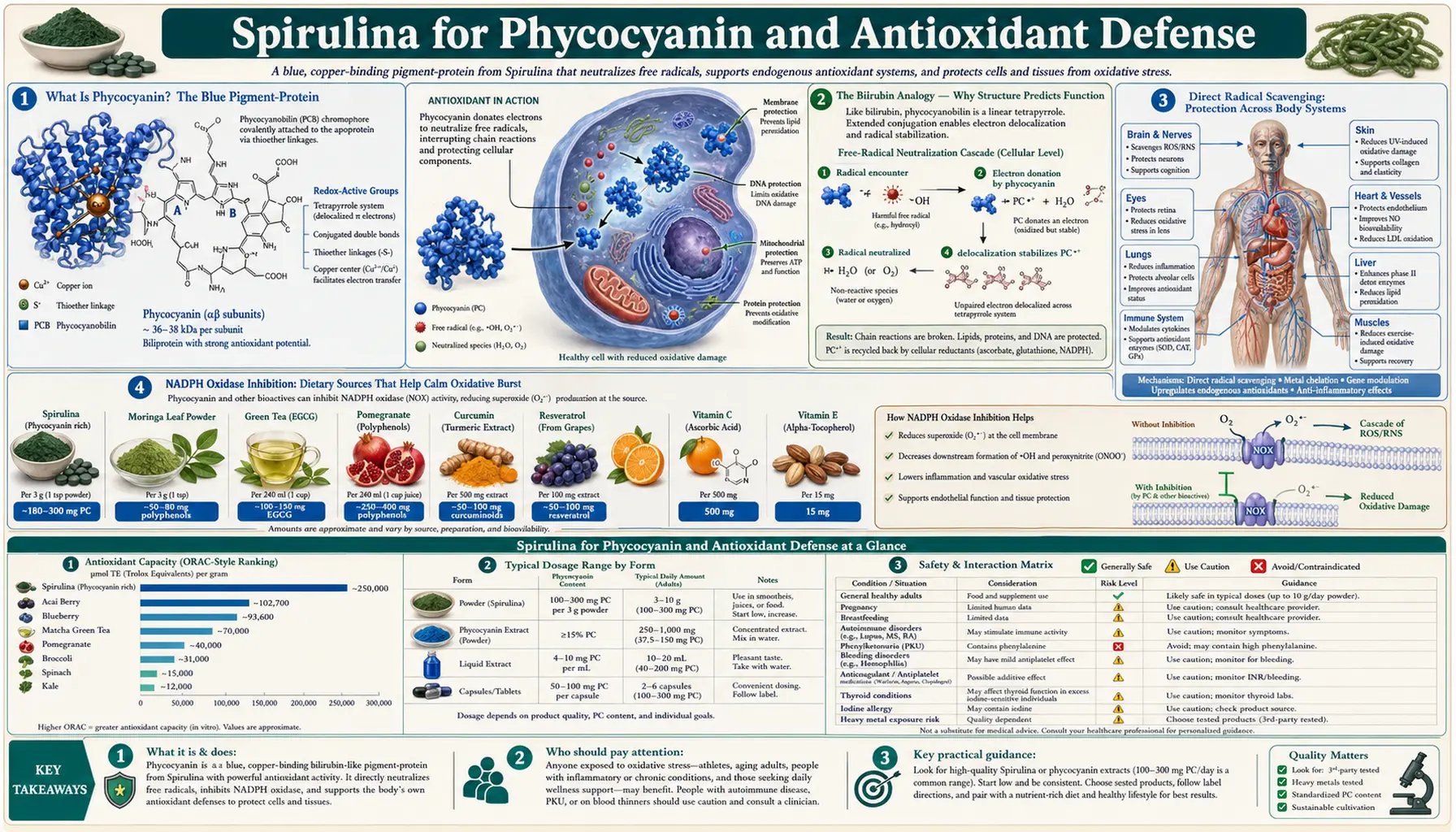
Phycocyanin (C-PC) is the molecule that makes Spirulina blue, and the molecule that does most of the clinically interesting work. Comprising up to 20% of Spirulina's dry weight, C-phycocyanin is a 250 kDa biliprotein in which an open-chain tetrapyrrole chromophore — phycocyanobilin — is covalently bound to the apoprotein. The chromophore is structurally analogous to bilirubin, the body's most potent endogenous antioxidant. C-PC scavenges peroxyl, hydroxyl, and peroxynitrite radicals; inhibits reduced nicotinamide adenine dinucleotide phosphate (NADPH) oxidase (the primary cellular generator of reactive oxygen species); induces the cytoprotective transcription factor Nrf2 with downstream heme oxygenase-1 (HO-1) expression; suppresses NF-kappaB-driven inflammation; and selectively inhibits cyclooxygenase-2 (COX-2) with minimal cyclooxygenase-1 (COX-1) effect. The result is a single molecule that simultaneously addresses the four major axes of oxidative-inflammatory disease — reactive oxygen species (ROS) generation, reactive oxygen species scavenging, cytokine production, and inducible-enzyme inflammation.
Table of Contents
- Phycocyanin: The Blue Pigment-Protein
- The Bilirubin Analogy — Why Structure Predicts Function
- Direct Radical Scavenging
- Reduced Nicotinamide Adenine Dinucleotide Phosphate Oxidase Inhibition
- Nrf2 / HO-1 Pathway Induction
- NF-kappaB Suppression and Cytokine Modulation
- Hepatoprotection in Toxin Models
- Neuroprotection and the Blood-Brain Barrier
- Dose, Bioavailability, and Clinical Application
- Cautions and Limitations
- Key Research Papers
- Connections
- Featured Videos
Phycocyanin: The Blue Pigment-Protein
Phycocyanin is a member of the phycobiliprotein family — the light-harvesting pigment-proteins that cyanobacteria and red algae use to absorb light wavelengths that chlorophyll cannot capture efficiently. In Spirulina, C-phycocyanin is the dominant phycobiliprotein, accounting for 60-70% of the cell's total soluble protein and up to 20% of total dry weight.
The functional active site is not the protein scaffold itself but rather the prosthetic group — phycocyanobilin, an open-chain (linear) tetrapyrrole chromophore covalently attached to the apoprotein via thioether bonds at conserved cysteine residues. The phycocyanobilin chromophore is what absorbs photons at ~620 nm, what gives Spirulina its characteristic deep blue color, and what does the antioxidant chemistry.
Structurally, the four functional units that explain phycocyanin's biology are:
- Phycocyanobilin chromophore — the open-chain tetrapyrrole, structurally and electronically analogous to bilirubin and biliverdin
- Hexameric quaternary structure — alpha and beta subunits assemble into trimers and then hexamers, organized in vivo into stacked rod-shaped phycobilisomes on the thylakoid membrane
- Thermolabile chromophore-apoprotein bond — heating Spirulina above ~60 °C denatures the protein and breaks the chromophore from the active conformation, destroying most antioxidant activity (why Spirulina supplements are typically freeze-dried or low-temperature dried, not roasted)
- Water solubility — phycocyanin is highly water-soluble, in contrast to the lipophilic carotenoid antioxidants (beta-carotene, lycopene). This means it acts in the aqueous compartments of cells — cytosol, blood plasma, extracellular fluid — rather than within membranes.
The aqueous-phase localization is biologically important. Most well-known antioxidants — vitamin E, beta-carotene, coenzyme Q10 — are lipid-soluble and act within membranes and lipoproteins. Phycocyanin fills a complementary niche: scavenging radicals in the watery compartments where vitamin C also operates. Together with vitamin C, phycocyanin contributes to the body's aqueous-phase antioxidant capacity.
The Bilirubin Analogy — Why Structure Predicts Function
The key insight that organizes everything else about phycocyanin biology is its structural relationship to bilirubin. Bilirubin is the open-chain tetrapyrrole product of heme catabolism. For most of medical history it was viewed simply as a waste product to be excreted via bile, and elevated serum bilirubin in adults was synonymous with hepatic or hemolytic disease. The biochemist Roland Stocker overturned this in 1987 with the discovery that bilirubin is, gram for gram, one of the most potent endogenous antioxidants in human plasma — potentially explaining the long-observed inverse correlation between mildly elevated bilirubin (Gilbert syndrome) and reduced rates of cardiovascular disease.
Phycocyanobilin and bilirubin share the same fundamental open-chain tetrapyrrole architecture and therefore share the same antioxidant chemistry. Both:
- Scavenge peroxyl (ROO·) and hydroxyl (·OH) radicals at near-diffusion-limited rates
- Inhibit lipid peroxidation chain reactions
- Quench peroxynitrite (ONOO-) generated from superoxide and nitric oxide
- Inhibit reduced nicotinamide adenine dinucleotide phosphate oxidase, the source of cellular reactive oxygen species in neutrophils, macrophages, and vascular cells
The clinical implication: oral phycocyanin can be thought of as a supplementary source of "bilirubin-like" antioxidant activity, providing the protective chemistry of mildly elevated bilirubin without requiring (or producing) the actual hyperbilirubinemia.
Direct Radical Scavenging
In vitro radical-scavenging assays consistently rank phycocyanin among the most potent natural antioxidants tested. In laboratory (test-tube) studies:
- C-PC was a potent peroxyl radical scavenger with an IC50 (the concentration that gives half the maximum effect) of 5.0 micromolar; the rate-constant ratios measured for phycocyanin and for uric acid, a known peroxyl radical scavenger, were 1.54 and 3.5 (Bhat and Madyastha, 2000, laboratory study)
- Phycocyanin scavenged hydroxyl radicals (IC50 = 0.91 mg/mL) and alkoxyl radicals (IC50 = 76 µg/mL) (Romay and colleagues, 1998, laboratory study)
- Native C-PC inhibited peroxyl-radical-induced lipid peroxidation in rat liver microsomes with an IC50 of 11.35 micromolar (Bhat and Madyastha, 2000); in the Fe(2+)/ascorbic-acid-induced liver microsomal lipid peroxidation test, Romay and colleagues (1998) reported an IC50 of 12 mg/mL (both laboratory studies)
- C-PC quenches peroxynitrite at rate constants comparable to glutathione, the body's primary endogenous peroxynitrite scavenger; in a test-tube assay, phycocyanin was a more efficient peroxynitrite scavenger than its free chromophore phycocyanobilin (Bhat and Madyastha, 2001)
The kinetics matter because the body produces a continuous low-grade flux of reactive oxygen species as a normal byproduct of mitochondrial respiration, plus acute bursts during exercise, immune activation, and exposure to environmental toxins. The antioxidant defense system — superoxide dismutase, catalase, glutathione peroxidase, glutathione, vitamin C, vitamin E, urate, bilirubin — works in concert to neutralize these reactive species before they damage lipids, proteins, or DNA. Phycocyanin contributes by handling the aqueous-phase radical chemistry, particularly in vascular endothelium and inflammatory sites where reduced nicotinamide adenine dinucleotide phosphate oxidase activity generates a high local reactive oxygen species burden.
Reduced Nicotinamide Adenine Dinucleotide Phosphate Oxidase Inhibition
Direct radical scavenging is only half the antioxidant story. The other half is reducing radical production at the source. The dominant source of pathological reactive oxygen species in cells is the reduced nicotinamide adenine dinucleotide phosphate oxidase enzyme family (NOX1, NOX2, NOX3, NOX4, NOX5, DUOX1, DUOX2), which deliberately generates superoxide as a signaling molecule. In neutrophils and macrophages, NOX2 is essential for the respiratory burst that kills phagocytosed microbes. In vascular endothelial cells and smooth muscle, NOX1, NOX4, and NOX5 generate the reactive oxygen species signal that drives atherogenesis, hypertensive vascular remodeling, and diabetic vascular dysfunction.
The chromophore phycocyanobilin (PCB) has been found to be a potent inhibitor of reduced nicotinamide adenine dinucleotide phosphate oxidase. In a 2007 review, Mark McCarty proposed — as a hypothesis built on cell and rodent work, not a tested mechanism — that this is likely because in mammalian cells PCB is rapidly reduced to phycocyanorubin, a close homolog of bilirubin, and free bilirubin functions physiologically as a potent inhibitor of reduced nicotinamide adenine dinucleotide phosphate oxidase activity.
McCarty estimated that a heaping tablespoon (about 15 g) of Spirulina provides about 100 mg of PCB. Extrapolating from rodent studies, he concluded that 2 heaping tablespoons daily would be likely to have important antioxidant activity in humans — “assuming that humans and rodents digest and absorb Spirulina-bound PCB in a comparable manner” — and called for such a regimen to be evaluated in clinical syndromes in part driven by reduced nicotinamide adenine dinucleotide phosphate oxidase overactivity. The estimate is his extrapolation, not a trial result.
The clinical implication is broad: any disease driven by chronic NOX-derived oxidative stress would, in principle, be expected to respond to Spirulina. The list includes atherosclerosis, hypertension, diabetic complications, chronic kidney disease, certain neurodegenerative diseases, and likely some forms of chronic inflammatory bowel disease. Animal-model and small-clinical evidence supports each of these, though the trial base is thinnest in the cardiovascular indications outside of pure lipid effects.
Nrf2 / HO-1 Pathway Induction
Phycocyanin not only scavenges existing reactive oxygen species but also up-regulates the cell's own intrinsic antioxidant defense system through the Nrf2 transcription factor pathway. Nrf2 (nuclear factor erythroid 2-related factor 2) is the master regulator of the cellular cytoprotective response — when activated, it translocates to the nucleus and binds antioxidant response elements (AREs) in the promoters of more than 200 cytoprotective genes, including:
- Heme oxygenase-1 (HO-1) — degrades pro-oxidant heme and releases bilirubin, the body's endogenous antioxidant
- NAD(P)H quinone dehydrogenase 1 (NQO1, also called NAD(P)H quinone oxidoreductase 1; NAD(P)H is reduced nicotinamide adenine dinucleotide (phosphate)) — detoxifies quinones
- Glutamate-cysteine ligase (GCLC, GCLM) — rate-limiting enzymes for glutathione synthesis
- Glutathione S-transferases — phase II detoxification enzymes
- Superoxide dismutase, catalase, and thioredoxin
By inducing Nrf2 activation, phycocyanin provides not just acute radical scavenging but durable amplification of the cell's own antioxidant capacity. The Nrf2 induction is thought to underlie the protective effects observed in liver-toxicity models (acetaminophen, CCl4) and in chemotherapy-nephrotoxicity models (cisplatin), where the protective effect persists for hours after the phycocyanin would have been cleared from the bloodstream.
For more on the broader Nrf2 pathway and the dietary compounds that activate it, see the Sulforaphane page (broccoli-derived isothiocyanate, the most-studied dietary Nrf2 activator).
NF-kappaB Suppression and Cytokine Modulation
Oxidative stress and inflammation are biochemically inseparable — reactive oxygen species activate the NF-kappaB transcription factor, NF-kappaB drives transcription of pro-inflammatory cytokines (tumor necrosis factor-alpha, interleukin-1beta, interleukin-6, interleukin-8) and inducible enzymes (inducible nitric oxide synthase, cyclooxygenase-2), and these cytokines and enzymes drive further reactive oxygen species production. The result is a self-amplifying loop that underlies chronic low-grade inflammation in aging, metabolic syndrome, atherosclerosis, and chronic inflammatory disease.
Phycocyanin breaks this loop at multiple points. By scavenging the reactive oxygen species that activate NF-kappaB, by inhibiting reduced nicotinamide adenine dinucleotide phosphate oxidase, and through direct interference with NF-kappaB nuclear translocation, phycocyanin downregulates pro-inflammatory cytokine production. In addition, in laboratory tests (isolated-enzyme and human whole-blood assays), phycocyanin selectively inhibited cyclooxygenase-2 (COX-2) while leaving constitutive cyclooxygenase-1 largely intact (IC50 COX-2/IC50 COX-1 ratio 0.04) — a profile similar to selective cyclooxygenase-2 inhibitor drugs (the coxibs). The same study found that reduced phycocyanin and phycocyanobilin, the chromophore, are poor inhibitors of COX-2 without COX-2 selectivity, suggesting that the apoprotein (the protein part of phycocyanin) plays a key role in the selective inhibition.
The clinical translation is most visible in two contexts: vascular endothelial function in atherosclerosis and Th2-driven allergic inflammation, both of which are sensitive to the NF-kappaB and cytokine modulation produced by Spirulina supplementation.
Hepatoprotection in Toxin Models
The liver is the primary site of xenobiotic metabolism and a constant battleground between reactive metabolites (from drugs, alcohol, environmental toxins) and the hepatic antioxidant defense system. Spirulina and pure phycocyanin show consistent hepatoprotective effects in animal models of:
- Acetaminophen toxicity — Spirulina pretreatment reduces alanine aminotransferase (ALT)/aspartate aminotransferase (AST) elevation, hepatic necrosis, and glutathione depletion induced by toxic acetaminophen doses, comparable to N-acetylcysteine (the standard clinical antidote)
- Carbon tetrachloride (CCl4) — the classic model of free-radical-driven hepatic necrosis; Spirulina reduces lipid peroxidation, histological damage, and serum transaminase elevation
- Alcoholic liver injury — both acute binge-alcohol and chronic-ethanol models show reduced steatosis and inflammation with Spirulina pretreatment
- Aflatoxin B1 — Spirulina reduces the genotoxic and hepatocarcinogenic effects of this common food-contamination mycotoxin
- Heavy metals (lead, mercury, cadmium) — Spirulina chelates and reduces hepatic accumulation, and the phycocyanin protects against the heavy-metal-induced oxidative damage
The mechanism integrates everything covered above — direct radical scavenging, reduced nicotinamide adenine dinucleotide phosphate oxidase inhibition, Nrf2 induction, and NF-kappaB suppression all converge on the hepatocyte protection observed in these models. Human clinical evidence is more limited. In a randomized, placebo-controlled trial in Bangladesh (Misbahuddin and colleagues, 2006), 41 patients with chronic arsenic poisoning, each supplied with arsenic-safe filtered drinking water, took either placebo (17 patients) or spirulina extract (250 mg) plus zinc (2 mg) (24 patients) twice daily for 16 weeks. Spirulina extract plus zinc sharply increased urinary arsenic excretion at 4 weeks, removed 47.1% of arsenic from scalp hair, and improved melanosis and keratosis skin scores within the treated group. The trial measured skin lesions and arsenic in urine and hair; it did not measure the liver.
Neuroprotection and the Blood-Brain Barrier
The brain is uniquely vulnerable to oxidative stress — it consumes ~20% of the body's oxygen budget despite being only 2% of body weight, has high concentrations of oxidation-prone polyunsaturated fatty acids in neuronal membranes, contains iron-rich regions (substantia nigra), and has relatively modest enzymatic antioxidant capacity. Almost every neurodegenerative disease — Parkinson, Alzheimer, amyotrophic lateral sclerosis (ALS), multiple sclerosis, Huntington — has oxidative stress as a documented contributor.
Phycocyanin's small chromophore phycocyanobilin can cross the blood-brain barrier (the intact phycocyanin protein cannot, but the chromophore released by digestion can). In animal models of cerebral ischemia-reperfusion, parkinsonism induced by the nerve toxin 1-methyl-4-phenyl-1,2,3,6-tetrahydropyridine (MPTP), and beta-amyloid neurotoxicity, Spirulina pretreatment reduces neuronal death, behavioral deficits, and neuroinflammation. Mechanistically, the same reduced nicotinamide adenine dinucleotide phosphate oxidase inhibition and Nrf2 induction discussed above apply in brain tissue, plus a specific suppression of microglial activation that addresses the neuroinflammatory component of chronic neurodegeneration.
Human clinical trials in neurological disease are limited but growing. In a randomized, double-blind, placebo-controlled trial in Korea (Choi and colleagues, 2022), 80 older volunteers with mild cognitive impairment took either 1 g/day of a Spirulina maxima ethanol extract or a placebo for 12 weeks; the treatment group showed a significant improvement in visual learning and visual working memory test results compared with placebo. The mechanistic case is strong; rigorous trial data remain to be generated.
Dose, Bioavailability, and Clinical Application
Standardized C-phycocyanin extracts are available, but most clinical evidence comes from whole-Spirulina supplements containing the native pigment-protein matrix. Doses and forms used in the research and in the commercial market:
- Whole Spirulina doses studied for antioxidant effect: 3-6 g/day of dried powder (typically supplying 0.5-1.2 g of C-phycocyanin), divided across one or two doses with meals
- Concentrated C-phycocyanin extracts: typically 100-200 mg twice daily of standardized extract (often 70% or higher C-PC by weight)
- Form: powder (least expensive, most flexible dosing, supports mixing into smoothies or yogurt), capsule (most convenient), tablet (compressed powder), or liquid extract
- Timing: commonly taken with meals, which is reported to support iron absorption and reduce gastrointestinal discomfort; the antioxidant effect is essentially continuous given the elimination kinetics
- Heat sensitivity: sustained temperatures above ~60 °C denature phycocyanin, so adding Spirulina to hot beverages or cooked foods destroys much of its antioxidant activity; in cool smoothies, room-temperature water, or yogurt the pigment-protein stays intact.
- Source quality: contamination findings differ by production method — Spirulina grown under controlled cultivation (large commercial spirulina farms in the United States and Europe) is tested for microcystin and heavy metals to specified detection limits. Spirulina blends with AFA (Aphanizomenon flos-aquae) carry a higher reported microcystin contamination risk.
Bioavailability of C-phycocyanin itself is limited — the intact 250 kDa protein is largely digested in the gut. The biologically relevant absorbable fraction is the released phycocyanobilin chromophore plus peptide-bound chromophore fragments. Recent reformulation work has explored stabilized phycocyanobilin to improve bioavailability, but whole Spirulina remains the clinically validated form.
What human trials show so far: a 2021 meta-analysis of 11 controlled clinical trials with 465 participants (Mohiti and colleagues) found that spirulina had no significant effect on tumour necrosis factor-alpha or on malondialdehyde (MDA), a marker of oxidative damage to fats, and only marginal decreases in interleukin-6 and in thiobarbituric acid reactive substances (TBARS), another lipid-damage marker. A significant rise in interleukin-2 became non-significant in sensitivity analysis. In subgroup analysis, interleukin-6 and TBARS fell significantly when participants' baseline body mass index was below 25 kg/m2. The strong laboratory antioxidant results have not yet shown up as clear changes in these markers in people.
Cautions and Limitations
- Heavy metal contamination — Spirulina readily accumulates lead, mercury, cadmium, and arsenic from contaminated growing water. Some producers publish heavy-metal test results; contamination levels vary between sources.
- Microcystin contamination — microcystins are hepatotoxic peptides produced by other cyanobacteria (notably Microcystis) that can contaminate Spirulina cultures, particularly from open-water harvests. Controlled raceway cultivation with documented microcystin testing below 1 µg/g is the standard cited for limiting this risk.
- Phenylketonuria (PKU) — Spirulina is high in phenylalanine and is contraindicated in PKU patients on dietary phenylalanine restriction.
- Autoimmune disease — theoretical caution due to Spirulina's immune-stimulating polysaccharides (such as calcium-spirulan) that could potentially worsen Th1-driven autoimmune disease (multiple sclerosis, lupus, rheumatoid arthritis). Clinical evidence is mixed and largely reassuring, but the theoretical concern applies most to people with active autoimmune disease; decisions about supplements belong with a clinician.
- Pseudovitamin B12 — Spirulina contains analogues of B12 (cobalamin) that are not bioavailable to humans and can interfere with true B12 measurement assays. Spirulina is not a reliable vegan B12 source despite frequent marketing claims to the contrary.
- Drug interactions — theoretical anti-platelet effect could potentiate anticoagulants (warfarin, direct oral anticoagulants, aspirin); the immune-modulating effect may interact with immunosuppressants (cyclosporine, tacrolimus) and biologic immune-modulators.
- Pregnancy and breastfeeding — insufficient safety data for high-dose supplementation; modest amounts as part of normal diet are generally considered safe, but there is no good safety data on supplementation at therapeutic doses.
- Gastrointestinal tolerance — some people develop nausea, bloating, or temporary loose stools starting Spirulina. A commonly described approach is starting at 1 g/day and increasing by 1 g/day every 3-4 days, which brings out the personal tolerance ceiling.
Key Research Papers
- Romay C, Gonzalez R, Ledon N, Remirez D, Rimbau V (2003). C-phycocyanin: a biliprotein with antioxidant, anti-inflammatory and neuroprotective effects. Current Protein and Peptide Science. — PubMed PMID: 12769719
- Bhat VB, Madyastha KM (2000). C-phycocyanin: a potent peroxyl radical scavenger in vivo and in vitro. Biochemical and Biophysical Research Communications. — PubMed PMID: 10944434
- Romay C et al. (1998). Antioxidant and anti-inflammatory properties of C-phycocyanin from blue-green algae. Inflammation Research. — PubMed PMID: 9495584
- McCarty MF (2011). Clinical potential of phycocyanobilin for induction of T regulatory cells in the management of inflammatory disorders. Medical Hypotheses. 2011;77(6):1031-1033. — PubMed PMID: 21917385
- McCarty MF (2007). Clinical potential of Spirulina as a source of phycocyanobilin. Journal of Medicinal Food. 2007;10(4):566-570. — PubMed PMID: 18158824
- Reddy CM et al. Selective inhibition of cyclooxygenase-2 by C-phycocyanin, a biliprotein from Spirulina platensis. Biochemical and Biophysical Research Communications. — PubMed PMID: 11062000
- Bhat VB, Madyastha KM. Scavenging of peroxynitrite by phycocyanin and phycocyanobilin from Spirulina platensis: protection against oxidative damage to DNA. BBRC. — PubMed PMID: 11444835
- Mohiti S, Zarezadeh M, Naeini F, Tutunchi H, Ostadrahimi A, Ghoreishi Z, Ebrahimi Mamaghani M (2021). Spirulina supplementation and oxidative stress and pro-inflammatory biomarkers: a systematic review and meta-analysis of controlled clinical trials. Clinical and Experimental Pharmacology and Physiology. 2021;48(8):1059-1069. — PubMed PMID: 33908048
- Rimbau V et al. Protective effects of C-phycocyanin against kainic acid-induced neuronal damage in rat hippocampus. Neuroscience Letters. — PubMed PMID: 10624795
- Pentón-Rol G et al. C-phycocyanin ameliorates experimental autoimmune encephalomyelitis and induces regulatory T cells. International Immunopharmacology. — PubMed PMID: 20971186
- Misbahuddin M et al. Efficacy of Spirulina extract plus zinc in patients with chronic arsenic poisoning: a randomized placebo-controlled study. Clinical Toxicology. — PubMed PMID: 16615668
- Wu Q, Liu L, Miron A, Klímová B, Wan D, Kuča K (2016). The antioxidant, immunomodulatory, and anti-inflammatory activities of Spirulina: an overview. Archives of Toxicology. 2016;90(8):1817-1840. — PubMed PMID: 27259333
- Choi WY, Lee WK, Kim TH, Ryu YK, Park A, Lee YJ, Heo SJ, Oh C, Chung YC, Kang DH (2022). The effects of Spirulina maxima extract on memory improvement in those with mild cognitive impairment: a randomized, double-blind, placebo-controlled clinical trial. Nutrients. 2022;14(18):3714. — PubMed PMID: 36145090