⚠ Evidence warning: Clinical trials or other evidence do not support the claim that spirulina reliably extends endurance, speeds recovery, prevents post-exercise infections and repletes iron in athletes. This page keeps it as a report of what people, websites or other media say.
Spirulina for Athletic Performance and Recovery
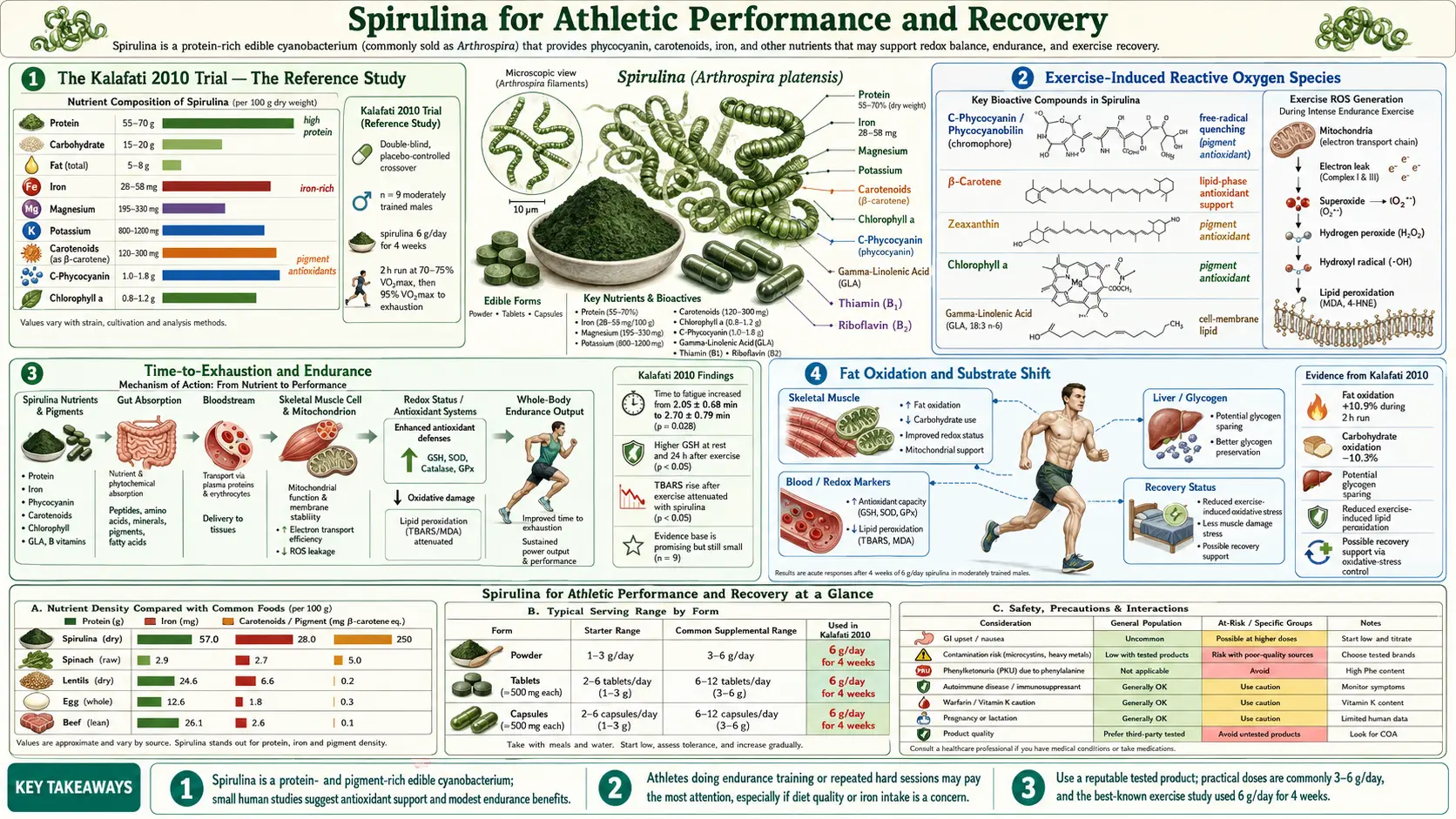
Spirulina occupies an unusual niche in sports nutrition. It is not a stimulant (no caffeine analogues), not an anabolic compound (no androgens or growth-factor agonists), and not a high-dose protein source (the daily dose contributes only 3-4 grams of protein, less than a single egg). Yet some trials in trained athletes report that it extends time-to-exhaustion, reduces post-exercise oxidative damage, and shifts substrate utilization toward fat oxidation, while other trials found no performance benefit. The mechanism most often proposed is antioxidant. Intense exercise generates a substantial flux of mitochondrial reactive oxygen species (ROS) that exceeds the muscle's endogenous antioxidant capacity, producing lipid peroxidation, muscle-membrane damage, and inflammatory cytokine release that limits performance and slows recovery. Phycocyanin and Spirulina's carotenoids are proposed to buffer this reactive oxygen species load, allowing trained athletes to sustain harder efforts for longer and recover faster.
Table of Contents
- The Kalafati 2010 Trial — The Reference Study
- Exercise-Induced Reactive Oxygen Species
- Time-to-Exhaustion and Endurance
- Fat Oxidation and Substrate Shift
- Muscle Damage Markers (Creatine Kinase, LDH, MDA)
- Iron Status and Female Athletes
- Post-Exercise Immune Suppression
- Dosing Patterns Described for Athletes
- Comparison with Other Ergogenic Aids
- Cautions for Competitive Athletes
- Key Research Papers
- Connections
- Featured Videos
The Kalafati 2010 Trial — The Reference Study
The single trial most often cited for Spirulina's ergogenic effect is Kalafati et al., published in Medicine and Science in Sports and Exercise in 2010. The design was a double-blind, placebo-controlled, crossover trial in nine moderately-trained male recreational runners. Each subject completed two arms separated by a washout period: 4 weeks of 6 g/day Spirulina, and 4 weeks of placebo. Each subject ran on a treadmill at 70–75% of individual VO2-max for 2 hours and then at 95% VO2-max until exhaustion. Blood samples, taken before, immediately after, and 1, 24 and 48 hours after exercise, were tested for reduced glutathione (GSH), oxidized glutathione (GSSG), the GSH/GSSG ratio, lipid peroxidation (thiobarbituric acid reactive substances, TBARS), protein carbonyls, catalase activity and total antioxidant capacity.
The Spirulina arm showed:
- Time to fatigue after the 2-hour run was significantly longer after spirulina than after placebo (the abstract gives the two times as 2.05 ± 0.68 vs 2.70 ± 0.79 minutes)
- Rate of fat oxidation increased by 10.9% during the 2-hour run compared with placebo (from the respiratory quotient)
- Carbohydrate oxidation rate decreased by 10.3%
- Reduced glutathione (GSH) levels were higher than with placebo at rest and 24 hours after exercise
- Lipid peroxidation (TBARS) rose after exercise with placebo but not with spirulina
- Protein carbonyls, catalase and total antioxidant capacity rose to a similar degree immediately after and 1 hour after exercise in both conditions
The Kalafati performance result was a short run to exhaustion at 95% VO2-max after 2 hours of steady running, in nine men. Later research has not consistently reproduced it. A 2022 systematic review of 13 studies (Calella and colleagues) concluded that “overall evidence regarding the benefit of spirulina supplementation in healthy people engaged in physical exercise is scarce and not consistent” and that spirulina “does not seem to enhance physical performance in power athletes”. A 2024 crossover trial in 17 recreationally active people (Ali and colleagues) found no performance benefit from 6 g/day for 14 days (details below).
Exercise-Induced Reactive Oxygen Species
The mechanistic foundation of Spirulina's ergogenic effect is the relationship between mitochondrial reactive oxygen species production and exercise fatigue. During intense exercise, the mitochondrial electron transport chain runs at near-maximum throughput, with proton pumping at complexes I, III, and IV driving adenosine triphosphate (ATP) synthesis at complex V (adenosine triphosphate synthase). At this high throughput, electron leakage from complex I and complex III to molecular oxygen produces superoxide (O2-) at rates roughly proportional to oxygen consumption.
Skeletal muscle has substantial endogenous antioxidant defenses — superoxide dismutase 2 (SOD2, MnSOD) inside mitochondria, glutathione peroxidase, catalase, and a large pool of reduced glutathione. At rest and during moderate exercise, these defenses easily handle the mitochondrial reactive oxygen species flux, and the small residual reactive oxygen species signal actually serves useful purposes (mitochondrial biogenesis signaling via PGC-1alpha, AMP-activated protein kinase (AMPK) activation, glucose transporter translocation).
At high exercise intensities (above ~80% VO2-max), the reactive oxygen species flux exceeds the antioxidant defense capacity and damage begins to accumulate. Lipid peroxidation in muscle membranes disrupts ion channels and excitation-contraction coupling. Protein carbonylation damages contractile proteins and metabolic enzymes. DNA damage triggers inflammatory signaling that further amplifies reactive oxygen species production. The net result is contractile dysfunction that contributes to the sensation of fatigue and the actual decline in force production that ends the exercise bout.
Phycocyanin and Spirulina's carotenoids add to the antioxidant defense capacity, extending the intensity-duration combination that the muscle can sustain before damage forces exercise termination. This is the proposed molecular basis for the time-to-exhaustion increase.
What is not known. A 2022 review of spirulina and chlorella in exercise (Gurney and Spendiff) notes that the early trials focused on the antioxidant capabilities of the algae, but that “a number of oxidative stress biomarkers reported in these studies are now considered to lack robustness and have consequently provided equivocal results”. The same review says that a confirmed primary mechanism behind the reported improvements “is still unclear”. A 2008 review of exercise and oxidative stress (Powers and Jackson) describes both sides: low, normal levels of reactive oxygen species are required for normal force production in muscle, while high levels promote contractile dysfunction resulting in muscle weakness and fatigue.
Time-to-Exhaustion and Endurance
The classic ergogenic-aid endpoint is time-to-exhaustion at a fixed submaximal workload — how long can the athlete sustain a given intensity before being forced to stop. This endpoint is sensitive to both metabolic and antioxidant interventions. Trial results for Spirulina on this endpoint are mixed.
Beyond the Kalafati finding, the evidence includes:
- Lu et al. (2006) in 16 untrained students: 3 weeks of 7.5 g/day Spirulina significantly extended time to exhaustion on an incremental (Bruce protocol) treadmill test and lowered blood malondialdehyde, a lipid peroxidation marker; the comparison group took soy protein
- Sandhu et al. (2010) in 40 trained and untrained volunteers: 8 weeks of 2 g/day Spirulina, tested with isometric (held) contractions of the thigh (quadriceps) muscles; according to the 2022 systematic review, it was effective in increasing peak isometric muscle strength and average force and in reducing fatigue, similarly in trained and untrained volunteers
- Ali et al. (2024), a double-blind randomized crossover trial in 17 recreationally active people: 6 g/day for 14 days raised hemoglobin by 3.4% (150.4 vs 145.6 g/L) compared with placebo, but there were no significant differences in VO2-max, maximal power output, time to fatigue, heart rate, oxygen uptake, respiratory exchange ratio or blood lactate
- Anaerobic and sprint tests give mixed results. The 2022 systematic review reports that spirulina “does not seem to enhance physical performance in power athletes”. In a 2022 double-blind randomized crossover trial in 15 trained male cyclists (Gurney and colleagues), however, 6 g/day for 21 days lowered heart rate (139 vs 144 bpm) and blood lactate (2.05 vs 2.39 mmol/L) during a 1-hour submaximal ride, raised hemoglobin (152.6 vs 143.2 g/L), and raised peak power (968 vs 929 W) and average power (770 vs 738 W) in repeated sprint tests, with no difference in oxygen consumption or in a 16.1-km time trial
A 2026 meta-analysis of 22 randomized controlled trials (822 people) of algae supplements — Spirulina, Chlorella, brown-algal polysaccharides and astaxanthin — found a significant improvement in time to exhaustion (standardized mean difference, SMD = 1.06, 95% CI 0.16 to 1.96), a smaller effect on maximal power output (SMD = 0.29), a suggestive improvement in VO2-max (SMD = 0.88, 95% CI 0.00 to 1.75), and no significant benefit for time-trial performance (SMD = −0.27). Subgroup analysis suggested greater effects for Chlorella, higher dosages and aerobic training. The authors concluded that algae supplements, “particularly Spirulina and Chlorella”, “may modestly enhance aerobic exercise performance and attenuate exercise-induced muscle damage under certain conditions”, and that high-quality, multi-center trials are needed.
The dose-response curve appears to plateau above approximately 6 g/day — trials at 8-10 g/day do not consistently show larger effects than 6 g/day. The duration of supplementation matters: trials of 2 weeks or less show smaller or absent effects, while 4-6 weeks of consistent supplementation appears to be required for full benefit. This is consistent with the Nrf2-induced upregulation of endogenous antioxidant systems being part of the mechanism, which would require weeks of consistent exposure to manifest.
Fat Oxidation and Substrate Shift
One of the more interesting Kalafati findings was the shift in substrate utilization — with Spirulina, the same workload was sustained with proportionally more energy coming from fat oxidation and proportionally less from carbohydrate oxidation (as measured by respiratory exchange ratio, RER). This is a metabolically advantageous shift for endurance athletes because muscle glycogen stores are limited (~400-500 g in a well-fed athlete) while fat stores are functionally unlimited.
The proposed mechanisms for the fat-oxidation shift include:
- Mitochondrial preservation — antioxidant protection prevents the oxidative damage to mitochondrial enzymes (particularly beta-oxidation enzymes and electron transport chain components) that would otherwise force a shift to less efficient glycolytic metabolism during prolonged exercise
- Improved lipid mobilization — phycocyanin's effects on adipocyte function and circulating free fatty acid availability
- Insulin sensitivity improvement — demonstrated in the diabetes-and-metabolic-syndrome trials of Spirulina, the improved insulin sensitivity may carry over to facilitate substrate selection in trained athletes as well
- GLA contribution — gamma-linolenic acid from Spirulina contributes to anti-inflammatory prostaglandin signaling that supports lipid mobilization
The practical implication for endurance athletes is glycogen sparing — the same race distance can be completed with less reliance on stored glycogen, reducing the risk of "bonking" (carbohydrate depletion) at the end of long events. This is particularly relevant for marathon running, century cycling, triathlons of Olympic-distance and longer, and ultra-endurance events.
Muscle Damage Markers (Creatine Kinase, LDH, MDA)
Exercise-induced muscle damage, particularly from eccentric or high-intensity exercise, is measured clinically by elevated serum creatine kinase (CK), lactate dehydrogenase (LDH), and lipid peroxidation markers like malondialdehyde (MDA). These markers correlate with delayed-onset muscle soreness (DOMS), reduced force-generating capacity in the days following intense exercise, and slowed recovery between training sessions.
Multiple Spirulina trials show:
- Reduced post-exercise creatine kinase elevation (typically 20-30% less than placebo)
- Reduced lactate dehydrogenase elevation
- Reduced MDA (lipid peroxidation marker) elevation
- Reduced protein carbonyl content (protein oxidation marker)
- Faster recovery of maximum voluntary contraction force in the 24-72 hour post-exercise window
Two named sources for these markers: in a 2022 double-blind trial in 17 elite male rugby union players (Chaouachi and colleagues; 9 took 5.7 g/day of Spirulina platensis and 8 took placebo), the blood markers F2-isoprostanes (lipid peroxidation), C-reactive protein (inflammation) and creatine kinase rose immediately after an exhaustive running test only in the placebo group, with no change in the spirulina group. The 2026 meta-analysis of algae supplements also found creatine kinase concentrations significantly reduced (SMD = −0.78, 95% CI −1.28 to −0.28), with reductions in muscle-damage markers more evident after resistance exercise. In the Kalafati trial, by contrast, protein carbonyls rose to a similar degree in both conditions.
The practical implication for training is reduced recovery time between hard sessions, allowing athletes to sustain higher weekly training loads. This is particularly relevant during the build phase of periodized training programs, where the goal is to apply maximum sustainable training stress while recovering well enough to absorb the adaptations.
Other recovery-related compounds are covered on the Branched-Chain Amino Acids and Tart Cherry pages.
Iron Status and Female Athletes
Iron deficiency without anemia (low ferritin, normal hemoglobin) is endemic in endurance athletes, particularly female athletes and adolescents in growth phases. The condition reduces exercise capacity even before frank anemia develops because iron is required for myoglobin (muscle oxygen transport), cytochromes (electron transport chain), and aerobic enzyme function.
Spirulina contains a meaningful amount of iron — approximately 28 mg per 100 g of dried powder, or about 1.5 mg in a typical 5 g daily dose. While this is less than typical iron supplement doses (45-65 mg of elemental iron), it has two advantages: (1) the iron in Spirulina is bound to organic molecules that improve absorption compared with inorganic ferrous sulfate, and (2) the simultaneous antioxidant content of Spirulina supports iron absorption (Spirulina is not a high-vitamin-C food: USDA FoodData Central lists 10.1 mg of vitamin C per 100 g of dried spirulina) and reduces the gastrointestinal side effects (constipation, dark stools, abdominal cramping) that limit tolerability of conventional iron supplements.
For female athletes with marginal iron status and gastrointestinal intolerance of conventional iron supplements, Spirulina at 5-10 g/day combined with vitamin C and dietary heme-iron sources has been described as one approach to repleting iron status over several months. Severe iron deficiency anemia is conventionally treated with iron supplementation (or intravenous iron in cases of malabsorption) under physician supervision.
Iron deficiency in athletes is covered further on the Iron page and the Iron Deficiency Anemia page.
Post-Exercise Immune Suppression
Prolonged or intense exercise produces a well-described "open window" of immune suppression in the 3-72 hours following the exercise bout, characterized by reduced natural killer cell function, reduced salivary immunoglobulin A (IgA), and increased susceptibility to upper respiratory tract infection (URTI). Marathoners and triathletes have measurably higher URTI rates in the week following race events than the general population.
Spirulina's immune-modulating compounds (calcium-spirulan, and a spirulina extract enriched for Braun-type lipoproteins) and direct effects on natural killer-cell function are proposed to offset some of this exercise-induced immune suppression. The claims made for spirulina in this window are:
- Preserved or enhanced natural killer-cell activity in the post-exercise window
- Preserved salivary immunoglobulin A levels post-exercise
These claims are not yet supported in athletes. The 2022 systematic review (Calella and colleagues) found that “data supporting benefits to the immune system from spirulina supplementation is still lacking”. In its words, “Only one study, carried out on rowers of the Polish Rowing Team, showed that SP could influence the immune system”: in that randomized trial (Juszkiewicz and colleagues; 1.5 g/day for 6 weeks), the placebo group had a rise after recovery in a ratio of regulatory T cells to other immune cells (natural killer cells, gamma-delta T cells and cytotoxic lymphocytes) that was absent in the spirulina group, and there was no performance (ergogenic) effect in a 2000-m rowing test.
Dosing Patterns Described for Athletes
Doses used in the trials described on this page:
- Kalafati 2010 (nine moderately trained men): 6 g/day for 4 weeks
- Lu 2006 (16 untrained students): 7.5 g/day for 3 weeks
- Sandhu 2010 (40 trained and untrained volunteers): 2 g/day for 8 weeks
- Gurney 2022 (15 trained male cyclists): 6 g/day for 21 days
- Ali 2024 (17 recreationally active people): 6 g/day for 14 days, with no performance benefit
- Chaouachi 2022 (17 elite rugby players): 5.7 g/day
- Juszkiewicz (Polish rowing team): 1.5 g/day for 6 weeks
Other patterns described in sports-nutrition writing, not tested as protocols in these trials:
- Endurance training: 4-6 g/day, divided into two doses (morning and pre-training), taken for at least 4 weeks
- High-volume training blocks: 6-8 g/day during peak training weeks, returning to 4 g/day during recovery and taper periods
- Race week: the 4-6 g/day dose kept through race week; an acute "loading dose" on race day is not supported by the research, since the trials tested weeks of intake, not a single dose
- Post-race recovery: 4 g/day during the recovery week; some athletes describe taking 6-8 g/day for the 3-5 days after a marathon or ultra
- Female athletes with marginal iron status: 5-10 g/day with 100 mg vitamin C taken with each Spirulina dose, and serum ferritin rechecked every 8-12 weeks
- Power and strength athletes: the 2022 systematic review reports that spirulina “does not seem to enhance physical performance in power athletes”
Tablets, capsules, and powder are all used. Powder, often mixed into a smoothie or yogurt, usually costs the least per gram. The taste is grassy and earthy — some athletes find it off-putting in plain water but acceptable in juice or with fruit. Tablets and capsules eliminate the taste issue at higher cost per gram.
Comparison with Other Ergogenic Aids
Spirulina occupies a different role in the ergogenic supplement landscape than the better-known performance enhancers:
- vs Caffeine: Caffeine produces larger acute performance gains (5-15% in many endurance protocols) with a single pre-exercise dose, and has stronger evidence overall. Spirulina's effects emerge over weeks of supplementation, not from a single dose. The two act on different timescales — caffeine as an acute race-day effect, Spirulina as a chronic training adaptation.
- vs Creatine: Creatine is the most evidence-supported supplement for strength and high-intensity intermittent exercise. Spirulina's benefits are in oxidative endurance, a different domain. No interaction between the two has been described.
- vs Beta-alanine: Beta-alanine increases muscle carnosine and buffering capacity for high-intensity exercise lasting 1-4 minutes. Different domain than Spirulina.
- vs Beetroot (nitrate): Beetroot juice increases nitric oxide bioavailability and reduces oxygen cost of exercise. Mechanistically distinct but functionally overlapping with Spirulina's endothelial-function effects. No conflict between the two has been described.
- vs Tart cherry: Tart cherry juice has the best evidence for reduced post-exercise inflammation and muscle damage in the 24-72 hour recovery window. Mechanistically similar to Spirulina's antioxidant effects; the two are partial substitutes.
- vs Vitamin C and E megadosing: High-dose isolated antioxidant vitamins (vitamin C > 1 g/day, vitamin E > 400 international units (IU)/day) actually blunt training adaptations in some studies, by suppressing the beneficial reactive oxygen species-signaling that drives mitochondrial biogenesis. Spirulina's polyphenolic antioxidants do not appear to produce this blunting effect, perhaps because the antioxidant action is distributed across many compounds at moderate doses rather than concentrated in a single high-dose intervention.
Cautions for Competitive Athletes
- World Anti-Doping Agency (WADA) banned substance contamination — third-party sport-testing certification programs exist to screen supplements for banned substances. The Spirulina molecule itself is not banned, but supplement manufacturing facilities can produce cross-contamination with banned substances (anabolic steroids, stimulants, beta-2 agonists) that result in failed drug tests despite the absence of any deliberate doping.
- Heavy metal contamination — particularly concerning for female athletes of reproductive age and adolescent athletes. Products vary in whether they are tested for heavy metals.
- Microcystin contamination — the hepatotoxic risk affects all populations but is especially concerning for athletes whose hepatic function is already stressed by high training loads, nonsteroidal anti-inflammatory drug (NSAID) use, or supplement polypharmacy.
- Gastrointestinal distress before competition — some athletes develop nausea or loose stools when starting Spirulina. Common sports-nutrition guidance is to establish tolerance several weeks before an important race and not to introduce a new supplement in the week before competition.
- Iron stacking caution — in athletes already taking high-dose iron supplements, Spirulina's iron adds to the total, which counts toward the tolerable upper intake level of 45 mg/day of iron.
- Phenylketonuria — absolute contraindication regardless of athletic context.
- Pregnancy in competitive athletes — therapeutic doses lack adequate safety data in pregnancy; only dietary amounts are outside that gap.
Key Research Papers
- Kalafati M et al. (2010). Ergogenic and antioxidant effects of Spirulina supplementation in humans. Medicine and Science in Sports and Exercise. — PubMed PMID: 20010119
- Lu HK et al. (2006). Preventive effects of Spirulina platensis on skeletal muscle damage under exercise-induced oxidative stress. European Journal of Applied Physiology. — PubMed PMID: 16944194
- Sandhu J, Dheera B, Shweta S (2010). Efficacy of Spirulina supplementation on isometric strength and isometric endurance of quadriceps in trained and untrained individuals – a comparative study. Ibnosina Journal of Medicine and Biomedical Sciences 2:79-86 (not PubMed-indexed). — doi:10.4103/1947-489X.210974
- Hernández-Lepe MA et al. (2019). Hypolipidemic effect of Arthrospira (Spirulina) maxima supplementation and a systematic physical exercise program in overweight and obese men: a double-blind, randomized, and crossover controlled trial. Marine Drugs 17(5):270. — PubMed PMID: 31067674
- Calella P et al. Antioxidant, anti-inflammatory and immunomodulatory effects of Spirulina in exercise and sport: a systematic review. Frontiers in Nutrition. — PubMed PMID: 36590230
- Gurney T, Spendiff O (2022). Algae supplementation for exercise performance: current perspectives and future directions for spirulina and chlorella. Frontiers in Nutrition 9:865741. — PubMed PMID: 35321288
- Gurney T, Brouner J, Spendiff O (2022). Twenty-one days of spirulina supplementation lowers heart rate during submaximal cycling and augments power output during repeated sprints in trained cyclists. Applied Physiology, Nutrition, and Metabolism 47(1):18-26. — PubMed PMID: 34399066
- Ali Y, Aubeeluck R, Gurney T (2024). Fourteen-days spirulina supplementation increases hemoglobin, but does not provide ergogenic benefit in recreationally active cyclists: a double-blinded randomized crossover trial. Journal of Dietary Supplements 21(3):261-280. — PubMed PMID: 37807529
- Chaouachi M, Gautier S, Carnot Y, Guillemot P, Pincemail J, Moison Y, Collin T, Groussard C, Vincent S (2022). Spirulina supplementation prevents exercise-induced lipid peroxidation, inflammation and skeletal muscle damage in elite rugby players. Journal of Human Nutrition and Dietetics 35(6):1151-1163. — PubMed PMID: 35394687
- Wei Y, Liu S, You T, Liu X, Zhong W, Wu Y, Azhati S, Han Q, Jiang W, Liu C (2026). The effects of seaweed and microalgae supplementation on exercise performance and recovery: a systematic review and meta-analysis. Nutrients 18(8):1289. — PubMed PMID: 42075102
- Selmi C et al. The effects of Spirulina on anemia and immune function in senior citizens. Cellular and Molecular Immunology. — PubMed PMID: 21278762
- Powers SK, Jackson MJ. Exercise-induced oxidative stress: cellular mechanisms and impact on muscle force production. Physiological Reviews (2008) 88(4):1243-76. — PubMed PMID: 18923182
- Nieman DC. Exercise immunology: nutritional countermeasures. Canadian Journal of Applied Physiology. — PubMed PMID: 11897882