Sea Moss — Benefits Deep Dive
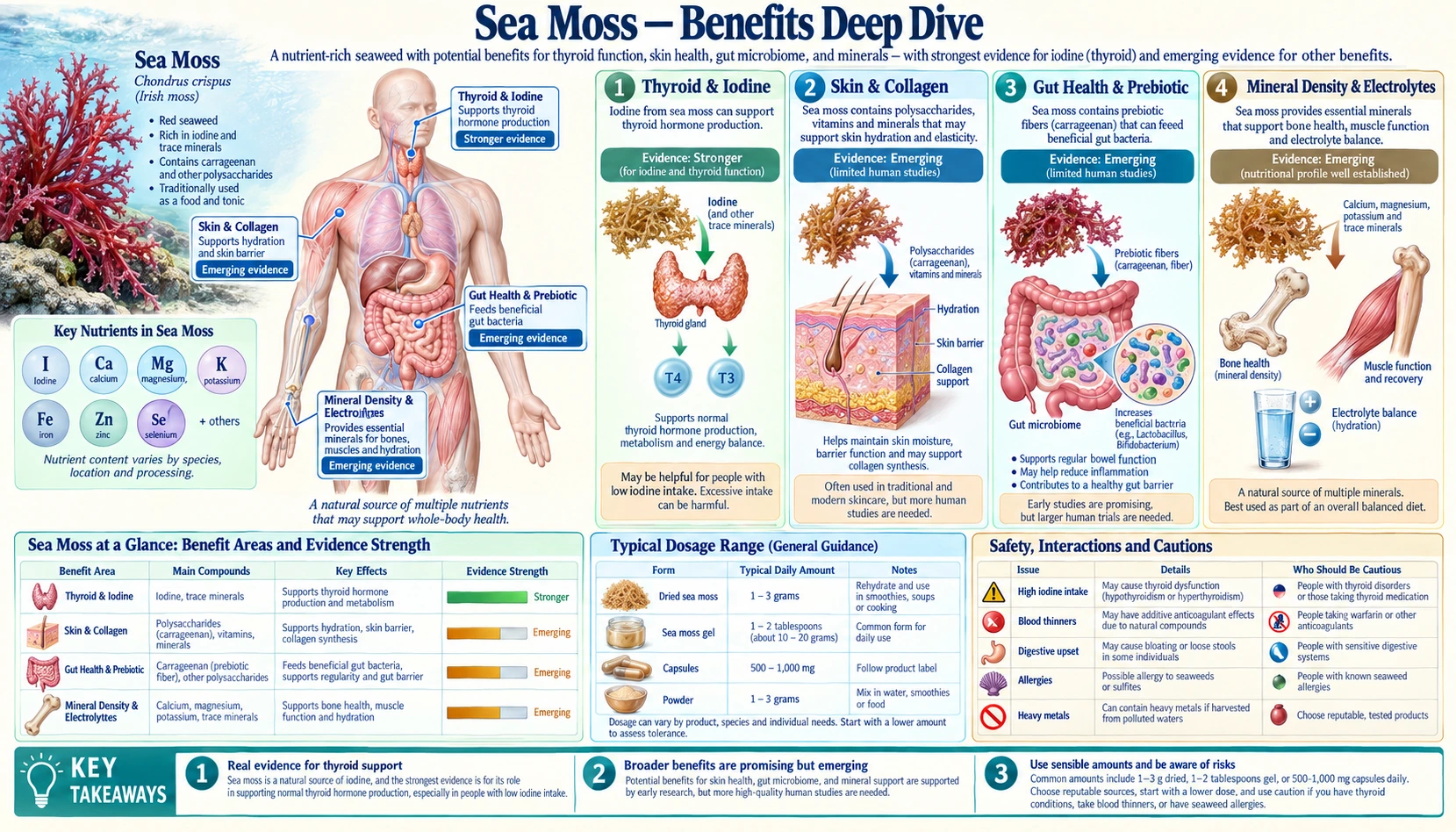
Sea moss is the name sold for several red marine algae: Chondrus crispus (true Irish moss), harvested along the rocky North Atlantic coasts of Ireland, Scotland, Iceland, and the Canadian Maritimes, and the warm-water Eucheuma cottonii and Gracilaria species behind a parallel Caribbean tradition. The modern wellness revival, which the late herbalist Alfredo "Dr. Sebi" Bowman is credited with helping popularize, spread the claim that sea moss contains "92 of the 102 minerals the human body needs." That figure is a marketing claim with no scientific basis — no scientific source documents it, and the body is not known to need 92 minerals. What laboratory analyses do report is a variable mix of minerals, including iodine, together with sulfated polysaccharides (carrageenans). Most benefits claimed for sea moss itself have no human trial behind them; the evidence consists largely of composition data, animal and cell studies, and studies of isolated carrageenan. The four pages below cover thyroid and iodine (including the research concerns for Hashimoto's thyroiditis), skin and collagen, gut health and the carrageenan debate, and the measured mineral content set apart from the marketing.
Deep-Dive Articles
Thyroid & Iodine
Iodine content in seaweeds varies enormously: a 2004 analysis of 12 commercially available species measured from 16 to more than 8,000 micrograms per gram, while a study of retail Irish moss (Chondrus crispus) found about 3.86 mg per kg dry weight — a level at which about 286 g a day would be needed to exceed the 1,100 µg adult upper limit. No human trial has tested sea moss for any thyroid outcome. The page covers iodine deficiency, the Wolff-Chaikoff and Jod-Basedow effects of iodine excess, the research concerns for Hashimoto's thyroiditis, the Japanese population data, and the thyroid and iodine tests used to assess status.
Read the deep dive →Skin & Collagen
The sulfated polysaccharides (carrageenans) that give sea moss its gel bind water, which is the basis of its use as a topical humectant in face masks. The page sets this against the popular "collagen" claim (sea moss contains no collagen), covers the minerals involved in the body's own collagen synthesis, and describes what is known about eczema, psoriasis, rosacea and UV exposure — much of it anecdotal or from studies of algal extracts rather than sea moss itself.
Read the deep dive →Gut Health & Prebiotic
The prebiotic evidence for Chondrus crispus comes from a rat study, in which a supplemented diet raised Bifidobacterium breve and fecal short-chain fatty acids; no human prebiotic trial of sea moss was found. The page also covers the traditional use of Irish moss mucilage as a demulcent for the stomach and gut, the food-grade carrageenan versus poligeenan (degraded carrageenan) distinction, the Tobacman review of animal studies and its critics, IBD findings (largely animal and cell studies), and the argument that whole sea moss differs from isolated food-additive carrageenan.
Read the deep dive →Mineral Density & Electrolytes
The "92 minerals" figure is a marketing claim with no scientific basis. The page sets it beside what USDA data and peer-reviewed analyses report — variable amounts of potassium, calcium, magnesium, sulfur and trace minerals — and compares sea moss with ordinary whole-food mineral sources. It also covers electrolytes, the heavy metals and microbes a 2026 analysis found in US sea moss products (arsenic, cobalt and mercury in dried products; bacteria including Salmonella and Escherichia species), and wild versus pool-cultivated sourcing.
Read the deep dive →Table of Contents
- Deep-Dive Articles
- Why Sea Moss Produces Effects
- Quality, Sourcing, and Heavy Metals
- Research Papers: Thyroid & Iodine
- Research Papers: Skin & Collagen
- Research Papers: Gut Health & Prebiotic
- Research Papers: Mineral Density & Electrolytes
- Research Papers: Cross-Cutting (Carrageenan, Safety, Composition)
- External Authoritative Resources
- Connections
- Featured Videos
Why Sea Moss Produces Effects
Sea moss is at once a mineral source, a fermentable fiber, a topical humectant, and an iodine source. Its reported effects are attributed to five groups of constituents; for most of them, the evidence for sea moss itself comes from composition analyses and animal or cell studies rather than human trials:
- Iodine — the thyroid mechanism — seaweeds take up iodine from seawater, and the amount varies enormously by species, origin, and processing. A 2004 analysis of 12 commercially available seaweeds measured from 16 to more than 8,000 micrograms per gram. Irish moss (Chondrus crispus) sits far below the kelps (Laminaria, Saccharina): a study of retail Irish moss found about 3.86 mg per kg dry weight, a level at which about 286 g a day would be needed to exceed the 1,100 µg adult upper limit. Iodide is the substrate for thyroid hormone synthesis; the research links too little iodine to hypothyroidism and goiter, and excess iodine to both hypothyroidism and hyperthyroidism, with particular concern for people with autoimmune thyroid disease. No human trial has tested sea moss for any thyroid outcome. The Wolff-Chaikoff and Jod-Basedow mechanisms are discussed in detail on the Thyroid and Iodine sub-article.
- Sulfated polysaccharides (carrageenans and related polymers) — the gel and the prebiotic mechanism — the gel-forming property of raw sea moss comes from the same sulfated galactans (kappa-, iota-, and lambda-carrageenan) that the food industry isolates and uses as a thickener. These polysaccharides hold water, the basis of their use as humectants on skin, and they are fermentable fiber: in a rat study, a Chondrus crispus-supplemented diet raised fecal short-chain fatty acids (acetic, propionic, and butyric acids) and Bifidobacterium breve. No human prebiotic trial of sea moss was found. The distinction between intact food-grade carrageenan and the partially degraded "poligeenan" that has drawn safety concerns in animal studies is covered on the Gut Health sub-article.
- Macro- and micromineral content — the electrolyte and structural minerals — laboratory analyses report potassium, calcium, magnesium, sulfur, and manganese as prominent, with measurable iron, zinc, and copper, in amounts that vary widely by species, harvest site, and processing. The popular "92 minerals" claim is a marketing claim with no scientific basis; the National Academies set dietary reference intakes for 15 mineral elements. See the Mineral Density sub-article for the USDA and published figures.
- Silica and zinc — minerals linked to collagen — zinc and other minerals take part in the body's own collagen synthesis, and silicon has been studied in connective tissue, but no link between the amounts in sea moss and a skin or collagen outcome in people has been established. Sea moss is not a collagen source (it contains no animal-derived collagen and no significant glycine-proline-hydroxyproline tripeptide). The skin-hydration effect that is widely attributed to "collagen" is a humectant effect of the sulfated polysaccharides — covered on the Skin and Collagen sub-article.
- Polyphenols, carotenoids, and pigments — the antioxidant mechanism — the deep red-purple color of Chondrus crispus comes from phycoerythrin, phycocyanin, and a mix of carotenoids and polyphenols. These show free-radical scavenging activity in laboratory and animal studies; whether eating sea moss produces a meaningful antioxidant effect in people has not been tested.
Taken together, the research describes sea moss as a mineral- and fiber-containing food whose iodine content raises thyroid concerns for some people. Its marketing as a cure-all goes beyond the evidence: for sea moss itself, that evidence consists mainly of composition analyses and animal and cell studies. The NIH Drugs and Lactation Database (LactMed) states that no medicinal value of sea moss has been proven. Antiviral activity of iota-carrageenan has been shown in cell and animal studies, and carrageenan nasal sprays have been tested in common-cold trials; these concern isolated carrageenan applied in the nose, not sea moss eaten as food.
Quality, Sourcing, and Heavy Metals
Three variables recur in the research and reporting on sea moss products:
- Species. True Irish moss is Chondrus crispus, harvested wild from the cold rocky North Atlantic (Ireland, Maine, Nova Scotia, Iceland). Much of what is sold as "sea moss" or "Caribbean sea moss" is Eucheuma cottonii or Gracilaria species, warm-water red algae cultivated in shallow water and on rope farms in places including St. Lucia, Jamaica, Indonesia, and the Philippines. They share sulfated polysaccharides and a broadly similar mineral profile, but iodine and contaminant levels vary by species, origin, and processing, and labels do not always state species or origin.
- Heavy metals and microbes. Marine algae bind metals from their growing water, including cadmium, arsenic, mercury, and lead. A 2026 analysis of 66 sea moss products bought from major US online retailers detected arsenic, cobalt, and mercury in dried sea moss (mercury at trace levels in gels) and identified bacteria including Bacillus, Staphylococcus, Salmonella, Cronobacter, and Escherichia species, with wide variation in water activity and pH between products; the authors called for evidence-based guidance on processing, storage, and handling. Some products carry third-party certificates of analysis for heavy metals. Related: the Heavy Metals page, the Cadmium page, and the Arsenic page.
- Color and processing. Sun-dried Chondrus crispus ranges from red and purple to brown and golden; cultivated Eucheuma is typically pale gold to creamy yellow. Uniformly white or bright-yellow product is commonly described by sellers as bleached for appearance; there is little published data on how bleaching affects the polysaccharides or leaves processing residues.
There is no established dose of sea moss; servings commonly described in popular use are one to two tablespoons of prepared gel a day. The retail Irish moss study above judged 4 g a day of the dried seaweed it analyzed not to pose an iodine risk. The research raises a concern for people with thyroid disease, including those taking thyroid medication, because excess iodine can push thyroid function either way, and LactMed notes that maternal consumption of excess iodine from seaweed has caused thyroid suppression in breastfed infants. Decisions about supplements belong with a clinician.
Research Papers: Thyroid & Iodine
- Teas J, Pino S, Critchley A, Braverman LE (2004). Variability of iodine content in common commercially available edible seaweeds. Thyroid 14(10):836–841. — PubMed PMID: 15588380
- Zava TT, Zava DT (2011). Assessment of Japanese iodine intake based on seaweed consumption in Japan: a literature-based analysis. Thyroid Research 4:14. — PubMed PMID: 21975053
- Wolff-Chaikoff effect and acute iodide-induced hypothyroidism — PubMed: Wolff-Chaikoff effect
- Jod-Basedow phenomenon and iodine-induced hyperthyroidism — PubMed: Jod-Basedow phenomenon
- Iodine excess and Hashimoto's thyroiditis autoimmune flare — PubMed: Iodine and Hashimoto's
- Darias-Rosales J, Rubio C, Gutiérrez ÁJ, Paz S, Hardisson A (2020). Risk assessment of iodine intake from the consumption of red seaweeds (Palmaria palmata and Chondrus crispus). Environmental Science and Pollution Research 27(36):45737–45741. — PubMed PMID: 32803579
- Recommended iodine intake (WHO: 150 mcg/day for adults) and the US adult tolerable upper intake level (1,100 mcg/day) — PubMed: WHO iodine UL
- Goiter prevalence and seaweed consumption: ecological data — PubMed: Goiter and seaweed
- Excess iodine from kelp / seaweed case reports of thyroid dysfunction — PubMed: Kelp case reports
- Selenium-iodine synergy in thyroid hormone deiodination — PubMed: Selenium-iodine synergy
- Urinary iodine concentration as marker of population iodine status — PubMed: Urinary iodine status
- Levothyroxine and iodine-rich food interaction (timing, T4 conversion) — PubMed: Levothyroxine interaction
Research Papers: Skin & Collagen
- Topical sulfated polysaccharides from red algae as skin humectants — PubMed: Algae humectant
- Carrageenan in cosmetic formulations: safety review — PubMed: Cosmetic carrageenan
- Silica intake and collagen synthesis — PubMed: Silica and collagen
- Zinc as cofactor in fibroblast collagen production — PubMed: Zinc collagen cofactor
- Red algae extracts and UV-protective effect on skin — PubMed: Algae UV protection
- Polysaccharide-based facial mask formulations and skin barrier — PubMed: Polysaccharide mask
- Anti-inflammatory effects of marine algae extracts in dermatology — PubMed: Marine anti-inflammatory
- Atopic dermatitis and topical seaweed preparations — PubMed: Atopic dermatitis
- Rosacea and marine polysaccharide topical formulations — PubMed: Rosacea topical
- Glycine-proline-hydroxyproline tripeptide bioavailability (the actual collagen mechanism) — PubMed: Collagen tripeptide
- Phycoerythrin and phycocyanin as antioxidants in skin — PubMed: Phycoerythrin
- Sulfated galactan wound healing in animal models — PubMed: Galactan wound healing
Research Papers: Gut Health & Prebiotic
- Tobacman JK (2001). Review of harmful gastrointestinal effects of carrageenan in animal experiments. Environmental Health Perspectives 109(10):983–994. — PubMed PMID: 11675262
- Weiner ML (2014). Food additive carrageenan: Part II: A critical review of carrageenan in vivo safety studies. Critical Reviews in Toxicology 44(3):244–269. — PubMed PMID: 24467586
- Distinction between food-grade carrageenan and poligeenan (degraded form) — PubMed: Poligeenan distinction
- Sulfated polysaccharide fermentation in the colon and short-chain fatty acid production — PubMed: SCFA fermentation
- Red algae polysaccharides and Bifidobacterium growth in vitro — PubMed: Bifidobacterium
- Mucilage and gastric mucosal protection mechanism — PubMed: Gastric mucilage
- Carrageenan in inflammatory bowel disease: clinical caution — PubMed: Carrageenan IBD
- Gut microbiome modulation by seaweed-derived fibers — PubMed: Seaweed microbiome
- Soluble fiber and stool consistency in IBS — PubMed: Soluble fiber IBS
- FDA and JECFA evaluations of food-grade carrageenan safety — PubMed: FDA/JECFA carrageenan
- Borthakur A, Bhattacharyya S, Dudeja PK, Tobacman JK (2007). Carrageenan induces interleukin-8 production through distinct Bcl10 pathway in normal human colonic epithelial cells. American Journal of Physiology – Gastrointestinal and Liver Physiology 292(3):G829–G838. — PubMed PMID: 17095757
- Whole-food versus isolated additive: the "food matrix" argument for sea moss — PubMed: Food matrix concept
- Liu J, Kandasamy S, Zhang J, et al. (2015). Prebiotic effects of diet supplemented with the cultivated red seaweed Chondrus crispus or with fructo-oligo-saccharide on host immunity, colonic microbiota and gut microbial metabolites. BMC Complementary and Alternative Medicine 15:279. (Rat study.) — PubMed PMID: 26271359
Research Papers: Mineral Density & Electrolytes
- MacArtain P, Gill CI, Brooks M, Campbell R, Rowland IR (2007). Nutritional value of edible seaweeds. Nutrition Reviews 65(12 Pt 1):535–543. — PubMed PMID: 18236692
- Rupérez P (2002). Mineral content of edible marine seaweeds. Food Chemistry 79(1):23–26. — doi:10.1016/S0308-8146(02)00171-1
- Chondrus crispus proximate and mineral composition — PubMed: Chondrus composition
- Heavy-metal biosorption by red algae and contamination assessment — PubMed: Algae biosorption
- Arsenic speciation in edible seaweeds — PubMed: Arsenic speciation
- Cadmium accumulation in marine macroalgae — PubMed: Cadmium algae
- Potassium and magnesium content of Eucheuma species — PubMed: Eucheuma minerals
- Electrolyte replacement and post-exercise rehydration — PubMed: Electrolyte rehydration
- POTS (postural orthostatic tachycardia syndrome) and sodium / electrolyte management — PubMed: POTS electrolytes
- Calcium bioavailability from algal sources — PubMed: Algal calcium
- Selenium and iodine content of Gracilaria species — PubMed: Gracilaria minerals
- Trace element profile of cultivated vs wild-harvested seaweeds — PubMed: Cultivated vs wild
- Rejuso A, Çobo M, Curran JE, et al. (2026). Microbial and heavy metal analyses of commercially available sea moss and sea moss products. Journal of Food Protection 89(11):100915. — PubMed PMID: 42710593
Research Papers: Cross-Cutting (Carrageenan, Safety, Composition)
- Carrageenan-induced paw edema model in pharmacology (the assay context) — PubMed: Paw edema model
- Sulfated polysaccharides and anticoagulant activity — PubMed: Anticoagulant activity
- Marine algae antiviral activity (sulfated polysaccharide mechanism) — PubMed: Antiviral activity
- Iota- vs kappa- vs lambda-carrageenan structural differences — PubMed: Carrageenan structures
- Sea moss / Irish moss historical pharmacy use — PubMed: Pharmacy history
- Eucheuma cottonii aquaculture and nutritional profile — PubMed: Eucheuma aquaculture
- Glycemic effect of seaweed-enriched bread — PubMed: Glycemic response
- Lipid-lowering effect of red algae extracts — PubMed: Lipid lowering
- Allergy and hypersensitivity case reports for marine algae — PubMed: Algae allergy
- Quality and labeling of commercial sea moss supplements — PubMed: Sea moss labeling
- Leibbrandt A, Meier C, König-Schuster M, et al. (2010). Iota-carrageenan is a potent inhibitor of influenza A virus infection. PLoS One 5(12):e14320. (Cell and mouse studies.) — PubMed PMID: 21179403
- Eccles R, Meier C, Jawad M, et al. (2010). Efficacy and safety of an antiviral iota-carrageenan nasal spray: a randomized, double-blind, placebo-controlled exploratory study in volunteers with early symptoms of the common cold. Respiratory Research 11:108. — PubMed PMID: 20696083
- Eccles R, Winther B, Johnston SL, et al. (2015). Efficacy and safety of iota-carrageenan nasal spray versus placebo in early treatment of the common cold in adults: the ICICC trial. Respiratory Research 16:121. — PubMed PMID: 26438038
- Sea Moss. In: Drugs and Lactation Database (LactMed). Bethesda (MD): National Institute of Child Health and Human Development; 2006– (updated 2026). — PubMed PMID: 41730053
External Authoritative Resources
- PubMed — All research on Chondrus crispus / Eucheuma cottonii / Irish moss
- NIH Office of Dietary Supplements — Iodine Fact Sheet (iodine intake, status, and thyroid-disease considerations)
- Linus Pauling Institute — Iodine Micronutrient Information Center
- WHO — Iodine deficiency (Nutrition Landscape Information System)
- eCFR — 21 CFR 172.620 Carrageenan (FDA food additive regulation)
- MedlinePlus (NIH-curated consumer health database)
Connections
- Sea Moss (Main Page)
- Sea Moss for Thyroid & Iodine
- Sea Moss for Skin & Collagen
- Sea Moss for Gut Health
- Sea Moss Mineral Density
- Chlorella
- Spirulina
- Iodine
- Magnesium
- Potassium
- Calcium
- Selenium
- Zinc
- Hashimoto's Thyroiditis
- Hypothyroidism
- Hyperthyroidism
- Graves' Disease
- Heavy Metals
- Cadmium
- Arsenic
- Immune Boosting
- TSH Test
- History