Bilberry for Circulation & Veins
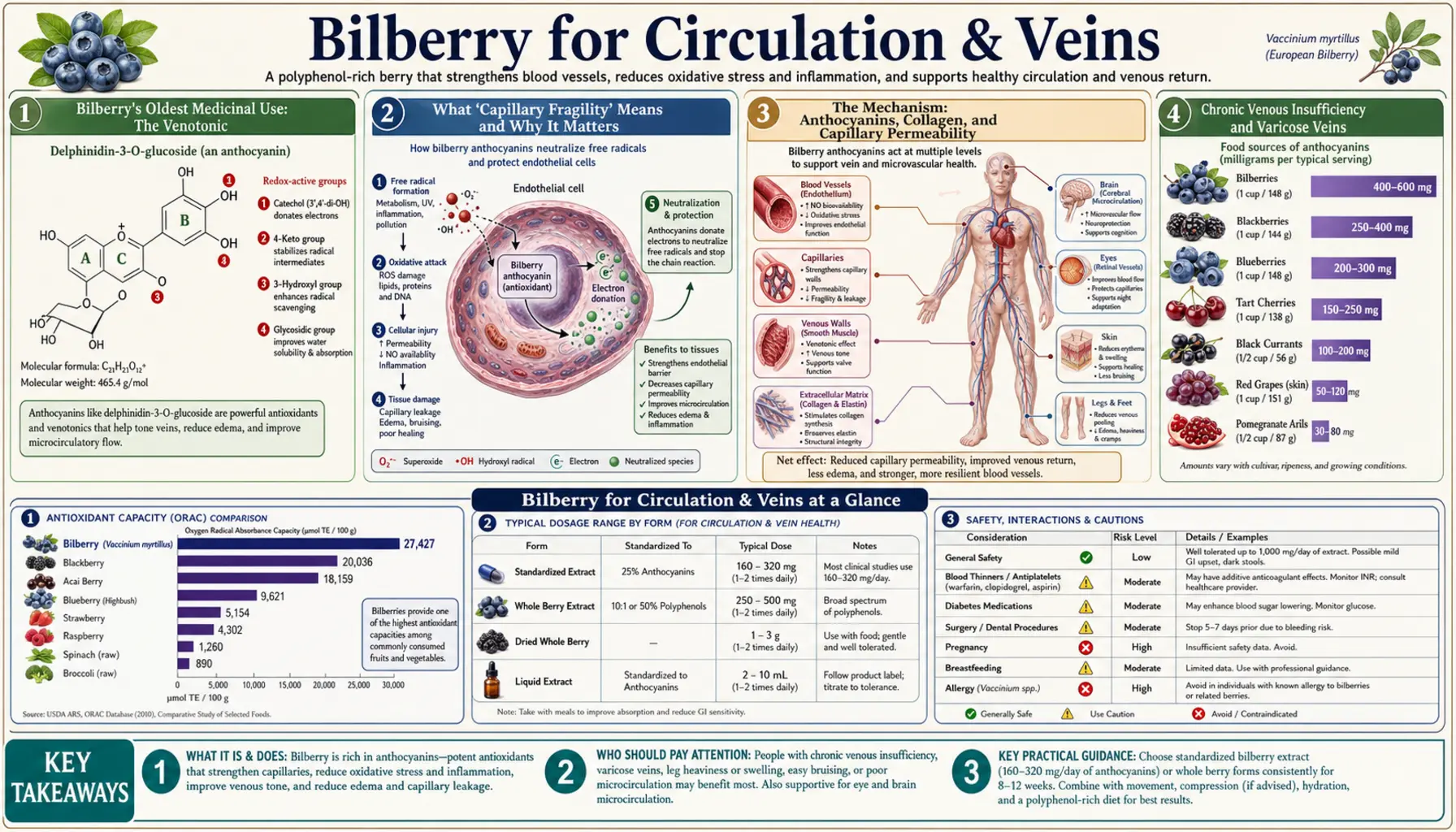
Long before anyone talked about bilberry and night vision, European herbalists and, later, European physicians used bilberry anthocyanosides for the small blood vessels: for heavy, aching legs, for easy bruising, for the leaky capillaries of chronic venous insufficiency. This is bilberry's deepest and most coherent story, because the mechanism is well described — anthocyanins reinforce the collagen scaffolding of vessel walls and reduce capillary leakiness — and it connects directly to the newer work on endothelial function and microcirculation. It is also a story that must be told with its evidence gaps intact: many of the venous-insufficiency trials are decades old, small, and European, and the modern high-quality data are strongest for the mechanism and for surrogate markers rather than for hard clinical outcomes. This page walks the whole arc, from the capillary wall to the meta-analysis, and marks clearly where the ground is firm and where it is soft.
Table of Contents
- Bilberry's Oldest Medicinal Use: The Venotonic
- What "Capillary Fragility" Means and Why It Matters
- The Mechanism: Anthocyanins, Collagen, and Capillary Permeability
- Chronic Venous Insufficiency and Varicose Veins
- Endothelial Function and Blood Pressure
- Microcirculation and Ischemia-Reperfusion
- What the Reviews and Meta-Analyses Say
- Practical Use and Honest Expectations
- Cautions
- Key Research Papers
- External Authoritative Resources
- Connections
- Featured Videos
Bilberry's Oldest Medicinal Use: The Venotonic
A "venotonic" is an agent thought to improve the tone and integrity of veins and the small vessels that feed and drain them. In continental European medicine — particularly in France, Italy, and Germany — plant-derived venotonics have a long, semi-official history, and bilberry anthocyanosides sit in that tradition alongside horse chestnut, red vine leaf, and the flavonoid rutin. They were prescribed for the cluster of complaints that go with sluggish venous return: heavy, tired, swollen legs at the end of the day; visible or palpable varicose veins; a tendency to bruise easily; and the skin changes of long-standing venous insufficiency.
This use predates and is largely independent of the night-vision folklore that later made bilberry famous in the English-speaking world. It rests on a simpler and better-supported idea: that the anthocyanin pigments do something useful to the wall of a small blood vessel. The rest of this page examines what that "something" is, how well it is established, and how far it carries into treating actual venous disease.
What "Capillary Fragility" Means and Why It Matters
Capillaries are the body's smallest blood vessels, a single cell layer thick, where oxygen, nutrients, and fluid pass between blood and tissue. Their walls have to be selectively leaky — open enough to exchange what they must, tight enough to keep blood cells and excess fluid in. When that balance tips toward too-leaky, the results are visible and uncomfortable: fluid pools in tissue as swelling (edema), red cells escape and show up as easy bruising or tiny skin hemorrhages, and over time the chronically waterlogged, poorly drained tissue of the lower leg develops the brown staining and hardening of venous skin disease.
"Capillary fragility" and "increased capillary permeability" are the old clinical terms for this leakiness, and they were the explicit targets of the early bilberry research. The appeal of an anthocyanin here is mechanistic and direct: if the pigment can make the capillary wall a little more robust and a little less leaky, it should reduce swelling, bruising, and the discomfort of venous congestion — exactly the traditional indications.
The Mechanism: Anthocyanins, Collagen, and Capillary Permeability
Two strands of laboratory and clinical-physiology research give bilberry's vascular use a credible mechanism.
Reducing capillary permeability. Detre, Jellinek, Miskulin, and Robert (1986), working in Clinical Physiology and Biochemistry, studied vascular permeability in the setting of hypertension and reported that anthocyanosides reduced abnormal capillary leakiness. This is the direct experimental correlate of the traditional "anti-fragility" claim: the pigments appear to tighten the exchange barrier of the small vessel.
Reinforcing the collagen scaffold. Boniface and Robert (1996) examined the effect of anthocyanins on human connective-tissue metabolism and found effects on the collagen and glycosaminoglycan matrix that forms the structural scaffolding around vessels. Because a capillary or venule is only as strong as the connective-tissue sleeve that supports it, anthocyanins that stabilise collagen, resist its enzymatic breakdown, and support its cross-linking would be expected to make vessel walls more resilient. Anthocyanins also have a well-documented ability to bind and protect collagen from degradation, a property shared with the closely related proanthocyanidins of grape seed extract and Pycnogenol.
On top of these two structural mechanisms sits a general antioxidant and anti-inflammatory effect: by mopping up reactive oxygen species and dampening inflammatory signalling in the vessel wall, anthocyanins may reduce the ongoing injury that drives capillary leak and venous remodeling. Together these explain, at the bench, why a deeply pigmented berry might help a leaky, congested lower leg. Whether that bench mechanism produces meaningful clinical benefit is the harder question the next sections tackle.
Chronic Venous Insufficiency and Varicose Veins
Chronic venous insufficiency (CVI) is the condition in which the leg veins and their valves fail to return blood efficiently, so blood and fluid pool in the lower legs. Symptoms range from aching, heaviness, and swelling through to visible varicose veins, skin discoloration, and in severe cases venous ulcers. It is common, it is chronic, and its mainstays of treatment are unglamorous but effective: compression stockings, leg elevation, exercise, weight management, and, where appropriate, procedures to close or remove failing veins.
Bilberry anthocyanosides have been used as an oral adjunct for the symptoms of CVI, and a number of European clinical trials from the 1970s through the 1990s reported reductions in symptoms such as heaviness, swelling, and paresthesia. Here honesty is essential. Most of those trials are old, small, and of limited methodological quality by modern standards — often open-label or inadequately blinded, with subjective endpoints and industry involvement. They are enough to explain bilberry's established place in European venotonic practice, but they are not the kind of large, rigorous, modern randomised trials that would let anyone claim CVI benefit with confidence. Compare this with a related agent such as horse chestnut seed extract, which has a more substantial modern evidence base for CVI; bilberry's dossier is thinner.
The fair conclusion is a modest one: bilberry has a plausible mechanism and a long tradition for the symptoms of venous insufficiency and capillary fragility, and the older trials are consistent with a symptomatic benefit, but it should be positioned as a possible adjunct to — never a replacement for — compression, movement, and proper vascular assessment. It does not shrink varicose veins or fix failing valves.
Endothelial Function and Blood Pressure
The endothelium is the single-cell lining of every blood vessel, and its ability to relax the vessel in response to demand — largely by releasing nitric oxide — is one of the best modern markers of vascular health. Here the anthocyanin evidence is stronger and more contemporary, though it is mostly about anthocyanins in general rather than bilberry specifically.
Zhu and colleagues (2011), in Clinical Chemistry, gave purified anthocyanins to people with high cholesterol and showed improved endothelial function, measured as flow-mediated dilation, together with evidence that the effect ran through the nitric-oxide/cyclic-GMP pathway. This is a mechanistically clean, placebo-controlled human demonstration that anthocyanins can improve how a blood vessel relaxes.
On blood pressure and population risk, Cassidy and colleagues (2011) analysed habitual flavonoid intake in a large cohort and found that higher intake of anthocyanins was associated with a lower risk of developing hypertension. As an observational finding it cannot prove cause, but it points in the same direction as the mechanistic work. Erlund and colleagues (2008) added a randomised human trial showing that regular berry consumption favourably affected platelet function, blood pressure, and HDL cholesterol — a combination relevant to the whole arterial side of the circulation, not just the veins.
Taken together, these give bilberry's anthocyanins a credible, modern rationale for supporting the arterial circulation and endothelial health, even though the venous-disease evidence remains older and softer.
Microcirculation and Ischemia-Reperfusion
Beyond the big arteries and veins lies the microcirculation — the network of arterioles, capillaries, and venules that actually delivers blood to tissue. Mastantuono and colleagues (2016), publishing in PLoS One, studied Vaccinium myrtillus extract in an animal model (hamster pial microcirculation) subjected to hypoperfusion and reperfusion — the injury that happens when blood flow is cut off and then restored. Bilberry extract preserved microvascular perfusion and reduced the vascular damage of reperfusion, consistent with its antioxidant and vessel-protective mechanisms.
This is animal, mechanistic evidence, and it should be read as supporting the plausibility of a microvascular benefit rather than as a clinical result. But it dovetails neatly with the capillary-permeability and endothelial findings, and with the retinal-microvasculature work discussed on the Eye & Vision page — the retina, after all, is just one especially delicate microvascular bed. The recurring theme is that bilberry's most consistent action is on small vessels under stress.
What the Reviews and Meta-Analyses Say
Stepping back from individual studies, the summary literature is cautiously supportive of the vascular story while candid about its limits. A 2024 review by Ghosh and colleagues in Frontiers in Molecular Biosciences surveyed the effects of Vaccinium-derived antioxidants on human health and catalogued the vascular, metabolic, and antioxidant mechanisms discussed here, while noting the need for larger, better-controlled human trials. A 2019 review by Wood and colleagues in Food Function focused on blueberries and cardiovascular disease prevention and reached a similar cautious-optimism conclusion for the wider Vaccinium genus.
On quantitative synthesis, Yang and colleagues (2017) meta-analysed randomised controlled trials of anthocyanins on cardiometabolic health in Advances in Nutrition and found favourable pooled effects on several lipid and glycemic markers. That meta-analysis is not bilberry-specific — it pools anthocyanin sources — but bilberry is one of the richest dietary anthocyanin sources, so its findings are directly relevant to what a bilberry-rich intake might do. The honest reading of the review literature is: real, reproducible effects on vascular surrogate markers; a genuine need for larger trials with hard clinical endpoints; and no basis for treating bilberry as a drug.
Practical Use and Honest Expectations
- Best-supported uses: supporting general vascular and endothelial health as part of a berry-rich diet, and as a traditional adjunct for the symptoms of capillary fragility and mild venous congestion (heaviness, easy bruising, minor swelling).
- Reasonable but unproven: symptomatic support in chronic venous insufficiency, alongside — not instead of — compression, elevation, and exercise.
- Not established: shrinking varicose veins, healing venous ulcers, or replacing any prescribed cardiovascular therapy.
- Whole fruit first. The population and mechanistic evidence is strongest for regular intake of anthocyanin-rich berries. A standardised extract is a concentrated option; see Sources & Extracts for what the "25% anthocyanidin / 36% anthocyanoside" standard means and how it is dosed.
- Get real vascular symptoms assessed. Leg swelling that is new, one-sided, painful, or accompanied by breathlessness needs medical evaluation — it can signal deep vein thrombosis or heart failure, which no supplement addresses.
Bilberry belongs to a family of flavonoid vascular agents on this site, including Rutin, Hesperidin, Grape Seed Extract, and Pycnogenol. They share the collagen-stabilising, capillary-protective theme and are often discussed together.
Cautions
- Bleeding and antiplatelet/anticoagulant drugs. Because anthocyanins can affect platelet function and vascular tone, people taking warfarin, direct oral anticoagulants, aspirin, or other antiplatelet agents should use concentrated bilberry extracts cautiously and tell their clinician, and should stop before surgery.
- Not a substitute for compression or vascular care. For diagnosed venous disease, the evidence-based mainstays are compression, movement, and, where indicated, procedures. Treat bilberry as an optional adjunct.
- Fruit versus leaf. Bilberry leaf preparations are a different product; prolonged high-dose leaf use has safety concerns and is not what the vascular fruit evidence supports.
- Diabetes and blood pressure medication. Because anthocyanins may nudge glucose and blood pressure downward, monitor if you are on treatment for either, to avoid additive effects.
- Pregnancy and breastfeeding. Bilberry fruit as food is fine; concentrated supplements are not well studied, so food amounts are the safe default.
Key Research Papers
- Detre Z, Jellinek H, Miskulin M, Robert AM (1986). Studies on vascular permeability in hypertension: action of anthocyanosides. Clinical Physiology and Biochemistry. — PMID 3698472
- Boniface R, Robert AM (1996). Effect of anthocyanins on human connective tissue metabolism. Klinische Monatsblätter für Augenheilkunde. — PMID 9091714
- Zhu Y et al. (2011). Purified anthocyanin supplementation improves endothelial function via NO-cGMP activation in hypercholesterolemic individuals. Clinical Chemistry. — PMID 21926181
- Cassidy A et al. (2011). Habitual intake of flavonoid subclasses and incident hypertension in adults. American Journal of Clinical Nutrition. — PMID 21106916
- Erlund I et al. (2008). Favorable effects of berry consumption on platelet function, blood pressure, and HDL cholesterol. American Journal of Clinical Nutrition. — PMID 18258621
- Mastantuono T et al. (2016). The effects of Vaccinium myrtillus extract on hamster pial microcirculation during hypoperfusion-reperfusion injury. PLoS One. — PMID 27070318
- Yang L et al. (2017). Effects of anthocyanins on cardiometabolic health: a systematic review and meta-analysis of randomized controlled trials. Advances in Nutrition. — PMID 28916569
- Wood E et al. (2019). Blueberries and cardiovascular disease prevention. Food & Function. — PMID 31776541
- Ghosh A et al. (2024). Effects of Vaccinium-derived antioxidants on human health: the past, present and future. Frontiers in Molecular Biosciences. — PMID 39758282
- Kim J et al. (2015). Vaccinium myrtillus extract prevents or delays the onset of diabetes-induced blood-retinal barrier breakdown. International Journal of Food Sciences and Nutrition. — PMID 25582181
PubMed Topic Searches
- PubMed: bilberry and capillary permeability
- PubMed: anthocyanosides and venous insufficiency
- PubMed: anthocyanins and endothelial function
- PubMed: anthocyanins and blood pressure
- PubMed: bilberry and microcirculation
External Authoritative Resources
- NIH NCCIH — Bilberry
- MedlinePlus — Bilberry (uses, dosing, interactions)
- MedlinePlus — Varicose Veins and Venous Insufficiency
Connections
- Bilberry Overview
- Bilberry Benefits Hub
- Bilberry for Eye & Vision
- Bilberry Sources & Extracts
- Anthocyanins
- Grape Seed Extract
- Pycnogenol
- Rutin
- Hesperidin
- Varicose Veins
- Hypertension
- Atherosclerosis
- Peripheral Artery Disease
- Blueberries
- All Antioxidants