Bilberry for Blood Sugar & Metabolic Health
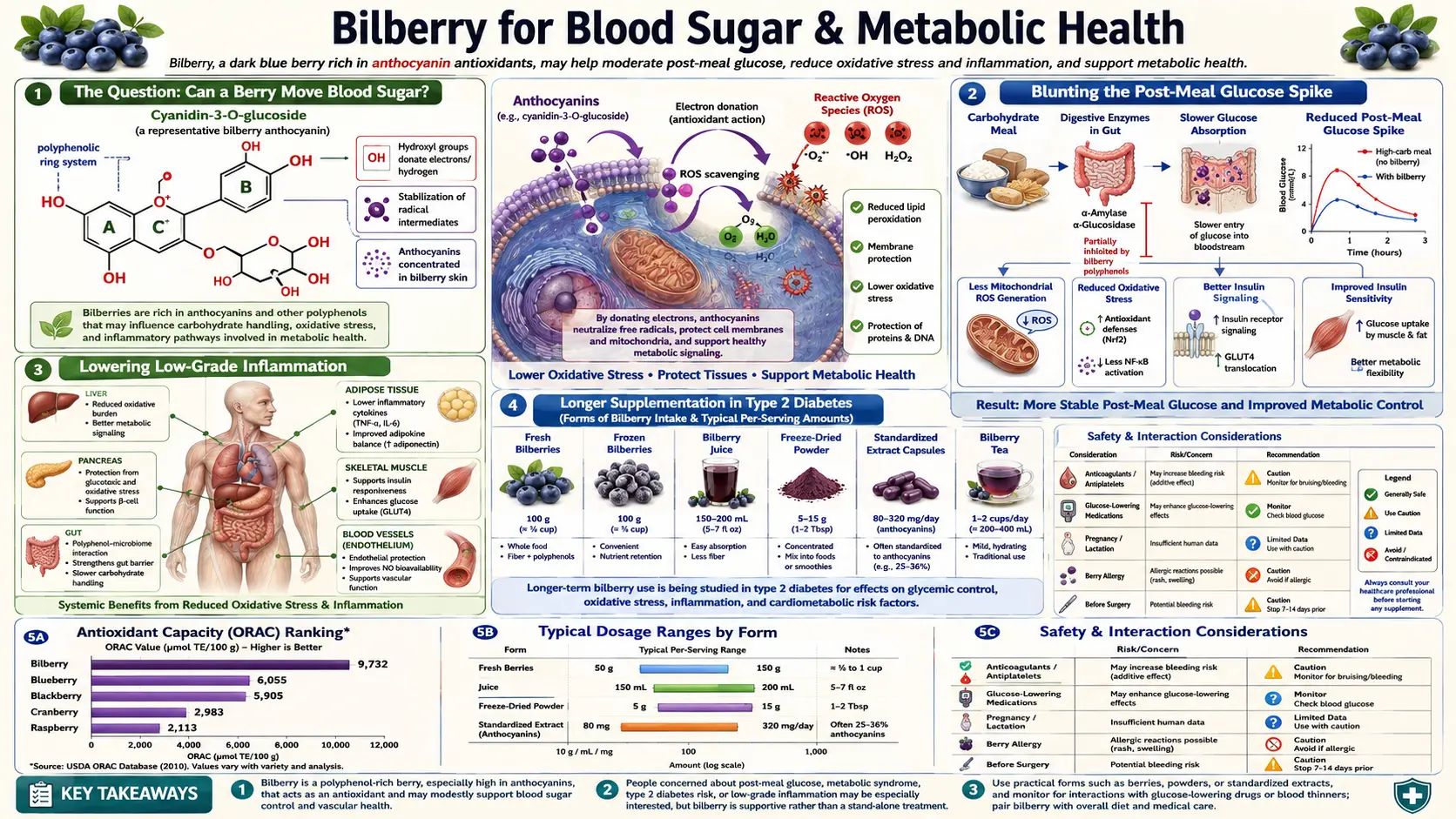
Bilberry has a genuine, if modest, story to tell about blood sugar. Small human trials show that a dose of standardised bilberry extract can flatten the sharp glucose-and-insulin spike after a meal, that a regular bilberry intake lowers markers of the low-grade inflammation that runs through metabolic syndrome, and that whole-diet patterns rich in bilberries shift glucose and lipid handling in a favourable direction. Animal work fills in a plausible mechanism — activation of AMP-activated protein kinase, the cell's master fuel-sensing switch. But every one of these trials is small, and none of them turns bilberry into a treatment for diabetes. This page lays out exactly what the studies showed, at what doses, in how many people, so the promise and the limits are both visible. The honest headline: bilberry is a supportive food for metabolic health, not a substitute for the diet, movement, and medication that actually control diabetes.
Table of Contents
- The Question: Can a Berry Move Blood Sugar?
- Blunting the Post-Meal Glucose Spike
- Lowering Low-Grade Inflammation
- Longer Supplementation in Type 2 Diabetes
- The Whole-Diet Trials
- The Mechanism: AMPK, Insulin Sensitivity, and the Fat Cell
- Lipids and the Bigger Cardiometabolic Picture
- Honest Verdict: A Supportive Food, Not a Drug
- Practical Use
- Cautions
- Key Research Papers
- External Authoritative Resources
- Connections
- Featured Videos
The Question: Can a Berry Move Blood Sugar?
Berries are sweet, so it can seem paradoxical that a berry might help blood sugar. The resolution is that bilberry's metabolic effects come from its anthocyanins and other polyphenols, not from its modest sugar content, and they act in several places at once: slowing the digestion and absorption of carbohydrate, nudging insulin sensitivity in muscle and fat, and dampening the chronic low-grade inflammation that both accompanies and worsens insulin resistance. Bilberry also has a long folk history in Europe as a plant used for diabetes — though much of that tradition centred on the leaf, which carries its own safety caveats discussed below, rather than the fruit that modern trials have studied.
What follows is a walk through the actual human and animal evidence, in ascending order of ambition: first a single dose, then a few weeks of supplementation, then whole dietary patterns, then the mechanism that ties them together. Throughout, the sample sizes are deliberately kept in view, because they are the honest limit on how much weight any of this can bear.
Blunting the Post-Meal Glucose Spike
The cleanest bilberry blood-sugar result is also one of the simplest. Hoggard and colleagues (2013), publishing in the Journal of Nutritional Science, gave people with type 2 diabetes (managed by diet and lifestyle) a single supplement of a standardised bilberry extract — the 36%-anthocyanin extract — alongside a carbohydrate load, and compared their glucose and insulin response with a matched control drink. The bilberry supplement produced a lower post-meal glucose peak and a more efficient insulin response: the body handled the same carbohydrate with less of a sugar spike.
This is an acute (single-dose) crossover study in a small group, so it demonstrates a real physiological effect rather than a long-term clinical outcome. But the post-meal (postprandial) glucose surge is itself meaningful — repeated large spikes drive glycation, oxidative stress, and vascular damage — so an agent that reliably flattens the curve is worth taking seriously. The likely mechanisms are a mix of slowed carbohydrate digestion (anthocyanins and other polyphenols inhibit the α-glucosidase and α-amylase enzymes that break starch into absorbable sugar) and improved early insulin action.
Lowering Low-Grade Inflammation
Metabolic syndrome — the cluster of abdominal obesity, high blood pressure, high triglycerides, low HDL, and elevated fasting glucose — is soaked in chronic, low-grade inflammation, and that inflammation is not just a marker but part of the machinery driving insulin resistance forward. Kolehmainen and colleagues (2012), in Molecular Nutrition & Food Research, ran a controlled trial in people with features of metabolic syndrome, giving one group a regular intake of bilberries. The bilberry group showed reduced markers of low-grade inflammation — lower levels of several inflammatory signalling molecules — compared with the control group.
This matters because it points to a mechanism beyond the acute glucose curve: over weeks, bilberry appears to quiet the inflammatory tone of metabolic dysfunction. It fits with the broader anthocyanin literature and with the vascular anti-inflammatory effects described on the Circulation & Veins page. As always, it was a modest-sized trial, and reduced inflammatory markers are a surrogate, not a hard clinical endpoint. See our page on Metabolic Syndrome for the full clinical picture.
Longer Supplementation in Type 2 Diabetes
Chan and colleagues (2021), in Phytotherapy Research, took the question further with a short-term supplementation trial of bilberry in Chinese patients with type 2 diabetes, looking at glycemic control, cardiovascular risk factors, and antioxidant status together. The trial reported measurable effects on antioxidant status and some cardiometabolic markers over the supplementation period.
Trials like this are important because they move from a single meal toward the sustained use a person would actually adopt, and they combine glucose with the lipid and antioxidant measures that matter in diabetes. But they remain small and short, and their endpoints are biochemical markers rather than the outcomes patients care about most — HbA1c held down over years, complications prevented. Nothing in this literature yet demonstrates that bilberry changes the long-term course of type 2 diabetes. It is entirely compatible with the evidence to say bilberry supports metabolic control while insisting it does not treat the disease.
The Whole-Diet Trials
Some of the most policy-relevant evidence comes not from a bilberry pill but from a bilberry-rich diet. Lankinen and colleagues (2011) reported the Sysdimet study in PLoS One, a randomised controlled trial in people with impaired glucose metabolism or metabolic syndrome. One arm combined whole-grain and low-postprandial-insulin grain products, fatty fish, and bilberries; the study found favourable changes in glucose and lipid metabolism and in the metabolomic profile associated with that dietary pattern.
Because bilberries were bundled with whole grains and fish, this trial cannot isolate the berry's individual contribution — but that is arguably the point. In real life, bilberries are eaten as part of a pattern, and the Sysdimet result supports the sensible, low-risk conclusion that including anthocyanin-rich berries in an otherwise healthy diet is a reasonable metabolic move. It is the whole-food, whole-diet framing that the honest evidence best supports.
The Mechanism: AMPK, Insulin Sensitivity, and the Fat Cell
Animal and cell studies give the human trials a coherent mechanistic backbone. The centrepiece is Takikawa and colleagues (2010), in the Journal of Nutrition, who fed an anthocyanin-rich bilberry extract to diabetic mice and found that it ameliorated hyperglycemia and improved insulin sensitivity by activating AMP-activated protein kinase (AMPK) in muscle, liver, and fat. AMPK is the cell's fuel-gauge enzyme: when it is switched on, cells take up and burn glucose and fat more readily and store less. It is, notably, the same enzyme that the first-line diabetes drug metformin is thought to activate — which puts bilberry's mechanism in respectable company while also underlining that it is a gentle nutritional nudge, not a pharmaceutical lever.
Complementary cell work by Molonia and colleagues (2021), in Chemistry & Biodiversity, showed that cyanidin-3-O-glucoside — one of bilberry's major anthocyanins — acted on inflammatory and insulin-sensitising genes in human fat cells exposed to a saturated fatty acid, dampening the inflammatory response and supporting insulin signalling in the adipocyte. Grace and colleagues (2009), in Phytomedicine, demonstrated hypoglycemic activity of an anthocyanin-rich Vaccinium formulation, and Stull and colleagues (2010), in the Journal of Nutrition, showed in a human trial that blueberry bioactives improved insulin sensitivity in obese, insulin-resistant adults — a close-relative result that reinforces the anthocyanin-and-insulin theme.
The mechanistic picture, then, is consistent across species: bilberry anthocyanins slow carbohydrate absorption, activate AMPK, improve insulin signalling, and quiet fat-cell inflammation. Consistent mechanism plus small positive human trials is a reasonable basis for a supportive role — and no basis at all for abandoning proven therapy.
Lipids and the Bigger Cardiometabolic Picture
Blood sugar never travels alone; it comes bundled with lipids, blood pressure, and vascular risk. Two threads round out the metabolic story. First, Mauray and colleagues (2012), in Nutrition, Metabolism & Cardiovascular Diseases, showed that a bilberry anthocyanin-rich extract altered the expression of genes related to atherosclerosis development in the aorta of apoE-deficient mice — linking bilberry's metabolic and vascular effects at the level of the artery wall (see Atherosclerosis). Second, and with an important safety flag, Cignarella and colleagues (1996), in Thrombosis Research, reported lipid-lowering properties of Vaccinium myrtillus leaves in animal models — a reminder that the traditional antidiabetic use of bilberry often meant the leaf, which is chemically distinct from the fruit and not interchangeable with it.
Pulling the human trials together, Yang and colleagues (2017) meta-analysed randomised controlled trials of anthocyanins on cardiometabolic health in Advances in Nutrition and found favourable pooled effects on glucose and lipid markers. Bilberry is one of the richest dietary anthocyanin sources, so the meta-analysis is directly relevant even though it pools sources. The overall cardiometabolic signal is real, reproducible on surrogate markers, and modest in size.
Honest Verdict: A Supportive Food, Not a Drug
Weighing all of it:
- Real effects, honestly small. Bilberry blunts post-meal glucose (Hoggard 2013), lowers inflammatory markers (Kolehmainen 2012), and fits into metabolic-benefit diets (Lankinen 2011), with a coherent AMPK mechanism (Takikawa 2010). These are genuine findings.
- Small and short. The trials are modest in size and duration, and use biochemical surrogates rather than long-term outcomes. None shows bilberry lowering complications or replacing therapy.
- Best framed as food. The strongest, safest conclusion is the whole-food one: including anthocyanin-rich berries in a good diet is a sensible, low-risk support for metabolic health.
- Not a diabetes treatment. Nobody with diabetes should reduce or stop prescribed medication in favour of bilberry. It is an adjunct to — never a replacement for — diet, activity, weight management, and medical care.
Practical Use
- Whole berries first. A regular serving of bilberries (or, if unavailable, other dark berries and blueberries) is the best-supported and safest way to get the metabolic benefit.
- Standardised extract as an option. The trials used standardised extracts; the Hoggard study used the 36%-anthocyanin form. See Sources & Extracts for what standardisation means and typical dosing.
- Use the fruit, be wary of the leaf. Modern metabolic trials studied bilberry fruit and its extract. Bilberry leaf, though traditionally used for diabetes, is not established as safe at high or prolonged doses.
- Monitor if you are treated for diabetes. If you already take glucose-lowering medication, an added glucose-lowering effect from bilberry could, in theory, contribute to lows — monitor and discuss with your clinician.
For the underlying conditions, see Insulin Resistance, Prediabetes, and Type 2 Diabetes.
Cautions
- Additive glucose lowering. Combined with insulin or other glucose-lowering drugs, bilberry's mild effect could add up; monitor blood sugar and watch for hypoglycemia symptoms.
- Bilberry leaf is not bilberry fruit. Leaf preparations contain compounds (including hydroquinone) that raise safety concerns with high or long-term use; the metabolic fruit evidence does not extend to the leaf.
- Bleeding risk. As with all anthocyanin-rich extracts, use caution alongside anticoagulant/antiplatelet drugs and before surgery.
- Not a replacement for therapy. Do not reduce prescribed diabetes medication on the strength of bilberry; any changes belong with your clinician.
- Pregnancy and breastfeeding. Bilberry fruit as food is fine; concentrated extracts are not well studied, so food amounts are the safe default.
Key Research Papers
- Hoggard N et al. (2013). A single supplement of a standardised bilberry (Vaccinium myrtillus L.) extract (36% wet weight anthocyanins) modifies glycaemic response in individuals with type 2 diabetes controlled by diet and lifestyle. Journal of Nutritional Science. — PMID 25191571
- Kolehmainen M et al. (2012). Bilberries reduce low-grade inflammation in individuals with features of metabolic syndrome. Molecular Nutrition & Food Research. — PMID 22961907
- Chan SW et al. (2021). Impact of short-term bilberry supplementation on glycemic control, cardiovascular disease risk factors, and antioxidant status in Chinese patients with type 2 diabetes. Phytotherapy Research. — PMID 33599340
- Lankinen M et al. (2011). Whole grain products, fish and bilberries alter glucose and lipid metabolism in a randomized, controlled trial: the Sysdimet study. PLoS One. — PMID 21901116
- Takikawa M et al. (2010). Dietary anthocyanin-rich bilberry extract ameliorates hyperglycemia and insulin sensitivity via activation of AMP-activated protein kinase in diabetic mice. Journal of Nutrition. — PMID 20089785
- Molonia MS et al. (2021). In vitro effects of cyanidin-3-O-glucoside on inflammatory and insulin-sensitizing genes in human adipocytes exposed to palmitic acid. Chemistry & Biodiversity. — PMID 34643021
- Stull AJ et al. (2010). Bioactives in blueberries improve insulin sensitivity in obese, insulin-resistant men and women. Journal of Nutrition. — PMID 20724487
- Grace MH et al. (2009). Hypoglycemic activity of a novel anthocyanin-rich formulation from lowbush blueberry, Vaccinium angustifolium Aiton. Phytomedicine. — PMID 19303751
- Mauray A et al. (2012). Bilberry anthocyanin-rich extract alters expression of genes related to atherosclerosis development in aorta of apoE-deficient mice. Nutrition, Metabolism & Cardiovascular Diseases. — PMID 20678907
- Cignarella A et al. (1996). Novel lipid-lowering properties of Vaccinium myrtillus L. leaves in several models of rat dyslipidaemia. Thrombosis Research. — PMID 8948058
- Yang L et al. (2017). Effects of anthocyanins on cardiometabolic health: a systematic review and meta-analysis of randomized controlled trials. Advances in Nutrition. — PMID 28916569
PubMed Topic Searches
- PubMed: bilberry and glycemic response
- PubMed: bilberry and metabolic syndrome
- PubMed: anthocyanins, AMPK and insulin sensitivity
- PubMed: anthocyanins and type 2 diabetes trials
- PubMed: bilberry leaf and lipids
External Authoritative Resources
- NIH NCCIH — Bilberry
- MedlinePlus — Bilberry (uses, dosing, interactions)
- NIH NIDDK — Diabetes Information
Connections
- Bilberry Overview
- Bilberry Benefits Hub
- Bilberry for Circulation & Veins
- Bilberry Sources & Extracts
- Anthocyanins
- Quercetin
- Resveratrol
- Type 2 Diabetes
- Insulin Resistance
- Prediabetes
- Metabolic Syndrome
- Atherosclerosis
- Diabetic Retinopathy
- Blueberries
- All Antioxidants