Bilberry for Eye & Vision
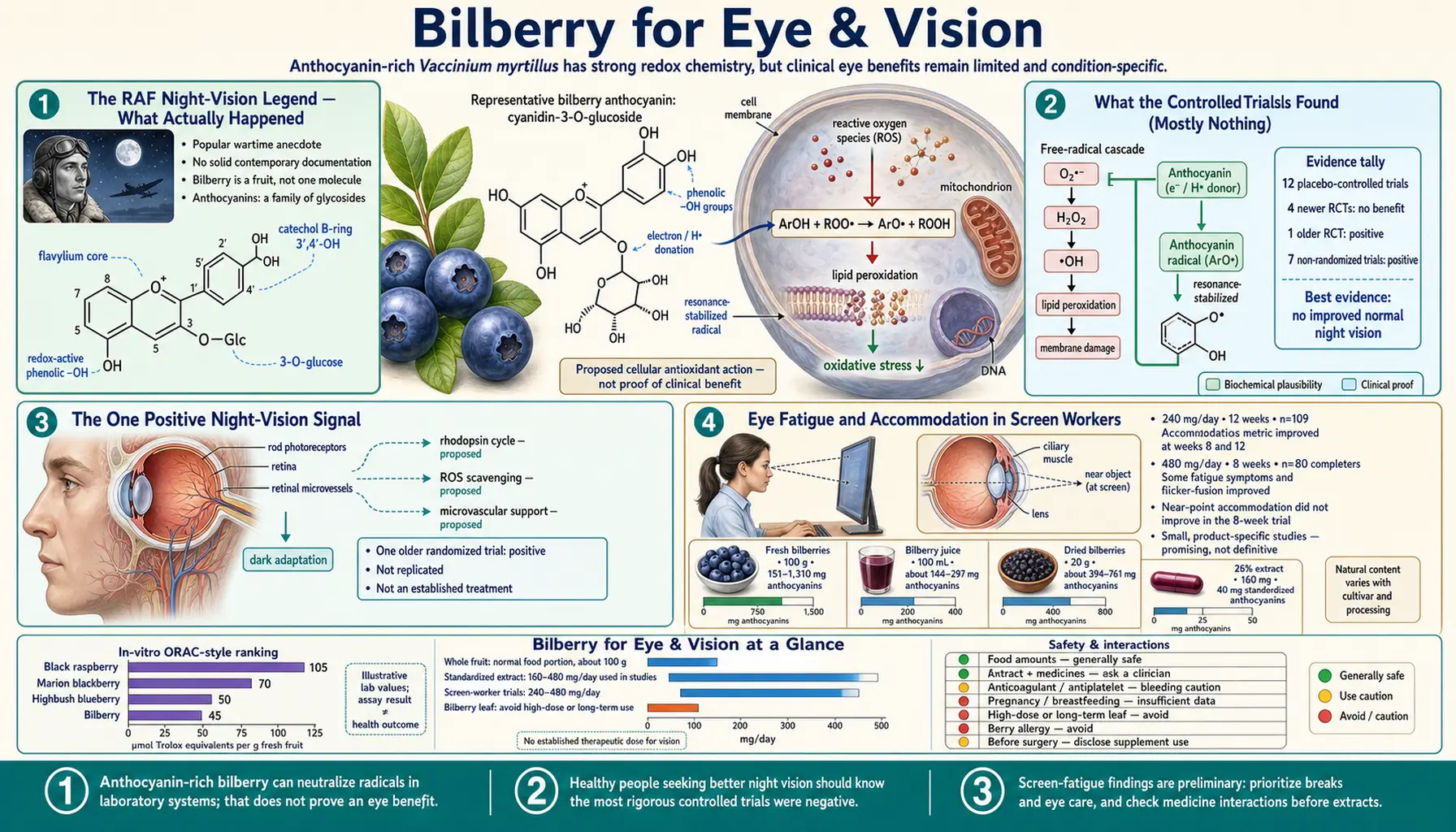
No supplement claim is repeated more confidently, or supported more weakly, than the idea that bilberry sharpens night vision because Royal Air Force pilots ate it to see German bombers in the dark. The story is almost certainly false — a piece of Second World War misdirection meant to hide the invention of airborne radar — and the placebo-controlled trials that chased it for fifty years have mostly come up empty. This page tells that story straight, then does something more useful: it lays out the eye research that does hold up. Bilberry anthocyanins have earned modest, real evidence for relieving eye fatigue in screen workers, easing dry-eye symptoms, and protecting the delicate retinal microvasculature in diabetes. The honest summary is that bilberry is not night-vision goggles in a capsule, but it is not nothing either.
Table of Contents
- The RAF Night-Vision Legend — What Actually Happened
- What the Controlled Trials Found (Mostly Nothing)
- The One Positive Night-Vision Signal
- Eye Fatigue and Accommodation in Screen Workers
- Dry Eye
- The Retinal Microvasculature and Diabetic Retinopathy
- How Anthocyanins Might Act in the Eye
- Practical Guidance: What Bilberry Can and Cannot Do
- Cautions
- Key Research Papers
- External Authoritative Resources
- Connections
- Featured Videos
The RAF Night-Vision Legend — What Actually Happened
The story goes like this: during the Second World War, Royal Air Force night-fighter pilots developed an uncanny ability to spot and shoot down German aircraft in darkness after eating bilberry jam before missions, and the humble British berry was the secret behind their success. It is a wonderful story. It is also, as far as any historian can tell, propaganda.
What the RAF actually had was airborne interception radar — a genuinely secret, war-winning technology fitted to night fighters such as the Bristol Beaufighter. The Air Ministry needed a cover story to explain how pilots like John "Cat's Eyes" Cunningham were finding enemy bombers in the dark, without revealing that they were tracking them on a radar scope. A tale about pilots eating carrots (rich in Vitamin A, a real requirement for the light-sensing chemistry of the retina) and, in the British telling, bilberries, served that purpose beautifully. It even had the side benefit of nudging a rationed public toward home-grown vegetables. The carrot version is well documented as wartime disinformation; the bilberry version is the same legend in a different fruit.
Two things are worth separating here. First, the historical claim — that the RAF used bilberry to improve pilots' night vision — has no credible documentary support and every hallmark of a cover story. Second, the biological claim that grew out of it — that bilberry anthocyanins meaningfully improve dark adaptation or night vision in healthy people — is a testable scientific hypothesis, and it has been tested many times. The next section is what those tests found.
It is easy to see why the idea took hold. Bilberries really are packed with anthocyanins, anthocyanins really are antioxidants, and the retina really does depend on Vitamin-A-based chemistry (the rhodopsin cycle) to see in low light. The leap from "plausible" to "proven," though, is exactly the leap the evidence does not let us make.
What the Controlled Trials Found (Mostly Nothing)
The most important document on this subject is a systematic review by Canter and Ernst, published in Survey of Ophthalmology in 2004. They gathered every placebo-controlled trial they could find that tested bilberry anthocyanosides on night vision in healthy people with normal eyesight. Thirty studies existed in total; twelve were placebo-controlled. Of those twelve, the four most rigorous (randomised, double-blind, placebo-controlled) all reported no effect on night vision. The authors concluded, in unusually plain language for a scientific paper, that the evidence does not support the widespread belief that bilberry improves normal night vision, and that the hypothesis should be considered disproven for the better-quality trials.
Two individual studies are worth naming because they are the ones the review leaned on:
- Muth, Laurent, and Jasper (2000), published in Alternative Medicine Review, gave healthy young adults bilberry extract or placebo and measured night visual acuity and contrast sensitivity. They found no significant difference between bilberry and placebo on either measure.
- Zadok, Levy, and Glovinsky (1999), in the journal Eye, tested a multiple-dose regimen of anthocyanosides on night vision and likewise found no measurable benefit.
The pattern extends beyond bilberry to close relatives. A well-designed pair of placebo-controlled crossover studies by Kalt and colleagues (2014) tested blueberry on dark vision and on the recovery of vision after a bright bleaching flash — two of the exact functions the folklore predicts anthocyanins should improve — and found no effect. The research on black currant anthocyanosides (Nakaishi and colleagues, 2000) is more mixed, with some reported effects on dark adaptation and on screen-work-induced eye strain, but these are small studies and a different berry.
The honest bottom line is this: if you have healthy eyes and normal night vision, the best-quality evidence says bilberry will not let you see better in the dark. Anyone selling it primarily for that purpose is selling folklore.
The One Positive Night-Vision Signal
Science is rarely tidy, and there is one interesting exception worth reporting honestly. A 2005 study by Lee and colleagues in the British Journal of Nutrition gave a purified, high-dose anthocyanoside oligomer to people with myopia (short-sightedness) and reported improvements in nocturnal (twilight) contrast sensitivity and in subjective visual symptoms compared with placebo.
This does not resurrect the RAF legend, and it is important not to overstate it. The effect was seen in people with an underlying refractive problem, not in the general population; the product was a concentrated purified oligomer rather than ordinary bilberry extract; and it is a single trial that has not been convincingly replicated at scale. But it does suggest the possibility that in eyes that are already strained — by myopia, by fatigue, by microvascular disease — anthocyanins may do something detectable, even though they do nothing measurable in healthy, rested eyes. That distinction, between the healthy eye and the stressed eye, turns out to be the thread that runs through the rest of the credible bilberry-and-eye research.
Eye Fatigue and Accommodation in Screen Workers
The most defensible modern eye claim for bilberry is not about darkness at all — it is about the tired, aching, blurred-at-the-end-of-the-day feeling of eyes that have spent hours locked onto a screen. This is asthenopia (eye fatigue), and it is bound up with the workload on the ciliary muscle, the tiny ring of muscle that changes the shape of the lens to keep near objects in focus (accommodation).
Ozawa and colleagues (2015) ran a randomised, double-blind, placebo-controlled trial of bilberry extract in adults who did prolonged work at video display terminals. The bilberry group reported significantly less eye fatigue — fewer symptoms of ocular tiredness and strain — than the placebo group over the supplementation period. Because this was a symptom-based outcome, it is open to the usual caveats about self-report, but it was a properly controlled trial with a plausible mechanism.
Kosehira and colleagues (2020), publishing in Nutrients, went further and measured something objective. Over twelve weeks, they used an autorefractometer to quantify ciliary muscle contraction — how hard the focusing muscle was working — in people taking bilberry extract versus placebo. The bilberry group showed improved objective findings of ciliary muscle contraction, suggesting the eye was accommodating more efficiently rather than merely reporting less discomfort. That combination of a symptom trial and an objective-measure trial is the strongest eye evidence bilberry has.
The practical read: for the specific, common, modern complaint of screen-related eye fatigue, bilberry has real (if modest) controlled-trial support. This is a world away from the night-vision myth, and it is worth keeping the two claims firmly separated.
Dry Eye
Dry-eye disease — the gritty, burning, watering-then-drying cycle that affects a large share of older adults and screen users — has also been studied with a standardised bilberry extract. Riva and colleagues (2017) conducted a randomised, double-blind, placebo-controlled trial of a natural, standardised bilberry extract (the Mirtoselect profile) in people with dry eye, reporting improvement in dry-eye parameters relative to placebo.
This is a single trial with a commercial extract, so it should be read as promising rather than settled, and it does not replace the mainstay treatments for dry eye (artificial tears, lid hygiene, treating the underlying inflammation, and addressing screen habits). But it fits the same "stressed eye" pattern as the fatigue research: where the ocular surface and its microcirculation are under strain, anthocyanins seem more likely to register a benefit than in a healthy resting eye. Our dedicated page on Dry-Eye Disease covers the condition and its first-line management in depth.
The Retinal Microvasculature and Diabetic Retinopathy
The retina is fed by some of the smallest, most delicate blood vessels in the body, and in diabetes those vessels are the first to fail — leaking, closing off, and eventually driving diabetic retinopathy, a leading cause of blindness in working-age adults. This is the arena where bilberry's vascular chemistry (covered in depth on the Circulation & Veins page) and its eye interest overlap.
Kim and colleagues (2015), publishing in the International Journal of Food Sciences and Nutrition, showed in a diabetic animal model that Vaccinium myrtillus extract prevented or delayed the breakdown of the blood-retinal barrier — the tight seal that normally keeps fluid and blood components out of retinal tissue and whose failure is a central event in diabetic macular edema. The proposed mechanism is a combination of antioxidant protection and stabilisation of the tight junctions and pericytes that hold the microvessels together, echoing the capillary-permeability work (Detre and colleagues, 1986) discussed on the Circulation page.
Two honest caveats matter enormously here. First, this is animal and mechanistic evidence, not a demonstration that bilberry prevents or treats diabetic retinopathy in people. Second, diabetic retinopathy is a sight-threatening disease that requires proper ophthalmic care — screening, laser, anti-VEGF injections when indicated, and above all good diabetes control. Bilberry is at most a supportive nutritional adjunct within that framework, never a substitute for it. See our page on Diabetic Retinopathy for what actually protects sight in diabetes.
How Anthocyanins Might Act in the Eye
If bilberry does anything useful for the eye, three overlapping mechanisms are the usual candidates, and it is worth being clear about which are established and which are hypothetical.
- Microvascular protection (best supported) — anthocyanins reduce capillary permeability and reinforce the collagen and basement membrane of small vessels. In a tissue as vascular as the retina, steadier, less leaky microvessels is a plausible route to benefit, and it links the retinal-barrier and diabetic-retinopathy research directly to bilberry's traditional venotonic use.
- Antioxidant defence of the retina (plausible) — the retina is bathed in light and oxygen and is one of the most oxidatively stressed tissues in the body. Anthocyanins are antioxidants, and reducing oxidative load on retinal cells is a reasonable mechanism, though hard to prove is doing the work in any given trial.
- Faster rhodopsin regeneration (the original hypothesis, weakly supported) — the night-vision folklore rested on the idea that anthocyanins speed the regeneration of rhodopsin, the light-sensing pigment in rod cells. Some early laboratory work suggested such an effect, but as the controlled human trials above showed, whatever happens in a test tube does not translate into better night vision in healthy people.
The shift in thinking over the last two decades has been away from the rhodopsin story and toward the microvascular one. That is why the surviving credible eye claims — fatigue, dry eye, diabetic retinal protection — are all, at heart, claims about blood flow and vessel integrity rather than about the photochemistry of seeing in the dark.
Practical Guidance: What Bilberry Can and Cannot Do
Putting the evidence together, here is an honest, practical summary for someone considering bilberry for their eyes:
- Do not take it to improve normal night vision. The best trials say it will not work, and no amount of wartime storytelling changes that.
- It is reasonable to try for screen-related eye fatigue. This is the claim with the strongest controlled-trial support (Ozawa 2015; Kosehira 2020). Give it several weeks and judge honestly whether your eyes feel less tired at the end of the day.
- It may help dry-eye symptoms as an adjunct (Riva 2017), but it does not replace tears, lid care, or treating the underlying cause.
- If you have diabetes, prioritise glucose control and eye screening. Bilberry's retinal-microvascular research is encouraging but preclinical; it is a possible supportive food, not a treatment for retinopathy.
- Any new or worsening vision symptom is a reason to see an eye doctor, not to reach for a supplement. Flashes, floaters, curtains, sudden blur, or eye pain need professional assessment.
For dosing and how to choose a standardised extract that actually contains the pigment you are paying for, see the Sources & Extracts page. For the vascular chemistry underlying most of these effects, see Circulation & Veins. Bilberry also sits alongside the carotenoids Lutein and Zeaxanthin, which have their own, separate eye evidence for the macula.
Cautions
- It is a food, and safe as one. Bilberry fruit eaten as food has an excellent safety record. Concentrated extracts at typical doses are also generally well tolerated in trials.
- Bleeding risk in theory. Anthocyanins can modestly affect platelet function, so people on anticoagulant or antiplatelet drugs, or approaching surgery, should be cautious and tell their clinician before using high-dose extracts.
- Do not confuse fruit with leaf. Bilberry leaf preparations are a different product with a different (and less reassuring) safety profile at high or prolonged doses; the eye evidence is about the fruit and its extracts.
- Not a substitute for eye care. No supplement treats glaucoma, cataract, macular degeneration, or diabetic retinopathy on its own. Use bilberry, if at all, alongside proper ophthalmic management.
- Pregnancy and breastfeeding. Bilberry fruit as food is fine; concentrated supplements have not been well studied in pregnancy, so food amounts are the sensible default.
Key Research Papers
- Canter PH, Ernst E (2004). Anthocyanosides of Vaccinium myrtillus (bilberry) for night vision — a systematic review of placebo-controlled trials. Survey of Ophthalmology. — PMID 14711439
- Muth ER, Laurent JM, Jasper P (2000). The effect of bilberry nutritional supplementation on night visual acuity and contrast sensitivity. Alternative Medicine Review. — PMID 10767671
- Zadok D, Levy Y, Glovinsky Y (1999). The effect of anthocyanosides in a multiple oral dose on night vision. Eye (London). — PMID 10707135
- Kalt W, McDonald JE, Fillmore SA, Tremblay F (2014). Blueberry effects on dark vision and recovery after photobleaching: placebo-controlled crossover studies. Journal of Agricultural and Food Chemistry. — PMID 25335781
- Lee J et al. (2005). Purified high-dose anthocyanoside oligomer administration improves nocturnal vision and clinical symptoms in myopia subjects. British Journal of Nutrition. — PMID 16022759
- Ozawa Y et al. (2015). Bilberry extract supplementation for preventing eye fatigue in video display terminal workers. Journal of Nutrition, Health & Aging. — PMID 25923485
- Kosehira M, Machida N, Kitaichi N (2020). A 12-week intake of bilberry extract improved objective findings of ciliary muscle contraction: a randomized, double-blind, placebo-controlled study. Nutrients. — PMID 32106548
- Riva A, Togni S, Franceschi F et al. (2017). The effect of a natural, standardized bilberry extract (Mirtoselect) in dry eye: a randomized, double-blind, placebo-controlled trial. European Review for Medical and Pharmacological Sciences. — PMID 28617532
- Nakaishi H, Matsumoto H, Tominaga S, Hirayama M (2000). Effects of black currant anthocyanoside intake on dark adaptation and VDT work-induced transient refractive alteration in healthy humans. Alternative Medicine Review. — PMID 11134978
- Kim J et al. (2015). Vaccinium myrtillus extract prevents or delays the onset of diabetes-induced blood-retinal barrier breakdown. International Journal of Food Sciences and Nutrition. — PMID 25582181
- Fındık H et al. (2024). Protective effect of Vaccinium myrtillus extract on X-ray irradiation-induced retinal toxicity. Cells Tissues Organs. — PMID 37517384
PubMed Topic Searches
- PubMed: bilberry and night vision
- PubMed: bilberry and eye fatigue
- PubMed: bilberry and dry eye
- PubMed: bilberry and diabetic retinopathy
- PubMed: anthocyanins and dark adaptation
External Authoritative Resources
- NIH NCCIH — Bilberry
- MedlinePlus — Bilberry (uses, dosing, interactions)
- American Academy of Ophthalmology — Diet and Nutrition for Eye Health
Connections
- Bilberry Overview
- Bilberry Benefits Hub
- Bilberry for Circulation & Veins
- Bilberry Sources & Extracts
- Anthocyanins
- Lutein
- Zeaxanthin
- Vitamin A for Vision
- Macular Degeneration
- Diabetic Retinopathy
- Dry-Eye Disease
- Glaucoma
- Cataracts
- Type 2 Diabetes
- Blueberries