Bilberry Sources & Extracts
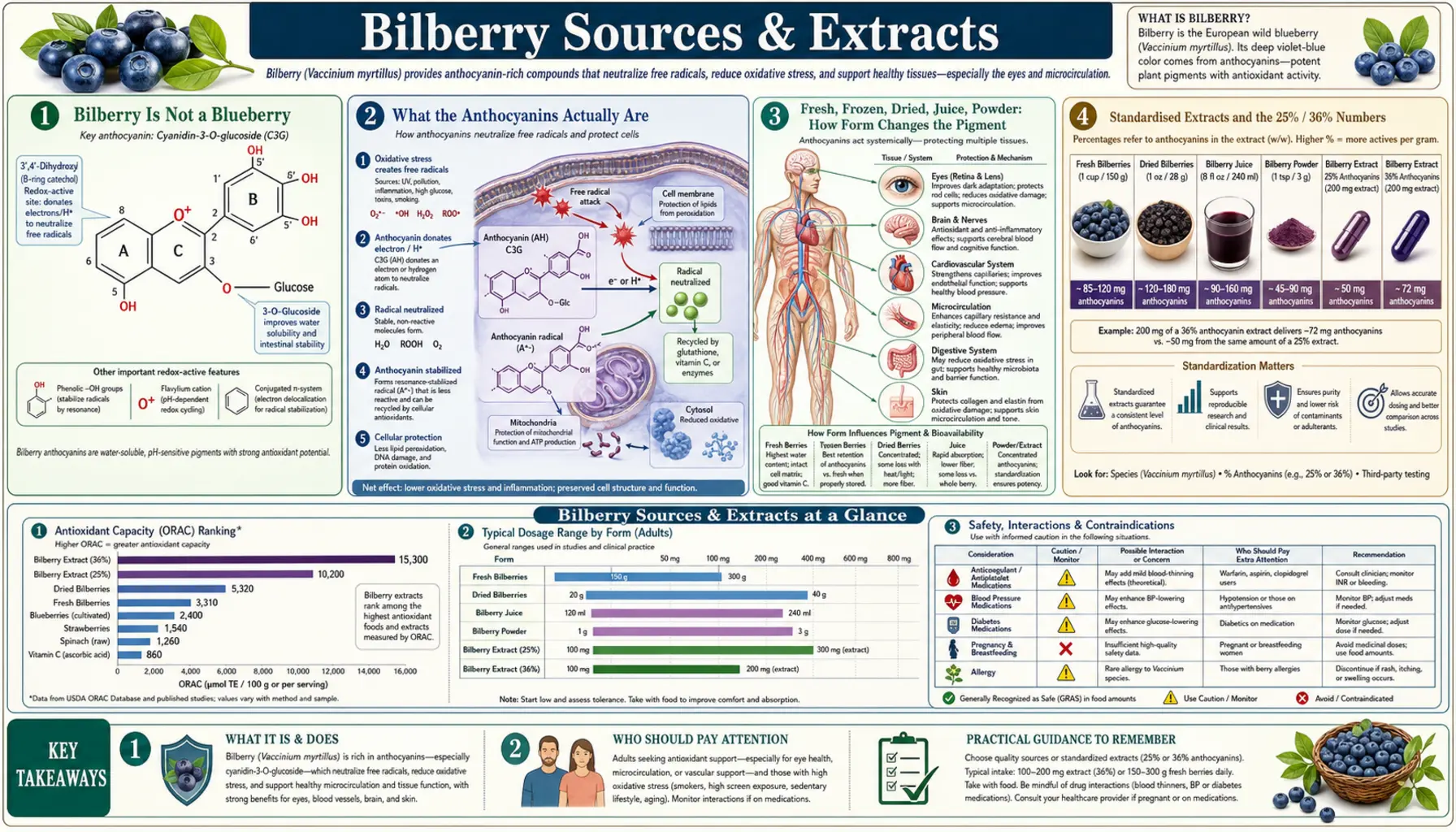
Almost everything that makes bilberry worth studying — the eye, vascular, and metabolic effects on the other three pages — comes down to its anthocyanins, and almost every practical mistake people make with bilberry comes down to not understanding those pigments. A wild European bilberry is not a supermarket blueberry; a "36% anthocyanoside" extract is not the same as a scoop of berry powder; and even the best extract is limited by the fact that anthocyanins are absorbed poorly and broken down quickly. This page is the buyer's and eater's guide: how bilberry differs from cultivated blueberry, what the standardisation numbers on a supplement label actually mean, how much the trials used, why bioavailability is the quiet ceiling on every result, and how to read a bottle so you get the pigment you are paying for.
Table of Contents
- Bilberry Is Not a Blueberry
- What the Anthocyanins Actually Are
- Fresh, Frozen, Dried, Juice, Powder: How Form Changes the Pigment
- Standardised Extracts and the 25% / 36% Numbers
- Dosing: How Much, How Often
- Bioavailability: the Quiet Limiting Factor
- How to Read a Label and Not Get Fooled
- Cooking and Eating Bilberries
- Quality, Cautions & Safety
- Key Research Papers
- External Authoritative Resources
- Connections
- Featured Videos
Bilberry Is Not a Blueberry
The single most useful fact about bilberry sources is that "bilberry" and "blueberry" are different plants that behave differently. Bilberry is Vaccinium myrtillus, a small wild shrub of northern European and Asian heath and forest; the familiar cultivated blueberry of North American supermarkets is mostly highbush blueberry, Vaccinium corymbosum. They are cousins in the same genus, but three practical differences matter:
- Pigment location. This is the big one. In a bilberry the anthocyanin pigment saturates the whole fruit, so the flesh and juice are deep purple; in a typical highbush blueberry the anthocyanins sit mainly in the skin and the flesh is pale green-white. Crush each and the difference is obvious on your fingers. Because bilberry pigments the pulp too, it packs substantially more anthocyanin per gram.
- Wild vs cultivated. Bilberry is essentially still a wild-harvested fruit — it resists commercial cultivation — while blueberries are a large cultivated crop. Wild harvest means more batch-to-batch variation in anthocyanin content, driven by species, region, altitude, sun exposure, and season.
- Anthocyanin profile. The two fruits carry overlapping but distinct mixtures of individual anthocyanins, which is why analytical papers can tell them apart and why substituting one for the other is not chemically neutral.
Müller, Schantz, and Richling (2012) quantified exactly this with HPLC, comparing the anthocyanin content of bilberries, blueberries, and their juices, and Burdulis and colleagues (2009) ran a comparative study of anthocyanin composition and antioxidant activity between bilberry and blueberry. The consistent finding: bilberry runs markedly higher in total anthocyanins, which is the whole reason bilberry, not blueberry, is the traditional medicinal berry. When you buy "bilberry," you are paying for that higher pigment load — so it matters that you actually get Vaccinium myrtillus.
What the Anthocyanins Actually Are
Bilberry's anthocyanins are a family of about fifteen related pigments. Chemically they are glycosides — sugar-attached forms — of five anthocyanidin "backbones": delphinidin, cyanidin, petunidin, peonidin, and malvidin. Each backbone appears attached to different sugars (glucose, galactose, arabinose), which is how you arrive at roughly fifteen distinct anthocyanins. In bilberry, delphinidin and cyanidin glycosides dominate, and delphinidin’s abundance is part of what gives bilberry its especially dark, blue-leaning colour.
Two vocabulary points clear up most label confusion:
- Anthocyanin = the sugar-attached (glycoside) pigment as it exists in the fruit. Anthocyanoside is an older, largely synonymous term used in the European literature.
- Anthocyanidin = the sugar-free core (aglycone) left after the sugar is removed. Because the sugar makes up a big fraction of the molecule’s weight, the same extract is a higher percentage when expressed as anthocyanosides and a lower percentage when expressed as anthocyanidins. That is the whole reason the same standardised bilberry extract is described both as "36% anthocyanosides" and as "25% anthocyanidins" — two ways of measuring the same material.
Lätti, Riihinen, and Kainulainen (2008) documented how much the anthocyanin content of wild Vaccinium myrtillus varies across natural populations in Finland — a reminder that "bilberry" is not one fixed dose of pigment but a range, which is precisely why standardised extracts exist. For the pure-compound view of these pigments, see the dedicated Anthocyanins page.
Fresh, Frozen, Dried, Juice, Powder: How Form Changes the Pigment
Anthocyanins are chemically fragile — sensitive to heat, oxygen, light, and changes in acidity — so the form you buy affects how much intact pigment you actually consume.
- Fresh bilberries — the reference standard, but genuinely fresh wild bilberries are seasonal and regional, hard to find outside northern Europe.
- Frozen — an excellent practical choice; freezing preserves anthocyanins well, and frozen wild bilberries retain most of their pigment.
- Dried — convenient and concentrated by weight, but drying (especially with heat) degrades some anthocyanin; quality varies widely.
- Juice — can be anthocyanin-rich but is sensitive to processing and storage; Müller and colleagues (2012) specifically analysed juices and found processing losses relative to the whole fruit.
- Powder — freeze-dried whole-fruit powder can retain pigment well; spray-dried or heat-processed powders may lose more. Powder is not the same as a standardised extract.
- Standardised extract (capsule/tablet) — the concentrated, quantified form used in most clinical trials, covered next.
The take-home: for food, frozen wild bilberries are the most reliable everyday source; for a trial-matching dose, a standardised extract is the way to get a known amount of anthocyanin.
Standardised Extracts and the 25% / 36% Numbers
Because wild bilberry pigment content varies so much, the pharmaceutical answer is a standardised extract: the fruit is extracted and the product is adjusted so that every batch contains a defined percentage of anthocyanins. The best-known standard, established by the Italian extract Mirtoselect and adopted across much of the research, is an extract standardised to 36% anthocyanosides, equivalent to about 25% anthocyanidins — the same material expressed two ways, as explained above. A well-defined standardised extract also fixes the profile of the fifteen anthocyanins, not just the total, so that it matches the natural fruit rather than being spiked with cheaper single pigments.
This standardisation is why the clinical literature is even interpretable. When Hoggard and colleagues (2013) studied a "36% anthocyanin" bilberry extract for glycemic response, or Riva and colleagues (2017) used the standardised Mirtoselect extract for dry eye, the reader knows roughly how much active pigment was delivered. An unstandardised "bilberry" capsule offers no such guarantee. When you shop, a stated standardisation (for example, "standardised to 25% anthocyanidins" or "36% anthocyanosides") is the single most useful quality signal on the label.
Dosing: How Much, How Often
There is no official Recommended Dietary Allowance for bilberry or for anthocyanins — they are not essential nutrients — so "dose" means the amounts that have been used in studies and in traditional European practice, not a requirement.
- Standardised extract (25% anthocyanidin / 36% anthocyanoside): traditional venotonic and study dosing is broadly in the range of 80–160 mg once to three times daily, with the classic European venous-support regimen around 160 mg twice daily. Different endpoints used different amounts.
- Eye-fatigue and dry-eye trials used standardised extracts in this general range over weeks; the metabolic (glycemic) study by Hoggard delivered a single sizeable anthocyanin load with a meal.
- Whole fruit: the whole-diet studies used everyday culinary servings (on the order of a cupful of berries, fresh or frozen, most days), which is the simplest and safest way to get a meaningful anthocyanin intake.
Because anthocyanins clear the body quickly (next section), split dosing through the day is more physiologic than a single large dose for ongoing use. Start at the lower end, give any trial several weeks, and judge honestly against the realistic expectations set on the Eye & Vision, Circulation & Veins, and Blood Sugar pages.
Bioavailability: the Quiet Limiting Factor
Here is the fact that quietly governs every bilberry result: anthocyanins are absorbed poorly. Human bioavailability studies consistently find that only a small percentage of ingested anthocyanin appears intact in the blood, that plasma levels peak low and fall within a few hours, and that much of the pigment is metabolised in the gut and liver into other phenolic compounds or handled by the gut microbiota before it ever reaches tissue.
Mazza, Kay, Cottrell, and Holub (2002) measured the absorption of anthocyanins from blueberries and the resulting serum antioxidant status in human subjects, documenting this characteristically low absorption. Manach and colleagues (2005), in a landmark review of ninety-seven human bioavailability studies of polyphenols in the American Journal of Clinical Nutrition, placed anthocyanins among the least well-absorbed of all dietary polyphenols.
Two honest implications follow. First, low bioavailability is a real reason to be modest about bilberry's effects — it is part of why the clinical results are gentle rather than dramatic. Second, it reframes the mechanism: because so little intact pigment circulates, some of bilberry's benefit may come from its metabolites and from effects in the gut itself rather than from high anthocyanin concentrations in distant tissues. It also argues for split, regular dosing over occasional megadoses, and for realistic expectations. A brightly coloured berry does not deliver its colour to your bloodstream in proportion to what you eat.
How to Read a Label and Not Get Fooled
The bilberry supplement aisle is a place where the pigment you pay for and the pigment you get can diverge widely. A short checklist:
- Species named. The label should say Vaccinium myrtillus. If it just says "bilberry" with no Latin name, or names a different Vaccinium species, be sceptical — some products substitute cheaper blueberry or other berry material.
- Standardisation stated. Look for "standardised to 25% anthocyanidins" or "36% anthocyanosides." A milligram figure with no standardisation tells you the weight of powder, not the amount of active pigment.
- Fruit, not leaf. Confirm it is the fruit/berry extract. Bilberry leaf is a different product with safety concerns at high doses (see below).
- Third-party testing. Because bilberry is wild-harvested and expensive, adulteration is a documented problem; a reputable third-party quality seal is worth seeking.
- Beware "proprietary blends." If bilberry is buried in a blend without its own quantity and standardisation, you cannot know what you are getting.
Bilberry sits alongside other standardised flavonoid extracts on this site — Grape Seed Extract, Pycnogenol, Rutin, and Hesperidin — and the same label-reading discipline applies to all of them.
Cooking and Eating Bilberries
For most people, the best "source" of bilberry is simply the fruit. Frozen wild bilberries stirred into yoghurt or oatmeal, blended into a smoothie, or eaten by the handful deliver anthocyanins in the whole-food matrix the diet studies actually tested. A few practical notes:
- Cold beats hot. Because heat degrades anthocyanins, raw or gently used berries preserve more pigment than long cooking. If you make a compote or jam, keep cooking brief.
- Acidity helps colour. Anthocyanins are more stable and more vividly coloured in acidic conditions, which is part of why a squeeze of lemon brightens a berry sauce.
- Whole diet, not heroic dose. The metabolic and vascular population evidence is about a regular berry-containing pattern, not an occasional megadose. Everyday, ordinary servings are the point.
- Blueberries are a fine stand-in for general health. If wild bilberries are unavailable, blueberries and other dark berries still supply anthocyanins — just less concentrated — and carry much of the same general benefit.
Quality, Cautions & Safety
- Adulteration is the main quality risk. Genuine wild bilberry extract is costly, which creates an incentive to dilute or substitute it. Species labelling, stated standardisation, and third-party testing are your defences.
- Fruit is very safe; leaf is not equivalent. Bilberry fruit and its standardised extract have an excellent safety record at usual doses. Bilberry leaf preparations contain compounds (including hydroquinone) that raise concern with high or prolonged use — do not treat the two as interchangeable.
- Bleeding and drug interactions. Concentrated anthocyanin extracts may mildly affect platelet function and can add to the glucose- and blood-pressure-lowering effects of medication; use caution with anticoagulants/antiplatelets and before surgery, and monitor if you are treated for diabetes or hypertension.
- Pregnancy and breastfeeding. Bilberry fruit as food is fine; concentrated extracts are not well studied, so food amounts are the sensible default.
- Not a cure. No form or dose of bilberry treats eye disease, venous disease, or diabetes on its own; use it as a supportive food or adjunct within proper care.
Key Research Papers
- Müller D, Schantz M, Richling E (2012). HPLC analysis of anthocyanins in bilberries (Vaccinium myrtillus L.), blueberries (Vaccinium corymbosum L.), and corresponding juices. Journal of Food Science. — PMID 22394068
- Burdulis D et al. (2009). Comparative study of anthocyanin composition, antimicrobial and antioxidant activity in bilberry and blueberry fruits. Acta Poloniae Pharmaceutica. — PMID 19702172
- Lätti AK, Riihinen KR, Kainulainen PS (2008). Analysis of anthocyanin variation in wild populations of bilberry (Vaccinium myrtillus L.) in Finland. Journal of Agricultural and Food Chemistry. — PMID 18072741
- Lätti AK et al. (2010). Anthocyanin and flavonol variation in bog bilberries (Vaccinium uliginosum L.) in Finland. Journal of Agricultural and Food Chemistry. — PMID 20000402
- Mazza G, Kay CD, Cottrell T, Holub BJ (2002). Absorption of anthocyanins from blueberries and serum antioxidant status in human subjects. Journal of Agricultural and Food Chemistry. — PMID 12475297
- Manach C et al. (2005). Bioavailability and bioefficacy of polyphenols in humans. I. Review of 97 bioavailability studies. American Journal of Clinical Nutrition. — PMID 15640486
- Hoggard N et al. (2013). A single supplement of a standardised bilberry extract modifies glycaemic response in individuals with type 2 diabetes. Journal of Nutritional Science. — PMID 25191571
- Riva A et al. (2017). The effect of a natural, standardized bilberry extract (Mirtoselect) in dry eye. European Review for Medical and Pharmacological Sciences. — PMID 28617532
- Ghosh A et al. (2024). Effects of Vaccinium-derived antioxidants on human health: the past, present and future. Frontiers in Molecular Biosciences. — PMID 39758282
- Yang L et al. (2017). Effects of anthocyanins on cardiometabolic health: a systematic review and meta-analysis of randomized controlled trials. Advances in Nutrition. — PMID 28916569
PubMed Topic Searches
- PubMed: bilberry vs blueberry anthocyanin content
- PubMed: standardised bilberry extract
- PubMed: anthocyanin bioavailability
- PubMed: anthocyanin stability and processing
- PubMed: bilberry supplement authentication
External Authoritative Resources
- NIH NCCIH — Bilberry
- MedlinePlus — Bilberry (uses, dosing, interactions)
- USDA FoodData Central — berry nutrient composition
Connections
- Bilberry Overview
- Bilberry Benefits Hub
- Bilberry for Eye & Vision
- Bilberry for Circulation & Veins
- Bilberry for Blood Sugar
- Bilberry History
- Anthocyanins
- Grape Seed Extract
- Pycnogenol
- Rutin
- Hesperidin
- Astaxanthin
- Blueberries
- Vitamin C
- All Antioxidants