Methionine: History and Discovery
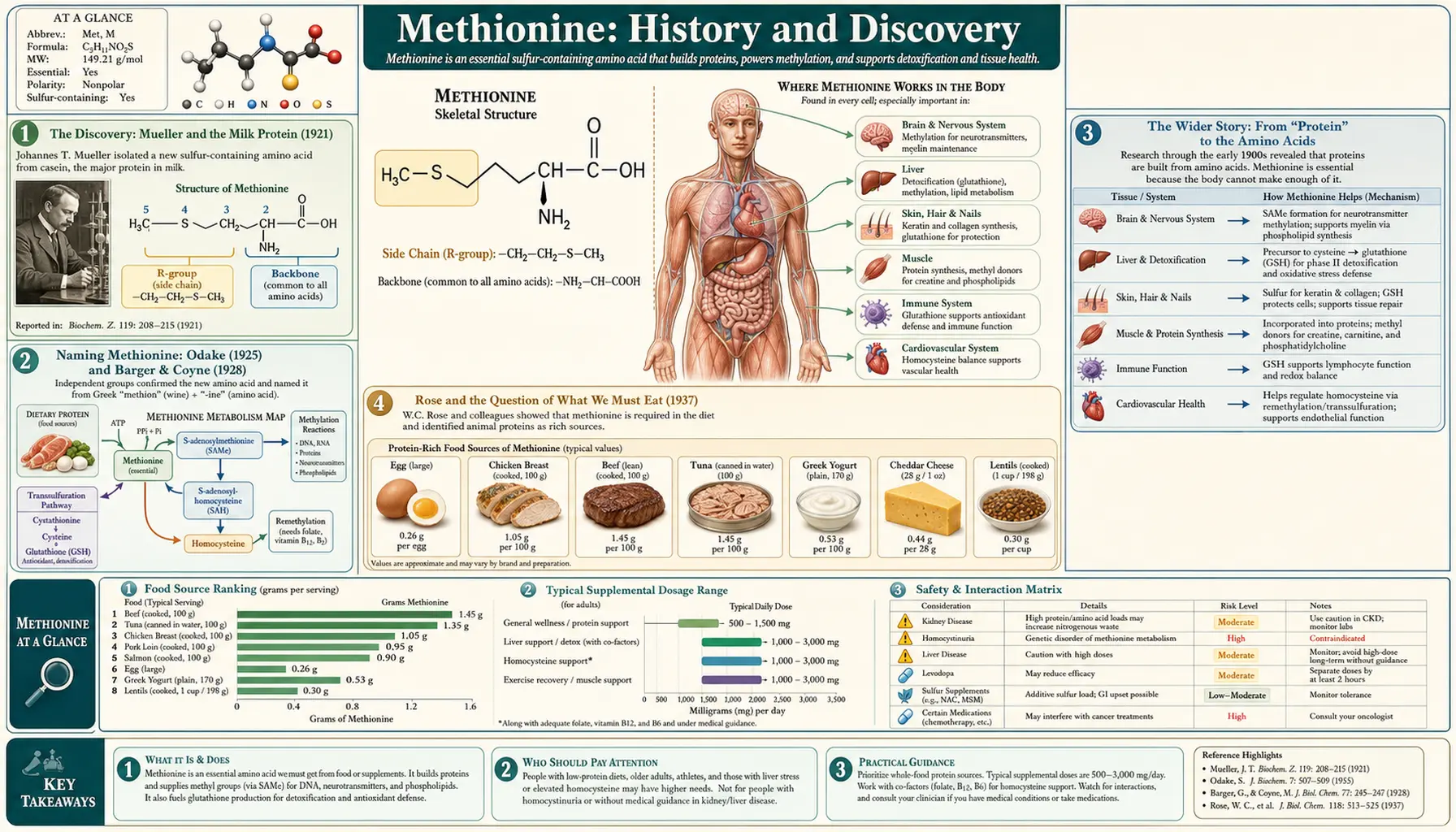
Methionine has an unusually well-documented birthday. Unlike the very first amino acids — some of which were teased out of asparagus juice or gelatin in the early 1800s — methionine arrived late, in 1921, when the American bacteriologist John Howard Mueller was hunting for the nutrients that bacteria need to grow and isolated a new sulfur-containing amino acid from milk protein. The short, chemical name we still use is most often credited to the Japanese chemist Satoru Odake in 1925, though two chemists in Edinburgh independently proposed the same name in 1928 when they worked out the molecule's exact structure — and, in doing so, left the clearest written record explaining precisely why it is called “methionine.” (Exactly who deserves priority for the name is a genuine, unresolved point, discussed below.) This article tells that story plainly: who isolated it and from what, how it got its name, how it came to be recognized as one of the handful of amino acids the human body cannot make for itself, and how later scientists discovered that this one molecule sits at the center of the body's chemistry of methylation. Where the historical record is firm we say so; where dates or credit are reported differently by different sources, we say that too.
Table of Contents
- The Discovery: Mueller and the Milk Protein (1921)
- Naming Methionine: Odake (1925) and Barger & Coyne (1928)
- The Wider Story: From “Protein” to the Amino Acids
- Rose and the Question of What We Must Eat
- Du Vigneaud and the Chemistry of Methylation
- The Amino Acid That Starts Every Protein
- From Discovery to Modern Understanding
- Research Papers and References
- Connections
- Featured Videos
The Discovery: Mueller and the Milk Protein (1921)
Methionine was one of the last of the common protein amino acids to be found, and it was discovered almost by accident, by a scientist who was not looking for it at all. John Howard Mueller (1891–1954) was an American bacteriologist studying what bacteria need to eat in order to grow. To answer that question he took proteins apart, broke them down into their building blocks, and tested which fragments fed his cultures. Working with casein — the main protein of milk — he separated out, around 1921–1922, a new amino acid that contained sulfur, and he published the full account in the Journal of Biological Chemistry in 1923 under the plain title “A new sulphur-containing amino-acid isolated from the hydrolytic products of protein.” (Sources commonly date the isolation to either 1921 or 1922; the published paper is firmly 1923.)
The effort this took is worth pausing on, because it shows how hard early amino-acid chemistry was. There were no modern separation machines; everything was done by crystallizing substances out of solution by hand. By later accounts, isolating roughly a hundred to two hundred grams of the new amino acid required on the order of fifty to seventy kilograms of casein and enormous patience. Part of the purification was carried out in the summer of 1922, while Mueller spent time in the Cambridge laboratory of Frederick Gowland Hopkins, the British biochemist who would later share the Nobel Prize for his work on vitamins and who had himself, two decades earlier, co-discovered the amino acid tryptophan.
At the moment of discovery the substance had no friendly name. Because it was a sulfur-bearing relative of a known acid, it was described chemically — as the “γ-methylthiol” derivative of α-amino-n-butyric acid — a label accurate enough for chemists but far too clumsy for everyday use. What Mueller had established was the important thing: a previously unknown, sulfur-containing amino acid was a genuine constituent of an ordinary food protein. Naming it, and pinning down its exact shape, fell to others a few years later.
Naming Methionine: Odake (1925) and Barger & Coyne (1928)
The name methionine is usually traced to the mid-1920s, and unusually for a scientific word, the question of who coined it is itself part of the story. Many standard reference works credit the Japanese chemist Satoru Odake, a colleague of Mueller's, with proposing the name in 1925 — as a contraction of the systematic description 2-amino-4-(methylthio)butanoic acid — in the course of correcting the molecular formula Mueller had first reported. A few years later, working independently in Britain, the chemists George Barger and Frederick Philip Coyne, in the Department of Medical Chemistry at the University of Edinburgh, determined the molecule's correct chemical structure and, in the same 1928 paper, also put the name “methionine” into print — giving us the inventors' own explanation of it. Their paper, titled “The amino-acid methionine; constitution and synthesis” and published in the Biochemical Journal, is the earliest primary document in which the name and the structure appear together and remains directly checkable today.
Barger and Coyne's reasoning, preserved in the paper, is refreshingly direct. Because the amino acid clearly deserved to be treated as a normal constituent of protein, they wrote, a name shorter than “γ-methylthiol-α-aminobutyric acid” was plainly needed, and so — “after consultation with Dr Mueller,” who had found it — they suggested methionine, “in allusion to the characteristic grouping.” That characteristic grouping is the methylthio group — a sulfur atom carrying a methyl (CH3) cap — which is exactly what makes methionine chemically distinctive. The word is, in effect, a compression of meth(yl) + thio (sulfur) + the -ine ending used for many such compounds.
So who, then, really named methionine? This is a real and unresolved point of priority, and it is worth being plain about. Numerous secondary sources — including standard encyclopaedias and chemistry references — state flatly that Odake coined the name in 1925, which would give the Japanese chemist clear precedence. Yet the Barger and Coyne paper of 1928 proposes the name in its authors' own words, as something they are suggesting, and (in the text as printed) does not cite an earlier coinage by Odake. The two facts are hard to reconcile completely: either Barger and Coyne were unaware of, or did not credit, an existing 1925 name, or the widely repeated “Odake 1925” attribution rests on a source that is itself uncertain. What is not in doubt is what the name describes — the methylthio group — on which every account agrees. We lay out both attributions here rather than choosing between them, because the documented record genuinely does not settle the question, and a discovery story owes its readers the dispute rather than a tidy fiction.
The Wider Story: From “Protein” to the Amino Acids
Methionine's 1921 discovery makes more sense against the century of work that came before it. The earliest amino acids were isolated long before anyone understood what proteins really were. Asparagine — the first amino acid of all — was obtained from asparagus juice in 1806 by the French chemists Louis-Nicolas Vauquelin and Pierre-Jean Robiquet. Glycine was crystallized from gelatin in 1820 by Henri Braconnot, who tasted its sweetness and called it “sugar of gelatin.” Tyrosine was drawn from cheese by Justus von Liebig in 1846, which is why its name comes from the Greek tyros, “cheese.” These discoveries were scattered across decades, each amino acid coaxed out of whatever natural material happened to be rich in it.
The unifying idea arrived in 1838, when the Dutch chemist Gerardus Johannes Mulder, in correspondence with the great Swedish chemist Jöns Jacob Berzelius, gave these nitrogen-rich substances a single name: protein, from a Greek root meaning “first” or “of prime importance.” Around the turn of the twentieth century, the German chemist Emil Fischer showed how amino acids actually link together — through what we now call the peptide bond — to form the long chains that make up proteins. Fischer received the Nobel Prize in Chemistry in 1902, though that award was specifically for his earlier work on sugars and purines; his foundational studies of peptides and amino acids came mostly in the years just after the prize. By the time Mueller isolated methionine, then, chemists already understood that proteins were chains of amino acids; the remaining task, which occupied the first decades of the twentieth century, was to find every link in the chain. Methionine was one of the last of the common ones to be added to that list.
Rose and the Question of What We Must Eat
Finding an amino acid is one thing; learning whether the human body can build it for itself is another, and far harder, question. The scientist who answered it for methionine — and for the rest of the amino acids — was the American biochemist William Cumming Rose (1887–1985), working at the University of Illinois. Beginning in the 1930s, Rose fed laboratory rats carefully controlled diets in which purified amino acids, rather than whole protein, were the only source of nitrogen, then removed them one at a time to see which ones the animals could not do without.
This program of work produced the modern concept of the essential (or “indispensable”) amino acids — those that must come from food because the body cannot synthesize them in adequate amounts. Methionine was among them. Rose's rat studies also revealed a relationship that still shapes nutrition advice today: the sulfur amino acid cysteine (long studied in its paired form, cystine) can “spare” methionine, reducing how much methionine the diet must supply — which is why dietary requirements are often given for methionine and cysteine together rather than separately. In the course of this same research, Rose and his colleagues isolated threonine in 1935, the last of the standard amino acids to be discovered and the final piece that let rats thrive on purified amino acids alone.
In 1942 Rose carried the method over to people, running balance studies in which healthy adult volunteers lived on diets built from purified amino acids while their nitrogen intake and output were measured. From these human experiments he established which amino acids are essential for adults and roughly how much of each is needed — foundational numbers that still inform dietary reference values. Methionine's status as an essential nutrient, in other words, is not a matter of tradition or assumption; it rests on decades of deliberate, quantitative experiment.
Du Vigneaud and the Chemistry of Methylation
If Mueller found methionine and Rose proved we need it, it was the American biochemist Vincent du Vigneaud (1901–1978) who, more than anyone, revealed what it does. Over a long career working with sulfur-containing molecules, du Vigneaud traced how the body handles methionine, cysteine, and their relatives, and he became closely associated with the discovery of transmethylation — the biological transfer of a methyl group from one molecule to another. He showed that methionine carries a “labile” (readily movable) methyl group that the body can pass along to build other essential compounds.
This insight is the historical seed of everything the main Methionine page describes about methylation. Methionine is the raw material from which the body makes S-adenosylmethionine (commonly written SAMe or AdoMet), the molecule that actually delivers methyl groups in hundreds of reactions — switching genes on and off, helping make neurotransmitters, and processing hormones. Du Vigneaud's work on these sulfur compounds, together with his later achievement of being the first to synthesize a peptide hormone (oxytocin), earned him the Nobel Prize in Chemistry in 1955, awarded, in the committee's words, “for his work on biochemically important sulphur compounds, especially for the first synthesis of a polypeptide hormone.” The chemistry that makes methionine matter so much to human health was, in large part, mapped by him.
The Amino Acid That Starts Every Protein
Methionine holds one more distinction, uncovered when scientists cracked the genetic code in the 1960s. As researchers worked out which three-letter sequences of genetic code (the codons) stand for which amino acids, they found that one codon — AUG — does double duty. It both specifies methionine and serves as the universal “start” signal that tells the cell's protein-building machinery where to begin. Because of this, in the cells of humans, animals, plants, and fungi, the very first amino acid laid down in essentially every freshly made protein is methionine. (In many finished proteins it is later trimmed off, but the chain almost always begins with it.)
This was not part of methionine's original discovery story — Mueller, Barger, Coyne, Rose, and du Vigneaud did their work before anyone knew of codons — but it rounds out the historical picture in a satisfying way. A molecule first noticed because bacteria needed it to grow turned out, decades later, to be the literal starting point of protein synthesis itself. It is a fitting role for an amino acid whose history is, from the beginning, bound up with the question of what living things must have in order to build themselves.
From Discovery to Modern Understanding
The thread running from 1921 to today is one of a single molecule being understood in ever greater depth. Mueller isolated methionine; Barger and Coyne named it and drew its structure; Rose proved the body cannot make it and measured how much we need; du Vigneaud showed how its sulfur and its methyl group drive the chemistry of methylation; and the geneticists of the 1960s found it standing at the head of every protein. Each step added a layer rather than overturning the last, which is why methionine's history reads as a steady accumulation of fact rather than a series of reversals.
Modern research has carried this foundation into medicine. The role of S-adenosylmethionine in liver health, in mood, and in joint comfort — reviewed in depth by investigators such as José Mato and Shelly Lu — grows directly out of du Vigneaud's transmethylation chemistry. The careful attention paid today to homocysteine, the by-product of methionine metabolism that can rise when B vitamins run short, grows directly out of the metabolic pathways those early chemists first sketched. The detailed biology, the food sources, the supplement forms, and the cautions are covered on the companion Methionine Benefits articles and on the main Methionine page; this history is concerned only with how we came to know the molecule in the first place.
Two honest notes close any history like this. First, knowing a molecule's past tells you what it is and does, not how to dose it; nutritional and clinical decisions belong with a qualified practitioner. Second, the names and dates above are the ones the documented record supports, and where that record is genuinely uncertain — as with the exact attribution of the name “methionine” — this page has flagged the uncertainty rather than papering over it. That, in the end, is what a discovery story owes its readers.
Research Papers and References
The list below combines the key primary papers in methionine's discovery with authoritative biographical and review sources and a pair of curated PubMed topic searches. Author names, titles, and journals are given as plain text; only a stable DOI, PMID, PMC, or institutional link is hyperlinked, and each opens in a new tab. The historical naming dispute noted in the article (Odake, 1925, versus Barger and Coyne, 1928) is reflected in these primary sources.
- Mueller JH. A new sulphur-containing amino-acid isolated from the hydrolytic products of protein. Journal of Biological Chemistry. 1923;56:157–169. — PubMed: Mueller 1923 sulphur-containing amino acid
- Barger G, Coyne FP. The amino-acid methionine; constitution and synthesis. Biochemical Journal. 1928;22(6):1417–1425. — doi:10.1042/bj0221417 · PMID: 16744158
- Simoni RD, Hill RL, Vaughan M. The discovery of the amino acid threonine: the work of William C. Rose [classical article]. Journal of Biological Chemistry. 2002;277(37):e25. — PMID: 12218068
- Carter HE, Coon MJ. William Cumming Rose, 1887–1985: a biographical memoir. National Academy of Sciences, Biographical Memoirs. — National Academy of Sciences: W. C. Rose memoir
- The Nobel Prize in Chemistry 1955: Vincent du Vigneaud, “for his work on biochemically important sulphur compounds.” The Nobel Foundation. — NobelPrize.org: du Vigneaud 1955
- Mato JM, Lu SC. Role of S-adenosyl-L-methionine in liver health and injury. Hepatology. 2007;45(5):1306–1312. — PMID: 17464973
- Methionine — isolation, history, and naming — PubMed: methionine history and discovery
- Methionine and S-adenosylmethionine metabolism — PubMed: methionine and transmethylation metabolism
External Authoritative Resources
- Encyclopædia Britannica — Methionine
- NIH Office of Dietary Supplements — Fact Sheets
- PubMed — All research on methionine
Connections
- All Amino Acids
- Methionine
- Methionine Benefits
- Cysteine
- Threonine
- Glycine
- Taurine
- Homocysteine
- Sulfur