Taurine for Cardiac Function
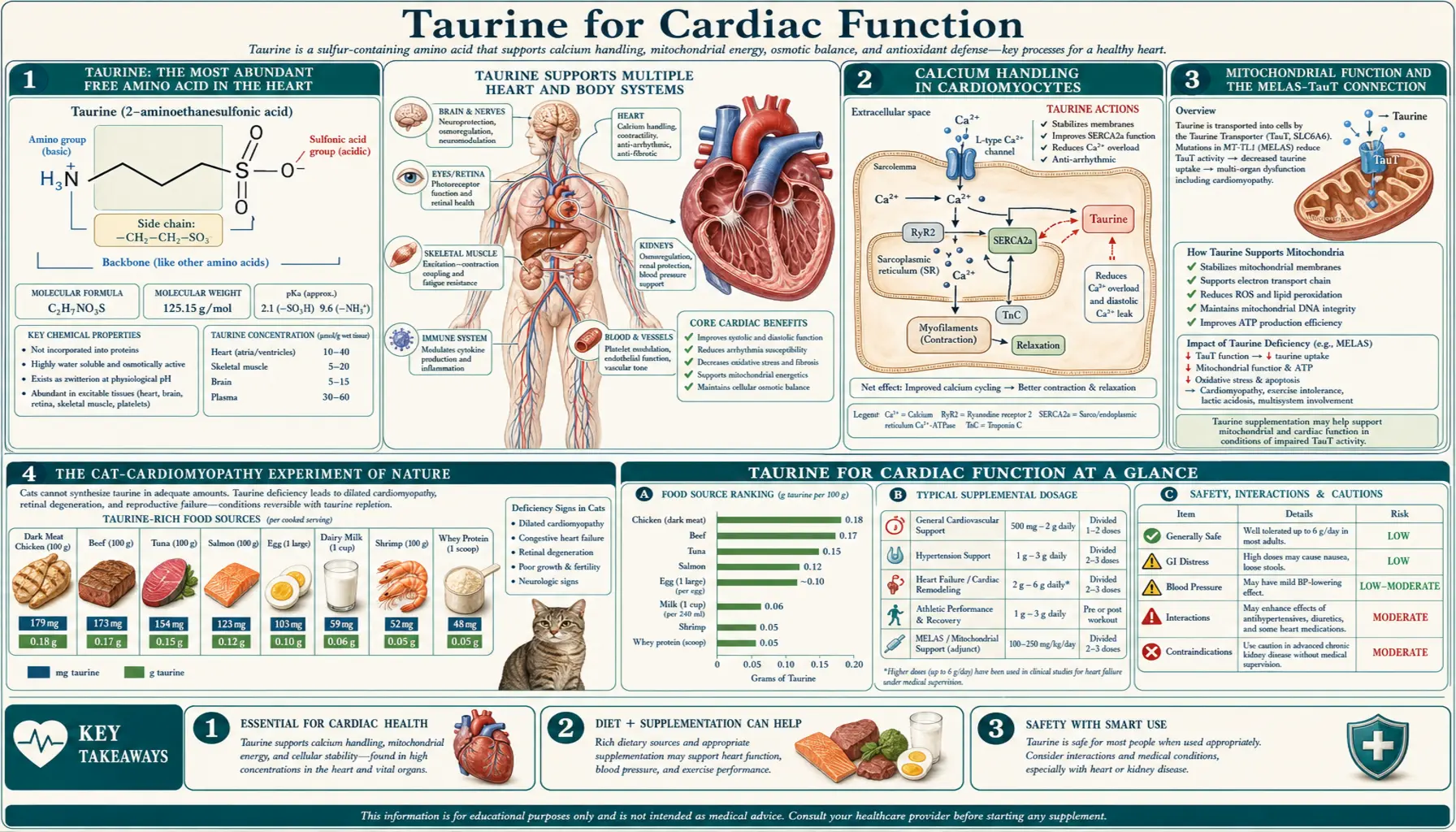
Taurine is present in millimolar concentrations in the heart muscle of all mammals (Pion and colleagues 1987) and is found in very high concentrations in heart and skeletal muscle (Schaffer and colleagues 2010). A 1987 study in Science by Pion and colleagues linked low plasma taurine in cats to a dilated cardiomyopathy that improved with oral taurine — an observation that established taurine as essential to the cat heart. In people, small trials in congestive heart failure (Azuma 1985, Beyranvand 2011) reported improvements in functional class and exercise capacity, and meta-analyses report modest effects on blood pressure, heart rate, and ejection fraction. This deep-dive covers the calcium-handling and mitochondrial mechanisms studied in the laboratory, the cat studies, the human trials, and what they did and did not show.
Table of Contents
- Taurine Concentrations in the Heart
- Calcium Handling in Cardiomyocytes
- Mitochondrial Function and the MELAS-TauT Connection
- The Cat-Cardiomyopathy Experiment of Nature
- Congestive Heart Failure: The Azuma and Beyranvand Trials
- Mitral Valve Prolapse and Magnesium
- Ischemia-Reperfusion Protection
- Population Data: The WHO-CARDIAC Study
- Multi-Nutrient Supplement Trials
- Doses Used in Cardiac Studies
- Safety Findings for People With Heart Conditions
- Key Research Papers
- Connections
- Featured Videos
Taurine Concentrations in the Heart
Taurine is present in millimolar concentrations in the myocardium of all mammals, and myocardial taurine concentrations are directly related to plasma concentrations (Pion and colleagues 1987). Unlike most amino acids, taurine is not built into proteins. Its amino group is involved in conjugation reactions and in scavenging hypochlorous acid, and it acts as a modulator of osmotic pressure, cation balance, enzyme activity, and cell signalling (Schaffer and colleagues 2010).
The heart contains large amounts of contractile protein (actin, myosin, troponin, titin), but taurine is not part of any of them; it exists as a free molecule inside the cells.
Taurine is carried into cells by the sodium-dependent taurine transporter (TauT, gene SLC6A6) (Han and colleagues 2006). Mice in which the TauT gene is knocked out lose tissue taurine and show loss of body weight, abnormal cardiac function, and reduced exercise capacity (Ito and colleagues 2010). A 2022 systematic review notes that genome-wide association studies of human dilated cardiomyopathy have identified the SLC6A6 locus (McGurk and colleagues 2022).
Taurine was long regarded as an end product of sulfur amino acid metabolism (Gaull 1989). The 1987 cat study, described below, was the first to associate taurine depletion with a decrease in heart-muscle function in any species (Pion and colleagues 1987).
Calcium Handling in Cardiomyocytes
The heart contracts by releasing calcium from the sarcoplasmic reticulum (SR) into the cytoplasm in a precisely timed wave. Calcium binds to troponin C, which uncovers actin binding sites on the thin filament, allowing myosin cross-bridges to engage and produce force. Relaxation requires equally precise removal of calcium: SERCA (sarco/endoplasmic reticulum calcium ATPase) pumps calcium back into the SR, and the sodium-calcium exchanger (NCX) extrudes calcium across the plasma membrane in exchange for sodium. The whole cycle — calcium release, contraction, calcium reuptake, relaxation — happens approximately once per second at rest and more frequently during exercise.
Reviews attribute taurine's role in normal contraction to changes in the activity of key calcium transporters and in the calcium sensitivity of the myofibrils (Schaffer and colleagues 2010). Laboratory studies describe effects at several sites:
- L-type calcium channels (the plasma membrane gateway): taurine reduces the inappropriate prolonged opening of L-type voltage-gated calcium channels during stress conditions (ischemia, hypoxia, adrenergic surge). This reduces the calcium overload that drives ischemia-reperfusion injury and adverse remodeling.
- SERCA (the calcium re-uptake pump): taurine enhances SERCA activity, accelerating the removal of cytoplasmic calcium during diastole.
- Ryanodine receptor (RyR2, the calcium release channel): taurine stabilizes RyR2 in its closed state during diastole, reducing the calcium leak that contributes to ventricular arrhythmia and impaired contractility.
- Sodium-calcium exchanger (NCX): taurine modulates NCX activity in a way that prevents calcium overload during ischemia-reperfusion. When the sodium gradient collapses during ischemia, NCX can reverse direction and pump calcium into the cell — a major driver of reperfusion injury. Taurine attenuates this reverse-mode NCX activity.
Proposed mechanisms include taurine's direct interactions with membrane phospholipids and its inhibition of the enzyme phospholipid N-methyltransferase, which changes the phospholipid make-up of membranes and in turn the function of membrane proteins (Schaffer and colleagues 2010). These are findings from animal and cell studies.
Mitochondrial Function and the MELAS-TauT Connection
Heart-muscle cells are densely packed with mitochondria, which supply the ATP for continuous contraction, and mitochondrial damage is considered a contributor to heart failure.
In 2002, Suzuki and colleagues identified two taurine-containing modified uridines (5-taurinomethyluridine and 5-taurinomethyl-2-thiouridine) in human and bovine mitochondrial tRNAs, the first evidence that taurine is a constituent of a biological macromolecule. These nucleosides are made by direct incorporation of taurine.
The same study found that these taurine modifications are missing in mutant mitochondrial tRNAs for leucine (UUR) and lysine from cells of patients with the mitochondrial diseases MELAS (mitochondrial encephalomyopathy, lactic acidosis, and stroke-like episodes) and MERRF, respectively (Suzuki and colleagues 2002). In those diseases the defect lies in the tRNA mutation itself, not in a shortage of taurine. Whether dietary taurine deficiency in people impairs heart mitochondria in a similar way has not been shown.
In experimental studies, taurine also limits activation of the mitochondrial permeability transition, a key step in cell death during ischemia-reperfusion injury, partly by reducing sodium-driven calcium overload and partly by preventing excessive generation of reactive oxygen species by the respiratory chain (Schaffer and colleagues 2014).
The Cat-Cardiomyopathy Experiment of Nature
The evidence that taurine matters for heart function came first from domestic cats. As Pion and colleagues wrote in 1987, thousands of pet cats died each year of dilated cardiomyopathy, a weakening and enlargement of the heart muscle, of unknown cause.
Cats depend on dietary taurine: a 1989 review describes cats as unable to absorb or synthesize enough taurine to cover their needs, and reports taurine deficiency in “a large number of cats fed unfortified commercial diets” (Hayes and Trautwein 1989).
Pion and colleagues found low plasma taurine together with echocardiographic evidence of heart-muscle failure in 21 cats fed commercial cat foods, and in 2 of 11 cats kept for 4 years on a purified diet marginally low in taurine. Oral taurine raised plasma taurine and was associated with normalization of left ventricular function in both groups. The findings were published in 1987 in Science. In a 1992 follow-up of 37 cats with moderate to severe dilated cardiomyopathy given taurine, 14 died within the first 30 days, 22 showed marked clinical and echocardiographic improvement, and 1-year survival was 58%, against 13% in an earlier, retrospectively reviewed group (Pion and colleagues 1992).
The cat findings raised the question of whether taurine plays a part in human cardiomyopathy. A 2022 systematic review of eleven human studies in heart failure found that only one was of high quality; improvements in heart function, exercise capacity, and haemodynamics were described, but the meta-analysis of ejection fraction and stroke volume was not significant, and the authors concluded that a formal clinical trial is needed (McGurk and colleagues 2022).
Commercial cat food came to be fortified with taurine. In dogs, the U.S. Food and Drug Administration announced in July 2018 that it had begun investigating reports of dilated cardiomyopathy in dogs eating certain pet foods, many labeled “grain-free” and high in peas, lentils, other pulses, or potatoes; the agency states that adverse-event reports by themselves do not supply sufficient data to establish a causal relationship (FDA investigation page). The FDA notes that dilated cardiomyopathy in Cocker Spaniels is associated with taurine deficiency.
Congestive Heart Failure: The Azuma and Beyranvand Trials
Two small trials are the most often cited for taurine in congestive heart failure (CHF). The first, by Azuma and colleagues, was published in 1985 in Clinical Cardiology: a double-blind, randomized, placebo-controlled crossover study in 14 patients, adding taurine to conventional treatment for 4 weeks. Compared with placebo, taurine:
- Improved New York Heart Association (NYHA) functional class
- Improved pulmonary crackles and chest X-ray abnormalities
- Shortened the pre-ejection period, a timing measure of heart contraction
- Produced no side effects; no patient worsened on taurine, while four worsened on placebo
The trial was small and short.
The second was Beyranvand and colleagues (2011), published in the Journal of Cardiology: a randomized, single-blind, placebo-controlled trial in 29 patients with heart failure (NYHA class II or III, mean ejection fraction about 29%) on standard treatment. Fifteen patients received 500 mg of taurine three times daily and 14 received placebo for 2 weeks. Results:
- Exercise time, metabolic equivalents (METs), and exercise distance on an exercise tolerance test increased significantly with taurine
- The same measures did not increase significantly with placebo
Ejection fraction was measured at the start of the trial; the abstract does not report a change in it.
A 2024 meta-analysis of 20 randomized trials (808 participants, across several conditions) reported that taurine increased left ventricular ejection fraction by about 5 percentage points and improved NYHA class, with no significant adverse effects compared with controls (Tzang and colleagues 2024). The 2022 systematic review limited to heart failure reached a more cautious conclusion, as noted above (McGurk and colleagues 2022). In the trials, taurine was added to standard heart-failure treatment, not used in place of it.
Mitral Valve Prolapse and Magnesium
Mitral valve prolapse (MVP) is a common valve abnormality. A subset of patients with “MVP syndrome” report palpitations, chest pain, fatigue, anxiety, and shortness of breath.
The trial evidence in MVP concerns magnesium rather than taurine. In a 1997 study, low serum magnesium was found in 60% of 141 patients with heavily symptomatic MVP and in 5% of 40 controls; in a double-blind crossover comparison with placebo, magnesium supplementation for 5 weeks cut the mean number of symptoms from 10.4 to 5.6 per patient and reduced catecholamine excretion (Lichodziejewska and colleagues 1997). No trial of taurine or magnesium taurate in MVP was found in PubMed.
An early report that linked low heart-muscle taurine and high urinary taurine to mitral valve prolapse and cardiomyopathy in one family (New England Journal of Medicine, 1981) was retracted in 1983.
Magnesium taurate combines magnesium with taurine; its effects in MVP have not been tested in a published trial.
Ischemia-Reperfusion Protection
Ischemia-reperfusion injury is the damage that occurs when blood flow is restored to tissue that has been starved of oxygen. In the heart it is relevant to heart attacks treated by reopening the artery, to cardiac surgery, and to heart transplantation. It involves calcium overload, an oxidative burst, opening of the mitochondrial permeability transition pore, and cell death.
A 2014 review describes several ways in which taurine influences ischemia-reperfusion injury in experimental studies (Schaffer and colleagues 2014). Mechanisms proposed in the laboratory literature include:
- Reduced calcium overload through modulation of L-type calcium channels and NCX reverse-mode
- Inhibition of mitochondrial permeability transition pore opening
- Reduced reactive oxygen species generation and improved antioxidant capacity
- Stabilization of cardiomyocyte plasma membranes against necrotic rupture
- Reduced inflammatory cell infiltration into the reperfused zone
The review concludes that the experimental evidence shows “potential promise” for taurine in preventing cardiac damage during bypass surgery, heart transplantation, and myocardial infarction, and that severe loss of taurine from the heart during ischemia-reperfusion may increase the risk of ventricular remodeling and heart failure (Schaffer and colleagues 2014).
In a 2002 double-blind trial in 41 patients with an ejection fraction of 40% or less awaiting coronary bypass surgery, a multi-nutrient supplement containing carnitine, coenzyme Q10, and taurine raised heart-muscle levels of these nutrients (measured in surgical biopsies) and was associated with a fall in left ventricular end-diastolic volume of 7.5 mL, against a rise of 10.0 mL with placebo (Jeejeebhoy and colleagues 2002). The trial measured nutrient levels and heart volume before surgery, not surgical outcomes.
Population Data: The WHO-CARDIAC Study
The largest population data on taurine and heart health come from the WHO-coordinated CARDIAC (Cardiovascular Diseases and Alimentary Comparison) Study led by Yukio Yamori, which measured diet-related markers, including 24-hour urinary taurine as a marker of taurine intake, in 61 populations in 25 countries.
Across populations, the urinary taurine-to-creatinine ratio was inversely related to coronary heart disease mortality and to stroke mortality in men and women. In an analysis of 3,960 individuals from 41 of the study populations (Japanese populations, with their much higher taurine excretion from fish eating, were excluded), people with above-average urinary taurine had significantly lower body mass index, blood pressure, total cholesterol, and atherogenic index (Yamori and colleagues 2010).
The authors note that taurine and magnesium in urine are biomarkers for eating seafood and other foods, so these associations reflect diet as a whole as well as taurine.
Observational data carry well-known limitations. Confounding by overall dietary quality is difficult to control fully: people who eat more seafood may differ in many other ways. Associations of this kind do not by themselves show that taurine causes the lower risk.
Seafood and meat are the main dietary sources of taurine (Laidlaw and colleagues 1990).
Multi-Nutrient Supplement Trials
Taurine has been tested in combination with other nutrients thought to affect heart-muscle energy metabolism. The best-documented example is the 2002 trial described above, in which a supplement containing carnitine, coenzyme Q10, and taurine was given to patients with left ventricular dysfunction before bypass surgery (Jeejeebhoy and colleagues 2002).
The trial's rationale was that congestive heart failure depletes the heart muscle of carnitine, coenzyme Q10, and taurine. Supplementation raised myocardial coenzyme Q10 and taurine significantly, and carnitine to a borderline degree (P = .06).
Because the product combined several nutrients, the effect of taurine alone cannot be separated out. The authors suggested that supplementation could improve surgical outcomes, since the risk of death from revascularization is related to end-diastolic volume, but the trial did not measure those outcomes.
No large trial of taurine, alone or in combination, has reported effects on heart attack, stroke, or death.
Doses Used in Cardiac Studies
The doses below are those used in the studies cited on this page; they describe research, not recommendations.
- Heart failure: 500 mg three times daily for 2 weeks (Beyranvand and colleagues 2011); doses across the heart-failure studies in a 2022 systematic review ranged from 500 mg to 6 g per day for 2 to 48 weeks (McGurk and colleagues 2022).
- Prehypertension: 1.6 g/day for 12 weeks (Sun and colleagues 2016).
- Blood pressure, pooled: 1 to 6 g/day for 1 day to 12 weeks across seven studies (Waldron and colleagues 2018).
- Mitral valve prolapse: trials used magnesium, not taurine (Lichodziejewska and colleagues 1997).
A 2008 risk assessment found strong evidence for the absence of adverse effects at supplemental intakes up to 3 g/day and set this as the Observed Safe Level for normal healthy adults; higher intakes had been tested without adverse effects, but the authors judged the data insufficient for a confident conclusion about long-term safety (Shao and Hathcock 2008).
Safety Findings for People With Heart Conditions
- Taurine was studied as an add-on. In the heart-failure trials, taurine was added to standard medicines such as diuretics and other heart drugs, not substituted for them (Azuma and colleagues 1985; Beyranvand and colleagues 2011).
- Blood pressure. Taurine lowered blood pressure modestly in trials (Waldron and colleagues 2018; Sun and colleagues 2016), a finding relevant to people already taking blood-pressure medicines.
- Adverse effects. The 2024 meta-analysis found no significant adverse effects compared with controls, and the 2022 heart-failure review reported no significant safety concerns (Tzang and colleagues 2024; McGurk and colleagues 2022).
- Energy drinks. Energy drinks combine taurine with substantial amounts of caffeine, so their effects cannot be attributed to taurine alone; a 2016 review concluded that little is known about taurine's own neuroendocrine effects (Caine and Geracioti 2016).
- Who the safety data cover. The 2008 Observed Safe Level applies to normal healthy adults (Shao and Hathcock 2008); it does not address pregnancy or kidney disease. Decisions about supplements alongside heart medicines belong with a clinician.
Key Research Papers
- Pion PD, Kittleson MD, Rogers QR, Morris JG. Myocardial failure in cats associated with low plasma taurine: a reversible cardiomyopathy. Science. 1987;237(4816):764-8. — doi:10.1126/science.3616607 · PubMed PMID: 3616607
- Azuma J, Sawamura A, Awata N, Ohta H, Hamaguchi T, Harada H, et al. Therapeutic effect of taurine in congestive heart failure: a double-blind crossover trial. Clinical Cardiology. 1985;8(5):276-82. — doi:10.1002/clc.4960080507 · PubMed PMID: 3888464
- Beyranvand MR, Khalafi MK, Roshan VD, Choobineh S, Parsa SA, Piranfar MA. Effect of taurine supplementation on exercise capacity of patients with heart failure. Journal of Cardiology. 2011;57(3):333-7. — doi:10.1016/j.jjcc.2011.01.007 · PubMed PMID: 21334852
- Jeejeebhoy F, Keith M, Freeman M, Barr A, McCall M, Kurian R, et al. Nutritional supplementation with MyoVive repletes essential cardiac myocyte nutrients and reduces left ventricular size in patients with left ventricular dysfunction. American Heart Journal. 2002;143(6):1092-100. — doi:10.1067/mhj.2002.121927 · PubMed PMID: 12075268
- Schaffer SW, Jong CJ, Ramila KC, Azuma J. Physiological roles of taurine in heart and muscle. Journal of Biomedical Science. 2010;17 Suppl 1(Suppl 1):S2. — doi:10.1186/1423-0127-17-S1-S2 · PubMed PMID: 20804594
- Yamori Y, Taguchi T, Hamada A, Kunimasa K, Mori H, Mori M. Taurine in health and diseases: consistent evidence from experimental and epidemiological studies. Journal of Biomedical Science. 2010;17 Suppl 1(Suppl 1):S6. — doi:10.1186/1423-0127-17-S1-S6 · PubMed PMID: 20804626
- Suzuki T, Suzuki T, Wada T, Saigo K, Watanabe K. Taurine as a constituent of mitochondrial tRNAs: new insights into the functions of taurine and human mitochondrial diseases. EMBO Journal. 2002;21(23):6581-9. — doi:10.1093/emboj/cdf656 · PubMed PMID: 12456664
- Jong CJ, Sandal P, Schaffer SW. The Role of Taurine in Mitochondria Health: More Than Just an Antioxidant. Molecules. 2021;26(16). — doi:10.3390/molecules26164913 · PubMed PMID: 34443494
- Militante JD, Lombardini JB. Treatment of hypertension with oral taurine: experimental and clinical studies. Amino Acids. 2002;23(4):381-93. — doi:10.1007/s00726-002-0212-0 · PubMed PMID: 12436205
- Sun Q, Wang B, Li Y, Sun F, Li P, Xia W, et al. Taurine Supplementation Lowers Blood Pressure and Improves Vascular Function in Prehypertension: Randomized, Double-Blind, Placebo-Controlled Study. Hypertension. 2016;67(3):541-9. — doi:10.1161/HYPERTENSIONAHA.115.06624 · PubMed PMID: 26781281
- Fujita T, Sato Y. Hypotensive effect of taurine. Possible involvement of the sympathetic nervous system and endogenous opiates. Journal of Clinical Investigation. 1988;82(3):993-7. — doi:10.1172/JCI113709 · PubMed PMID: 2971083
- Bkaily G, Jaalouk D, Sader S, Shbaklo H, Pothier P, Jacques D, et al. Taurine indirectly increases [Ca]i by inducing Ca2+ influx through the Na(+)-Ca2+ exchanger. Molecular and Cellular Biochemistry. 1998;188(1-2):187-97. — PubMed PMID: 9823024
- Pion PD, Kittleson MD, Thomas WP, Delellis LA, Rogers QR. Response of cats with dilated cardiomyopathy to taurine supplementation. Journal of the American Veterinary Medical Association. 1992;201(2):275-84. — PubMed PMID: 1500324
- Hayes KC, Trautwein EA. Taurine deficiency syndrome in cats. Veterinary Clinics of North America. Small Animal Practice. 1989;19(3):403-13. — doi:10.1016/s0195-5616(89)50052-4 · PubMed PMID: 2658282
- Yamori Y, Taguchi T, Mori H, Mori M. Low cardiovascular risks in the middle aged males and females excreting greater 24-hour urinary taurine and magnesium in 41 WHO-CARDIAC study populations in the world. Journal of Biomedical Science. 2010;17 Suppl 1(Suppl 1):S21. — doi:10.1186/1423-0127-17-S1-S21 · PubMed PMID: 20804596
- Ito T, Oishi S, Takai M, Kimura Y, Uozumi Y, Fujio Y, et al. Cardiac and skeletal muscle abnormality in taurine transporter-knockout mice. Journal of Biomedical Science. 2010;17 Suppl 1(Suppl 1):S20. — doi:10.1186/1423-0127-17-S1-S20 · PubMed PMID: 20804595
- Han X, Patters AB, Jones DP, Zelikovic I, Chesney RW. The taurine transporter: mechanisms of regulation. Acta Physiologica. 2006;187(1-2):61-73. — doi:10.1111/j.1748-1716.2006.01573.x · PubMed PMID: 16734743
- McGurk KA, Kasapi M, Ware JS. Effect of taurine administration on symptoms, severity, or clinical outcome of dilated cardiomyopathy and heart failure in humans: a systematic review. Wellcome Open Research. 2022;7:9. — doi:10.12688/wellcomeopenres.17505.3 · PubMed PMID: 35855073
- Tzang CC, Lin WC, Lin LH, Lin TY, Chang KV, Wu WT, et al. Insights into the cardiovascular benefits of taurine: a systematic review and meta-analysis. Nutrition Journal. 2024;23(1):93. — doi:10.1186/s12937-024-00995-5 · PubMed PMID: 39148075
- Waldron M, Patterson SD, Tallent J, Jeffries O. The Effects of Oral Taurine on Resting Blood Pressure in Humans: a Meta-Analysis. Current Hypertension Reports. 2018;20(9):81. — doi:10.1007/s11906-018-0881-z · PubMed PMID: 30006901
- Schaffer SW, Jong CJ, Ito T, Azuma J. Effect of taurine on ischemia-reperfusion injury. Amino Acids. 2014;46(1):21-30. — doi:10.1007/s00726-012-1378-8 · PubMed PMID: 22936072
- Lichodziejewska B, Kłoś J, Rezler J, Grudzka K, Dłuzniewska M, Budaj A, et al. Clinical symptoms of mitral valve prolapse are related to hypomagnesemia and attenuated by magnesium supplementation. American Journal of Cardiology. 1997;79(6):768-72. — doi:10.1016/s0002-9149(96)00865-x · PubMed PMID: 9070556
- Shao A, Hathcock JN. Risk assessment for the amino acids taurine, L-glutamine and L-arginine. Regulatory Toxicology and Pharmacology. 2008;50(3):376-99. — doi:10.1016/j.yrtph.2008.01.004 · PubMed PMID: 18325648
- Caine JJ, Geracioti TD. Taurine, energy drinks, and neuroendocrine effects. Cleveland Clinic Journal of Medicine. 2016;83(12):895-904. — doi:10.3949/ccjm.83a.15050 · PubMed PMID: 27938518
- Gaull GE. Taurine in pediatric nutrition: review and update. Pediatrics. 1989;83(3):433-42. — PubMed PMID: 2645571
- Laidlaw SA, Grosvenor M, Kopple JD. The taurine content of common foodstuffs. Journal of Parenteral and Enteral Nutrition. 1990;14(2):183-8. — doi:10.1177/0148607190014002183 · PubMed PMID: 2352336
- Darsee JR, Heymsfield SB. Decreased myocardial taurine levels and hypertaurinuria in a kindred with mitral-valve prolapse and congestive cardiomyopathy. New England Journal of Medicine. 1981;304(3):129-135. — doi:10.1056/NEJM198101153040301 · PubMed PMID: 7003386 — Retracted (retraction notice: PubMed PMID: 6341848)
PubMed Topic Searches
- PubMed: Taurine and heart failure clinical trials
- PubMed: Taurine and cardiomyopathy
- PubMed: Taurine and atrial fibrillation
- PubMed: Magnesium taurate and mitral valve
- PubMed: Taurine and ischemia-reperfusion injury
- PubMed: Taurine and cardiac calcium handling
- PubMed: Taurine and mitochondrial permeability transition