Taurine: History and Discovery
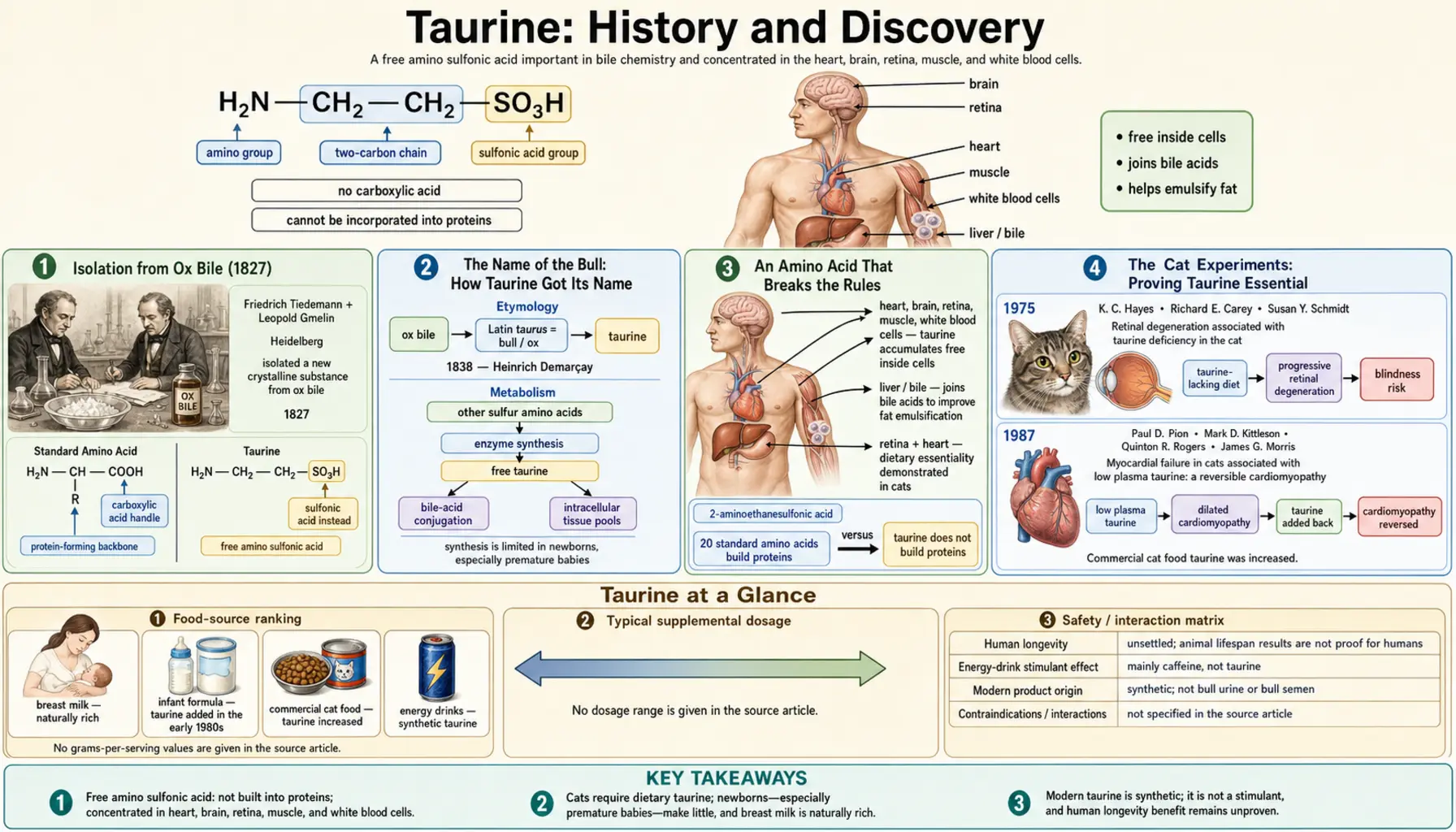
Taurine owes its name to an ox. In 1827, the German scientists Friedrich Tiedemann and Leopold Gmelin described a previously unknown substance from the bile of an ox, and the molecule was later named after the Latin word taurus — bull. For more than a century afterward it was regarded mainly as an end product of sulfur metabolism with one recognised job, the conjugation of bile acids. Only in the second half of the twentieth century — through studies in cats — was taurine shown to be a dietary essential for at least one mammal, a finding followed by changes to cat food and infant formula. This article traces that documented record: who isolated it and from what, how it got its name, why it stands apart from the ordinary amino acids, the feline studies that showed it to be essential, and the recent, conflicting research on taurine and aging. Where the history is firmly recorded it is stated plainly; where a detail is less certain that is noted.
Table of Contents
- Isolation from Ox Bile (1827)
- The Name of the Bull: How Taurine Got Its Name
- An Amino Acid That Breaks the Rules
- The Cat Experiments: Proving Taurine Essential
- From Kittens to Cribs: Taurine in Infant Formula
- A Curious Detour: Taurine and Energy Drinks
- The Longevity Question: Taurine and Aging
- Key Research Papers
- Connections
- Featured Videos
Isolation from Ox Bile (1827)
The documented story of taurine begins in 1827, when the German physiologist Friedrich Tiedemann and the chemist Leopold Gmelin, working in Heidelberg, reported new constituents of ox bile in the journal Annalen der Physik ("Einige neue Bestandtheile der Galle des Ochsen"), among them the crystalline substance later called taurine. Bile — the fluid the liver makes to help digest fat — was a fitting place to find it: for a long time taurine's "only clearly recognized biochemical role," as a 1989 review in Pediatrics put it, was as a substrate in the conjugation of bile acids, the step in which the liver joins taurine (or glycine) to bile acids to form the bile salts that emulsify fat.
The milestones in this article on one time axis: two early chemical findings, a long gap, then a crowded half-century of biology.
Tiedemann and Gmelin were not looking for a dietary nutrient; they were doing the analytical chemistry of their era, breaking down a biological fluid to see what it was made of. It is worth being plain about what this discovery was and was not. The two chemists did not understand taurine's biological role — that would take another century and a half — nor did they invent the molecule, which animals make and which is found free in millimolar concentrations in animal tissues. What they did was specific and real: they were the first to isolate and describe it as a distinct chemical substance. Everything that follows in taurine's history rests on that 1827 starting point.
The Name of the Bull: How Taurine Got Its Name
The name taurine comes straight from where it was found. It is derived from the Latin taurus, meaning bull or ox (a cousin of the Ancient Greek tauros) — a direct nod to the ox bile from which it was first isolated. Standard accounts credit the chemist H. Demarçay with first using the name "taurine" in 1838, the year his study of the nature of bile ("Ueber die Natur der Galle") appeared in the Annalen der Pharmacie. In other words, the molecule was described in 1827 but acquired its familiar name about a decade later.
A widespread rumour holds that taurine is extracted from bull urine or bull semen. The name honours the ox bile of the original 1827 isolation, nothing more. Taurine sold as an ingredient is made by chemical synthesis; the European Food Safety Authority's 2025 opinion on taurine as an animal-feed additive, for example, describes the authorised product as "produced by chemical synthesis." The etymology is a historical fingerprint, not a recipe.
An Amino Acid That Breaks the Rules
Part of what kept taurine in the scientific background for so long is that it does not behave like the amino acids most people learn about. The twenty "standard" amino acids — the ones with names like glycine, leucine, and lysine — are the building blocks that the body strings together to make proteins. Each carries a carboxylic acid group, which is the chemical handle that lets them link into the long chains we call proteins.
Taurine is different. Chemically it is 2-aminoethanesulfonic acid, and in place of the usual carboxylic acid group it carries a sulfonic acid group built around a sulfur atom. That structural difference has a large consequence: taurine is not built into proteins. It stays free inside cells, and it does so in abundance: a 2002 overview describes it as the most abundant intracellular amino acid in humans, and a 2016 review notes high concentrations in the brain, retina, heart, and reproductive organs. Strictly speaking, this makes taurine an amino sulfonic acid rather than a classical amino acid, though by long convention it is still called an amino acid.
This quirk helps explain the long gap between taurine's 1827 isolation and the recognition of its importance. Early biochemists naturally focused on the amino acids that build proteins. As the 1989 Pediatrics review summarised, taurine "was long considered an end product of the metabolism of the sulfur-containing amino acids, methionine and cyst(e)ine." The discovery that this apparent end product was in fact indispensable came not from human studies but from an unexpected direction, taken up in the next section.
The Cat Experiments: Proving Taurine Essential
The turning point in taurine's history came in the 1970s and 1980s, and the subjects were cats. In 1975, K. C. Hayes, R. E. Carey, and S. Y. Schmidt published a paper in Science titled "Retinal degeneration associated with taurine deficiency in the cat." They reported that a degeneration of the retina's photoreceptor cells — the light-sensing cells at the back of the eye — developed in cats when casein was the source of dietary protein, and that it was associated with a selective fall in plasma and retinal taurine. They attributed it to the casein diet's sulfur amino acid deficit combined with the cat's particular amino acid requirements. A 1989 review by Hayes and Trautwein summed up the point: cats cannot absorb or synthesise enough taurine to cover what they need, "which makes taurine an essential amino acid for cats."
The second finding came in 1987, when Paul D. Pion, Mark D. Kittleson, Quinton R. Rogers, and James G. Morris published another Science paper, "Myocardial failure in cats associated with low plasma taurine: a reversible cardiomyopathy." At the time, thousands of pet cats died each year of dilated cardiomyopathy, a weakening and enlargement of the heart muscle, of unknown cause. The team found low plasma taurine together with echocardiographic signs of heart-muscle failure in 21 cats fed commercial cat foods, and in 2 of 11 cats kept for 4 years on a purified diet marginally low in taurine. Oral taurine raised plasma taurine and was associated with normalization of left ventricular function in both groups. A follow-up report by Pion and colleagues in 1992 described 37 cats with moderate to severe dilated cardiomyopathy given taurine: 14 died within the first 30 days, 22 showed marked clinical and echocardiographic improvement, and the 1-year survival rate was 58%, against 13% in an earlier, retrospectively reviewed group of cats with the disease.
The 1989 Hayes and Trautwein review described taurine deficiency in "a large number of cats fed unfortified commercial diets," and commercial cat food came to be fortified with taurine. These feline studies also forced a reappraisal of the molecule itself. A compound long regarded as a metabolic end product had been shown, in a living mammal, to be essential for the eye and the heart. The obvious next question was whether something similar might apply, at least in part, to people — and that question pointed at newborns.
From Kittens to Cribs: Taurine in Infant Formula
Researchers were meanwhile asking whether taurine matters for human infants. A 2002 overview describes taurine as essential for preterm newborns, with breast milk as their source, and the 1989 Pediatrics review called it nonessential in the rodent, essential in the cat, and "conditionally essential in man and monkey" — meaning its absence from the diet does not produce immediate deficiency disease but can cause problems in the long term. A 1984 analysis from Germany measured the gap between milks: human milk averaged 458 mg of taurine per kg of dry matter, cow's milk 68 mg/kg, and the 24 milk-based infant formulas tested only 38 mg/kg.
Primate studies added weight. In 1987, Neuringer and Sturman reported that infant rhesus monkeys fed a taurine-free, soy-protein-based infant formula from birth had significantly impaired visual acuity, with changes in the photoreceptors, compared with monkeys given the same formula with taurine added. During the 1980s, taurine was added to many infant formulas; the 1989 Pediatrics review described the addition as made "as a measure of prudence" to match the margin of safety found in human milk, and cited improved fat absorption in preterm infants and in children with cystic fibrosis, and effects on auditory brainstem-evoked responses in preterm infants, as findings that justified it. It was a precaution informed by animal and early clinical data, not a response to a dramatic deficiency disease in formula-fed babies like the one seen in cats.
A Curious Detour: Taurine and Energy Drinks
For most of the public, the word "taurine" is associated less with bile chemistry or cat food than with energy drinks, and that too is part of its modern history. Taurine became a standard ingredient of the category: a 2017 review notes that many of the top-selling energy drinks contain high doses of caffeine together with taurine, and a 2016 review describes energy drinks as a major source of taurine supplementation. This is how a compound first isolated from ox bile in a Heidelberg laboratory came to be printed on drink cans.
Two clarifications belong here. First, the taurine in these drinks is made by chemical synthesis, like the taurine used in supplements and formula, not derived from bulls, despite the bovine name. Second, the drinks combine taurine with substantial amounts of caffeine, so their effects cannot be put down to taurine alone. The 2016 review concluded that little is known about taurine's own neuroendocrine effects, and the 2017 review, drawing mostly on animal studies, reported both benefits and adverse effects of caffeine and taurine and raised a concern about chronic high intakes in adolescents.
The Longevity Question: Taurine and Aging
The most recent chapter in taurine's history is also the most widely reported. In June 2023, a large international team with senior author Vijay K. Yadav (Columbia University and the National Institute of Immunology, New Delhi) and joint first authors including Parminder Singh and Kishore Gollapalli published "Taurine deficiency as a driver of aging" in Science. The researchers reported that circulating taurine declines with age in mice, monkeys, and humans. Taurine supplementation increased health span and life span in mice and health span in monkeys (and both in worms), and in the animals it reduced cellular senescence, mitochondrial dysfunction, DNA damage, and inflammation markers. In people the evidence was associational: lower taurine concentrations correlated with several age-related diseases, and taurine rose after acute endurance exercise. The authors concluded that clinical trials in humans "seem warranted." The paper discloses that Columbia University had filed provisional patent applications naming Yadav as an inventor.
In June 2025, a team at the U.S. National Institute on Aging led by Maria Emilia Fernandez and Rafael de Cabo published "Is taurine an aging biomarker?", also in Science. Measuring taurine both repeatedly in the same individuals and across people of different ages, they found that circulating taurine increased or stayed the same with age in three geographically distinct human cohorts, as well as in nonhuman primates and mice. Links between taurine and age-related changes in physical function and energy metabolism varied considerably. The authors concluded that a change in circulating taurine is not a universal feature of aging.
The two papers leave the question open. The lifespan results remain animal results; the decline in blood taurine with age that motivated them was not found in the 2025 cohorts; and no long-term human trial has tested whether taurine affects human aging.
It is a fitting place for this history to end. The molecule that nineteenth-century chemists pulled from ox bile and then largely set aside, and that twentieth-century cat studies showed to be essential for cats, now sits at the centre of an unsettled question in modern biology. Taurine's effects, mechanisms, food sources, and supplementation are covered in the companion Taurine Benefits articles and the main Taurine page; this article is concerned only with how taurine came to be discovered, named, and understood.
Key Research Papers
The list below combines the key historical and peer-reviewed sources behind this article with curated PubMed topic-search links. The original 1827 report by Friedrich Tiedemann and Leopold Gmelin and Demarçay's 1838 paper are cited by their journal DOIs; the modern papers on taurine's essentiality, infant nutrition, energy drinks, and aging are cited with their stable identifiers. Author names, titles, and journals are given as plain text; only the stable DOI, PMID, or archive link is hyperlinked, and each opens in a new tab.
- Hayes KC, Carey RE, Schmidt SY. Retinal degeneration associated with taurine deficiency in the cat. Science. 1975;188(4191):949-951. — doi:10.1126/science.1138364 · PubMed PMID: 1138364
- Pion PD, Kittleson MD, Rogers QR, Morris JG. Myocardial failure in cats associated with low plasma taurine: a reversible cardiomyopathy. Science. 1987;237(4816):764-768. — doi:10.1126/science.3616607 · PubMed PMID: 3616607
- Huxtable RJ. Physiological actions of taurine. Physiological Reviews. 1992;72(1):101-163. — doi:10.1152/physrev.1992.72.1.101 · PubMed PMID: 1731369
- Singh P, Gollapalli K, Mangiola S, et al. Taurine deficiency as a driver of aging. Science. 2023;380(6649):eabn9257. — doi:10.1126/science.abn9257 · PubMed PMID: 37289866
- Fernandez ME, Bernier M, Price NL, Camandola S, Aon MA, Vaughan K, Mattison JA, Preston JD, Jones DP, Tanaka T, Tian Q, González-Freire M, Ferrucci L, de Cabo R. Is taurine an aging biomarker? Science. 2025;388(6751):eadl2116. — doi:10.1126/science.adl2116 · PubMed PMID: 40472098
- Tiedemann F, Gmelin L. Einige neue Bestandtheile der Galle des Ochsen. Annalen der Physik. 1827;85(2):326-337. — doi:10.1002/andp.18270850214
- Demarçay H. Ueber die Natur der Galle. Annalen der Pharmacie. 1838;27(3):270-291. — doi:10.1002/jlac.18380270304
- Gaull GE. Taurine in pediatric nutrition: review and update. Pediatrics. 1989;83(3):433-442. — PubMed PMID: 2645571
- Hayes KC, Trautwein EA. Taurine deficiency syndrome in cats. Veterinary Clinics of North America: Small Animal Practice. 1989;19(3):403-413. — doi:10.1016/s0195-5616(89)50052-4 · PubMed PMID: 2658282
- Pion PD, Kittleson MD, Thomas WP, Delellis LA, Rogers QR. Response of cats with dilated cardiomyopathy to taurine supplementation. Journal of the American Veterinary Medical Association. 1992;201(2):275-284. — PubMed PMID: 1500324
- Erbersdobler HF, Trautwein E, Greulich HG. Determinations of taurine in milk and infant formula diets. European Journal of Pediatrics. 1984;142(2):133-134. — doi:10.1007/BF00445594 · PubMed PMID: 6332023
- Neuringer M, Sturman J. Visual acuity loss in rhesus monkey infants fed a taurine-free human infant formula. Journal of Neuroscience Research. 1987;18(4):597-601. — doi:10.1002/jnr.490180413 · PubMed PMID: 3437473
- Lourenço R, Camilo ME. Taurine: a conditionally essential amino acid in humans? An overview in health and disease. Nutrición Hospitalaria. 2002;17(6):262-270. — PubMed PMID: 12514918
- Caine JJ, Geracioti TD. Taurine, energy drinks, and neuroendocrine effects. Cleveland Clinic Journal of Medicine. 2016;83(12):895-904. — doi:10.3949/ccjm.83a.15050 · PubMed PMID: 27938518
- Curran CP, Marczinski CA. Taurine, caffeine, and energy drinks: reviewing the risks to the adolescent brain. Birth Defects Research. 2017;109(20):1640-1648. — doi:10.1002/bdr2.1177 · PubMed PMID: 29251842
- EFSA Panel on Additives and Products or Substances used in Animal Feed (FEEDAP). Assessment of the feed additive consisting of taurine (3a370) for Canidae, Felidae, Mustelidae and carnivorous fish for the renewal of its authorisation and the request for a new use in all poultry and all porcine species. EFSA Journal. 2025;23(7):e9540. — doi:10.2903/j.efsa.2025.9540 · PubMed PMID: 40708713
PubMed Topic Searches
- Taurine — history, discovery, and metabolism PubMed PMID: 22739941
- Taurine deficiency, essentiality, and aging PubMed PMID: 42201902