Glycine for Sleep and Relaxation
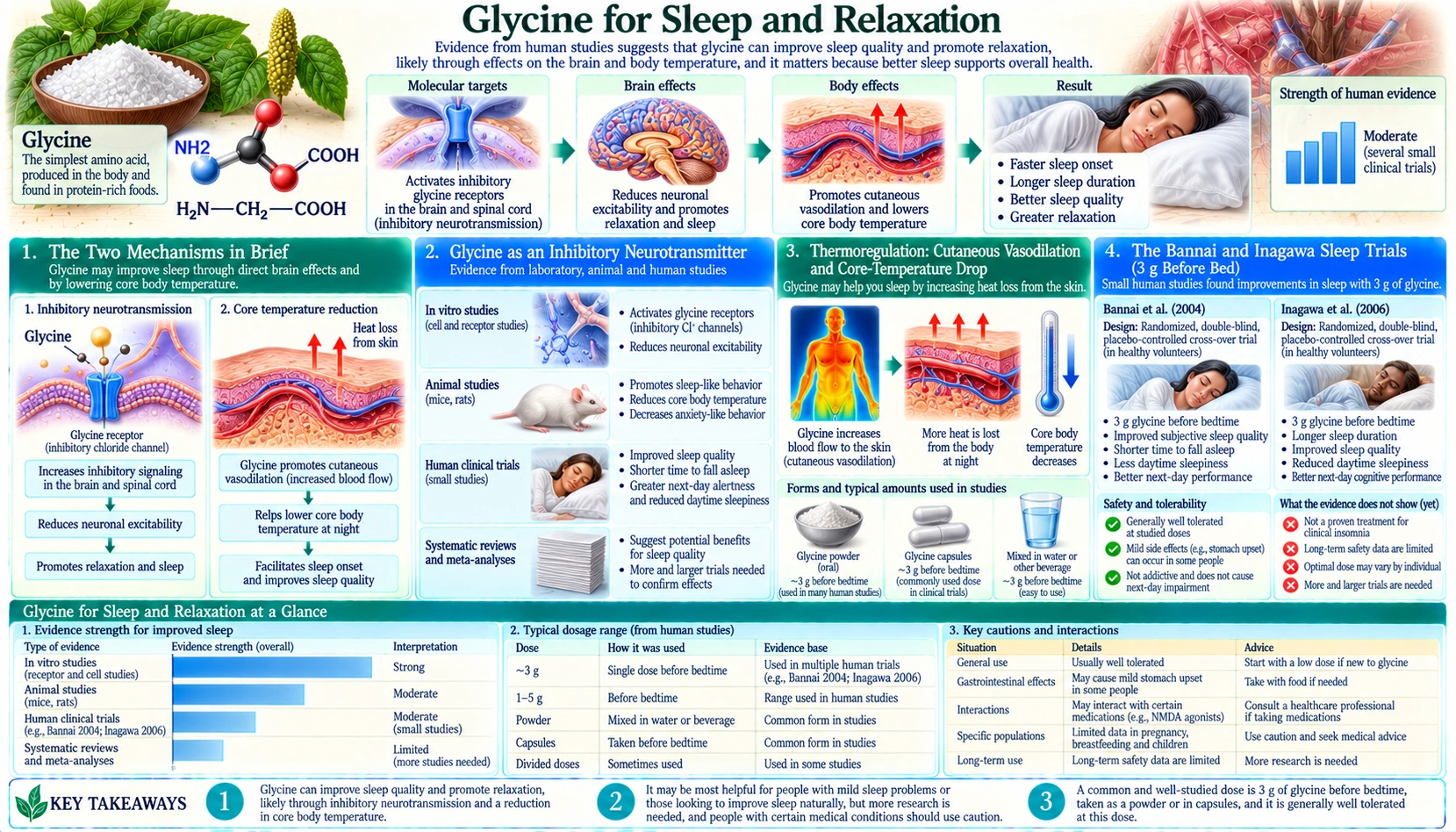
Glycine is an amino acid that also works as a signalling molecule in the nervous system: it is an inhibitory neurotransmitter in the brainstem and spinal cord, and a required co-agonist at NMDA glutamate receptors (Bannai & Kawai 2012). Three small Japanese studies, each giving 3 g of glycine at bedtime and each including authors employed by a manufacturer of amino acids, form most of the human evidence on glycine and sleep. They reported better subjective sleep quality, a shorter time to fall asleep and to reach slow-wave sleep in sleep-laboratory recordings, and less next-day fatigue after a few nights of shortened sleep (Yamadera 2007; Bannai 2012). In rats, oral glycine increased blood flow to the skin and lowered core body temperature, an effect that depended on NMDA receptors in the brain's circadian clock (Kawai 2015). A 2026 scoping review found three glycine sleep trials in all and concluded that larger trials are needed (Fan 2026).
Table of Contents
- The Two Mechanisms in Brief
- Glycine as an Inhibitory Neurotransmitter
- Thermoregulation: Cutaneous Vasodilation and Core-Temperature Drop
- The Human Sleep Trials (3 g Before Bed)
- Effects on Sleep Architecture and Slow-Wave Sleep
- NMDA Coagonism and the Suprachiasmatic Nucleus
- Daytime Calm, Anxiety, and Schizophrenia Research
- Doses Used in the Studies, Forms, and Timing
- Glycine Combined With Other Sleep Supplements
- Cautions, Drug Interactions, and Who the Research Raises Concerns For
- Key Research Papers
- Connections
- Featured Videos
The Two Mechanisms in Brief
Research on glycine and sleep describes two pathways. One is a well-established property of glycine in the nervous system; the other has so far been shown mainly in rats.
The first is direct neural inhibition. Glycine is a major inhibitory neurotransmitter in the brainstem and spinal cord. Its receptor is a chloride channel: when glycine binds, chloride flows into the neuron and makes it less likely to fire (Lynch 2004). GABA does a similar job through related receptors elsewhere in the brain.
The second is thermoregulatory. In rats, oral glycine increased blood flow to the skin of the paws, so that more heat was lost, lowered core body temperature, and promoted non-REM sleep. These effects depended on NMDA receptors in the suprachiasmatic nucleus, the brain's circadian clock, and not on glycine receptors (Kawai 2015). Because the onset of sleep normally involves a fall in core body temperature, the researchers proposed this temperature drop as a mechanism behind glycine's effect on sleep (Bannai & Kawai 2012).
Whether the temperature pathway operates the same way in people has not been shown directly, and the human trials did not test the two mechanisms separately.
Glycine as an Inhibitory Neurotransmitter
The glycine receptor (GlyR) is a chloride channel built from five subunits, in the same family of ligand-gated ion channels as the nicotinic acetylcholine receptor. It is best known for mediating inhibitory neurotransmission in the spinal cord and brainstem (Lynch 2004). When glycine binds, the channel opens and chloride ions flow into the neuron, making its membrane more negative and the cell less likely to fire.
Inherited mutations in human glycine-receptor genes cause a rare neurological disorder, hyperekplexia or startle disease (Lynch 2004). The poison strychnine blocks the glycine receptor; the muscle spasms of strychnine poisoning follow from the loss of glycine's inhibition of the motor system.
Glycine also takes part in the muscle paralysis of REM sleep, which keeps sleepers from acting out their dreams. In rats, a combined GABA and glycine drive switches off motor neurons during REM sleep; the paralysis was reversed only when GABAB, GABAA and glycine receptor inhibition were all blocked, and no single receptor mechanism was enough to produce it. The authors suggested that a breakdown of this inhibition may underlie REM sleep behavior disorder (Brooks & Peever 2012).
In rats, oral glycine raised glycine levels in both the blood and the cerebrospinal fluid (Bannai & Kawai 2012). Whether a 3 g bedtime dose raises inhibitory signalling in the human brainstem has not been measured.
Thermoregulation: Cutaneous Vasodilation and Core-Temperature Drop
Falling asleep is normally accompanied by a fall in core body temperature, and a low core temperature is maintained during sleep (Bannai & Kawai 2012). Much of that heat is lost through the skin as its blood vessels widen.
The temperature mechanism for glycine comes from rat studies by the same research group that ran the human trials, working with a university sleep laboratory (Kawai 2015). In those rats:
- Oral glycine induced non-REM sleep and shortened the time to non-REM sleep, with a simultaneous decrease in core body temperature
- Oral glycine, and glycine injected into the brain's ventricles, increased blood flow in the skin of the paw in a dose-dependent way, resulting in heat loss
- Glycine injected directly into the suprachiasmatic nucleus increased skin blood flow; injections into two nearby hypothalamic areas did not
- Destroying the suprachiasmatic nucleus completely abolished glycine's sleep-promoting and temperature-lowering effects
The authors concluded that glycine promotes sleep through widening of peripheral blood vessels, driven by NMDA receptors in the suprachiasmatic nucleus (Kawai 2015). The human trial abstracts do not report skin or core temperature measurements, so this pathway has not been confirmed in people.
The Human Sleep Trials (3 g Before Bed)
Three small studies from Japan form most of the human evidence. All gave 3 g of glycine before bedtime, and each included authors employed by a manufacturer of amino acids, working with university collaborators — in effect, manufacturer-run studies.
Inagawa 2006 (Sleep and Biological Rhythms). A short report (pages 75–77) on the subjective effects of glycine taken before bedtime on sleep quality. No abstract is indexed, so its design, size and results could not be checked here.
Yamadera 2007 (Sleep and Biological Rhythms). In volunteers who had been experiencing unsatisfactory sleep for some time, 3 g of glycine before bedtime improved subjective sleep quality and sleep efficiency (time asleep as a share of time in bed). In sleep-laboratory recordings (polysomnography) it shortened the time to fall asleep and the time to reach slow-wave sleep, without changes in the overall structure of sleep. Daytime sleepiness was lower and performance on memory-recognition tasks improved. The abstract does not give the number of participants.
Bannai 2012 (Frontiers in Neurology). Healthy volunteers had their sleep cut to 25% less than usual for three nights in a row and took 3 g of glycine or a placebo before bed. The next day, the glycine group reported significantly less fatigue and a trend toward less sleepiness, on a visual scale and a questionnaire, and did significantly better on a computer-based psychomotor vigilance test. In rats in the same paper, glycine did not change melatonin levels or the activity of the clock genes Bmal1 and Per2, but raised two neuropeptides in the suprachiasmatic nucleus.
Bannai & Kawai 2012 (Journal of Pharmacological Sciences). A review by two of the same researchers, summarizing their rat and human work and proposing the core-temperature drop as the mechanism.
The studies are small and come from one research program. A 2026 scoping review of glycine and collagen supplements found three trials of supplemental glycine and sleep-related outcomes; all three reported a benefit on at least one sleep-related outcome. The review concluded that glycine is a biologically plausible mechanism, that this has not been directly tested, and that larger trials with standardized sleep outcomes are needed (Fan 2026).
Effects on Sleep Architecture and Slow-Wave Sleep
Sleep is not a uniform state — it is a cycle of distinct stages with characteristic EEG signatures: stage 1 (light, drowsy sleep), stage 2 (sleep spindles and K-complexes), stage 3 (slow-wave or deep sleep), and REM (rapid-eye-movement, dreaming sleep), repeating several times through the night.
Slow-wave sleep is marked by large, slow delta waves on the EEG, and its share of the night declines with age.
The only human sleep-laboratory evidence for glycine is Yamadera 2007. There, glycine shortened the time taken to reach slow-wave sleep, “without changes in the sleep architecture” (Yamadera 2007). The abstract does not report an increase in the amount of slow-wave sleep, and no other polysomnography study of glycine alone was found in PubMed.
Because the overall structure of sleep did not change, that study gives no sign that glycine reduced REM sleep. Its authors described glycine as improving sleep quality “in a different way than traditional hypnotic drugs such as benzodiazepines” (Yamadera 2007).
NMDA Coagonism and the Suprachiasmatic Nucleus
The thermoregulatory mechanism above runs through NMDA glutamate receptors in the suprachiasmatic nucleus (SCN), the brain's master circadian clock. NMDA receptors need two agonists to open — glutamate at the main binding site, and glycine (or D-serine) at a separate, strychnine-insensitive “glycine site” (Heresco-Levy 1999).
In the rat studies, drugs that block NMDA receptors prevented the rise in skin blood flow caused by glycine injected into the brain, while the glycine-receptor blocker strychnine did not. D-serine injected into the SCN also increased skin blood flow (Kawai 2015).
The NMDA-coagonist role is also the basis of the schizophrenia research described in the next section, which tested whether high-dose glycine could strengthen NMDA signalling (Heresco-Levy 1999).
The 3 g bedtime dose comes from the human trials. No study comparing different doses of glycine for sleep was found in PubMed.
Daytime Calm, Anxiety, and Schizophrenia Research
Randomized trials testing whether glycine supplements reduce anxiety or improve mood in healthy people were not found in PubMed. Reports of a calming effect from bedtime glycine are anecdotal, and the reasoning behind them rests on mechanisms rather than trial results:
- Glycine receptors mediate inhibitory signalling in the brainstem and spinal cord (Lynch 2004)
- Glycine is one of the three amino acids from which the antioxidant glutathione is made (see the Glutathione Synthesis page)
The most extensive psychiatric trial data on glycine come from schizophrenia, where the aim was to strengthen NMDA receptor function and so ease negative symptoms (social withdrawal, blunted emotion, reduced speech and motivation) that respond poorly to standard antipsychotics. In a double-blind, placebo-controlled, 6-week crossover trial in 22 treatment-resistant patients, 0.8 g/kg per day of glycine added to their antipsychotic medication was well tolerated and reduced negative symptoms by 30% (±16%) on the PANSS scale (Heresco-Levy 1999). The larger CONSIST trial (157 participants, 16 weeks) found no significant difference between glycine and placebo in negative symptoms or cognition, and its authors concluded that neither glycine nor D-cycloserine is a generally effective treatment for these problems (Buchanan 2007).
The schizophrenia doses are far above the 3 g sleep dose. Trials of glycine added to the antipsychotic clozapine are described in the cautions section below.
Doses Used in the Studies, Forms, and Timing
The human sleep studies used 3 g of glycine taken before bedtime (Yamadera 2007; Bannai 2012). How long before bedtime is not stated in the abstracts, and the effects of doses other than 3 g on sleep have not been studied.
Forms:
- Free glycine. A sweet-tasting white powder that dissolves in water; it is also sold in capsules. The trial abstracts describe the dose only as “3 g of glycine”.
- Magnesium glycinate. A magnesium compound in which magnesium is bound to glycine. It was not the form tested in the glycine sleep studies.
- Collagen, gelatin and bone broth. Glycine makes up about every third amino acid in collagen. In a 2026 scoping review, glycine-containing supplements generally raised blood glycine. Of the collagen-peptide trials, one placebo-controlled trial reported fewer awakenings in sleep recordings and one reported lower fatigue scores, while studies comparing collagen peptides with another protein, alpha-lactalbumin, did not find collagen better for sleep. Whether glycine is what produces any sleep effect of collagen has not been tested (Fan 2026).
Glycine Combined With Other Sleep Supplements
The three glycine sleep studies tested glycine on its own. One randomized, double-blind crossover study tested a blend of tryptophan, glycine, magnesium, tart cherry powder and L-theanine in 16 young adults over 3 days per condition. Compared with placebo, the blend shortened the time to fall asleep by 24 (±25) minutes and increased total sleep time by 22 (±32) minutes on wrist-worn activity monitors, and morning sleepiness was lower (Langan-Evans 2023). Because the blend had five ingredients, the study cannot show what glycine itself contributed.
Trials testing glycine together with melatonin, GABA or apigenin for sleep were not found in PubMed.
Cautions, Drug Interactions, and Who the Research Raises Concerns For
- Clozapine. The research raises a concern for people taking the antipsychotic clozapine. In a 12-week trial in 19 people with treatment-resistant schizophrenia on clozapine, 30 g/day of glycine did not reduce symptoms, while the placebo group had a 35% reduction in positive symptoms; the authors suggested glycine may interfere with clozapine's effect (Potkin 1999). In an 8-week trial in 30 adults, 60 g/day of glycine added to clozapine produced no significant change in symptoms or cognition, and no participant worsened clinically (Evins 2000).
- Non-ketotic hyperglycinemia (glycine encephalopathy). A rare inherited disorder of metabolism in which glycine builds up to harmful levels in the body and brain.
- Kidney or liver disease, pregnancy, children. The sleep studies were carried out in adult volunteers; their abstracts give no data for people with kidney or liver disease, during pregnancy, or for children.
- Tolerability. The sleep-trial abstracts do not report side effects in detail. In the schizophrenia trials, far larger doses (0.8 g/kg per day) were reported as well tolerated (Heresco-Levy 1999).
Decisions about supplements, especially alongside prescription sleep medicines or antipsychotics, belong with a clinician.
Key Research Papers
- Bannai M, Kawai N (2012). New therapeutic strategy for amino acid medicine: glycine improves the quality of sleep. Journal of Pharmacological Sciences 118(2):145-8. (Review.) — PubMed PMID: 22293292
- Yamadera W, Inagawa K, Chiba S, et al. (2007). Glycine ingestion improves subjective sleep quality in human volunteers, correlating with polysomnographic changes. Sleep and Biological Rhythms 5(2):126-131. (Not indexed in PubMed.) — doi:10.1111/j.1479-8425.2007.00262.x
- Inagawa K, Hiraoka T, Kohda T, Yamadera W, Takahashi M (2006). Subjective effects of glycine ingestion before bedtime on sleep quality. Sleep and Biological Rhythms 4(1):75-77. (Not indexed in PubMed; no abstract available.) — doi:10.1111/j.1479-8425.2006.00193.x
- Bannai M, Kawai N, Ono K, Nakahara K, Murakami N (2012). The effects of glycine on subjective daytime performance in partially sleep-restricted healthy volunteers. Frontiers in Neurology 3:61. — PubMed PMID: 22529837
- Kawai N, Sakai N, Okuro M, et al. (2015). The sleep-promoting and hypothermic effects of glycine are mediated by NMDA receptors in the suprachiasmatic nucleus. Neuropsychopharmacology 40(6):1405-16. (Animal study.) — PubMed PMID: 25533534
- Lopez-Corcuera B, Geerlings A, Aragon C (2001). Glycine neurotransmitter transporters: an update. Molecular Membrane Biology 18(1):13-20. — PubMed PMID: 11396606
- Lynch JW (2004). Molecular structure and function of the glycine receptor chloride channel. Physiological Reviews 84(4):1051-95. — PubMed PMID: 15383648
- Heresco-Levy U, Javitt DC, Ermilov M, et al. (1999). Efficacy of high-dose glycine in the treatment of enduring negative symptoms of schizophrenia. Archives of General Psychiatry 56(1):29-36. — PubMed PMID: 9892253
- Buchanan RW, Javitt DC, Marder SR, et al. (2007). The Cognitive and Negative Symptoms in Schizophrenia Trial (CONSIST): the efficacy of glutamatergic agents for negative symptoms and cognitive impairments. American Journal of Psychiatry 164(10):1593-602. — PubMed PMID: 17898352
- Kruger T, Schiavi RC, Mandeli J, et al. (2003). Effects of acute glycine ingestion on cardiovascular response in healthy volunteers. Journal of Clinical Pharmacology. — PubMed (Editorial note, 2026-10-14: no paper matching this entry was found in PubMed or Crossref; nothing on this page rests on it, and the link is a PubMed topic search.)
- Krystal AD, Benca RM, Kilduff TS (2013). Understanding the sleep-wake cycle: sleep, insomnia, and the orexin system. Journal of Clinical Psychiatry 74(Suppl 1):3-20. — PubMed PMID: 24107804
- Razak MA, Begum PS, Viswanath B, Rajagopal S (2017). Multifarious beneficial effect of nonessential amino acid, glycine: a review. Oxidative Medicine and Cellular Longevity 2017:1716701. (Erratum published 2022.) — PubMed PMID: 28337245
- Hardeland R (2019). Aging, melatonin, and the pro- and anti-inflammatory networks. International Journal of Molecular Sciences 20(5):1223. — PubMed PMID: 30862067
- Potkin SG, Jin Y, Bunney BG, Costa J, Gulasekaram B (1999). Effect of clozapine and adjunctive high-dose glycine in treatment-resistant schizophrenia. American Journal of Psychiatry 156(1):145-7. — PubMed PMID: 9892314
- Evins AE, Fitzgerald SM, Wine L, Rosselli R, Goff DC (2000). Placebo-controlled trial of glycine added to clozapine in schizophrenia. American Journal of Psychiatry 157(5):826-8. — PubMed PMID: 10784481
- Brooks PL, Peever JH (2012). Identification of the transmitter and receptor mechanisms responsible for REM sleep paralysis. Journal of Neuroscience 32(29):9785-95. (Animal study.) — PubMed PMID: 22815493
- Langan-Evans C, Hearris MA, Gallagher C, et al. (2023). Nutritional modulation of sleep latency, duration, and efficiency: a randomized, repeated-measures, double-blind deception study. Medicine and Science in Sports and Exercise 55(2):289-300. — PubMed PMID: 36094342
- Fan Z, Nelson JM, Wallace TC (2026). Glycine bioavailability and sleep-related outcomes following oral glycine and collagen supplementation — a scoping review. Journal of Dietary Supplements 23(5):602-622. — PubMed PMID: 42687500
PubMed Topic Searches
Connections
- All Amino Acids
- Glycine Overview
- Glycine Benefits Hub
- Glycine for Collagen Synthesis
- Glycine for Glutathione Synthesis
- Glycine and Aspirin Metabolism
- Taurine
- Tryptophan
- L-Theanine
- Magnesium
- Magnesium Glycinate
- Melatonin
- Sleep Hygiene
- Stress Management
- Anxiety
- Insomnia
- Bone Broth
- Collagen
- History
- Sources