Glycine: Food Sources & Daily Intake
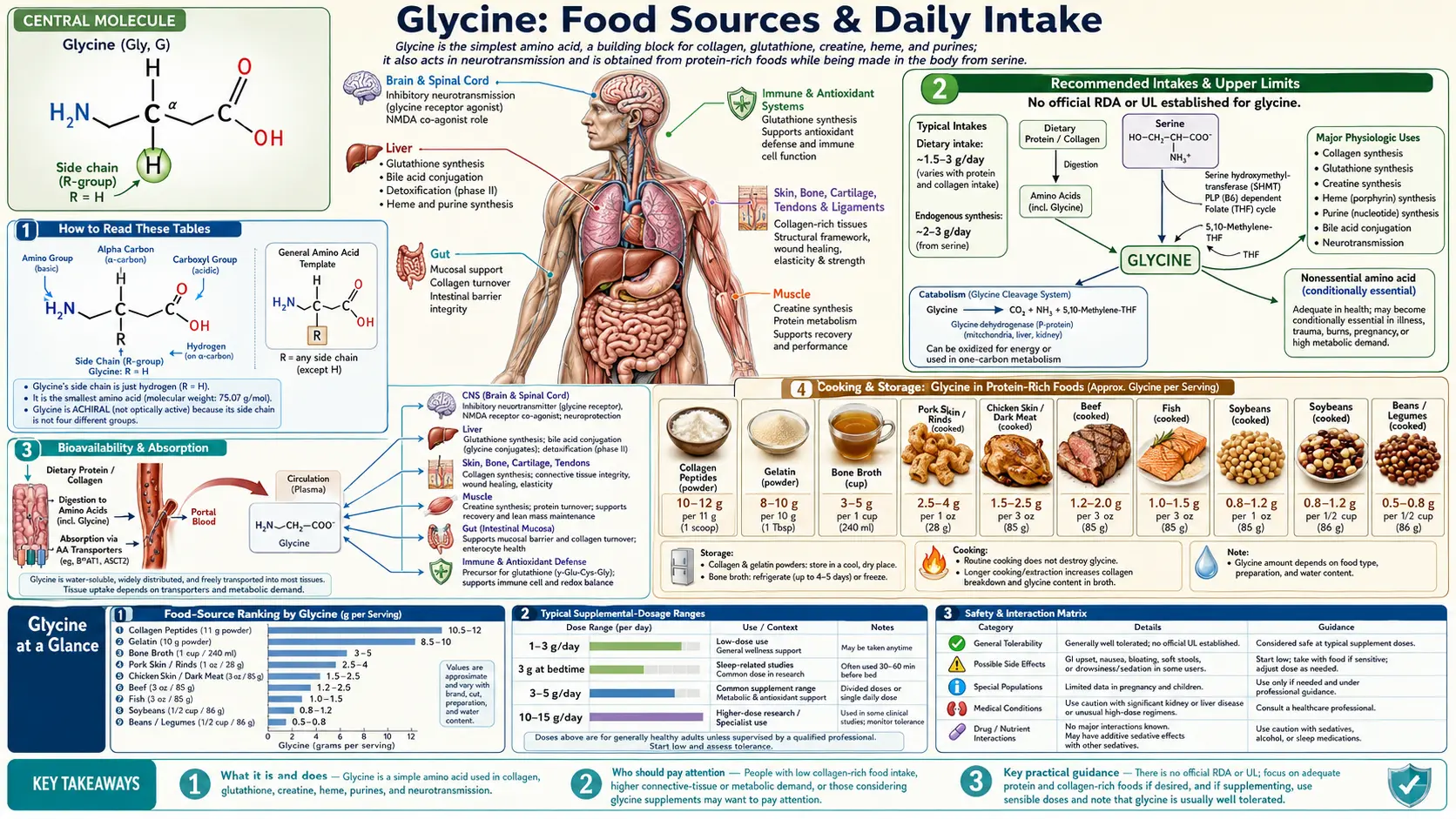
Glycine is the smallest amino acid. In collagen — the most abundant protein in mammals — glycine is the obligatory residue at every third position of the triple helix, so roughly one residue in three is glycine. The body also uses glycine to make glutathione, heme, creatine, nucleic acids and uric acid, and glycine is a major component of the bile acids used to digest fat. In the nervous system it activates glycine-gated chloride channels and is a co-agonist at NMDA receptors. The body synthesizes glycine (mainly from serine), and reviewers describe it as conditionally essential. A 2009 model estimate by Meléndez-Hevia and colleagues put synthesis at about 3 g/day and dietary intake at 1.5–3.0 g/day, and estimated that together these may fall short of total metabolic demand, including collagen synthesis, by about 10 g per day for a 70 kg adult. The table below lists grams of glycine per 100 g of food from USDA FoodData Central; there is no FDA Daily Value for individual amino acids.
| Glycine: Food Sources & Daily IntakeGrams of glycine per 100 g of the food as described (raw or cooked), from USDA FoodData Central SR Legacy records. | |||
|---|---|---|---|
| Rank | Food (USDA record) | Per 100 g | Notes |
| 1 | Gelatin, dry powder, unsweetened USDA SR Legacy, FDC ID 169599 | 🟢 19.0 g | Gelatin is made from collagen. |
| 2 | Pork skins (pork-rind snack), plain USDA SR Legacy, FDC ID 167961 | 🟢 11.9 g | |
| 3 | Chicken skin, roasted USDA SR Legacy, FDC ID 171055 | ⚪ 3.25 g | Raw chicken skin: 2.13 g (FDC ID 171452). |
| 4 | Turkey skin, roasted USDA SR Legacy, FDC ID 171082 | ⚪ 3.11 g | |
| 5 | Pumpkin and squash seed kernels, dried USDA SR Legacy, FDC ID 170556 | ⚪ 1.84 g | Highest plant figure in this table. |
| 6 | Chicken, meat and skin, roasted USDA SR Legacy, FDC ID 171450 | ⚪ 1.76 g | |
| 7 | Beef liver, braised USDA SR Legacy, FDC ID 168626 | ⚪ 1.63 g | |
| 8 | Peanuts, all types, raw USDA SR Legacy, FDC ID 172430 | ⚪ 1.55 g | |
| 9 | Pork liver, braised USDA SR Legacy, FDC ID 167863 | ⚪ 1.51 g | |
| 10 | Beef, composite of retail cuts, lean and fat, cooked USDA SR Legacy, FDC ID 170206 | ⚪ 1.47 g | |
| 11 | Sunflower seed kernels, dried USDA SR Legacy, FDC ID 170562 | ⚪ 1.46 g | |
| 12 | Turkey, whole, meat and skin, roasted USDA SR Legacy, FDC ID 171479 | ⚪ 1.43 g | |
| 13 | Shrimp, mixed species, cooked, moist heat USDA SR Legacy, FDC ID 171971 | ⚪ 1.34 g | |
| 14 | Pork loin, whole, lean and fat, roasted USDA SR Legacy, FDC ID 167821 | ⚪ 1.33 g | |
| 15 | Salmon, Atlantic, wild, cooked, dry heat USDA SR Legacy, FDC ID 171998 | ⚪ 1.22 g | |
| 16 | Sesame seeds, whole, dried USDA SR Legacy, FDC ID 170150 | ⚪ 1.22 g | |
| 17 | Chicken liver, simmered USDA SR Legacy, FDC ID 171061 | ⚪ 1.20 g | |
| 18 | Brown rice, long-grain, cooked USDA SR Legacy, FDC ID 169704 | ⚪ 0.127 g | |
Table of Contents
How to Read These Tables
- Conditionally essential. The body makes glycine from serine, threonine, choline and hydroxyproline, mainly in the liver and kidneys; a 2013 review describes its de novo synthesis as insufficient and calls it a conditionally essential amino acid. Meléndez-Hevia and colleagues (2009) estimated that synthesis from serine accounts for more than 85% of the body’s glycine. Their figure of a shortfall of about 10 g per day is a model estimate built from reported glycine fluxes in a 70 kg adult, not a measured intake study.
- Grams per 100 g, not %DV. There is no FDA Daily Value for individual amino acids, so the table reports the grams of glycine per 100 g of food listed in each USDA FoodData Central record (linked by FDC ID), ranked by that figure. Values are for the food in the state the record describes, raw or cooked.
- Where glycine concentrates. Because glycine fills every third position of collagen’s triple helix, the highest figures in the USDA records are for collagen-derived foods: dry gelatin (19.0 g per 100 g) and pork-rind snacks (11.9 g). Roasted chicken and turkey skin list 3.25 and 3.11 g; the meat, fish and organ-meat records in the table list 1.20–1.76 g.
Intake Reference Values
No intake requirement exists for glycine. The 2007 WHO/FAO/UNU expert report on protein and amino acid requirements sets adult requirements for the indispensable (essential) amino acids; glycine is not one of them.
| Reference | Adult value | Notes |
|---|---|---|
| Essential? | Conditionally essential | Synthesized in the body, mainly from serine; a 2013 review calls its de novo synthesis insufficient and describes it as conditionally essential. |
| Adult requirement | None set | Not among the indispensable amino acids for which WHO/FAO/UNU (2007) set requirements. |
| Estimated supply vs demand | Model estimate | Meléndez-Hevia and colleagues (2009): synthesis about 3 g/day plus diet 1.5–3.0 g/day may fall short of total metabolic demand, including collagen synthesis, by about 10 g per day for a 70 kg adult. |
| Key roles | Collagen, glutathione, creatine, heme, bile acids | Glycine is used to make glutathione, heme, creatine, nucleic acids and uric acid, is a component of bile acids, and acts in the nervous system through glycine receptors and NMDA receptors. |
| Highest USDA figures | Gelatin, pork-rind snacks, poultry skin | Dry gelatin 19.0 g, pork skins 11.9 g, roasted chicken skin 3.25 g and roasted turkey skin 3.11 g per 100 g (FDC records in the table above). |
Bioavailability & Absorption
No food-by-food bioavailability figures for glycine were found in the sources cited on this page. What the USDA records do show is that the amount depends on which parts of the animal are eaten: the skin records list more glycine per 100 g than the meat records, and the collagen-derived foods (gelatin, pork rinds) list the most. Bone broth has no glycine figure in USDA FoodData Central. A 2019 laboratory analysis of commercial, café-made and home-style bone broths found that broth made to a standardized recipe contained significantly less glycine, proline and hydroxyproline than a 20 g dose of the collagen supplements used in research, and that broths made to non-standardized recipes varied widely; the authors concluded that bone broth is unlikely to provide a consistently reliable source of these amino acids.
Cooking & Storage
Long simmering of bones, skin and connective tissue breaks collagen down into gelatin, which dissolves into the liquid — the reason a cooled stock can set to a jelly. How much glycine ends up in a given broth varies with the recipe (see the 2019 bone-broth analysis above). USDA figures are per 100 g of food in the state the record describes, so raw and cooked values are not directly comparable: FDC lists raw chicken skin at 2.13 g and roasted chicken skin at 3.25 g per 100 g.
Vegetarian & Vegan Sources
The highest glycine figures in the USDA records are for collagen-derived animal foods (gelatin, skin), and the plant foods in the table list less. Among plant foods, USDA SR Legacy lists, per 100 g: pumpkin and squash seed kernels, dried, 1.84 g; watermelon seed kernels, dried, 1.66 g (FDC ID 169407); hulled hemp seed 1.61 g (FDC ID 170148); raw peanuts 1.55 g; dried sunflower seed kernels 1.46 g; whole dried sesame seeds 1.22 g; dried chia seeds 0.943 g (FDC ID 170554); cooked lentils 0.367 g (FDC ID 172421); cooked black beans 0.346 g (FDC ID 175237); and cooked brown rice 0.127 g. A 2018 review argued that the higher urinary excretion of 5-oxoproline reported in vegetarians and others eating relatively low-protein diets suggests that dietary glycine can limit the rate of glutathione synthesis; that is an inference from a marker, not a trial result.
Diet Patterns the Research Discusses
The research on glycine intake is mostly modelling and review work rather than intake trials. Meléndez-Hevia and colleagues (2009) estimated that the glycine available from synthesis and a typical diet may fall short of total metabolic demand, including collagen synthesis, by about 10 g per day; their abstract concludes that this supports earlier suggestions that glycine is semi-essential. A 2013 review notes that glycine synthesis is especially inadequate in disease states (in animal work). A 2018 review proposed that dietary glycine can be rate-limiting for glutathione synthesis, pointing to the 5-oxoproline marker in vegetarians and people on lower-protein diets, and called for clinical research to test supplemental glycine. Glycine and glutathione are covered in more depth on the Glycine for Glutathione Synthesis page. In sleep research, small trials from an amino-acid manufacturer’s research group reported improved sleep quality with glycine at bedtime; in one, 3 g before bed reduced next-day fatigue in healthy volunteers after three nights of restricted sleep. Questions about diet or supplements are for a clinician.
Key Research Papers
- NIH MedlinePlus — Amino acids
- Linus Pauling Institute — protein and amino acids (the page formerly linked here no longer exists).
- U.S. Department of Agriculture, Agricultural Research Service. FoodData Central, SR Legacy (glycine, nutrient 516); each food’s record is linked by FDC ID in the table above. — fdc.nal.usda.gov
- Meléndez-Hevia E, De Paz-Lugo P, Cornish-Bowden A, Cárdenas ML (2009). A weak link in metabolism: the metabolic capacity for glycine biosynthesis does not satisfy the need for collagen synthesis. Journal of Biosciences, 34(6), 853–872. — PubMed PMID: 20093739
- Wang W, Wu Z, Dai Z, Yang Y, Wang J, Wu G (2013). Glycine metabolism in animals and humans: implications for nutrition and health. Amino Acids, 45(3), 463–477. — PubMed PMID: 23615880
- Bächinger HP, Morris NP, Davis JM (1993). Thermal stability and folding of the collagen triple helix and the effects of mutations in osteogenesis imperfecta on the triple helix of type I collagen. American Journal of Medical Genetics, 45(2), 152–162. — PubMed PMID: 8456797
- Ricard-Blum S (2011). The collagen family. Cold Spring Harbor Perspectives in Biology, 3(1), a004978. — PubMed PMID: 21421911
- McCarty MF, O'Keefe JH, DiNicolantonio JJ (2018). Dietary glycine is rate-limiting for glutathione synthesis and may have broad potential for health protection. Ochsner Journal, 18(1), 81–87. — PubMed PMID: 29559876
- Alcock RD, Shaw GC, Burke LM (2019). Bone broth unlikely to provide reliable concentrations of collagen precursors compared with supplemental sources of collagen used in collagen research. International Journal of Sport Nutrition and Exercise Metabolism, 29(3), 265–272. — PubMed PMID: 29893587
- Bannai M, Kawai N, Ono K, Nakahara K, Murakami N (2012). The effects of glycine on subjective daytime performance in partially sleep-restricted healthy volunteers. Frontiers in Neurology, 3, 61. — PubMed PMID: 22529837
- Joint WHO/FAO/UNU Expert Consultation (2007). Protein and amino acid requirements in human nutrition. WHO Technical Report Series, 935, 1–265. — PubMed PMID: 18330140
PubMed Topic Searches
- PubMed — glycine, collagen synthesis and metabolic demand. — Search PubMed
- PubMed — glycine, glutathione and oral supplementation