Glycine for Collagen Synthesis
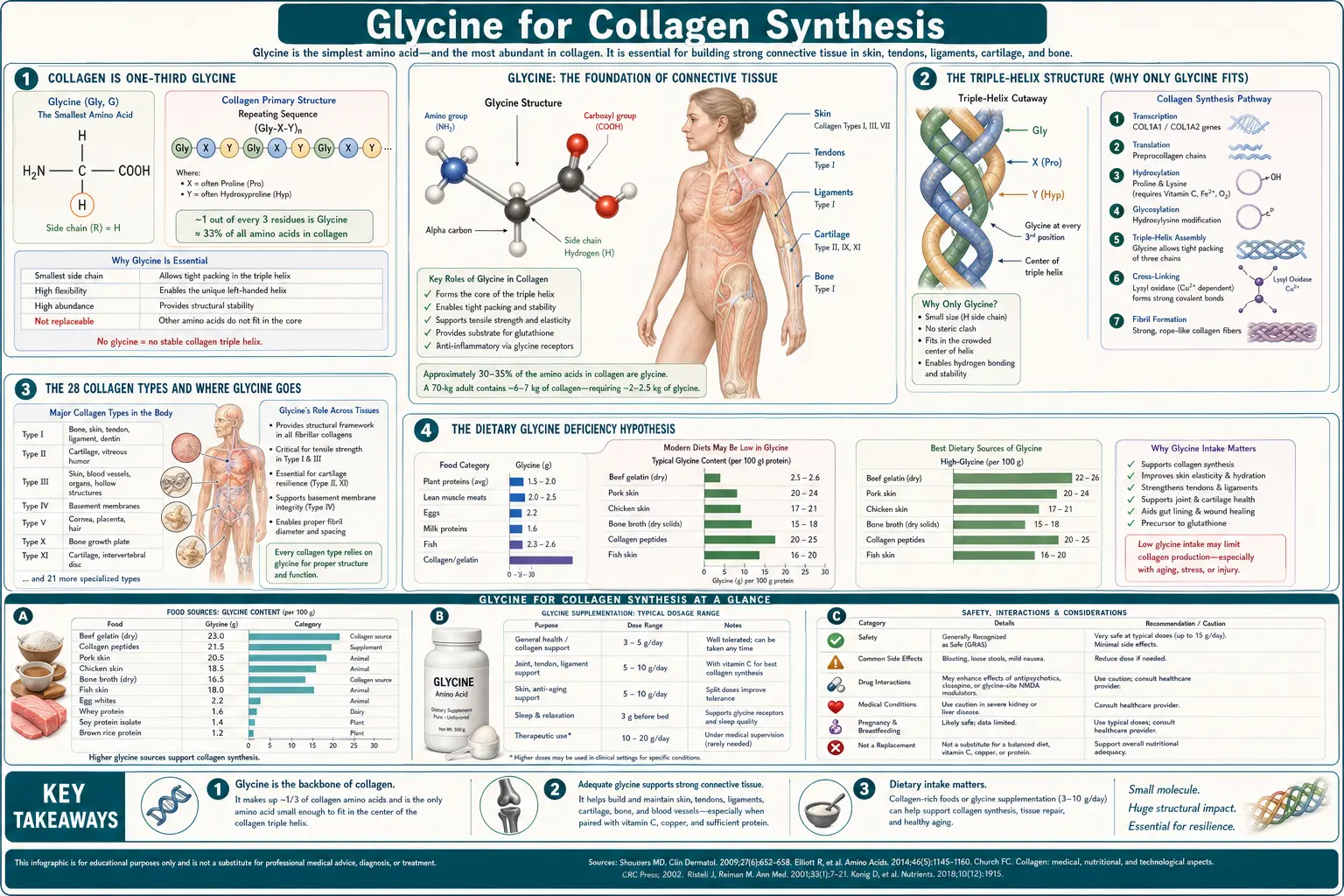
Collagen is the most abundant protein in animals (Shoulders 2009), and its triple helix requires a glycine at every third position (Xiao 2011). This deep-dive covers why glycine is the residue that fits there, the 2009 hypothesis of Meléndez-Hevia and colleagues that the body's own synthesis plus a typical diet may supply less glycine than it uses, the trials of gelatin and collagen peptides on collagen markers, pressure ulcers, skin and joints — which tested whole collagen products, not glycine on its own — and the GlyNAC (glycine plus N-acetylcysteine) studies in older adults.
Table of Contents
- Collagen Is One-Third Glycine
- The Triple-Helix Structure (Why Only Glycine Fits)
- The 28 Collagen Types and Where Glycine Goes
- The Dietary Glycine Deficiency Hypothesis
- Muscle Meat vs Whole-Animal Eating
- Wound Healing and Pressure Ulcers
- Skin Aging and Collagen Peptide Trials
- Joints, Cartilage, and Tendon Repair
- Bone Broth, Gelatin, and Collagen Peptides
- GlyNAC, Sekhar, and the Aging Connection
- Cofactors: Vitamin C, Iron, and Copper
- Doses Used in the Studies
- Key Research Papers
- Connections
- Featured Videos
Collagen Is One-Third Glycine
Collagen's chains are built on a repeating three-residue pattern, written Gly-X-Y, in which glycine is mandatory at every third position and the other two positions readily take the imino acids proline and hydroxyproline (Bhattacharjee 2005). In the fibrillar collagens this pattern runs, with glycine at every third position, for more than 1,000 amino acids (Byers 2001). Roughly one residue in three of the triple helix is therefore glycine.
That makes collagen synthesis one of the body's uses of glycine, alongside glutathione and the porphyrins, purines, creatine, sarcosine and bile salts for which glycine is a building block (McCarty 2018). How much glycine all of these uses need, and whether ordinary diets supply enough, is unsettled. A 2009 modelling study estimated that the body's own synthesis (about 3 g/day) plus a typical diet (1.5–3.0 g/day) may fall short of the amount needed for all metabolic uses, including collagen synthesis, by about 10 g per day for a 70 kg adult (Meléndez-Hevia 2009). That figure is a model estimate and a hypothesis, not a measured deficiency; it is described in The Dietary Glycine Deficiency Hypothesis below.
The Triple-Helix Structure (Why Only Glycine Fits)
Collagen's defining structure is the triple helix: a right-handed bundle of three parallel, left-handed polyproline II-type helices (Shoulders 2009). The coiled-coil triple-helical model was first proposed by Ramachandran's group in Madras, and crystal structures of collagen-like peptides have since confirmed its essential correctness; hydroxyproline residues help stabilize it (Bhattacharjee 2005). The stability of a stretch of triple helix can be predicted from its amino-acid sequence, including the effect of changes at the X and Y positions (Persikov 2005).
Close packing of the three chains is the reason for the glycine requirement: glycine, whose side chain is a single hydrogen atom, is required as every third residue, and replacing even one glycine in the repeating sequence with a larger residue leads to a pathological condition (Xiao 2011).
The inherited brittle-bone disease osteogenesis imperfecta shows this directly. It is caused mainly by dominant mutations in the genes for type I collagen (Marini 2017). In a 2007 catalogue of 832 independent structural mutations in type I collagen that cause the disease, 682 substituted another amino acid for a glycine in the triple helix and 150 altered splice sites; one-third of the glycine substitutions in the alpha1(I) chain were lethal, especially when the substituting residue was charged or had a branched side chain (Marini 2007). Substitutions for glycine are among the most common effects of mutations in the fibrillar collagens generally (Byers 2001).
The 28 Collagen Types and Where Glycine Goes
The collagen family has 28 members, each containing at least one triple-helical domain. Most are deposited in the extracellular matrix, where they form larger assemblies; four are membrane proteins that also exist in a soluble form; and some have a restricted tissue distribution and specific functions (Ricard-Blum 2011). In the fibrillar collagens, the three chains are assembled into several different molecules with tissue-specific distributions (Byers 2001). Type I collagen forms the prototypical collagen fibril (Shoulders 2009) and is the collagen whose mutations cause most osteogenesis imperfecta (Marini 2017).
Because every type is built on triple-helical domains, every type needs glycine at every third position of those domains.
The Dietary Glycine Deficiency Hypothesis
The proposition that many people may be short of glycine was set out most fully by Enrique Meléndez-Hevia and colleagues in a 2009 paper in Journal of Biosciences titled "A weak link in metabolism: the metabolic capacity for glycine biosynthesis does not satisfy the need for collagen synthesis." Starting from the observation that making glycine from serine is limited by the chemistry of the enzyme involved, they compared all the reported rates at which an adult makes and uses glycine, and estimated that:
- synthesis from serine accounts for more than 85% of the glycine the body makes;
- synthesis provides about 3 g/day, and the diet 1.5–3.0 g/day;
- together these may fall short of the amount needed for all metabolic uses, including collagen synthesis, by about 10 g per day for a 70 kg person.
The authors concluded that this supports the view that glycine is a semi-essential amino acid, and wrote that it should be taken as a nutritional supplement (Meléndez-Hevia 2009). That conclusion is theirs; the figure is a model estimate and a hypothesis, not a measured deficiency, and trials testing whether extra glycine changes collagen turnover in people were not found in PubMed.
A 2018 review by Mark McCarty and colleagues made a related argument about glutathione rather than collagen. It reported that tissue glycine levels are below the level at which the glutathione-making enzyme works at half speed, and that urinary excretion of 5-oxoproline — a by-product that rises when glycine is too scarce for glutathione synthesis — is raised in vegetarians and others eating relatively low-protein diets, which the authors took as strong evidence that dietary glycine can limit glutathione synthesis in normally fed people. The review concluded that clinical research is warranted (McCarty 2018).
Glycine is usually classed as a non-essential amino acid (Lizzo 2022), because the body can make it. The Meléndez-Hevia argument is that the body's maximum capacity to make it may fall short of total demand, which is a different question from whether it is technically essential.
Muscle Meat vs Whole-Animal Eating
Because glycine fills every third position in collagen's triple helix, foods made from or rich in collagen — gelatin, skin, and cuts with tendon and cartilage — are the richest food sources of it. Per-100 g glycine figures from the USDA FoodData Central records are listed on the Glycine Sources page. Bone broth and slow-cooked connective-tissue cuts contain collagen and so glycine, but their content varies with the recipe and cooking time, and no standard figure is given here.
Proponents of the deficiency hypothesis argue that diets built on muscle meat, without the skin, bone and connective tissue that earlier cuisines used, supply less glycine. Dietary surveys comparing glycine intake between muscle-only and whole-animal eating patterns were not found.
Wound Healing and Pressure Ulcers
The human trials found for this section tested collagen products — gelatin or collagen hydrolysate — rather than glycine on its own:
- Collagen synthesis markers after exercise (Shaw 2017). In a randomized, double-blind crossover study, 8 healthy men took 5 g or 15 g of vitamin C-enriched gelatin or a placebo, then skipped rope for 6 minutes an hour later, three times a day for 3 days. Gelatin raised blood glycine, proline, hydroxyproline and hydroxylysine, peaking an hour after the drink; 15 g taken an hour before exercise doubled a blood marker of collagen synthesis (the amino-terminal propeptide of collagen I); and lab-grown ligaments treated with the men's serum showed more collagen and better mechanics. The authors suggested gelatin could play a role in injury prevention and tissue repair; the study did not measure injuries.
- Pressure ulcers in long-term care (Lee 2006). In a randomized trial at 23 long-term-care facilities, 89 residents with stage II–IV pressure ulcers received standard care plus a concentrated, fortified collagen protein hydrolysate supplement or placebo three times a day for 8 weeks; 71 completed the study. Scores on the Pressure Ulcer Scale for Healing were significantly better with the supplement, which the authors described as about twice the rate of healing.
- Pressure ulcers (Sugihara 2018). In a double-blind, placebo-controlled trial of 120 people with stage II or III pressure ulcers (112 completed), 10 g/day of a collagen hydrolysate high in the collagen dipeptides Pro-Hyp and Hyp-Gly, added to standard care for 16 weeks, gave significantly better healing scores and a smaller wound area than placebo; a hydrolysate low in those dipeptides improved one of the healing scores. The trial was funded by a gelatin manufacturer, and two of its authors worked for it.
Skin Aging and Collagen Peptide Trials
Reviews of skin aging describe collagen atrophy as a major factor in it, report a strong correlation between skin collagen loss and the fall in oestrogen at menopause, and note that oestrogen use after menopause increases skin collagen content, dermal thickness and elasticity (Calleja-Agius 2012).
Trials of oral collagen peptides on skin test these products as a whole, not glycine on its own, and many were run or funded by collagen manufacturers:
- Proksch 2014 (elasticity). 69 women aged 35–55 took 2.5 g or 5.0 g of collagen hydrolysate or placebo once daily for 8 weeks. Skin elasticity improved significantly with both doses compared with placebo; effects on skin moisture were seen only in a subgroup analysis and were not statistically significant.
- Proksch 2014 (wrinkles). 114 women aged 45–65 took 2.5 g of a specific collagen peptide or placebo daily for 8 weeks. Eye-wrinkle volume fell significantly compared with placebo, and in a biopsy subgroup procollagen type I and elastin were higher in the collagen group.
- Asserin 2015. Two placebo-controlled trials reported significantly higher skin hydration after 8 weeks, and higher dermal collagen density with less fragmentation of the collagen network after 4 weeks, persisting at 12 weeks. In skin explants in the lab, collagen peptides increased collagen and glycosaminoglycan production. Several authors worked for collagen-ingredient suppliers.
- Kim 2018. 64 people took 1,000 mg of a low-molecular-weight collagen peptide or placebo daily for 12 weeks. Skin hydration and wrinkle measures were significantly better than placebo, and two of three elasticity measures were higher.
- de Miranda 2021 meta-analysis. 19 randomized, double-blind trials with 1,125 participants aged 20–70 (95% women) found that hydrolyzed collagen improved skin hydration, elasticity and wrinkles compared with placebo.
- Myung 2025 meta-analysis. 23 randomized trials with 1,474 participants also found an overall benefit, but when the trials were split by funding, those not funded by companies showed no effect on hydration, elasticity or wrinkles, and the high-quality trials showed no significant effect in any category. Its authors concluded there is currently no clinical evidence to support collagen supplements to prevent or treat skin aging.
In hairless mice, oral collagen peptide for nine weeks reduced the loss of skin hydration and the wrinkling caused by ultraviolet B light and raised hyaluronic acid in the skin (Kang 2018); that is an animal result. Trials of free glycine on its own for skin outcomes were not found.
Joints, Cartilage, and Tendon Repair
As with skin, the joint and tendon trials tested collagen hydrolysate, collagen peptides or gelatin, not glycine alone:
- Clark 2008. 147 athletes with activity-related joint pain but no evidence of joint disease were randomized to 10 g of collagen hydrolysate in a liquid or placebo daily for 24 weeks; data from 97 could be evaluated. Six pain measures (one rated by a physician, five by participants) changed significantly more with collagen hydrolysate than with placebo, more so in those with knee pain. The authors noted the study's size and limitations and called for further studies.
- Bruyère 2012. 200 people aged 50 or over with joint pain took 1,200 mg/day of collagen hydrolysate or placebo for 6 months. At 6 months the proportion with at least a 20% improvement in pain was significantly higher with collagen hydrolysate; at 3 months there was no significant difference (44.1% vs 39.6%). The authors wrote that more studies are needed.
- Kumar 2015. In a double-blind, placebo-controlled trial in people with knee osteoarthritis, collagen peptides from pork skin or bovine bone for 13 weeks lowered pain, function (WOMAC) and quality-of-life scores significantly compared with placebo. The first author worked for a gelatin manufacturer.
- Shaw 2017. 15 g of vitamin C-enriched gelatin taken an hour before 6 minutes of rope skipping doubled a blood marker of collagen synthesis in 8 healthy men (details under Wound Healing above). Tendon or ligament outcomes in people were not measured.
- Praet 2019. In a pilot crossover study of 20 people with chronic Achilles tendinopathy doing a calf-strengthening and return-to-running programme, the score on a standard Achilles questionnaire rose more during the 3 months on collagen peptides than during the 3 months on placebo; the authors concluded the peptides may speed the benefits of the exercise programme.
Bone Broth, Gelatin, and Collagen Peptides
Three collagen-derived foods and products carry glycine together with proline and hydroxyproline:
- Bone broth is made by simmering animal bones and connective tissue in water. Its glycine content varies with the recipe and cooking time, and no standard figure is given here.
- Gelatin is made from collagen. It is the form used in the Shaw 2017 study.
- Collagen peptides (collagen hydrolysate) are collagen broken down further by enzymes; studies have reported that they are absorbed and reach joint tissues (Kumar 2015). They are the form used in most of the skin, pressure-ulcer and joint trials above.
Free glycine powder supplies glycine alone, without proline or hydroxyproline. Trials comparing free glycine with collagen peptides or gelatin for collagen outcomes were not found. Per-food glycine figures are on the Glycine Sources page.
GlyNAC, Sekhar, and the Aging Connection
Glutathione, the main antioxidant made inside cells, is built from glutamate, cysteine and glycine, so it draws on the same glycine supply as collagen. A research group at Baylor College of Medicine led by Rajagopal Sekhar proposes that deficiencies of glutathione and of its precursors glycine and cysteine contribute to oxidative stress and mitochondrial decline in aging, and calls the combination of glycine and N-acetylcysteine (NAC) GlyNAC (Sekhar 2021). Because these studies gave the two precursors together, they cannot show how much glycine alone contributed. Nearly all of the human GlyNAC evidence comes from this one group:
- Sekhar 2011. 12 adults with uncontrolled type 2 diabetes had lower red-cell glycine and cysteine, lower glutathione and slower glutathione synthesis than 12 non-diabetic controls; after 2 weeks of dietary cysteine and glycine, glutathione synthesis and concentrations rose and markers of oxidative stress fell.
- Kumar 2021. An open-label pilot with no placebo group: 8 older adults and 8 young adults. After 24 weeks of GlyNAC the older adults showed improvements in glutathione, oxidative stress, mitochondrial function, inflammation, insulin resistance, strength, gait speed and cognition, which declined during 12 weeks off the supplement.
- Kumar 2023. A randomized trial in 24 older adults (12 GlyNAC, 12 alanine placebo) for 16 weeks, which reported that GlyNAC, and not placebo, improved glutathione deficiency, oxidative stress, mitochondrial function, insulin resistance, physical function and other measures.
The one trial from outside the group gave different results. Lizzo 2022, a randomized, controlled trial run by researchers employed by a nutrition company that markets glycine-and-NAC products, gave 114 healthy older volunteers GlyNAC at 2.4, 4.8 or 7.2 g/day or placebo for 2 weeks. GlyNAC was safe and well tolerated but did not meet its primary endpoint: it did not raise total glutathione or the ratio of reduced to oxidized glutathione. A post-hoc analysis found more glutathione generation in a subgroup with high oxidative stress and low starting glutathione who took the medium or high dose.
None of these studies measured collagen. The full GlyNAC record is on the Glutathione Synthesis page.
Cofactors: Vitamin C, Iron, and Copper
Glycine is one raw material for collagen; several enzyme steps that turn the new chains into stable fibres depend on other nutrients:
- Vitamin C and iron. Collagen prolyl 4-hydroxylases convert proline residues to 4-hydroxyproline, which is essential for the stability of the triple helix; these enzymes require iron (Fe2+), 2-oxoglutarate, oxygen and ascorbate (vitamin C) (Myllyharju 2008). Lysyl hydroxylases make the matching modification to lysine residues (Salo 2021).
- Copper. The lysyl oxidases are copper-containing enzymes that catalyze the first step of the covalent cross-linking of collagens and elastin, which contributes to the stiffness and mechanical properties of the extracellular matrix (Vallet 2019). See the Copper page for context.
- Proline and hydroxyproline readily occupy the two non-glycine positions of the Gly-X-Y triplet (Bhattacharjee 2005).
Doses Used in the Studies
The amounts below are those the studies on this page used; they describe the research, not a regimen. Most tested collagen products, whose glycine content was not reported in the abstracts.
- Gelatin before exercise: 5 g or 15 g of vitamin C-enriched gelatin an hour before 6 minutes of rope skipping, three times a day for 3 days (Shaw 2017).
- Skin: 2.5 g or 5.0 g of collagen hydrolysate daily for 8 weeks (Proksch 2014, elasticity); 2.5 g daily for 8 weeks (Proksch 2014, wrinkles); 1,000 mg daily for 12 weeks (Kim 2018).
- Pressure ulcers: 10 g/day of collagen hydrolysate for 16 weeks (Sugihara 2018); a fortified collagen protein hydrolysate supplement three times a day for 8 weeks (Lee 2006).
- Joints: 10 g of collagen hydrolysate daily for 24 weeks (Clark 2008); 1,200 mg/day for 6 months (Bruyère 2012).
- GlyNAC: 2.4, 4.8 or 7.2 g/day of glycine and NAC in a 1:1 ratio for 2 weeks, reported as safe and well tolerated (Lizzo 2022).
The 2009 estimate of a glycine shortfall of about 10 g per day (Meléndez-Hevia 2009) has not been tested in intake trials.
Key Research Papers
- Meléndez-Hevia E, De Paz-Lugo P, Cornish-Bowden A, Cárdenas ML (2009). A weak link in metabolism: the metabolic capacity for glycine biosynthesis does not satisfy the need for collagen synthesis. Journal of Biosciences 34(6):853-72. — PubMed PMID: 20093739
- McCarty MF, O'Keefe JH, DiNicolantonio JJ (2018). Dietary glycine is rate-limiting for glutathione synthesis and may have broad potential for health protection. Ochsner Journal 18(1):81-87. (Review.) — PubMed PMID: 29559876
- Shoulders MD, Raines RT (2009). Collagen structure and stability. Annual Review of Biochemistry 78:929-58. (Review.) — PubMed PMID: 19344236
- Bhattacharjee A, Bansal M (2005). Collagen structure: the Madras triple helix and the current scenario. IUBMB Life 57(3):161-72. (Review.) — PubMed PMID: 16036578
- Xiao J, Cheng H, Silva T, Baum J, Brodsky B (2011). Osteogenesis imperfecta missense mutations in collagen: structural consequences of a glycine to alanine replacement at a highly charged site. Biochemistry 50(50):10771-80. — PubMed PMID: 22054507
- Byers PH (2001). Folding defects in fibrillar collagens. Philosophical Transactions of the Royal Society of London B 356(1406):151-7. (Review.) — PubMed PMID: 11260795
- Persikov AV, Ramshaw JA, Brodsky B (2005). Prediction of collagen stability from amino acid sequence. Journal of Biological Chemistry 280(19):19343-9. — PubMed PMID: 15753081
- Marini JC, Forlino A, Cabral WA, et al. (2007). Consortium for osteogenesis imperfecta mutations in the helical domain of type I collagen: regions rich in lethal mutations align with collagen binding sites for integrins and proteoglycans. Human Mutation 28(3):209-21. — PubMed PMID: 17078022
- Marini JC, Forlino A, Bächinger HP, Bishop NJ, Byers PH, Paepe A, et al. (2017). Osteogenesis imperfecta. Nature Reviews Disease Primers 3:17052. (Review.) — PubMed PMID: 28820180
- Ricard-Blum S (2011). The collagen family. Cold Spring Harbor Perspectives in Biology 3(1):a004978. (Review.) — PubMed PMID: 21421911
- Shaw G, Lee-Barthel A, Ross ML, Wang B, Baar K (2017). Vitamin C-enriched gelatin supplementation before intermittent activity augments collagen synthesis. American Journal of Clinical Nutrition 105(1):136-143. — PubMed PMID: 27852613
- Lee SK, Posthauer ME, Dorner B, Redovian V, Maloney MJ (2006). Pressure ulcer healing with a concentrated, fortified, collagen protein hydrolysate supplement: a randomized controlled trial. Advances in Skin & Wound Care 19(2):92-6. — PubMed PMID: 16557055
- Sugihara F, Inoue N, Venkateswarathirukumara S (2018). Ingestion of bioactive collagen hydrolysates enhanced pressure ulcer healing in a randomized double-blind placebo-controlled clinical study. Scientific Reports 8(1):11403. — PubMed PMID: 30061579
- Calleja-Agius J, Brincat M (2012). The effect of menopause on the skin and other connective tissues. Gynecological Endocrinology 28(4):273-7. (Review.) — PubMed PMID: 21970508
- Proksch E, Segger D, Degwert J, Schunck M, Zague V, Oesser S (2014). Oral supplementation of specific collagen peptides has beneficial effects on human skin physiology: a double-blind, placebo-controlled study. Skin Pharmacology and Physiology 27(1):47-55. — PubMed PMID: 23949208
- Proksch E, Schunck M, Zague V, Segger D, Degwert J, Oesser S (2014). Oral intake of specific bioactive collagen peptides reduces skin wrinkles and increases dermal matrix synthesis. Skin Pharmacology and Physiology 27(3):113-9. — PubMed PMID: 24401291
- Asserin J, Lati E, Shioya T, Prawitt J (2015). The effect of oral collagen peptide supplementation on skin moisture and the dermal collagen network: evidence from an ex vivo model and randomized, placebo-controlled clinical trials. Journal of Cosmetic Dermatology 14(4):291-301. — PubMed PMID: 26362110
- Kim DU, Chung HC, Choi J, Sakai Y, Lee BY (2018). Oral intake of low-molecular-weight collagen peptide improves hydration, elasticity, and wrinkling in human skin: a randomized, double-blind, placebo-controlled study. Nutrients 10(7):826. — PubMed PMID: 29949889
- de Miranda RB, Weimer P, Rossi RC (2021). Effects of hydrolyzed collagen supplementation on skin aging: a systematic review and meta-analysis. International Journal of Dermatology 60(12):1449-1461. — PubMed PMID: 33742704
- Myung SK, Park Y (2025). Effects of collagen supplements on skin aging: a systematic review and meta-analysis of randomized controlled trials. American Journal of Medicine 138(9):1264-1277. — PubMed PMID: 40324552
- Kang MC, Yumnam S, Kim SY (2018). Oral intake of collagen peptide attenuates ultraviolet B irradiation-induced skin dehydration in vivo by regulating hyaluronic acid synthesis. International Journal of Molecular Sciences 19(11):3551. (Animal study.) — PubMed PMID: 30423867
- Clark KL, Sebastianelli W, Flechsenhar KR, Aukermann DF, Meza F, Millard RL, et al. (2008). 24-Week study on the use of collagen hydrolysate as a dietary supplement in athletes with activity-related joint pain. Current Medical Research and Opinion 24(5):1485-96. — PubMed PMID: 18416885
- Bruyère O, Zegels B, Leonori L, Rabenda V, Janssen A, Bourges C, Reginster JY (2012). Effect of collagen hydrolysate in articular pain: a 6-month randomized, double-blind, placebo controlled study. Complementary Therapies in Medicine 20(3):124-30. — PubMed PMID: 22500661
- Kumar S, Sugihara F, Suzuki K, Inoue N, Venkateswarathirukumara S (2015). A double-blind, placebo-controlled, randomised, clinical study on the effectiveness of collagen peptide on osteoarthritis. Journal of the Science of Food and Agriculture 95(4):702-7. — PubMed PMID: 24852756
- Praet SFE, Purdam CR, Welvaert M, Vlahovich N, Lovell G, Burke LM, et al. (2019). Oral supplementation of specific collagen peptides combined with calf-strengthening exercises enhances function and reduces pain in Achilles tendinopathy patients. Nutrients 11(1):76. (Pilot study.) — PubMed PMID: 30609761
- Sekhar RV, McKay SV, Patel SG, Guthikonda AP, Reddy VT, Balasubramanyam A, Jahoor F (2011). Glutathione synthesis is diminished in patients with uncontrolled diabetes and restored by dietary supplementation with cysteine and glycine. Diabetes Care 34(1):162-7. — PubMed PMID: 20929994
- Kumar P, Liu C, Hsu JW, Chacko S, Minard C, Jahoor F, Sekhar RV (2021). Glycine and N-acetylcysteine (GlyNAC) supplementation in older adults improves glutathione deficiency, oxidative stress, mitochondrial dysfunction, inflammation, insulin resistance, endothelial dysfunction, genotoxicity, muscle strength, and cognition: results of a pilot clinical trial. Clinical and Translational Medicine 11(3):e372. (Open-label pilot, no placebo group.) — PubMed PMID: 33783984
- Kumar P, Liu C, Suliburk J, Hsu JW, Muthupillai R, Jahoor F, et al. (2023). Supplementing glycine and N-acetylcysteine (GlyNAC) in older adults improves glutathione deficiency, oxidative stress, mitochondrial dysfunction, inflammation, physical function, and aging hallmarks: a randomized clinical trial. Journals of Gerontology Series A 78(1):75-89. — PubMed PMID: 35975308
- Sekhar RV (2021). GlyNAC supplementation improves glutathione deficiency, oxidative stress, mitochondrial dysfunction, inflammation, aging hallmarks, metabolic defects, muscle strength, cognitive decline, and body composition: implications for healthy aging. Journal of Nutrition 151(12):3606-3616. (Review.) — PubMed PMID: 34587244
- Lizzo G, Migliavacca E, Lamers D, Frézal A, Corthesy J, Vinyes-Parès G, et al. (2022). A randomized controlled clinical trial in healthy older adults to determine efficacy of glycine and N-acetylcysteine supplementation on glutathione redox status and oxidative damage. Frontiers in Aging 3:852569. — PubMed PMID: 35821844
- Myllyharju J (2008). Prolyl 4-hydroxylases, key enzymes in the synthesis of collagens and regulation of the response to hypoxia, and their roles as treatment targets. Annals of Medicine 40(6):402-17. (Review.) — PubMed PMID: 19160570
- Salo AM, Myllyharju J (2021). Prolyl and lysyl hydroxylases in collagen synthesis. Experimental Dermatology 30(1):38-49. (Review.) — PubMed PMID: 32969070
- Vallet SD, Ricard-Blum S (2019). Lysyl oxidases: from enzyme activity to extracellular matrix cross-links. Essays in Biochemistry 63(3):349-364. (Review.) — PubMed PMID: 31488698