Glycine for Glutathione Synthesis
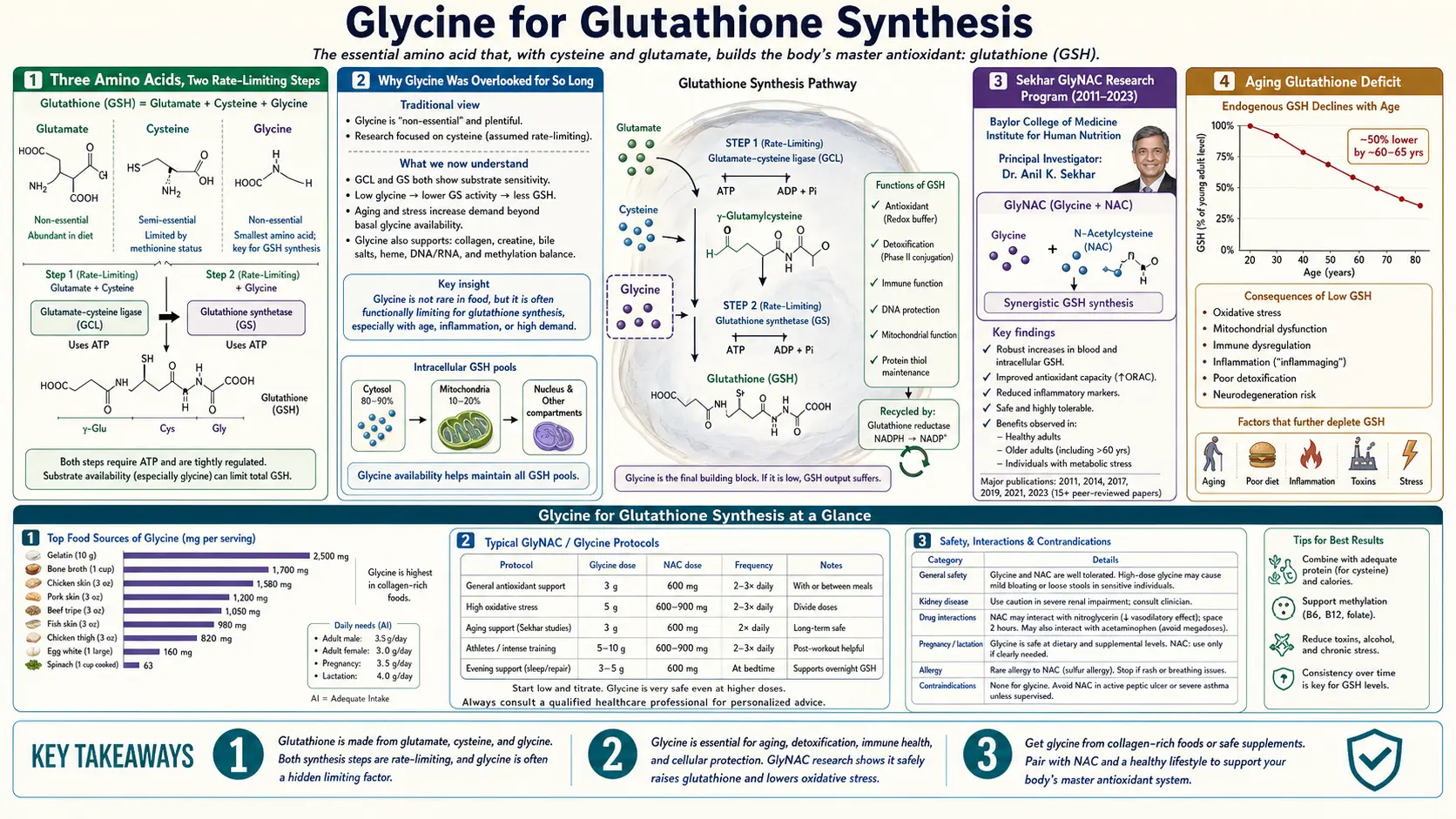
Glutathione (gamma-glutamyl-cysteinyl-glycine, abbreviated GSH) is the main non-protein thiol antioxidant inside cells, a tripeptide made in the cytosol from three amino acids: glutamate, cysteine, and glycine. The standard biochemical account treats cysteine availability and the first enzyme of the pathway as the key limits on synthesis — the basis for the use of N-acetylcysteine (NAC) as a glutathione precursor. A series of small studies from one research group at Baylor College of Medicine (2011 onward) reported that older adults, people with uncontrolled type 2 diabetes and older people with HIV had low red-blood-cell glycine and cysteine, low glutathione and slow glutathione synthesis, and that oral glycine plus NAC (“GlyNAC”) raised glutathione and lowered oxidative-stress markers; their later trials also reported changes in mitochondrial fuel oxidation, inflammation, insulin resistance, strength and other measures. An independent industry-funded randomized trial in healthy older adults did not find a rise in glutathione on its primary endpoint. This deep-dive walks through the biochemistry, the trial sequence, the mitochondrial connection, and the doses the trials used.
Table of Contents
- Three Amino Acids, Two Enzymatic Steps
- Why Glycine Was Overlooked for So Long
- The Sekhar GlyNAC Research Program (2011–2023)
- The Aging Glutathione Deficit
- Mitochondrial Dysfunction and Oxidative Stress
- GlyNAC and the Hallmarks of Aging
- Diabetes, HIV, and Other Chronic-Disease Populations
- NAC Alone vs Glycine Alone vs GlyNAC Combined
- Doses Used in the Trials
- Safety Findings and Drug Interactions
- Key Research Papers
- Connections
- Featured Videos
Three Amino Acids, Two Enzymatic Steps
Glutathione (GSH) is synthesized in the cytosol in a two-step ATP-dependent process (reviewed by Lu 2013):
- Step 1. Glutamate-cysteine ligase (GCL, also called gamma-glutamylcysteine synthetase) joins glutamate to cysteine through a gamma-peptide bond, producing gamma-glutamyl-cysteine (gamma-GC). GCL is described as the rate-limiting enzyme and is made of a catalytic (GCLC) and a modifier (GCLM) subunit. Its activity is subject to feedback inhibition by GSH itself, and the availability of cysteine is the other key determinant of synthesis.
- Step 2. Glutathione synthetase (GS) joins gamma-GC to glycine, producing the final tripeptide glutathione. In the standard account GS is not the rate-limiting step.
The conventional textbook account stops there: cysteine and GCL set the pace, glycine is assumed to be plentiful, and the usual way to supply cysteine is N-acetylcysteine (NAC), an acetylated form that is absorbed orally and converted to cysteine. In cultured human liver-cancer cells, about half of the intracellular glutathione pool was derived from homocysteine via the transsulfuration pathway, which makes cysteine from methionine (Mosharov 2000, a cell study).
The Sekhar group's position is that this account is incomplete. In their studies of older adults, people with uncontrolled type 2 diabetes and older people with HIV, red-blood-cell glycine and cysteine concentrations were lower than in controls and glutathione synthesis was slower, and supplementing both precursors together raised glutathione. Those studies tested only the combination, so they do not show how much of the effect is due to glycine rather than cysteine.
Why Glycine Was Overlooked for So Long
The historical neglect of glycine as a glutathione precursor traces to two assumptions:
Assumption 1: Glycine is abundant. Glycine is the smallest amino acid, is present in almost all dietary proteins, and the body makes it, mostly from serine. The textbook conclusion was that glycine supply could not realistically become limiting. Meléndez-Hevia and colleagues (2009; covered on the Collagen Synthesis page) compared reported glycine fluxes in an adult and estimated that synthesis (about 3 g/day, more than 85% of it from serine) plus diet (1.5–3.0 g/day) may fall short of total metabolic demand, including collagen synthesis, by about 10 g per day for a 70 kg person. McCarty and colleagues (2018) argued that higher urinary 5-oxoproline in vegetarians and others on lower-protein diets suggests dietary glycine can be rate-limiting for glutathione synthesis, and noted animal studies in which supplemental glycine raised tissue glutathione.
Assumption 2: The second enzyme is not rate-limiting. Because GCL is the slower, feedback-regulated step, glutathione synthetase was not seen as a control point. The argument for glycine is that when glycine supply is short, the second step can also slow; the Sekhar studies did not measure enzyme kinetics directly.
The Sekhar 2011 Diabetes Care study measured this in patients: 12 adults with uncontrolled type 2 diabetes and 12 non-diabetic controls were infused with a labelled glycine tracer to measure glutathione synthesis. The diabetic patients had lower red-blood-cell glycine and cysteine, much lower glutathione, slower fractional and absolute glutathione synthesis, and higher reactive oxygen metabolites and lipid peroxides. After 2 weeks of oral cysteine (as NAC) plus glycine, glutathione synthesis and concentrations rose significantly and oxidative stress and lipid peroxides fell significantly. The authors concluded that the deficient synthesis was attributable to limited precursor availability.
The Sekhar GlyNAC Research Program (2011–2023)
Rajagopal V. Sekhar at Baylor College of Medicine has led a research program on glutathione in aging and chronic disease. The combination is called “GlyNAC” — oral glycine plus N-acetylcysteine, given daily for 2 weeks to 6 months depending on the study. The main published studies, in chronological order:
- Sekhar et al. 2011, Diabetes Care. 12 adults with uncontrolled type 2 diabetes vs 12 non-diabetic controls. Two weeks of cysteine (as NAC) plus glycine raised glutathione synthesis and concentrations and lowered reactive oxygen metabolites and lipid peroxides.
- Sekhar et al. 2011, American Journal of Clinical Nutrition. 8 older and 8 younger adults. The older group had lower red-blood-cell glycine, cysteine and glutathione and slower glutathione synthesis; after 2 weeks of supplementation their glutathione and synthesis rates rose and oxidative-stress markers fell, with no differences remaining from the younger group.
- Nguyen et al. 2013, Aging Cell. Combined studies in old and young mice and in older vs young humans; glutathione deficiency in old mice and older humans was associated with lower fasted mitochondrial fatty-acid oxidation and insulin resistance, which improved when glutathione was restored.
- Nguyen et al. 2014, Journal of Clinical Endocrinology and Metabolism. Open-label study of 8 older men with HIV before and after 14 days of cysteine plus glycine: glutathione synthesis was restored, with reported improvements in mitochondrial fuel oxidation, insulin sensitivity, body composition, muscle strength and blood lipids.
- Sekhar et al. 2015, AIDS. A short research letter reporting that raising glutathione with cysteine and glycine lowered inflammation in patients with HIV.
- Kumar et al. 2020, Biomedicines. Open-label trial in 8 people with HIV and 8 matched uninfected controls; after 12 weeks of GlyNAC the HIV group showed improvement in the measured defects, and the benefits receded 8 weeks after stopping.
- Kumar et al. 2021, Clinical and Translational Medicine. A 36-week open-label pilot trial in 8 older and 8 young adults: the older adults took GlyNAC for 24 weeks and then stopped for 12 weeks. The authors reported corrected red-blood-cell glutathione deficiency, oxidative stress and mitochondrial dysfunction, and improvements in inflammation, endothelial function, insulin resistance, genomic damage, cognition, strength, gait speed, exercise capacity, body fat and waist circumference — and that the benefits declined after supplementation stopped.
- Sekhar 2021, Journal of Nutrition. A review of the group's rodent and human GlyNAC work, which noted that the findings needed confirmation in a randomized clinical trial.
- Sekhar 2022, Antioxidants. A pilot study in 10 adults with type 2 diabetes and 10 unsupplemented non-diabetic controls: 14 days of GlyNAC improved fasted mitochondrial fatty-acid oxidation by 30%, lowered insulin resistance by 22% and lowered plasma free fatty acids by 25%.
- Kumar et al. 2023, Journal of Gerontology: Medical Sciences (randomized trial). 24 older adults were randomized to GlyNAC (12) or an isonitrogenous alanine placebo (12) for 16 weeks; 12 young adults took GlyNAC for 2 weeks for comparison. The authors reported that GlyNAC, and not placebo, improved or corrected glutathione deficiency, oxidative stress, mitochondrial dysfunction, inflammation, endothelial dysfunction, insulin resistance, multiple aging hallmarks, gait speed, muscle strength, 6-minute walk, waist circumference and systolic blood pressure.
The 2023 trial is the group's first placebo-controlled randomized trial of GlyNAC in older adults. It is still small (12 people per arm), and its abstract does not list cognition among the outcomes.
A separate randomized controlled trial run by a nutrition-industry research institute (Lizzo et al. 2022, Frontiers in Aging) gave 114 healthy older volunteers (mean age 65) GlyNAC at 2.4, 4.8 or 7.2 g/day (1:1 ratio) or placebo for 2 weeks. GlyNAC was safe and well tolerated but did not increase the reduced-to-oxidized glutathione ratio or total glutathione, the primary endpoint. In a post-hoc analysis, a subgroup with high oxidative stress and low baseline glutathione who took the medium or high dose showed higher glutathione than placebo.
The Aging Glutathione Deficit
In the Sekhar 2011 American Journal of Clinical Nutrition study, red-blood-cell glutathione was 2.08 mmol/L in the younger subjects and 1.12 mmol/L in the elderly subjects. In the authors' view, the deficit is linked to oxidative damage and to the mitochondrial dysfunction associated with age-related decline in muscle and metabolism.
The same study measured the upstream substrates and synthesis rates. Compared with the younger subjects, the elderly subjects had:
- Lower red-blood-cell glycine (486.7 vs 218.0 μmol/L)
- Lower red-blood-cell cysteine (26.2 vs 19.8 μmol/L)
- Slower fractional and absolute glutathione synthesis, measured with a stable-isotope glycine tracer
- Higher plasma oxidative stress and F2-isoprostanes
After two weeks of cysteine plus glycine, the elderly subjects had a 94.6% higher glutathione concentration, a 78.8% higher fractional synthesis rate and a 230.9% higher absolute synthesis rate, with significantly lower oxidative stress and F2-isoprostanes; no differences in these measures remained between the younger subjects and the supplemented elderly subjects.
The authors' interpretation is that aging produces a precursor-deficit state — not simply lower antioxidant defense, but lower supply of the building blocks for it. The study was small (8 per group) and short (2 weeks).
Mitochondrial Dysfunction and Oxidative Stress
Mitochondria are a major intracellular source of reactive oxygen species. Electrons that leak from the respiratory chain, mainly at complexes I and III, reduce oxygen to superoxide, which is converted to hydrogen peroxide. Hydrogen peroxide is then detoxified by catalase or by the glutathione peroxidase system — the latter using reduced glutathione as the electron donor.
When intracellular glutathione drops, hydrogen peroxide and its downstream products (hydroxyl radical, lipid peroxides, oxidized proteins) accumulate. The mitochondrial inner membrane itself becomes a target — oxidation of cardiolipin disrupts respiratory-chain organization, and mitochondrial DNA accumulates oxidative damage. The proposed result is a feed-forward cycle: lower glutathione → more oxidative damage → impaired mitochondrial function → more electron leak → more oxidative damage.
The GlyNAC trials measured mitochondrial fuel oxidation with stable-isotope and calorimetry methods and reported improvements after 24 weeks (the 2021 pilot) and 16 weeks (the 2023 randomized trial) of supplementation in older adults. The outcomes reported across the 2021 pilot and the 2023 trial include:
- Lower plasma 8-hydroxy-deoxyguanosine, a marker of oxidative DNA damage (2021 pilot)
- Lower oxidative-stress markers (both)
- Lower inflammation markers (both)
- Lower insulin resistance (both)
- Improved endothelial function (both)
- Improved muscle strength (both)
- Improved gait speed and 6-minute walk distance (both)
- Improvements on cognitive tests (2021 pilot)
The authors interpret the breadth of these changes as support for the hypothesis that mitochondrial oxidative stress lies upstream of many apparently separate declines of aging. Both studies were small, and the pilot was open-label.
GlyNAC and the Hallmarks of Aging
In the “Hallmarks of Aging” framework proposed by López-Otín and colleagues in 2013 (nine hallmarks) and updated in 2023 (twelve), these interconnected processes are proposed as core drivers of aging:
- Genomic instability
- Telomere attrition
- Epigenetic alterations
- Loss of proteostasis
- Disabled macroautophagy
- Deregulated nutrient sensing
- Mitochondrial dysfunction
- Cellular senescence
- Stem cell exhaustion
- Altered intercellular communication
- Chronic inflammation
- Dysbiosis
The 2023 randomized trial reported that GlyNAC improved “multiple aging hallmarks” in older adults, and the Sekhar 2021 review states that GlyNAC “appears to reverse multiple aging hallmarks” while noting the need for confirmation in a randomized trial. The trial cohorts are small, the markers used are indirect, and how many hallmarks count as “improved” depends on how each is measured.
In an animal study (Kumar 2022, Nutrients), mice given GlyNAC lived 24% longer than control mice. Whether anything similar applies to human healthspan or lifespan cannot be shown by a 16- or 24-week trial; data on hospitalization, disability or mortality would need long-term follow-up.
Diabetes, HIV, and Other Chronic-Disease Populations
Beyond the aging cohort, the Sekhar group has reported glutathione deficiency and responses to glycine plus cysteine in specific patient groups:
- Type 2 diabetes (Sekhar 2011; Sekhar 2022). Patients with uncontrolled diabetes had lower red-blood-cell glutathione, glycine and cysteine and higher oxidative stress than controls; 2 weeks of cysteine plus glycine raised glutathione synthesis and concentrations and lowered oxidative stress markers. A later 14-day GlyNAC pilot in 10 patients reported improved mitochondrial fatty-acid oxidation and lower insulin resistance. Low circulating glycine in metabolic syndrome and type 2 diabetes is covered on the main Glycine page.
- HIV infection (Nguyen 2014; Sekhar 2015; Kumar 2020). In older men with HIV, impaired synthesis contributed to glutathione deficiency, and 14 days of cysteine plus glycine restored it, with reported improvements in mitochondrial fuel oxidation, insulin sensitivity, body composition and muscle strength. A 12-week open-label GlyNAC trial in people with HIV reported improvements in the measured defects that receded after stopping.
- Genetic disorders of glutathione metabolism. Hereditary glutathione synthetase deficiency is a rare inborn disorder of the second step of synthesis; it is a separate clinical condition from the age-related deficit described above.
- Pulmonary fibrosis and COPD. NAC has been studied as a glutathione precursor in some lung diseases; no trial testing glycine added to NAC in these conditions was found for this page.
Across the Sekhar group's studies the pattern reported is consistent: aging and the chronic-disease states they studied showed a precursor-deficient glutathione system that responded to glycine plus cysteine. Those studies are small, mostly open-label, and come from one research group; the independent 2022 trial in healthy older adults did not reproduce a glutathione rise on its primary endpoint.
NAC Alone vs Glycine Alone vs GlyNAC Combined
A common question is whether the GlyNAC combination does more than NAC alone (which has a long clinical history) or glycine alone.
The trials did not test this directly. The Sekhar studies compared the combination with no treatment, with young or healthy controls, or (in the 2023 trial) with an alanine placebo. No arm received NAC alone or glycine alone, so they do not show whether the combination does more than either precursor by itself.
NAC alone supplies cysteine for the first enzymatic step. In acetaminophen (paracetamol) overdose, intravenous NAC is the standard antidote, a setting in which cysteine supply is the critical limit.
Glycine alone supplies the substrate for the second step. The biochemical argument is that it can only add to glutathione when cysteine and the first step are not limiting; McCarty and colleagues cite animal studies in which supplemental glycine raised tissue glutathione.
The GlyNAC combination supplies both substrates. Its proponents' rationale is that older adults and the patients studied were low in both. For young healthy adults, no trial evidence of a glutathione benefit was found.
Doses Used in the Trials
The Sekhar studies dosed by body weight. The 2011 Diabetes Care and American Journal of Clinical Nutrition studies and the 2021 pilot trial report:
- Glycine: 1.33 mmol per kg body weight per day
- Cysteine: 0.81 mmol per kg body weight per day, given as N-acetylcysteine
In the 2021 pilot the supplements were capsules prepared by a licensed pharmacist, with kidney and liver function monitored during the trial. The abstract of the 2023 randomized trial does not state the dose. The independent 2022 trial used fixed daily totals of 2.4, 4.8 or 7.2 g of GlyNAC (glycine and NAC in a 1:1 ratio) for 2 weeks.
Trial durations ranged from 2 weeks to 24 weeks. Glutathione and oxidative-stress markers changed within the 2-week studies; the 2021 pilot reported strength, cognition and other functional changes after 24 weeks. In that pilot and in the 2020 HIV trial, the reported benefits declined after GlyNAC was stopped (12 and 8 weeks after stopping, respectively).
NAC has a sulfurous smell and taste; glycine tastes sweet. No trial data comparing other NAC forms (such as the ethyl ester or liposomal products) with standard NAC for glutathione restoration was found for this page.
Safety Findings and Drug Interactions
- Clozapine. In a 12-week placebo-controlled trial in 19 people with treatment-resistant schizophrenia on clozapine, 30 g/day of glycine did not reduce symptoms, while the placebo group had a 35% reduction in positive symptoms; the authors suggested glycine may interfere with clozapine's effect (Potkin 1999). An 8-week trial of 60 g/day glycine added to clozapine in 30 adults found no significant change in symptoms or cognition and no clinically significant worsening (Evins 2000). The research raises a concern for people taking clozapine.
- NAC and nitroglycerin. NAC potentiates the vasodilator effect of nitroglycerin. In a trial in unstable angina, symptomatic hypotension occurred in 7 of 24 patients given intravenous nitroglycerin plus intravenous NAC vs none of 22 given nitroglycerin alone (Horowitz 1988).
- NAC and cancer. NAC has been studied for reducing cisplatin ototoxicity. In mouse models of lung cancer, dietary NAC and vitamin E increased tumor progression and reduced survival (Sayin 2014, an animal study). Whether this applies to people with cancer is not established; questions about timing during cancer treatment are for the oncology team.
- Anticoagulants. A nitroglycerin–NAC product (S-nitroso-NAC) inhibits platelet aggregation (Horowitz 1988). No trial data on NAC combined with warfarin or DOACs was found for this page.
- Asthma. Adverse reactions (typically anaphylactoid) occurred in 12.4% of patients given intravenous NAC for paracetamol overdose in one UK unit (Yamamoto 2014), and asthma is a reported risk factor; a fatal reaction has been reported in a patient with brittle asthma (Appelboam 2002). These reports concern intravenous NAC, not oral use.
- Pregnancy. Glycine is a normal dietary amino acid. The high-dose GlyNAC regimens have not been studied in pregnancy.
- Tolerance. The 2021 pilot, the 2022 independent trial and the 2023 randomized trial each described GlyNAC as well tolerated.
- Hereditary glycine encephalopathy. In this inborn disorder of glycine breakdown, extra glycine is a concern; it is covered in the Glycine section.
Decisions about supplements and medicines belong with a clinician.
Key Research Papers
- Sekhar RV, McKay SV, Patel SG, et al. (2011). Glutathione synthesis is diminished in patients with uncontrolled diabetes and restored by dietary supplementation with cysteine and glycine. Diabetes Care, 34(1), 162–167. — PubMed PMID: 20929994
- Nguyen D, Hsu JW, Jahoor F, Sekhar RV (2014). Effect of increasing glutathione with cysteine and glycine supplementation on mitochondrial fuel oxidation, insulin sensitivity, and body composition in older HIV-infected patients. Journal of Clinical Endocrinology and Metabolism, 99(1), 169–177. — PubMed PMID: 24081740
- Sekhar RV, Patel SG, Guthikonda AP, et al. (2011). Deficient synthesis of glutathione underlies oxidative stress in aging and can be corrected by dietary cysteine and glycine supplementation. American Journal of Clinical Nutrition, 94(3), 847–853. — PubMed PMID: 21795440
- Kumar P, Liu C, Hsu JW, et al. (2021). Glycine and N-acetylcysteine (GlyNAC) supplementation in older adults improves glutathione deficiency, oxidative stress, mitochondrial dysfunction, inflammation, insulin resistance, endothelial dysfunction, genotoxicity, muscle strength, and cognition: results of a pilot clinical trial. Clinical and Translational Medicine, 11(3), e372. — PubMed PMID: 33783984
- Kumar P, Osahon OW, Sekhar RV (2023). GlyNAC (glycine and N-acetylcysteine) supplementation in old mice improves brain glutathione deficiency, oxidative stress, glucose uptake, mitochondrial dysfunction, genomic damage, inflammation and neurotrophic factors to reverse age-associated cognitive decline: implications for improving brain health in aging. Antioxidants, 12(5), 1042. (Animal study.) — PubMed PMID: 37237908
- Kumar P, Liu C, Suliburk J, et al. (2023). Supplementing glycine and N-acetylcysteine (GlyNAC) in older adults improves glutathione deficiency, oxidative stress, mitochondrial dysfunction, inflammation, physical function, and aging hallmarks: a randomized clinical trial. Journals of Gerontology Series A: Biological Sciences and Medical Sciences, 78(1), 75–89. — PubMed PMID: 35975308
- Sekhar RV (2021). GlyNAC supplementation improves glutathione deficiency, oxidative stress, mitochondrial dysfunction, inflammation, aging hallmarks, metabolic defects, muscle strength, cognitive decline, and body composition: implications for healthy aging. Journal of Nutrition, 151(12), 3606–3616. — PubMed PMID: 34587244
- McCarty MF, O'Keefe JH, DiNicolantonio JJ (2018). Dietary glycine is rate-limiting for glutathione synthesis and may have broad potential for health protection. Ochsner Journal, 18(1), 81–87. — PubMed PMID: 29559876
- Meléndez-Hevia E, De Paz-Lugo P, Cornish-Bowden A, Cárdenas ML (2009). A weak link in metabolism: the metabolic capacity for glycine biosynthesis does not satisfy the need for collagen synthesis. Journal of Biosciences, 34(6), 853–872. — PubMed PMID: 20093739
- López-Otín C, Blasco MA, Partridge L, Serrano M, Kroemer G (2013). The hallmarks of aging. Cell, 153(6), 1194–1217. — PubMed PMID: 23746838
- López-Otín C, Blasco MA, Partridge L, Serrano M, Kroemer G (2023). Hallmarks of aging: an expanding universe. Cell, 186(2), 243–278. — PubMed PMID: 36599349
- Mosharov E, Cranford MR, Banerjee R (2000). The quantitatively important relationship between homocysteine metabolism and glutathione synthesis by the transsulfuration pathway and its regulation by redox changes. Biochemistry, 39(42), 13005–13011. — PubMed PMID: 11041866
- Lu SC (2013). Glutathione synthesis. Biochimica et Biophysica Acta, 1830(5), 3143–3153. — PubMed PMID: 22995213
- Lizzo G, Migliavacca E, Lamers D, et al. (2022). A randomized controlled clinical trial in healthy older adults to determine efficacy of glycine and N-acetylcysteine supplementation on glutathione redox status and oxidative damage. Frontiers in Aging, 3, 852569. — PubMed PMID: 35821844
- Nguyen D, Samson SL, Reddy VT, Gonzalez EV, Sekhar RV (2013). Impaired mitochondrial fatty acid oxidation and insulin resistance in aging: novel protective role of glutathione. Aging Cell, 12(3), 415–425. — PubMed PMID: 23534396
- Sekhar RV, Liu CW, Rice S (2015). Increasing glutathione concentrations with cysteine and glycine supplementation lowers inflammation in HIV patients. AIDS, 29(14), 1899–1900. — PubMed PMID: 26372395
- Kumar P, Liu C, Suliburk JW, et al. (2020). Supplementing glycine and N-acetylcysteine (GlyNAC) in aging HIV patients improves oxidative stress, mitochondrial dysfunction, inflammation, endothelial dysfunction, insulin resistance, genotoxicity, strength, and cognition: results of an open-label clinical trial. Biomedicines, 8(10), 390. — PubMed PMID: 33007928
- Sekhar RV (2022). GlyNAC (glycine and N-acetylcysteine) supplementation improves impaired mitochondrial fuel oxidation and lowers insulin resistance in patients with type 2 diabetes: results of a pilot study. Antioxidants, 11(1), 154. — PubMed PMID: 35052658
- Kumar P, Osahon OW, Sekhar RV (2022). GlyNAC (glycine and N-acetylcysteine) supplementation in mice increases length of life by correcting glutathione deficiency, oxidative stress, mitochondrial dysfunction, abnormalities in mitophagy and nutrient sensing, and genomic damage. Nutrients, 14(5), 1114. (Animal study.) — PubMed PMID: 35268089
- Potkin SG, Jin Y, Bunney BG, Costa J, Gulasekaram B (1999). Effect of clozapine and adjunctive high-dose glycine in treatment-resistant schizophrenia. American Journal of Psychiatry, 156(1), 145–147. — PubMed PMID: 9892314
- Evins AE, Fitzgerald SM, Wine L, Rosselli R, Goff DC (2000). Placebo-controlled trial of glycine added to clozapine in schizophrenia. American Journal of Psychiatry, 157(5), 826–828. — PubMed PMID: 10784481
- Horowitz JD, Henry CA, Syrjanen ML, et al. (1988). Combined use of nitroglycerin and N-acetylcysteine in the management of unstable angina pectoris. Circulation, 77(4), 787–794. — PubMed PMID: 3127076
- Sayin VI, Ibrahim MX, Larsson E, Nilsson JA, Lindahl P, Bergo MO (2014). Antioxidants accelerate lung cancer progression in mice. Science Translational Medicine, 6(221), 221ra15. (Animal study.) — PubMed PMID: 24477002
- Yamamoto T, Spencer T, Dargan PI, Wood DM (2014). Incidence and management of N-acetylcysteine-related anaphylactoid reactions during the management of acute paracetamol overdose. European Journal of Emergency Medicine, 21(1), 57–60. — PubMed PMID: 23912471
- Appelboam AV, Dargan PI, Knighton J (2002). Fatal anaphylactoid reaction to N-acetylcysteine: caution in patients with asthma. Emergency Medicine Journal, 19(6), 594–595. — PubMed PMID: 12421803
PubMed Topic Searches
Connections
- All Amino Acids
- Glycine Overview
- Glycine Benefits Hub
- Glycine for Sleep and Relaxation
- Glycine for Collagen Synthesis
- Glycine and Aspirin Metabolism
- Cysteine
- Methionine
- Glutamic Acid
- NAC (N-Acetylcysteine)
- NAC and Glutathione
- Glutathione
- Oxidative Stress
- Anti-Aging
- Type 2 Diabetes
- Metabolic Syndrome
- Bone Broth
- Collagen
- Vitamin B6 (P5P)
- Folate
- Selenium (GPX cofactor)
- History
- Sources