Carnitine Deficiency: Signs, Causes & Who Is at Risk
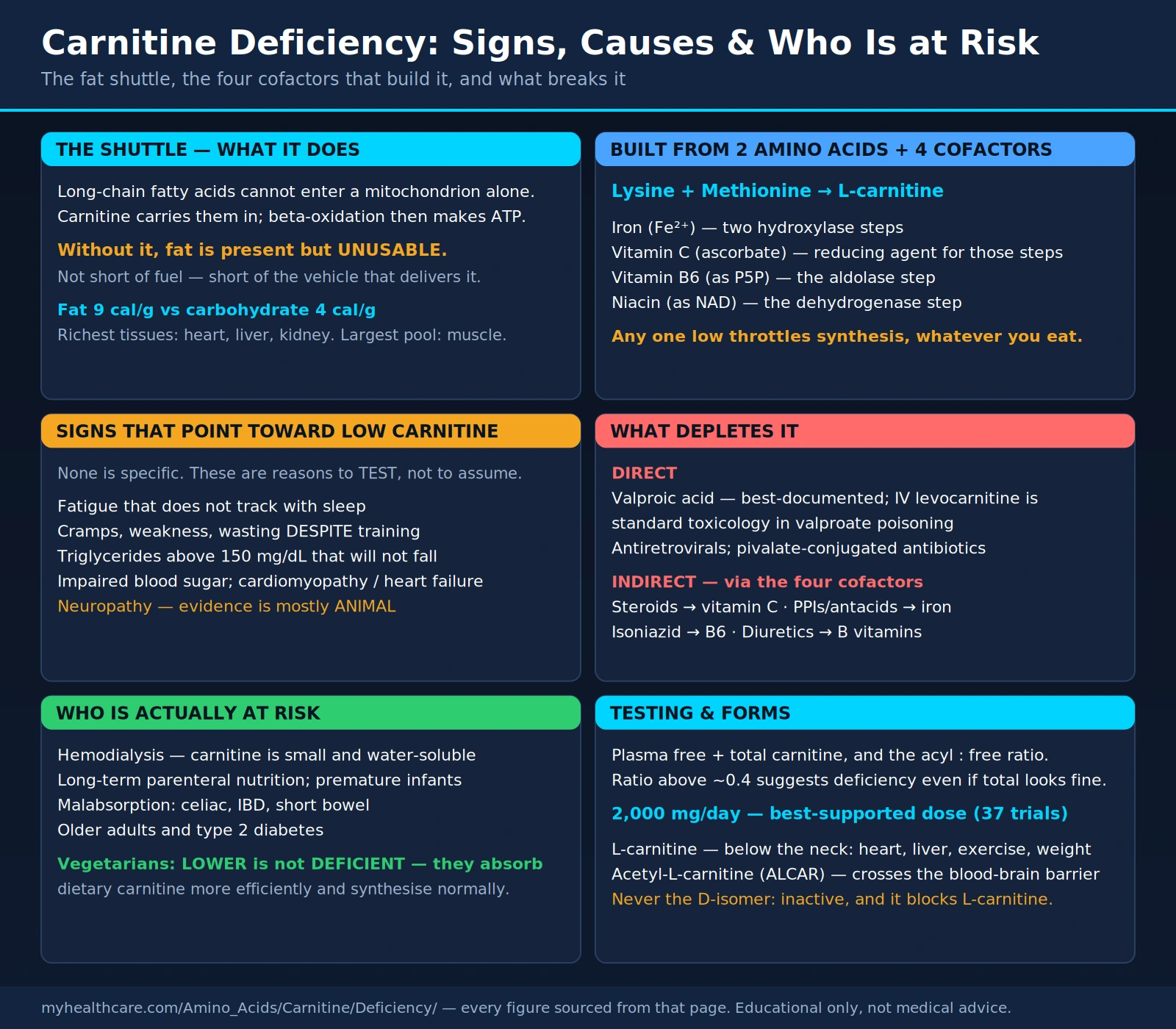
Carnitine is the molecule that carries fat into the furnace. Long-chain fatty acids cannot cross into a mitochondrion on their own — carnitine ferries them in, where they are burned for ATP. Your body builds its own carnitine and you eat more of it in meat, so for most healthy people this system simply works and never needs a thought. But it is a system with moving parts, and when one of them fails, the failure does not look like a nutrient deficiency. It looks like fatigue that sleep does not fix, muscles that cramp and shrink despite training, triglycerides that will not come down, or a heart that is slowly running out of fuel.
This page is about that failure mode: what low carnitine actually looks like, which drugs and conditions cause it, who is genuinely at risk, and what the evidence supports doing about it. It was written from a full episode of Dr. Osborne’s Zone, embedded permanently below, and every research claim in it has been checked against the source paper — including two places where this page corrects the video.
Source Video
This article summarizes and fact-checks the following episode. The video is embedded here permanently — unlike the Featured Videos further down the page, which rotate, this frame is fixed in the page itself and is the source document for everything that follows.
Source: Dr. Peter Osborne — Ultimate Crash Course on Carnitine, Dr. Osborne’s Zone (42 minutes, published 21 February 2024). Biography and editorial notes: Dr. Peter Osborne.
Table of Contents
- Source Video
- What Carnitine Actually Does
- Why It Is “Conditionally Essential”
- Built From Two Amino Acids and Four Cofactors
- Signs That Point Toward Low Carnitine
- Primary vs. Secondary Deficiency
- Medications That Deplete Carnitine
- Who Is Actually at Risk
- Where Carnitine Comes From in Food
- Testing Before Supplementing
- Forms and Doses
- Safety, TMAO and the Thyroid Caveat
- Where This Page Corrects the Video
- Key Research Papers
- Live PubMed Searches
- Connections
What Carnitine Actually Does
Osborne’s working metaphor in the video is a taxi cab, and it is a good one. A long-chain fatty acid arrives at the cell with plenty of energy in it — fat carries nine calories per gram against a carbohydrate’s four — but it cannot get through the inner mitochondrial membrane by itself. Carnitine binds it, carries it across, drops it inside, and comes back out for the next one. This is the carnitine shuttle. Once inside, the fatty acid is broken down by beta-oxidation into acetyl-CoA and fed into the machinery that makes ATP.
The consequence is the thing to hold onto: without enough carnitine, fat is still in your bloodstream and still in your fat cells, but it cannot be used. You are not short of fuel. You are short of the vehicle that delivers it. That single fact explains why the symptoms of low carnitine cluster the way they do — fatigue, exercise intolerance, muscle problems, rising triglycerides, and a struggling heart are all downstream of the same bottleneck.
The tissues that suffer first are the ones that run on fat and never stop. The highest carnitine concentrations in the body are found in heart, liver and kidney, and skeletal muscle holds the largest total pool. The heart in particular derives most of its energy from fatty acid oxidation and, unlike a bicep, never gets a rest day.
Why It Is “Conditionally Essential”
Nutrients get sorted into three buckets, and carnitine sits awkwardly in the middle one.
- Essential — your body cannot make it at all. You must eat it. Lysine is essential; so is methionine.
- Non-essential — your body makes as much as it needs, and dietary intake is irrelevant.
- Conditionally essential — your body normally makes enough, but under specific conditions demand outruns synthesis and diet has to make up the difference.
Carnitine is conditionally essential. A healthy adult synthesizes roughly a quarter of their daily turnover and absorbs the rest from food, and the kidney reclaims most of what is filtered, so the pool stays topped up without effort. The conditions that break this arrangement are the subject of the rest of this page: prematurity, advanced age, diabetes, kidney failure on dialysis, tube feeding, certain drugs, and a handful of genetic transport defects.
It is worth being precise about a term that gets used loosely: carnitine is not, strictly speaking, an amino acid in the protein-building sense. It is a quaternary ammonium compound derived from amino acids — the body assembles it from lysine and methionine rather than incorporating it into proteins. This site files it under Amino Acids because that is where readers look for it, but the distinction matters when you are reading a research paper.
Built From Two Amino Acids and Four Cofactors
This is the part of the video most worth carrying away, because it reframes carnitine deficiency as something that can happen to people who eat plenty of meat.
Carnitine is synthesized from lysine and methionine through a multi-step pathway, and four separate steps require a cofactor:
- Iron (as Fe2+) — required by two of the hydroxylase enzymes in the pathway.
- Vitamin C (ascorbate) — the reducing agent those same iron-dependent hydroxylases need to keep working.
- Vitamin B6 (as pyridoxal 5′-phosphate) — required by the aldolase step.
- Niacin (as NAD) — required by the dehydrogenase step.
Any of those four running low throttles your own carnitine production, regardless of how much carnitine you eat. This is a genuinely useful clinical insight and it is the reason the classic scurvy picture includes profound fatigue and muscle weakness that plain vitamin C chemistry does not fully explain — a scorbutic patient is also, quietly, a carnitine-synthesis-impaired patient.
It also means the reader with long-standing iron-deficiency anemia — common in menstruating women, and common again in celiac disease and other malabsorptive conditions — may be running two deficiencies where they think they have one.
Signs That Point Toward Low Carnitine
None of these is specific. Every one of them has a dozen more common explanations, and the honest framing is the one Osborne uses in the video: these are reasons to test, not reasons to assume.
Persistent fatigue
The most direct consequence of a shuttle bottleneck. Cells that would ordinarily run on fat cannot, so they lean harder on glucose, and the mismatch shows up as tiredness that does not track with sleep.
Muscle cramps, weakness and wasting
Specifically the kind that persists despite training. Age-related muscle loss from disuse is ordinary; muscle that shrinks while you are actively working to keep it, accompanied by repetitive cramping, is a different signal.
Elevated triglycerides that will not come down
Conventional laboratories flag triglycerides above 150 mg/dL. If diet is genuinely dialed in, carbohydrate intake is moderate, and the number stays stubbornly high anyway, impaired fatty acid transport is one candidate explanation. Note that Osborne’s stated personal target of “under 75” is his own clinical preference, not a guideline threshold.
Impaired blood sugar
When fat oxidation is throttled, tissues rely more heavily on glucose and insulin sensitivity tends to worsen. Osborne argues in the video that the normal fasting-glucose reference range has been widened over the decades and that 60–90 mg/dL is the range he wants to see. That is his clinical opinion. The American Diabetes Association standard is that fasting glucose below 100 mg/dL is normal and 100–125 mg/dL is prediabetes. Both framings are worth knowing; only one of them is the standard your laboratory is using.
Cardiomyopathy and heart failure
The best-established of the deficiency syndromes. A heart deprived of its primary fuel weakens over time, and in genuine primary carnitine deficiency the cardiomyopathy is often the presenting problem — and is often reversible with replacement.
Neuropathy
Evidence tier: mostly animal. Osborne flags this honestly in the video and this page keeps the flag. The rodent work on sciatic nerve injury and carnitine is reasonably consistent; the human trial evidence is thin. Treat clinical reports of improvement as anecdote until better trials exist.
Primary vs. Secondary Deficiency
These are different conditions that share a name, and conflating them is how a rare genetic disease gets used to sell a supplement to people who do not have it.
Primary carnitine deficiency is a genuine inherited disorder, caused by mutations in SLC22A5, the gene encoding the OCTN2 transporter that pulls carnitine into cells and reclaims it in the kidney. Without a working transporter, carnitine is lost in the urine no matter how much is eaten. It presents in infancy or childhood with hypoketotic hypoglycemia, cardiomyopathy, muscle weakness, or liver dysfunction, and it is picked up on newborn screening in many countries. It is rare — on the order of one in tens of thousands — and it is treated with lifelong prescription levocarnitine, not with a supplement bought online.
Secondary carnitine deficiency is far more common and is what the rest of this page is about: a normal transporter, but losses or demands that exceed supply. Dialysis, valproate, tube feeding, prematurity, and severe malabsorption all produce it. It is a consequence of something else, which means the first question is always what is causing it, not how much should I take.
Medications That Deplete Carnitine
Two drug classes interfere with carnitine directly, and several more interfere with the cofactors needed to make it.
Direct depletion
- Valproic acid (Depakote and relatives, used for epilepsy, bipolar disorder and migraine). This is the best-documented drug–nutrient interaction in the whole carnitine literature. Valproate forms valproylcarnitine, which is excreted, and it also inhibits carnitine biosynthesis and transport. The resulting deficiency is implicated in valproate-associated hyperammonemia and hepatotoxicity, and intravenous levocarnitine is an established part of managing valproate toxicity — not alternative medicine, but standard toxicology.
- Antiretroviral therapy, particularly the older nucleoside analogues, through mitochondrial toxicity.
- Pivalate-conjugated antibiotics (pivmecillinam, pivampicillin) deplete carnitine by the same conjugate-excretion mechanism. These are not mentioned in the video but belong on the list.
Indirect depletion, via the cofactors
This is the second-order effect the video makes well. Anything that lowers iron, vitamin C, B6 or niacin also lowers your capacity to build carnitine:
- Corticosteroids (prednisone, inhaled and oral steroids) — deplete vitamin C.
- Acid suppressants (proton-pump inhibitors, H2 blockers, antacids) — impair iron absorption, and are associated with lower vitamin C.
- Isoniazid and some antibiotics — antagonize vitamin B6. Pyridoxine is co-prescribed with isoniazid precisely for this reason.
- Loop and thiazide diuretics (furosemide, hydrochlorothiazide) — increase urinary loss of B vitamins.
If you take any of these long-term, the practical step is not to start carnitine — it is to ask whether the cofactor is low, and to fix that first.
Who Is Actually at Risk
- People on hemodialysis. Carnitine is a small, water-soluble molecule and dialysis removes it efficiently. Deficiency in this group is well documented and levocarnitine is an approved therapy for it. Anyone on dialysis should be discussing this with their nephrologist rather than self-supplementing.
- People on long-term parenteral nutrition. Standard intravenous feeding formulas historically contained no carnitine at all, so the body relies entirely on synthesis while bypassing dietary intake.
- Premature infants. Biosynthetic capacity is immature and stores are small. This is the textbook conditionally-essential case.
- Vegetarians and vegans. Carnitine is concentrated in meat, and plant foods contain very little. Two honest qualifications, both of which the video gets right: vegetarians show measurably lower plasma and muscle carnitine, and they absorb dietary carnitine substantially more efficiently than omnivores, and they synthesize it normally. Long-term vegetarians are not, as a group, clinically carnitine deficient. Lower is not the same as deficient.
- People with malabsorption. Celiac disease, inflammatory bowel disease, and post-surgical short bowel all reduce absorption of carnitine and of the cofactors at the same time.
- Older adults and people with type 2 diabetes. Both show reduced synthesis and lower tissue stores.
- People on very-low-carbohydrate or ketogenic diets. The logic here is Osborne’s and it is mechanistically sound: a diet that shifts the body onto fat as its primary fuel increases traffic through the carnitine shuttle. The plausible risk case is the person eating a high-fat, low-meat ketogenic diet — high demand, low dietary supply. A meat-based ketogenic diet supplies carnitine along with the fat. Evidence tier: mechanistic reasoning, not trial evidence. There is no good outcome data showing that ketogenic dieters develop clinical carnitine deficiency.
Where Carnitine Comes From in Food
The word itself is the mnemonic — carnitine, from the Latin carnis, flesh. The redder the meat, the more it contains.
- Beef — by a wide margin the richest common source; roughly 80–160 mg per 100 g cooked.
- Pork — substantially less than beef, around 20–30 mg per 100 g.
- Poultry and fish — modest, in the single digits to low tens of mg per 100 g.
- Dairy — small amounts, concentrated in the whey fraction.
- Plant foods — trace only. Avocado and asparagus are the usual examples and both are measured in fractions of a milligram.
A note on the video’s “A2 dairy” recommendation: Osborne specifies A2 dairy on the grounds that A1 beta-casein promotes inflammation. That claim is contested and the trial evidence is limited and mostly concerns digestive comfort rather than inflammation or autoimmunity. It is also orthogonal to this page’s subject: the carnitine content of milk does not depend on whether the cow produces A1 or A2 beta-casein. If A2 dairy suits you, there is no reason not to drink it; just do not expect it to change your carnitine intake.
Testing Before Supplementing
This is the most sensible practical advice in the video and it deserves emphasis, because it cuts against the interest of everyone selling a supplement: the way to answer “should I take carnitine” is to measure it.
The standard test is a plasma carnitine panel reporting free carnitine, total carnitine, and the acylcarnitine-to-free-carnitine ratio. The ratio is the informative part — a ratio above roughly 0.4 suggests deficiency even when total carnitine looks acceptable, because it indicates that most of the pool is tied up as acyl esters rather than free and available. An acylcarnitine profile by tandem mass spectrometry is the follow-up test when a metabolic disorder is suspected, and it is the same technology used in newborn screening.
Plasma is an imperfect proxy for muscle carnitine, which is where most of the body pool sits, so a normal plasma level does not entirely exclude tissue depletion. It is nevertheless what is available, inexpensive, and far better than guessing.
Forms and Doses
Two forms matter for practical purposes, and the choice between them is genuinely straightforward.
- L-carnitine — the plain form. Appropriate for anything below the neck: cardiovascular, metabolic, liver, exercise performance and recovery, weight, and male fertility. Also sold as L-carnitine tartrate, the form used in most exercise-recovery trials, and as propionyl-L-carnitine, which has the best evidence in peripheral arterial disease and intermittent claudication.
- Acetyl-L-carnitine (ALCAR) — carries an acetyl group, which lets it cross the blood–brain barrier. This is the form to choose for anything above the neck: mood, cognition, neuropathy, age-related cognitive decline. The acetyl group is not just a delivery trick — it also feeds acetyl-CoA pools used in acetylcholine synthesis.
Never take the D-isomer. D-carnitine is biologically inactive and competitively interferes with L-carnitine, and DL-carnitine mixtures have caused myasthenic syndromes. Any reputable product is L-.
On dosing, the trial literature converges tightly:
- 2,000 mg/day is the single best-supported dose. The 37-trial weight meta-analysis found it to be the point of maximum effect in a dose–response analysis, and it is the dose used in most exercise studies.
- 1,000–2,000 mg/day is a reasonable conservative range without testing.
- 1,500–3,000 mg/day covers the exercise-performance literature.
- Trials have used up to 6,000 mg/day without notable harm, but there is no reason to go there without a measured deficiency and medical supervision.
- Duration matters more than dose for recovery. The five-week trial found benefit specifically beyond 35 days, which is a useful corrective to the expectation of a rapid effect.
Prescription levocarnitine, used for primary deficiency and dialysis, is dosed far higher and is a different conversation entirely — one to have with a nephrologist or metabolic specialist.
Safety, TMAO and the Thyroid Caveat
Carnitine has a genuinely good safety record. No cases of frank toxicity have been reported even at high doses, and the NAFLD meta-analyses specifically noted no significant adverse effects. Three caveats are still worth stating plainly, and two of them are not mentioned in the source video.
1. Gastrointestinal upset — common, minor
Nausea, cramping and loose stools are the usual complaints, and they are dose-related. Osborne’s suggestion that cheap capsules and fillers are often the real culprit is plausible but untested; splitting the dose and taking it with food is the standard fix.
2. TMAO — more than a smell
At higher doses, gut bacteria convert unabsorbed carnitine to trimethylamine, which the liver oxidizes to trimethylamine-N-oxide (TMAO). The video presents this purely as a cosmetic problem — a fishy body odor — and that is where this page has to add something.
TMAO is also the subject of a serious cardiovascular hypothesis. Koeth and colleagues showed in 2013 that gut microbial metabolism of dietary L-carnitine produces TMAO, that TMAO accelerates atherosclerosis in mice, and that plasma TMAO levels predict cardiovascular event risk in humans. The finding is real and replicated; its interpretation remains contested — the human data are observational, TMAO may be a marker of kidney function and microbiome composition rather than a cause, and carnitine trials themselves have generally shown cardiovascular benefit rather than harm. This site treats the question in depth on Forms and the TMAO Question. The honest summary: it is an open question, it is not settled against carnitine, and it is not merely about odor.
3. Thyroid hormone antagonism — the caveat the video omits
Carnitine is a peripheral antagonist of thyroid hormone action. It inhibits the entry of T3 and T4 into cell nuclei. Benvenga and colleagues demonstrated this in a randomized, double-blind, placebo-controlled trial and turned it into a therapy — carnitine is genuinely useful for reversing the symptoms of iatrogenic hyperthyroidism.
The flip side is the part that matters for a general reader: if you are hypothyroid, or being treated with levothyroxine, carnitine is working against your medication. This does not make it contraindicated, but it is a real pharmacological interaction that belongs in the conversation with your prescriber, and it is entirely absent from the video’s “no downside” framing.
4. Seizure threshold, and one thing not to do
There are scattered reports of increased seizure frequency in people with pre-existing seizure disorders taking carnitine. Given that many of those people are on valproate — which depletes carnitine and is a reason to supplement — this is precisely a decision for a neurologist rather than a self-experiment.
The video, in discussing preclinical neuroprotection data, suggests that a parent of a child with brain injury and no other options might raise carnitine with their doctor. Raising it with a doctor is fine. What the underlying research does not support is treating neonatal or pediatric brain injury with a supplement: the evidence is rodent work, the authors themselves state that human trials are needed, and “there is no downside” is not a sound basis for intervening in a child’s brain injury.
Where This Page Corrects the Video
The episode is, on the whole, an accurate piece of nutrition education — the mechanism is right, the cofactor argument is genuinely valuable, the recommendation to test before supplementing is sound, and the animal-versus-human evidence is flagged honestly where it matters. Three specific corrections:
- The blood-pressure subgroup figures are transposed. The video states that the 1.639 mmHg diastolic reduction was seen in overweight and obese participants at doses of two grams per day. The source meta-analysis reports something different: the overweight/obesity subgroup fell by 1.232 mmHg, while the 1.639 mmHg reduction was seen in the subgroup taking less than 2 g/day. The dose relationship is the reverse of the one stated — in this analysis the lower-dose trials showed the larger diastolic effect. The headline result the video gives is correct: 1.162 mmHg diastolic reduction overall, with no change in systolic.
- TMAO is not just an odor problem — see above.
- “Carnitine is very safe, there’s no downside” overstates it. The safety record is good, but thyroid hormone antagonism is a documented pharmacological effect with clinical consequences for anyone on thyroid replacement, and it is not mentioned.
Two smaller framings are the presenter’s opinion rather than established standards and are labeled as such above: the fasting-glucose range of 60–90 mg/dL, and the triglyceride target of 75 mg/dL. The A2 dairy recommendation is unrelated to carnitine content.
Key Research Papers
- Askarpour M, Hadi A, Dehghani Kari Bozorg A, et al. Effects of L-carnitine supplementation on blood pressure: a systematic review and meta-analysis of randomized controlled trials. Journal of Human Hypertension, 2019;33(10):725–734. (PMID 31481697)
- Talenezhad N, Mohammadi M, Ramezani-Jolfaie N, et al. Effects of l-carnitine supplementation on weight loss and body composition: a systematic review and meta-analysis of 37 randomized controlled clinical trials with dose-response analysis. Clinical Nutrition ESPEN, 2020;37:9–23. (PMID 32359762)
- Abolfathi M, Mohd-Yusof BN, Hanipah ZN, et al. The effects of carnitine supplementation on clinical characteristics of patients with non-alcoholic fatty liver disease: a systematic review and meta-analysis. Complementary Therapies in Medicine, 2020;48:102273. (PMID 31987257)
- Liu A, Cai Y, Yuan Y, et al. Efficacy and safety of carnitine supplementation on NAFLD: a systematic review and meta-analysis. Systematic Reviews, 2023;12(1):74. (PMID 37120548)
- Wang SM, Han C, Lee SJ, et al. A review of current evidence for acetyl-l-carnitine in the treatment of depression. Journal of Psychiatric Research, 2014;53:30–37. (PMID 24607292)
- Ferreira GC, McKenna MC. L-carnitine and acetyl-L-carnitine roles and neuroprotection in developing brain. Neurochemical Research, 2017;42(6):1661–1675. (PMID 28508995)
- Koozehchian MS, Daneshfar A, Fallah E, et al. Effects of nine weeks L-carnitine supplementation on exercise performance, anaerobic power, and exercise-induced oxidative stress in resistance-trained males. Journal of Exercise Nutrition & Biochemistry, 2018;22(4):7–19. (PMID 30661327)
- Stefan M, Sharp M, Gheith R, et al. L-carnitine tartrate supplementation for 5 weeks improves exercise recovery in men and women: a randomized, double-blind, placebo-controlled trial. Nutrients, 2021;13(10):3432. (PMID 34684429)
- Alhasaniah AH. l-carnitine: nutrition, pathology, and health benefits. Saudi Journal of Biological Sciences, 2023;30(2):103555. (PMID 36632072)
- Koeth RA, Wang Z, Levison BS, et al. Intestinal microbiota metabolism of L-carnitine, a nutrient in red meat, promotes atherosclerosis. Nature Medicine, 2013;19(5):576–585. (PMID 23563705)
- Benvenga S, Ruggeri RM, Russo A, et al. Usefulness of L-carnitine, a naturally occurring peripheral antagonist of thyroid hormone action, in iatrogenic hyperthyroidism: a randomized, double-blind, placebo-controlled clinical trial. Journal of Clinical Endocrinology & Metabolism, 2001;86(8):3579–3594. (PMID 11502782)
- Lheureux PE, Hantson P. Carnitine in the treatment of valproic acid-induced toxicity. Clinical Toxicology, 2009;47(2):101–111. (PMID 19280426)
Live PubMed Searches
- carnitine deficiency
- primary carnitine deficiency SLC22A5
- valproic acid carnitine depletion
- levocarnitine hemodialysis
- carnitine biosynthesis lysine methionine
- acylcarnitine to free carnitine ratio
- vegetarian plasma carnitine status
- carnitine thyroid hormone antagonist
- TMAO carnitine cardiovascular risk
Connections
- Carnitine — the main topic hub
- Carnitine Benefits — the seven-article benefits cluster
- Forms and the TMAO Question — the cardiovascular controversy in full
- Carnitine, Heart and Circulation
- Carnitine for Exercise and Recovery
- Carnitine and Liver Disease
- Carnitine, Brain, Mood and Depression
- Carnitine, Fat Metabolism and Weight
- Dr. Peter Osborne — the source of this page’s framing
- Lysine — one of the two amino acids carnitine is built from
- Methionine — the other
- Vitamin C — required cofactor for carnitine synthesis
- Iron — required cofactor; deficiency is common and often chronic
- Vitamin B6 — required cofactor
- Niacin (Vitamin B3) — required cofactor as NAD
- Beef — the richest common dietary source
- All Amino Acids