Carnitine Forms & the TMAO Question
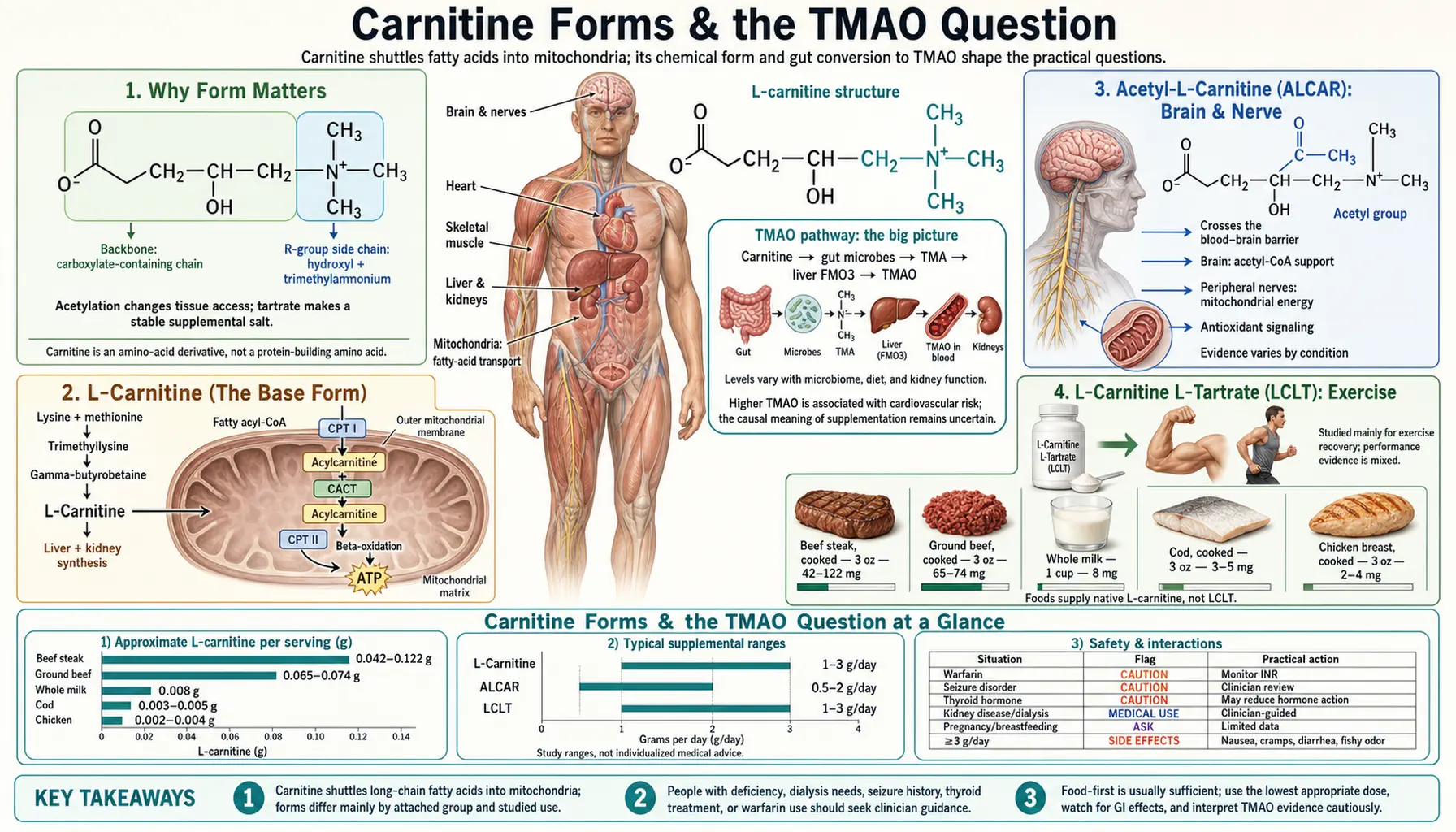
"Carnitine" on a label can mean several different molecules, and the differences matter. Plain L-carnitine is the base form for general and cardiovascular use. Acetyl-L-carnitine (ALCAR) adds an acetyl group that lets it cross the blood-brain barrier, which is why it is the form studied for cognition, mood, and nerve health. L-carnitine L-tartrate (LCLT) is the exercise-recovery form, and propionyl-L-carnitine is the vascular one. Then there is the question that hangs over all of them: gut bacteria can convert carnitine into TMA, which the liver turns into TMAO — a compound repeatedly linked to atherosclerosis. Yet the cardiovascular trials show benefit. This "carnitine paradox" is genuinely unsettled, and this page lays out honestly what is known and what is not.
Interactive Visualization Fat Burning & Ketosis — what actually happens Follow a fatty acid out of a fat cell to the mitochondrial gate and find it padlocked by insulin. Drop the carbs, open CPT1, and watch the liver start making ketones. Launch →
Table of Contents
- Why Form Matters
- L-Carnitine (The Base Form)
- Acetyl-L-Carnitine (ALCAR): Brain & Nerve
- L-Carnitine L-Tartrate (LCLT): Exercise
- Propionyl-L-Carnitine (PLC): Vascular
- Choosing a Form by Goal
- The TMAO Pathway: How Gut Bacteria Reshape Carnitine
- The Carnitine Paradox: Benefit Trials vs the TMAO Hypothesis
- What Is Actually Known vs Unsettled
- Practical Takeaways & Safety
- Key Research Papers
- Connections
- Featured Videos
Why Form Matters
All carnitine supplements deliver the same core molecule, but the chemical group attached to it (or paired with it) changes where the carnitine goes, how well it is absorbed, and what it can do once inside the body. Choosing the wrong form for your goal is a common and avoidable mistake — taking acetyl-L-carnitine for a heart-failure question, or plain L-carnitine for a cognitive one, wastes the specific advantage each form was studied for. The four forms below cover essentially all legitimate uses.
L-Carnitine (The Base Form)
Plain L-carnitine (sometimes sold as L-carnitine tartrate for stability, or as a liquid) is the reference form and the one used in most cardiovascular and general-metabolism trials. Only the "L" stereoisomer is biologically active; the "D" form is inactive and can even interfere with L-carnitine, which is why reputable products specify L-carnitine and never a "DL" racemic mix.
L-carnitine is the appropriate choice for the applications on the Heart & Circulation page (heart failure, post-heart-attack, angina) and for correcting documented deficiency. Oral bioavailability is modest — roughly 15–20% from supplements, considerably lower than from food — because much is metabolized by gut bacteria before absorption, a fact that becomes important in the TMAO discussion below.
Acetyl-L-Carnitine (ALCAR): Brain & Nerve
Acetyl-L-carnitine (ALCAR) carries an added acetyl group, and that small change has a big consequence: ALCAR crosses the blood-brain barrier far more readily than plain L-carnitine. Once in the brain, it supplies both carnitine and an acetyl group that can feed acetylcholine synthesis and mitochondrial energy metabolism in neurons. This is why ALCAR — not the other forms — is the one studied for the nervous system:
- Diabetic peripheral neuropathy. Sima and colleagues (Diabetes Care, 2005) reported that ALCAR improved pain, nerve-fiber regeneration, and vibratory perception in patients with chronic diabetic neuropathy, with the clearest benefit at higher doses. This is among the stronger ALCAR findings.
- Depressive symptoms. A systematic review and meta-analysis by Veronese and colleagues (Psychosomatic Medicine, 2018) found that ALCAR reduced depressive symptoms versus placebo, with tolerability comparable to placebo — a promising but not definitive signal that warrants larger trials.
- Mild cognitive impairment and early Alzheimer's. A meta-analysis by Montgomery and colleagues (International Clinical Psychopharmacology, 2003) of double-blind trials found modest benefit of ALCAR over placebo in mild cognitive impairment and mild Alzheimer's disease. The effect is small and the condition is difficult, so ALCAR is not a treatment — but the data are real.
- Fatigue in older adults. Malaguarnera and colleagues (American Journal of Clinical Nutrition, 2007) found reduced physical and mental fatigue and improved cognitive measures in centenarians given L-carnitine.
The honest framing for ALCAR mirrors the rest of the carnitine story: genuinely interesting, mechanistically sensible, supported by real trials, but modest in effect and not a substitute for established treatment of neuropathy, depression, or dementia.
L-Carnitine L-Tartrate (LCLT): Exercise
L-carnitine L-tartrate (LCLT) pairs carnitine with tartaric acid, giving rapid dissolution and absorption that make it convenient for dosing around workouts. It is the form used in the University of Connecticut recovery studies described on the Exercise & Recovery page, where roughly 2 g/day reduced markers of exercise-induced muscle damage and soreness. If your interest is post-exercise recovery, LCLT is the studied choice — while keeping in mind that the overall exercise benefit is modest and the endurance case is weak.
Propionyl-L-Carnitine (PLC): Vascular
Propionyl-L-carnitine (PLC) attaches a propionyl group that can be converted to succinyl-CoA and fed directly into the Krebs cycle, and PLC also appears to support endothelial (blood-vessel-lining) function. These properties made it the form of choice for vascular conditions — angina and, especially, the intermittent claudication of peripheral artery disease. As covered on the Heart & Circulation page, the walking-distance evidence is mixed. A 2013 systematic review (Delaney and colleagues, Atherosclerosis, PubMed 23557982) was modestly positive, while the 2021 Cochrane review of propionyl-L-carnitine for intermittent claudication (Kamoen and colleagues, PubMed 34954832) judged the benefit small and the evidence uncertain.
Choosing a Form by Goal
- Heart failure, post-heart-attack, angina, or documented deficiency: plain L-carnitine (as an adjunct, with a physician).
- Cognition, mood, or diabetic nerve pain: acetyl-L-carnitine (ALCAR), the only form that reaches the brain well.
- Exercise recovery and soreness: L-carnitine L-tartrate (LCLT).
- Peripheral artery disease / claudication: propionyl-L-carnitine (PLC).
- General weight loss: no form is a proven fat burner in healthy people — see Fat Metabolism & Weight.
The TMAO Pathway: How Gut Bacteria Reshape Carnitine
Here is the wrinkle that complicates every carnitine benefit claim. In 2013, Koeth and colleagues at the Cleveland Clinic published a landmark paper in Nature Medicine showing a three-step pathway:
- Gut bacteria metabolize dietary carnitine into trimethylamine (TMA). Carnitine that is not absorbed in the small intestine reaches the colon, where certain gut microbes cleave it into the gas-like compound TMA.
- The liver oxidizes TMA into trimethylamine-N-oxide (TMAO) via the enzyme flavin-containing monooxygenase 3 (FMO3).
- TMAO is associated with atherosclerosis. In their mouse and human work, higher TMAO correlated with, and in animal models appeared to promote, atherosclerotic plaque — through effects on cholesterol handling in artery-wall macrophages and on reverse cholesterol transport.
Crucially, the same group showed this is a microbiome-dependent effect: habitual red-meat eaters (omnivores) harbor the bacterial community that produces TMAO from carnitine, whereas long-term vegetarians and vegans produce very little TMAO from the same carnitine dose — their gut flora simply lacks the machinery. A parallel 2013 New England Journal of Medicine paper by Tang and colleagues established the same TMA→TMAO pathway for choline and phosphatidylcholine, and linked higher TMAO to increased cardiovascular risk in a large patient cohort. A 2019 follow-up by Koeth and colleagues in the Journal of Clinical Investigation traced the specific microbial steps by which an omnivorous diet builds this atherogenic pathway in humans.
The Carnitine Paradox: Benefit Trials vs the TMAO Hypothesis
Now hold the two bodies of evidence side by side and the tension is obvious:
- On one hand, the cardiovascular trials and meta-analysis suggest L-carnitine helps the heart — less remodeling after heart attack, fewer arrhythmias, possibly lower mortality.
- On the other hand, the TMAO research suggests carnitine feeds a gut-microbial pathway that promotes the atherosclerosis underlying most heart disease.
How can both be true? Several possibilities are debated, none proven:
- Different timescales and endpoints. The benefit trials measured short-to-medium-term cardiac function and events in people who already had heart disease; the TMAO hypothesis concerns slow, lifelong plaque development. A molecule could aid a stressed heart acutely while modestly nudging long-term plaque — or the two effects could operate in different tissues.
- TMAO may be a marker as much as a cause. Elevated TMAO also reflects impaired kidney function and particular dietary and microbiome patterns. Some researchers argue TMAO is partly a bystander flagging risk rather than a primary driver, which would soften the supplement concern. This remains contested.
- Dose and route differ. A therapeutic carnitine dose in a monitored patient is not the same as decades of high red-meat intake shaping the gut flora. The relevance of the TMAO pathway to a discrete supplement course is unclear.
- The microbiome is modifiable. Because TMAO production depends on gut bacteria, it varies enormously between people and can shift with diet — making blanket statements about "carnitine causes TMAO" too simple.
This genuinely is an open scientific question. The New England Journal of Medicine and Nature Medicine papers are serious science; so is the cardiovascular-benefit literature. They have not been reconciled by a definitive study, and honest sources say so rather than picking a side.
What Is Actually Known vs Unsettled
Reasonably established:
- Gut bacteria convert unabsorbed carnitine (and choline) into TMA, which the liver oxidizes to TMAO. The pathway is real.
- TMAO production is strongly microbiome-dependent; omnivores make much more from a carnitine dose than vegetarians and vegans do.
- Higher circulating TMAO is statistically associated with cardiovascular events in large cohorts.
Genuinely unsettled:
- Whether TMAO causes human atherosclerosis or largely marks other risk (kidney function, diet, microbiome), and how much each contributes.
- Whether therapeutic carnitine supplementation meaningfully raises long-term cardiovascular risk in practice — no long-term outcome trial has tested this directly.
- How to weigh the short-to-medium-term cardiac benefit signal against the theoretical long-term TMAO concern in any individual patient.
The intellectually honest position is to hold both findings, acknowledge the unresolved paradox, and avoid overclaiming in either direction — neither "carnitine is dangerous" nor "TMAO is nothing."
Practical Takeaways & Safety
- Match the form to the goal using the list above — L-carnitine for cardiac/deficiency, ALCAR for brain and nerve, LCLT for exercise recovery, PLC for claudication.
- Insist on the "L" form. Avoid any "DL-carnitine" product; the D-isomer is inactive and potentially interfering.
- Take the TMAO question seriously but proportionately. For someone using a physician-supervised therapeutic course for a real indication, the benefit rationale is defensible; for a healthy person taking carnitine speculatively as a "fat burner," the risk-benefit tilts unfavorably — there is little upside (see Fat Metabolism & Weight) and a theoretical downside.
- Kidney disease is a special case. Impaired kidneys clear TMAO poorly and change carnitine handling; carnitine decisions in chronic kidney disease and dialysis belong with a nephrologist.
- General tolerability. Oral carnitine is usually well tolerated; higher doses can cause nausea, cramping, diarrhea, and a fishy body odor (from trimethylamine, the very compound at the head of the TMAO pathway).
This page is educational and does not constitute medical advice. The TMAO field is evolving; discuss any supplement with a clinician who knows your cardiovascular and kidney status.
Key Research Papers
- Koeth RA et al. (2013). Intestinal microbiota metabolism of L-carnitine, a nutrient in red meat, promotes atherosclerosis. Nature Medicine. — PubMed 23563705
- Tang WH, Wang Z, Levison BS, Koeth RA, Britt EB, Fu X, Wu Y, Hazen SL (2013). Intestinal microbial metabolism of phosphatidylcholine and cardiovascular risk. New England Journal of Medicine. — PubMed 23614584
- Koeth RA et al. (2019). L-Carnitine in omnivorous diets induces an atherogenic gut microbial pathway in humans. Journal of Clinical Investigation. — PubMed 30530985
- Sima AA, Calvani M, Mehra M, Amato A (2005). Acetyl-L-carnitine improves pain, nerve regeneration, and vibratory perception in patients with chronic diabetic neuropathy. Diabetes Care. — PubMed 15616239
- Veronese N, Stubbs B, Solmi M, Ajnakina O, Carvalho AF, Maggi S (2018). Acetyl-L-carnitine supplementation and the treatment of depressive symptoms: a systematic review and meta-analysis. Psychosomatic Medicine. — PubMed 29076953
- Montgomery SA, Thal LJ, Amrein R (2003). Meta-analysis of double blind randomized controlled clinical trials of acetyl-L-carnitine versus placebo in the treatment of mild cognitive impairment and mild Alzheimer's disease. International Clinical Psychopharmacology. — PubMed 12598816
- Kamoen V, Vander Stichele R, Campens L, De Bacquer D, Van Bortel L, De Backer TL (2021). Propionyl-L-carnitine for intermittent claudication. Cochrane Database of Systematic Reviews. — PubMed 34954832
- Delaney CL, Spark JI, Thomas J, Wong YT, Chan LT, Miller MD (2013). A systematic review to evaluate the effectiveness of carnitine supplementation in improving walking performance among individuals with intermittent claudication. Atherosclerosis. — PubMed 23557982
- Malaguarnera M et al. (2007). L-Carnitine treatment reduces severity of physical and mental fatigue and increases cognitive functions in centenarians. American Journal of Clinical Nutrition. — PubMed 18065594
PubMed Topic Searches
- PubMed: Carnitine, TMAO & atherosclerosis
- PubMed: TMAO cardiovascular risk
- PubMed: ALCAR diabetic neuropathy
- PubMed: ALCAR and depression
- PubMed: ALCAR and cognition
- PubMed: PLC and vascular function
External Resources
- NIH Office of Dietary Supplements — Carnitine (Forms & Safety)
- Linus Pauling Institute — L-Carnitine (forms and metabolism)
- MedlinePlus — Acetyl-L-Carnitine
Connections
- All Amino Acids
- Fat Burning & Ketosis — interactive animation
- Carnitine Benefits Hub
- Carnitine (Main Page)
- Heart & Circulation
- Fat Metabolism & Weight
- Exercise & Recovery
- Atherosclerosis
- Coronary Artery Disease
- Peripheral Artery Disease
- Alzheimer's Disease
- Neurology
- Type 2 Diabetes
- Beef (Red Meat & TMAO)
- Organ Meats
- Mediterranean Diet