Creatine for Cognitive Function
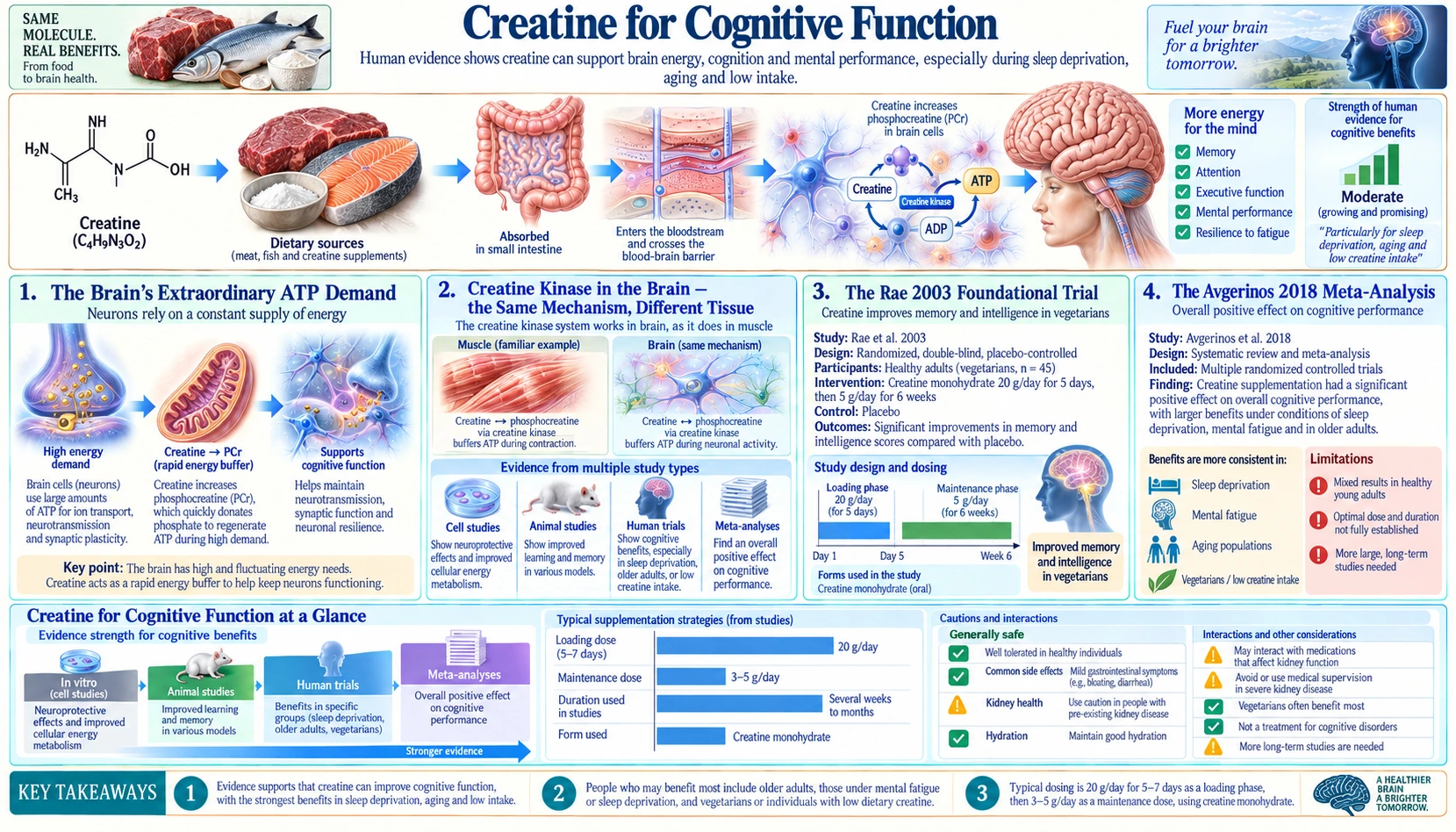
The brain is metabolically demanding, and creatine, stored as phosphocreatine, acts as a reserve of high-energy phosphate (Prokopidis 2023; Benton 2011). Oral creatine can raise total brain creatine, although reviews note that higher or longer dosing than is used for muscle may be needed (Dechent 1999; Dolan 2019). The Rae 2003 crossover trial in 45 vegetarian young adults found better working-memory and intelligence-test scores on creatine. The Avgerinos 2018 systematic review of six trials (281 people) found evidence that short-term memory and intelligence/reasoning may improve, conflicting results in other cognitive domains, unchanged performance in young individuals, and better memory responses in vegetarians than in meat-eaters; it did not pool the trials into one effect size. Two later meta-analyses found a small overall improvement in memory, larger in older adults (Prokopidis 2023), and improvements in memory, attention time and processing speed but not in overall cognitive function or executive function (Xu 2024). A 2014 brain-scan study found similar brain creatine in vegetarians and omnivores (Yazigi Solis 2014). This deep-dive covers brain energy metabolism, the main trials, the vegetarian question, sleep deprivation, mental fatigue, depression, traumatic brain injury, the doses studies have used, and what the evidence does not show.
Table of Contents
- The Brain's Extraordinary ATP Demand
- Creatine Kinase in the Brain — the Same Mechanism, Different Tissue
- The Rae 2003 Crossover Trial
- The Avgerinos 2018 Systematic Review and Later Meta-Analyses
- Vegetarians, Omnivores and Brain Creatine
- Creatine and Sleep Deprivation
- Mental Fatigue and Demanding Cognitive Tasks
- Depression, Mood, and the Emerging Psychiatric Literature
- Traumatic Brain Injury and Neuroprotection
- Doses Used in Brain Studies (Which May Differ from Muscle)
- What the Evidence Does Not (Yet) Show
- Key Research Papers
- Connections
- Featured Videos
The Brain's Extraordinary ATP Demand
A 2023 meta-analysis sets out the premise of this research: from an energy perspective the brain is very metabolically demanding, creatine plays a key role in brain bioenergetics, and there is some evidence that supplementation can augment brain creatine stores, which could improve memory (Prokopidis 2023).
Creatine combines with phosphate to form phosphocreatine, which acts as a reserve of high-energy phosphate (Benton 2011). Rae and colleagues describe creatine as playing a pivotal role in brain energy homeostasis, as a temporal and spatial buffer for the cytosolic and mitochondrial pools of ATP and of its regulator, ADP (Rae 2003).
The trials below test whether raising brain creatine changes performance. Reviews conclude that creatine is most likely to influence cognition when cognitive processes are stressed — during sleep deprivation, experimental hypoxia, or more complex and therefore more demanding tasks (Dolan 2019) — and that the potential is greatest in conditions marked by brain creatine deficits, whether from acute stressors such as exercise and sleep deprivation or from chronic conditions (Roschel 2021).
Creatine Kinase in the Brain — the Same Mechanism, Different Tissue
The phosphocreatine energy reserve that supports high-intensity effort in muscle also operates in brain tissue: after phosphorylation, creatine is used as an energy source for ATP synthesis, and it is abundant in both muscle and brain (Watanabe 2002).
Dechent and colleagues (Am J Physiol 1999) used proton magnetic resonance spectroscopy in six healthy young volunteers who took 20 g/day of creatine monohydrate (4 × 5 g) for 4 weeks. Mean total brain creatine rose by 8.7% (0.6 mM; P < 0.001) averaged across brain regions, with considerable variation between people (3.5-13.3%); the smallest rises were in the two male volunteers with the largest body weights. The rise was most pronounced in the thalamus (14.6%), and all of the changes had reversed when measured at least 3 months after supplementation ended.
Reviews conclude that brain creatine is responsive to supplementation but that higher or more prolonged dosing than is typically used to raise muscle creatine may be required, and that the optimal protocol is not yet known (Dolan 2019; Roschel 2021). In a 2025 single-arm pilot in 20 people with Alzheimer's disease, 20 g/day for 8 weeks raised brain total creatine by 11% (Smith 2025).
The Rae 2003 Crossover Trial
Rae and colleagues at the University of Sydney (Proc R Soc B 2003) ran a double-blind, placebo-controlled crossover trial in 45 young adult vegetarians, testing 5 g/day of creatine monohydrate for six weeks. In a crossover design each participant goes through both a creatine phase and a placebo phase, so each acts as their own control.
The outcomes were working memory (backward digit span) and intelligence (Raven's Advanced Progressive Matrices), both tasks that, the authors note, require speed of processing. Results:
- Raven's Advanced Progressive Matrices: significantly better on creatine than on placebo (p < 0.0001).
- Backward digit span (working memory): significantly better on creatine than on placebo (p < 0.0001).
The authors concluded that the findings underline a dynamic and significant role of brain energy capacity in brain performance. Because every participant was vegetarian, the trial does not show whether meat-eaters respond the same way. Vegetarians eat very little creatine: in a 2014 study, dietary creatine intake was 0.03 g/day in vegetarians against 1.34 g/day in omnivores, yet brain creatine was comparable in the two groups (Yazigi Solis 2014; see the vegetarian section below).
Later reviews put the trial in context. The Avgerinos 2018 review found that performance on cognitive tasks stayed unchanged in young individuals across its six included trials, and a 2023 meta-analysis found no memory effect in younger participants aged 11-31 (Prokopidis 2023).
The Avgerinos 2018 Systematic Review and Later Meta-Analyses
Avgerinos and colleagues (Exp Gerontol 2018) systematically reviewed randomized controlled trials of oral creatine and cognitive function in healthy individuals. Six studies (281 individuals) met the inclusion criteria. The review describes the trials individually; it does not pool them into a combined effect size. Its findings:
- Short-term memory and intelligence/reasoning: evidence that these may be improved by creatine.
- Other domains — long-term memory, spatial memory, memory scanning, attention, executive function, response inhibition, word fluency, reaction time and mental fatigue: conflicting results.
- Young individuals: performance on cognitive tasks stayed unchanged.
- Vegetarians: responded better than meat-eaters in memory tasks; for other cognitive domains no differences were observed.
The authors concluded that oral creatine may improve short-term memory and intelligence/reasoning, that its effect on other domains remains unclear, that the findings suggest potential benefit for aging and stressed individuals, and that future studies should include larger samples.
Prokopidis and colleagues (Nutr Rev 2023) meta-analyzed 8 randomized trials of memory in healthy people (10 trials entered the systematic review). Creatine improved measures of memory compared with placebo (standardized mean difference 0.29, 95% CI 0.04-0.53; P = 0.02), with substantial heterogeneity (I² = 66%). In subgroup analyses, memory improved significantly in older adults aged 66-76 (SMD 0.88, 95% CI 0.22-1.55) but not in participants aged 11-31 (SMD 0.03, 95% CI -0.14 to 0.20; P = 0.72). Dose (about 2.2-20 g/day), duration (5 days to 24 weeks), sex and geographical origin did not influence the findings.
Xu and colleagues (Front Nutr 2024) meta-analyzed 16 randomized trials with 492 participants aged 20.8-76.4, including healthy people and patients with specific diseases; all used creatine monohydrate. Creatine had significant positive effects on memory (SMD 0.31, 95% CI 0.18-0.44), attention time and processing speed time, but no significant improvement in overall cognitive function or executive function. By GRADE, the certainty of evidence was moderate for memory and low for processing speed, overall cognitive function, executive function and attention. Subgroup analyses found more benefit in people with diseases, in those aged 18-60, and in females. A 2025 corrigendum corrected translation wording in the attention and processing-speed results. The two meta-analyses therefore differ on which age group benefits most.
Narrative reviews by Roschel et al. (Nutrients 2021) and Forbes et al. (Nutrients 2022) describe a potential for creatine to improve cognitive processing, especially in conditions characterized by brain creatine deficits, call the available data promising, and note that the optimal protocol for raising brain creatine is still to be determined and that studies assessing brain creatine and cognition together are needed. Several authors of both reviews disclose advisory roles with, or research support from, a creatine manufacturer.
Vegetarians, Omnivores and Brain Creatine
Creatine is found mostly in meat, fish and other animal products, and muscle creatine is known to be lower in vegetarians (Benton 2011). Whether brain creatine is also lower is a separate question, and the one brain-scan comparison found here says it is not.
Yazigi Solis and colleagues (Br J Nutr 2014) compared vegetarians and omnivores using proton magnetic resonance spectroscopy of the posterior cingulate cortex. Vegetarians had much lower dietary creatine intake (0.03 vs 1.34 g/day; P = 0.005), but brain total creatine was comparable (5.999 vs 5.917 IU; P = 0.77). The authors concluded that dietary creatine did not influence brain creatine in healthy individuals, suggesting that under normal conditions the brain depends on its own creatine synthesis.
Benton and Donohoe (Br J Nutr 2011) divided 128 young adult women into vegetarians and meat-eaters and randomly assigned them, double-blind, to 20 g of creatine a day or placebo for 5 days:
- Creatine did not influence verbal fluency or vigilance.
- Creatine resulted in better memory in vegetarians rather than in meat-eaters.
- Irrespective of diet, creatine decreased the variability of responses on a choice reaction-time task.
Across trials, the Avgerinos 2018 review reached a similar conclusion: vegetarians responded better than meat-eaters in memory tasks, with no differences in other cognitive domains. The studies on this page do not explain why vegetarians respond better on memory when brain creatine was similar in the 2014 scan study.
The muscle side of creatine research is covered in the Muscle Strength & Performance deep-dive.
Creatine and Sleep Deprivation
McMorris and colleagues based their trials on the hypothesis that sleep deprivation harms cognitive and psychomotor performance and mood partly through decreases in brain creatine (McMorris 2006).
In the first trial (Psychopharmacology 2006), participants took 5 g of creatine monohydrate (n = 10) or placebo (n = 9) four times a day for 7 days, double-blind, then went through 24 hours of sleep deprivation with intermittent mild exercise. At 24 hours the creatine group showed significantly less change from baseline in random movement generation, choice reaction time, balance and mood state. Plasma catecholamines and cortisol did not differ between groups. The authors concluded that after 24-hour sleep deprivation creatine had a positive effect on mood state and on tasks that place a heavy stress on the prefrontal cortex.
In a second trial (Physiol Behav 2007), with the same dose and up to 36 hours of sleep deprivation with moderate intermittent exercise, the creatine group performed significantly better than placebo on a central executive task, but only at 36 hours; there were no significant group differences for short-term memory, choice reaction time, balance, mood state or effort. The authors concluded that under these conditions creatine only affects performance of complex central executive tasks.
Gordji-Nejad and colleagues (Sci Rep 2024) tested a single high dose of creatine monohydrate (0.35 g/kg) against placebo during 21 hours of sleep deprivation, with phosphorus and proton magnetic resonance spectroscopy and cognitive tests at baseline and 3, 5.5 and 7.5 hours after the dose. They report that creatine changed measures of brain high-energy phosphates, prevented a drop in pH, and improved cognitive performance and processing speed, and suggest that a high single dose can partially reverse fatigue-related cognitive deterioration.
Mental Fatigue and Demanding Cognitive Tasks
Watanabe and colleagues (Neurosci Res 2002) ran a double-blind, placebo-controlled study in which participants repeatedly performed a simple mathematical calculation. Creatine at 8 g/day for 5 days reduced mental fatigue. After supplementation, the task-evoked rise in cerebral oxygenated hemoglobin measured by near-infrared spectroscopy was significantly reduced, which the authors describe as compatible with increased oxygen utilization in the brain.
Across trials the picture is mixed: the Avgerinos 2018 review rated the results for mental fatigue, attention and reaction time as conflicting. The Dolan 2019 review concluded that creatine is most likely to have an effect during more complex, and thus more cognitively demanding, tasks or when cognitive processes are otherwise stressed.
Depression, Mood, and the Emerging Psychiatric Literature
Lyoo and colleagues proposed adding creatine to an SSRI on the reasoning that it might bring a faster and greater antidepressant response, potentially by restoring brain bioenergetics (Lyoo 2012). Studies include:
- Lyoo et al. (Am J Psychiatry 2012): 52 women with major depressive disorder in an 8-week double-blind, placebo-controlled trial, all taking escitalopram plus either creatine (5 g/day) or placebo. The creatine group improved significantly more on the Hamilton Depression Rating Scale, from week 2, and the difference was maintained at weeks 4 and 8. Only women were enrolled, so the trial does not test the effect in men.
- Roitman et al. (Bipolar Disord 2007): an open add-on study of 3-5 g/day for four weeks in 8 unipolar and 2 bipolar patients with treatment-resistant depression. One patient improved considerably after one week and withdrew; scale scores improved significantly in the remaining seven; both bipolar patients developed hypomania/mania. The authors concluded that the study suggests a benefit in unipolar depression but a possible precipitation of a manic switch in bipolar depression.
- Kondo et al. (J Affect Disord 2011): an open-label study, without placebo, in 5 female adolescents with SSRI-resistant depression who had been on fluoxetine, given adjunctive creatine 4 g/day for 8 weeks. The mean depression rating score (CDRS-R) fell from 69 to 30.6, and brain phosphocreatine rose relative to 10 healthy controls. The authors list the lack of placebo control and the small sample as limitations.
A 2025 meta-analysis of 11 placebo-controlled trials (1,093 participants) found a standardized mean difference of -0.34 (95% CI -0.68 to -0.00), equivalent to 2.2 points on the 17-item Hamilton scale, below the minimal important difference of 3.0 points. Heterogeneity was substantial, subgroup and trim-and-fill analyses indicated substantial bias favouring creatine, and GRADE certainty was very low. The authors concluded that average effects were not clinically important, that the true effect may be trivial or null, and that larger, more rigorous trials are required (Eckert 2025).
A 2026 systematic review of five randomized trials in people with a mental disorder (four in major depressive disorder, one in bipolar depression) found that creatine outperformed placebo when combined with escitalopram and when added to cognitive behavioural therapy, while a trial in female adolescents and one in bipolar depression found no difference from placebo; 2 of 17 participants given creatine experienced hypomania/mania. The authors call for large double-blind trials (Jeryous Fares 2026).
Depression and its treatments are covered on the Depression page. Decisions about adding any supplement to depression treatment belong with a clinician.
Traumatic Brain Injury and Neuroprotection
Reviews conclude that there is evidence that increased brain creatine may reduce the severity of, or enhance recovery from, mild traumatic brain injury, but that only limited human data are available (Dolan 2019), and describe creatine as showing some promise for attenuating symptoms of concussion and mild traumatic brain injury (Forbes 2022).
Sakellaris and colleagues (J Trauma 2006), building on experimental findings, ran a prospective, randomized, open-label pilot study in 39 children and adolescents aged 1-18 with traumatic brain injury, giving creatine at 0.4 g/kg daily as an oral suspension for 6 months. They report improvement in several measures, including duration of post-traumatic amnesia, duration of intubation, intensive-care stay, and cognitive, personality/behavior, self-care and communication scores, with no side effects attributed to creatine.
A report from the same group (Acta Paediatr 2008), describing a 39-patient open-label randomized pilot with the same dose and duration, recorded significant improvement in post-traumatic headache, dizziness and fatigue. The authors called for double-blind studies.
Both studies were small and unblinded. The evidence is preliminary; questions about any supplement after a head injury are for a clinician.
Doses Used in Brain Studies (Which May Differ from Muscle)
The studies on this page used a range of regimens:
- Rae 2003: 5 g/day for 6 weeks.
- Benton 2011: 20 g/day for 5 days.
- Watanabe 2002: 8 g/day for 5 days.
- McMorris 2006 and 2007: 5 g four times a day for 7 days.
- Dechent 1999: 20 g/day for 4 weeks.
- Gordji-Nejad 2024: a single dose of 0.35 g/kg.
- Lyoo 2012: 5 g/day for 8 weeks; Kondo 2011: 4 g/day for 8 weeks; Roitman 2007: 3-5 g/day for 4 weeks.
- Sakellaris 2006: 0.4 g/kg/day for 6 months.
- Smith 2025 (Alzheimer's pilot): 20 g/day for 8 weeks.
In the Prokopidis 2023 meta-analysis, dose (about 2.2-20 g/day) and duration (5 days to 24 weeks) did not influence the memory findings, and Xu 2024 found no significant difference between interventions shorter and longer than 4 weeks. Reviews conclude that higher or more prolonged dosing than is used to raise muscle creatine may be needed to raise brain creatine, and that the optimal strategy is unknown (Dolan 2019; Roschel 2021).
These are the doses the studies used, reported as findings, not a dosing guide. Decisions about supplements belong with a clinician.
What the Evidence Does Not (Yet) Show
The limits of the evidence, as the sources on this page state them:
- Young, healthy people: the Avgerinos 2018 review found performance unchanged in young individuals, and Prokopidis 2023 found no memory effect in participants aged 11-31 (SMD 0.03; P = 0.72).
- Overall cognition: Xu 2024 found no significant improvement in overall cognitive function or executive function, and rated the evidence as low certainty for every domain except memory.
- Alzheimer's disease: the 2025 pilot (single-arm, 20 patients, no placebo group) noted that there was no clinical evidence yet on creatine's effects in Alzheimer's disease, and described its improvements on some cognitive measures as preliminary evidence for future studies (Smith 2025). The Forbes 2022 review concluded that creatine's effect on neurodegenerative diseases appears to be lacking. The disease is covered more broadly on the Alzheimer's page.
- Depression: the 2025 meta-analysis found an average effect below the clinically important threshold and judged the evidence very uncertain (Eckert 2025), and hypomania/mania has been reported in people with bipolar disorder (Roitman 2007; Jeryous Fares 2026).
- Brain creatine and cognition together: reviews note that supplementation studies measuring both at once are still needed (Roschel 2021).
What the sources do support: oral creatine can raise brain creatine (Dechent 1999); meta-analyses find a small improvement in memory, with disagreement about which groups benefit most (Prokopidis 2023; Xu 2024); and effects appear most likely when cognition is under stress, such as during sleep deprivation (Dolan 2019; McMorris 2006).
Key Research Papers
- Rae C, Digney AL, McEwan SR, Bates TC (2003). Oral creatine monohydrate supplementation improves brain performance: a double-blind, placebo-controlled, cross-over trial. Proc R Soc B 270(1529):2147-2150. — PubMed PMID: 14561278
- Avgerinos KI, Spyrou N, Bougioukas KI, Kapogiannis D (2018). Effects of creatine supplementation on cognitive function of healthy individuals: a systematic review of randomized controlled trials. Exp Gerontol 108:166-173. — PubMed PMID: 29704637
- Benton D, Donohoe R (2011). The influence of creatine supplementation on the cognitive functioning of vegetarians and omnivores. Br J Nutr 105(7):1100-1105. — PubMed PMID: 21118604
- Watanabe A, Kato N, Kato T (2002). Effects of creatine on mental fatigue and cerebral hemoglobin oxygenation. Neurosci Res 42(4):279-285. — PubMed PMID: 11985880
- McMorris T et al. (2006). Effect of creatine supplementation and sleep deprivation, with mild exercise, on cognitive and psychomotor performance, mood state, and plasma concentrations of catecholamines and cortisol. Psychopharmacology (Berl) 185(1):93-103. — PubMed PMID: 16416332
- Dechent P et al. (1999). Increase of total creatine in human brain after oral supplementation of creatine-monohydrate. Am J Physiol 277(3):R698-704. — PubMed PMID: 10484486
- Roschel H, Gualano B et al. (2021). Creatine supplementation and brain health. Nutrients 13(2):586. — PubMed PMID: 33578876
- Forbes SC et al. (2022). Effects of creatine supplementation on brain function and health. Nutrients 14(5):921. — PubMed PMID: 35267907
- Lyoo IK et al. (2012). A randomized, double-blind placebo-controlled trial of oral creatine monohydrate augmentation for enhanced response to a selective serotonin reuptake inhibitor in women with major depressive disorder. Am J Psychiatry 169(9):937-945. — PubMed PMID: 22864465
- Kondo DG et al. (2011). Open-label adjunctive creatine for female adolescents with SSRI-resistant major depressive disorder: a 31-phosphorus magnetic resonance spectroscopy study. J Affect Disord 135(1-3):354-361. — PubMed PMID: 21831448
- Dolan E, Gualano B, Rawson ES (2019). Beyond muscle: the effects of creatine supplementation on brain creatine, cognitive processing, and traumatic brain injury. Eur J Sport Sci 19(1):1-14. — PubMed PMID: 30086660
- Sakellaris G et al. (2006). Prevention of complications related to traumatic brain injury in children and adolescents with creatine administration: an open label randomized pilot study. J Trauma 61(2):322-329. — PubMed PMID: 16917445
- Yazigi Solis M, de Salles Painelli V, Giannini Artioli G, Roschel H, Concepción Otaduy M, Gualano B (2014). Brain creatine depletion in vegetarians? A cross-sectional 1H-magnetic resonance spectroscopy (1H-MRS) study. Br J Nutr 111(7):1272-1274. — PubMed PMID: 24290771
- McMorris T, Harris RC, Howard AN, et al. (2007). Creatine supplementation, sleep deprivation, cortisol, melatonin and behavior. Physiol Behav 90(1):21-28. — PubMed PMID: 17046034
- Prokopidis K, Giannos P, Triantafyllidis KK, Kechagias KS, Forbes SC, Candow DG (2023). Effects of creatine supplementation on memory in healthy individuals: a systematic review and meta-analysis of randomized controlled trials. Nutr Rev 81(4):416-427. — PubMed PMID: 35984306
- Xu C, Bi S, Zhang W, Luo L (2024). The effects of creatine supplementation on cognitive function in adults: a systematic review and meta-analysis. Front Nutr 11:1424972. (Corrigendum: Front Nutr 2025;12:1570800, PMID 40034739.) — PubMed PMID: 39070254
- Gordji-Nejad A, Matusch A, Kleedörfer S, et al. (2024). Single dose creatine improves cognitive performance and induces changes in cerebral high energy phosphates during sleep deprivation. Sci Rep 14(1):4937. — PubMed PMID: 38418482
- Roitman S, Green T, Osher Y, Karni N, Levine J (2007). Creatine monohydrate in resistant depression: a preliminary study. Bipolar Disord 9(7):754-758. — PubMed PMID: 17988366
- Sakellaris G, Nasis G, Kotsiou M, Tamiolaki M, Charissis G, Evangeliou A (2008). Prevention of traumatic headache, dizziness and fatigue with creatine administration. A pilot study. Acta Paediatr 97(1):31-34. — PubMed PMID: 18053002
- Eckert I, Lima J, Dariva AA (2025). Creatine supplementation for treating symptoms of depression: a systematic review and meta-analysis. Br J Nutr 134(11):947-959. — PubMed PMID: 41189312
- Jeryous Fares B, Zhou C, Fabiano N, et al. (2026). The effect of creatine monohydrate on mental disorders: a systematic review of randomized controlled trials. Can J Psychiatry 71(10):741-751. — PubMed PMID: 41558805
- Smith AN, Choi IY, Lee P, et al. (2025). Creatine monohydrate pilot in Alzheimer's: feasibility, brain creatine, and cognition. Alzheimers Dement (N Y) 11(2):e70101. — PubMed PMID: 40395689
PubMed Topic Searches
Connections
- All Amino Acids
- Creatine Benefits Hub
- Creatine Overview
- Creatine for Muscle Strength
- Creatine for Aging
- Creatine Forms & Safety
- Depression
- Alzheimer's Disease
- Dementia
- Arginine (Creatine Precursor)
- Glycine (Creatine Precursor)
- Methionine (Methyl Donor)
- Tyrosine
- Vitamin B12
- Omega-3 Fatty Acids
- Gut-Brain Axis
- Salmon
- History
- Sources