Creatine — Benefits Deep Dive
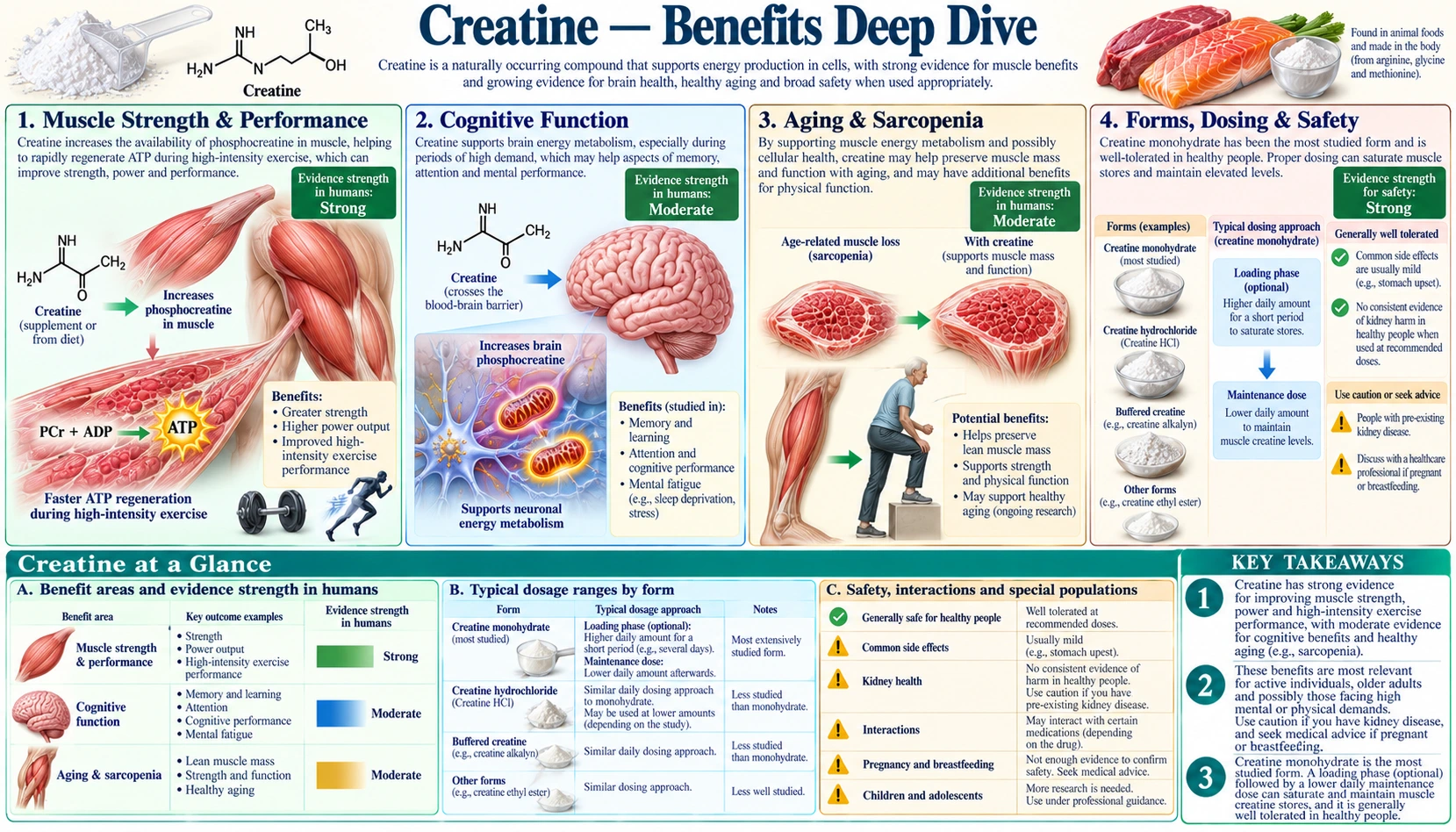
Creatine is described by the 2017 International Society of Sports Nutrition (ISSN) position stand as one of the most popular nutritional ergogenic aids for athletes; a 2021 review counts over 500 peer-refereed publications on creatine supplementation (Antonio 2021), and a 2025 safety analysis drew on 685 human clinical trials (Kreider 2025). Its central role is as the store of phosphocreatine that regenerates ATP during high-intensity effort. The position stand reports that supplementation raises muscle creatine, which may help explain improvements in high-intensity exercise performance and training adaptations, and lists clinical uses that have been studied, among them aging, brain ischemia and adolescent depression. It also states that short- and long-term supplementation (up to 30 g/day for 5 years) has been safe and well tolerated in healthy people and in a number of patient groups (Kreider 2017). Two 2026 meta-analyses of randomized trials found that creatine raises serum creatinine without changing urea; one attributes the creatinine-based changes to altered creatinine metabolism rather than kidney injury, and the other calls for trials longer than a year (Tsiaras 2026; de Souza Almeida 2026). On regulation: in the United States creatine is sold as a dietary supplement, and FDA states that under the Dietary Supplement Health and Education Act it does not have the authority to approve dietary supplements before they are marketed. Separately, FDA closed GRAS notice GRN 931, for creatine monohydrate as an ingredient in drinks, bars and powders at about 1 g of creatine per serving, with a “no questions” letter in November 2020. In the European Union, a 2016 EFSA panel opinion found evidence for an effect of creatine, at doses of at least 3 g/day combined with regular resistance training, on muscle strength in adults over 55 (EFSA NDA Panel 2016). Five deep-dive pages below cover the strength-and-performance literature, the cognitive-function trials, creatine in older adults, forms and safety (including the creatine vs creatinine lab question), and a 2026 trial of creatine with and without exercise.
Deep-Dive Articles
Muscle Strength & Performance
The Kreider 2017 International Society of Sports Nutrition position stand, a 2003 review reporting that short-term supplementation improved maximal power and strength by 5–15% in the studies it covered, the phosphocreatine system that regenerates ATP during high-intensity effort, the loading studies (about a 20% rise in muscle creatine after 6 days at 20 g/day, and a similar rise over 28 days at 3 g/day), and how creatine compares with caffeine, beta-alanine and citrulline.
Read the deep dive →Cognitive Function
The Rae 2003 crossover trial in 45 vegetarian young adults, which found better working memory and intelligence-test scores on creatine; the Avgerinos 2018 systematic review of six trials, which found evidence for short-term memory and reasoning, with vegetarians responding better than meat-eaters on memory tasks; creatine and creatine kinase in the brain; a 2014 brain-scan study that found similar brain creatine in vegetarians and omnivores; and the sleep-deprivation studies.
Read the deep dive →Aging & Sarcopenia
The Chilibeck 2017 meta-analysis of 22 trials in older adults, in which creatine during resistance training produced greater gains in lean tissue mass and chest- and leg-press strength than placebo; the bone research by Chilibeck, Candow and colleagues, including a 2-year trial in postmenopausal women that found no effect on bone mineral density but some changes in hip bone geometry; and what the research in older adults does not yet cover.
Read the deep dive →Forms, Dosing & Safety
Why creatine monohydrate is the most extensively studied form, and what trials comparing it with newer forms (buffered creatine, creatine ethyl ester and others) found; the doses trials have used, with and without a loading week; what body-water studies measured; the kidney-function trials and meta-analyses; and the difference between creatine and the lab marker creatinine.
Read the deep dive →Creatine Without Exercise: The 2026 Middle-Age Trial
A 12-week trial in adults aged 45 to 65 that tested creatine with and without an exercise programme: what was randomised, what the scans measured and what it cannot show.
Read the deep dive →Table of Contents
Why Creatine Produces Effects Across So Many Tissues
Creatine’s central role is a basic one in cellular energy: as phosphocreatine, it regenerates ATP from ADP by phosphate transfer. About 95% of the body’s creatine is in skeletal muscle, with small amounts in the brain and testes (Kreider 2017), and research on supplementation has extended from muscle to the brain, bone and aging.
The mechanism in one paragraph: about two-thirds of the creatine in muscle is held as phosphocreatine, the rest as free creatine (Kreider 2017). During high-intensity activity, phosphocreatine donates its phosphate to ADP through the creatine kinase reaction (PCr + ADP ↔ Cr + ATP), regenerating ATP. The ISSN position stand states that on a normal diet containing 1–2 g/day of creatine, muscle creatine stores are about 60–80% saturated, and that supplementation increases muscle creatine and phosphocreatine by 20–40% (Kreider 2017).
Three distinct categories of benefit follow from this one mechanism:
- Muscle — the most-studied application. A 2011 review describes creatine monohydrate as raising muscle creatine and phosphocreatine by about 15–40%, enhancing anaerobic exercise capacity and increasing training volume, leading to greater gains in strength, power and muscle mass (Jäger 2011). A 2003 review counted about 300 studies of performance, of which about 70% reported statistically significant results and none a significant performance loss (Kreider 2003). See Muscle Strength & Performance for the full literature.
- Brain — creatine also acts as an energy buffer in the brain. In a 6-person brain-scan study, 20 g/day for 4 weeks raised total brain creatine by 8.7% on average (Dechent 1999). A review concludes that creatine is most likely to affect cognition when cognitive processes are stressed — during sleep deprivation, experimental hypoxia, or more demanding tasks (Dolan 2019). The Avgerinos 2018 systematic review found evidence that short-term memory and intelligence/reasoning may improve, conflicting results for other domains, unchanged performance in young individuals, and better memory responses in vegetarians than in meat-eaters; a 2014 brain-scan study, however, found similar brain creatine in vegetarians and omnivores (Yazigi Solis 2014). See Cognitive Function.
- Aging, sarcopenia, and bone — the Chilibeck 2017 meta-analysis (22 trials, 721 participants with mean ages of 57–70) found greater gains in lean tissue mass (1.37 kg) and in chest- and leg-press strength with creatine than with placebo during resistance training. For bone, a 12-week trial in 29 men aged about 71 found that arm bone mineral content rose 3.2% with creatine and fell a non-significant 1.0% with placebo (Chilibeck 2005), while a 2-year trial in 237 postmenopausal women found no effect on bone mineral density, with some improvement in hip bone geometry (Chilibeck 2023). A 2021 review notes that research in older adults who already have sarcopenia or osteoporosis is very limited (Candow 2021). See Aging & Sarcopenia.
The fourth deep-dive page covers the practical questions commonly asked about creatine: forms, loading, water retention, kidney function, and why lab creatinine can rise. See Forms, Dosing & Safety. In brief, from the sources listed below: a review found little to no evidence that newer forms are more effective or safer than creatine monohydrate (Jäger 2011); muscle creatine rose about 20% after 6 days at 20 g/day, and by a similar amount over 28 days at 3 g/day (Hultman 1996); a 28-day trial found increases in body mass and total body water with no change in fluid distribution (Powers 2003); and a 2026 meta-analysis found that creatine raised serum creatinine and lowered creatinine-based estimates of kidney filtration but not filtration measured by Cr-EDTA, which its authors attribute to altered creatinine metabolism rather than kidney injury (de Souza Almeida 2026).
Research Papers: Muscle Strength & Performance
- Kreider RB et al. (2017). International Society of Sports Nutrition position stand: safety and efficacy of creatine supplementation in exercise, sport, and medicine. J Int Soc Sports Nutr. — PubMed PMID: 28615996
- Branch JD (2003). Effect of creatine supplementation on body composition and performance: a meta-analysis. Int J Sport Nutr Exerc Metab. — PubMed PMID: 12945830
- Lanhers C et al. (2015). Creatine supplementation and lower limb strength performance: a systematic review and meta-analyses. Sports Med. — PubMed PMID: 25946994
- Lanhers C et al. (2017). Creatine supplementation and upper limb strength performance: a systematic review and meta-analysis. Sports Med. — PubMed PMID: 27328852
- Harris RC et al. (1992). Elevation of creatine in resting and exercised muscle of normal subjects by creatine supplementation. Clin Sci. — PubMed PMID: 1327657
- Hultman E et al. (1996). Muscle creatine loading in men. J Appl Physiol. — PubMed PMID: 8828669
- Volek JS et al. (1999). Performance and muscle fiber adaptations to creatine supplementation and heavy resistance training. Med Sci Sports Exerc. — PubMed PMID: 10449017
- Cribb PJ, Hayes A (2006). Effects of supplement timing and resistance exercise on skeletal muscle hypertrophy. Med Sci Sports Exerc. — PubMed PMID: 17095924
- Casey A, Greenhaff PL (2000). Does dietary creatine supplementation play a role in skeletal muscle metabolism and performance? Am J Clin Nutr. — PubMed PMID: 10919967
- Wax B et al. (2021). Creatine for exercise and sports performance, with recovery considerations for healthy populations. Nutrients. — PubMed PMID: 34199588
- Kreider RB (2003). Effects of creatine supplementation on performance and training adaptations. Mol Cell Biochem. — PubMed PMID: 12701815
Research Papers: Cognitive Function
- Rae C et al. (2003). Oral creatine monohydrate supplementation improves brain performance: a double-blind, placebo-controlled, cross-over trial. Proc R Soc B. — PubMed PMID: 14561278
- Avgerinos KI et al. (2018). Effects of creatine supplementation on cognitive function of healthy individuals: a systematic review of randomized controlled trials. Exp Gerontol. — PubMed PMID: 29704637
- Benton D, Donohoe R (2011). The influence of creatine supplementation on the cognitive functioning of vegetarians and omnivores. Br J Nutr. — PubMed PMID: 21118604
- Watanabe A et al. (2002). Effects of creatine on mental fatigue and cerebral hemoglobin oxygenation. Neurosci Res. — PubMed PMID: 11985880
- McMorris T et al. (2006). Effect of creatine supplementation and sleep deprivation, with mild exercise, on cognitive and psychomotor performance, mood state, and plasma concentrations of catecholamines and cortisol. Psychopharmacology. — PubMed PMID: 16416332
- Dechent P et al. (1999). Increase of total creatine in human brain after oral supplementation of creatine-monohydrate. Am J Physiol. — PubMed PMID: 10484486
- Roschel H et al. (2021). Creatine supplementation and brain health. Nutrients. — PubMed PMID: 33578876
- Forbes SC et al. (2022). Effects of creatine supplementation on brain function and health. Nutrients. — PubMed PMID: 35267907
- Smith-Ryan AE et al. (2021). Creatine supplementation in women's health: a lifespan perspective. Nutrients. — PubMed PMID: 33800439
- Dolan E et al. (2019). Beyond muscle: the effects of creatine supplementation on brain creatine, cognitive processing, and traumatic brain injury. Eur J Sport Sci. — PubMed PMID: 30086660
- Yazigi Solis M et al. (2014). Brain creatine depletion in vegetarians? A cross-sectional 1H-magnetic resonance spectroscopy (1H-MRS) study. Br J Nutr. — PubMed PMID: 24290771
Research Papers: Aging & Sarcopenia
- Chilibeck PD et al. (2017). Effect of creatine supplementation during resistance training on lean tissue mass and muscular strength in older adults: a meta-analysis. Open Access J Sports Med. — PubMed PMID: 29138605
- Candow DG, Chilibeck PD, Forbes SC (2014). Creatine supplementation and aging musculoskeletal health. Endocrine. — PubMed PMID: 24190049
- Candow DG et al. (2015). Strategic creatine supplementation and resistance training in healthy older adults. Appl Physiol Nutr Metab. — PubMed PMID: 25993883
- Chilibeck PD et al. (2005). Creatine monohydrate and resistance training increase bone mineral content and density in older men. J Nutr Health Aging. — PubMed PMID: 16222402
- Forbes SC et al. (2022; online 2021). Effects of creatine supplementation on properties of muscle, bone, and brain function in older adults: a narrative review. J Diet Suppl. — PubMed PMID: 33502271
- Devries MC, Phillips SM (2014). Creatine supplementation during resistance training in older adults — a meta-analysis. Med Sci Sports Exerc. — PubMed PMID: 24576864
- Gualano B et al. (2016). Creatine supplementation in the aging population: effects on skeletal muscle, bone and brain. Amino Acids. — PubMed PMID: 27108136
- Tarnopolsky MA (2010). Caffeine and creatine use in sport. Ann Nutr Metab. — PubMed PMID: 21346331
- Aguiar AF et al. (2013). Long-term creatine supplementation improves muscular performance during resistance training in older women. Eur J Appl Physiol. — PubMed PMID: 23053133
- Stares A, Bains M (2020). The additive effects of creatine supplementation and exercise training in an aging population: a systematic review of randomized controlled trials. J Geriatr Phys Ther. — PubMed PMID: 30762623
- Chilibeck PD et al. (2023). A 2-yr randomized controlled trial on creatine supplementation during exercise for postmenopausal bone health. Med Sci Sports Exerc. — PubMed PMID: 37144634
- Candow DG, Forbes SC, Kirk B, Duque G (2021). Current evidence and possible future applications of creatine supplementation for older adults. Nutrients. — PubMed PMID: 33652673
Research Papers: Forms, Dosing & Safety
- Jagim AR et al. (2012). A buffered form of creatine does not promote greater changes in muscle creatine content, body composition, or training adaptations than creatine monohydrate. J Int Soc Sports Nutr. — PubMed PMID: 22971354
- Spillane M et al. (2009). The effects of creatine ethyl ester supplementation combined with heavy resistance training on body composition, muscle performance, and serum and muscle creatine levels. J Int Soc Sports Nutr. — PubMed PMID: 19228401
- Poortmans JR, Francaux M (2000). Adverse effects of creatine supplementation: fact or fiction? Sports Med. — PubMed PMID: 10999421
- Kim HJ et al. (2011). Studies on the safety of creatine supplementation. Amino Acids. — PubMed PMID: 21399917
- Gualano B et al. (2008). Effects of creatine supplementation on renal function: a randomized, double-blind, placebo-controlled clinical trial. Eur J Appl Physiol. — PubMed PMID: 18188581
- Bender A, Klopstock T (2016). Creatine for neuroprotection in neurodegenerative disease: end of story? Amino Acids. — PubMed PMID: 26748651
- Hall M, Trojian TH (2013). Creatine supplementation. Curr Sports Med Rep. — PubMed PMID: 23851411
- Powers ME et al. (2003). Creatine supplementation increases total body water without altering fluid distribution. J Athl Train. — PubMed PMID: 12937471
- Williamson L, New D (2014). How the use of creatine supplements can elevate serum creatinine in the absence of underlying kidney pathology. BMJ Case Rep. — PubMed PMID: 25239988
- Antonio J et al. (2021). Common questions and misconceptions about creatine supplementation: what does the scientific evidence really show? J Int Soc Sports Nutr. — PubMed PMID: 33557850
- Jäger R et al. (2011). Analysis of the efficacy, safety, and regulatory status of novel forms of creatine. Amino Acids. — PubMed PMID: 21424716
- Kreider RB et al. (2025). Safety of creatine supplementation: analysis of the prevalence of reported side effects in clinical trials and adverse event reports. J Int Soc Sports Nutr. — PubMed PMID: 40198156
- Tsiaras A et al. (2026). The effect of creatine supplementation on kidney function: a systematic review and meta-analysis of randomized controlled trials. J Ren Nutr (online ahead of print). — PubMed PMID: 42035842
- de Souza Almeida A et al. (2026). Impact of creatine supplementation on kidney health: a systematic review and meta-analysis. Int Urol Nephrol (online ahead of print). — PubMed PMID: 42507286
- EFSA Panel on Dietetic Products, Nutrition and Allergies (NDA) (2016). Creatine in combination with resistance training and improvement in muscle strength: evaluation of a health claim pursuant to Article 13(5) of Regulation (EC) No 1924/2006. EFSA Journal 14(2):4400. — doi:10.2903/j.efsa.2016.4400
External Resources
- International Society of Sports Nutrition (ISSN) Position Stand on Creatine — Kreider et al. 2017 — open-access full text
- NIH Office of Dietary Supplements — Exercise and Athletic Performance Fact Sheet (includes a creatine section)
- FDA GRAS Notice Inventory — GRN 931, creatine monohydrate (closed November 2020, “FDA has no questions”)
- FDA — Questions and Answers on Dietary Supplements (how dietary supplements are regulated under DSHEA)
- Examine.com — Creatine (a third-party summary of the research)
- EFSA Scientific Opinion on Creatine (2011) (on health claims for creatine and physical performance in short-term, high-intensity, repeated exercise bouts)
- PubMed — All research on creatine supplementation
Connections
- All Amino Acids
- Creatine (Main Page)
- Creatine for Muscle Strength & Performance
- Creatine for Cognitive Function
- Creatine for Aging & Sarcopenia
- Creatine Forms, Dosing & Safety
- Arginine (Creatine Precursor)
- Glycine (Creatine Precursor)
- Methionine (Methyl Donor)
- Phosphorus (Phosphocreatine)
- Kidney Function (Creatinine vs Creatine)
- Osteoporosis
- Depression
- Alzheimer's Disease
- Heart Failure
- Beef (Dietary Creatine)
- Salmon (Dietary Creatine)
- Herring (Dietary Creatine)
- History
- Sources