Creatine for Aging and Sarcopenia
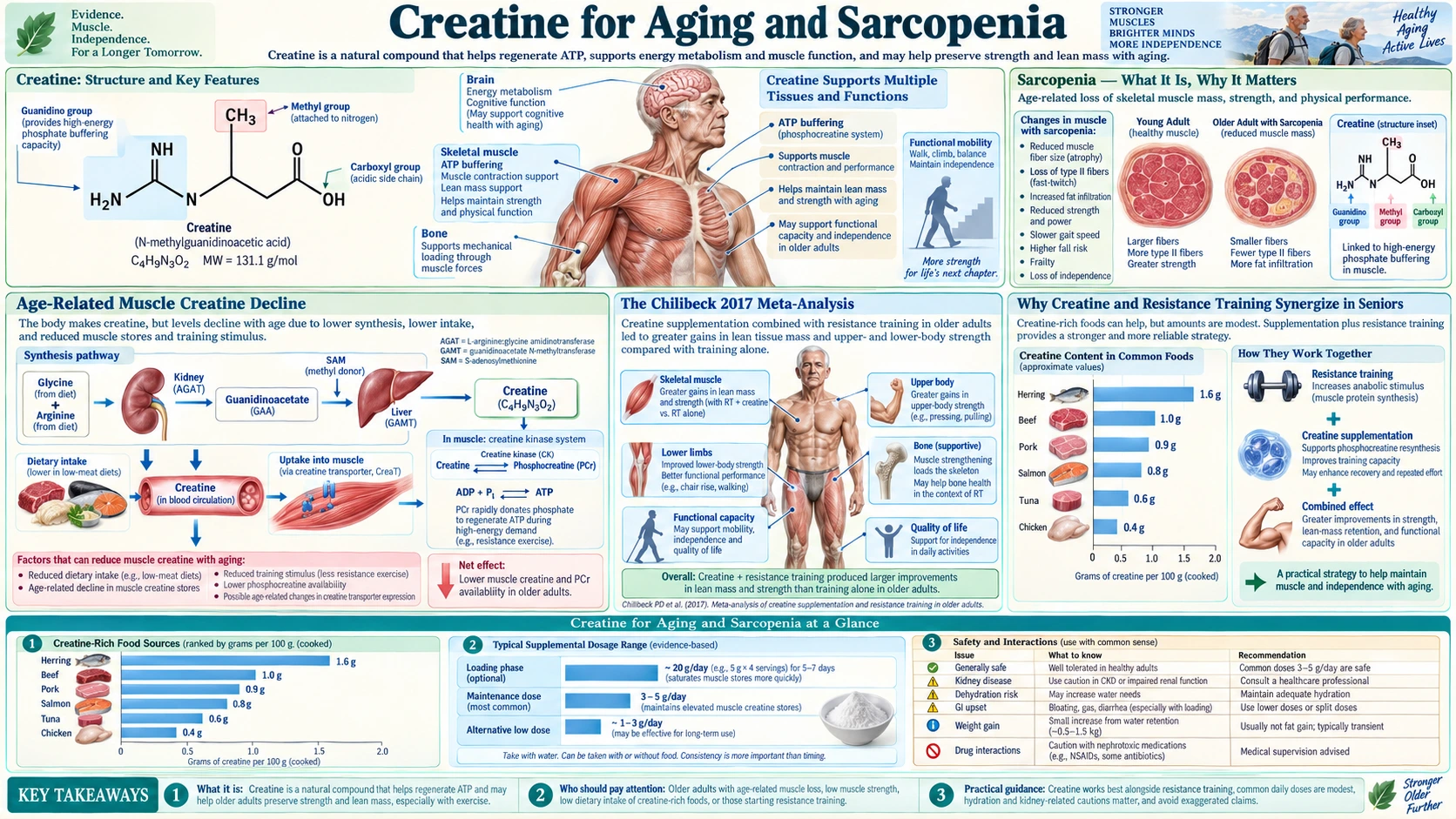
Sarcopenia is the age-related loss of skeletal muscle mass, strength and function. The European Working Group on Sarcopenia in Older People (EWGSOP2, 2019) describes it as a muscle disease that is common in older adults but can begin earlier in life. Resistance training is the established countermeasure, and a body of randomized trials has asked whether adding creatine changes the result. A 2017 meta-analysis by Chilibeck, Kaviani, Candow and Zello pooled 22 randomized trials in 721 older adults (mean ages 57–70 years) and found greater gains in lean tissue mass, chest press strength and leg press strength with creatine plus resistance training than with training plus placebo. The bone results are less consistent: a 12-week trial in 29 older men found a gain in arm bone mineral content with creatine, while a 2-year trial in 237 postmenopausal women found no effect on bone mineral density at the hip or spine.
Table of Contents
- Sarcopenia — What It Is, Why It Matters
- Does Muscle Creatine Decline With Age?
- The Chilibeck 2017 Meta-Analysis
- Proposed Mechanisms in Older Adults
- Bone Mineral Density Trials
- Functional Outcomes
- Frailty and the Robust–Pre-frail–Frail Spectrum
- Creatine and Cognitive Aging Research
- Gaps in the Older-Adult Evidence
- Doses and Training Programmes Used in the Trials
- Safety in Older Adults (Including the Renal Question)
- Key Research Papers
- Connections
- Featured Videos
Sarcopenia — What It Is, Why It Matters
Sarcopenia is the age-related progressive loss of skeletal muscle mass, strength and function. The revised European consensus (EWGSOP2, Cruz-Jentoft and colleagues, 2019) describes sarcopenia as a muscle disease (“muscle failure”) rooted in adverse muscle changes that accrue across a lifetime. It is common in older adults but can also occur earlier in life. The consensus:
- treats low muscle strength as the key characteristic;
- uses detection of low muscle quantity or quality to confirm the diagnosis;
- treats poor physical performance as a sign of severe sarcopenia;
- sets cut-off points for each measurement and a clinical algorithm for case-finding, diagnosis and severity.
Why it matters: the 2013 PROT-AGE position paper notes that older people are vulnerable to losses in physical function, and that such losses predict loss of independence, falls and even mortality. Frailty, a related syndrome covered below, independently predicted falls, worsening mobility or disability, hospitalization and death in the Cardiovascular Health Study (Fried 2001).
Resistance training is the reference intervention. A 2014 meta-analysis (Devries and Phillips) describes resistance training as an established countermeasure for sarcopenia and dynapenia (age-related loss of strength), and the creatine trials on this page all ask the same question: does adding creatine to resistance training change the gains in muscle mass, strength and function compared with training alone?
Does Muscle Creatine Decline With Age?
It is not settled. The discussion section of the Chilibeck 2017 meta-analysis states that “controversy exists” over whether creatine stores fall and phosphocreatine metabolism changes with aging. Some studies show reduced creatine stores in older adults and slower phosphocreatine kinetics during or after exercise. Others find no difference between young and older adults, or even higher phosphocreatine stores in older adults.
The same discussion lists possible reasons why lower stores might occur in older adults:
- Fibre-type changes — type II (fast-twitch) muscle fibres, which generally hold more phosphocreatine than type I fibres, are preferentially lost with aging.
- Diet — older adults typically eat less meat, and therefore take in less dietary creatine.
- Physical activity — activity levels generally fall with age, and higher activity raises phosphocreatine stores while immobilization lowers them.
The authors also note that people with low muscle creatine stores, such as vegetarians, respond more to creatine supplementation. Whether older adults as a group respond more than younger adults was not tested in the meta-analysis.
The Chilibeck 2017 Meta-Analysis
Chilibeck, Kaviani, Candow and Zello (Open Access Journal of Sports Medicine, 2017) carried out a systematic review and meta-analysis of randomized controlled trials of creatine during resistance training in older adults. They included 22 studies with 721 participants, men and women, with mean ages of 57–70 years across studies. Participants were randomized to creatine or placebo while doing resistance training 2–3 days a week for 7–52 weeks. Compared with placebo, creatine gave greater increases in:
- Lean tissue mass — mean difference 1.37 kg (95% CI 0.97–1.76; p<0.00001).
- Chest press strength — standardized mean difference 0.35 (95% CI 0.16–0.53; p=0.0002).
- Leg press strength — standardized mean difference 0.24 (95% CI 0.05–0.43; p=0.01).
The full text adds detail. Fifteen of the studies were in healthy older adults, two in frail or vulnerable older adults, and one each in older adults with heart disease, Parkinson’s disease, chronic obstructive pulmonary disease, type 2 diabetes or osteoarthritis. Taken one by one, twelve studies reported that creatine increased lean tissue mass or muscle function and ten found no effect. The meta-analysis did not report results by age band. A few included studies reported men and women separately and were entered as separate subgroups, but no pooled comparison between the sexes is given.
Reviews differ on sex. A 2016 narrative review (Gualano, Rawson, Candow and Chilibeck) states that the effect on lean mass and muscle function “appears to be applicable to older individuals regardless of sex, fitness or health status.” It adds that studies in very old (over 90) and severely frail people remain scarce. A 2020 systematic review of 17 trials (Stares and Bains) concludes that the effects of creatine “are more consistent in older women than in men.”
An earlier meta-analysis by Devries and Phillips (Medicine & Science in Sports & Exercise, 2014) pooled 357 older adults (mean age about 64 years) who trained for an average of about 12.6 weeks. Creatine plus training increased total body mass and fat-free mass more than training alone, with no effect on fat mass. It also produced greater gains in chest press and leg press one-repetition maximum, but showed no difference in knee extension or biceps curl one-repetition maximum, or in isokinetic or isometric knee extension peak torque.
A 2019 meta-analysis of 19 studies (609 adults aged 50 or over; Forbes and colleagues) looked at fat mass. With creatine during resistance training, body fat percentage fell 0.55% more than with placebo (p=0.04). Fat mass fell about 0.5 kg more, a difference that was not statistically significant (p=0.13).
Proposed Mechanisms in Older Adults
The Chilibeck 2017 abstract states that “a number of mechanisms exist” by which creatine may increase lean tissue mass and strength, but that these “have yet to be evaluated extensively.” The mechanisms discussed in that paper and the reviews cited here are:
- Energy buffering — creatine raises muscle phosphocreatine, which regenerates ATP during short, intense efforts. A 2010 review (Tarnopolsky) reports that either a higher dose (about 20 g/day for 3–5 days) or a lower dose (about 5 g/day for 30 days) raises muscle total creatine and phosphocreatine by 10–20%. In the Brose 2003 trial in adults over 65, intramuscular total creatine rose significantly in the creatine group.
- Less muscle protein breakdown — in a couple of the trials in the Chilibeck review, urinary 3-methylhistidine, a whole-body marker of muscle protein breakdown, fell with creatine in older men but not in older women.
- Growth signalling — the review discusses changes in myogenic regulatory factors and myostatin. The myostatin evidence it cites comes from pigs and young men, not older adults.
Anabolic resistance is part of the background. The PROT-AGE position paper describes “declining anabolic responses to ingested protein” with age, one of its reasons for proposing higher protein intakes in older people. Whether creatine offsets anabolic resistance has not been shown directly in the sources cited here.
Bone Mineral Density Trials
Darren Candow (University of Regina) and Philip Chilibeck (University of Saskatchewan) have authored much of the research on creatine and bone in older adults.
Older men, 12 weeks (Chilibeck 2005, J Nutr Health Aging). Twenty-nine men with a mean age of 71 were randomized, double blind, to creatine (0.3 g/kg for 5 days, then 0.07 g/kg) or placebo during 12 weeks of resistance training. Bone was measured by DEXA before and after. Whole-body and leg bone mineral density rose by about 0.5% and 1% across both groups combined, a training effect. Arm bone mineral content rose 3.2% with creatine and fell 1.0% with placebo (the fall was not significant), a significant group-by-time interaction. The authors concluded that training raised bone mineral density in older men and that creatine “may provide an additional benefit for increasing regional bone mineral content.” They suggested this could reflect greater muscle mass pulling on bone.
Postmenopausal women, 2 years (Chilibeck 2023, Med Sci Sports Exerc). In a 2-year randomized controlled trial in 237 postmenopausal women, creatine (0.14 g/kg/day) or placebo was taken during a resistance training and walking programme. Creatine had no effect on bone mineral density at the femoral neck, total hip or lumbar spine, the trial’s primary outcome. It did maintain femoral-neck section modulus, a predictor of bone bending strength, and buckling ratio, a predictor of cortical stability under compression. It also shortened 80-metre walking time, but had no effect on bench-press or hack-squat strength.
Reviews. A 2014 review with meta-analyses (Candow, Chilibeck and Forbes, Endocrine) states that creatine “shows promise for improving bone mineral density and indices of bone biology.” The 2016 Gualano review concludes that creatine may affect bone remodelling but that “the effects of creatine on bone accretion are inconsistent,” and calls for larger trials longer than 52 weeks. The 2020 Stares and Bains review suggests that any creatine-specific gain in femur bone mineral density may need at least a year of supplementation with resistance training. No trial cited here measured fractures.
Osteoporosis is covered on the Osteoporosis page.
Functional Outcomes
Function in older adults is often measured with chair-stand tests, walking tests, stair climbing and the Short Physical Performance Battery (SPPB), which combines gait speed, balance and chair-rise tests. What the creatine trials and meta-analyses cited here report:
- Devries and Phillips 2014 (meta-analysis) — creatine plus resistance training improved the 30-second chair stand test more than training alone (p=0.03).
- Brose 2003 — 28 healthy men and women over 65 trained 3 days a week for 14 weeks with creatine (5 g/day plus 2 g dextrose) or placebo. Chair stand, 30-metre walk and 14-stair climb improved in both groups. The abstract reports a creatine advantage for fat-free mass, total body mass and isometric knee extension strength, and for dorsiflexion strength in men only. It does not report a creatine advantage on the functional tasks.
- Aguiar 2013 — 18 healthy women (mean age 64.9) trained 3 days a week for 12 weeks with creatine (5 g/day) or placebo. The creatine group had larger gains in training volume, bench press, knee extension and biceps curl strength, fat-free mass and muscle mass, and was more efficient at submaximal-strength functional tests.
- Chilibeck 2023 — in the 2-year trial in postmenopausal women, creatine shortened 80-metre walking time.
The 2025 narrative review by Candow and colleagues lists “functional ability” among the measures on which creatine, mainly when combined with exercise training, has shown benefit in older adults. None of the trials cited on this page measured falls, so effects on fall rates have not been shown.
Frailty and the Robust–Pre-frail–Frail Spectrum
Frailty overlaps with sarcopenia but is a separate syndrome. Fried and colleagues (2001) defined the frailty phenotype in 5,317 men and women aged 65 and over in the Cardiovascular Health Study. It is defined by five criteria: unintentional weight loss (10 lb in the past year), self-reported exhaustion, weakness (grip strength), slow walking speed and low physical activity. Three or more criteria define frailty. One or two define an intermediate stage, often called pre-frailty, which carried an intermediate risk of adverse outcomes and a higher risk of becoming frail over 3–4 years. Frailty prevalence was 6.9%, and it independently predicted falls, worsening mobility or disability, hospitalization and death.
Creatine research in frail people is limited. Two of the 22 studies in the Chilibeck 2017 meta-analysis were in frail or vulnerable older adults, and the 2016 Gualano review notes that studies in severely frail individuals “remain scarce.” The 2025 Candow review concludes that creatine “may have application” for age-related sarcopenia, osteoporosis and frailty. Several of its authors disclose research funding or advisory roles with creatine manufacturers.
Protein is the other nutrition question in frailty research. For people over 65, the 2013 PROT-AGE study group recommends:
- an average intake of at least 1.0–1.2 g protein per kg body weight per day;
- at least 1.2 g/kg/day for people who exercise or are otherwise active;
- 1.2–1.5 g/kg/day for most older adults with acute or chronic disease;
- an exception for people with severe kidney disease (estimated GFR below 30) who are not on dialysis, who may need to limit protein.
The same paper states that evidence on protein quality and timing of intake is not yet sufficient to support specific recommendations.
Creatine and Cognitive Aging Research
The 2018 systematic review by Avgerinos and colleagues (covered in the Cognitive Function deep-dive) found six randomized trials in 281 healthy people. Its findings:
- creatine may improve short-term memory and intelligence/reasoning;
- results for other cognitive domains were conflicting;
- performance on cognitive tasks stayed unchanged in young individuals;
- vegetarians responded better than meat-eaters in memory tasks.
The authors wrote that the findings “suggest potential benefit for aging and stressed individuals.”
The older-adult data are thin. The 2016 Gualano review states that “few data are available on older adults, and the findings are discordant.” The 2020 Stares and Bains review found that the limited data showed no additive effect of creatine over exercise alone on measures of mental health. The 2025 Candow review lists cognition and memory among the outcomes with reported benefits in older adults.
Cognitive decline and dementia are covered on the Dementia page and the Alzheimer's Disease page.
Gaps in the Older-Adult Evidence
The reviews cited on this page name several open questions:
- Who has been studied — most trials enrolled healthy older adults with mean ages of 57–70 (Chilibeck 2017). Studies in very old (over 90) and severely frail people remain scarce (Gualano 2016).
- How long, and at what dose — the Stares and Bains review concludes that more studies are needed to find the effective dose and duration for bone and cognition. It suggests any additive effects on strength, function and lean mass need daily low-dose creatine with at least 12 weeks of resistance training.
- Bone — trials longer than 52 weeks, with bone geometry and microarchitecture measures, are called for (Gualano 2016). The one 2-year trial found no effect on bone mineral density (Chilibeck 2023).
- Women — a 2021 review (Smith-Ryan and colleagues) reports that postmenopausal women may see benefits in muscle size and function with high doses (0.3 g/kg/day) and favourable effects on bone when creatine is combined with resistance training. It also reports that females have 70–80% lower endogenous creatine stores than males. Two of its authors disclose advisory roles with a creatine manufacturer.
- Who funds the research — several authors of the main reviews in this field disclose research funding, donated creatine or advisory roles with creatine manufacturers (Candow 2025; Antonio 2021).
Doses and Training Programmes Used in the Trials
A summary of what the studies on this page used:
- Training — resistance training 2–3 days a week for 7–52 weeks across the 22 trials in the Chilibeck 2017 meta-analysis. Brose 2003 and Aguiar 2013 trained 3 days a week. The 2023 postmenopausal trial combined resistance training with walking for 2 years.
- Loading or not — eight of the 22 trials in the Chilibeck meta-analysis began with a loading phase of 20 g/day for 5–7 days. Maintenance doses, and doses in the other trials, ranged from 3 to 5 g/day.
- Fixed doses — 5 g/day (with 2 g dextrose) for 14 weeks (Brose 2003); 5 g/day for 12 weeks (Aguiar 2013).
- Body-weight doses — 0.3 g/kg for 5 days, then 0.07 g/kg (Chilibeck 2005); 0.1 g/kg on training days, taken either immediately before or immediately after training, for 32 weeks (Candow 2015); 0.14 g/kg/day for 2 years (Chilibeck 2023).
- Timing — in Candow 2015 (39 adults aged 50–71), creatine taken either before or after training increased leg press and chest press strength more than placebo. Only creatine taken after training increased lean tissue mass more than placebo (3.0 vs 0.5 kg).
- Upper doses — the 2010 Tarnopolsky review states that there is no rationale for creatine doses above the recommended ones, and that some people get stomach upset, especially at higher doses.
The International Society of Sports Nutrition position stand (Kreider 2017) describes the quickest way to raise muscle creatine as about 0.3 g/kg/day for 5–7 days followed by 3–5 g/day. Smaller daily amounts raise stores over 3–4 weeks. Decisions about supplements and exercise programmes belong with a clinician.
Safety in Older Adults (Including the Renal Question)
What the trials and reviews cited on this page report:
- Adverse events in the older-adult trials — in the Chilibeck 2017 meta-analysis, most of the 22 studies reported no adverse effects related to creatine. Four reported gastrointestinal adverse events and two reported muscle cramping; none of these led participants to withdraw. Five studies lasting 3–52 weeks tested liver or kidney function in blood or urine and found no adverse effects. Brose 2003 reported no significant side effects. The 2020 Stares and Bains review concludes that creatine monohydrate “is safe to use in older adults.”
- Kidney function — two 2026 meta-analyses found mean serum creatinine rises of 0.13 and 0.14 mg/dL with creatine. Tsiaras 2026 (19 randomized trials and one crossover study) found no difference in urea or eGFR. De Souza Almeida 2026 (26 studies, 1,036 participants, including people with chronic kidney disease) found creatinine-based GFR lower but no significant change in GFR measured with Cr-EDTA, or in urea, albuminuria or proteinuria. Its authors interpreted the creatinine changes as altered creatinine metabolism rather than kidney injury.
- The creatinine lab artifact — eGFR is calculated from serum creatinine, so a creatine user’s creatinine-based eGFR can read lower without a change in measured kidney filtration. The creatinine question is covered in more detail on the Forms, Dosing & Safety page.
- Pre-existing kidney disease — data are limited. The ISSN position stand notes that some have suggested people with pre-existing kidney disease consult a physician before supplementing (Kreider 2017).
- Hydration — the 2021 review by Antonio and colleagues concludes that “experimental and clinical research does not validate the notion that creatine supplementation causes dehydration and muscle cramping.”
- Medicines — the trials and reviews cited on this page do not report formal interaction studies between creatine and the medicines older adults commonly take.
The ISSN position stand concludes: “There is no compelling scientific evidence that the short- or long-term use of creatine monohydrate (up to 30 g/day for 5 years) has any detrimental effects on otherwise healthy individuals or among clinical populations who may benefit from creatine supplementation.” Decisions about supplements, particularly with kidney disease, belong with a clinician.
Kidney function testing and the creatinine vs creatine question are covered on the Kidney Function page.
Key Research Papers
- Chilibeck PD, Kaviani M, Candow DG, Zello GA (2017). Effect of creatine supplementation during resistance training on lean tissue mass and muscular strength in older adults: a meta-analysis. Open Access J Sports Med 8:213-226. — PubMed PMID: 29138605
- Candow DG, Chilibeck PD, Forbes SC (2014). Creatine supplementation and aging musculoskeletal health. Endocrine 45(3):354-361. — PubMed PMID: 24190049
- Candow DG, Vogt E, Johannsmeyer S, Forbes SC, Farthing JP (2015). Strategic creatine supplementation and resistance training in healthy older adults. Appl Physiol Nutr Metab 40(7):689-694. — PubMed PMID: 25993883
- Chilibeck PD, Chrusch MJ, Chad KE, Shawn Davison K, Burke DG (2005). Creatine monohydrate and resistance training increase bone mineral content and density in older men. J Nutr Health Aging 9(5):352-353. — PubMed PMID: 16222402
- Devries MC, Phillips SM (2014). Creatine supplementation during resistance training in older adults—a meta-analysis. Med Sci Sports Exerc 46(6):1194-1203. — PubMed PMID: 24576864
- Forbes SC, Candow DG, Krentz JR, Roberts MD, Young KC (2019). Changes in fat mass following creatine supplementation and resistance training in adults ≥50 years of age: a meta-analysis. J Funct Morphol Kinesiol 4(3):62. — PubMed PMID: 33467377
- Gualano B, Rawson ES, Candow DG, Chilibeck PD (2016). Creatine supplementation in the aging population: effects on skeletal muscle, bone and brain. Amino Acids 48(8):1793-1805. — PubMed PMID: 27108136
- Aguiar AF, Januário RS, Junior RP, Gerage AM, Pina FL, do Nascimento MA, Padovani CR, Cyrino ES (2013). Long-term creatine supplementation improves muscular performance during resistance training in older women. Eur J Appl Physiol 113(4):987-996. — PubMed PMID: 23053133
- Tarnopolsky MA (2010). Caffeine and creatine use in sport. Ann Nutr Metab 57 Suppl 2:1-8. — PubMed PMID: 21346331
- Brose A, Parise G, Tarnopolsky MA (2003). Creatine supplementation enhances isometric strength and body composition improvements following strength exercise training in older adults. J Gerontol A Biol Sci Med Sci 58(1):11-19. — PubMed PMID: 12560406
- Stares A, Bains M (2020). The additive effects of creatine supplementation and exercise training in an aging population: a systematic review of randomized controlled trials. J Geriatr Phys Ther 43(2):99-112. — PubMed PMID: 30762623
- Smith-Ryan AE, Cabre HE, Eckerson JM, Candow DG (2021). Creatine supplementation in women's health: a lifespan perspective. Nutrients 13(3):877. — PubMed PMID: 33800439
- Chilibeck PD, Candow DG, Gordon JJ, et al. (2023). A 2-yr randomized controlled trial on creatine supplementation during exercise for postmenopausal bone health. Med Sci Sports Exerc 55:1750-1760. — PubMed PMID: 37144634
- Candow DG, Ostojic SM, Chilibeck PD, et al. (2025). Creatine monohydrate supplementation for older adults and clinical populations. J Int Soc Sports Nutr 22(sup1):2534130. — PubMed PMID: 40673730
- Kreider RB, Kalman DS, Antonio J, et al. (2017). International Society of Sports Nutrition position stand: safety and efficacy of creatine supplementation in exercise, sport, and medicine. J Int Soc Sports Nutr 14:18. — PubMed PMID: 28615996
- Antonio J, Candow DG, Forbes SC, et al. (2021). Common questions and misconceptions about creatine supplementation: what does the scientific evidence really show? J Int Soc Sports Nutr 18:13. — PubMed PMID: 33557850
- Tsiaras A, Loufopoulos G, Theodoridis X, et al. (2026). The effect of creatine supplementation on kidney function: a systematic review and meta-analysis of randomized controlled trials. J Ren Nutr. — PubMed PMID: 42035842
- de Souza Almeida A, da Silva LOD, Takahasi BNA, et al. (2026). Impact of creatine supplementation on kidney health: a systematic review and meta-analysis. Int Urol Nephrol. — PubMed PMID: 42507286
- Cruz-Jentoft AJ, Bahat G, Bauer J, et al. (2019). Sarcopenia: revised European consensus on definition and diagnosis. Age Ageing 48(1):16-31. — PubMed PMID: 30312372
- Fried LP, Tangen CM, Walston J, et al. (2001). Frailty in older adults: evidence for a phenotype. J Gerontol A Biol Sci Med Sci 56(3):M146-M156. — PubMed PMID: 11253156
- Bauer J, Biolo G, Cederholm T, et al. (2013). Evidence-based recommendations for optimal dietary protein intake in older people: a position paper from the PROT-AGE Study Group. J Am Med Dir Assoc 14(8):542-559. — PubMed PMID: 23867520
- Avgerinos KI, Spyrou N, Bougioukas KI, Kapogiannis D (2018). Effects of creatine supplementation on cognitive function of healthy individuals: a systematic review of randomized controlled trials. Exp Gerontol 108:166-173. — PubMed PMID: 29704637
PubMed Topic Searches
Connections
- All Amino Acids
- Creatine Benefits Hub
- Creatine Overview
- Creatine for Muscle Strength
- Creatine for Cognitive Function
- Creatine Forms & Safety
- Osteoporosis
- Dementia
- Alzheimer's Disease
- Diabetes (Muscle Glucose Disposal)
- Vitamin D3 (Muscle & Bone)
- Vitamin K2 (Bone Mineralization)
- Calcium
- Magnesium
- Leucine (Anabolic Threshold)
- Collagen (Joint & Bone Support)
- Kidney Function (Creatinine vs Creatine)
- History
- Sources