Creatine Forms, Dosing, and Safety
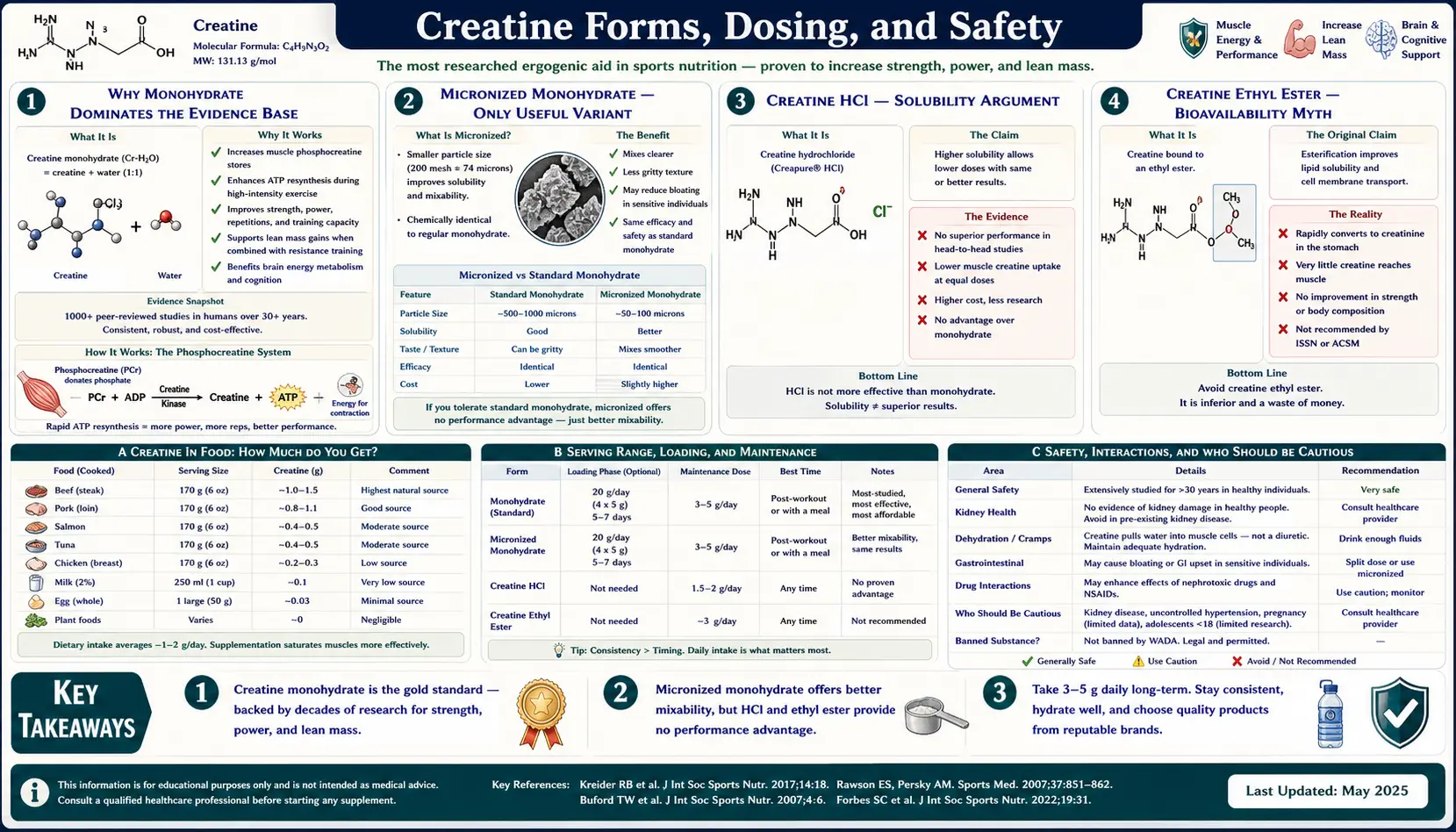
Most creatine research has been done with creatine monohydrate, and the 2017 International Society of Sports Nutrition (ISSN) position stand calls it the most extensively studied and clinically effective form. Newer forms — creatine HCl, creatine ethyl ester, buffered creatine, creatine nitrate, citrate, malate, liquid creatine — have been marketed for better absorption, lower doses or fewer side effects; the reviews and head-to-head trials summarized here did not find that any of them raised muscle creatine more than monohydrate. Trials have used either a loading phase (about 20 g/day for 5–7 days) followed by 3–5 g/day, or 3–5 g/day from the start, which reaches similar muscle levels more slowly. Creatine raises serum creatinine — by about 0.13–0.14 mg/dL on average in two 2026 meta-analyses — without a change in measured kidney filtration, which matters for anyone interpreting a routine kidney panel.
Table of Contents
- Why Monohydrate Dominates the Evidence Base
- Micronized Monohydrate
- Creatine HCl — the Solubility Argument
- Creatine Ethyl Ester — What the Trial and Lab Studies Found
- Buffered Creatine — the pH Stability Claim
- Creatine Nitrate, Malate, Citrate, Magnesium Chelate, Liquid Creatine
- Loading and Maintenance Regimens Used in Research
- Water Retention and Body Weight
- Kidney Function: What the Trials and Meta-Analyses Report
- Creatine and the Serum Creatinine Lab Test
- Reported Side Effects: GI Upset, Cramping, Heat, Hair Loss
- Regulatory Status (FDA, EFSA, WADA)
- Product Purity and Stability
- Key Research Papers
- Connections
- Featured Videos
Why Monohydrate Dominates the Evidence Base
A 2021 review counted more than 500 peer-reviewed publications on creatine supplementation (Antonio 2021), and most of the trials behind its strength, power, lean-mass and clinical findings used creatine monohydrate — creatine crystallized with one molecule of water.
The chemistry: creatine monohydrate is a white crystalline powder with a molecular weight of 149.15 g/mol. By mass it is 87.9% creatine; most other forms contain less creatine per gram (for example creatine citrate 66% and creatine malate 66% or 74.7%, depending on the ratio), while anhydrous creatine is 100% (Jäger 2011). Monohydrate dissolves at about 14 g/L in water at 20°C, giving a neutral solution, and its solubility rises with temperature (Jäger 2011). As a dry powder it shows no meaningful breakdown to creatinine over years of storage. In solution it is less stable: it converts to creatinine faster at lower pH and higher temperature — one study cited by Jäger 2011 found 4% degraded at pH 5.5, 12% at pH 4.5 and 21% at pH 3.5 after 3 days at 25°C — while very low pH (below about 2.5) or a high pH slows the reaction (Jäger 2011; Antonio 2021).
The pharmacokinetics: in Harris 1992, a single 5 g dose produced a peak plasma creatine level about 1 hour after ingestion, and repeated 5 g doses every 2 hours held plasma levels elevated. Reviews report that less than 1% of ingested monohydrate is degraded to creatinine during digestion and that about 99% is either taken up by tissues or excreted in urine as creatine (Jäger 2011; Antonio 2021). Muscle takes up creatine through the creatine transporter (SLC6A8). Uptake into muscle was greatest in the first 2 days of high-dose supplementation and in people whose starting muscle creatine was lowest; in three subjects taking 6 × 5 g/day, 40–68% of the dose was excreted in urine over the first 3 days (Harris 1992).
The ISSN position stand (Kreider 2017) states that "creatine monohydrate is the most extensively studied and clinically effective form of creatine for use in nutritional supplements in terms of muscle uptake and ability to increase high-intensity exercise capacity," and that clinical evidence has not shown creatine citrate, creatine serum, creatine ethyl ester, buffered creatine or creatine nitrate to promote greater creatine retention than monohydrate. A 2011 review of novel forms reached the same conclusion: "there is little to no evidence that any of the newer forms of creatine are more effective and/or safer" than monohydrate (Jäger 2011). Several authors of the 2021 review disclose advisory roles with, or research funding from, companies that manufacture or sell creatine.
Micronized Monohydrate
Micronized creatine monohydrate is the same molecule ground to a finer particle size. It is marketed mainly for faster dispersion and a less gritty texture in cold liquid. The 2021 review notes that warmer liquids raise creatine's solubility but that "solubility has no influence on tissue uptake" (Antonio 2021). The reviews cited on this page do not report a trial comparing micronized with standard monohydrate on muscle creatine content or performance.
Creatine HCl — the Solubility Argument
Creatine hydrochloride is a salt of creatine with hydrochloric acid. The marketing argument runs in three steps: HCl is more soluble than monohydrate, so a smaller dose is needed, so it is more effective per gram.
The first step is supported by laboratory data: in a physicochemical study of six creatine salts, creatine hydrochloride was 38 times more soluble in water than creatine monohydrate (Gufford 2010).
The later steps are not established. In the same study, the permeability of creatine hydrochloride across Caco-2 cell monolayers (a laboratory model of the intestinal lining) did not differ significantly from that of monohydrate (Gufford 2010) — a cell-culture result, not a human absorption trial. The 2021 review found no peer-reviewed paper showing that equal amounts of creatine salts, a group that includes the hydrochloride, increase muscle creatine storage more than monohydrate (Antonio 2021). Reviews also report that nearly all ingested monohydrate is already absorbed or excreted intact (Jäger 2011). Whether a smaller dose of HCl matches a larger dose of monohydrate in muscle creatine content has not been shown in the head-to-head muscle-biopsy trials covered by these reviews.
Creatine Ethyl Ester — What the Trial and Lab Studies Found
Creatine ethyl ester (CEE) was marketed as a more bioavailable form, on the reasoning that the ester group makes the molecule more lipophilic so it would cross cell membranes more readily.
Laboratory studies describe a different fate. Incubated at body temperature in water and phosphate-buffered saline, CEE cyclized to creatinine as the exclusive product, nearly instantaneously as the pH approached 7.4; the authors concluded it is "a pronutrient for creatinine rather than creatine" (Giese 2009). A second laboratory study found CEE most stable in strong acid (half-life 570 hours at pH 1.0) and increasingly fast conversion to creatinine as pH rose, with a half-life of 23 seconds above pH 8.0; it also measured greater CEE permeability than creatine across Caco-2 cells and porcine skin, and its authors suggested CEE might have potential for improved oral absorption (Gufford 2013). Both are test-tube studies, not human trials.
The human trial is Spillane 2009: 30 non-resistance-trained men were randomized in a double-blind design to placebo, creatine monohydrate or CEE, at about 20 g/day for 5 days followed by about 5 g/day for 42 days (doses set per kg of fat-free mass), alongside resistance training. Results:
- Serum creatine was significantly higher in the placebo and monohydrate groups than in the CEE group.
- Serum creatinine was significantly higher in the CEE group than in either the placebo or monohydrate group, and rose at days 6, 27 and 48.
- Total muscle creatine content was significantly higher than placebo in both the monohydrate and the CEE group, with no significant difference between monohydrate and CEE.
- Body composition, body water, strength and power changed over time, but no significant differences were found between groups.
The authors concluded that, compared with monohydrate, CEE "was not as effective at increasing serum and muscle creatine levels or in improving body composition, muscle mass, strength, and power," and that the improvements seen could most likely be attributed to the training itself.
Buffered Creatine — the pH Stability Claim
"Buffered creatine" is creatine monohydrate combined with an alkaline buffer to raise its pH. The marketing argument: creatine degrades to creatinine in acid, so buffering protects it, allowing lower doses with fewer side effects.
The chemistry reported in the reviews: creatine degradation in solution is slowed at very low pH (below about 2.5) as well as at high pH (Jäger 2011), and reviews report that less than 1% of ingested monohydrate is degraded during digestion (Antonio 2021).
Jagim 2012 tested the claim directly. In a double-blind design, 36 resistance-trained participants were randomized for 28 days to creatine monohydrate (4 × 5 g/day for 7 days, then 5 g/day for 21 days), a commercial buffered creatine at the manufacturer's recommended dose (1.5 g/day), or the buffered creatine at the same loading and maintenance doses as the monohydrate group. Measurements included muscle biopsies, DEXA body composition, 1RM strength and anaerobic capacity. Results:
- Muscle free creatine rose over time in all groups, with no significant difference among groups (p = 0.46). In a pairwise comparison, the rise tended to be greater with monohydrate than with the low-dose buffered product (p = 0.053, not significant).
- No significant group differences were found in body mass, fat-free mass, fat mass, body water, bench and leg press strength, or anaerobic power.
- No side effects were reported, and the buffered form did not produce fewer side effects than monohydrate.
- Serum creatinine rose in all groups, more with the higher doses; the increases (0.1–0.2 mg/dL) stayed within normal values for active people.
The authors concluded that the findings "do not support claims that consuming a buffered form of creatine is a more efficacious and/or safer form of creatine to consume than creatine monohydrate."
Creatine Nitrate, Malate, Citrate, Magnesium Chelate, Liquid Creatine
The remaining forms are covered by the same review conclusions: the ISSN position stand and the 2021 review report no evidence that creatine nitrate, creatine salts, effervescent creatine, creatine dipeptides or creatine serums increase muscle creatine storage more than equal amounts of monohydrate (Kreider 2017; Antonio 2021).
- Creatine nitrate — creatine combined with nitrate, marketed for "nitric oxide" effects. Both reviews list it among forms not shown to raise muscle creatine more than monohydrate.
- Creatine malate — creatine combined with malic acid (malate is a citric acid cycle intermediate). It contains 66% (2:1) or 74.7% (3:1) creatine by mass, compared with 87.9% for monohydrate (Jäger 2011).
- Creatine citrate — more soluble than monohydrate (29 g/L at 20°C) but 66% creatine by mass; the performance studies of creatine citrate reviewed by Jäger 2011 did not compare it with monohydrate.
- Creatine magnesium chelate — marketed as improving uptake; the reviews cited on this page do not report evidence that it raises muscle creatine more than monohydrate.
- Liquid creatine — creatine is not stable in solution for long, converting to creatinine (Jäger 2011; Antonio 2021). In a randomized, double-blind trial described by Jäger 2011, 5 days of monohydrate raised muscle free creatine by 31 ± 28%, while a liquid creatine product, at either the recommended single 5 mL dose or eight 5 mL doses a day, had no effect on muscle phosphagen levels. The 2021 review states that efforts to develop stable beverages with 3–5 g of creatine per serving have been unsuccessful.
- "Creatine matrix" or blend products — products combining several of the forms above. No head-to-head trial in the reviews cited here shows an advantage over monohydrate.
Loading and Maintenance Regimens Used in Research
Two regimens dominate the research literature.
Loading, then maintenance. The ISSN position stand describes the quickest way to raise muscle creatine as about 0.3 g/kg/day of creatine monohydrate — commonly given as 5 g four times daily — for 5–7 days, followed by 3–5 g/day to maintain the elevated stores; it adds that some studies indicate larger athletes may need as much as 5–10 g/day to maintain them (Kreider 2017). A clinical review describes loading at 0.3 g/kg/day for 5–7 days followed by maintenance at 0.03 g/kg/day (Hall 2013). In Harris 1992, 5 g taken four or six times a day for 2 or more days significantly raised total creatine in the thigh muscle of 17 subjects, by as much as 50% in some, with the greatest rises in those who started lowest.
Daily dose without loading. In Hultman 1996 (31 men), 20 g/day for 6 days raised muscle total creatine by about 20%, and 2 g/day maintained that level for a further 30 days; 3 g/day for 28 days produced a similar, more gradual 20% rise. Without the 2 g/day maintenance dose, muscle creatine drifted back to its starting value by 30 days after supplementation stopped. The ISSN states that 3–5 g/day raises muscle creatine over 3–4 weeks, though the early performance effects of this approach are less supported (Kreider 2017). The 2021 review concludes that smaller daily doses (3–5 g, or 0.1 g/kg of body mass) are effective and that a loading phase is not required; it describes loading as reaching maximal muscle stores sooner and the daily dose as avoiding the weight gain that sometimes accompanies loading (Antonio 2021).
Other details reported in this research:
- Single-serving size — in a 28-day randomized trial in 59 soccer players, diarrhea was more frequent with one 10 g dose a day than with two 5 g doses (55.6% vs 28.6%; placebo 35.0%) (Ostojic 2008). The 2021 review notes that servings above 10 g may lead to gastrointestinal distress.
- Co-ingestion with carbohydrate — the ISSN reports that taking creatine with carbohydrate, or carbohydrate and protein, has more consistently promoted greater creatine retention; one cited study combined 5 g of creatine with 95 g of glucose. The ISSN adds that the effect on performance may not be greater than creatine alone (Kreider 2017).
- Hot liquids — early studies dissolved creatine in hot tea because heat raises solubility; heat and low pH also speed the conversion of dissolved creatine to creatinine (Antonio 2021; Jäger 2011).
- Duration — the ISSN reports that use of up to 30 g/day for 5 years has been studied in clinical populations (Kreider 2017).
Water Retention and Body Weight
Creatine is osmotically active inside muscle cells. The 2021 review reports that a loading phase (20 g/day for 5–7 days) typically increases body mass by 1–3 kg, mostly from water, and that water retention in the first several days is the most commonly reported adverse effect (Antonio 2021; Hall 2013).
Powers 2003 measured where that water goes. Thirty-two resistance-trained men and women were randomized to creatine (25 g/day for 7 days, then 5 g/day for 21 days) or placebo, and total, intracellular and extracellular water were measured by deuterium oxide and sodium bromide dilution. The creatine group had significant increases in muscle creatine, body mass and total body water; the placebo group had a small but significant increase in total body water only. Fluid distribution between the intracellular and extracellular compartments did not change.
Over longer periods, the 2021 review describes several studies in which creatine did not change total, intracellular or extracellular water relative to muscle mass — for example, about 20 g/day for 7 days followed by about 5 g/day for 28 days in resistance-trained men — and concludes that "creatine supplementation does not always lead to water retention." The review also notes that lean-mass gains in short studies of about a week are likely explained by increased body water.
Kidney Function: What the Trials and Meta-Analyses Report
Concern about creatine and the kidneys stems partly from creatine's link to creatinine, the standard kidney-function marker (discussed below), and partly from case reports. The 2021 review traces the idea in part to a single 1998 case report (Antonio 2021).
The evidence from controlled studies and reviews:
- Meta-analyses (2026) — Tsiaras 2026 (19 randomized trials and one crossover study) found serum creatinine higher with creatine (mean difference 0.13 mg/dL, 95% CI 0.07 to 0.18) but no difference in urea or eGFR, with no difference between supplementation periods shorter or longer than 1 month; its authors noted that trials longer than 1 year are still needed. De Souza Almeida 2026 (26 studies, 1,036 participants, including people with chronic kidney disease) found serum creatinine higher (mean difference 0.14 mg/dL) and creatinine-based GFR lower, but no significant change in GFR measured with Cr-EDTA, or in urea, albuminuria or proteinuria; its authors interpreted the creatinine changes as altered creatinine metabolism rather than kidney injury.
- Healthy adults — Gualano 2008 randomized 18 healthy sedentary men in aerobic training to about 10 g/day of creatine or placebo for 3 months; cystatin C fell over time in both groups, and the authors concluded the regimen did not provoke renal dysfunction. Poortmans and Francaux (2000) reported no adverse effects on renal function, measured by clearance methods and urine protein excretion, in small cohorts of athletes supplementing for 5 days, 9 weeks and up to 5 years, while noting that well-controlled studies of adverse effects were then almost nonexistent. The Kim 2011 review reports no change in kidney function (glomerular filtration, urea and albumin excretion) in healthy young and older people supplementing for several months.
- Type 2 diabetes — in a 12-week randomized, double-blind trial in people with type 2 diabetes undergoing exercise training, creatine did not change 51Cr-EDTA clearance (a measured GFR), creatinine clearance, urea, proteinuria or albuminuria (Gualano 2011).
- Pre-existing kidney disease — data are limited. Kim 2011 advised that high-dose creatine (above 3–5 g/day) not be used by people with pre-existing renal disease or at risk of renal dysfunction (diabetes, hypertension, reduced GFR). The ISSN notes that some have suggested people with pre-existing renal disease consult a physician before supplementing (Kreider 2017).
- Case reports — a clinical review notes cases of liver and kidney complications when creatine was combined with other supplements or taken at higher than recommended doses for several months, and calls for further study of long-term effects (Hall 2013).
The ISSN position stand concludes: "There is no compelling scientific evidence that the short- or long-term use of creatine monohydrate (up to 30 g/day for 5 years) has any detrimental effects on otherwise healthy individuals or among clinical populations who may benefit from creatine supplementation" (Kreider 2017). Decisions about supplements in kidney disease belong with a clinician.
Creatine and the Serum Creatinine Lab Test
Creatine use is directly relevant to one of the most commonly ordered blood tests.
The two molecules involved:
- Creatine — the supplement, and the body's phosphocreatine substrate in muscle.
- Creatinine — the non-enzymatic breakdown product of creatine and phosphocreatine. It is released into the blood, filtered by the kidneys and excreted in urine, so its blood level is used as a proxy for kidney function (Antonio 2021).
The connection: supplementation raises muscle creatine and phosphocreatine by about 20–40% (Kreider 2017), and blood and urine creatinine can rise as a result, as they also do after eating meat (Antonio 2021). Hultman 1996 also reported a corresponding increase in urinary creatinine excretion. The two 2026 meta-analyses found mean serum creatinine rises of 0.13 and 0.14 mg/dL with creatine (Tsiaras 2026; de Souza Almeida 2026); in Jagim 2012 the rises were 0.1–0.2 mg/dL and larger at higher doses. An older review summarized by Antonio 2021 found no rise in serum creatinine in 12 studies, a rise within the normal range in 8, and a rise above normal limits in 2.
Because eGFR is calculated from serum creatinine, a higher creatinine produces a lower creatinine-based eGFR. De Souza Almeida 2026 found exactly that pattern — creatinine-based GFR lower, Cr-EDTA-measured GFR unchanged — and Gualano 2008 and 2011 found no adverse change in cystatin C or measured GFR. The 2021 review states that "one must exercise caution when using blood creatinine and estimated creatinine clearance/glomerular filtration rate in individuals who consume high meat intake or supplement with creatine" (Antonio 2021). Muscle creatine returned to its starting level about 30 days after supplementation stopped in Hultman 1996; the sources cited here do not report how quickly serum creatinine returns to baseline.
Creatine use is therefore relevant information for anyone interpreting a creatinine or eGFR result. Cystatin C, a filtration marker much less dependent on muscle mass and diet, is covered on the Creatinine page; kidney function testing more broadly is covered on the Kidney Function page.
Reported Side Effects: GI Upset, Cramping, Heat, Hair Loss
Reviews describe creatine as relatively well tolerated at the doses used in trials, with occasional gastrointestinal complaints and muscle cramps reported mostly as anecdotes (Poortmans 2000; Kim 2011; Antonio 2021). The specific concerns:
- Gastrointestinal upset — diarrhea, stomach upset and belching were the most frequent complaints in all groups, including placebo, of a 28-day trial in 59 soccer players; diarrhea was more frequent with a single 10 g dose than with 2 × 5 g doses or placebo, and 2 × 5 g did not differ from placebo (Ostojic 2008).
- Initial weight gain — 1–3 kg during a loading phase, mostly water (Antonio 2021; see above).
- Muscle cramps — surveys of athletes record perceived cramping on creatine (Antonio 2021). In open-label studies of college football players, creatine users had significantly less cramping, heat illness or dehydration and total injuries than non-users over one season (Greenwood 2003, J Athl Train), and cramping and injury rates were lower than or proportional to the rate of creatine use over three seasons (Greenwood 2003, Mol Cell Biochem). These were not randomized trials, since players chose whether to take creatine. The 2021 review concludes that the research "does not validate the notion that creatine supplementation causes dehydration and muscle cramping."
- Heat tolerance and hydration — a systematic review with meta-analyses of 10 studies found no evidence that creatine hinders the body's ability to dissipate heat or harms fluid balance in athletes exercising in the heat at the doses studied (Lopez 2009).
- Hair loss and DHT — the concern traces to one study (van der Merwe 2009): a double-blind, placebo-controlled crossover study in 20 college rugby players taking 25 g/day of creatine with glucose for 7 days, then 5 g/day for 14 days. Testosterone did not change; dihydrotestosterone (DHT) rose 56% after loading and stayed 40% above baseline after maintenance, and the DHT-to-testosterone ratio rose 36% and 22%. The study measured blood hormones only — it did not measure hair or hair loss. The authors called for further investigation. The 2021 review notes that the DHT values stayed within normal clinical limits, that baseline DHT was 23% lower in the creatine group than in the placebo group, that other studies found no rise in total or free testosterone, and that no study has reported hair loss in humans; it concludes that the evidence does not support a link with hair loss (Antonio 2021).
Kim 2011 also discusses a concern raised by a French food-safety agency about heterocyclic amine formation; it reports a slight increase, within the normal range, in urinary methylamine and formaldehyde after 20 g/day, without effect on kidney function, and describes the heterocyclic-amine question as still to be settled.
Regulatory Status (FDA, EFSA, WADA)
- United States — creatine is sold as a dietary supplement under the Dietary Supplement Health and Education Act of 1994 (DSHEA), under which FDA does not approve supplements before sale. A 2011 review lists creatine monohydrate as a grandfathered dietary ingredient in the US, and lists FDA objections to several newer forms (Jäger 2011).
- Canada — the same review reports that only creatine monohydrate was approved for use in natural health products, with a Natural Health Products Directorate monograph from 2008 (Jäger 2011).
- European Union (EFSA) — in a 2016 scientific opinion, EFSA's Panel on Dietetic Products, Nutrition and Allergies concluded that the human studies provided evidence for an effect of creatine, at doses of at least 3 g/day combined with regular resistance training, on muscle strength in adults over 55; no such effect was seen when similar weekly doses were given on training days only (EFSA NDA Panel 2016).
- WADA (World Anti-Doping Agency) — creatine is not on the WADA Prohibited List.
- NCAA — college athletes in the United States may use creatine; NCAA rules do not allow member institutions to provide it to athletes, because it falls outside the category of supplements institutions may supply.
Product Purity and Stability
Facts about product quality reported in the reviews:
- Form used in trials — most efficacy and safety trials used plain creatine monohydrate powder (Kreider 2017; Antonio 2021).
- Contaminants — the 2021 review reports that creatine monohydrate made from some starting materials and synthesis methods has been found to contain up to 5.4% dicyandiamide, 0.09% dihydrotriazine, 1.3% creatinine, dimethyl sulphate, thiourea and/or higher concentrations of heavy metals such as mercury and lead, attributed to the chemical precursors, poorly controlled synthesis or inadequate filtration (Antonio 2021).
- Stability — monohydrate powder shows no signs of degradation into creatinine over years, even at elevated storage temperatures, whereas dissolved creatine converts to creatinine, faster at higher temperature and lower pH; this is why creatine is sold mainly as a powder (Antonio 2021).
- Third-party testing — independent certification programs test supplement batches for contaminants and substances banned in sport, which is relevant to athletes subject to drug testing.
Key Research Papers
- Kreider RB et al. (2017). International Society of Sports Nutrition position stand: safety and efficacy of creatine supplementation in exercise, sport, and medicine. J Int Soc Sports Nutr 14:18. — PubMed PMID: 28615996
- Antonio J et al. (2021). Common questions and misconceptions about creatine supplementation: what does the scientific evidence really show? J Int Soc Sports Nutr 18(1):13. — PubMed PMID: 33557850
- Jagim AR et al. (2012). A buffered form of creatine does not promote greater changes in muscle creatine content, body composition, or training adaptations than creatine monohydrate. J Int Soc Sports Nutr 9(1):43. — PubMed PMID: 22971354
- Spillane M et al. (2009). The effects of creatine ethyl ester supplementation combined with heavy resistance training on body composition, muscle performance, and serum and muscle creatine levels. J Int Soc Sports Nutr 6:6. — PubMed PMID: 19228401
- Poortmans JR, Francaux M (2000). Adverse effects of creatine supplementation: fact or fiction? Sports Med 30(3):155-170. — PubMed PMID: 10999421
- Kim HJ, Kim CK, Carpentier A, Poortmans JR (2011). Studies on the safety of creatine supplementation. Amino Acids 40(5):1409-1418. — PubMed PMID: 21399917
- Gualano B et al. (2008). Effects of creatine supplementation on renal function: a randomized, double-blind, placebo-controlled clinical trial. Eur J Appl Physiol 103(1):33-40. — PubMed PMID: 18188581
- Powers ME et al. (2003). Creatine supplementation increases total body water without altering fluid distribution. J Athl Train 38(1):44-50. — PubMed PMID: 12937471
- Hultman E et al. (1996). Muscle creatine loading in men. J Appl Physiol (1985) 81(1):232-237. — PubMed PMID: 8828669
- Harris RC, Söderlund K, Hultman E (1992). Elevation of creatine in resting and exercised muscle of normal subjects by creatine supplementation. Clin Sci (Lond) 83(3):367-374. — PubMed PMID: 1327657
- Bender A, Klopstock T (2016). Creatine for neuroprotection in neurodegenerative disease: end of story? Amino Acids 48(8):1929-1940. — PubMed PMID: 26748651
- Hall M, Trojian TH (2013). Creatine supplementation. Curr Sports Med Rep 12(4):240-244. — PubMed PMID: 23851411
- van der Merwe J, Brooks NE, Myburgh KH (2009). Three weeks of creatine monohydrate supplementation affects dihydrotestosterone to testosterone ratio in college-aged rugby players. Clin J Sport Med 19(5):399-404. — PubMed PMID: 19741313
- Gufford BT, Sriraghavan K, Miller NJ, et al. (2010). Physicochemical characterization of creatine N-methylguanidinium salts. J Diet Suppl 7(3):240-252. — PubMed PMID: 22432515
- Gufford BT, Ezell EL, Robinson DH, et al. (2013). pH-dependent stability of creatine ethyl ester: relevance to oral absorption. J Diet Suppl 10(3):241-251. — PubMed PMID: 23957855
- Giese MW, Lecher CS (2009). Non-enzymatic cyclization of creatine ethyl ester to creatinine. Biochem Biophys Res Commun 388(2):252-255. — PubMed PMID: 19660433
- Jäger R, Purpura M, Shao A, Inoue T, Kreider RB (2011). Analysis of the efficacy, safety, and regulatory status of novel forms of creatine. Amino Acids 40(5):1369-1383. — PubMed PMID: 21424716
- Tsiaras A, Loufopoulos G, Theodoridis X, et al. (2026). The effect of creatine supplementation on kidney function: a systematic review and meta-analysis of randomized controlled trials. J Ren Nutr (online ahead of print). — PubMed PMID: 42035842
- de Souza Almeida A, da Silva LOD, Takahasi BNA, et al. (2026). Impact of creatine supplementation on kidney health: a systematic review and meta-analysis. Int Urol Nephrol (online ahead of print). — PubMed PMID: 42507286
- Gualano B, de Salles Painelli V, Roschel H, et al. (2011). Creatine supplementation does not impair kidney function in type 2 diabetic patients: a randomized, double-blind, placebo-controlled, clinical trial. Eur J Appl Physiol 111(5):749-756. — PubMed PMID: 20976468
- Ostojic SM, Ahmetovic Z (2008). Gastrointestinal distress after creatine supplementation in athletes: are side effects dose dependent? Res Sports Med 16(1):15-22. — PubMed PMID: 18373286
- Lopez RM, Casa DJ, McDermott BP, et al. (2009). Does creatine supplementation hinder exercise heat tolerance or hydration status? A systematic review with meta-analyses. J Athl Train 44(2):215-223. — PubMed PMID: 19295968
- Greenwood M, Kreider RB, Greenwood L, Byars A (2003). Cramping and injury incidence in collegiate football players are reduced by creatine supplementation. J Athl Train 38(3):216-219. — PubMed PMID: 14608430
- Greenwood M, Kreider RB, Melton C, et al. (2003). Creatine supplementation during college football training does not increase the incidence of cramping or injury. Mol Cell Biochem 244(1-2):83-88. — PubMed PMID: 12701814
- EFSA Panel on Dietetic Products, Nutrition and Allergies (NDA) (2016). Creatine in combination with resistance training and improvement in muscle strength: evaluation of a health claim pursuant to Article 13(5) of Regulation (EC) No 1924/2006. EFSA Journal 14(2):4400. — doi:10.2903/j.efsa.2016.4400
PubMed Topic Searches
Connections
- All Amino Acids
- Creatine Benefits Hub
- Creatine Overview
- Creatine for Muscle Strength
- Creatine for Cognitive Function
- Creatine for Aging & Sarcopenia
- Kidney Function (Creatinine vs Creatine)
- Arginine (Creatine Precursor)
- Glycine (Creatine Precursor)
- Methionine (Methyl Donor)
- Phosphorus
- Collagen
- Beef (Dietary Creatine)
- Salmon (Dietary Creatine)
- Herring (Dietary Creatine)
- Organ Meats
- History
- Sources