⚠ Evidence warning: Clinical trials or other evidence do not support the claims that bright yellow urine marks adequate riboflavin dosing and that riboflavin pairs naturally with N-acetylcysteine and glycine in the GlyNAC protocol. This page keeps it as a report of what people, websites or other media say.
Vitamin B2 (Riboflavin) — Benefits Deep Dive
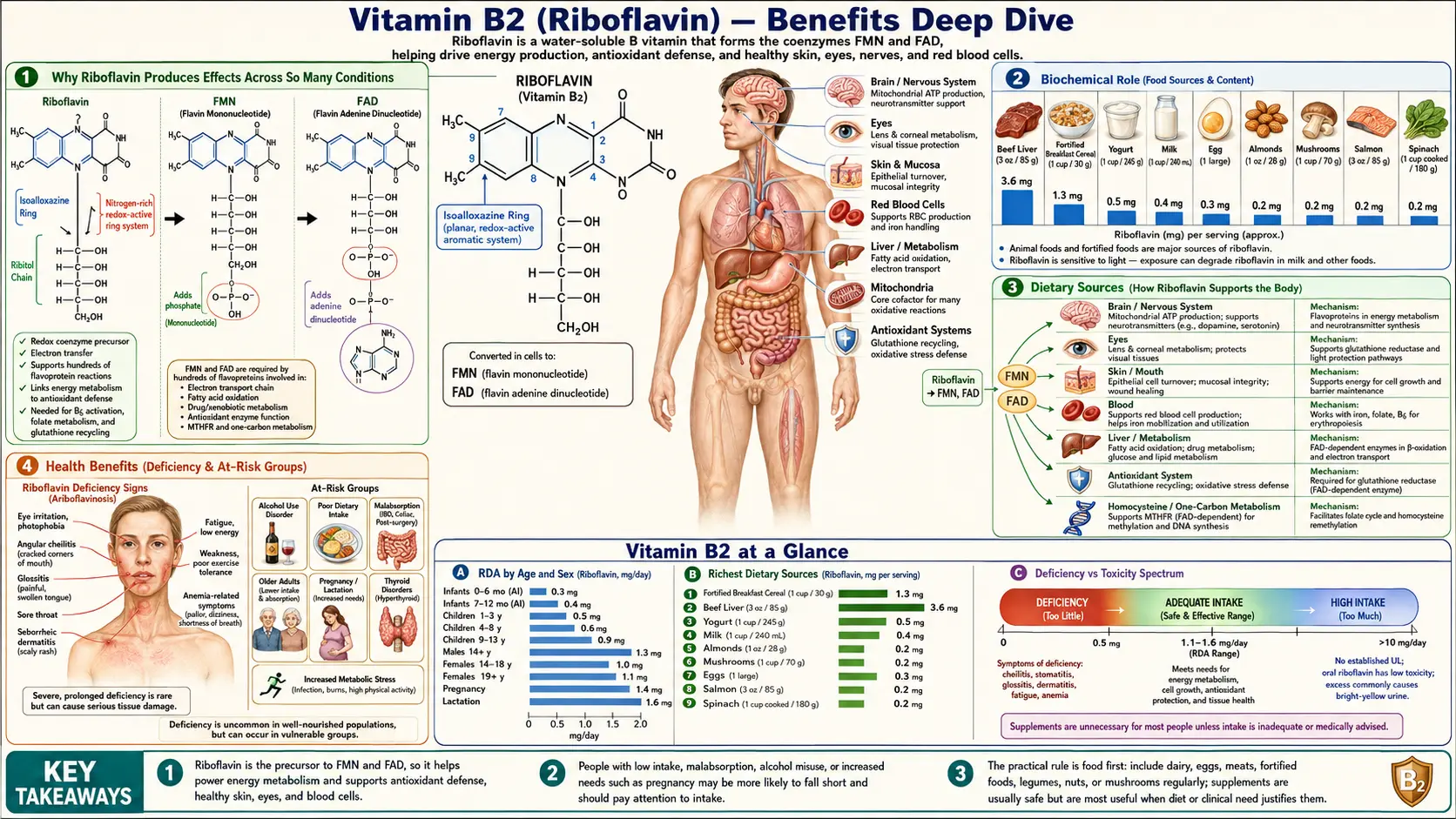
Vitamin B2 (riboflavin) is the precursor to two flavin coenzymes — FAD (flavin adenine dinucleotide) and FMN (flavin mononucleotide) — that participate in more than 100 enzymatic reactions across mitochondrial bioenergetics, redox defense, and one-carbon metabolism. Most benefits trace back to four distinct flavin-dependent enzyme roles: electron carrier in Complex I and II of the respiratory chain, cofactor for the antioxidant-regenerating enzyme glutathione reductase, cofactor for the methyl-folate-producing enzyme methylenetetrahydrofolate reductase (MTHFR), and cofactor for the acyl-CoA dehydrogenases of fatty-acid β-oxidation. Each benefit page below explores one of these mechanisms in clinical-trial depth.
Deep-Dive Articles
Migraine Prevention
The Schoenen 1998 trial in Neurology compared 400 mg/day riboflavin with placebo in 55 patients for 3 months: 59% on riboflavin versus 15% on placebo had at least 50% fewer headache days. The 2012 American Academy of Neurology and American Headache Society (AAN/AHS) guideline later rated riboflavin probably effective (Level B). The proposed mechanism is restoration of cortical mitochondrial energy reserve. Some practitioners combine it with coenzyme Q10 (CoQ10) and magnesium, a combination they call the "mitochondrial migraine stack." Pediatric and pregnancy data are also covered; the only placebo-controlled trial in children (48 children, 200 mg a day) found no benefit over placebo, with a high placebo response. Bright yellow urine is the marker of adequate dosing.
Read the deep dive →Mitochondrial Cofactor
FAD and FMN are the obligate electron carriers in Complex I (reduced nicotinamide adenine dinucleotide (NADH):ubiquinone oxidoreductase) and Complex II (succinate dehydrogenase) of the respiratory chain. FAD is also the prosthetic group on every acyl-CoA dehydrogenase of fatty-acid β-oxidation. Multiple acyl-CoA dehydrogenase deficiency (MADD / glutaric aciduria type II) is the textbook riboflavin-responsive inborn error and the proof that B2 is a true mitochondrial drug.
Read the deep dive →Glutathione Reductase Cofactor
Glutathione reductase (GR) is a FAD-flavoprotein that regenerates active reduced glutathione (GSH) from its oxidized disulfide (GSSG). Without adequate riboflavin, the entire glutathione defense system fails — B2 deficiency phenocopies glutathione deficiency. The erythrocyte glutathione reductase activity coefficient (EGRAC) is the clinical lab marker. Pairs naturally with N-acetylcysteine (NAC) + glycine in the GlyNAC protocol. The GlyNAC protocol is glycine plus N-acetylcysteine (NAC) and contains no riboflavin; no study combining it with riboflavin is cited here.
Read the deep dive →Methylenetetrahydrofolate Reductase & Methylation
The less commonly discussed riboflavin role: FAD is the obligate cofactor for methylenetetrahydrofolate reductase (MTHFR). In carriers of the C677T thermolabile variant, the mutant enzyme has weaker FAD-binding affinity and is unusually sensitive to riboflavin status. The McNulty and Wilson trials showed that B2 supplementation lowers homocysteine and blood pressure specifically in 677TT homozygotes (people with two copies of the variant); in the Wilson 2013 trial the blood-pressure effect came from a low dose of 1.6 mg a day.
Read the deep dive →Table of Contents
- Deep-Dive Articles
- Why Riboflavin Produces Effects Across So Many Conditions
- Research Papers: Migraine Prevention
- Research Papers: Mitochondrial Cofactor & MADD
- Research Papers: Glutathione Reductase & Redox
- Research Papers: Methylenetetrahydrofolate Reductase, Homocysteine & Blood Pressure
- Research Papers: Cross-Cutting (Forms, Status, Safety)
- External Authoritative Resources
- Connections
- Featured Videos
Why Riboflavin Produces Effects Across So Many Conditions
Most water-soluble vitamins are required as a single enzyme cofactor. Riboflavin is unusual because the two flavin coenzymes it produces — FAD and FMN — are prosthetic groups on at least 90 flavoenzymes in the human flavoproteome, and the relevant flavoenzymes cluster into four functionally distinct categories that each map to a different family of clinical benefits:
- Mitochondrial respiratory chain — FMN sits at the entry to Complex I and accepts electrons from NADH; FAD is covalently attached to Complex II (succinate dehydrogenase) and ETF-ubiquinone oxidoreductase. Without adequate flavins, oxidative phosphorylation stalls. This is the mechanism behind riboflavin's effect on migraine (the migrainous brain has reduced cortical adenosine triphosphate (ATP) reserve) and the cellular fatigue of clinical riboflavin deficiency.
- Fatty-acid oxidation — every acyl-CoA dehydrogenase that shortens a fatty-acid chain in the mitochondrial matrix uses FAD as its electron acceptor. Defective FAD binding causes multiple acyl-CoA dehydrogenase deficiency (MADD), a riboflavin-responsive inborn error of metabolism that produces metabolic crises responsive to high-dose oral B2.
- Glutathione redox cycle — glutathione reductase is the FAD-flavoprotein that regenerates active reduced glutathione from GSSG using reduced nicotinamide adenine dinucleotide phosphate (NADPH) electrons. Riboflavin deficiency lowers GSH:GSSG ratios system-wide, increases oxidative stress, and reduces the eye lens's capacity to resist cataract formation.
- One-carbon metabolism — methylenetetrahydrofolate reductase (MTHFR) uses FAD to reduce 5,10-methylene-THF to 5-methyl-THF, which donates the methyl group that remethylates homocysteine to methionine. In people with two copies (TT) of the C677T thermolabile variant, riboflavin status strongly affects homocysteine clearance.
Additional roles operate as well — activation of vitamin B6 to pyridoxal 5′-phosphate by pyridoxine-5′-phosphate oxidase (a FMN flavoenzyme), reduction of methemoglobin to functional hemoglobin via cytochrome b5 reductase, mobilization of iron from ferritin, and the kynurenine-tryptophan-to-niacin pathway. The combination is why riboflavin status touches energy, mood, neuroprotection, cardiovascular risk, hematology, and metabolic disease all at once.
Research Papers: Migraine Prevention
A 2026 dose-response meta-analysis of 12 trials with 749 people found that riboflavin reduced how often migraine attacks came (about 1.4 fewer, weighted mean difference −1.39) and how long they lasted, compared with control, and that the reductions grew with dose up to 400 mg a day. The results varied strongly from trial to trial, and the authors noted the small size of some included studies. Children are different: in the only double-blind placebo-controlled trial in children (MacLennan 2008, 48 children, 200 mg a day), 12 of 27 on riboflavin and 14 of 21 on placebo had at least 50% fewer migraine attacks, so riboflavin showed no benefit over placebo, and the placebo response was high.
- Schoenen J, Jacquy J, Lenaerts M. Effectiveness of high-dose riboflavin in migraine prophylaxis. A randomized controlled trial. Neurology 1998;50(2):466-70 — 400 mg/day versus placebo in 55 patients; 59% versus 15% responders — PubMed PMID: 9484373
- Amini S, Heidari Z, Clark CCT, Bagherniya M. The effect of riboflavin on the mean attack frequency, severity, and duration of migraine headaches: a systematic review and dose-response meta-analysis of clinical trials. J Res Med Sci 2026;31:1 — PubMed PMID: 41769676
- Boehnke 2004 open-label trial — PubMed: Boehnke 2004
- Condò 2009 pediatric migraine trial — PubMed: Condò 2009 pediatric
- MacLennan SC, Wade FM, Forrest KM, Ratanayake PD, Fagan E, Antony J. High-dose riboflavin for migraine prophylaxis in children: a double-blind, randomized, placebo-controlled trial. J Child Neurol 2008;23(11):1300-4 — no benefit over placebo in 48 children — PubMed PMID: 18984840
- Maizels 2004 riboflavin + magnesium + feverfew combination — PubMed: Maizels combination 2004
- Holland S, Silberstein SD, Freitag F, Dodick DW, Argoff C, Ashman E; Quality Standards Subcommittee of the American Academy of Neurology and the American Headache Society. Evidence-based guideline update: NSAIDs and other complementary treatments for episodic migraine prevention in adults. Neurology 2012;78(17):1346-53 — rates riboflavin probably effective (Level B) — PubMed PMID: 22529203
- Thompson and Saluja 2017 review of riboflavin in migraine — PubMed: Thompson 2017 review
- Di Lorenzo C, Pierelli F, Coppola G, et al. Mitochondrial DNA haplogroups influence the therapeutic response to riboflavin in migraineurs. Neurology 2009;72(18):1588-94 — open trial in 64 patients, response compared by mitochondrial DNA haplogroup (not MTHFR) — PubMed PMID: 19414726
- Namazi N, Heshmati J, Tarighat-Esfanjani A. Supplementation with riboflavin (vitamin B2) for migraine prophylaxis in adults and children: a review. Int J Vitam Nutr Res 2015;85(1-2):79-87 — a review of 11 studies, not a meta-analysis — PubMed PMID: 26780280
- Magis D, Ambrosini A, Sándor P, Jacquy J, Laloux P, Schoenen J. A randomized double-blind placebo-controlled trial of thioctic acid in migraine prophylaxis. Headache 2007;47(1):52-7 — thioctic acid versus placebo, with no riboflavin arm — PubMed PMID: 17355494
- Mitochondrial dysfunction in migraine — PubMed: mitochondrial dysfunction migraine
Research Papers: Mitochondrial Cofactor & MADD
- Olsen 2007 MADD riboflavin response — PubMed: Olsen ETFDH MADD
- Gianazza riboflavin-responsive MADD review — PubMed: RR-MADD review
- FMN at Complex I (NADH:ubiquinone oxidoreductase) — PubMed: FMN Complex I
- FAD at Complex II (succinate dehydrogenase) — PubMed: FAD SDH Complex II
- ETF and ETF-QO — the flavin electron bridge from β-oxidation to the respiratory chain — PubMed: ETF-QO flavin bridge
- Acyl-CoA dehydrogenases and FAD — PubMed: acyl-CoA dehydrogenase FAD
- Riboflavin in chronic fatigue and post-exertional malaise — PubMed: riboflavin chronic fatigue
- Riboflavin transporter deficiency (Brown-Vialetto-Van Laere syndrome) — PubMed: BVVL riboflavin transporter
Research Papers: Glutathione Reductase & Redox
- Glutathione reductase — FAD-binding crystallography — PubMed: GR FAD crystal structure
- EGRAC (erythrocyte glutathione reductase activity coefficient) as B2 status marker — PubMed: EGRAC riboflavin status
- Riboflavin deficiency lowers GSH:GSSG ratio — PubMed: B2 deficiency glutathione
- Riboflavin and cataract prevention — PubMed: B2 cataract lens
- Riboflavin and oxidative damage to red blood cells — PubMed: B2 erythrocyte oxidative damage
- Corneal cross-linking with riboflavin in keratoconus — PubMed: corneal cross-linking
Research Papers: Methylenetetrahydrofolate Reductase, Homocysteine & Blood Pressure
The blood-pressure trial in this list used a low dose. Wilson 2013 found 157 people with the 677TT genotype among 1,427 patients with high blood pressure; 91 took part and were randomized to riboflavin 1.6 mg a day or placebo for 16 weeks. More than 60% had not reached goal blood pressure despite several classes of blood-pressure drugs. Systolic blood pressure fell from 141.8 to 137.1 mmHg with riboflavin and went from 143.5 to 144.3 mmHg with placebo, a treatment effect of 5.6 mmHg; the effect on diastolic pressure was not significant. That dose is far below the 400 mg a day used in the migraine trials.
A 2020 observational study from the Joint Irish Nutrigenomics Organisation (JINGO) project, in 6,076 adults aged 18–102, found the 677TT genotype in 12% of adults. From 18 to 70 years it was linked to a higher risk of high blood pressure (odds ratio 1.42). About 30% of participants had deficient riboflavin status, and the TT genotype combined with deficient riboflavin status carried three times the risk (odds ratio 3.00) of the CC genotype with normal riboflavin status. The authors noted that riboflavin as a way to prevent high blood pressure in TT adults still needs a randomized trial in people who do not yet have it.
- McNulty 2006 B2-MTHFR677TT homocysteine RCT — PubMed: McNulty MTHFR 677TT
- Wilson CP, McNulty H, Ward M, et al. Blood pressure in treated hypertensive individuals with the MTHFR 677TT genotype is responsive to intervention with riboflavin: findings of a targeted randomized trial. Hypertension 2013;61(6):1302-8 — PubMed PMID: 23608654
- Ward M, Hughes CF, Strain JJ, et al. Impact of the common MTHFR 677C→T polymorphism on blood pressure in adulthood and role of riboflavin in modifying the genetic risk of hypertension: evidence from the JINGO project. BMC Med 2020;18(1):318 — PubMed PMID: 33172445
- Horigan 2010 riboflavin BP — PubMed: Horigan riboflavin BP
- Frosst 1995 MTHFR C677T thermolabile variant — PubMed: Frosst 1995 C677T
- Bønaa KH, Njølstad I, Ueland PM, et al. Homocysteine lowering and cardiovascular events after acute myocardial infarction. N Engl J Med 2006;354(15):1578-88 — the NORVIT trial tested folic acid, vitamin B12 and vitamin B6, not riboflavin; lowering homocysteine did not lower the risk of further cardiovascular events — PubMed PMID: 16531614
- Yamada 2001 FAD binding affinity of mutant MTHFR 677TT — PubMed: Yamada FAD binding 677TT
- Hustad 2000 plasma riboflavin and homocysteine — PubMed: Hustad riboflavin homocysteine
- Powers riboflavin and one-carbon metabolism review — PubMed: Powers riboflavin folate review
- Strain 2013 B2-genotype-targeted hypertension paper — PubMed: Strain genotype-targeted BP
Research Papers: Cross-Cutting (Forms, Status, Safety)
- Powers 2003 comprehensive riboflavin review — PubMed: Powers 2003 AJCN review
- Riboflavin-5′-phosphate (FMN) bioavailability — PubMed: R5P bioavailability
- Riboflavin absorption ceiling per single dose — PubMed: B2 absorption ceiling
- Photodegradation of riboflavin in milk and supplements — PubMed: riboflavin photodegradation
- RFVT2 / RFVT3 / SLC52 riboflavin transporters — PubMed: RFVT transporters
- Riboflavin safety profile — PubMed: B2 upper intake safety
- Vitamin B2 status in pregnancy and lactation — PubMed: B2 pregnancy lactation
- EGRAC reference values and clinical interpretation — PubMed: EGRAC reference values
External Authoritative Resources
- Linus Pauling Institute — Riboflavin Micronutrient Information Center — the single most authoritative scientific summary of riboflavin biology and clinical evidence, regularly updated
- U.S. National Institutes of Health (NIH) Office of Dietary Supplements — Riboflavin Fact Sheet for Health Professionals
- MedlinePlus — Riboflavin
- PubMed — All research on riboflavin
Connections
- All Vitamins
- Vitamin B2 (Main Page)
- B2 for Migraine Prevention
- B2 as Mitochondrial Cofactor
- B2 as Glutathione Reductase Cofactor
- B2 for Methylenetetrahydrofolate Reductase & Methylation
- Riboflavin and Energy Production
- Riboflavin and Migraine Prevention
- Vitamin B1 (Thiamine)
- Vitamin B3 (Niacin)
- Vitamin B6 (Pyridoxine)
- Vitamin B9 (Folate)
- Vitamin B12 (Cobalamin)
- Glutathione
- ALA for Mitochondria
- Coenzyme Q10 for Migraine
- Migraine (Disease)
- Homocysteine
- Magnesium
- Oxidative Stress
- Deficiency
- Toxicity
- History
- Sources