Riboflavin and Migraine Prevention
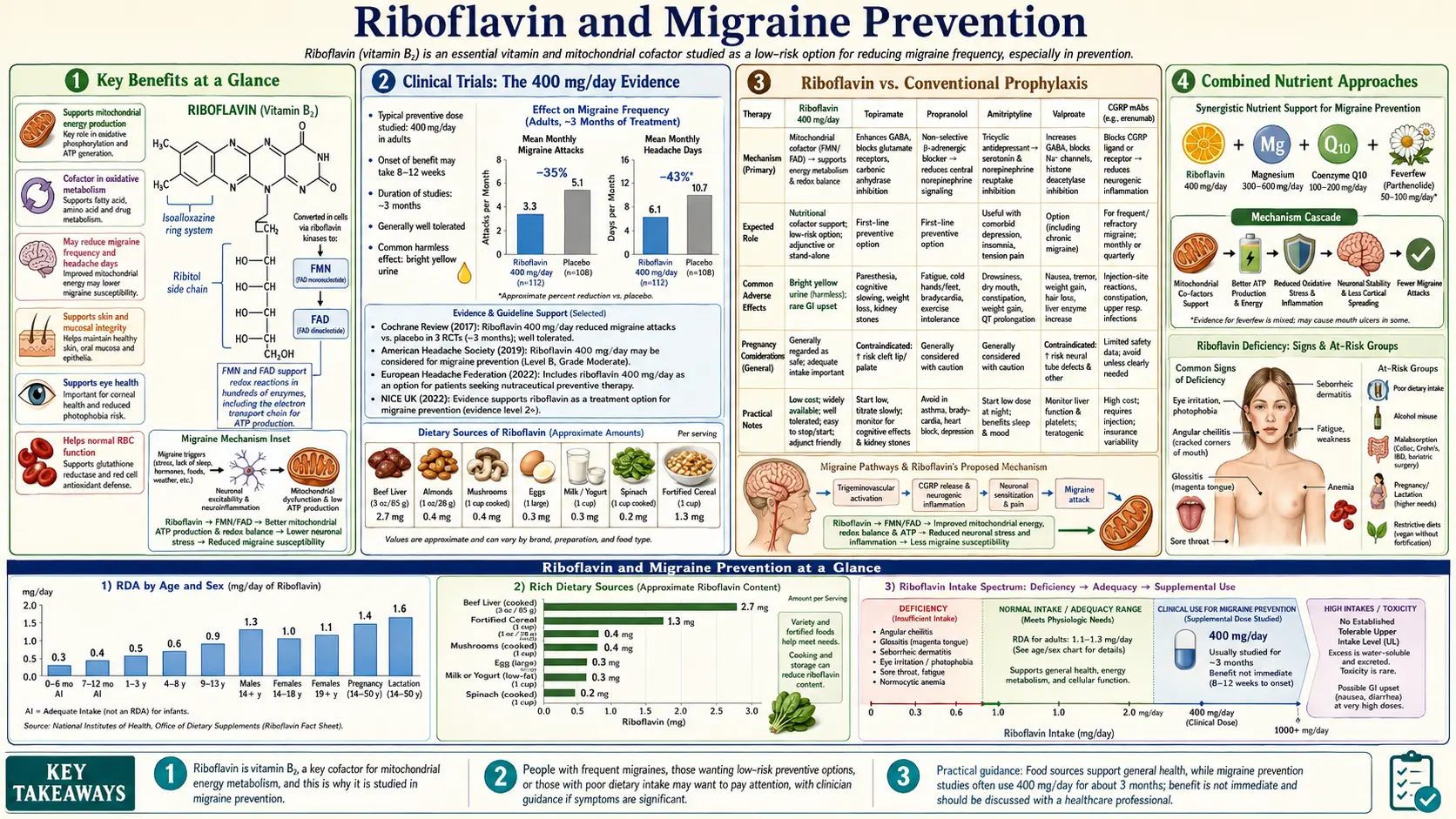
Migraine is a common, recurrent headache disorder, and preventive (prophylactic) treatment aims to make attacks less frequent, shorter or milder. Riboflavin (vitamin B2) has been studied as a migraine preventive since the 1990s, mostly at 400 mg a day. The rationale is that riboflavin is the precursor of the flavin coenzymes FAD and FMN used in mitochondrial energy production, and that one line of research proposes a reduced brain energy reserve in migraine. The first placebo-controlled trial (Schoenen et al. 1998) found a benefit in adults; later studies in adults and children have been small and their results mixed. The Linus Pauling Institute describes the results of riboflavin supplementation for migraine as conflicting.
Table of Contents
- Key Findings at a Glance
- Mitochondrial Energy Metabolism in Migraine
- FAD and FMN Cofactor Roles
- Clinical Trials: What the Studies Found
- Proposed Mechanism of Action
- Riboflavin, Conventional Prophylaxis and the Guidelines
- Reported Side Effects and Safety
- Doses Used in the Studies
- Combined Nutrient Studies
- Key Research Papers
- Connections
- Featured Videos
Key Findings at a Glance
- First placebo-controlled trial — Schoenen et al. 1998 (55 adults, 400 mg a day for 3 months): riboflavin was superior to placebo for attack frequency (p = 0.005) and headache days (p = 0.012). The share of patients whose headache days fell by at least 50% was 59% with riboflavin and 15% with placebo (p = 0.002). The abstract does not report a percentage fall in attack frequency.
- Later adult studies — an open study without a placebo group (Boehnke 2004) and an open trial (Di Lorenzo 2009) reported improvement; a single-blind trial in 90 patients (Rahimdel 2015) found no significant difference between riboflavin 400 mg a day and sodium valproate 500 mg a day, with fewer side effects on riboflavin.
- Children: mixed results — placebo-controlled trials at 200 mg (MacLennan 2008) and 50 mg a day (Bruijn 2010) found no benefit on migraine attacks; a three-arm trial (Talebian 2018) found fewer and shorter attacks with 200 mg a day but not with 100 mg a day.
- Reviews — a 2017 systematic review described a consistent positive effect in five adult trials and a mixed effect in children; a 2022 meta-analysis of nine studies found significant reductions in migraine days, duration, frequency and pain score, with high heterogeneity for some outcomes.
- Guidelines — the 2012 AAN/AHS guideline graded riboflavin Level B (probably effective); the AAN retired that guideline in 2015 over safety concerns with butterbur. The 2012 Canadian Headache Society guideline gave riboflavin a strong recommendation.
- Side effects — few and minor in the trials; high doses turn urine bright yellow, which the Linus Pauling Institute describes as harmless.
- Mechanism not established — the brain-energy explanation is a hypothesis; in a rat study, riboflavin had no significant effect on cortical spreading depression.
Mitochondrial Energy Metabolism in Migraine
The riboflavin trials grew out of the hypothesis that the migraine brain works with a reduced energy reserve. Schoenen's trial report opens: "A deficit of mitochondrial energy metabolism may play a role in migraine pathogenesis." The evidence behind the hypothesis comes from small studies:
- Brain phosphorus spectroscopy during attacks – Welch et al. (1989) used phosphorus-31 NMR spectroscopy and found that during attacks ATP was preserved while phosphocreatine fell and inorganic phosphate rose, lowering the phosphocreatine/phosphate ratio (an index of phosphorylation potential). This was found in migraine with aura (classic) but not in migraine without aura (common). Inorganic phosphate was also raised between attacks, and brain pH did not change.
- Brain and muscle between attacks – Barbiroli et al. (1992) studied 12 patients with migraine with aura between attacks: all had low brain phosphocreatine, with high ADP and low phosphorylation potential, and 9 of the 12 had abnormal muscle mitochondrial function without clinical signs of muscle impairment.
- Platelet mitochondrial enzymes – Sangiorgi et al. (1994) compared 40 patients with migraine with aura, 40 with migraine without aura and 24 healthy controls between attacks. NADH-dehydrogenase, citrate synthase and cytochrome-c-oxidase activities were lower in both patient groups; NADH-cytochrome-c-reductase was lower only in migraine with aura; succinate dehydrogenase was not altered.
- Cortical spreading depression – cortical spreading depression (CSD) is described by Bogdanov et al. (2011) as "the most likely cause of the migraine aura". In their rat study, 4 weeks of riboflavin injections had no significant effect on CSD, while lamotrigine suppressed it.
- Mitochondrial DNA – in a 4-month open trial of riboflavin 400 mg in 64 people with migraine (Di Lorenzo et al. 2009), 40 responded and 24 did not. Responders were more often outside mitochondrial DNA haplogroup H (67.5%), and non-responders were mostly haplogroup H (66.7%; p = 0.01). The presence of aura did not affect the response, and the authors state that the underlying mechanisms are unknown.
FAD and FMN Cofactor Roles
According to the Linus Pauling Institute, riboflavin is the precursor of two coenzymes, flavin adenine dinucleotide (FAD) and flavin mononucleotide (FMN), which act as electron carriers in oxidation-reduction reactions involved in energy production, antioxidant function and many metabolic pathways. Roles described there that bear on the migraine hypothesis:
- Electron transport chain – FAD and FMN are required by the flavoproteins of the mitochondrial electron transport chain. Complex I carries electrons from NADH to coenzyme Q10; Di Lorenzo et al. describe complex I as "a major target for riboflavin".
- Electron transfer flavoprotein (ETF) – the FAD-dependent first step of fatty-acid beta-oxidation passes electrons to ETF, which passes them to ETF-ubiquinone oxidoreductase in the respiratory chain.
- Glutathione reductase – an FAD-dependent enzyme that regenerates reduced glutathione from oxidized glutathione, part of the cell's defence against reactive oxygen species.
- Vitamin B6 activation – conversion of vitamin B6 to its coenzyme form, pyridoxal 5′-phosphate, requires the FMN-dependent enzyme pyridoxine 5′-phosphate oxidase.
Clinical Trials: What the Studies Found
Most riboflavin trials in adults used 400 mg a day. In 2004, Maizels et al. wrote that there had been only a single placebo-controlled trial of riboflavin. The studies, as their abstracts report them:
- Schoenen et al. (1998), Neurology – a randomized trial comparing riboflavin 400 mg with placebo in 55 patients with migraine for 3 months. On intention-to-treat analysis, riboflavin was superior to placebo in reducing attack frequency (p = 0.005) and headache days (p = 0.012). For headache days, 59% of the riboflavin group and 15% of the placebo group improved by at least 50% ("responders"; p = 0.002), and the number needed to treat was 2.3. Three minor adverse events occurred: diarrhea and polyuria with riboflavin, abdominal cramps with placebo; none was serious. The authors called riboflavin "a candidate for a comparative trial with an established prophylactic drug." The Linus Pauling Institute notes that the benefit was most pronounced in the third month.
- Boehnke et al. (2004) – an open-label study in a specialist outpatient clinic, with no placebo group. With riboflavin 400 mg a day, headache frequency fell from 4 days a month at baseline to 2 days a month after 3 and 6 months (P < 0.05), and use of acute migraine drugs fell from 7 to 4.5 units a month. Headache hours and headache intensity did not change significantly. The abstract does not report brain imaging.
- Di Lorenzo et al. (2009) – a 4-month open trial of 400 mg in 64 people with migraine: 40 responded and 24 did not, with response linked to mitochondrial DNA haplogroup (see above).
- Rahimdel et al. (2015) – a single-blind trial in 90 patients comparing riboflavin 400 mg a day with sodium valproate 500 mg a day for 3 months. Headache frequency, duration and severity fell in both groups, with no significant difference between them (p > 0.05); side effects were significantly fewer in the riboflavin group (p = 0.005).
- Maizels et al. (2004) – a combination of riboflavin 400 mg, magnesium 300 mg and feverfew 100 mg a day against a "placebo" containing riboflavin 25 mg, for 3 months. Of 49 patients who completed the trial, 10 (42%) on the combination and 11 (44%) on the control had a 50% or greater reduction in migraines (P = .87); both groups improved from baseline, and the authors suggested that riboflavin 25 mg may itself be an active comparator.
- Children and adolescents – results differ between trials:
- MacLennan et al. (2008): riboflavin 200 mg a day or placebo in 48 children. A 50% or greater reduction in attacks was seen in 12 of 27 on riboflavin and 14 of 21 on placebo (P = .125, not significant), with no differences in any outcome. The authors concluded the results "suggest that riboflavin is not an effective therapy for preventing migraine in children" and noted a high placebo response.
- Bruijn et al. (2010): a crossover trial of riboflavin 50 mg a day and placebo, 16 weeks each, in 42 children aged 6–13. There was no significant difference in migraine attack frequency (P = 0.44); headaches with a tension-type pattern fell more with riboflavin (P = 0.04).
- Talebian et al. (2018): 90 children randomized to placebo, riboflavin 100 mg (low dose) or riboflavin 200 mg (high dose) a day for 12 weeks. The high-dose group had significantly fewer and shorter attacks than placebo; the low-dose group did not; neither dose reduced attack intensity.
- Condò et al. (2009): a retrospective report, without a control group, on 41 children and adolescents given 200 or 400 mg once daily for 3, 4 or 6 months. Attack frequency and intensity decreased (P < 0.01), and during follow-up 68.4% had a 50% or greater reduction in attack frequency.
- Kohandel Gargari et al. (2024): a network meta-analysis of 45 pediatric prevention trials found riboflavin associated with fewer attacks than placebo (ratio of means 0.50; 95% CI 0.32–0.77), but noted the finding was drawn from individual studies and that more studies are needed for a robust conclusion.
- Systematic reviews – Thompson and Saluja (2017) reviewed 11 clinical trials: five in adults showed a consistent positive effect, four in children and adolescents a mixed effect, and two of combination therapy did not show benefit. Chen et al. (2022) pooled nine studies (eight randomized trials and one controlled clinical trial; 673 participants): riboflavin significantly reduced migraine days (p = .005, I² = 89%), duration (p = .003), frequency (p = .001) and pain score (p = .015, I² = 84%), and the authors' conclusion refers to 400 mg a day for three months.
- Time course – the studies ran from 12 weeks to 6 months. The abstracts cited here do not report a week-by-week onset of effect, and none reports what happens after riboflavin is stopped.
Proposed Mechanism of Action
How riboflavin might prevent migraine has not been shown. The explanations put forward in the research are:
- Mitochondrial energy supply – the main hypothesis is that high doses raise the supply of FAD and FMN and so improve mitochondrial energy metabolism in the brain. The 400 mg doses studied are far above the Recommended Dietary Allowance of 1.3 mg a day for men and 1.1 mg a day for women. Sándor et al. (2000) found that beta-blockers changed an evoked-potential measure of cortical information processing while riboflavin did not (P = .39), and concluded that the two treatments act on distinct mechanisms.
- Cortical spreading depression – in the rat study by Bogdanov et al. (2011), riboflavin had no significant effect on CSD; the authors concluded that riboflavin and valproate do not affect the triggering of CSD although they are effective in migraine without aura. In Di Lorenzo et al. (2009), the presence of aura did not influence riboflavin's effectiveness.
- Antioxidant role – FAD is required by glutathione reductase, which regenerates reduced glutathione. The studies cited here did not test whether this plays any part in migraine.
- Mitochondrial genetics – Di Lorenzo et al. suggest the haplogroup association could relate to higher complex I activity in haplogroup H, and state that the mechanisms are unknown.
Riboflavin, Conventional Prophylaxis and the Guidelines
Riboflavin has been compared directly with a prescription preventive in only a few of the studies cited here:
- Direct comparisons – the single-blind Rahimdel 2015 trial found no significant difference in benefit between riboflavin 400 mg a day and sodium valproate 500 mg a day, and fewer side effects with riboflavin. Sándor 2000 compared changes in an evoked-potential measure, not clinical efficacy, after beta-blockers or riboflavin. No placebo-controlled trial cited here compared riboflavin with propranolol, topiramate or amitriptyline.
- The 2012 AAN/AHS guideline (retired in 2015) – the American Academy of Neurology and American Headache Society guideline on NSAIDs and complementary treatments for episodic migraine prevention in adults (Holland et al. 2012) reviewed studies published from June 1999 to May 2009. It graded butterbur Level A (effective); fenoprofen, ibuprofen, ketoprofen, naproxen, naproxen sodium, a feverfew extract, magnesium, riboflavin and subcutaneous histamine Level B (probably effective); and cyproheptadine, CoQ10, estrogen, mefenamic acid and flurbiprofen Level C (possibly effective). The retirement notice now printed with the guideline states that the AAN Board of Directors retired it on September 16, 2015, "due to serious safety concerns with a preventative treatment, butterbur, recommended by this guideline," and that the recommendations of retired guidelines are considered no longer valid. The Level B grade for riboflavin is therefore a historical grading, not a current AAN position.
- The 2012 Canadian Headache Society guideline – for episodic migraine, Pringsheim et al. gave a strong recommendation to 11 prophylactic treatments (topiramate, propranolol, nadolol, metoprolol, amitriptyline, gabapentin, candesartan, butterbur, riboflavin, coenzyme Q10 and magnesium citrate) and a weak recommendation to six others. The abstract states that the quality of evidence varied from high to low and that choosing a medication for an individual patient "requires careful consideration of patient clinical features."
- Side effects of drugs in children – in the 2024 pediatric network meta-analysis, adverse events were more frequent than with placebo for amitriptyline, topiramate and valproate.
- Drug interactions – the Linus Pauling Institute reports that phenothiazine antipsychotics, tricyclic antidepressants, the antimalarial quinacrine and the chemotherapy drug adriamycin inhibit the conversion of riboflavin to FAD and FMN, and that long-term use of phenobarbital may increase the breakdown of riboflavin in the liver. Tricyclic antidepressants are among the drug classes used in migraine prevention (the Canadian guideline includes a tricyclic strategy).
- Pregnancy – the Recommended Dietary Allowance rises to 1.4 mg a day in pregnancy. None of the studies cited here tested high doses such as 400 mg a day in pregnant women.
Reported Side Effects and Safety
The trials report few adverse effects, but they were small and short, so rare or long-term effects would not be detected:
- No established upper limit – the Food and Nutrition Board did not set a Tolerable Upper Intake Level (UL) for riboflavin when the RDA was revised in 1998 (Linus Pauling Institute). The Harvard T.H. Chan School of Public Health states that a toxic level has not been observed from food or from longer-term intakes of high-dose supplements, and that the gut can absorb only a limited amount at one time.
- Absorption ceiling – in a pharmacokinetic study of nine healthy adults given single oral doses of 20, 40 and 60 mg (Zempleni et al. 1996), the maximal amount of riboflavin that could be absorbed from a single dose was 27 mg, and urinary excretion accounted for about one-half of riboflavin's removal from the blood.
- Bright yellow urine – high-dose riboflavin intensifies urine color to a bright yellow (flavinuria), which the Linus Pauling Institute describes as a harmless side effect.
- Adverse events in the trials – diarrhea and polyuria with riboflavin in Schoenen 1998 (none serious); vomiting in one patient and increased appetite in another in Condò 2009, judged most likely unrelated; significantly fewer side effects than sodium valproate in Rahimdel 2015. The 2017 systematic review described adverse reactions as generally mild.
- Light – riboflavin is easily destroyed on exposure to light, and it acts as a photosensitizer, a property used with ultraviolet-A light in corneal cross-linking (Linus Pauling Institute).
Doses Used in the Studies
These are the regimens the studies reported, not dosing instructions:
- Adults, riboflavin alone – 400 mg a day for 3 months (Schoenen 1998; Rahimdel 2015); 400 mg a day, assessed at 3 and 6 months (Boehnke 2004); 400 mg once daily for 4 months (Di Lorenzo 2009).
- Children and adolescents – 200 mg a day (MacLennan 2008); 50 mg a day (Bruijn 2010); 100 or 200 mg a day for 12 weeks (Talebian 2018); 200 or 400 mg once daily for 3, 4 or 6 months (Condò 2009).
- Combinations – riboflavin 400 mg + magnesium 300 mg + feverfew 100 mg a day (Maizels 2004); a fixed combination of magnesium, riboflavin and CoQ10 (Gaul 2015).
- Absorption – no more than 27 mg was absorbed from a single oral dose in the Zempleni 1996 study. None of the studies cited here compared once-daily with divided doses, or taking riboflavin with or without food.
Decisions about supplements, and about combining them with migraine medicines, belong with a clinician.
Combined Nutrient Studies
Riboflavin is often discussed together with coenzyme Q10 and magnesium. Each has its own small evidence base, and the combination products have been tested in few trials:
- Coenzyme Q10 (CoQ10) – Sándor et al. (2005) compared CoQ10 100 mg three times a day with placebo in 42 patients. CoQ10 was superior for attack frequency, headache days and days with nausea in the third month; the 50% responder rate for attack frequency was 47.6% with CoQ10 and 14.4% with placebo (number needed to treat 3). The 2012 AAN/AHS guideline (since retired) graded CoQ10 Level C; the 2012 Canadian guideline gave it a strong recommendation.
- Magnesium – graded Level B in the retired 2012 AAN/AHS guideline; magnesium citrate received a strong recommendation in the 2012 Canadian guideline. A retrospective study without a control group in children with migraine without aura (Karatoprak et al. 2025) reported lower headache frequency and disability scores after four months of magnesium oxide; the authors call for randomized trials.
- Feverfew (Tanacetum parthenium) – a feverfew extract was graded Level B in the retired 2012 AAN/AHS guideline. In Maizels 2004, a combination of riboflavin, magnesium and feverfew did no better than a 25 mg riboflavin control.
- Riboflavin, magnesium and CoQ10 together – in Gaul et al. (2015), 130 adults took a fixed combination supplement or placebo for 3 months. Migraine days a month fell from 6.2 to 4.4 with the supplement and from 6.2 to 5.2 with placebo, a difference that was not significant (p = 0.23); pain intensity (p = 0.03) and the HIT-6 burden-of-disease score (p = 0.01) improved more with the supplement. The 2017 systematic review found that two trials of combination therapy had not shown benefit.
No trial cited here tests whether combining riboflavin, CoQ10 and magnesium works better than any one of them alone. Taken together, the placebo-controlled evidence for riboflavin in adults rests on a small number of small trials, with supportive open studies, a single-blind comparison with valproate and a 2022 meta-analysis; the trials in children are mixed. The AAN/AHS Level B grade comes from a guideline that has since been retired, while the 2012 Canadian Headache Society guideline gives riboflavin a strong recommendation.
Key Research Papers
- Schoenen J, Jacquy J, Lenaerts M. Effectiveness of high-dose riboflavin in migraine prophylaxis. A randomized controlled trial. Neurology. 1998;50(2):466-470. — PubMed PMID: 9484373
- Boehnke C, Reuter U, Flach U, et al. High-dose riboflavin treatment is efficacious in migraine prophylaxis: an open study in a tertiary care centre. Eur J Neurol. 2004;11(7):475-7. — PubMed PMID: 15257686
- Condò M, Posar A, Arbizzani A, et al. Riboflavin prophylaxis in pediatric and adolescent migraine. J Headache Pain. 2009;10(5):361-5. — PubMed PMID: 19649688
- MacLennan SC, Wade FM, Forrest KM, et al. High-dose riboflavin for migraine prophylaxis in children: a double-blind, randomized, placebo-controlled trial. J Child Neurol. 2008;23(11):1300-4. — PubMed PMID: 18984840
- Karatoprak EY, Ozkan CM, Tural MS, et al. Efficacy and safety of magnesium prophylaxis in children with migraine without aura. North Clin Istanb. 2025;12(6):724-729. — PubMed PMID: 41574142
- NIH Office of Dietary Supplements. Riboflavin: Fact Sheet for Health Professionals. — NIH Office of Dietary Supplements — Riboflavin Fact Sheet for Health Professionals
- Linus Pauling Institute, Micronutrient Information Center. Riboflavin. — Linus Pauling Institute — Riboflavin
- Harvard T.H. Chan School of Public Health, The Nutrition Source. Riboflavin (Vitamin B2). — Harvard T.H. Chan School of Public Health — Riboflavin (Vitamin B2)
- Maizels M, Blumenfeld A, Burchette R. A combination of riboflavin, magnesium, and feverfew for migraine prophylaxis: a randomized trial. Headache. 2004;44(9):885-90. — PubMed PMID: 15447697
- Holland S, Silberstein SD, Freitag F, et al. Evidence-based guideline update: NSAIDs and other complementary treatments for episodic migraine prevention in adults: report of the Quality Standards Subcommittee of the American Academy of Neurology and the American Headache Society. Neurology. 2012;78(17):1346-53. (AAN/AHS guideline; retired by the AAN Board of Directors on September 16, 2015, per the retirement notice printed with the PMC copy, PMC3335449) — PubMed PMID: 22529203
- Pringsheim T, Davenport W, Mackie G, et al. Canadian Headache Society guideline for migraine prophylaxis. Can J Neurol Sci. 2012;39(2 Suppl 2):S1-59. — PubMed PMID: 22683887
- Rahimdel A, Zeinali A, Yazdian-Anari P, et al. Effectiveness of Vitamin B2 versus Sodium Valproate in Migraine Prophylaxis: a randomized clinical trial. Electron Physician. 2015;7(6):1344-8. — PubMed PMID: 26516440
- Bruijn J, Duivenvoorden H, Passchier J, et al. Medium-dose riboflavin as a prophylactic agent in children with migraine: a preliminary placebo-controlled, randomised, double-blind, cross-over trial. Cephalalgia. 2010;30(12):1426-34. — PubMed PMID: 20974610
- Talebian A, Soltani B, Banafshe HR, et al. Prophylactic effect of riboflavin on pediatric migraine: a randomized, double-blind, placebo-controlled trial. Electron Physician. 2018;10(2):6279-6285. — PubMed PMID: 29629048
- Thompson DF, Saluja HS. Prophylaxis of migraine headaches with riboflavin: A systematic review. J Clin Pharm Ther. 2017;42(4):394-403. — PubMed PMID: 28485121
- Chen YS, Lee HF, Tsai CH, et al. Effect of Vitamin B2 supplementation on migraine prophylaxis: a systematic review and meta-analysis. Nutr Neurosci. 2022;25(9):1801-1812. — PubMed PMID: 33779525
- Kohandel Gargari O, Aghajanian S, Togha M, et al. Preventive Medications in Pediatric Migraine: A Network Meta-Analysis. JAMA Netw Open. 2024;7(10):e2438666. — PubMed PMID: 39388181
- Di Lorenzo C, Pierelli F, Coppola G, et al. Mitochondrial DNA haplogroups influence the therapeutic response to riboflavin in migraineurs. Neurology. 2009;72(18):1588-94. — PubMed PMID: 19414726
- Sándor PS, Afra J, Ambrosini A, et al. Prophylactic treatment of migraine with beta-blockers and riboflavin: differential effects on the intensity dependence of auditory evoked cortical potentials. Headache. 2000;40(1):30-5. — PubMed PMID: 10759900
- Sándor PS, Di Clemente L, Coppola G, et al. Efficacy of coenzyme Q10 in migraine prophylaxis: a randomized controlled trial. Neurology. 2005;64(4):713-5. — PubMed PMID: 15728298
- Gaul C, Diener HC, Danesch U. Improvement of migraine symptoms with a proprietary supplement containing riboflavin, magnesium and Q10: a randomized, placebo-controlled, double-blind, multicenter trial. J Headache Pain. 2015;16:516. — PubMed PMID: 25916335
- Welch KM, Levine SR, D'Andrea G, et al. Preliminary observations on brain energy metabolism in migraine studied by in vivo phosphorus 31 NMR spectroscopy. Neurology. 1989;39(4):538-41. — PubMed PMID: 2927679
- Barbiroli B, Montagna P, Cortelli P, et al. Abnormal brain and muscle energy metabolism shown by 31P magnetic resonance spectroscopy in patients affected by migraine with aura. Neurology. 1992;42(6):1209-14. — PubMed PMID: 1603349
- Sangiorgi S, Mochi M, Riva R, et al. Abnormal platelet mitochondrial function in patients affected by migraine with and without aura. Cephalalgia. 1994;14(1):21-3. — PubMed PMID: 8200018
- Bogdanov VB, Multon S, Chauvel V, et al. Migraine preventive drugs differentially affect cortical spreading depression in rat. Neurobiol Dis. 2011;41(2):430-5. — PubMed PMID: 20977938
- Zempleni J, Galloway JR, McCormick DB. Pharmacokinetics of orally and intravenously administered riboflavin in healthy humans. Am J Clin Nutr. 1996;63(1):54-66. — PubMed PMID: 8604671
PubMed Topic Searches
- PubMed — Coenzyme Q10 for migraine prophylaxis (topic search) — Search PubMed
- PubMed — Mitochondrial dysfunction in migraine (topic search) — Search PubMed
- PubMed — Cortical spreading depression in migraine (topic search) — Search PubMed
- PubMed — Riboflavin for migraine meta-analyses (topic search) — Search PubMed