Taurine: Functions, Research Findings and Safety
Interactive Visualization GABA, the Brain's Brake — press it with a benzo or alcohol Watch glutamate try to fire a neuron while GABA slams the chloride brake on — then add a benzodiazepine or alcohol and see the brake amplified, and why stacking them is dangerous. Launch →
Table of Contents
- Overview
- Cardiovascular Health and Heart Rhythm
- Bile Salt Formation and Fat Digestion
- Antioxidant and Anti-Inflammatory Properties
- Nervous System and Brain Protection
- Eye Health
- Electrolyte Balance and Hydration
- Exercise Performance and Muscle Function
- Blood Sugar Regulation
- Anti-Aging and Longevity Research
- Immune System Modulation
- Deficiency Signs
- Food Sources
- Doses Used in Studies
- Recommended Daily Intake
- Key Research Papers
- Connections
- Featured Videos
Overview
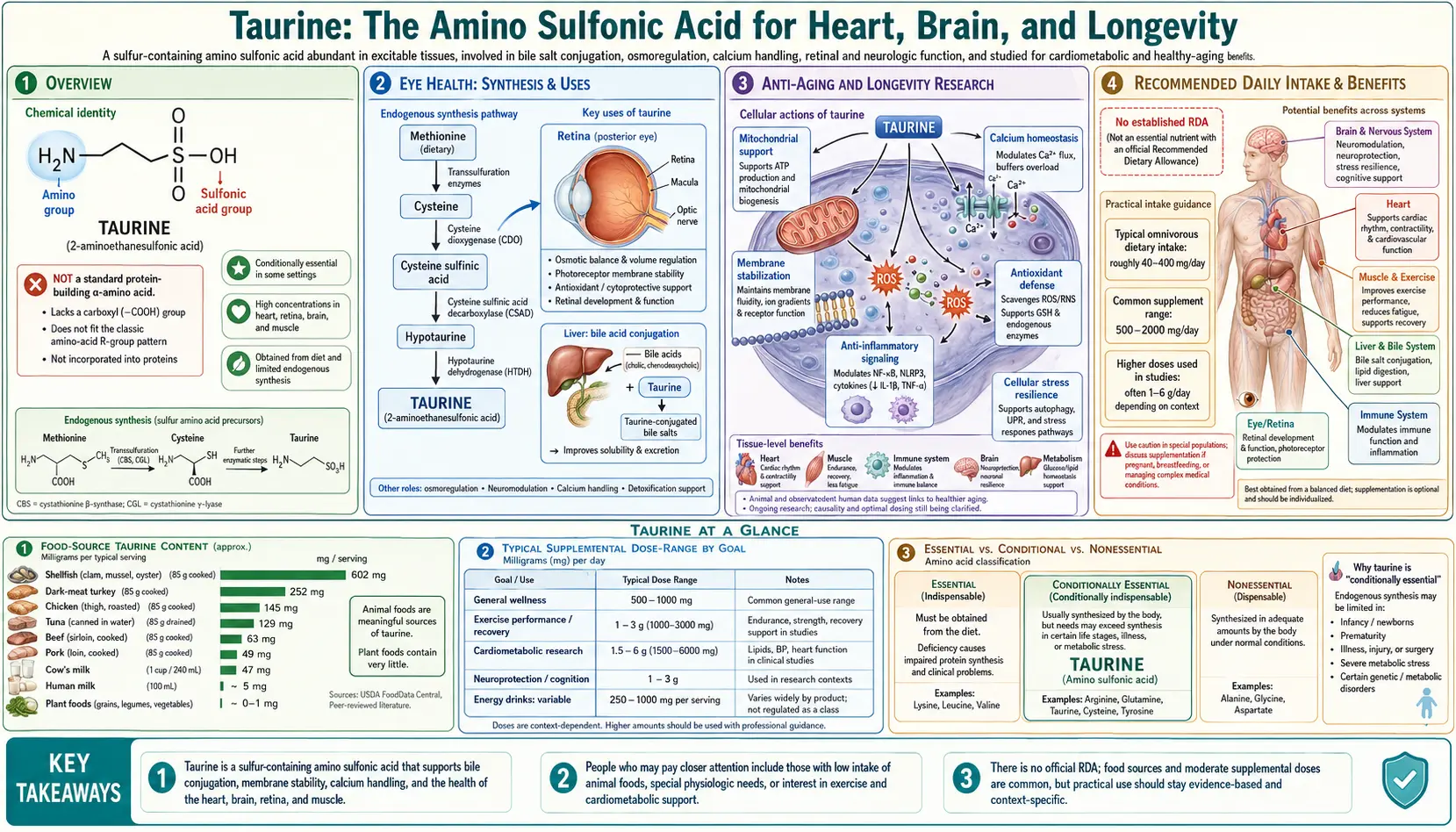
Taurine, chemically known as 2-aminoethanesulfonic acid, is a sulfur-containing amino sulfonic acid that is usually described as conditionally essential in humans. Unlike most amino acids, taurine is not incorporated into proteins. It exists as a free molecule in millimolar concentrations in animal tissues, particularly those that are excitable, rich in membranes, and generate oxidants (Gaull 1989), and a 2002 overview describes it as the most abundant intracellular amino acid in humans (Lourenço and Camilo 2002). In healthy people the diet is the usual source, and taurine is also made in the body from methionine and cysteine in the presence of vitamin B6. The same overview lists groups at risk of low taurine: patients on long-term parenteral nutrition (including premature and newborn infants) and people with chronic liver, heart, or kidney failure.
Reviews describe a range of physiological roles for taurine: conjugation of bile acids, regulation of cell volume as an osmolyte, modulation of calcium handling, membrane stabilization, and antioxidant and anti-inflammatory activity (Lourenço and Camilo 2002; Schaffer and colleagues 2010; Marcinkiewicz and Kontny 2014). Much of this evidence comes from animal and cell studies. The sections below report what has been found in people separately from what has been found in laboratory models.
Taurine was first isolated from ox bile in 1827 by the German scientists Friedrich Tiedemann and Leopold Gmelin, and its name derives from the Latin word taurus, meaning bull or ox. It was long considered an end product of the metabolism of the sulfur-containing amino acids, with bile acid conjugation its only clearly recognized role (Gaull 1989). In 2023, a study in Science (Singh and colleagues) reported that circulating taurine declines with age in mice, monkeys, and humans, and that taurine given to middle-aged mice increased their median lifespan by 10 to 12%. In 2025, a second study in Science (Fernandez and colleagues, U.S. National Institute on Aging) found that circulating taurine increased or stayed the same with age in three human cohorts, as well as in monkeys and mice. Both studies are described in the longevity section below.
Cardiovascular Health and Heart Rhythm
Taurine is found in very high concentrations in heart and skeletal muscle (Schaffer and colleagues 2010). In animals, taurine depletion leads to a cardiomyopathy, and the same review attributes taurine's role in normal contractile function to changes in the activity of key calcium transporters and in the calcium sensitivity of the heart's contractile fibres. In cats, low plasma taurine was linked to a reversible dilated cardiomyopathy: Pion and colleagues (1987) found low plasma taurine and echocardiographic signs of heart-muscle failure in 21 cats fed commercial cat foods, and oral taurine was associated with normalization of left ventricular function. Whether taurine prevents heart-rhythm disorders such as atrial fibrillation in people has not been established in clinical trials.
Trials of taurine and blood pressure are small. A 2018 meta-analysis of seven studies with 103 participants found mean reductions of about 3 mmHg in both systolic and diastolic pressure (ranges 0 to 15 and 0 to 7 mmHg), at doses of 1 to 6 g/day given for 1 day to 12 weeks, with no adverse events reported; the authors called the findings preliminary (Waldron and colleagues 2018). In a randomized, double-blind trial in 120 people with prehypertension, 1.6 g/day of taurine for 12 weeks lowered mean clinic systolic pressure by 7.2 mmHg against 2.6 mmHg with placebo, and diastolic pressure by 4.7 against 1.3 mmHg; taurine also improved measures of blood-vessel function (Sun and colleagues 2016). A 2024 meta-analysis of 20 randomized trials with 808 participants reported pooled reductions of about 4.0 mmHg systolic, 1.4 mmHg diastolic, and 3.6 beats per minute in heart rate (Tzang and colleagues 2024).
In heart failure, a 1985 double-blind, randomized crossover trial in 14 patients found that adding taurine to conventional treatment for 4 weeks improved New York Heart Association (NYHA) functional class, pulmonary crackles, and chest X-ray findings compared with placebo (Azuma and colleagues 1985). A 2011 single-blind trial in 29 patients with heart failure found that 500 mg of taurine three times daily for 2 weeks increased exercise time and distance on an exercise test, while placebo did not (Beyranvand and colleagues 2011). The 2024 meta-analysis reported an average 5-percentage-point rise in left ventricular ejection fraction and improved NYHA class, with no significant adverse effects compared with controls (Tzang and colleagues 2024). A separate review of experimental work describes how taurine limits calcium overload and the mitochondrial permeability transition during ischemia-reperfusion injury, and notes “potential promise” for bypass surgery, heart transplantation, and myocardial infarction based on experimental evidence (Schaffer and colleagues 2014).
Bile Salt Formation and Fat Digestion
One of taurine's oldest-known roles is its conjugation with bile acids in the liver. In humans a single liver enzyme, bile acid CoA:amino acid N-acyltransferase, joins bile acids to either glycine or taurine (Falany and colleagues 1994), producing bile salts such as taurocholate and glycocholate. Conjugated bile salts promote the absorption of dietary fat and fat-soluble vitamins and cycle between the liver and intestine in the enterohepatic circulation (Hofmann and Hagey 2008). The balance between glycine and taurine conjugation in humans shifts with taurine supply; this was studied with dietary glycine and taurine as early as 1959 (Sjövall 1959).
A 2026 meta-analysis of 34 randomized trials reported that taurine supplementation lowered total cholesterol by about 12 mg/dL, LDL cholesterol by about 5 mg/dL, and triglycerides by about 14 mg/dL on average (Nie and colleagues 2026). That meta-analysis did not report an effect on HDL cholesterol in its abstract.
Evidence on fat absorption in people comes mainly from infants and children: a 1989 review in Pediatrics cited improved fat absorption in preterm infants and in children with cystic fibrosis given taurine as one justification for adding taurine to infant formula (Gaull 1989). Vegans eat almost no taurine; a study of 12 vegan men found lower plasma taurine (45 versus 58 µmol/L) and much lower urinary taurine excretion than in nonvegetarian men (Laidlaw and colleagues 1988).
Antioxidant and Anti-Inflammatory Properties
Taurine's antioxidant action is described as indirect. A 2010 review calls taurine an indirect regulator of oxidative stress whose mechanism of action is unclear (Schaffer and colleagues 2010). At sites of inflammation, taurine reacts with hypochlorous acid, a strong oxidant produced by the neutrophil enzyme myeloperoxidase, to form the less toxic taurine chloramine. Taurine chloramine and taurine bromamine have antimicrobial and anti-inflammatory properties (Marcinkiewicz and Kontny 2014).
The same review notes that the regulatory role of taurine and its haloamines in acute inflammation is well documented, but their role in chronic inflammatory diseases is not clear; rheumatoid arthritis is the best-studied example (Marcinkiewicz and Kontny 2014). In human trials, the 2026 meta-analysis reported lower C-reactive protein, tumour necrosis factor-α, and malondialdehyde (a marker of lipid oxidation) with taurine supplementation (Nie and colleagues 2026).
Taurine also interacts directly with membrane phospholipids, and through inhibition of the enzyme phospholipid N-methyltransferase it alters the phospholipid content of membranes (Schaffer and colleagues 2010).
Nervous System and Brain Protection
Taurine is one of the most abundant amino acids in the brain and retina. It satisfies many of the criteria for a neurotransmitter, but no taurine-specific receptor has been identified in the vertebrate nervous system (Ripps and Shen 2012). A 2019 review describes taurine as modulating calcium homeostasis, endoplasmic-reticulum stress, and neuronal activity, and reports that it attenuates inflammation- and oxidative-stress-related injury in disease models, including models of neurodegenerative disease, stroke, epilepsy, and diabetic neuropathy (Jakaria and colleagues 2019).
Newborn mammals have a limited ability to make taurine and rely on dietary supply (Lambert and colleagues 2015). A 2002 overview describes taurine as essential for preterm newborns, with breast milk as their source (Lourenço and Camilo 2002), and taurine has been added to many infant formulas since the 1980s “as a measure of prudence” (Gaull 1989).
Most of the neurological evidence comes from animal and cell models. The 2019 review notes current biopharmaceutical limitations and proposes new delivery approaches, derivatives, and precursors of taurine as options for future study (Jakaria and colleagues 2019).
Eye Health
In an analysis of rat eye tissues, taurine was the most abundant amino acid in the retina, vitreous, lens, cornea, iris, and ciliary body (Ripps and Shen 2012). The first evidence that taurine is needed for the retina came from cats: in 1975, Hayes, Carey, and Schmidt reported that photoreceptor degeneration developed in cats fed casein as their protein source, associated with a selective fall in plasma and retinal taurine. Mice lacking the taurine transporter gene have markedly lower tissue taurine and lose vision through severe retinal degeneration (Heller-Stilb and colleagues 2002).
In the retina, taurine is described as critical for photoreceptor development and as a protectant against stress-related damage to retinal neurons, although the cellular and biochemical mechanisms are not fully known (Ripps and Shen 2012). In people, the clearest evidence concerns children on long-term parenteral nutrition without taurine: their plasma taurine was low and electroretinograms were abnormal in all eight children examined; adding taurine to the intravenous solution restored plasma levels in four children and normalized the electroretinograms of three (Geggel and colleagues 1985). No large trial has tested taurine for age-related macular degeneration.
The antiepileptic drug vigabatrin irreversibly constricts the visual field in some patients. In rats and mice, vigabatrin lowered plasma taurine by 67%, its retinal damage was prevented by darkness, and taurine supplementation reduced all components of the retinal lesions; among six vigabatrin-treated infants, plasma taurine was below normal in three and undetectable in two (Jammoul and colleagues 2009). The authors proposed future studies of taurine co-treatment; their paper discloses patents and drug-company funding.
Electrolyte Balance and Hydration
Taurine contributes significantly to the cellular pool of organic osmolytes, small molecules that cells use to restore their volume after osmotic stress (Lambert and colleagues 2015). It is moved into cells by a sodium-dependent taurine transporter (Han and colleagues 2006). In some species taurine is an established osmoregulator, but in the mammalian heart its osmoregulatory function has been questioned (Schaffer and colleagues 2010).
The mechanisms behind the blood-pressure effects seen in trials are still being worked out. In the 2016 prehypertension trial, taurine improved blood-vessel dilation and raised plasma hydrogen sulfide, and accompanying laboratory experiments pointed to reduced calcium entry into artery muscle cells (Sun and colleagues 2016).
Claims that taurine improves everyday hydration, muscle cramps, or headaches are not supported by the trials summarized above.
Deep dive: For the full biochemistry of taurine's role in electrolyte handling — including the sodium-taurine cotransporter, magnesium and taurine, sweat losses, and the blood-pressure trials — see Taurine and Electrolyte Balance: The Forgotten Osmolyte.
Exercise Performance and Muscle Function
In skeletal muscle, taurine's main roles are thought to be helping calcium-dependent contraction, contributing to cell-volume regulation, and aiding antioxidant defence (Spriet and Whitfield 2015). In rodents, dietary taurine raises muscle taurine content and contractile function. In humans it does not: the transport of taurine into muscle resists large and prolonged increases in plasma taurine after oral supplementation, so any effect of supplements on muscle function in people has to act outside the muscle cell (Spriet and Whitfield 2015).
A 2018 meta-analysis of ten studies found that taurine improved endurance performance overall (Hedges' g 0.40), with similar results in time-to-exhaustion trials. Doses ranged from 1 to 6 g/day, given as a single dose or for up to 2 weeks; neither the dose nor the length of supplementation changed the size of the effect (Waldron and colleagues 2018, Sports Medicine).
Effects on recovery, muscle damage, and heart rhythm during exercise were not the subject of that meta-analysis, and the studies it pooled were small.
Blood Sugar Regulation
A 2012 review reports that taurine is effective against diabetes, insulin resistance, and diabetic complications (retinopathy, nephropathy, neuropathy, atherosclerosis, and cardiomyopathy) in several animal models, independent of any glucose-lowering effect (Ito and colleagues 2012).
In people, the 2026 meta-analysis of 34 randomized trials reported average reductions in fasting blood glucose (about 5.9 mg/dL), hemoglobin A1c (about 0.21 percentage points), fasting insulin, and the HOMA insulin-resistance index. In its subgroup and dose-response analyses, daily doses of 1.5 to 3.0 g were more effective, and interventions of 8 weeks or longer gave greater improvements in glucose and lipid measures (Nie and colleagues 2026). In an analysis of 11,966 people in the EPIC-Norfolk study, higher blood taurine was associated with a lower prevalence of type 2 diabetes and lower glucose levels; the authors stress that association does not establish causation (Singh and colleagues 2023).
The pooled trials were mostly short, and the reductions are modest.
Anti-Aging and Longevity Research
In June 2023, a team led by Vijay K. Yadav (Columbia University and the National Institute of Immunology, New Delhi) published “Taurine deficiency as a driver of aging” in Science (Singh and colleagues 2023). In mice, serum taurine fell from about 132 ng/mL at 4 weeks of age to about 40 ng/mL at 56 weeks; in 15-year-old monkeys it was 85% lower than in 5-year-old monkeys; and in elderly humans it was more than 80% lower than in younger people. Mice given taurine (1,000 mg per kg of body weight daily) from 14 months of age had a 10 to 12% longer median lifespan, and their life expectancy at 28 months was 18 to 25% longer. Taurine-treated female mice gained about 10% less weight with age and had greater bone mass, and treated mice and monkeys showed improvements in several measures of health span. The paper discloses that Columbia University filed provisional patent applications naming Yadav as an inventor.
In the animal experiments, taurine reduced cellular senescence, protected against telomerase deficiency, suppressed mitochondrial dysfunction, decreased DNA damage, and attenuated inflammation linked to aging. In humans the evidence was associational: lower taurine concentrations correlated with several age-related diseases, and taurine rose after acute endurance exercise. The authors concluded that clinical trials in humans “seem warranted” (Singh and colleagues 2023).
In June 2025, researchers at the U.S. National Institute on Aging reported in Science that circulating taurine increased or remained unchanged with age in three geographically distinct human cohorts, as well as in nonhuman primates and mice, whether measured repeatedly in the same individuals or across people of different ages. Associations between taurine and age-related changes in physical function and energy metabolism varied considerably, and the authors concluded that a change in circulating taurine is not a universal feature of aging (Fernandez and colleagues 2025). The lifespan results therefore remain animal results, and no long-term human trial has tested whether taurine affects human aging.
Immune System Modulation
Taurine reaches particularly high concentrations in tissues exposed to high levels of oxidants, such as inflammatory cells. At sites of inflammation it detoxifies hypochlorous acid produced by neutrophils, forming taurine chloramine (Marcinkiewicz and Kontny 2014).
Taurine chloramine and taurine bromamine have antimicrobial and anti-inflammatory properties, and their regulatory role in acute inflammation is well documented; their role in chronic inflammatory and autoimmune diseases, of which rheumatoid arthritis is the best-studied example, is not clear (Marcinkiewicz and Kontny 2014).
In the Singh 2023 study, taurine-treated aged female mice showed less of the age-related shift toward myeloid white blood cells, and in the EPIC-Norfolk analysis white blood cell counts correlated positively with blood taurine metabolites.
Deficiency Signs
Documented taurine deficiency states come mainly from animals and from special medical situations. Taurine deficiency is associated with cardiomyopathy, renal dysfunction, developmental abnormalities, and severe damage to retinal neurons (Ripps and Shen 2012). In cats it causes retinal degeneration (Hayes and colleagues 1975) and a reversible dilated cardiomyopathy (Pion and colleagues 1987). In children on long-term parenteral nutrition without taurine, plasma taurine fell and electroretinograms became abnormal (Geggel and colleagues 1985). Everyday symptoms such as anxiety, poor sleep, or palpitations have not been shown to signal taurine deficiency.
Groups described as at risk of low taurine include patients on long-term parenteral nutrition (among them premature and newborn infants) and people with chronic liver, heart, or kidney failure (Lourenço and Camilo 2002). Taurine is described as essential for preterm newborns, with breast milk as their source. Vegans have negligible dietary taurine intake; in one study their plasma taurine averaged 45 µmol/L against 58 µmol/L in nonvegetarians, and their urinary taurine was about 266 against 903 µmol per day (Laidlaw and colleagues 1988).
Drugs can also lower taurine: in animal studies vigabatrin reduced plasma taurine by 67% (Jammoul and colleagues 2009). Plasma and urinary taurine can be measured, as in the studies cited above.
Food Sources
Taurine is found in animal foods. When Laidlaw and colleagues (1990) measured 29 meats, nine dairy products, 17 infant or adult feeding solutions, and 48 plant foods, they detected taurine in meats, dairy products, and infant feeding solutions but not in plant products or adult feeding solutions.
- Meat and other animal foods: taurine was detected in the meats tested (Laidlaw and colleagues 1990); a 2010 review also covers taurine's food sources (Wójcik and colleagues 2010).
- Milk: taurine was detected in dairy products (Laidlaw and colleagues 1990). A 1984 analysis found far more taurine in human milk (an average of 458 mg per kg of dry matter) than in cow's milk (68 mg/kg) or the 24 milk-based infant formulas tested (38 mg/kg) (Erbersdobler and colleagues 1984).
- Plant foods: none of the 48 plant foods tested contained detectable taurine (Laidlaw and colleagues 1990).
In line with these measurements, vegans have very low taurine intake and lower plasma and urinary taurine than omnivores (Laidlaw and colleagues 1988). Taurine sold as an ingredient is made by chemical synthesis; the European Food Safety Authority's 2025 opinion on taurine as a feed additive describes the authorised product as “produced by chemical synthesis” (EFSA FEEDAP Panel 2025).
Doses Used in Studies
Taurine is sold as a supplement and is an ingredient of energy drinks. The doses below are those reported in the trials and reviews cited on this page; they describe research, not recommendations.
- Blood pressure: 1 to 6 g/day for 1 day to 12 weeks across the trials in a 2018 meta-analysis (Waldron and colleagues 2018); 1.6 g/day for 12 weeks in the prehypertension trial (Sun and colleagues 2016).
- Heart failure: 500 mg three times daily for 2 weeks (Beyranvand and colleagues 2011).
- Endurance exercise: 1 to 6 g, as a single dose or daily for up to 2 weeks; the dose did not change the size of the effect (Waldron and colleagues 2018, Sports Medicine).
- Glucose, lipids, and inflammation markers: in a 2026 meta-analysis of 34 trials, subgroup and dose-response analyses found daily doses of 1.5 to 3.0 g more effective (Nie and colleagues 2026).
- Aging research: the 2023 lifespan study used 1,000 mg per kg of body weight daily in mice and 250 mg per kg daily in monkeys; it did not test a dose in people (Singh and colleagues 2023).
A 2008 risk assessment found strong evidence for the absence of adverse effects at supplemental intakes up to 3 g/day and set this as the Observed Safe Level for healthy adults; much higher intakes had been tested without adverse effects, but the authors judged the data insufficient for a confident conclusion about long-term safety (Shao and Hathcock 2008). The 2018 blood-pressure meta-analysis reported no adverse events (Waldron and colleagues 2018), and the 2024 cardiovascular meta-analysis found no significant adverse effects compared with controls (Tzang and colleagues 2024). Decisions about supplements, particularly alongside prescription medicines, belong with a clinician.
Recommended Daily Intake
There is no established Recommended Dietary Allowance or Adequate Intake for taurine. Because no systematic pattern of adverse effects has been found in humans, a 2008 risk assessment could not use the usual approach to setting a tolerable upper intake level and used an Observed Safe Level instead (Shao and Hathcock 2008).
Laidlaw and colleagues (1990) calculated daily taurine intakes for sample omnivore, lacto-ovo-vegetarian, and vegan diets from their food measurements; vegan diets supply negligible taurine (Laidlaw and colleagues 1988). The body also makes taurine from methionine and cysteine with vitamin B6 (Lourenço and Camilo 2002).
The trial doses reported on this page (about 1 to 6 g/day) are well above what food provides, and the human evidence for long-term use at those doses is limited.
Key Research Papers
The peer-reviewed papers behind the statements on this page are listed below. Author names, titles, and journals are given as plain text; only the DOI or PubMed identifier is linked. Curated PubMed topic searches follow the list.
- Singh P, Gollapalli K, Mangiola S, Schranner D, Yusuf MA, Chamoli M, et al. Taurine deficiency as a driver of aging. Science. 2023;380(6649):eabn9257. — doi:10.1126/science.abn9257 · PubMed PMID: 37289866
- Fernandez ME, Bernier M, Price NL, Camandola S, Aon MA, Vaughan K, et al. Is taurine an aging biomarker? Science. 2025;388(6751):eadl2116. — doi:10.1126/science.adl2116 · PubMed PMID: 40472098
- Hayes KC, Carey RE, Schmidt SY. Retinal degeneration associated with taurine deficiency in the cat. Science. 1975;188(4191):949-51. — doi:10.1126/science.1138364 · PubMed PMID: 1138364
- Pion PD, Kittleson MD, Rogers QR, Morris JG. Myocardial failure in cats associated with low plasma taurine: a reversible cardiomyopathy. Science. 1987;237(4816):764-8. — doi:10.1126/science.3616607 · PubMed PMID: 3616607
- Azuma J, Sawamura A, Awata N, Ohta H, Hamaguchi T, Harada H, et al. Therapeutic effect of taurine in congestive heart failure: a double-blind crossover trial. Clinical Cardiology. 1985;8(5):276-82. — doi:10.1002/clc.4960080507 · PubMed PMID: 3888464
- Beyranvand MR, Khalafi MK, Roshan VD, Choobineh S, Parsa SA, Piranfar MA. Effect of taurine supplementation on exercise capacity of patients with heart failure. Journal of Cardiology. 2011;57(3):333-7. — doi:10.1016/j.jjcc.2011.01.007 · PubMed PMID: 21334852
- Sun Q, Wang B, Li Y, Sun F, Li P, Xia W, et al. Taurine Supplementation Lowers Blood Pressure and Improves Vascular Function in Prehypertension: Randomized, Double-Blind, Placebo-Controlled Study. Hypertension. 2016;67(3):541-9. — doi:10.1161/HYPERTENSIONAHA.115.06624 · PubMed PMID: 26781281
- Waldron M, Patterson SD, Tallent J, Jeffries O. The Effects of Oral Taurine on Resting Blood Pressure in Humans: a Meta-Analysis. Current Hypertension Reports. 2018;20(9):81. — doi:10.1007/s11906-018-0881-z · PubMed PMID: 30006901
- Tzang CC, Lin WC, Lin LH, Lin TY, Chang KV, Wu WT, et al. Insights into the cardiovascular benefits of taurine: a systematic review and meta-analysis. Nutrition Journal. 2024;23(1):93. — doi:10.1186/s12937-024-00995-5 · PubMed PMID: 39148075
- Nie Z, Liu Y, Zhang M, Wu C, Cao Q, Xu J, et al. Effects of Oral Taurine Supplementation on Cardiometabolic Risk Factors: A Meta-analysis and Systematic Review of Randomized Clinical Trials. Nutrition Reviews. 2026;84(10):2028-2051. — doi:10.1093/nutrit/nuaf220 · PubMed PMID: 41275513
- Waldron M, Patterson SD, Tallent J, Jeffries O. The Effects of an Oral Taurine Dose and Supplementation Period on Endurance Exercise Performance in Humans: A Meta-Analysis. Sports Medicine. 2018;48(5):1247-1253. — doi:10.1007/s40279-018-0896-2 · PubMed PMID: 29546641
- Spriet LL, Whitfield J. Taurine and skeletal muscle function. Current Opinion in Clinical Nutrition and Metabolic Care. 2015;18(1):96-101. — doi:10.1097/MCO.0000000000000135 · PubMed PMID: 25415270
- Shao A, Hathcock JN. Risk assessment for the amino acids taurine, L-glutamine and L-arginine. Regulatory Toxicology and Pharmacology. 2008;50(3):376-99. — doi:10.1016/j.yrtph.2008.01.004 · PubMed PMID: 18325648
- Gaull GE. Taurine in pediatric nutrition: review and update. Pediatrics. 1989;83(3):433-42. — PubMed PMID: 2645571
- Lourenço R, Camilo ME. Taurine: a conditionally essential amino acid in humans? An overview in health and disease. Nutrición Hospitalaria. 2002;17(6):262-70. — PubMed PMID: 12514918
- Laidlaw SA, Shultz TD, Cecchino JT, Kopple JD. Plasma and urine taurine levels in vegans. American Journal of Clinical Nutrition. 1988;47(4):660-3. — doi:10.1093/ajcn/47.4.660 · PubMed PMID: 3354491
- Laidlaw SA, Grosvenor M, Kopple JD. The taurine content of common foodstuffs. Journal of Parenteral and Enteral Nutrition. 1990;14(2):183-8. — doi:10.1177/0148607190014002183 · PubMed PMID: 2352336 (erratum: Journal of Parenteral and Enteral Nutrition 1990;14(4):380)
- Erbersdobler HF, Trautwein E, Greulich HG. Determinations of taurine in milk and infant formula diets. European Journal of Pediatrics. 1984;142(2):133-4. — doi:10.1007/BF00445594 · PubMed PMID: 6332023
- Geggel HS, Ament ME, Heckenlively JR, Martin DA, Kopple JD. Nutritional requirement for taurine in patients receiving long-term parenteral nutrition. New England Journal of Medicine. 1985;312(3):142-6. — doi:10.1056/NEJM198501173120302 · PubMed PMID: 3917547
- Jammoul F, Wang Q, Nabbout R, Coriat C, Duboc A, Simonutti M, et al. Taurine deficiency is a cause of vigabatrin-induced retinal phototoxicity. Annals of Neurology. 2009;65(1):98-107. — doi:10.1002/ana.21526 · PubMed PMID: 19194884
- Ripps H, Shen W. Review: taurine: a "very essential" amino acid. Molecular Vision. 2012;18:2673-86. — PubMed PMID: 23170060
- Heller-Stilb B, van Roeyen C, Rascher K, Hartwig HG, Huth A, Seeliger MW, et al. Disruption of the taurine transporter gene (taut) leads to retinal degeneration in mice. FASEB Journal. 2002;16(2):231-3. — doi:10.1096/fj.01-0691fje · PubMed PMID: 11772953
- Schaffer SW, Jong CJ, Ramila KC, Azuma J. Physiological roles of taurine in heart and muscle. Journal of Biomedical Science. 2010;17 Suppl 1(Suppl 1):S2. — doi:10.1186/1423-0127-17-S1-S2 · PubMed PMID: 20804594
- Schaffer SW, Jong CJ, Ito T, Azuma J. Effect of taurine on ischemia-reperfusion injury. Amino Acids. 2014;46(1):21-30. — doi:10.1007/s00726-012-1378-8 · PubMed PMID: 22936072
- Marcinkiewicz J, Kontny E. Taurine and inflammatory diseases. Amino Acids. 2014;46(1):7-20. — doi:10.1007/s00726-012-1361-4 · PubMed PMID: 22810731
- Jakaria M, Azam S, Haque ME, Jo SH, Uddin MS, Kim IS, et al. Taurine and its analogs in neurological disorders: Focus on therapeutic potential and molecular mechanisms. Redox Biology. 2019;24:101223. — doi:10.1016/j.redox.2019.101223 · PubMed PMID: 31141786
- Ito T, Schaffer SW, Azuma J. The potential usefulness of taurine on diabetes mellitus and its complications. Amino Acids. 2012;42(5):1529-39. — doi:10.1007/s00726-011-0883-5 · PubMed PMID: 21437784
- Lambert IH, Kristensen DM, Holm JB, Mortensen OH. Physiological role of taurine--from organism to organelle. Acta Physiologica. 2015;213(1):191-212. — doi:10.1111/apha.12365 · PubMed PMID: 25142161
- Han X, Patters AB, Jones DP, Zelikovic I, Chesney RW. The taurine transporter: mechanisms of regulation. Acta Physiologica. 2006;187(1-2):61-73. — doi:10.1111/j.1748-1716.2006.01573.x · PubMed PMID: 16734743
- Falany CN, Johnson MR, Barnes S, Diasio RB. Glycine and taurine conjugation of bile acids by a single enzyme. Molecular cloning and expression of human liver bile acid CoA:amino acid N-acyltransferase. Journal of Biological Chemistry. 1994;269(30):19375-9. — PubMed PMID: 8034703
- Hofmann AF, Hagey LR. Bile acids: chemistry, pathochemistry, biology, pathobiology, and therapeutics. Cellular and Molecular Life Sciences. 2008;65(16):2461-83. — doi:10.1007/s00018-008-7568-6 · PubMed PMID: 18488143
- Sjövall J. Dietary glycine and taurine on bile acid conjugation in man; bile acids and steroids 75. Proceedings of the Society for Experimental Biology and Medicine. 1959;100(4):676-8. — doi:10.3181/00379727-100-24741 · PubMed PMID: 13645682
- Wójcik OP, Koenig KL, Zeleniuch-Jacquotte A, Costa M, Chen Y. The potential protective effects of taurine on coronary heart disease. Atherosclerosis. 2010;208(1):19-25. — doi:10.1016/j.atherosclerosis.2009.06.002 · PubMed PMID: 19592001
- EFSA Panel on Additives and Products or Substances used in Animal Feed (FEEDAP). Assessment of the feed additive consisting of taurine (3a370) for Canidae, Felidae, Mustelidae and carnivorous fish for the renewal of its authorisation and the request for a new use in all poultry and all porcine species. EFSA Journal. 2025;23(7):e9540. — doi:10.2903/j.efsa.2025.9540 · PubMed PMID: 40708713
PubMed Topic Searches
- PubMed: Search — Taurine: Metabolism and biochemistry (review)
- PubMed: Search — Taurine: Dietary intake and requirements
- PubMed: Search — Taurine: Supplementation randomized controlled trials
- PubMed: Search — Taurine: Plasma levels and clinical outcomes
- PubMed: Search — Taurine: Muscle protein synthesis and exercise
- PubMed: Search — Taurine: Deficiency: signs and consequences
- PubMed: Search — Taurine: Cardiovascular effects
- PubMed: Search — Taurine: Neurological and cognitive effects
- PubMed: Search — Taurine: Immune function
- PubMed: Search — Taurine: Oxidative stress and antioxidant activity
- PubMed: Search — Taurine: Gastrointestinal and gut health
- PubMed: Search — Taurine: Safety, toxicity, and upper limit
For a broader literature review, see the full PubMed record for Taurine and the NIH Office of Dietary Supplements Fact Sheets.
This content is provided for informational purposes only and does not constitute medical advice. Decisions about supplements belong with a qualified clinician.
Connections
- Fluoride Chelation — liver conjugation during a protocol
- All Amino Acids
- GABA: The Brain’s Brake — interactive animation
- Taurine Benefits Deep Dive
- Deep Dives: Taurine and Electrolyte Balance, Cardiac Function, Bile Acids and Fat Digestion, Retinal and Eye Health
- Cysteine
- Glycine
- Methionine
- Alanine
- Arginine
- Taurine for Tinnitus
- Glycine for Tinnitus
- Hypertension
- Calcium
- Magnesium
- Blood Sugar
- Metabolic Syndrome
- Anxiety
- Insulin Resistance
- Oxidative Stress
- Liver Cleansing
- Beef
- Conditions on this site that reference this page: Angina (Angina Pectoris) · Tinnitus · Bile Acid Malabsorption in IBS-D · IDOL Enzyme