Vitamin K: History and Discovery
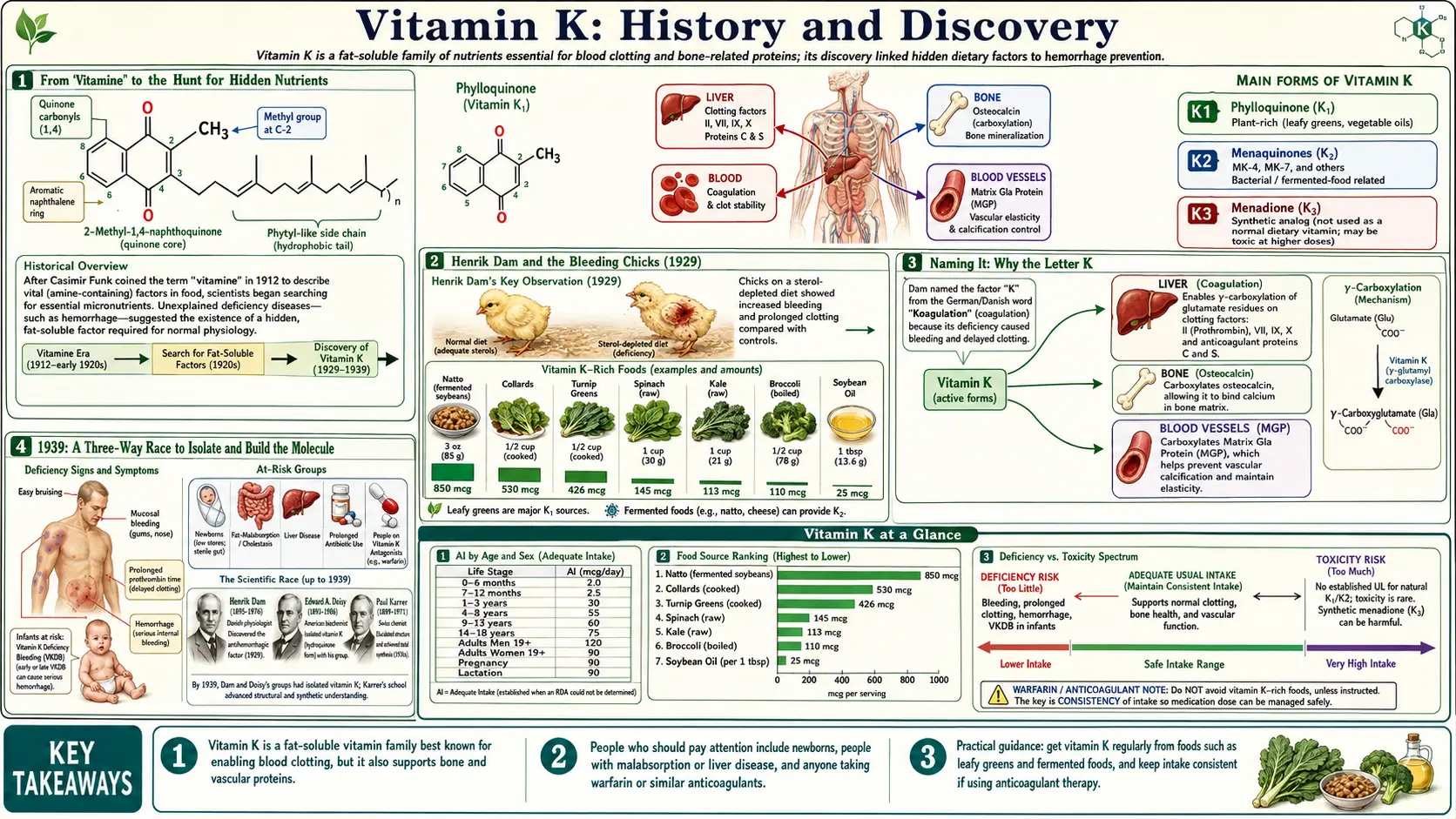
Vitamin K is the only vitamin still known by a single letter that stands for a word in another language: the K is short for Koagulation, the German and Scandinavian spelling of "coagulation," because the vitamin was discovered through bleeding, not nutrition. Around 1929, the Danish biochemist Henrik Dam was studying cholesterol in chicks when he noticed something he was not looking for: chicks fed a fat-stripped diet began to bleed and bruise, and their blood was slow to clot. No known vitamin fixed it. Over the next decade Dam tracked down the missing factor, named it "vitamin K," and — together with the American biochemist Edward Adelbert Doisy, whose laboratory worked out its chemical structure and synthesized it — shared the 1943 Nobel Prize in Physiology or Medicine. This article tells that discovery story carefully: who saw what and when, the genuinely simultaneous race in 1939 to isolate and build the molecule, how a cattle disease led to the rat poison and clot-preventing drug warfarin, the 1970s breakthrough that finally explained how the vitamin works, and the modern expansion of vitamin K from a clotting factor into a vitamin for bone and arteries. Where the record is firm we say so; where priority was shared or a date is approximate, we say that too.
Table of Contents
- From "Vitamine" to the Hunt for Hidden Nutrients
- Henrik Dam and the Bleeding Chicks (1929)
- Naming It: Why the Letter K
- 1939: A Three-Way Race to Isolate and Build the Molecule
- The 1943 Nobel Prize
- Sweet Clover, Dicoumarol, and Warfarin
- 1974: How It Actually Works — The Discovery of Gla
- Beyond Clotting: Bone, Arteries, and the K2 Story
- Research Papers and References
- Connections
- Featured Videos
From "Vitamine" to the Hunt for Hidden Nutrients
To understand how vitamin K was found, it helps to remember what scientists believed about food in the early twentieth century. The idea that tiny, otherwise unremarkable amounts of certain substances in food were absolutely essential to life was brand new. In 1912, the Polish-born biochemist Casimir Funk proposed the word vitamine — from "vital" plus "amine" — for the trace factors he believed prevented diseases such as beriberi, scurvy, rickets, and pellagra. The "-amine" part turned out to be wrong (most of these factors are not amines), so the final "e" was later dropped and the word became vitamin. But Funk's core insight was right and revolutionary: some deficiency diseases were caused not by germs or poisons but by the absence of something the body could not make for itself.
This set off a decades-long search in which letters were handed out, roughly in order of discovery, to newly found dietary factors: A, B, C, D, E. Most of these were tied to a specific deficiency disease — scurvy pointed researchers to vitamin C, beriberi to thiamine (B1), rickets to vitamin D. Vitamin K fits this pattern but with a twist. Its "deficiency disease" was not a long-known human ailment with a famous name; it was an unexplained bleeding disorder that first showed up in laboratory chicks. The letter K, as the next sections explain, was not simply the next free letter in the alphabet — it was chosen for a reason.
Henrik Dam and the Bleeding Chicks (1929)
The central figure in vitamin K's discovery is Carl Peter Henrik Dam (1895–1976), a Danish biochemist at the Biochemical Institute of the University of Copenhagen. Around 1929 — in experiments running roughly from 1928 to 1930 — Dam was not studying blood at all. He was investigating whether chicks could make their own cholesterol, and to test this he fed them a diet from which fats and sterols had been extracted. The discovery, like many in the history of nutrition, was accidental: after two to three weeks on this stripped-down feed, the chicks developed spontaneous hemorrhages — bleeding under the skin, in the muscles, and in other tissues — and their blood took far longer than normal to clot.
This was the crucial clue, and Dam pursued it with care. He methodically ruled out the suspects already known to science. Adding vitamin C did not stop the bleeding; neither did cholesterol itself, nor the other recognized vitamins of the day. Whatever was preventing the hemorrhages was something new — a previously unrecognized, fat-soluble dietary factor. By the mid-1930s, working in part with the Danish researcher F. Schønheyder, Dam had shown that the bleeding tendency could be cured by a substance present in green leaves, certain seeds (such as hempseed), and other foods. In a series of papers culminating around 1934–1935, he established that this anti-hemorrhagic factor was a genuine vitamin.
It is worth being precise about what Dam discovered and what he did not. Dam identified the existence and biological role of vitamin K — that a specific dietary factor was required to prevent hemorrhage — and he gave it its name. He did not, at that point, know its chemical structure or have it in pure form; that work fell to others, and is the subject of a later section. Earlier observers had also noticed bleeding in chicks on deficient diets (workers at the Ontario Agricultural College in Canada are often credited with related observations), but it was Dam who recognized the cause as a missing vitamin, characterized it, and named it — which is why the Nobel committee later credited him with "the discovery of vitamin K."
Naming It: Why the Letter K
The name vitamin K has a tidy and well-documented origin. Dam reported his findings in part in a German-language journal, where he designated the new factor the Koagulationsvitamin — the "coagulation vitamin" — because its defining role was to make blood clot normally. The letter K is simply the first letter of Koagulation, the spelling shared by German and the Scandinavian languages (in English it would be "coagulation," with a C). The widely cited English-language announcement, "The Antihæmorrhagic Vitamin of the Chick," appeared in the journal Nature in 1935.
This makes vitamin K unusual among the vitamins. Most vitamin letters (A, B, C, D, E) were assigned in rough alphabetical order of discovery and carry no other meaning. Vitamin K's letter, by contrast, is a tiny piece of preserved history: it tells you, in a single character, both the language Dam published in and the function he discovered. Every time the vitamin is written today, the K still quietly points back to a Danish laboratory and a German word for clotting.
A note on the forms and their later names: the major natural forms of vitamin K are K1 (phylloquinone), made by green plants, and the K2 (menaquinone) family, made by bacteria and found in fermented and animal foods. These names came after Dam's original discovery, as chemists sorted out that "vitamin K" was really a family of closely related molecules rather than a single compound.
1939: A Three-Way Race to Isolate and Build the Molecule
Discovering that a vitamin exists is one thing; getting it in pure form, working out its exact chemical structure, and then building it from scratch in a flask is another. For vitamin K, this second phase reached its climax in a single remarkable year: 1939. And it is an honest example of a discovery that does not belong to one person — several laboratories arrived at the answer essentially at the same time.
The pure isolation of vitamin K1 (phylloquinone) from alfalfa was reported independently in 1939 by three separate research groups: the laboratory of Edward Adelbert Doisy at Saint Louis University in the United States; Henrik Dam's group working with the Swiss chemist Paul Karrer (himself already a Nobel laureate for earlier vitamin work); and Karrer's own laboratory. Doisy's team — in work published by MacCorquodale, Binkley, and colleagues — is specifically credited with determining the chemical structure of vitamin K1 and with achieving its synthesis. In the same year, the celebrated American organic chemist Louis Frederick Fieser at Harvard independently confirmed the structure and accomplished a synthesis of vitamin K1, publishing in the Journal of the American Chemical Society.
So when people say vitamin K was "first synthesized in 1939," the accurate version is that several chemists, on more than one continent, isolated it, defined its structure, and synthesized it within months of one another. This kind of near-simultaneous, multi-laboratory result is common in the history of science: once the tools and the question are ripe, the answer tends to fall out in more than one place at once. The fair way to tell it is not to crown a single "first" but to credit the cluster — Doisy, Dam, Karrer, and Fieser among them — while recognizing that Doisy's structural and synthetic work was singled out by the Nobel committee.
The 1943 Nobel Prize
The discovery of vitamin K was honored with science's highest recognition. The Nobel Prize in Physiology or Medicine for 1943 was divided equally between two men: Henrik Carl Peter Dam, "for his discovery of vitamin K," and Edward Adelbert Doisy, "for his discovery of the chemical nature of vitamin K." The split captures the two halves of the story neatly — Dam found the vitamin and its role; Doisy found out what it actually was, chemically, and how to make it.
There is a small wartime wrinkle worth noting, because it is sometimes a source of confusion. Although the prize is designated as the 1943 award, it was not actually presented in 1943. The Nobel Foundation reserved that year's prize, and the award was formally conferred the following year, in 1944, with the Second World War shaping the timing of the ceremony and lectures. Both men are nonetheless the official 1943 laureates.
Edward Adelbert Doisy (1893–1986) was an American biochemist based for most of his career at Saint Louis University. Vitamin K was not even his only major achievement — he had earlier done pioneering work isolating the estrogen hormones — but his vitamin K research, isolating two forms of the vitamin in pure form and determining and synthesizing the structure of phylloquinone, is what the Nobel committee recognized. The Dam–Doisy prize stands as one of a series of Nobel awards in the first half of the twentieth century that established the very concept of vitamins as essential micronutrients.
Sweet Clover, Dicoumarol, and Warfarin
One of the most consequential threads in vitamin K's history began not in a nutrition lab but on North American cattle farms in the 1920s. Cows that ate spoiled hay made from sweet clover were dying of uncontrolled internal bleeding — a condition that became known as "sweet clover disease." The cause was a mystery for years. The puzzle was finally cracked in the laboratory of the American biochemist Karl Paul Link at the University of Wisconsin. In 1939–1940, Link's team — with a key crystallization by his colleague Harold Campbell — isolated the culprit: a compound they named dicoumarol, formed in the moldy hay, which acted as a powerful anticoagulant by interfering with vitamin K.
The story did not stop at explaining a cattle disease. Link's laboratory went on to synthesize and test scores of related coumarin compounds in search of a more potent, practical anticoagulant. One of them — the compound covered by a 1947 patent assigned to the Wisconsin Alumni Research Foundation — was named warfarin and introduced commercially in 1948; the "warf" honors the Wisconsin Alumni Research Foundation, which funded the work, and the "-arin" marks it as a coumarin. Warfarin was first marketed as a rat poison (a bleeding agent), but it was soon found to be safe and controllable enough for human use, and it became one of the most widely prescribed blood-thinning medications in the world — given to prevent strokes and dangerous clots in millions of patients.
The vitamin K connection is the heart of why this matters. Warfarin works precisely by blocking vitamin K's function — it is, in effect, a controlled, deliberate vitamin K deficiency confined to the clotting system. That relationship is also why vitamin K is the antidote to a warfarin overdose, and why patients on warfarin are advised to keep their intake of vitamin K–rich foods steady rather than swinging wildly up and down. The exact molecular target warfarin hits would not be fully understood for decades, but the practical link between the spoiled-clover poison and the coagulation vitamin was clear from the start.
1974: How It Actually Works — The Discovery of Gla
For more than forty years after Dam's discovery, scientists knew that vitamin K was needed for blood to clot, but not how it did its job at the molecular level. The answer came in 1974, and it is one of the more elegant discoveries in vitamin biochemistry. It also, like the 1939 isolation, was made independently by more than one group — a genuine co-discovery rather than a single eureka moment.
The Swedish biochemist Johan Stenflo, comparing normal prothrombin (a key clotting protein) with the abnormal prothrombin produced under anticoagulant drugs, isolated a small fragment from the normal protein and found that it contained a previously unknown amino acid: gamma-carboxyglutamic acid, abbreviated Gla. At essentially the same time, working in the United States, Gary Nelsestuen and colleagues reported the same modified amino acid in prothrombin. The two findings, published in 1974, together solved the puzzle.
Here is why Gla mattered so much. Vitamin K's real job, it turned out, is to act as the essential helper (a cofactor) for an enzyme that performs a special chemical edit on certain proteins — converting ordinary glutamic acid building blocks into gamma-carboxyglutamic acid (Gla). This edit, called gamma-carboxylation, gives those proteins a powerful new ability: to grab onto calcium. In the case of clotting factors, calcium-binding is exactly what lets them assemble at the site of a wound and form a clot. Without vitamin K, the carboxylation does not happen, the proteins cannot bind calcium, and they are biologically useless — which is precisely the bleeding state Dam had seen in his chicks in 1929. The 1974 discovery closed the loop, connecting the vitamin to the molecule to the disease.
This insight had a reach far beyond clotting. Once scientists knew to look for Gla-containing, vitamin K–dependent proteins, they began finding them outside the blood entirely — a development that reshaped the whole picture of what vitamin K is for.
Beyond Clotting: Bone, Arteries, and the K2 Story
The discovery of gamma-carboxyglutamic acid opened a door, and through it came a steady stream of newly recognized vitamin K–dependent proteins that had nothing to do with bleeding. In the mid-1970s, researchers including Peter Hauschka, Paul Price, and their colleagues identified Gla in a protein of bone — the protein now called osteocalcin — showing that vitamin K helps direct calcium into the skeleton. In the early 1980s, another Gla protein, matrix Gla protein (MGP), was characterized; it turned out to be one of the body's most important natural brakes on the unwanted deposition of calcium in artery walls. Vitamin K, in other words, was not just a clotting vitamin after all — it was a master regulator of where calcium goes in the body.
This reframing fueled a surge of interest in vitamin K2 (menaquinones), the bacterial and fermented-food forms of the vitamin, which appear especially active in these bone and cardiovascular roles. A landmark moment came in 2004, when researchers led by Johanna Geleijnse and Cees Vermeer published an analysis from the large Dutch population study known as the Rotterdam Study. They reported that people with the highest dietary intake of vitamin K2 had substantially lower rates of coronary heart disease and aortic calcification, while ordinary dietary K1 showed no such association — a result that put K2 firmly on the map for heart and bone research.
Two honest cautions belong at the close of this history. First, the bone and cardiovascular story of vitamin K is younger and less settled than its clotting story; much of the evidence is observational, and large randomized trials are still working out exactly how much benefit supplemental K2 delivers and for whom. Second, this remains an area of active investigation, not final answers. What is not in doubt is the spine of the tale: a curious bleeding disorder in chicks in 1929 led to a named vitamin, a Nobel Prize, a life-saving drug, a molecular mechanism, and ultimately a far broader understanding of a nutrient that helps decide whether calcium strengthens your bones or stiffens your arteries. The detailed modern evidence, forms, dosing, and cautions are covered in the companion Vitamin K Benefits articles and on the main Vitamin K page; this history is concerned with how the vitamin came to be known in the first place.
Research Papers and References
The list below combines key peer-reviewed and historical sources on the discovery of vitamin K with curated PubMed topic-search links and authoritative reference pages. Author names, titles, and journals are given as plain text; only the stable DOI, PMID, or archive link is hyperlinked, and each opens in a new tab. Where a discovery was made independently by more than one group (the 1939 isolation of vitamin K1 and the 1974 finding of gamma-carboxyglutamic acid), the article above credits the multiple claimants rather than a single "first."
- Ferland G. The discovery of vitamin K and its clinical applications. Annals of Nutrition and Metabolism. 2012;61(3):213-218. — PMID: 23183291
- Dam H. The antihæmorrhagic vitamin of the chick: occurrence and chemical nature. Nature. 1935;135(3417):652-653. — doi:10.1038/135652b0
- Stenflo J, Fernlund P, Egan W, Roepstorff P. Vitamin K dependent modifications of glutamic acid residues in prothrombin. Proceedings of the National Academy of Sciences USA. 1974;71(7):2730-2733. — doi:10.1073/pnas.71.7.2730 (PMID: 4528109)
- Geleijnse JM, Vermeer C, Grobbee DE, Schurgers LJ, Knapen MHJ, van der Meer IM, Hofman A, Witteman JCM. Dietary intake of menaquinone is associated with a reduced risk of coronary heart disease: the Rotterdam Study. The Journal of Nutrition. 2004;134(11):3100-3105. — doi:10.1093/jn/134.11.3100 (PMID: 15514282)
- Stafford DW. The vitamin K cycle. Journal of Thrombosis and Haemostasis. 2005;3(8):1873-1878. — doi:10.1111/j.1538-7836.2005.01419.x
- DiNicolantonio JJ, Bhutani J, O'Keefe JH. The health benefits of vitamin K. Open Heart. 2015;2(1):e000300. — doi:10.1136/openhrt-2015-000300 ( — Search PubMed)
- Vitamin K discovery and history PubMed: vitamin K discovery and history
- Vitamin K–dependent gamma-carboxylation and Gla proteins PubMed: vitamin K-dependent carboxylation and Gla
External Authoritative Resources
- NobelPrize.org — The 1943 Nobel Prize in Physiology or Medicine (Dam and Doisy)
- NIH Office of Dietary Supplements — Vitamin K
- PubMed — Vitamin K history and forms
Connections
- All Vitamins
- Vitamin K
- Vitamin K Benefits
- Vitamin D3
- Vitamin E
- Calcium
- Osteoporosis
- Cardiovascular Disease
- Natto