Vitamin B3 (Niacin): Food Sources & Daily Intake
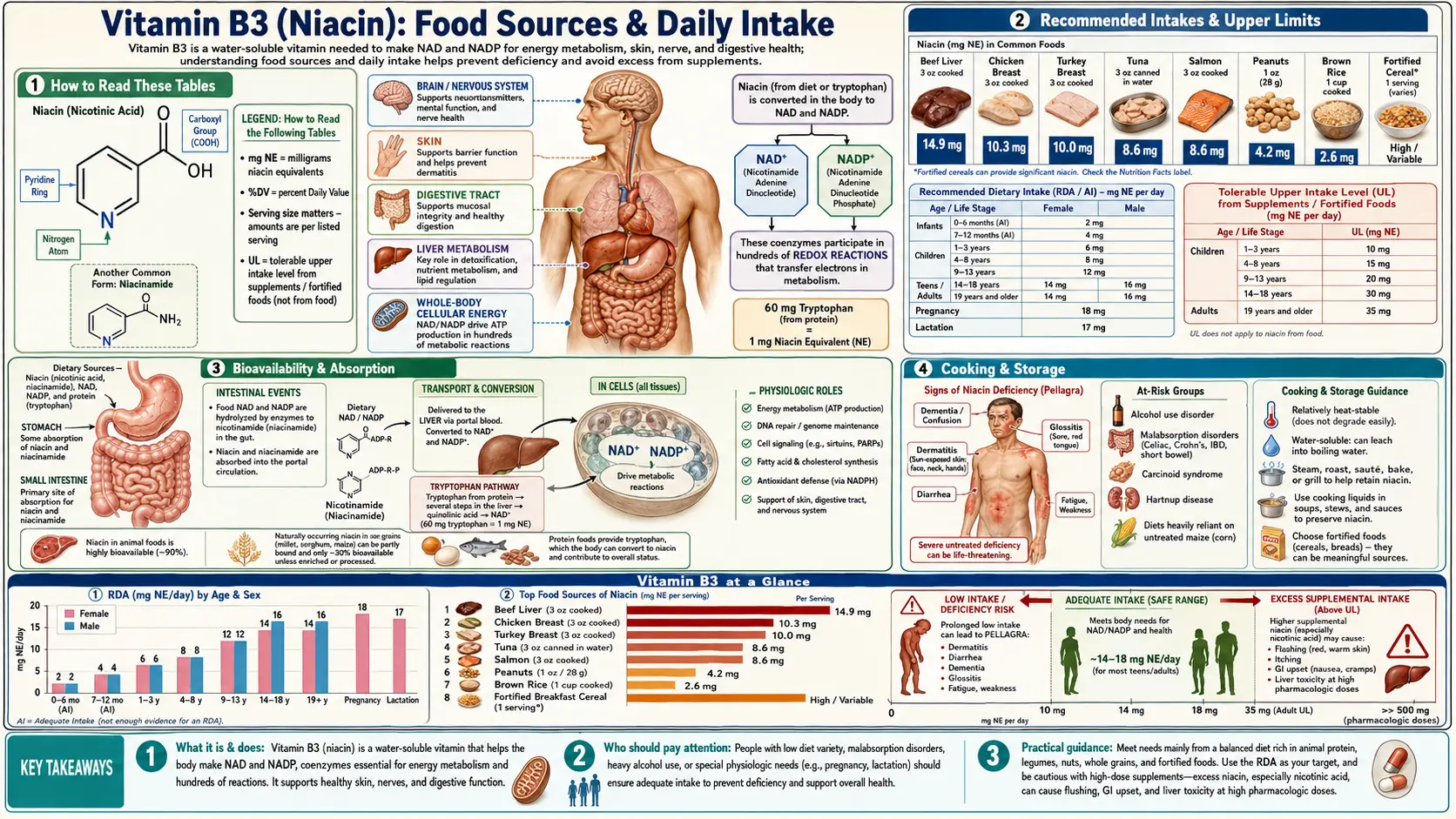
Vitamin B3 (niacin) is a water-soluble B vitamin the body uses to turn food into energy and to build the coenzymes NAD and NADP that hundreds of reactions depend on. It is unusual among the vitamins: your body can also make niacin from the amino acid tryptophan, so protein-rich foods deliver more usable niacin than the niacin column alone suggests. The richest direct sources are poultry, fish, pork, beef, peanuts and enriched or fortified grains, with useful amounts from mushrooms, legumes and whole grains.
| Vitamin B3 (Niacin): Food Sources & Daily Intake | ||||||
|---|---|---|---|---|---|---|
| Rank | Food (serving) | Per 100 g | %DV / 100g | Glucose | Fructose | Notes |
| 1 | Peanut Butter, Smooth 2 tbsp / 32 g | 15 mg | 🟢 91% | — | — | |
| 2 | Tuna, Light, Canned In Water 3 oz / 85 g | 13 mg | 🟢 83% | 0 | 0 | Inexpensive and niacin-dense. |
| 3 | Turkey Breast 3 oz / 85 g | 12 mg | 🟢 74% | 0 | 0 | |
| 4 | Salmon 3 oz / 85 g | 10 mg | 🟢 62% | — | — | |
| 5 | Peanuts, Dry 1 oz / 28 g | 7.9 mg | 🟡 50% | — | — | The leading plant source; also rich in protein. |
| 6 | Pork Loin 3 oz / 85 g | 7.1 mg | 🟡 44% | 0 | 0 | |
| 7 | Sunflower Seeds, Dry 1 oz / 30 g | 7.0 mg | 🟡 44% | 0.0 | 0 | |
| 8 | Chicken Breast 3 oz / 85 g | 6.5 mg | 🟡 41% | — | — | Lean poultry is one of the top niacin foods; tryptophan adds even more NE. |
| 9 | Pork Organ Meats 3 oz / 85 g | 5.8 mg | 🟡 36% | — | — | Nutrient-dense organ meat. |
| 10 | Beef Meat 3 oz / 85 g | 5.5 mg | 🟡 34% | 0 | 0 | |
| 11 | Chicken Organ Meats 3 oz / 85 g | 4.1 mg | 🟡 26% | — | — | Nutrient-dense organ meat (giblets). |
| 12 | Beef Organ Meats 3 oz / 85 g | 3.9 mg | 🟡 24% | 0 | 0 | Nutrient-dense organ meat. |
| 13 | Mushrooms, White, Raw 1 cup / 70 g | 3.6 mg | 🟡 23% | 1.5 | 0.2 | A leading plant source of preformed niacin. |
| 14 | Brown Rice 1 cup / 195 g | 2.6 mg | 🟡 16% | 0 | 0 | Whole grain; enriched white rice is also fortified. |
| 15 | Green Peas ½ cup / 80 g | 2.0 mg | 🟡 13% | 0.1 | 0.4 | |
| 16 | Avocado 1 cup / 150 g | 1.9 mg | 🟡 12% | 0.1 | 0.1 | |
Table of Contents
- How to Read These Tables
- Recommended Intakes & Upper Limits
- Bioavailability & Absorption
- Cooking & Storage
- Vegetarian & Vegan Sources
- Who Needs to Pay Attention
- Data Sources & References
- Connections
- Featured Videos
How to Read These Tables
- Niacin vs niacin equivalents (NE). The niacin shown here is preformed niacin in milligrams, but the requirement is set in niacin equivalents (NE) because the body converts the amino acid tryptophan into niacin — roughly 60 mg of tryptophan yields 1 mg of niacin. That means high-protein animal foods (chicken, fish, beef, eggs) effectively supply more than the niacin number on this page shows, while the RDA table is expressed in NE.
- %DV vs RDA. The %DV column compares a serving against the FDA Daily Value of 16 mg. Your personal target (the RDA) is 16 mg NE for men and 14 mg NE for women, slightly higher in pregnancy and lactation — see the second table.
- Per 100 g vs per serving. Per-100 g lets you compare foods fairly; the serving size shown beside each food is what you actually eat. A single chicken breast, a can of tuna, or an ounce of peanuts covers most of a day’s need on the niacin column alone — and more once tryptophan is counted.
Recommended Intakes & Upper Limits
Your personal target depends on age, sex and pregnancy. The Daily Value used for the %DV column above is a single label figure; the table below is the age-specific guidance.
| Life stage | RDA / AI (mg/day) | Upper limit (mg/day) |
|---|---|---|
| Infants 0–6 mo | 2* (AI) | Not set |
| Infants 7–12 mo | 4* (AI) | Not set |
| Children 1–3 y | 6 | 10 |
| Children 4–8 y | 8 | 15 |
| Children 9–13 y | 12 | 20 |
| Males 14–18 y | 16 | 30 |
| Males 19+ y | 16 | 35 |
| Females 14–18 y | 14 | 30 |
| Females 19+ y | 14 | 35 |
| Pregnancy | 18 | 30–35 |
| Lactation | 17 | 30–35 |
Bioavailability & Absorption
Niacin from animal foods and enriched grains is well absorbed. The catch is in whole grains and corn: much of their niacin is bound in a form called niacytin that the body cannot readily release, so it counts for little unless the grain is treated. The traditional practice of soaking corn (maize) in an alkaline solution — nixtamalization, used to make tortillas and hominy — frees the bound niacin and historically prevented the deficiency disease pellagra in maize-eating populations. Remember too that protein contributes through the tryptophan pathway, so a meal’s real niacin value depends on both its niacin and its protein content.
Cooking & Storage
Niacin is one of the more heat-stable vitamins, so ordinary cooking does not destroy much of it. The main loss is that, being water-soluble, some niacin leaches into cooking water — so use the liquid from boiled or braised dishes (soups, stews, pan juices) to recover it, or steam and roast rather than boil away the water. Roasting meat and poultry retains niacin well; the drippings carry some too.
Vegetarian & Vegan Sources
Plant-based eaters have solid options even though the densest sources are animal foods. The standouts are peanuts and peanut butter, sunflower seeds, mushrooms and enriched grains, brown rice, green peas, avocado and lentils. Because plant protein still supplies tryptophan, a varied diet with adequate total protein adds niacin equivalents on top of the preformed niacin listed here. Overt niacin deficiency is rare on a varied vegetarian or vegan diet.
Who Needs to Pay Attention
True deficiency causes pellagra — classically the “four Ds”: dermatitis (a sun-exposed rash), diarrhea, dementia and, untreated, death. It is now rare in well-fed populations but still seen with alcohol-use disorder, severe malnutrition, malabsorption, certain medications, and diets heavily based on untreated corn. On the safety side, the Tolerable Upper Intake Level of 35 mg/day applies only to supplemental niacin — chiefly nicotinic acid, which at high doses causes skin flushing, itching and, at pharmacologic doses, liver effects. Niacin from ordinary food is not capped by the UL: you cannot reach those amounts by eating, and food sources do not cause flushing.
Data Sources & References
- NIH Office of Dietary Supplements — Niacin Fact Sheet (DV, RDA in NE, UL)
- Linus Pauling Institute — Niacin Micronutrient Information Center
- PubMed — niacin, tryptophan conversion, requirements and pellagra
Connections
- All Vitamins
- Vitamin B3 (Niacin) (Main Page)
- Vitamin B3 (Niacin) Benefits
- Vitamin B3 (Niacin) History
- Vitamin B1 (Thiamin)
- Vitamin B6
- Tryptophan (converts to niacin)
- Tuna