Inositol for Bipolar & Depression — With Critical Mania Caution
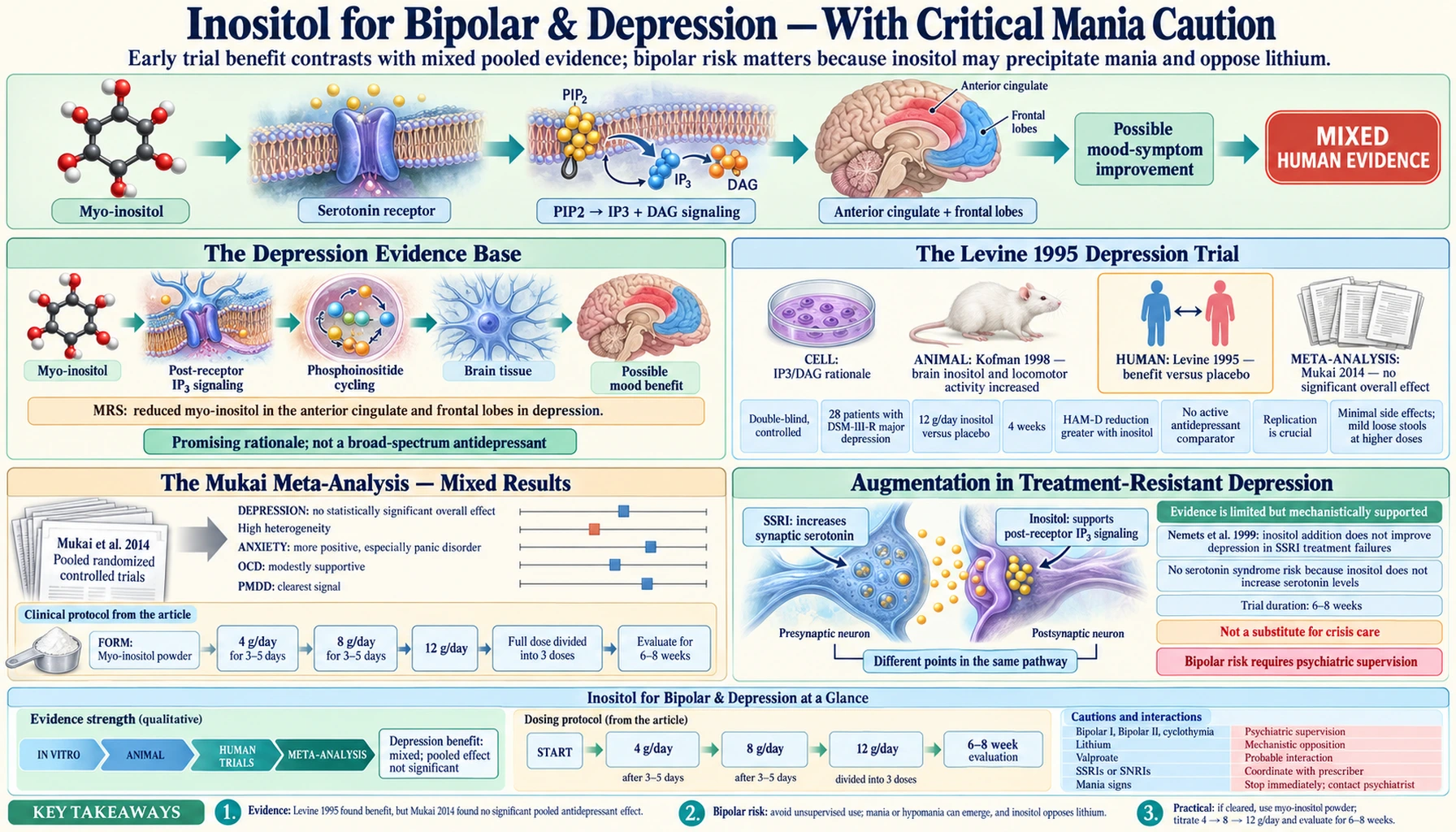
Inositol was studied for mood disorders mainly in the 1990s and 2000s. The Levine 1995 trial found 12 g/day inositol better than placebo for depression in 28 patients over four weeks — there was no active antidepressant comparator, and the authors themselves wrote that “replication is crucial.” Later trials adding inositol to SSRI antidepressants found no added benefit, a 2004 Cochrane review called any benefit unclear, and a 2014 meta-analysis found no statistically significant effect on depressive symptoms. In bipolar depression, three small add-on trials found no statistically significant benefit on their main measures; the Nierenberg STEP-BD trial found no significant difference between inositol, lamotrigine and risperidone on its primary outcome, and its post-hoc analyses favoured lamotrigine. The safety concern is bipolar disorder: lithium is thought to work partly by depleting brain inositol (the inositol-depletion hypothesis), large doses of inositol reversed behavioral effects of lithium in animals and side effects of lithium in people, and a 1996 case-report letter raised the possibility that inositol can trigger mania. This deep-dive covers the depression trials, the SSRI add-on trials, the bipolar trials, the lithium–inositol hypothesis, the mania concern, brain-imaging studies, and the doses the trials used.
Table of Contents
- The Depression Evidence Base
- The Levine 1995 Depression Trial
- The Mukai Meta-Analysis — No Significant Pooled Effect
- Inositol Added to SSRI Antidepressants
- Bipolar Depression — Chengappa, STEP-BD & Eden Evins
- The Inositol-Depletion Hypothesis of Lithium
- The Mania Caution — What Has Been Reported
- Brain Inositol Levels — MRS Studies
- Bulimia and PMDD Trials
- Doses and Durations Used in the Trials
- Patient FAQ
- Cautions — What the Research Raises Concerns About
- Key Research Papers
- Connections
- Featured Videos
The Depression Evidence Base
Standard treatment for major depression includes antidepressant drugs such as SSRIs and SNRIs, and psychotherapies such as cognitive-behavioral therapy. Inositol has been studied both on its own and as an add-on to these treatments.
The research group that ran the early trials based the idea on the phosphatidylinositol (PI) cycle, a second-messenger system used by several noradrenergic, serotonergic and cholinergic receptors, and on reports that cerebrospinal fluid inositol is low in depression (Benjamin 1995; Levine 1995). A magnetic resonance spectroscopy (MRS) study found lower myo-inositol in the prefrontal/anterior cingulate cortex of 13 unmedicated people with major depression than in 13 matched controls (Coupland 2005). In rats, chronic dietary inositol raised brain inositol by 36% in the cortex and 27% in the hippocampus and increased locomotor activity (Kofman 1998, an animal study). Whether extra dietary inositol changes this signaling in the human brain has not been shown directly; the mechanism remains a hypothesis.
After the positive Levine 1995 trial, the results were weaker. A 1999 trial adding inositol to SSRIs and a 1999 trial in SSRI non-responders found no added benefit; a 2004 Cochrane review of four short trials (141 participants) found no clear evidence of benefit; and a 2014 meta-analysis found no statistically significant effect on depressive symptoms.
Depression itself is covered on the Depression page.
The Levine 1995 Depression Trial
Levine et al. 1995, published in the American Journal of Psychiatry, was the research group's double-blind trial of inositol in depression, following an open-label add-on trial (Benjamin 1995). The authors described it as possibly “the first use of the precursor strategy for a second messenger rather than a neurotransmitter in treating depression.” What the abstract reports:
- Design: Double-blind, controlled trial. Depressed patients received inositol 12 g/day (13 patients) or placebo (15 patients) for 4 weeks.
- Outcome: Hamilton Depression Rating Scale (HAM-D).
- Results: Overall improvement in HAM-D scores was significantly greater on inositol than on placebo at week 4 (a 1995 review by the same group gives p = .043).
- Safety: No changes were noted in hematology or in kidney or liver function. The abstract does not describe other side effects.
- Authors' conclusion: inositol had a significant antidepressant effect in this study, but “replication is crucial.”
The same research group (Belmaker, Levine, Benjamin, Fux and colleagues) went on to run the panic-disorder and OCD trials covered in the inositol anxiety and panic deep-dive listed under Connections.
Later controlled trials in depression did not show a clear benefit; they are described in the next two sections.
The Mukai Meta-Analysis — No Significant Pooled Effect
Mukai et al. 2014, published in Human Psychopharmacology, pooled double-blind, randomized, placebo-controlled trials of inositol in depression and anxiety disorders (literature searched to August 2013). What the abstract reports:
- Depression: seven trials (242 participants) — two in bipolar depression, one in bipolar depression and major depressive disorder, two in major depressive disorder and two in premenstrual dysphoric disorder (PMDD). There was no statistically significant effect of inositol on depressive symptoms. Inositol had marginally more responders than placebo (p = 0.06) and a trend toward better depressive-symptom scores in PMDD (p = 0.07).
- Anxiety and OCD: four trials (70 participants) — two in obsessive-compulsive disorder, one in panic disorder and one in posttraumatic stress disorder. There was no statistically significant effect on anxiety or obsessive-compulsive symptoms.
- Discontinuation (all-cause, for side effects, or for worsening psychiatric symptoms): no significant difference from placebo.
- Side effects: inositol marginally caused more gastrointestinal upset than placebo (p = 0.06).
The authors concluded that inositol “may be beneficial for depressed patients, especially those with PMDD,” and named the small number of included studies as the main limitation. An earlier Cochrane review (Taylor 2004) found four short double-blind trials with 141 participants; they showed no clear evidence of benefit and no evidence of poor acceptability, and the reviewers concluded that it is “currently unclear” whether inositol helps depression.
No subtype of depression has been shown to respond. The one trial in SSRI treatment failures was negative: Nemets et al. (1999) titled the paper “Inositol addition does not improve depression in SSRI treatment failures.” The PMDD trials disagree with each other (see the Bulimia and PMDD section).
Inositol Added to SSRI Antidepressants
The idea behind combining the two is that an SSRI raises synaptic serotonin while inositol acts on the signaling cascade downstream of some serotonin receptors. Two controlled trials from the same research group tested it in depression:
- Levine et al. 1999 (Biological Psychiatry): 27 depressed patients completed a double-blind 4-week trial of an SSRI plus inositol or an SSRI plus placebo. No significant difference was found between the groups on the Hamilton scale.
- Nemets et al. 1999 (Journal of Neural Transmission): in patients who had not responded to an SSRI, inositol added in a controlled double-blind trial did not improve depression.
The Levine 1999 authors noted that earlier studies combining two effective antidepressant therapies also found no additive effect, while augmentation with lithium after a failed antidepressant course is effective; the Nemets trial then tested inositol in that failed-SSRI setting and found no benefit. Neither abstract reports safety findings for the combination.
Bipolar Depression — Chengappa, STEP-BD & Eden Evins
Bipolar depression is hard to treat: the STEP-BD investigators wrote that clinicians have few evidence-based options for treatment-resistant bipolar depression, and the Eden Evins trial report states that up to half of patients do not respond adequately to currently approved treatments. Three randomized trials have tested inositol as an add-on in bipolar depression.
Chengappa et al. 2000 (Bipolar Disorders), a pilot trial: 24 adults with bipolar depression (21 bipolar I, 3 bipolar II), already on stable therapeutic doses of lithium, valproate or carbamazepine, were randomly assigned to 12 g/day inositol or D-glucose placebo for 6 weeks. Among the 22 who completed it, six (50%) on inositol and three (30%) on placebo met the response criteria on the Hamilton scale and Clinical Global Improvement scale, a statistically nonsignificant difference; on the Montgomery-Asberg scale, 8 of 12 (67%) on inositol and 4 of 12 (33%) on placebo had a 50% or greater decrease (p = 0.10). Inositol was well tolerated with minimal side effects, and blood levels of the mood stabilizers did not change. The authors suggested a larger controlled study.
The Nierenberg et al. 2006 STEP-BD trial (Systematic Treatment Enhancement Program for Bipolar Disorder, American Journal of Psychiatry): 66 patients with bipolar I or II disorder, in a major depressive episode that had not responded to adequate doses of mood stabilizers plus at least one antidepressant, were randomly assigned to open-label add-on lamotrigine, inositol or risperidone for up to 16 weeks. The primary outcome was recovery (no more than two symptoms at DSM-IV threshold and no significant symptoms for 8 weeks). Findings:
- Recovery rates: lamotrigine 23.8%, inositol 17.4%, risperidone 4.6%
- The primary pairwise comparisons found no significant differences between any of the three. The recovery percentages come from an open-label effectiveness trial with no placebo arm, so they cannot be read as an inositol effect size.
- Post-hoc secondary analyses suggested lamotrigine may be superior to both inositol and risperidone — lower depression ratings, lower Clinical Global Impression severity, and higher Global Assessment of Functioning scores
Eden Evins et al. 2006 (Bipolar Disorders): 17 participants with bipolar depression, on proven therapeutic levels of lithium or valproate for more than 2 weeks, were randomized to double-blind inositol or placebo for 6 weeks. Four of nine on inositol (44%) and none of eight on placebo met the predefined response criteria (p = 0.053); there was no difference between groups in average change on the Hamilton scale or the Young Mania Rating Scale. The authors' conclusion: there was a trend toward more subjects improving on inositol, but “on average, inositol was not more effective than placebo as an adjunct for bipolar depression.”
Response varied widely. Of the nine people given inositol, four improved by more than 50% on the Hamilton scale, three did not change, and two got more than 50% worse. Those whose depression worsened had higher baseline scores on the Young Mania Rating Scale total and on its irritability, disruptive/aggressive behaviour and unkempt-appearance items; the authors suggested that baseline anger or hostility may predict response to inositol. The trial was small and the finding has not been tested further.
Taken together, the three trials were small, none found a statistically significant benefit of inositol on its primary measure, and all gave inositol on top of mood stabilizers — so they do not describe what inositol taken alone does in people with bipolar disorder.
The Inositol-Depletion Hypothesis of Lithium
Lithium inhibits inositol monophosphatase (IMPase), an enzyme needed both to recycle inositol and to make it new. From this, Berridge and colleagues proposed in the 1980s that lithium works by depleting brain inositol and damping phosphoinositide signaling, with the effect falling mainly on the most active cells (Berridge 1989, “a unifying hypothesis”). The proposed chain:
- Lithium blocks IMPase, so less free inositol is regenerated
- Less PIP2 is resynthesized
- IP3/DAG signaling is damped, according to the hypothesis most in heavily firing circuits
It remains a hypothesis. A 1996 review by the Belmaker group opened with “How lithium works in manic-depressive illness is unknown,” while describing the inositol-depletion hypothesis as gaining momentum (Belmaker 1996). In an MRS study of 12 depressed patients with bipolar disorder, lithium lowered right frontal myo-inositol by about 30% within 5–7 days, before any change in clinical state, and the authors concluded that the short-term reduction “is not associated with therapeutic response and does not support the inositol depletion hypothesis as originally posited” (Moore 1999). A 2002 laboratory study found that lithium, carbamazepine and valproic acid all changed nerve-cell growth cones in culture in a way that inositol reversed, and linked the effect to prolyl oligopeptidase in the amoeba Dictyostelium rather than to GSK3 or HDAC inhibition (Williams 2002); GSK3 inhibition is the main competing explanation for lithium's action.
Valproate: valproate has also been reported to deplete inositol in yeast, Dictyostelium and rat neurons, and acute valproate lowered inositol by 20% in mouse frontal cortex by inhibiting MIP synthase, the rate-limiting enzyme of inositol synthesis (Shaltiel 2004, laboratory and animal work).
Why it matters for supplements: pharmacological doses of inositol reversed behavioral effects of lithium in animals and side effects of lithium in people (Benjamin 1995). That raises a concern that high-dose inositol could counteract lithium's effect in people taking it. In the small add-on trials described above, inositol was given alongside lithium or valproate: mood-stabilizer blood levels did not change (Chengappa 2000), and average mania ratings did not differ from placebo (Eden Evins 2006). Those trials were short and were not designed to test whether inositol weakens lithium's protection against relapse.
The Mania Caution — What Has Been Reported
The concern rests on the lithium–inositol hypothesis and on a small number of reports, not on trials that measured mania as an outcome. What has been reported:
- A 1996 case-report letter in the American Journal of Psychiatry, titled “Inositol-induced mania?”, raised the possibility that inositol can trigger mania (Levine 1996). PubMed holds no abstract for the letter, so the doses and patient details are not given here.
- A 2001 letter described mania associated with an energy drink and discussed caffeine, taurine and inositol as possible contributors (Machado-Vieira 2001).
- In the Eden Evins trial, two of nine people given inositol had more than 50% worsening of depression, and they had higher baseline mania-scale scores; average mania ratings did not differ from placebo.
- In the 2014 meta-analysis, discontinuation for worsening psychiatric symptoms did not differ significantly between inositol and placebo.
The research raises a concern for people with bipolar disorder (bipolar I, bipolar II or cyclothymia), including people whose bipolar disorder has not yet been diagnosed — some people first diagnosed with depression are later found to have bipolar disorder. The concern was raised around the 12–18 g/day psychiatric doses; no report found for this page describes mania at the lower doses used in PCOS and fertility studies. No trial has measured how often inositol triggers mania.
The features of a manic or hypomanic episode include:
- Decreased need for sleep (sleeping less than usual without feeling tired)
- Racing thoughts or rapid speech
- Unusual energy, productivity, or goal-directed activity
- Grandiose plans or beliefs about oneself
- Hypersexuality or impulsive behavior
- Irritability disproportionate to circumstances
- Impulsive spending, gambling, or other risky behavior
- Feeling "wired," "invincible," or unusually elated
Mania is treated as a psychiatric emergency; decisions about medicines and supplements in that situation belong with a psychiatrist or an emergency service.
Groups the research raises concerns for:
- People with bipolar I or II disorder or cyclothymia (case-report letter; the worsening subgroup in the Eden Evins trial)
- People taking lithium (inositol reversed effects of lithium in animals and lithium side effects in people)
- People taking valproate (valproate also lowers inositol in laboratory and animal studies; no clinical interaction study was found)
- No trial found for this page looked specifically at people with a family history of bipolar disorder, psychotic disorders, or past antidepressant-induced mania, so there is no data for those groups
Brain Inositol Levels — MRS Studies
Magnetic resonance spectroscopy (MRS) is a non-invasive imaging technique that measures the concentration of specific metabolites in brain tissue, including myo-inositol. Studies cited on this page found:
- Major depression: lower myo-inositol/creatine ratios in the prefrontal/anterior cingulate cortex of 13 unmedicated patients than in 13 matched controls; the authors suggested this could reflect glial loss or altered glial metabolism (Coupland 2005).
- Lithium treatment: about a 30% decrease in right frontal myo-inositol after 5–7 days of lithium in 12 depressed patients with bipolar disorder, persisting at 3–4 weeks, but occurring before any clinical change (Moore 1999).
- Bipolar disorder, anterior cingulate cortex: in 9 patients taking lithium or valproate, scanned repeatedly, and 14 controls, no clinical or drug-related changes were seen in the myo-inositol ratio; the differences found were in choline-containing compounds (Moore 2000).
Kim et al. (2005) reviewed MRS studies across psychiatric disorders and concluded that the evidence suggests probable relevance of myo-inositol and the PI cycle to bipolar disorder, with much less support for a significant role in any other psychiatric disorder, and that more definitive work is needed before PI-cycle dysfunction can be considered specific to bipolar disorder.
Bulimia and PMDD Trials
Inositol has also been tested in two conditions that respond to SSRIs:
Bulimia Nervosa
Gelber et al. 2001 gave 18 g/day inositol or placebo for 6 weeks each in a double-blind crossover trial of 12 patients with bulimia nervosa or binge eating. Inositol was significantly better than placebo on the Global Clinical Impression, a Visual Analogue Scale and the Eating Disorders Inventory. There was no drug comparator; the authors wrote that the result increases inositol's parallelism with SSRIs.
Premenstrual Dysphoric Disorder (PMDD)
PMDD is a severe form of premenstrual syndrome featuring marked mood symptoms (irritability, depression, anxiety, lability) limited to the luteal phase. A crossover trial of 11 women taking 12 g/day myo-inositol in the luteal phase found no benefit over placebo (Nemets 2002); a later trial of lower-dose myo-inositol reported improvement on symptom and depression scales (Gianfranco 2011). The 2014 meta-analysis found a non-significant trend for depressive symptoms in PMDD (p = 0.07).
Doses and Durations Used in the Trials
These are the regimens the trials reported. None of the trials ran longer than 16 weeks.
- Depression, inositol alone: 12 g/day for 4 weeks (Levine 1995)
- Depression, added to an SSRI: 4 weeks (Levine 1999; the abstract does not state the dose); in SSRI non-responders (Nemets 1999; the abstract does not state dose or duration)
- Bipolar depression, added to mood stabilizers: 12 g/day for 6 weeks (Chengappa 2000); 6 weeks double-blind, then an optional 8-week open-label phase (Eden Evins 2006; the abstract does not state the dose); open-label for up to 16 weeks (STEP-BD, Nierenberg 2006; the abstract does not state the dose)
- Bulimia nervosa and binge eating: 18 g/day for 6 weeks (Gelber 2001)
- PMDD: 12 g/day in the luteal phase only (14 days before menses), alternating with placebo over six menstrual cycles (Nemets 2002)
Screening for bipolar disorder, mood-rating scales and stopping rules were not tested as part of any inositol regimen. Decisions about medicines and supplements for mood disorders belong with a clinician.
Patient FAQ
Q: Does the mania concern apply to people diagnosed with depression but never with bipolar disorder?
The concern is about bipolar disorder, and some people first diagnosed with depression are later found to have bipolar disorder. The abstracts of the unipolar depression trials (Levine 1995, Levine 1999, Nemets 1999) do not report mania.
Q: What about people with a family history of bipolar disorder?
First-degree relatives of people with bipolar disorder have a higher risk of the disorder themselves. No trial found for this page studied inositol in that group.
Q: What is known about inositol together with lithium?
Pharmacological doses of inositol reversed behavioral effects of lithium in animals and side effects of lithium in people, which raises a concern that inositol could counteract lithium. In two small add-on trials, inositol was given with lithium or valproate; mood-stabilizer blood levels did not change (Chengappa 2000), and average mania ratings did not differ from placebo (Eden Evins 2006).
Q: How is inositol different from SSRIs for depression?
The proposed mechanism differs: SSRIs raise synaptic serotonin, while inositol is a precursor in the signaling cascade downstream of some serotonin receptors. No head-to-head trial against an SSRI in depression was found. The trial evidence for inositol in depression is weak: one small positive trial, and negative add-on trials and pooled analyses after it. Side effects in the trials were few; the 2014 meta-analysis found marginally more gastrointestinal upset than placebo (p = 0.06).
Q: Does inositol help anxious depression specifically?
No trial tested anxious depression specifically. The panic-disorder trials were positive individually, but the 2014 meta-analysis found no statistically significant pooled effect on anxiety symptoms.
Q: What about PMDD mood symptoms?
Two trials disagree: 12 g/day in the luteal phase showed no benefit over placebo (Nemets 2002), while a lower-dose trial reported improvement (Gianfranco 2011).
Q: How long did the depression trials last?
The placebo-controlled trials lasted 4 to 6 weeks; the open-label STEP-BD trial lasted up to 16 weeks.
Q: What does sleeping less while feeling unusually good mean in this context?
A decreased need for sleep with elevated mood and energy is a core feature of hypomania and mania — the concern raised for inositol in people with bipolar disorder. Mania is treated as a psychiatric emergency.
Cautions — What the Research Raises Concerns About
- Bipolar disorder and mania — a 1996 case-report letter raised the possibility that inositol can trigger mania, and in one small bipolar trial two of nine people on inositol got markedly worse. The research raises a concern for people with bipolar I, bipolar II or cyclothymia, diagnosed or not. The features of mania are listed in the Mania Caution section.
- Lithium — lithium is thought to work partly by depleting brain inositol, and large doses of inositol reversed behavioral effects of lithium in animals and side effects of lithium in people. That raises a concern that high-dose inositol could counteract lithium.
- Valproate — valproate also lowers inositol in laboratory and animal studies. No clinical interaction study was found.
- Antidepressants — two controlled trials adding inositol to SSRIs found no added benefit; their abstracts do not report adverse effects of the combination.
- Pregnancy — there is no good safety data for the 12–18 g/day psychiatric doses in pregnancy. Lower-dose myo-inositol in pregnancy is covered in the PCOS & Insulin Sensitivity deep-dive listed under Connections.
- Children and adolescents — one 12-week pilot trial in 24 children aged 5–12 with bipolar spectrum disorders compared inositol, omega-3 fatty acids and the two combined; 54% completed the study, and the combination arm had the largest decrease in mania and depression ratings (Wozniak 2015). Other safety data in young people are scarce.
- Long-term use — the trials lasted 4 to 16 weeks. There is no good long-term safety data at 12–18 g/day.
- Crisis care — severe depression, suicidal thinking, mania and psychosis are psychiatric emergencies; inositol has not been tested as a treatment in those situations.
Key Research Papers
- Levine J, Barak Y, Gonzalves M, Szor H, Elizur A, Kofman O, Belmaker RH. (1995). Double-blind, controlled trial of inositol treatment of depression. American Journal of Psychiatry, 152(5), 792-794. — PubMed PMID: 7726322
- Mukai T, Kishi T, Matsuda Y, Iwata N. (2014). A meta-analysis of inositol for depression and anxiety disorders. Human Psychopharmacology, 29(1), 55-63. — PubMed PMID: 24424706
- Nierenberg AA et al. (2006). Treatment-resistant bipolar depression: a STEP-BD equipoise randomized effectiveness trial of antidepressant augmentation with lamotrigine, inositol, or risperidone. American Journal of Psychiatry — PubMed PMID: 16449473
- Eden Evins A, Demopulos C, Yovel I, Culhane M, Ogutha J, Grandin LD, Nierenberg AA, Sachs GS. (2006). Inositol augmentation of lithium or valproate for bipolar depression. Bipolar Disorders — PubMed PMID: 16542187
- Chengappa KN, Levine J, Gershon S, Mallinger AG, Hardan A, Vagnucci A, Pollock B, Luther J, Buttenfield J, Verfaille S, Kupfer DJ. (2000). Inositol as an add-on treatment for bipolar depression. Bipolar Disorders — PubMed PMID: 11254020
- Berridge MJ, Downes CP, Hanley MR. (1989). Neural and developmental actions of lithium: a unifying hypothesis. Cell — PubMed PMID: 2553271
- Belmaker RH, Bersudsky Y, Agam G, Levine J, Kofman O. (1996). How does lithium work on manic depression? Clinical and psychological correlates of the inositol theory. Annual Review of Medicine — PubMed PMID: 8712796
- Kim H, McGrath BM, Silverstone PH. (2005). A review of the possible relevance of inositol and the phosphatidylinositol second messenger system (PI-cycle) to psychiatric disorders — focus on magnetic resonance spectroscopy (MRS) studies. Human Psychopharmacology — PubMed PMID: 15880397
- Coupland NJ et al. (2005). Decreased prefrontal myo-inositol in major depressive disorder. Biological Psychiatry — PubMed PMID: 15953489
- Levine J, Mishori A, Susnosky M, Martin M, Belmaker RH. (1999). Combination of inositol and serotonin reuptake inhibitors in the treatment of depression. Biological Psychiatry — PubMed PMID: 10023500
- Nemets B, Mishory A, Levine J, Belmaker RH. (1999). Inositol addition does not improve depression in SSRI treatment failures. Journal of Neural Transmission, 106(7-8), 795-798. Negative trial. — PubMed PMID: 10907738
- Kofman O, Agam G, Shapiro J, Spencer A. (1998). Chronic dietary inositol enhances locomotor activity and brain inositol levels in rats. Psychopharmacology — PubMed PMID: 9784079
- Taylor MJ, Wilder H, Bhagwagar Z, Geddes J. (2004). Inositol for depressive disorders. Cochrane Database of Systematic Reviews, (2), CD004049. — PubMed PMID: 15106232
- Benjamin J, Agam G, Levine J, Bersudsky Y, Kofman O, Belmaker RH. (1995). Inositol treatment in psychiatry. Psychopharmacology Bulletin, 31(1), 167-175. — PubMed PMID: 7675981
- Levine J, Witztum E, Greenberg BD, Barak Y. (1996). Inositol-induced mania? American Journal of Psychiatry, 153(6), 839 (letter). — PubMed PMID: 8633705
- Machado-Vieira R, Viale CI, Kapczinski F. (2001). Mania associated with an energy drink: the possible role of caffeine, taurine, and inositol. Canadian Journal of Psychiatry, 46(5), 454-455 (letter). — PubMed PMID: 11441790
- Moore GJ, Bebchuk JM, Parrish JK, Faulk MW, Arfken CL, Strahl-Bevacqua J, Manji HK. (1999). Temporal dissociation between lithium-induced changes in frontal lobe myo-inositol and clinical response in manic-depressive illness. American Journal of Psychiatry, 156(12), 1902-1908. — PubMed PMID: 10588403
- Moore CM, Breeze JL, Gruber SA, Babb SM, Frederick BB, Villafuerte RA, Stoll AL, Hennen J, Yurgelun-Todd DA, Cohen BM, Renshaw PF. (2000). Choline, myo-inositol and mood in bipolar disorder: a proton magnetic resonance spectroscopic imaging study of the anterior cingulate cortex. Bipolar Disorders, 2(3 Pt 2), 207-216. — PubMed PMID: 11249799
- Williams RS, Cheng L, Mudge AW, Harwood AJ. (2002). A common mechanism of action for three mood-stabilizing drugs. Nature, 417(6886), 292-295. — PubMed PMID: 12015604
- Shaltiel G, Shamir A, Shapiro J, Ding D, Dalton E, Bialer M, Harwood AJ, Belmaker RH, Greenberg ML, Agam G. (2004). Valproate decreases inositol biosynthesis. Biological Psychiatry, 56(11), 868-874. — PubMed PMID: 15576064
- Gelber D, Levine J, Belmaker RH. (2001). Effect of inositol on bulimia nervosa and binge eating. International Journal of Eating Disorders, 29(3), 345-348. — PubMed PMID: 11262515
- Nemets B, Talesnick B, Belmaker RH, Levine J. (2002). Myo-inositol has no beneficial effect on premenstrual dysphoric disorder. World Journal of Biological Psychiatry, 3(3), 147-149. — PubMed PMID: 12478879
- Gianfranco C, Vittorio U, Silvia B, Francesco D. (2011). Myo-inositol in the treatment of premenstrual dysphoric disorder. Human Psychopharmacology, 26(7), 526-530. — PubMed PMID: 22031267
- Wozniak J, Faraone SV, Chan J, Tarko L, Hernandez M, Davis J, Woodworth KY, Biederman J. (2015). A randomized clinical trial of high eicosapentaenoic acid omega-3 fatty acids and inositol as monotherapy and in combination in the treatment of pediatric bipolar spectrum disorders: a pilot study. Journal of Clinical Psychiatry, 76(11), 1548-1555. — PubMed PMID: 26646031