Inositol for Fertility & Egg Quality
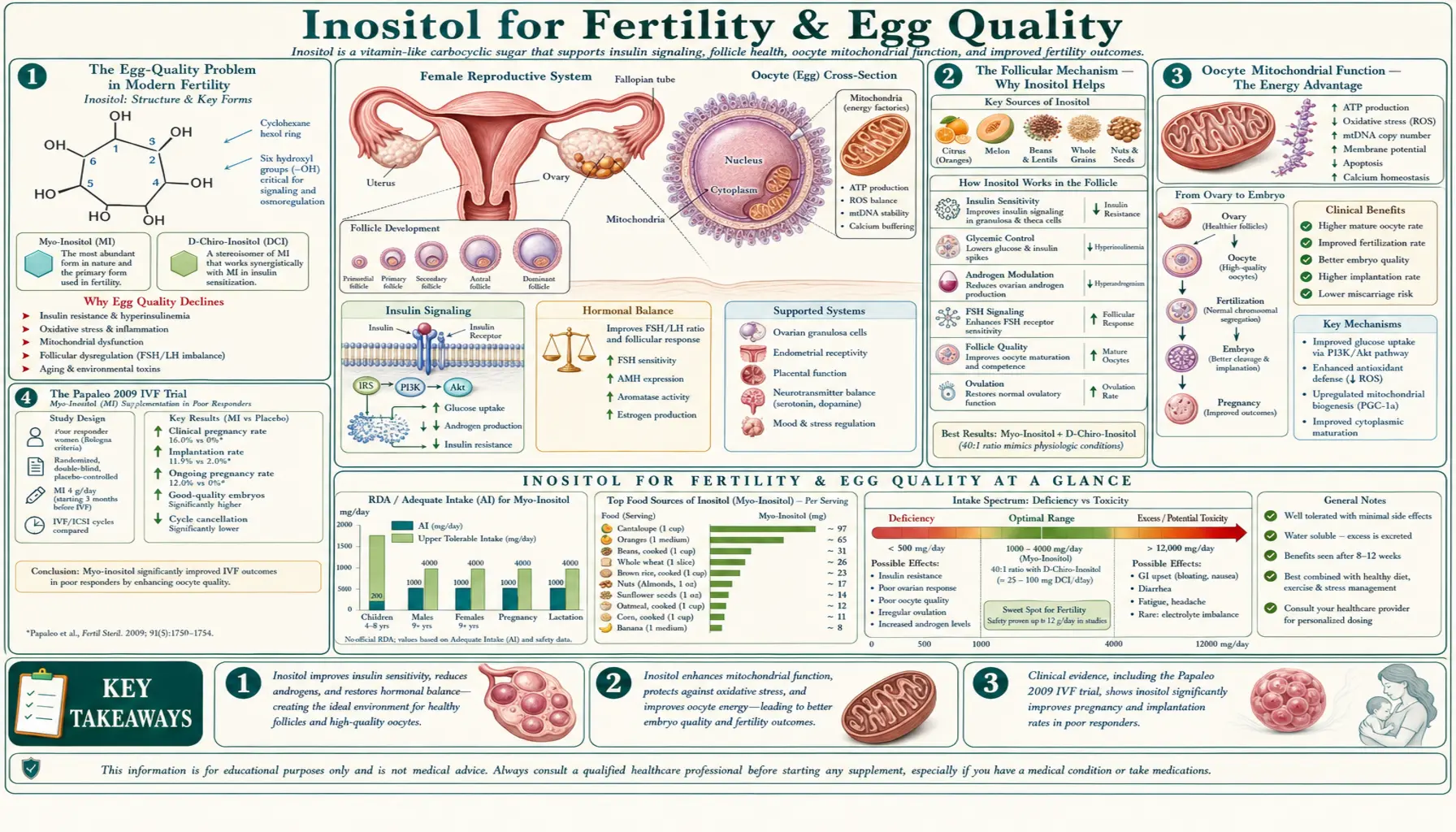
Myo-inositol is widely taken by people having fertility treatment, and most of the research is in women with polycystic ovary syndrome (PCOS) having in vitro fertilization (IVF). A 2018 Cochrane review of 13 trials rated that evidence low to very low quality and concluded that it is uncertain whether myo-inositol improves live birth or clinical pregnancy rates, and the 2023 International PCOS Guideline describes inositol for infertility as experimental therapy. Several early IVF trials have since been retracted or flagged: the Papaleo 2009 trial that reported better oocyte quality was retracted in 2025, and a 2011 trial comparing myo- with D-chiro-inositol was placed under an expression of concern. In men, a 2024 meta-analysis reported higher sperm motility and testosterone and less sperm DNA fragmentation with myo-inositol, but no change in sperm concentration. Melatonin, CoQ10 and DHEA are often discussed alongside inositol; a 2024 Cochrane review found that DHEA likely makes little or no difference to live birth in IVF. This deep-dive covers the IVF trials and their retractions, the proposed follicular and mitochondrial mechanisms, male fertility, the doses used in studies and the open questions.
Interactive Visualization Fertilization — follow the sperm and time the fertile window Watch 200 million sperm thin to a few hundred at the egg, harden the zona against the second one — then miss the window by two days and see nothing happen at all. Launch →
Table of Contents
- Age and Egg Quality
- The Proposed Follicular Mechanism
- Oocyte Mitochondrial Function
- The Papaleo 2009 IVF Trial (Retracted)
- Myo- and D-Chiro-Inositol Trials in IVF
- Male Fertility — Sperm Motility & DNA
- Combined Supplement Regimens — What the Trials Show
- Doses and Timing Used in the Studies
- Inositol During an IVF Cycle — What Is Known
- Common Questions and What the Research Shows
- Cautions and Open Questions
- Key Research Papers
- Connections
- Featured Videos
Age and Egg Quality
Women in many countries are having children later, and reproductive ageing has become a growing public-health question (Bentov and Casper 2013). With age, the main change is in egg quality as well as egg number. In a review of 15,169 embryo biopsies tested for chromosome number, aneuploidy (extra or missing chromosomes) rose steadily after age 26; the share of women with no chromosomally normal embryo was 2% to 6% at ages 26 to 37, 33% at age 42 and 53% at age 44 (Franasiak 2014). Changes described in ageing eggs include:
- Chromosome errors — chromosomes fail to separate properly during meiosis, producing aneuploid embryos (Franasiak 2014).
- Reduced mitochondrial function — lower expression of the enzymes that make coenzyme Q was found in older eggs in both mice and humans, and ageing mouse eggs had less oxidative phosphorylation and less ATP (Ben-Meir 2015, mainly an animal study).
- Oxidative stress — reviews describe a central role for mitochondrial dysfunction and oxygen radicals in reproductive ageing (Bentov and Casper 2013), and higher follicular-fluid levels of an oxidative DNA-damage marker were found in women with many degenerate oocytes (Tamura 2008).
- Follicular-fluid composition — the balance of myo- and D-chiro-inositol in follicular fluid differs between women with and without PCOS (Unfer 2014).
IVF can retrieve and select eggs but cannot change the eggs a woman's ovaries produce, which is why supplements taken before egg retrieval have drawn interest. Inositol is studied mainly for the follicular environment, CoQ10 for mitochondrial energy, and melatonin and DHEA for antioxidant and hormonal effects. The strength of the evidence for each is set out in the sections below.
The Proposed Follicular Mechanism
Inside the ovarian follicle the egg is surrounded by cumulus cells and bathed in follicular fluid. In one study of 20 healthy women and 20 women with PCOS, the myo-inositol to D-chiro-inositol ratio in follicular fluid was 100:1 in the healthy women and 0.2:1 in the women with PCOS, who also had higher insulin resistance, insulin and luteinizing hormone (Unfer 2014). The authors proposed that in PCOS with high insulin, more myo-inositol is converted to D-chiro-inositol in the ovary, leaving too little myo-inositol for FSH signaling and so lowering egg quality (Unfer 2014; Carlomagno 2011). This is a hypothesis put forward by the same research group whose trials are discussed below.
The processes in which myo-inositol is described as taking part include:
- FSH signaling — myo-inositol phospholipids act as second messengers for follicle-stimulating hormone (Unfer 2014)
- Cell-to-cell signaling in the follicle — inositol-derived messengers are part of the phosphoinositide signaling system that many cells use
- Calcium signaling at fertilization — the calcium waves that activate the egg after sperm entry run through the inositol trisphosphate (IP3) pathway
Whether taking myo-inositol by mouth changes follicular-fluid composition in a way that improves live birth has not been shown in the sources on this page.
Oocyte Mitochondrial Function
The egg is one of the largest cells in the body and carries a large population of mitochondria. Fertilization and the first cell divisions depend on the mother's mitochondria, because the sperm's mitochondria are not passed on. In ageing mice, eggs showed mitochondrial dysfunction with less ATP, and giving CoQ10 reversed the age-related decline in egg quality and number; disrupting coenzyme Q production in mouse eggs caused more spindle abnormalities and infertility (Ben-Meir 2015, an animal study). A review by two of the same researchers discusses CoQ10 deficiency as a possible contributor to egg ageing (Bentov and Casper 2013).
The supplements most often discussed for this are:
- CoQ10 — part of the mitochondrial electron transport chain. In a randomized trial of 186 women under 35 with poor ovarian reserve (169 analysed), 60 days of CoQ10 before IVF-ICSI gave more eggs retrieved, a higher fertilization rate and more high-quality embryos; clinical pregnancy and live birth rates tended to be higher but the difference was not statistically significant (Xu 2018).
- Myo-inositol — proposed to support the follicular environment and IP3/calcium signaling; the clinical evidence is in the sections below.
- Melatonin — an antioxidant found at higher concentrations in follicular fluid than in plasma (Tamura 2009, a review). In one study, 3 mg a day of melatonin lowered follicular-fluid oxidative-damage markers in 18 IVF patients, and among 115 women with a low fertilization rate in a previous cycle, the fertilization rate improved in the 56 given melatonin compared with their previous cycle but not in the 59 without it (Tamura 2008; this was not a placebo-controlled trial).
- DHEA — a hormone precursor proposed to improve ovarian response. A 2024 Cochrane review of IVF trials, mostly in women who had responded poorly to stimulation, found that DHEA likely makes little or no difference to live birth or clinical pregnancy (Naik 2024). An earlier matched case-control study of 22 women reported fewer aneuploid embryos with DHEA (Gleicher 2010).
These different proposed mechanisms are the reason the supplements are often discussed together. Trials of the combination are covered in the regimens section below.
The Papaleo 2009 IVF Trial (Retracted)
The Papaleo et al. 2009 trial, published in Fertility and Sterility, was for many years the trial most often cited for myo-inositol before IVF. It was a randomized trial in women with PCOS having IVF with ICSI that reported better oocyte quality with myo-inositol plus folic acid than with folic acid alone (Papaleo 2009).
The journal retracted the trial in 2025 (retraction notice: PubMed PMID 39971415). According to the notice, an investigation began after a reader reported an undisclosed conflict of interest: the trial used a myo-inositol supplement made by a company of which the corresponding author was co-founder and president. The corresponding author could not provide the original trial data when asked about errors the committee found in the statistical calculations of the baseline characteristics and the results, errors that “undermined the validity of the trial results.” The co-authors stated that they had not known of the conflict of interest.
Because of the retraction, the trial's reported findings on oocyte number, mature oocytes, FSH dose, embryo quality and pregnancy rate are not repeated here. An earlier uncontrolled study by the same group, in 25 women with PCOS and no other cause of infertility, gave myo-inositol with folic acid 2 g twice a day for six months; 22 of the 25 had at least one spontaneous menstrual cycle, 10 became pregnant and there were no multiple pregnancies (Papaleo 2007). That study had no control group and did not involve IVF.
The 2018 Cochrane review of 13 trials (1,472 subfertile women with PCOS, 11 of the trials using myo-inositol before IVF) rated the evidence low to very low quality and concluded that it is uncertain whether myo-inositol improves live birth or clinical pregnancy rates (Showell 2018). The 2023 International PCOS Guideline states that inositol for infertility should be considered experimental therapy (Teede 2023).
Myo- and D-Chiro-Inositol Trials in IVF
Colazingari et al. 2013, published in Archives of Gynecology and Obstetrics, compared two treatments in women with PCOS having IVF: myo-inositol 1.1 g combined with D-chiro-inositol 27.6 mg, or D-chiro-inositol alone at 500 mg. Outcomes were the number of mature oocytes, the total FSH dose given and the number of top-grade embryos. The authors reported that only the combination improved oocyte and embryo quality and pregnancy rates (Colazingari 2013). The comparison was against D-chiro-inositol, not against placebo or no treatment.
In an earlier trial, 84 women with PCOS and normal blood sugar having ICSI took myo-inositol 2 g twice a day (43 women) or D-chiro-inositol 0.6 g twice a day (41 women). The total number of eggs retrieved did not differ, but the myo-inositol group had more mature eggs, more top-quality embryos and more pregnancies (Unfer 2011). In 2025 the journal placed that paper under an expression of concern because of a possible undeclared conflict of interest involving an author's role at a company that markets inositol products (notice: PubMed PubMed PMID: 40748343).
The idea that too much D-chiro-inositol harms the ovary, sometimes called the “D-chiro-inositol paradox,” was proposed as a hypothesis in a 2011 letter by authors from the same group (Carlomagno 2011). The 2023 International PCOS Guideline states that specific types, doses or combinations of inositol cannot currently be recommended (Teede 2023). The 40:1 combination and the trials behind it are discussed on the Inositol overview page.
Male Fertility — Sperm Motility & DNA
Male factors are described as involved in about 40% to 50% of infertility cases (Ghaemi 2024). Semen analysis measures sperm concentration, motility (movement), morphology (shape) and, in some clinics, DNA fragmentation.
The Ghaemi et al. 2024 systematic review and meta-analysis (published in Food Science and Nutrition) pooled 16 human studies of myo-inositol, given by mouth or added to semen samples in the laboratory, mostly in men with oligo-astheno-teratozoospermia (low count, poor movement and abnormal shape). It reported:
- Total sperm motility — higher with myo-inositol (standardized mean difference 0.90)
- Progressive sperm motility — higher (standardized mean difference 1.48)
- Sperm DNA fragmentation — lower (standardized mean difference −1.37), with high heterogeneity between studies
- Testosterone — higher (standardized mean difference 0.54)
- Sperm concentration, normal morphology and viable sperm — no significant change
- Pregnancy — only four studies reported pregnancy, with no comparison group in the pooled figure; the authors noted that this limits any conclusion about effects on fertility (Ghaemi 2024)
In a laboratory study, sperm from 20 men with normal semen and 20 men with oligo-astheno-teratozoospermia were incubated with myo-inositol or a control solution for two hours. Myo-inositol increased progressive motility in both groups and, in the men with abnormal semen, the share of sperm with high mitochondrial membrane potential; it did not change DNA fragmentation in that experiment (Condorelli 2012). A 2020 systematic review of antioxidants, sperm mitochondrial function and motility found only one study that met its criteria, a myo-inositol study, and called the results not conclusive (Barbagallo 2020). Myo-inositol is proposed to act through calcium signaling in sperm, which is involved in capacitation and the acrosome reaction.
Combined Supplement Regimens — What the Trials Show
For women of advanced reproductive age or with diminished ovarian reserve, inositol, CoQ10, melatonin and DHEA are often grouped together in what is sometimes called a “fertility stack.” No trial among the sources for this page tested that combination. The table summarises what the cited studies of each component report:
| Supplement | Proposed mechanism | What the cited research reports |
|---|---|---|
| Myo-inositol | Follicular fluid composition; FSH signaling; oocyte maturation | Cochrane 2018: uncertain effect on live birth or pregnancy in PCOS (low to very low quality); 2023 guideline: experimental for infertility |
| CoQ10 | Mitochondrial ATP production in oocytes | One trial in women under 35 with poor ovarian reserve: more eggs and better embryos after 60 days; no significant difference in pregnancy or live birth (Xu 2018) |
| Melatonin | Antioxidant protection in the follicle | 3 mg a day in a non-placebo-controlled study: better fertilization rate than the women's own previous cycle (Tamura 2008) |
| DHEA | Substrate for ovarian steroid production | Cochrane 2024: likely little or no difference in live birth or clinical pregnancy in poor responders (Naik 2024) |
| Folic acid | DNA synthesis; neural tube development | The US Preventive Services Task Force recommends a daily 0.4 to 0.8 mg (400 to 800 mcg) folic acid supplement for anyone planning or able to become pregnant, to prevent neural tube defects (USPSTF 2023) |
| Vitamin D3 | Proposed roles in ovarian function and implantation | No trial of vitamin D in this setting is cited on this page |
| Omega-3 EPA/DHA | Cell membrane composition; inflammation | No trial of omega-3 in this setting is cited on this page |
The trials above gave their supplements for different lengths of time before IVF (for example, 60 days of CoQ10 in Xu 2018). Claims that supplements must be started a fixed number of months before stimulation to cover a full cycle of follicle development were not tested in the trials cited here.
DHEA is a hormone, and the 2015 and 2024 Cochrane reviews both reported that there is little data on its safety or adverse events in IVF (Nagels 2015; Naik 2024). Statements that inositol and CoQ10 are used almost universally in IVF clinics are not supported by a survey in the sources on this page; the 2018 Cochrane review notes that many fertility clinicians prescribe myo-inositol to women with PCOS before IVF although no high-quality evidence supports the practice (Showell 2018).
Doses and Timing Used in the Studies
Studies in women trying to conceive without IVF
- Myo-inositol: an uncontrolled study gave myo-inositol with folic acid 2 g twice a day for six months to 25 women with PCOS (Papaleo 2007)
- Folic acid: the USPSTF recommends 400 to 800 mcg a day for anyone planning or able to become pregnant (USPSTF 2023)
- Outcomes measured: return of spontaneous menstrual cycles and ovulation, and pregnancy (Papaleo 2007)
Studies in women having IVF or ICSI
- Myo-inositol: 2 g twice a day in one ICSI trial (Unfer 2011); myo-inositol 1.1 g with D-chiro-inositol 27.6 mg in another (Colazingari 2013)
- CoQ10: taken for 60 days before IVF-ICSI in a trial of young women with poor ovarian reserve (Xu 2018)
- Melatonin: 3 mg a day during an IVF cycle (Tamura 2008)
- DHEA: doses and durations varied between trials; the 2024 Cochrane review found likely little or no difference in live birth (Naik 2024)
- During pregnancy: a 2023 Cochrane review of seven trials (1,319 women) found that myo-inositol may reduce gestational diabetes (risk ratio 0.53), with low to very low certainty of evidence and inconsistent doses and timing between trials (Motuhifonua 2023). A retrospective study of women with PCOS who conceived reported gestational diabetes in 17.4% of those who took myo-inositol throughout pregnancy against 54% of a comparison group who had stopped metformin at the pregnancy diagnosis (D'Anna 2012).
Studies in male partners
- Myo-inositol: doses and durations varied across the 16 studies in the 2024 meta-analysis, and several were laboratory studies on semen samples (Ghaemi 2024)
- Antioxidant combinations: in the MOXI randomized trial, 174 men with male-factor infertility took a daily formulation of vitamin C 500 mg, vitamin E 400 mg, selenium 0.2 mg, L-carnitine 1,000 mg, zinc 20 mg, folic acid 1,000 mcg and lycopene 10 mg, or placebo, for three to six months; the antioxidants did not improve semen parameters or DNA fragmentation, and cumulative live birth was 15% with antioxidants against 24% with placebo (Steiner 2020)
- Folic acid and zinc: in a trial of 2,370 couples, 5 mg folic acid plus 30 mg zinc daily for six months in men did not improve semen quality or live birth compared with placebo, and DNA fragmentation was slightly higher in the supplement group (Schisterman 2020)
- Lifestyle factors: heat exposure to the testes, alcohol, smoking and environmental toxins are commonly listed as factors affecting sperm quality; the trials cited on this page did not test them
Inositol During an IVF Cycle — What Is Known
In the IVF and ICSI trials described above, myo-inositol was given alongside ovarian stimulation, and the total FSH dose was one of the outcomes measured (Colazingari 2013). None of the sources on this page tested for drug interactions between inositol and stimulation medicines, the hCG trigger or progesterone support. Points that are often raised:
- During stimulation: the trials used fixed daily doses (see the doses section); no trial on this page compared higher and lower doses during stimulation
- Around egg retrieval and embryo transfer: no source on this page reports on how inositol is handled on retrieval or transfer days
- After a positive pregnancy test: pregnancy trials of myo-inositol for gestational diabetes are summarised above; the Cochrane reviewers noted that the trials were too small to detect serious outcomes and asked that future trials report harms (Motuhifonua 2023)
- After an unsuccessful cycle: no source on this page tested whether benefits build up over several cycles
- Safety in the infertility setting: the 2023 PCOS guideline states that side effects and safety of inositol in this setting are not known (Teede 2023)
Decisions about supplements during fertility treatment belong with the treating clinician.
Common Questions and What the Research Shows
Q: What does the research show for women over 38 starting IVF?
Most inositol trials were in women with PCOS, not in older women without PCOS. For DHEA, the 2024 Cochrane review found likely little or no difference in live birth among poor responders (Naik 2024). For CoQ10, the one trial cited here was in women under 35 with poor ovarian reserve (Xu 2018). The combination of these supplements has not been tested in a trial cited on this page.
Q: Does supplementation in the male partner change outcomes?
A 2024 meta-analysis reported better sperm motility, testosterone and DNA fragmentation with myo-inositol, but no change in sperm concentration, and it could not draw conclusions about pregnancy (Ghaemi 2024). Two large randomized trials of other supplements in men, an antioxidant combination (Steiner 2020) and folic acid with zinc (Schisterman 2020), found no improvement in semen quality or live birth.
Q: What does the research show for combined myo- plus D-chiro-inositol in PCOS?
One trial reported better results with a myo- plus D-chiro-inositol combination than with D-chiro-inositol alone (Colazingari 2013), and another reported better egg quality with myo-inositol than with D-chiro-inositol (Unfer 2011, under an expression of concern). The 2023 International PCOS Guideline states that specific types, doses or combinations of inositol cannot currently be recommended and that inositol for infertility is experimental (Teede 2023).
Q: Does inositol raise the chance of twins or multiples?
The 2018 Cochrane review found low-quality evidence of little or no difference in multiple pregnancy rates with myo-inositol before IVF (Showell 2018). The uncontrolled 2007 ovulation study reported no multiple pregnancies among its 10 pregnancies (Papaleo 2007).
Q: Is there research on inositol while breastfeeding?
No trial of inositol supplements during breastfeeding was found among the sources for this page.
Q: How large is the effect?
The 2018 Cochrane review could not establish an effect on live birth: in two trials (84 women) the odds ratio was 2.42 with a confidence interval of 0.75 to 7.83, and for clinical pregnancy in four trials (535 women) the odds ratio was 1.27 (0.87 to 1.85), both from very low-quality evidence. An apparent lower miscarriage rate depended mainly on one trial and disappeared when that trial was removed (Showell 2018).
Cautions and Open Questions
- Bipolar disorder — a 1996 case-report letter raised the possibility that inositol can trigger mania (Levine 1996). The research raises a concern for people with bipolar disorder in particular.
- D-chiro-inositol in women without PCOS — the D-chiro-inositol trials cited here were in women with PCOS; no source on this page tested D-chiro-inositol in fertility patients without PCOS. The concern that high D-chiro-inositol could harm the follicle is a hypothesis (Carlomagno 2011).
- Pregnancy — the 2023 Cochrane review of myo-inositol in pregnancy rated the evidence low to very low certainty and found the trials too small to detect serious outcomes (Motuhifonua 2023). A 2016 Cochrane review found insufficient data to judge myo-inositol as a treatment for gestational diabetes (Brown 2016). There is less information on D-chiro-inositol in pregnancy.
- Who ran the trials — several of the inositol studies on this page share authors (Papaleo 2007, Papaleo 2009, Unfer 2011, Unfer 2014, Carlomagno 2011). The Papaleo 2009 IVF trial was retracted over an undisclosed conflict of interest and statistical errors, and Unfer 2011 was placed under an expression of concern over a possible undeclared conflict of interest. Other retracted inositol trials are listed on the PCOS and Insulin Sensitivity page.
- Glucose-lowering medicines — inositol is studied as an insulin sensitizer; the sources on this page do not report on combining it with metformin or insulin.
- Size of the effect — the 2018 Cochrane review and the 2023 guideline both describe the evidence for inositol in infertility as uncertain (Showell 2018; Teede 2023). Inositol is not a substitute for investigation of the causes of infertility.
Key Research Papers
- Papaleo E, Unfer V, Baillargeon JP, De Santis L, Fusi F, Brigante C, Marelli G, Cino I, Redaelli A, Ferrari A. (2007). Myo-inositol in patients with polycystic ovary syndrome: a novel method for ovulation induction. Gynecological Endocrinology, 23(12), 700-703. — PubMed PMID: 17952759
- Colazingari S, Treglia M, Najjar R, Bevilacqua A. (2013). The combined therapy myo-inositol plus D-chiro-inositol, rather than D-chiro-inositol, is able to improve IVF outcomes. Archives of Gynecology and Obstetrics, 288(6), 1405-1411. — PubMed PMID: 23708322
- Ghaemi M, Seighali N, Shafiee A, Beiky M, Kohandel Gargari O, Azarboo A, et al. (2024). The effect of myo-inositol on improving sperm quality and IVF outcomes: A systematic review and meta-analysis. Food Science and Nutrition, 12(11), 8515-8524. — PubMed PMID: 39619962
- Unfer V, Carlomagno G, Rizzo P, Raffone E, Roseff S. (2011). Myo-inositol rather than D-chiro-inositol is able to improve oocyte quality in intracytoplasmic sperm injection cycles. European Review for Medical and Pharmacological Sciences, 15(4), 452-457. — PubMed PMID: 21608442 — Expression of concern (notice: PubMed PMID: 40748343)
- Tamura H, Nakamura Y, Korkmaz A, Manchester LC, Tan DX, Sugino N, Reiter RJ. (2009). Melatonin and the ovary: physiological and pathophysiological implications. Fertility and Sterility, 92(1), 328-343. — PubMed PMID: 18804205
- Bentov Y, Casper RF. (2013). The aging oocyte — can mitochondrial function be improved? Fertility and Sterility, 99(1), 18-22. — PubMed PMID: 23273985
- Gleicher N, Weghofer A, Barad DH. (2010). Dehydroepiandrosterone (DHEA) reduces embryo aneuploidy: direct evidence from preimplantation genetic screening (PGS). Reproductive Biology and Endocrinology, 8, 140. — PubMed PMID: 21067609
- Condorelli RA, La Vignera S, Bellanca S, Vicari E, Calogero AE. (2012). Myoinositol: does it improve sperm mitochondrial function and sperm motility? Urology, 79(6), 1290-1295. — PubMed PMID: 22656408
- D'Anna R, Di Benedetto V, Rizzo P, Raffone E, Interdonato ML, Corrado F, Di Benedetto A. (2012). Myo-inositol may prevent gestational diabetes in PCOS women. Gynecological Endocrinology, 28(6), 440-442. — PubMed PMID: 22122627 — Retrospective study.
- Brown J, Crawford TJ, Alsweiler J, Crowther CA. (2016). Dietary supplementation with myo-inositol in women during pregnancy for treating gestational diabetes. Cochrane Database of Systematic Reviews, 9(9), CD012048. — PubMed PMID: 27602537
- Papaleo E, Unfer V, Baillargeon JP, Fusi F, Occhi F, De Santis L. (2009). Myo-inositol may improve oocyte quality in intracytoplasmic sperm injection cycles. A prospective, controlled, randomized trial. Fertility and Sterility, 91(5), 1750-1754. — PubMed PMID: 18462730 — Retracted (retraction notice: PubMed PMID: 39971415)
- Showell MG, Mackenzie-Proctor R, Jordan V, Hodgson R, Farquhar C. (2018). Inositol for subfertile women with polycystic ovary syndrome. Cochrane Database of Systematic Reviews, 12(12), CD012378. — PubMed PMID: 30570133
- Teede HJ, Tay CT, Laven J, Dokras A, Moran LJ, Piltonen TT, et al. (2023). Recommendations from the 2023 International Evidence-based Guideline for the Assessment and Management of Polycystic Ovary Syndrome. Human Reproduction, 38(9), 1655-1679. — PubMed PMID: 37580037
- Motuhifonua SK, Lin L, Alsweiler J, Crawford TJ, Crowther CA. (2023). Antenatal dietary supplementation with myo-inositol for preventing gestational diabetes. Cochrane Database of Systematic Reviews, 2(2), CD011507. — PubMed PMID: 36790138
- Ben-Meir A, Burstein E, Borrego-Alvarez A, Chong J, Wong E, Yavorska T, et al. (2015). Coenzyme Q10 restores oocyte mitochondrial function and fertility during reproductive aging. Aging Cell, 14(5), 887-895. — PubMed PMID: 26111777 — Mainly an animal (mouse) study.
- Barbagallo F, La Vignera S, Cannarella R, Aversa A, Calogero AE, Condorelli RA. (2020). Evaluation of sperm mitochondrial function: a key organelle for sperm motility. Journal of Clinical Medicine, 9(2), 363. — PubMed PMID: 32013061
- Xu Y, Nisenblat V, Lu C, Li R, Qiao J, Zhen X, Wang S. (2018). Pretreatment with coenzyme Q10 improves ovarian response and embryo quality in low-prognosis young women with decreased ovarian reserve: a randomized controlled trial. Reproductive Biology and Endocrinology, 16(1), 29. — PubMed PMID: 29587861
- Tamura H, Takasaki A, Miwa I, Taniguchi K, Maekawa R, Asada H, et al. (2008). Oxidative stress impairs oocyte quality and melatonin protects oocytes from free radical damage and improves fertilization rate. Journal of Pineal Research, 44(3), 280-287. — PubMed PMID: 18339123
- Naik S, Lepine S, Nagels HE, Siristatidis CS, Kroon B, McDowell S. (2024). Androgens (dehydroepiandrosterone or testosterone) for women undergoing assisted reproduction. Cochrane Database of Systematic Reviews, 6(6), CD009749. — PubMed PMID: 38837771
- Nagels HE, Rishworth JR, Siristatidis CS, Kroon B. (2015). Androgens (dehydroepiandrosterone or testosterone) for women undergoing assisted reproduction. Cochrane Database of Systematic Reviews, 2015(11), CD009749. — PubMed PMID: 26608695 — Superseded by the 2024 update (Naik 2024).
- Steiner AZ, Hansen KR, Barnhart KT, Cedars MI, Legro RS, Diamond MP, et al.; Reproductive Medicine Network. (2020). The effect of antioxidants on male factor infertility: the Males, Antioxidants, and Infertility (MOXI) randomized clinical trial. Fertility and Sterility, 113(3), 552-560.e3. — PubMed PMID: 32111479
- Schisterman EF, Sjaarda LA, Clemons T, Carrell DT, Perkins NJ, Johnstone E, et al. (2020). Effect of folic acid and zinc supplementation in men on semen quality and live birth among couples undergoing infertility treatment: a randomized clinical trial. JAMA, 323(1), 35-48. — PubMed PMID: 31910279
- Franasiak JM, Forman EJ, Hong KH, Werner MD, Upham KM, Treff NR, Scott RT Jr. (2014). The nature of aneuploidy with increasing age of the female partner: a review of 15,169 consecutive trophectoderm biopsies evaluated with comprehensive chromosomal screening. Fertility and Sterility, 101(3), 656-663.e1. — PubMed PMID: 24355045
- Unfer V, Carlomagno G, Papaleo E, Vailati S, Candiani M, Baillargeon JP. (2014). Hyperinsulinemia alters myoinositol to d-chiroinositol ratio in the follicular fluid of patients with PCOS. Reproductive Sciences, 21(7), 854-858. — PubMed PMID: 24501149
- Carlomagno G, Unfer V, Roseff S. (2011). The D-chiro-inositol paradox in the ovary. Fertility and Sterility, 95(8), 2515-2516. — PubMed PMID: 21641593 — Hypothesis letter.
- Levine J, Witztum E, Greenberg BD, Barak Y. (1996). Inositol-induced mania? American Journal of Psychiatry, 153(6), 839. — PubMed PMID: 8633705 — Letter.
- US Preventive Services Task Force; Barry MJ, Nicholson WK, Silverstein M, Chelmow D, Coker TR, Davis EM, et al. (2023). Folic acid supplementation to prevent neural tube defects: US Preventive Services Task Force reaffirmation recommendation statement. JAMA, 330(5), 454-459. — PubMed PMID: 37526713
PubMed Topic Searches
Connections
- All Vitamins
- Fertilization: How Sperm Meets Egg — interactive animation
- Inositol Overview
- Inositol Benefits Hub
- Inositol for PCOS & Insulin Sensitivity
- Inositol for Anxiety & Panic
- Inositol for Bipolar & Depression
- PCOS
- Gestational Diabetes
- CoQ10
- Melatonin
- Folate (B9)
- Vitamin D
- Zinc
- Selenium
- L-Carnitine
- Testosterone
- Preeclampsia
- History