Inositol for Anxiety & Panic Disorder
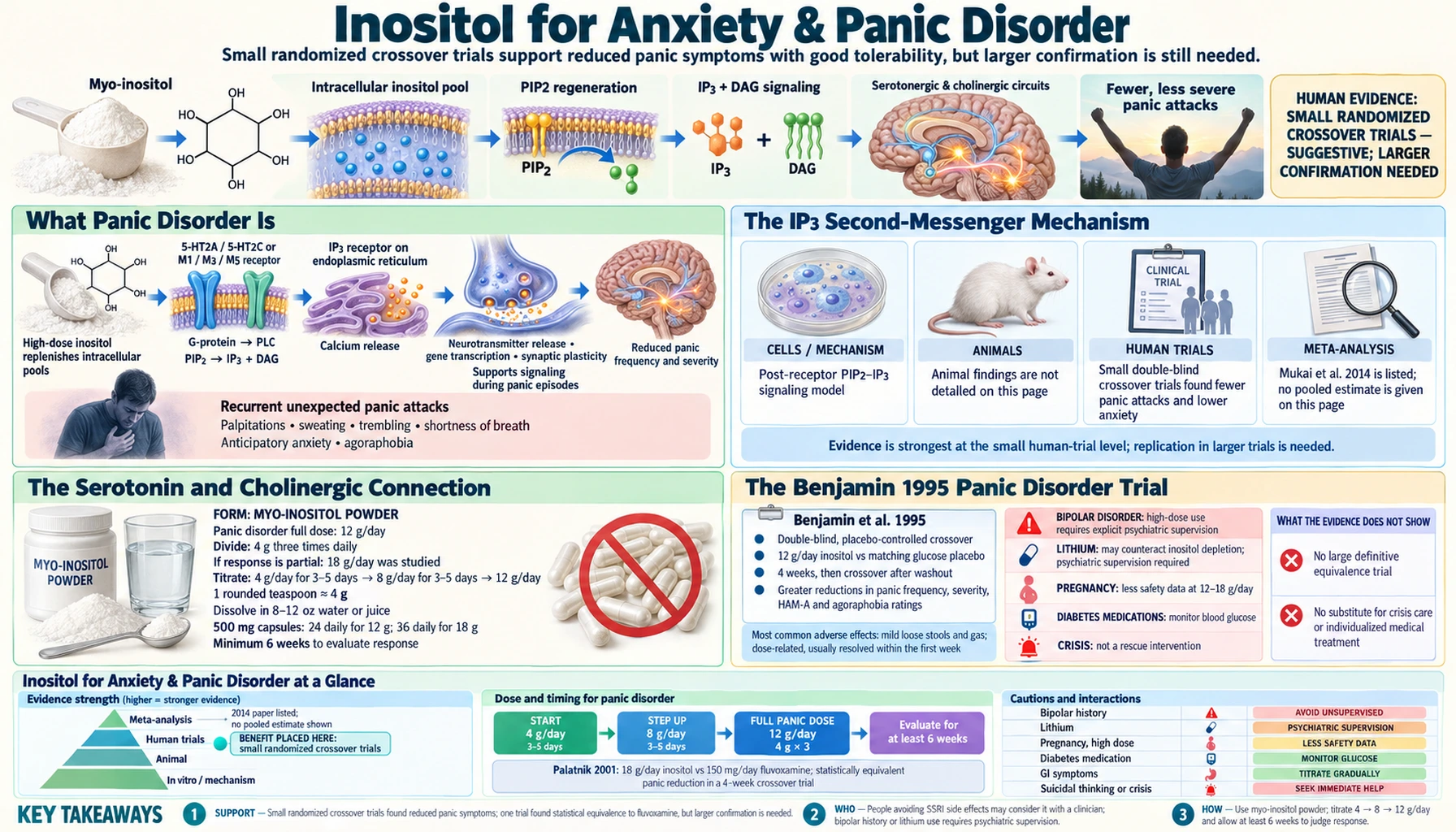
Inositol has been tested for panic disorder in a small number of small crossover trials. In the Benjamin 1995 trial, 21 patients completed 4 weeks each of 12 g/day inositol and placebo; panic attack frequency and severity and agoraphobia severity fell significantly more on inositol. In the Palatnik 2001 trial, 20 patients completed a month each of inositol (up to 18 g/day) and fluvoxamine (up to 150 mg/day, a prescription SSRI); anxiety, agoraphobia and global ratings improved similarly, inositol reduced weekly panic attacks more in the first month, and nausea and tiredness were more common on fluvoxamine. The Fux 1996 crossover trial in 13 patients with obsessive-compulsive disorder used 18 g/day. A 2014 meta-analysis that pooled the anxiety-disorder trials found no statistically significant effect of inositol on anxiety or obsessive-compulsive symptoms, and a 2022 international guideline taskforce found no nutraceutical other than N-acetylcysteine with sufficient evidence in any anxiety-related disorder. The proposed mechanism is the phosphatidylinositol (IP3) second-messenger system used by serotonin and cholinergic receptors. This page covers the trials, the proposed mechanism, the doses the trials used, and what the research says about safety.
Table of Contents
- What Panic Disorder Is
- The IP3 Second-Messenger Mechanism
- The Serotonin and Cholinergic Connection
- The Benjamin 1995 Panic Disorder Trial
- The Palatnik 2001 Trial — Inositol vs Fluvoxamine
- The Fux 1996 OCD Trial
- The Doses the Trials Used
- Inositol vs SSRIs — What the Evidence Compares
- Inositol Added to SSRIs — The Augmentation Trial
- Inositol in OCD-Spectrum Conditions, Bulimia and PMDD
- Trial Doses and Schedules at a Glance
- Common Questions and What the Research Says
- Safety Findings and Concerns Raised by the Research
- Key Research Papers
- Connections
- Featured Videos
What Panic Disorder Is
Panic disorder is a chronic anxiety condition characterized by recurrent, unexpected panic attacks — discrete episodes of intense fear that peak within minutes and include physical symptoms such as palpitations, sweating, trembling, shortness of breath, chest pain, nausea, dizziness, derealization, fear of losing control, and fear of dying. Between attacks, people often develop anticipatory anxiety (worry about the next attack) and sometimes agoraphobia (avoidance of situations where escape would be difficult or help unavailable). In the US National Comorbidity Survey Replication (Kessler 2006, 9,282 adults), lifetime prevalence was 3.7% for panic disorder without agoraphobia and 1.1% for panic disorder with agoraphobia.
Standard drug treatment includes antidepressants such as SSRIs, alongside cognitive-behavioral therapy; benzodiazepines are also used. A 2019 review of panic-disorder pharmacotherapy describes the standard drugs as having a slow therapeutic onset and several side effects, with most patients not responding fully. The Palatnik 2001 trial report opens by stating that only 70% of patients respond to current treatments for panic disorder and that many stop drugs because of side effects. An early fluvoxamine study in panic disorder described an initial increase in anxiety before gradual improvement.
Those limitations are why researchers tested inositol. Its trial record in panic disorder is two small crossover trials, both from the same research group in Beersheva, Israel, with no large confirmatory trial.
For the broader clinical picture of anxiety disorders, see the Anxiety page.
The IP3 Second-Messenger Mechanism
Inositol acts on intracellular signaling rather than by binding a receptor directly. Inositol is a key intermediate of the phosphatidylinositol (PI) cycle, a second-messenger system used by several noradrenergic, serotonergic and cholinergic receptors. When such a receptor is activated, a G-protein activates phospholipase C (PLC), which cleaves the membrane phospholipid PIP2 into two second messengers: diacylglycerol (DAG), which stays in the membrane and activates protein kinase C, and inositol 1,4,5-trisphosphate (IP3), which diffuses into the cytoplasm.
IP3 binds IP3 receptors on the endoplasmic reticulum, releasing calcium into the cytoplasm; this calcium signal influences neurotransmitter release, gene transcription and synaptic plasticity. PIP2 is regenerated from phosphatidylinositol, which is built from free inositol.
The research group that ran the trials proposed that pharmacological doses of inositol act through this cycle. The idea grew out of the inositol-depletion hypothesis of lithium (lithium lowers inositol levels), and out of experiments in which large doses of inositol reversed behavioral effects of lithium in animals and side effects of lithium in people. The same group reported low inositol in the cerebrospinal fluid of people with depression. How extra dietary inositol changes signaling in the human brain in panic disorder has not been shown directly; the mechanism remains a hypothesis.
The Serotonin and Cholinergic Connection
The 5-HT2A and 5-HT2C serotonin receptor subtypes signal through the IP3/DAG cascade. The serotonin research behind the inositol trials includes:
- The serotonin agonist m-CPP, used as a research probe, made panic-disorder patients more anxious in a 1988 study, and 60% of the 10 patients had panic attacks; healthy controls and depressed patients showed no notable behavioral response.
- The 5-HT2 antagonist ritanserin, by contrast, was ineffective for panic disorder in a 60-patient placebo-controlled trial (Den Boer 1990) in which fluvoxamine reduced panic attacks; the authors concluded their findings did not support 5-HT2 supersensitivity in panic disorder.
- Lithium is proposed to work partly by depleting brain inositol (the inositol-depletion hypothesis).
- Inositol has been reported to reverse desensitization of serotonin receptors, which was the rationale the trial group gave for testing it in OCD.
Muscarinic acetylcholine receptors also signal through the PI cycle. In the trial group's own summary, inositol 6 g daily for five days did not improve memory problems after electroconvulsive therapy, a test of the cholinergic route.
The Benjamin 1995 Panic Disorder Trial
The Benjamin et al. 1995 trial, published in the American Journal of Psychiatry, was the placebo-controlled trial that put inositol forward for panic disorder. The group had earlier found inositol effective for depression in a 4-week trial of 12 g/day (13 patients on inositol, 15 on placebo). What the abstract reports:
- Design: Double-blind, placebo-controlled, random-assignment crossover trial; 4 weeks of each treatment. Twenty-one patients with panic disorder, with or without agoraphobia, completed it.
- Dose: 12 g/day inositol.
- Results: The frequency and severity of panic attacks and the severity of agoraphobia declined significantly more after inositol than after placebo. A review by the same group gives p = .02 and describes the effect as comparable to that of imipramine in other studies.
- Side effects: Reported as minimal.
The authors concluded that inositol's efficacy, the absence of significant side effects, and the fact that it is a natural part of the diet made it a potentially attractive treatment for panic disorder. The trial was small and short, and its findings have not been tested in a larger placebo-controlled panic trial.
The Palatnik 2001 Trial — Inositol vs Fluvoxamine
The Palatnik et al. 2001 trial, published in the Journal of Clinical Psychopharmacology, compared inositol directly with an established drug for panic disorder. What the abstract reports:
- Design: Double-blind, controlled, random-order crossover trial. Twenty patients completed 1 month of inositol up to 18 g/day and 1 month of fluvoxamine up to 150 mg/day.
- Outcomes: Hamilton Rating Scale for Anxiety, agoraphobia scores, Clinical Global Impressions scale, and number of panic attacks per week.
- Efficacy results: Improvements in anxiety, agoraphobia and global-impression scores were similar for both treatments. In the first month, inositol reduced the number of panic attacks per week by a mean of 4.0 versus 2.4 with fluvoxamine (p = 0.049).
- Side effects: Nausea and tiredness were more common with fluvoxamine (p = 0.02 and p = 0.01). The abstract does not report percentages or sexual side effects.
The authors noted that inositol, as a natural compound with few known side effects, appeals to patients who are ambivalent about psychiatric medication, and they called for replication studies. A 20-patient crossover trial is not designed to prove two treatments equivalent, and no larger head-to-head trial has been published.
The Fux 1996 OCD Trial
Fux et al. 1996, published in the American Journal of Psychiatry, tested inositol in obsessive-compulsive disorder. What the abstract reports:
- Design: Double-blind, controlled crossover trial; 13 patients with OCD completed it. Inositol 18 g/day or placebo for 6 weeks each.
- Outcome: Yale-Brown Obsessive Compulsive Scale (Y-BOCS).
- Results: Y-BOCS scores were significantly lower on inositol than on placebo.
A follow-up trial by the same group (Fux 1999) added 18 g/day inositol or placebo to ongoing SSRI treatment in 10 OCD patients for 6 weeks each and found no significant difference. A 2011 review of nutraceuticals in OCD described the clinical evidence for myo-inositol as tentative and called for larger placebo-controlled trials.
The Doses the Trials Used
The psychiatric trials used doses measured in grams per day, far above the amounts studied for PCOS and fertility (covered on the PCOS and insulin-sensitivity page):
- Panic disorder: 12 g/day for 4 weeks (Benjamin 1995); up to 18 g/day for 1 month (Palatnik 2001)
- OCD: 18 g/day for 6 weeks, alone (Fux 1996) or added to an SSRI (Fux 1999)
- Depression: 12 g/day for 4 weeks (Levine 1995)
- Bulimia and binge eating: 18 g/day for 6 weeks (Gelber 2001)
- Trichotillomania: 6 to 18 g/day for 10 weeks (Leppink 2017)
The trial abstracts do not describe the form used or a titration schedule beyond Palatnik 2001's "up to" 18 g/day.
Inositol vs SSRIs — What the Evidence Compares
| Aspect | Inositol (12-18 g/day in trials) | SSRIs |
|---|---|---|
| Trials in panic disorder | Two small crossover trials (21 and 20 completers), one research group | Standard drug treatment; fluvoxamine reduced panic attacks in a 60-patient placebo-controlled trial (Den Boer 1990) |
| Pooled evidence | 2014 meta-analysis: no statistically significant effect on anxiety or obsessive-compulsive symptoms (4 anxiety-disorder trials, 70 patients) | Not covered by the sources on this page |
| Guideline view | 2022 WFSBP/CANMAT taskforce: no nutraceutical except N-acetylcysteine had sufficient evidence in any anxiety-related disorder | Listed among standard treatments in the 2019 review |
| Head-to-head side effects | Fewer reports of nausea and tiredness than fluvoxamine (Palatnik 2001) | Nausea and tiredness more common (Palatnik 2001) |
| Early anxiety increase | Not reported in the trial abstracts | Described with fluvoxamine in an early panic study |
| GI side effects | Marginally more gastrointestinal upset than placebo in the 2014 meta-analysis (p = 0.06) | Nausea more common than with inositol (Palatnik 2001) |
| Mania | A 1996 case-report letter raised the question of inositol-induced mania | Not covered by the sources on this page |
| Prescription required | No (sold as a supplement in the US) | Yes |
The comparison is uneven: SSRIs have a large trial base, while inositol's panic-disorder evidence rests on two small trials (21 and 20 completers), and the pooled analysis did not find a significant effect. Decisions about medicines and supplements belong with a clinician.
Inositol Added to SSRIs — The Augmentation Trial
The idea behind combining the two is that an SSRI raises synaptic serotonin while inositol acts on the signaling cascade downstream of some serotonin receptors. The one controlled test found here is Fux 1999: 10 OCD patients already on serotonin reuptake inhibitors took 18 g/day inositol or placebo for 6 weeks each in a double-blind crossover, and there was no significant difference on the Y-BOCS or the Hamilton depression and anxiety scales. No controlled trial of inositol added to an SSRI in panic disorder was found.
Inositol in OCD-Spectrum Conditions, Bulimia and PMDD
Inositol has been studied in several other conditions that respond to SSRIs, with mixed results:
- Bulimia nervosa and binge eating — in a double-blind crossover trial of 12 patients (Gelber 2001), 18 g/day inositol for 6 weeks was significantly better than placebo on the Global Clinical Impression, a visual analogue scale, and the Eating Disorders Inventory.
- Trichotillomania — in a 10-week placebo-controlled trial of 38 adults (Leppink 2017), inositol at 6 to 18 g/day did not reduce hair-pulling more than placebo on any primary or secondary outcome.
- Premenstrual dysphoric disorder (PMDD) — a crossover trial of 11 women taking 12 g/day myo-inositol in the luteal phase found no benefit over placebo (Nemets 2002); a later trial of lower-dose myo-inositol reported improvement on symptom and depression scales (Gianfranco 2011). The 2014 meta-analysis found a non-significant trend for depressive symptoms in PMDD (p = 0.07).
- Other anxiety disorders — the 2014 meta-analysis pooled one PTSD trial with the panic and OCD trials and found no significant effect on anxiety symptoms. No controlled trial in social anxiety disorder or generalized anxiety disorder was found.
- Conditions where the trial group found no benefit — in the group's 1997 summary, small controlled trials found no benefit in schizophrenia, Alzheimer's disease, autism or electroconvulsive-therapy memory problems, and a trend toward worsening in children with attention-deficit hyperactivity disorder.
Trial Doses and Schedules at a Glance
Panic disorder trials
- Benjamin 1995: 12 g/day inositol, 4 weeks, crossover against placebo
- Palatnik 2001: inositol up to 18 g/day for 1 month, crossover against fluvoxamine up to 150 mg/day for 1 month
OCD trials
- Fux 1996: 18 g/day inositol, 6 weeks, crossover against placebo
- Fux 1999: 18 g/day inositol added to ongoing SSRI treatment, 6 weeks, crossover against placebo (no significant difference)
These are the doses and durations the trials report, not instructions; the abstracts give no data on use beyond these short periods.
Common Questions and What the Research Says
Q: How fast did inositol act in the panic trials?
The trials measured effects after 4 weeks (Benjamin 1995) and 1 month (Palatnik 2001). Palatnik 2001 found a larger drop in weekly panic attacks with inositol than with fluvoxamine in the first month. Earlier time points are not reported in the abstracts.
Q: Has inositol been studied together with an SSRI?
In OCD only: the Fux 1999 augmentation trial added inositol to ongoing SSRI treatment in 10 patients and found no significant difference from placebo. The abstract does not report side effects of the combination.
Q: Has it been studied alongside benzodiazepines?
No trial found here tested inositol together with benzodiazepines.
Q: Does it cause emotional blunting?
The trial abstracts do not report on emotional blunting.
Q: What is known about long-term safety?
The trials described here were short; most gave each treatment for 4 to 6 weeks. The 1995 depression trial found no changes in hematology or in kidney or liver function at 12 g/day over 4 weeks. There is no good long-term safety data at 12-18 g/day.
Q: What side effects were reported?
The panic and OCD trial reports describe side effects as minimal. In the 2014 meta-analysis, inositol caused marginally more gastrointestinal upset than placebo (p = 0.06).
Safety Findings and Concerns Raised by the Research
- Bipolar disorder — a 1996 case-report letter in the American Journal of Psychiatry titled "Inositol-induced mania?" raised the possibility that inositol can trigger mania. The research raises a concern for people with bipolar disorder; the panic, OCD and bulimia trials did not study them.
- Lithium — lithium is thought to work partly by depleting brain inositol, and large doses of inositol reversed behavioral effects of lithium in animals and side effects of lithium in people. That raises a concern that high-dose inositol could counteract lithium's effect in people taking it.
- Pregnancy — the psychiatric trials were not pregnancy studies, and there is no good safety data on 12-18 g/day in pregnancy. Lower-dose myo-inositol in pregnancy is covered on the fertility and PCOS pages.
- Diabetes medicines — myo-inositol has been studied for insulin sensitivity (see the PCOS page); the anxiety trials did not report blood-glucose effects, and the combination with diabetes medicines at 12-18 g/day has not been studied.
- Crisis care — inositol was tested over weeks, not as an acute treatment. Panic attacks with suicidal thinking are a psychiatric emergency, and emergency services and crisis lines exist for that situation.
Key Research Papers
- Benjamin J, Levine J, Fux M, Aviv A, Levy D, Belmaker RH. (1995). Double-blind, placebo-controlled, crossover trial of inositol treatment for panic disorder. American Journal of Psychiatry, 152(7), 1084-1086. — PubMed PMID: 7793450
- Palatnik A, Frolov K, Fux M, Benjamin J. (2001). Double-blind, controlled, crossover trial of inositol versus fluvoxamine for the treatment of panic disorder. Journal of Clinical Psychopharmacology, 21(3), 335-339. — PubMed PMID: 11386498
- Fux M, Levine J, Aviv A, Belmaker RH. (1996). Inositol treatment of obsessive-compulsive disorder. American Journal of Psychiatry, 153(9), 1219-1221. — PubMed PMID: 8780431
- Levine J. (1997). Controlled trials of inositol in psychiatry. European Neuropsychopharmacology, 7(2), 147-155. — PubMed PMID: 9169302
- Mukai T, Kishi T, Matsuda Y, Iwata N. (2014). A meta-analysis of inositol for depression and anxiety disorders. Human Psychopharmacology, 29(1), 55-63. — PubMed PMID: 24424706
- Fux M, Benjamin J, Belmaker RH. (1999). Inositol versus placebo augmentation of serotonin reuptake inhibitors in the treatment of obsessive-compulsive disorder: a double-blind cross-over study. International Journal of Neuropsychopharmacology, 2(3), 193-195. — PubMed PMID: 11281989
- Belmaker RH, Bersudsky Y, Agam G, Levine J, Kofman O. (1996). How does lithium work on manic depression? Clinical and psychological correlates of the inositol theory. Annual Review of Medicine, 47, 47-56. — PubMed PMID: 8712796
- Benjamin J, Agam G, Levine J, Bersudsky Y, Kofman O, Belmaker RH. (1995). Inositol treatment in psychiatry. Psychopharmacology Bulletin, 31(1), 167-175. — PubMed PMID: 7675981
- Levine J, Barak Y, Gonzalves M, Szor H, Elizur A, Kofman O, Belmaker RH. (1995). Double-blind, controlled trial of inositol treatment of depression. American Journal of Psychiatry, 152(5), 792-794. — PubMed PMID: 7726322
- Camfield DA, Sarris J, Berk M. (2011). Nutraceuticals in the treatment of obsessive compulsive disorder (OCD): a review of mechanistic and clinical evidence. Progress in Neuro-Psychopharmacology and Biological Psychiatry, 35(4), 887-895. — PubMed PMID: 21352883
- Gelber D, Levine J, Belmaker RH. (2001). Effect of inositol on bulimia nervosa and binge eating. International Journal of Eating Disorders, 29(3), 345-348. — PubMed PMID: 11262515
- Leppink EW, Redden SA, Grant JE. (2017). A double-blind, placebo-controlled study of inositol in trichotillomania. International Clinical Psychopharmacology, 32(2), 107-114. — PubMed PMID: 27824633
- Nemets B, Talesnick B, Belmaker RH, Levine J. (2002). Myo-inositol has no beneficial effect on premenstrual dysphoric disorder. World Journal of Biological Psychiatry, 3(3), 147-149. — PubMed PMID: 12478879
- Gianfranco C, Vittorio U, Silvia B, Francesco D. (2011). Myo-inositol in the treatment of premenstrual dysphoric disorder. Human Psychopharmacology, 26(7), 526-530. — PubMed PMID: 22031267
- Levine J, Witztum E, Greenberg BD, Barak Y. (1996). Inositol-induced mania? American Journal of Psychiatry, 153(6), 839 (letter). — PubMed PMID: 8633705
- Den Boer JA, Westenberg HG. (1990). Serotonin function in panic disorder: a double blind placebo controlled study with fluvoxamine and ritanserin. Psychopharmacology, 102(1), 85-94. — PubMed PMID: 1697419
- Westenberg HG, den Boer JA. (1989). Serotonin-influencing drugs in the treatment of panic disorder. Psychopathology, 22(Suppl 1), 68-77. — PubMed PMID: 2498967
- Kahn RS, Wetzler S, van Praag HM, Asnis GM, Strauman T. (1988). Behavioral indications for serotonin receptor hypersensitivity in panic disorder. Psychiatry Research, 25(1), 101-104. — PubMed PMID: 3217461
- Kessler RC, Chiu WT, Jin R, Ruscio AM, Shear K, Walters EE. (2006). The epidemiology of panic attacks, panic disorder, and agoraphobia in the National Comorbidity Survey Replication. Archives of General Psychiatry, 63(4), 415-424. — PubMed PMID: 16585471
- Zulfarina MS, Syarifah-Noratiqah SB, Nazrun SA, Sharif R, Naina-Mohamed I. (2019). Pharmacological therapy in panic disorder: current guidelines and novel drugs discovery for treatment-resistant patient. Clinical Psychopharmacology and Neuroscience, 17(2), 145-154. — PubMed PMID: 30905115
- Sarris J, Ravindran A, Yatham LN, et al. (2022). Clinician guidelines for the treatment of psychiatric disorders with nutraceuticals and phytoceuticals: the World Federation of Societies of Biological Psychiatry (WFSBP) and Canadian Network for Mood and Anxiety Treatments (CANMAT) Taskforce. World Journal of Biological Psychiatry, 23(6), 424-455. — PubMed PMID: 35311615
PubMed Topic Searches
Connections
- All Vitamins
- Inositol Overview
- Inositol Benefits Hub
- Inositol for PCOS & Insulin Sensitivity
- Inositol for Fertility & Egg Quality
- Inositol for Bipolar & Depression
- Anxiety
- Panic Disorder — the condition in which high-dose inositol was tested in two small crossover trials.
- OCD
- Bipolar Disorder
- Depression
- Insomnia
- Choline
- Vitamin B6
- Magnesium
- Fasting
- History