Inositol — Benefits Deep Dive
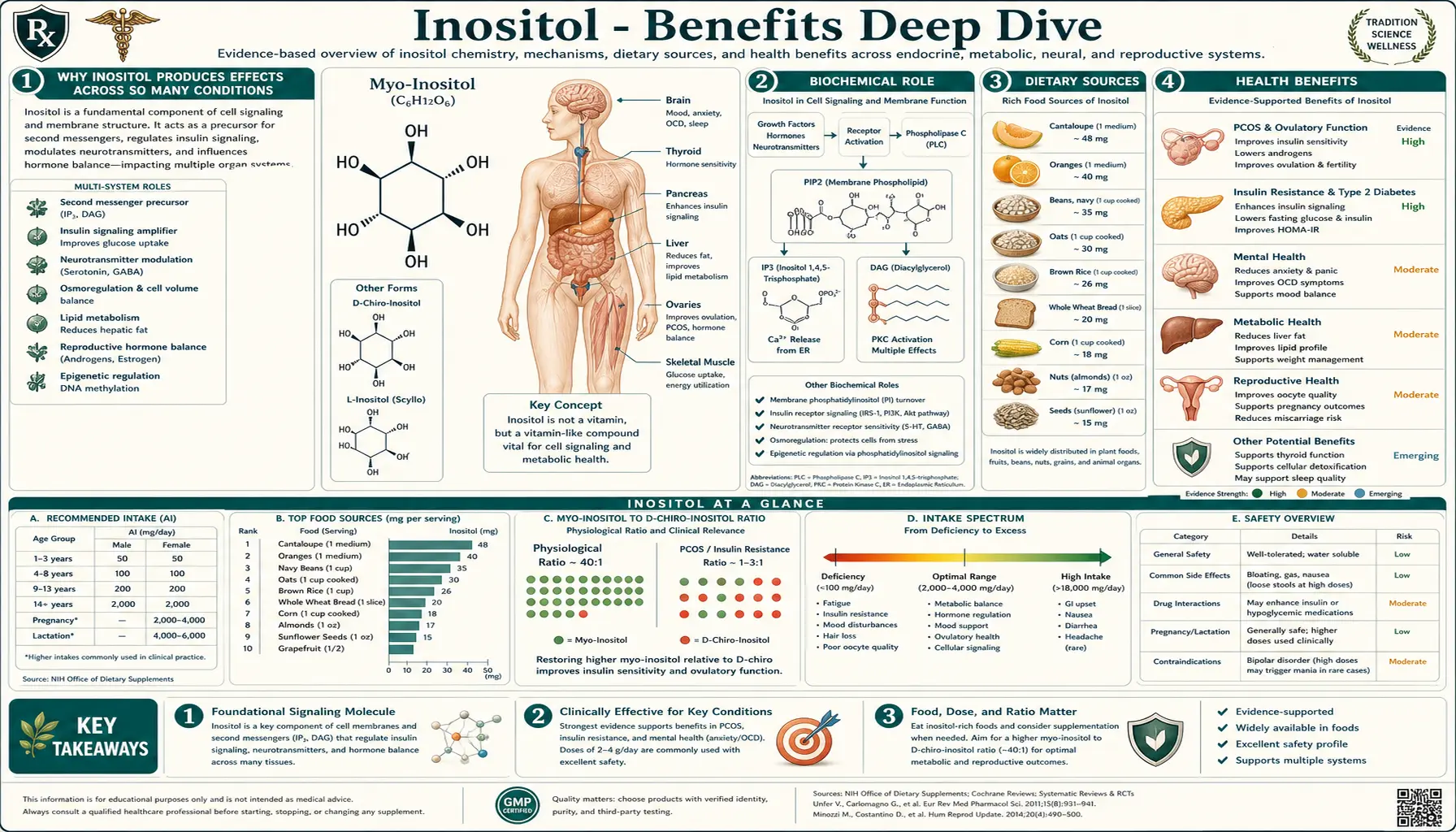
Inositol produces clinically meaningful effects across an unusually wide range of conditions because a single biochemical role — serving as the structural backbone of the phosphoinositide second-messenger system — underlies cellular response to insulin, follicle-stimulating hormone (FSH), thyroid-stimulating hormone (TSH), and serotonin. When intracellular myo-inositol falls or the myo/D-chiro ratio drifts out of physiological balance, the downstream signaling deficits manifest as polycystic ovary syndrome (PCOS), panic disorder, obsessive-compulsive disorder (OCD), bipolar instability, infertility, gestational diabetes, and metabolic syndrome. Each benefit page below explores one specific therapeutic application in clinical-trial depth.
Deep-Dive Articles
Polycystic Ovary Syndrome & Insulin Sensitivity
One of the most-studied uses. The Genazzani trials, Unfer meta-analyses, and the 40:1 myo-inositol to D-chiro-inositol ratio that mirrors human plasma physiology. What trials of 4 g/day myo-inositol with 100 mg D-chiro-inositol report on ovulation, free testosterone, luteinizing hormone (LH)/follicle-stimulating hormone and hemoglobin A1c (HbA1c), and how inositol compares with metformin. The 2024 review prepared for the international guideline (30 trials, 2,230 women) found possible benefits for some metabolic measures and, with D-chiro-inositol, for ovulation, fewer (mostly mild) stomach and gut side effects with myo-inositol than with metformin, and called the evidence “limited and inconclusive.” Mechanism deep-dive on inositol phosphoglycans as the insulin second messenger, which researchers have proposed is deficient in polycystic ovary syndrome.
Read the deep dive →Anxiety & Panic Disorder
The Benjamin 1995 panic disorder trial (21 patients, 12 g/day inositol vs placebo) and the Palatnik 2001 trial against fluvoxamine (20 patients, inositol up to 18 g/day; similar improvement, with nausea and tiredness more common on fluvoxamine). The Fux 1996 obsessive-compulsive disorder trial at 18 g/day (13 patients). The inositol trisphosphate (IP3) second-messenger mechanism behind serotonergic and cholinergic signaling. What the small trials report for obsessive-compulsive disorder, panic disorder, and bulimia — and why the doses used in the trials (12–18 g/day) are usually taken as powder.
Read the deep dive →Fertility & Egg Quality
The Papaleo 2009 in vitro fertilization (IVF) trial on egg (oocyte) quality was retracted by its journal in 2025, so its reported findings are not repeated here; several other inositol trials sharing authors with it have also been retracted since 2023. Mitochondrial-function support in the maturing oocyte. The male-fertility data on sperm motility and DNA fragmentation. Pre-conception regimens studied, and the combination of inositol with melatonin, coenzyme Q10 (CoQ10), and dehydroepiandrosterone (DHEA) used in IVF at older maternal age.
Read the deep dive →Bipolar & Depression
The Levine 1995 inositol-for-depression trial (28 patients, 12 g/day, 4 weeks). Augmentation strategy in treatment-resistant depression. The critical bipolar caution — inositol can precipitate mania in vulnerable individuals (mechanistically the opposite of lithium, which depletes brain inositol by inhibiting inositol monophosphatase (IMPase)). Eating-disorder trials, the lithium-inositol pharmacological opposition, and who the research raises concerns for.
Read the deep dive →Table of Contents
- Deep-Dive Articles
- Why Inositol Produces Effects Across So Many Conditions
- Myo-Inositol and Gestational Diabetes in the Cochrane Review
- Polycystic Ovary Syndrome Is Now Called Polyendocrine Metabolic Ovarian Syndrome
- Research Papers: Polycystic Ovary Syndrome & Insulin Sensitivity
- Research Papers: Anxiety, Obsessive-Compulsive Disorder & Panic
- Research Papers: Fertility & Egg Quality
- Research Papers: Bipolar, Depression & Mental Health
- Research Papers: Cross-Cutting (Forms, Safety, Mechanism)
- External Authoritative Resources
- Connections
- Featured Videos
Why Inositol Produces Effects Across So Many Conditions
Most nutraceuticals have one or two primary mechanisms of action that produce a narrow range of clinical effects. Inositol is unusual because a single underlying mechanism — its role as the structural backbone of the phosphoinositide second-messenger system — couples it to four distinct hormonal cascades, and each maps to a different category of clinical benefit:
- Insulin signal transduction — myo-inositol and D-chiro-inositol form the inositol phosphoglycan (IPG) second messengers that translate insulin receptor binding into glucose uptake and glycogen synthesis. Researchers have proposed IPG deficiency as a cellular defect in polycystic ovary syndrome, insulin resistance, type 2 diabetes, and metabolic syndrome.
- Follicle-stimulating hormone and reproductive hormone signaling — the same phosphoinositide pathway mediates follicle-stimulating hormone response in the ovary. The 100:1 myo-to-D-chiro ratio in follicular fluid is what supports normal oocyte maturation and is the basis for inositol's fertility benefits in both polycystic ovary syndrome-related and idiopathic infertility, including IVF outcomes.
- Serotonin and cholinergic neurotransmission — serotonin 5-HT2A/2C receptors and muscarinic acetylcholine receptors operate through the inositol trisphosphate/diacylglycerol (IP3/DAG) cascade. Restoring inositol availability supports panic disorder, obsessive-compulsive disorder, and certain anxiety circuits in which serotonergic signaling has become dysregulated.
- Mood-circuit signaling and the lithium paradox — lithium's mood-stabilizing mechanism partly involves inhibiting inositol monophosphatase (IMPase), depleting brain inositol. This makes inositol therapeutically interesting in depression but creates the bipolar-disorder mania-risk caution that defines its clinical use in mental health.
Additional mechanisms operate as well — the thyroid-stimulating hormone receptor uses the same phosphoinositide cascade (relevant to Hashimoto's thyroiditis with selenium combination therapy), inositol is independently required for neural tube closure (folate-independent pathway, relevant to gestational supplementation), and scyllo-inositol stabilizes non-toxic amyloid-beta conformations (early Alzheimer's research). The combination is why inositol shows up across endocrinology, psychiatry, reproductive medicine, dermatology, and metabolic medicine with a credible mechanistic story in each case.
The psychiatric trials behind these uses were small. The original placebo-controlled trials came from one Israeli research group and used 12–18 g of inositol a day: 28 patients with depression for 4 weeks (Levine 1995, whose authors wrote that “replication is crucial”), 21 with panic disorder in a 4-week crossover trial (Benjamin 1995) and 13 with obsessive-compulsive disorder in a 6-week crossover trial (Fux 1996). In a later one-month crossover trial in 20 people with panic disorder, inositol (up to 18 g/day) and the antidepressant fluvoxamine (up to 150 mg/day) gave similar improvements on anxiety and agoraphobia scores; in the first month, panic attacks fell by 4.0 a week on inositol and by 2.4 on fluvoxamine, and nausea and tiredness were more common on fluvoxamine (Palatnik 2001).
Myo-Inositol and Gestational Diabetes in the Cochrane Review
A 2023 Cochrane review pooled seven randomized trials in 1,319 women who were 10 to 24 weeks pregnant (six trials in Italy, one in Ireland). Myo-inositol may lower the rate of gestational diabetes (risk ratio 0.53, 95% confidence interval 0.31 to 0.90; 6 trials, 1,140 women), high blood pressure disorders of pregnancy (risk ratio 0.34) and preterm birth (risk ratio 0.35), but the reviewers rated the certainty of the evidence low to very low. The trials were small, doses and timing differed, and none reported stillbirth or newborn death (Motuhifonua 2023).
Polycystic Ovary Syndrome Is Now Called Polyendocrine Metabolic Ovarian Syndrome
In 2026 polycystic ovary syndrome received a new name, polyendocrine metabolic ovarian syndrome (PMOS), which reflects an understanding of the condition as a lifelong endocrine and metabolic disorder rather than mainly a reproductive one. It affects 10–13% of women of reproductive age. According to a 2026 review, insulin resistance affects 75% of lean and 95% of overweight women with the condition, and population studies report an almost 3-fold higher risk of type 2 diabetes (Forslund 2026). Most inositol research, including the trials on this page, uses the older name.
Research Papers: Polycystic Ovary Syndrome & Insulin Sensitivity
- Unfer V et al. (2017) — meta-analysis of myo-inositol in PCOS — PubMed: Unfer meta-analysis
- Genazzani AD et al. — myo-inositol in PCOS oligomenorrhea — PubMed: Genazzani PCOS trials
- Costantino D et al. (2009) — metabolic and hormonal effects of myo-inositol in PCOS — PubMed: Costantino 2009
- Nordio M, Proietti E (2012) — combined myo + D-chiro vs myo alone in PCOS — PubMed: Nordio Proietti combined therapy
- Fitz V, Graca S, Mahalingaiah S, Liu J, Lai L, Butt A, Armour M, Rao V, Naidoo D, Maunder A, Yang G, Vaddiparthi V, Witchel SF, Pena A, Spritzer PM, Li R, Tay C, Mousa A, Teede H, Ee C. (2024). Inositol for Polycystic Ovary Syndrome: A Systematic Review and Meta-analysis to Inform the 2023 Update of the International Evidence-based PCOS Guidelines. Journal of Clinical Endocrinology and Metabolism, 109(6), 1630-1655. — PubMed PMID: 38163998
- Forslund M, Melin J, Joham AE, Piltonen TT, Rees DA, Teede HJ. (2026). Recent advances in polyendocrine metabolic ovarian syndrome, formerly polycystic ovary syndrome, with emphasis on endocrine and metabolic dysfunction and cardiovascular risk. Journal of Internal Medicine, 300(5), 590-609. — PubMed PMID: 42669621
- Bizzarri M et al. (2014) — history of inositol therapy in PCOS — PubMed: Bizzarri 2014
- Myo-inositol vs metformin head-to-head in PCOS — PubMed: myo-inositol vs metformin
- Inositol phosphoglycan (IPG) second messengers in insulin signaling — PubMed: IPG insulin signaling
- The 40:1 myo to D-chiro inositol ratio in PCOS — PubMed: 40:1 ratio PCOS
- Epimerase deficiency and the PCOS insulin resistance paradox — PubMed: epimerase PCOS
- Inositol in metabolic syndrome — postmenopausal women trial — PubMed: inositol metabolic syndrome
- D-chiro-inositol in type 2 diabetes — PubMed: D-chiro-inositol type 2 diabetes
Research Papers: Anxiety, Obsessive-Compulsive Disorder & Panic
- Benjamin J, Levine J, Fux M, Aviv A, Levy D, Belmaker RH. (1995). Double-blind, placebo-controlled, crossover trial of inositol treatment for panic disorder. American Journal of Psychiatry, 152(7), 1084-6. — PubMed PMID: 7793450
- Palatnik A, Frolov K, Fux M, Benjamin J. (2001). Double-blind, controlled, crossover trial of inositol versus fluvoxamine for the treatment of panic disorder. Journal of Clinical Psychopharmacology, 21(3), 335-9. — PubMed PMID: 11386498
- Fux M, Levine J, Aviv A, Belmaker RH. (1996). Inositol treatment of obsessive-compulsive disorder. American Journal of Psychiatry, 153(9), 1219-21. — PubMed PMID: 8780431
- Levine J (1997) — controlled trials of inositol in psychiatry — PubMed: Levine 1997 review
- Mukai T et al. (2014) — meta-analysis of inositol for depression and anxiety disorders — PubMed: Mukai meta-analysis
- Inositol augmentation of selective serotonin reuptake inhibitors (SSRIs) in obsessive-compulsive disorder — PubMed: inositol SSRI augmentation in obsessive-compulsive disorder
- Inositol in bulimia nervosa — PubMed: inositol bulimia
- Serotonin 5-HT2 receptor phosphoinositide signaling and inositol depletion — PubMed: 5-HT2 phosphoinositide
- High-dose inositol pharmacokinetics and cerebrospinal fluid (CSF) penetration — PubMed: inositol pharmacokinetics cerebrospinal fluid
- Inositol in social anxiety disorder — PubMed: inositol social anxiety
Research Papers: Fertility & Egg Quality
- Papaleo E, Unfer V, Baillargeon JP, Fusi F, Occhi F, De Santis L. (2009). Myo-inositol may improve oocyte quality in intracytoplasmic sperm injection cycles. A prospective, controlled, randomized trial. Fertility and Sterility, 91(5), 1750-1754. — PubMed PMID: 18462730 — Retracted (retraction notice: PubMed PMID: 39971415)
- Colazingari S et al. (2013) — combined myo + D-chiro vs D-chiro alone in IVF — PubMed: Colazingari IVF combined
- Ghaemi SR et al. (2024) — myo-inositol on sperm quality and IVF outcomes, systematic review — PubMed: Ghaemi sperm IVF SR
- Myo-inositol and oocyte mitochondrial function — PubMed: inositol oocyte mitochondria
- Follicular fluid myo-inositol concentrations and oocyte quality — PubMed: follicular fluid myo-inositol
- Myo-inositol in sperm motility and DNA fragmentation — PubMed: inositol sperm motility
- Inositol + melatonin + CoQ10 combination for poor responder IVF — PubMed: inositol melatonin CoQ10 IVF
- D'Anna R et al. (2015) — myo-inositol for gestational diabetes prevention — PubMed: D'Anna gestational diabetes
- Motuhifonua SK, Lin L, Alsweiler J, Crawford TJ, Crowther CA. (2023). Antenatal dietary supplementation with myo-inositol for preventing gestational diabetes. Cochrane Database of Systematic Reviews, 2(2), CD011507. — PubMed PMID: 36790138
- Inositol and neural tube defect prevention (folate-independent) — PubMed: inositol NTD prevention
Research Papers: Bipolar, Depression & Mental Health
- Levine J, Barak Y, Gonzalves M, Szor H, Elizur A, Kofman O, Belmaker RH. (1995). Double-blind, controlled trial of inositol treatment of depression. American Journal of Psychiatry, 152(5), 792-4. — PubMed PMID: 7726322
- Eden Evins A et al. — inositol augmentation in bipolar depression — PubMed: Eden Evins bipolar augmentation
- Nierenberg AA et al. — STEP-BD inositol vs lamotrigine vs risperidone in bipolar depression — PubMed: STEP-BD inositol
- Berridge MJ et al. (1989) — inositol depletion hypothesis of lithium action — PubMed: Berridge inositol depletion
- Lithium inhibition of inositol monophosphatase (IMPase) — PubMed: lithium IMPase
- Magnetic resonance spectroscopy (MRS) studies of brain myo-inositol in bipolar disorder — PubMed: magnetic resonance spectroscopy myo-inositol bipolar
- Case reports of inositol-induced mania in vulnerable patients — PubMed: inositol-induced mania
- Anterior cingulate cortex myo-inositol in adolescent depression — PubMed: anterior cingulate myo-inositol depression
- Levine J et al. — inositol in eating disorders (bulimia) — PubMed: Levine bulimia inositol
- Inositol in postpartum depression — PubMed: inositol postpartum depression
Research Papers: Cross-Cutting (Forms, Safety, Mechanism)
- Berridge MJ et al. (1984) — IP3 as the canonical second messenger in cellular signal transduction — PubMed: Berridge IP3 Nature 1984
- Endogenous renal synthesis of myo-inositol — PubMed: renal myo-inositol synthesis
- Pharmacokinetics of myo-inositol vs D-chiro-inositol — PubMed: MI/DCI pharmacokinetics
- Inositol + selenium for Hashimoto's thyroiditis (Nordio, Monastra) — PubMed: inositol + selenium Hashimoto's
- Scyllo-inositol and amyloid-beta in Alzheimer's disease — PubMed: scyllo-inositol AD
- D-pinitol cognitive outcomes in early Alzheimer's — PubMed: D-pinitol AD
- Inositol safety profile in pregnancy (RCT pooled data) — PubMed: inositol pregnancy safety
- Sortino MA et al. (2020) — biomedical uses of inositols, nutraceutical review — PubMed: Sortino 2020 review
- Santamaria A et al. (2022) — myo-inositol across IR, MetS, PCOS, GDM — PubMed: Santamaria 2022 review
- Inositol and oral contraceptive interaction in PCOS hormonal management — PubMed: inositol oral contraceptive interaction
External Authoritative Resources
Connections
- All Vitamins
- Inositol (Main Page)
- Inositol for Polycystic Ovary Syndrome & Insulin Sensitivity
- Inositol for Anxiety & Panic
- Inositol for Fertility & Egg Quality
- Inositol for Bipolar & Depression
- Choline
- Folate (B9)
- Vitamin B6
- Magnesium
- Selenium
- Polycystic Ovary Syndrome
- Insulin Resistance
- Metabolic Syndrome
- Anxiety
- Depression
- Obsessive-Compulsive Disorder
- Bipolar Disorder
- Gestational Diabetes
- History