Microplastics and Nanoplastics: What We Know About Sources, Body Burden, and Emerging Health Risks
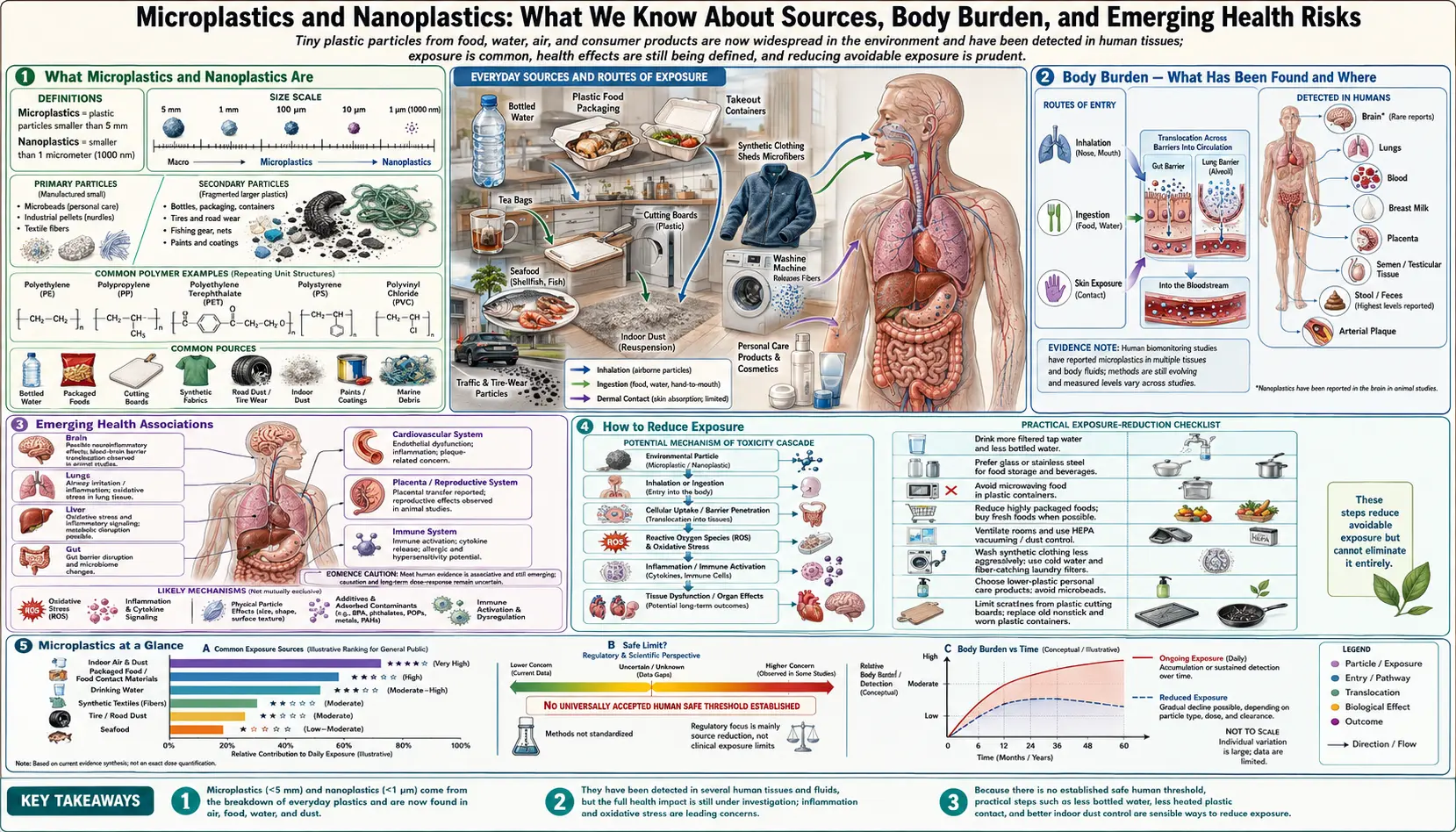
Microplastics — plastic particles from 1 µm up to 5 mm — and their smaller siblings nanoplastics (smaller than 1 µm) have been measured in water, food, air and dust, and in a growing list of human tissues. Studies since 2019 have reported plastic particles in stool, blood, lungs, placenta, breast milk, testes, liver, kidney, brain and atherosclerotic plaque. A 2024 observational study in the New England Journal of Medicine reported that patients whose carotid-artery plaque contained micro- and nanoplastics had a hazard ratio of 4.53 for heart attack, stroke or death over a mean of about 34 months. The field is young: measurement methods are still being validated, most findings come from single studies, and official assessments describe the information as too limited to settle whether current exposure affects health.
This article covers what microplastics and nanoplastics are, where exposure comes from, how intake has been estimated, what has been found in the body, the health associations reported so far, the open questions, and the regulatory actions taken.
Table of Contents
- What Microplastics and Nanoplastics Are
- Major Exposure Sources
- How Much Are We Actually Taking In?
- Body Burden — What Has Been Found and Where
- Emerging Health Associations
- Proposed Mechanisms
- What We Do Not Know, Stated Plainly
- Official Assessments and Regulation
- What Studies Report About Lowering Exposure
- Claims the Evidence Does Not Support
- Testing: What Exists and What Does Not
- Pregnancy, Infants and Higher-Exposure Groups
- Key Research Papers
- Connections
- Featured Videos
What Microplastics and Nanoplastics Are
Microplastics are plastic particles from about 1 µm to 5 mm — from the size of a sesame seed down to invisibility. Nanoplastics are smaller than 1 µm. Size decides what a particle can do in the body. The World Health Organization’s 2019 drinking-water report described particles larger than 150 µm as unlikely to be absorbed, uptake of smaller particles as expected to be limited, and data on the absorption of nano-sized particles as extremely scarce.
Particle counts and mass estimates tell very different stories. A 2026 tissue-imaging study of human placenta found that 73% of the particles it detected were smaller than 1 µm; the authors noted that this number-dominant fraction carries so little mass that it falls below the detection limits of the bulk pyrolysis methods most tissue studies use (Wouters 2026). The smallest particles are the hardest to measure, and they are the ones most able to cross biological barriers in laboratory and animal studies.
They come in two categories by origin:
- Primary microplastics — manufactured small: microbeads in cosmetics (now restricted in a number of countries, including the European Union), industrial pellets (“nurdles”), and abrasives.
- Secondary microplastics — larger plastic items broken down by ultraviolet light, heat, mechanical abrasion and weathering. A carrier bag, a car tyre or a fleece jacket does not disappear; it becomes progressively smaller pieces of itself.
Chemically they are not one substance. Polyethylene, polypropylene, polyvinyl chloride, polystyrene, polyethylene terephthalate and polyamide behave differently, carry different additives, and adsorb different contaminants from their surroundings. Studies that report “microplastics” as a single exposure are aggregating a chemically diverse mixture, which is one of the main reasons the health literature is hard to synthesise.
Major Exposure Sources
Exposure happens by three routes — ingestion, inhalation and, to a much lesser degree, skin contact.
Drinking water
- Bottled water. Qian and colleagues (PNAS, 2024) used stimulated Raman scattering microscopy, an imaging technique able to identify single particles below 100 nm, and estimated about 240,000 (±130,000) micro- and nanoplastic particles per litre of bottled water — about 90% of them nanoplastics, and, in the authors’ words, orders of magnitude more than the microplastic abundance reported previously in bottled water.
- Tap versus bottled. A 2019 modelling study estimated that people meeting their water intake only from bottled water may ingest an additional 90,000 microplastic particles a year, compared with 4,000 for those drinking only tap water (Cox 2019). That estimate predates the nanoplastic counts above.
Food
- Shellfish and small whole fish, because the whole animal including its gut is eaten.
- Salt, including sea salt, in which microplastics have been reported.
- Food contact materials — plastic packaging, containers, plastic-lined cups and cartons, cutting boards and plastic tea bags. Steeping a single plastic (nylon or PET) teabag at 95 °C released about 11.6 billion microplastic and 3.1 billion nanoplastic particles into one cup in a 2019 laboratory study (Hernandez 2019); the study drew a published comment and an authors’ reply.
- Heat increases release. In a 2023 study of plastic containers and reusable food pouches, microwave heating caused the highest release of any usage scenario tested, with some containers releasing as many as 4.22 million microplastic and 2.11 billion nanoplastic particles from one square centimetre of plastic within 3 minutes; refrigeration and room-temperature storage for over six months also released millions to billions of particles (Hussain 2023). The paper drew a published correspondence and an authors’ rebuttal.
- Cutting boards. Based on the authors’ assumptions, a 2023 study estimated a per-person exposure of 14.5 to 71.9 million polyethylene microplastics a year from a polyethylene board and 79.4 million from a polypropylene board (Yadav 2023).
Air and dust
- Indoor air and settled dust. The first study to investigate fibres in both indoor and outdoor air measured 1.0–60.0 fibres/m³ indoors against 0.3–1.5 outdoors; about two-thirds of indoor fibres were natural (mostly cellulose) and about a third contained petrochemical polymers. The authors described the fibres as mostly too large to inhale, with exposure possible through dust ingestion, particularly for young children (Dris 2017).
- Tyre and road wear particles. A 2017 review estimated per-capita tyre-wear emissions of 0.23 to 4.7 kg a year, substantially higher than other microplastic sources it compared, and estimated that 3–7% of fine particulate matter (PM2.5) in air consists of tyre wear (Kole 2017).
- Synthetic textiles shed fibres while worn and in the wash; one laboratory study estimated that over 700,000 fibres could be released from an average 6 kg wash load of acrylic fabric (Napper & Thompson 2016). That figure concerns release to wastewater, not personal intake.
How Much Are We Actually Taking In?
The best-known figure is that people swallow “a credit card a week” — about 5 g of plastic. It was publicised by WWF in 2019 from an analysis by researchers at the University of Newcastle, Australia, later published in peer-reviewed form.
That paper, Senathirajah and colleagues (Journal of Hazardous Materials, 2021; one co-author was affiliated with WWF), extracted data from 59 publications, converted particle counts to mass, and estimated that humans may ingest on average 0.1–5 g of microplastics per week. The credit-card figure is the top of that range.
Other estimates are far lower. A 2021 probabilistic lifetime model by Mohamed Nor and colleagues (Environmental Science & Technology), covering eight food types plus inhalation and particles of 1–5,000 µm, estimated median intakes of 883 particles (583 ng) per day for adults and 553 particles (184 ng) per day for children, and found that its simulated stool concentrations agreed with measured data. An earlier count-based estimate by Cox and colleagues (Environmental Science & Technology, 2019), covering about 15% of Americans’ caloric intake, put annual consumption at 39,000 to 52,000 particles depending on age and sex, rising to 74,000–121,000 when inhalation was included; the authors described their figures as likely underestimates.
All of these are models built on incomplete sampling of a small number of foods, and they disagree with one another by large margins. Intake is real and measurable; a precise weekly mass is not known.
Body Burden — What Has Been Found and Where
Since 2019 studies have moved from estimating exposure to measuring particles in human samples. Plastic particles have been reported in:
- Stool — Schwabl and colleagues (Annals of Internal Medicine, 2019) found microplastics in all 8 stool samples from 8 volunteers, a median of 20 particles (50–500 µm) per 10 g.
- Blood — Leslie and colleagues (Environment International, 2022) measured plastic particles of 700 nm and larger in whole blood from 22 healthy volunteers, at a mean summed concentration of 1.6 µg/mL; polyethylene terephthalate, polyethylene and styrene polymers were the most widely encountered. The authors described it as the first measurement of the mass concentration of plastic in human blood.
- Placenta — Ragusa and colleagues (Environment International, 2021) found 12 microplastic fragments (5–10 µm) in four of six placentas, on the fetal side, the maternal side and in the membranes. A 2024 study using pyrolysis gas chromatography–mass spectrometry (Py-GC-MS) reported plastics in all 62 placentas tested, at 6.5 to 685 µg per gram, mostly polyethylene (Garcia 2024).
- Lung — Jenner and colleagues (2022) identified 39 microplastics in 11 of 13 lung tissue samples, at levels significantly above their procedural blanks.
- Breast milk — a pilot study found microplastics (2–12 µm) in 26 of 34 samples (Ragusa 2022).
- Testis and semen — Zhao and colleagues (Science of the Total Environment, 2023) detected microplastics in 6 testis and 30 semen samples. A 2024 Py-GC-MS study reported microplastics in all 23 human testes tested, a mean of 328.44 µg/g, mostly polyethylene (Hu 2024); it drew a published comment and an authors’ response.
- Arterial plaque — Marfella and colleagues (NEJM, 2024), discussed below.
- Brain, liver and kidney — Nihart and colleagues (Nature Medicine, 2025) measured plastics in autopsy tissue by Py-GC-MS. In 2024 samples the median was 433 µg/g in liver, 404 µg/g in kidney and 4,917 µg/g in frontal cortex; concentrations were higher in 2024 than in 2016 samples in liver and brain, and higher again (median 26,076 µg/g) in 12 brains from people with a dementia diagnosis. The authors noted that brain atrophy, impaired blood–brain barrier integrity and poor clearance in dementia would be anticipated to increase these concentrations, and that no causality is assumed from the findings. An author correction (2025) fixed duplicated supplementary images and mis-sized scale bars.
How reliable are these numbers? Contamination during collection and analysis is a serious problem: plastic labware, laboratory air and clothing all shed particles. A 2026 screening of 133 datasets from 101 studies of microplastics in human organs, tissues and fluids found that none met all essential quality-assurance criteria; the authors judged the current value of these data to lie mainly in pioneering exploratory research, and wrote that some findings warrant careful evaluation of biological plausibility (Lane 2026). A specific concern applies to Py-GC-MS, the method behind the blood, plaque, brain, placenta and testis mass figures: reviews of the method describe interference from lipids in measuring polyethylene in biological samples as a recognised problem (Almeida 2026; Zhang 2026). The brain-study authors wrote that their potassium-hydroxide digestion was designed to reduce that concern.
Emerging Health Associations
The cardiovascular finding
The most widely cited human outcome study is Marfella and colleagues in the New England Journal of Medicine (2024). They enrolled 304 patients undergoing carotid endarterectomy for asymptomatic carotid artery disease in Italy; 257 completed a mean follow-up of 33.7 months. Polyethylene was detected in the plaque of 150 patients (58.4%) and polyvinyl chloride in 31 (12.1%). Patients whose plaque contained micro- and nanoplastics had a hazard ratio of 4.53 (95% confidence interval 2.00 to 10.27) for the composite of heart attack, stroke or death from any cause, compared with patients whose plaque did not.
Its limits are part of the finding:
- It is a single observational study in people already ill enough to need carotid surgery.
- It shows association, not causation. People with more plastic in their plaque may differ in other ways — occupation, diet, socioeconomic position, other exposures — that also affect cardiovascular risk, and an observational design cannot exclude all of them.
- The plastic was measured by Py-GC-MS, mostly as polyethylene, in fat-rich plaque tissue — the measurement whose lipid interference is described above.
- The journal published several letters questioning the study, with a reply from the authors. No independent replication of the outcome finding was identified for this page.
Everything else
Beyond cardiovascular disease, human outcome evidence is largely absent. There are laboratory and animal findings on inflammation, oxidative stress, gut barrier disruption, altered microbiome and reproductive effects. An expert review of mammalian studies for California found that 83% of the prioritised studies used a single polymer type (polystyrene spheres), which resemble weathered environmental fragments only loosely (Coffin 2022).
The World Health Organization’s 2019 assessment found no indication of a health risk from microplastics in drinking water at current levels while describing the information as limited, and a 2022 expert review for California could not set a health-based threshold (see Official Assessments and Regulation). The evidence is not settled in either direction.
Proposed Mechanisms
These are plausible and partly demonstrated in laboratory systems; none is confirmed as operating in humans at real-world doses.
- Physical and inflammatory irritation. Particles taken up by macrophages that cannot digest them are proposed to drive chronic low-grade inflammation. In the plaque study, electron microscopy showed jagged-edged foreign particles among plaque macrophages.
- Oxidative stress. Across the mammalian toxicity studies reviewed for California, biomarkers of inflammation and oxidative stress were the most consistent trend (Coffin 2022).
- Chemical carrier effect. Plastics carry additives put in during manufacture — phthalate plasticisers, bisphenols, flame retardants, stabilisers — several of which are studied as endocrine disruptors in their own right. They also adsorb persistent organic pollutants and metals from the environment. How much this adds is debated: the 2021 lifetime model estimated that the contribution of ingested microplastics to total chemical intake is small compared with food itself (Mohamed Nor 2021).
- Microbiome disruption. Particles and their additives can alter gut bacterial communities in animal models.
- Barrier crossing. Nanoplastics have been reported in animal studies to cross the gut, placental and blood–brain barriers; the human evidence is currently detection in those tissues rather than demonstrated transport.
What We Do Not Know, Stated Plainly
The human evidence climbs only part of the way from “found in the body” to “causes harm”:
- There is no established dose–response relationship for any human health outcome.
- There is no validated human biomarker of exposure and no reference range.
- Measurement methods are not standardised. Thermal methods lack certified reference materials for complex samples and harmonised marker choices (Zhang 2026), none of 101 human-tissue studies met all essential quality criteria (Lane 2026), and most methods cannot see the smallest particles (Wouters 2026).
- Almost all human data are cross-sectional — a snapshot of tissue at one moment, with no way to establish what came first.
- Animal studies mostly use high doses and idealised particles, which limits what they can tell us.
- It is not known how much of any effect belongs to the particle and how much to its chemical additives.
- No intervention trial exists. No study has shown that reducing microplastic intake improves any health outcome.
These gaps cut both ways: the data neither establish harm at current exposures nor rule it out. No study supports “detox” products as a response to the uncertainty (see Claims the Evidence Does Not Support).
Official Assessments and Regulation
- World Health Organization, 2019 — Microplastics in drinking-water. Announcing it, WHO stated that, based on the limited information available, microplastics in drinking water do not appear to pose a health risk at current levels, “but we need to find out more”. The report called for more research and for better monitoring and management of plastics, including removal in wastewater and drinking-water treatment.
- World Health Organization, 2022 — Dietary and inhalation exposure to nano- and microplastic particles and potential implications for human health. The report reviewed food and air exposure and set out the research needed to address current uncertainties.
- California, 2022 — an expert workshop for the State of California reviewed mammalian hazard studies and found it was not possible to derive a human-health-based threshold for microplastics in drinking water, because of the quality of current data and because polystyrene-sphere studies do not translate to real-world mixtures; it derived a conservative screening level to guide monitoring instead (Coffin 2022).
- European Union, 2023 — Commission Regulation (EU) 2023/2055 restricts synthetic polymer microparticles (microplastics) on their own or intentionally added to products. It entered into force on 17 October 2023, when loose plastic glitter and microbeads without a transition period could no longer be sold. Longer transition periods run to 16 October 2027 for rinse-off cosmetics, 16 October 2029 for leave-on cosmetics, and 16 October 2035 for make-up, lip and nail products (with labelling required from 2031), according to the European Commission.
What Studies Report About Lowering Exposure
No study has tested whether lowering microplastic intake changes any health outcome. What exists are measurements of which sources release the most particles and which conditions increase release:
- Heat. Microwave heating produced the highest release from plastic containers of any scenario tested (Hussain 2023), and sterilisation and high-temperature water significantly increased release from polypropylene infant feeding bottles (Li 2020). Containers made of glass, ceramic or stainless steel contain no plastic polymer to shed; studies of how much switching materials changes total intake have not been done.
- Bottled versus tap water. The modelled difference (about 90,000 versus 4,000 particles a year, Cox 2019) and the nanoplastic counts in bottled water (Qian 2024) are the basis for describing bottled water as a larger source. Filter performance against nanoplastics was not measured in either study.
- Tea bags. The billions-of-particles result came from plastic (nylon and PET) teabags; paper teabags and loose leaf were not the subject of that study.
- Cutting boards. Polypropylene boards released more microplastic by mass and number than polyethylene boards in the 2023 chopping study (Yadav 2023).
- Indoor dust. Settled dust held 190–670 fibres per milligram in the indoor–outdoor fibre study, which named dust ingestion, particularly by young children, as the likely route (Dris 2017).
- Packaging. In the breast-milk pilot study, microplastic presence showed no significant relationship with the mothers’ reported use of plastic-containing personal care products, seafood, or food and drink in plastic packaging; the authors concluded that ubiquitous microplastic presence makes human exposure inevitable (Ragusa 2022).
Claims the Evidence Does Not Support
- “Microplastic detox” supplements, binders, teas and cleanses. No study has shown that any product removes plastic particles from human tissue.
- Chelation. Chelating agents bind metals. They do not bind plastic polymers, and chelating drugs carry documented adverse effects of their own.
- Colonic irrigation or “cleanses”, for the same reason: no evidence shows they remove particles from tissue.
- Consumer “microplastic blood tests”. No validated clinical assay or reference range exists, and even research measurements in human samples have not yet met all essential quality criteria (Lane 2026).
- Excluding fish or shellfish to prevent harm. No study has examined whether leaving fish or shellfish out of the diet changes any microplastic-related health outcome. The health effects of eating fish are studied separately and are not settled by this research.
- Complete avoidance. The breast-milk pilot study’s authors concluded that ubiquitous microplastic presence makes human exposure inevitable (Ragusa 2022), and no study has measured a health benefit from attempting total avoidance.
Testing: What Exists and What Does Not
Measurement of microplastics in people is a research technique — pyrolysis gas chromatography–mass spectrometry, Raman or FTIR microscopy, in a contamination-controlled laboratory. It is not available as a validated clinical test, there is no normal range to compare a result against, and there is no treatment that a result would change. A consumer body-burden result therefore has no established clinical meaning.
Water samples are a different matter from tissue: they can be analysed with the same research methods used in the studies above. Results depend heavily on the method: the 2024 nanoplastic counts in bottled water required a newly developed imaging platform, and earlier counts covered microplastics only (Qian 2024).
Pregnancy, Infants and Higher-Exposure Groups
The groups the research describes as more exposed, or as exposed at more sensitive stages of life:
- Pregnancy — microplastics have been found on both the maternal and fetal sides of the placenta (Ragusa 2021) and, by Py-GC-MS, in all 62 placentas in one study (Garcia 2024); several plastic additives are studied as endocrine disruptors during fetal development. The Py-GC-MS study’s authors described their method as a step toward evaluating effects on pregnancy outcomes, which have not yet been established.
- Infant feeding — polypropylene infant feeding bottles released up to 16,200,000 microplastic particles per litre in laboratory tests; sterilisation and high-temperature water significantly increased release, and estimated infant exposure across 48 regions ranged from 14,600 to 4,550,000 particles per day (Li 2020). The authors called for urgent assessment of whether exposure at these levels poses a risk to infant health; that risk has not been measured. These findings concern particle release from bottles, not the nutrition that formula provides.
- Infants and young children — in the 2023 container study the highest estimated daily intakes per kilogram of body weight were for infants drinking microwaved water (20.3 ng/kg per day) and toddlers consuming microwaved dairy products (22.1 ng/kg per day) (Hussain 2023); the indoor–outdoor fibre study named young children as most exposed through dust ingestion (Dris 2017).
- Occupational exposure — respiratory symptoms and disease have been reported after occupational exposure to microplastics in industry (Jenner 2022). Workers in the nylon flocking industry were found at increased risk of a chronic interstitial lung disease, “flock worker’s lung”, linked to respirable-sized nylon fragments (Kern 2000).
Decisions about individual health concerns belong with a clinician.
Key Research Papers
Each citation below was checked against its PubMed record; the linked DOI resolves to the paper named. This is a fast-moving field, and several of these papers are single studies awaiting replication — that is noted where it applies, along with published corrections and critiques.
- Marfella R, Prattichizzo F, Sardu C, et al. Microplastics and nanoplastics in atheromas and cardiovascular events. N Engl J Med. 2024;390(10):900–910. — doi:10.1056/NEJMoa2309822 · PubMed PMID: 38446676 — observational; letters to the journal and an authors’ reply followed (reply: PubMed PMID: 38718368).
- Leslie HA, van Velzen MJM, Brandsma SH, et al. Discovery and quantification of plastic particle pollution in human blood. Environ Int. 2022;163:107199. — doi:10.1016/j.envint.2022.107199 ( PubMed PMID: 35367073)
- Ragusa A, Svelato A, Santacroce C, et al. Plasticenta: first evidence of microplastics in human placenta. Environ Int. 2021;146:106274. — doi:10.1016/j.envint.2020.106274 ( PubMed PMID: 33395930)
- Nihart AJ, Garcia MA, El Hayek E, et al. Bioaccumulation of microplastics in decedent human brains. Nat Med. 2025;31(4):1114–1119. — doi:10.1038/s41591-024-03453-1 · PubMed PMID: 39901044 — post-mortem association; direction of causation unknown. Author correction 2025 (duplicated supplementary images, scale bars): PubMed PMID: 40164728.
- Qian N, Gao X, Lang X, et al. Rapid single-particle chemical imaging of nanoplastics by SRS microscopy. Proc Natl Acad Sci U S A. 2024;121(3):e2300582121. — doi:10.1073/pnas.2300582121 · PubMed PMID: 38190543 — the bottled-water nanoplastic counts.
- Zhao Q, Zhu L, Weng J, et al. Detection and characterization of microplastics in the human testis and semen. Sci Total Environ. 2023;877:162713. — doi:10.1016/j.scitotenv.2023.162713 ( PubMed PMID: 36948312)
- Cox KD, Covernton GA, Davies HL, et al. Human consumption of microplastics. Environ Sci Technol. 2019;53(12):7068–7074. — doi:10.1021/acs.est.9b01517 ( PubMed PMID: 31184127) — a correction was published in 2020 (PubMed PMID: 32804499).
- Senathirajah K, Attwood S, Bhagwat G, et al. Estimation of the mass of microplastics ingested — a pivotal first step towards human health risk assessment. J Hazard Mater. 2021;404(Pt B):124004. — doi:10.1016/j.jhazmat.2020.124004 · PubMed PMID: 33130380 — the source of the “credit card a week” figure, at the top of a 0.1–5 g/week range.
- Vethaak AD, Legler J. Microplastics and human health. Science. 2021;371(6530):672–674. — doi:10.1126/science.abe5041 ( PubMed PMID: 33574197)
- Coffin S, Bouwmeester H, Brander S, et al. Development and application of a health-based framework for informing regulatory action in relation to exposure of microplastic particles in California drinking water. Microplast Nanoplast. 2022;2(1):12. — doi:10.1186/s43591-022-00030-6 ( PubMed PMID: 35634037) — a correction notice was published in 2022 (doi:10.1186/s43591-022-00039-x).
- Mohamed Nor NH, Kooi M, Diepens NJ, Koelmans AA. Lifetime accumulation of microplastic in children and adults. Environ Sci Technol. 2021;55(8):5084–5096. — doi:10.1021/acs.est.0c07384 · PubMed PMID: 33724830 — a far lower intake estimate than the credit-card figure.
- Lane T, de Ruijter VN, Wardani I, Barchiesi M, Koelmans AA. A QA/QC screening framework to assess studies reporting microplastic presence in human organs, tissues, and bodily fluids. Environ Int. 2026;214:110429. — doi:10.1016/j.envint.2026.110429 · PubMed PMID: 42503274
- Almeida FN, Leray C, Albignac M, et al. Py-GC-MS/MS quantification of microplastics in vertebrate tissues: addressing false positives of polyethylene. J Hazard Mater. 2026;501:140658. — doi:10.1016/j.jhazmat.2025.140658 · PubMed PMID: 41352016 — a seabird study; cited for the lipid-interference problem it addresses.
- Zhang Y, Liu Y, Li G, et al. Thermal analysis techniques for microplastic mass quantification: methodological challenges and standardization needs. Talanta. 2026;310:130095. — doi:10.1016/j.talanta.2026.130095 · PubMed PMID: 42275720
- Wouters Q, Abakumov S, Van Der Stukken C, et al. Hydrogel transformation reveals a conventionally inaccessible sub-micrometer microplastic fraction in intact human tissues. ACS Nano. 2026;20(34):24123–24134. — doi:10.1021/acsnano.6c12376 · PubMed PMID: 42689720
- Garcia MA, Liu R, Nihart A, et al. Quantitation and identification of microplastics accumulation in human placental specimens using pyrolysis gas chromatography mass spectrometry. Toxicol Sci. 2024;199(1):81–88. — doi:10.1093/toxsci/kfae021 · PubMed PMID: 38366932
- Hu CJ, Garcia MA, Nihart A, et al. Microplastic presence in dog and human testis and its potential association with sperm count and weights of testis and epididymis. Toxicol Sci. 2024;200(2):235–240. — doi:10.1093/toxsci/kfae060 · PubMed PMID: 38745431 — a published comment and the authors’ response followed (response: PubMed PMID: 39432568).
- Jenner LC, Rotchell JM, Bennett RT, et al. Detection of microplastics in human lung tissue using µFTIR spectroscopy. Sci Total Environ. 2022;831:154907. — doi:10.1016/j.scitotenv.2022.154907 · PubMed PMID: 35364151
- Ragusa A, Notarstefano V, Svelato A, et al. Raman microspectroscopy detection and characterisation of microplastics in human breastmilk. Polymers (Basel). 2022;14(13):2700. — doi:10.3390/polym14132700 · PubMed PMID: 35808745
- Schwabl P, Köppel S, Königshofer P, et al. Detection of various microplastics in human stool: a prospective case series. Ann Intern Med. 2019;171(7):453–457. — doi:10.7326/M19-0618 · PubMed PMID: 31476765
- Hernandez LM, Xu EG, Larsson HCE, et al. Plastic teabags release billions of microparticles and nanoparticles into tea. Environ Sci Technol. 2019;53(21):12300–12310. — doi:10.1021/acs.est.9b02540 · PubMed PMID: 31552738 — a published comment (PubMed PMID: 33052042) and the authors’ reply (PubMed PMID: 33064472).
- Hussain KA, Romanova S, Okur I, et al. Assessing the release of microplastics and nanoplastics from plastic containers and reusable food pouches: implications for human health. Environ Sci Technol. 2023;57(26):9782–9792. — doi:10.1021/acs.est.3c01942 · PubMed PMID: 37343248 — published correspondence (PubMed PMID: 38722707) and the authors’ rebuttal (PubMed PMID: 38722646).
- Li D, Shi Y, Yang L, et al. Microplastic release from the degradation of polypropylene feeding bottles during infant formula preparation. Nat Food. 2020;1(11):746–754. — doi:10.1038/s43016-020-00171-y · PubMed PMID: 37128027
- Yadav H, Khan MRH, Quadir M, et al. Cutting boards: an overlooked source of microplastics in human food? Environ Sci Technol. 2023;57(22):8225–8235. — doi:10.1021/acs.est.3c00924 · PubMed PMID: 37220346
- Dris R, Gasperi J, Mirande C, et al. A first overview of textile fibers, including microplastics, in indoor and outdoor environments. Environ Pollut. 2017;221:453–458. — doi:10.1016/j.envpol.2016.12.013 · PubMed PMID: 27989388
- Kole PJ, Löhr AJ, Van Belleghem FGAJ, Ragas AMJ. Wear and tear of tyres: a stealthy source of microplastics in the environment. Int J Environ Res Public Health. 2017;14(10):1265. — doi:10.3390/ijerph14101265 · PubMed PMID: 29053641
- Napper IE, Thompson RC. Release of synthetic microplastic plastic fibres from domestic washing machines: effects of fabric type and washing conditions. Mar Pollut Bull. 2016;112(1–2):39–45. — doi:10.1016/j.marpolbul.2016.09.025 · PubMed PMID: 27686821
- Kern DG, Kuhn C, Ely EW, et al. Flock worker's lung: broadening the spectrum of clinicopathology, narrowing the spectrum of suspected etiologies. Chest. 2000;117(1):251–259. — doi:10.1378/chest.117.1.251 · PubMed PMID: 10631226
Official Reports
- World Health Organization. Microplastics in drinking-water. Geneva: WHO; 2019. — who.int/publications/i/item/9789241516198
- World Health Organization. Dietary and inhalation exposure to nano- and microplastic particles and potential implications for human health. Geneva: WHO; 2022. — who.int/publications/i/item/9789240054608
- European Commission. Commission Regulation (EU) 2023/2055 — restriction of microplastics intentionally added to products. — single-market-economy.ec.europa.eu
PubMed Topic Searches
These queries surface current peer-reviewed work as it is indexed.
- PubMed: Search: microplastics human health
- PubMed: Search: nanoplastics toxicity
- PubMed: Search: microplastics cardiovascular disease
- PubMed: Search: microplastics bottled water
- PubMed: Search: microplastics placenta breast milk
- PubMed: Search: microplastics infant feeding bottles
- PubMed: Search: microplastics indoor air dust
- PubMed: Search: microplastics gut microbiome
- PubMed: Search: plastic additives endocrine disruption
- PubMed: Search: microplastics sample contamination controls
Connections
Featured Videos